

Drawing Seoul's Time: Part 2
 |
Description
Book Introduction
Captured in a delicate sketch
Seoul's past, present, and future
Yongsan, Han River, Seoul-ro, Daehak-ro…
Stroll through Seoul's intimate landscapes
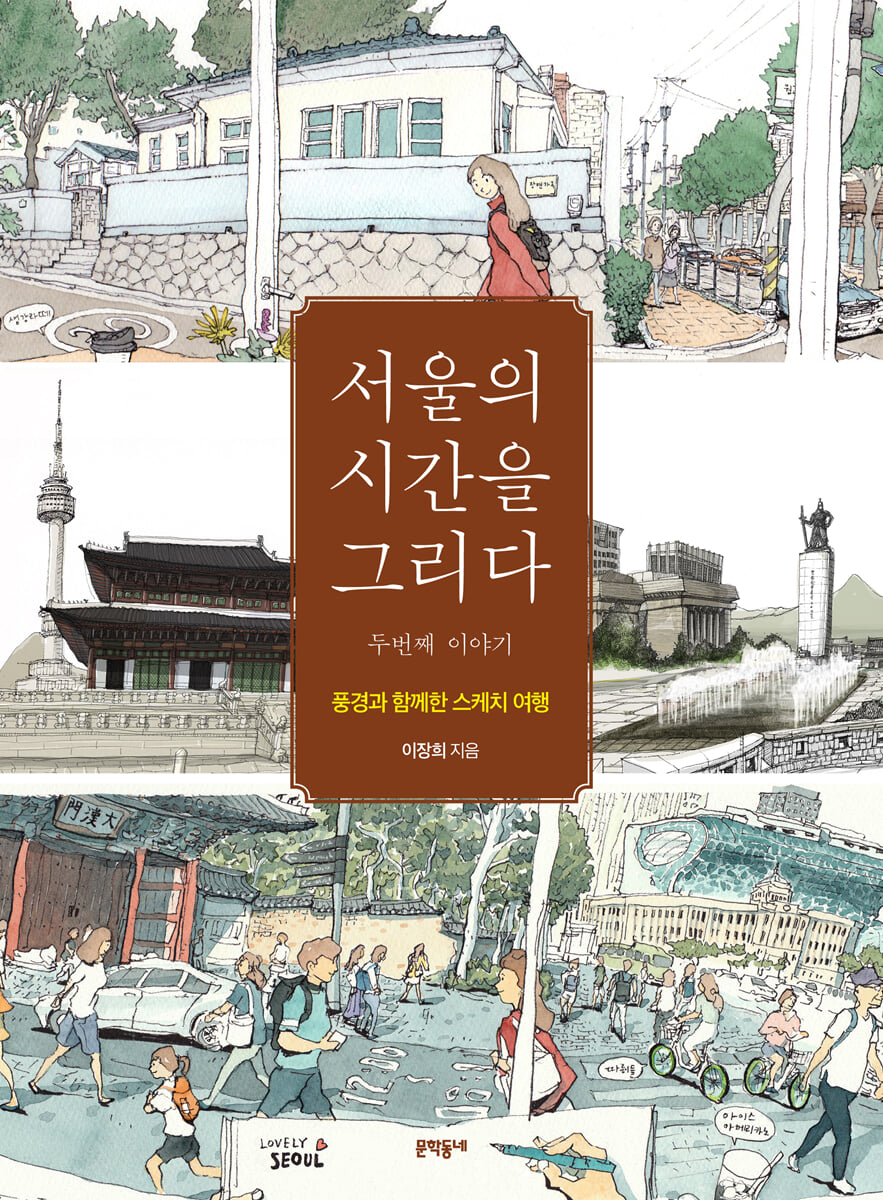
The second story of 『Drawing Seoul's Time』, which has been loved by people from all walks of life since its first publication in 2011, has been published.
Artist Lee Jang-hee has contributed illustrations and columns to various media outlets, including the Dong-A Ilbo, Buddhist Newspaper, JoongAng Sunday, and Bobodam, introducing various aspects of Seoul. As a member of the Seoul City Future Heritage Preservation Committee, he has explored various parts of Seoul that are not well known to the general public.
He has delved deeper into the city of Seoul than anyone else, to the point of renovating a hanok building near Yeongcheon Market in Seodaemun and running a bookstore. As a resident and observer of Seoul, he has lived closely in the city and continued sketching Seoul for over 20 years.
The first story of 『Drawing Seoul's Time』, which introduced Seoul's representative landmarks such as Gyeongbokgung Palace, Myeongdong, Sungnyemun Gate, Insadong, Jeongdong, and Cheonggyecheon, focused on informing us of the historical stories and meaning behind familiar places that we thought we 'knew' well, while this second story goes further and contains a more diverse spectrum of stories.
Traveling through time and space, it embraces not only the buildings of old Hanyang but also the hip spaces of present-day Seoul, leading us into the inner landscape of this city with each line.
The more I learned about this city, the more curious I became about it.
Even after I published my first book, my gaze never left Seoul.
Maybe it was because I wanted to know more about this city where I was born, where I have lived, and where I will live in the future.
After publishing the first 'Seoul Book', I received a commission to travel all over the country, not just in Seoul, and leave behind my writings and drawings.
It was definitely meaningful work.
However, the depth of a place seen from a traveler's perspective and the depth of a place seen from a resident's perspective could not be the same.
A first impression of a seaside town in Namhae, where a clear, sunny day is spent, may not be the whole story, and travelers are not given the opportunity to know more.
That thought may have led me to delve deeper into Seoul.
_Page 7
With just one step or one glance, you can start your 'Seoul trip' at any time.
Sometimes at a slow pace, sometimes riding a bicycle, 『Drawing Seoul's Time: The Second Story』 travels around Seoul, filling it with the colors of the four seasons.
The film captures not only the landscapes that have sadly disappeared from Yongsan, Seoul-ro, Daehak-ro and Munmyo, Sinyongsan, and Gyeonggang (Han River), but also new spaces created by renovating old buildings and buildings designed by world-renowned architects, all captured in detailed sketches.
After touring the interior of the Yongsan US military base, which has been a 'forbidden land' for the people of South Korea for over 120 years, with the help of officials, I left behind a sketch of the interior, adding to its significance as a record.
As the saying goes, “10 years can change the landscape of Seoul,” the city has changed significantly in the 15 years since the first book, “Drawing Seoul’s Time,” was published.
The alley where children used to play has been transformed into an apartment complex, and the streetlights in the alley have been transformed into dazzling neon signs.
However, there are still landscapes that survived through turbulent times such as the Japanese colonial period, the Korean War, and the post-war industrialization period.
There are many spaces where future changes are expected.
As you stroll through Seoul's landscapes with over 800 colorful sketches and listen to the stories of the people who lived here, you'll find yourself wanting to walk around the city with this book.
When I get distracted while working, I go for a walk in a large park nearby.
If you need to think longer, climb a mountain.
Now, I am old enough to sympathize to some extent with the joys and sorrows of the city people as seen from the mountaintop.
I don't know all the hidden history inside it, but I can tell where this is and where that is, so I guess I've been to quite a few places.
I open my sketchbook and capture the scenery.
After finishing the rough sketch, I write down the names of the places in a haphazard manner.
The Seoul I see is a modern and developed city, but the names I wrote are all traces of the past.
Stories that might be overlooked, but are actually quite close if you pay attention, are what made Seoul what it is today.
It sounds like the names of old friends who helped create Seoul.
I'm walking down the road again.
It is a step towards new moments that will be added to the long history along the seemingly endless mountain path.
The white stone walls of the city wall sparkle in the sunlight and guide me.
To the place where I must live, capture in my paintings, and walk.
Page 413
Seoul's past, present, and future
Yongsan, Han River, Seoul-ro, Daehak-ro…
Stroll through Seoul's intimate landscapes
The second story of 『Drawing Seoul's Time』, which has been loved by people from all walks of life since its first publication in 2011, has been published.
Artist Lee Jang-hee has contributed illustrations and columns to various media outlets, including the Dong-A Ilbo, Buddhist Newspaper, JoongAng Sunday, and Bobodam, introducing various aspects of Seoul. As a member of the Seoul City Future Heritage Preservation Committee, he has explored various parts of Seoul that are not well known to the general public.
He has delved deeper into the city of Seoul than anyone else, to the point of renovating a hanok building near Yeongcheon Market in Seodaemun and running a bookstore. As a resident and observer of Seoul, he has lived closely in the city and continued sketching Seoul for over 20 years.
The first story of 『Drawing Seoul's Time』, which introduced Seoul's representative landmarks such as Gyeongbokgung Palace, Myeongdong, Sungnyemun Gate, Insadong, Jeongdong, and Cheonggyecheon, focused on informing us of the historical stories and meaning behind familiar places that we thought we 'knew' well, while this second story goes further and contains a more diverse spectrum of stories.
Traveling through time and space, it embraces not only the buildings of old Hanyang but also the hip spaces of present-day Seoul, leading us into the inner landscape of this city with each line.
The more I learned about this city, the more curious I became about it.
Even after I published my first book, my gaze never left Seoul.
Maybe it was because I wanted to know more about this city where I was born, where I have lived, and where I will live in the future.
After publishing the first 'Seoul Book', I received a commission to travel all over the country, not just in Seoul, and leave behind my writings and drawings.
It was definitely meaningful work.
However, the depth of a place seen from a traveler's perspective and the depth of a place seen from a resident's perspective could not be the same.
A first impression of a seaside town in Namhae, where a clear, sunny day is spent, may not be the whole story, and travelers are not given the opportunity to know more.
That thought may have led me to delve deeper into Seoul.
_Page 7
With just one step or one glance, you can start your 'Seoul trip' at any time.
Sometimes at a slow pace, sometimes riding a bicycle, 『Drawing Seoul's Time: The Second Story』 travels around Seoul, filling it with the colors of the four seasons.
The film captures not only the landscapes that have sadly disappeared from Yongsan, Seoul-ro, Daehak-ro and Munmyo, Sinyongsan, and Gyeonggang (Han River), but also new spaces created by renovating old buildings and buildings designed by world-renowned architects, all captured in detailed sketches.
After touring the interior of the Yongsan US military base, which has been a 'forbidden land' for the people of South Korea for over 120 years, with the help of officials, I left behind a sketch of the interior, adding to its significance as a record.
As the saying goes, “10 years can change the landscape of Seoul,” the city has changed significantly in the 15 years since the first book, “Drawing Seoul’s Time,” was published.
The alley where children used to play has been transformed into an apartment complex, and the streetlights in the alley have been transformed into dazzling neon signs.
However, there are still landscapes that survived through turbulent times such as the Japanese colonial period, the Korean War, and the post-war industrialization period.
There are many spaces where future changes are expected.
As you stroll through Seoul's landscapes with over 800 colorful sketches and listen to the stories of the people who lived here, you'll find yourself wanting to walk around the city with this book.
When I get distracted while working, I go for a walk in a large park nearby.
If you need to think longer, climb a mountain.
Now, I am old enough to sympathize to some extent with the joys and sorrows of the city people as seen from the mountaintop.
I don't know all the hidden history inside it, but I can tell where this is and where that is, so I guess I've been to quite a few places.
I open my sketchbook and capture the scenery.
After finishing the rough sketch, I write down the names of the places in a haphazard manner.
The Seoul I see is a modern and developed city, but the names I wrote are all traces of the past.
Stories that might be overlooked, but are actually quite close if you pay attention, are what made Seoul what it is today.
It sounds like the names of old friends who helped create Seoul.
I'm walking down the road again.
It is a step towards new moments that will be added to the long history along the seemingly endless mountain path.
The white stone walls of the city wall sparkle in the sunlight and guide me.
To the place where I must live, capture in my paintings, and walk.
Page 413
- You can preview some of the book's contents.
Preview
index
Opening remarks
Chapter 1.
Yongsan
Chapter 2.
To Seoul
Chapter 3.
Gyeonggang
Chapter 4.
Daehakro
Chapter 5.
Shin Yong-san
Closing remarks
Chapter 1.
Yongsan
Chapter 2.
To Seoul
Chapter 3.
Gyeonggang
Chapter 4.
Daehakro
Chapter 5.
Shin Yong-san
Closing remarks
Publisher's Review
Connecting the past and present, history and people
Seoul Sketch Trip
Seoul is a city with a long history.
This is because it is a city that has been firmly established as the capital of our country for over 600 years, from the Joseon Dynasty to the present, at least half a millennium.
But it's not easy to find a place that resembles a long-standing center of power, history, and culture in downtown Seoul.
Due to the developmentalism, the link with the past has gradually weakened, and the skyline of Seoul has continued to rise to the point where the term "historic city" has become meaningless.
However, as it is a city where many people have lived for a long time, there are many rich stories piled up in various places.
While the first book focused on the historical stories within the Sadamun Gate, this book pays closer attention to the voices of the people who lived in this city, not just the history.
We visit places designated as Seoul's future heritage sites, such as Geumseong Real Estate, a living witness to the history of apartment development that has been in operation for over 50 years within the Yeouido pilot apartment complex, and Seongwoo Lee Yong-won, a third-generation business near Manri-dong Pass, to vividly tell old stories.
The author also tells the stories of people who were pushed out by development through stories related to places like Bamseom Island, which was so beautiful that it was monopolized by the royal family during the Joseon Dynasty, Bamseom Island, which had a population of 450 in the 1960s but was blown up for development purposes, and Hyochangwon, which was the tomb of Crown Prince Munhyo, the eldest son of King Jeongjo, but was damaged when a golf course was built during the Japanese colonial period and a sports field was built during the Syngman Rhee era.
However, I am not unconditionally opposed to development and reminiscing about the past.
It addresses spaces that strike a balance between tradition and development, such as Yeouido Saetgang Ecological Park, the first ecological park in Korea; Seoullo 7017, which was a former car-only overpass turned into a pedestrian-only promenade; Yongsan Railroad Hospital, which was reborn as the Yongsan History Museum; and cafes renovated from former Japanese colonial houses in Yongsan and Namyeong-dong. It also presents a philosophy and vision for the city's future.
Sitting on the steps of a house not swept away by the apartment complex, I recall the well site that Lee Bong-chang used as a child.
On one side of a narrow alley where cars could not enter, a well covered with a round plastic cover sat abandoned.
Looking into the well, which did not match the surrounding scenery at all, I saw that there was water, but the reality of Seoul is that you cannot wash your hands even after drawing a ladleful of water from the well.
Imagine the childhood of a young man who was willing to give up his life for his country.
The child stands at the well, draws water, quenches his thirst, and washes his hands.
The place where the child stands is the last handful of land in Joseon, like a dying light.
How must the chilling shadow of Japan's ambition have felt to a young mind? The child sits by the well, gazing up at the sky.
His sky will be no different from the one I look up at now.
Now I can only share the same sky under Yongsan with him.
How long will our precious links be buried in cold piles of reinforced concrete?
I think back to the meaning of that sip of water that the child must have drunk in his childhood.
I wonder how much depth Seoul would have as a city if it shared that story.
Pages 45-46
From the elders who have protected Seoul
Even the newly emerged rising star
When it comes to Seoul, many people first think of the Han River, which flows leisurely through the heart of the city, rather than any other landmark.
The Han River, which has flowed since time immemorial, has been a life-giving stream that supplies water to many people living in Seoul, and has also been an essential passageway for trade with foreign countries, connecting the capital and the provinces.
However, until the first bridge was built in 1900, there was no other means of transportation than boats.
In just over 100 years, 31 bridges (21 in Seoul) have been built across the Han River, and a 'Han River view' is considered a symbol of wealth.
The city's landscape does not remain stagnant, but changes with each season and each year.
In 『Drawing Seoul's Time: The Second Story』, we also touch on places that will rewrite Seoul's history.
From Sungkyunkwan, which many people visit in the fall to see the giant ginkgo tree that turns yellow, to Yakhyeon Cathedral, the first Western-style brick building built in Korea, the Seosomun Shrine History Museum built on the largest Catholic holy site in Korea, the Arko Arts Theater designed by Kim Swoo-geun, Gate Tower, the Namyeong-dong Anti-Communist Office, the Hyundai Department Store in Yeouido, which is the largest single-building department store in Seoul, and the Amorepacific headquarters building in Yongsan that is said to have been inspired by the white porcelain moon jar, etc.
From famous landmarks of the Joseon Dynasty to newly emerging hot spots, it conveys the diverse charms of Seoul.
Not only the buildings, but also the natural objects that fill the city are not left out.
The trees of Seoul change their appearance throughout the city, turning into light green buds in spring, deep green in summer, colorful leaves in fall, and white snow in winter.
The book also contains stories about the protected trees, natural monuments, and commemorative trees that silently guard the alleyways of Seoul, allowing readers to enjoy a moment of romantic leisure.
As you explore Seoul with "Drawing Seoul's Time," you will come to feel closer to Seoul, a city with a different meaning than before.
Spring is getting better.
I used to like fall more than I do now, but as I get older, I find that it can't compare to spring.
When I see the light green buds sprouting from the branches of trees that had been curled up as if dead after surviving the winter, I am moved by the wonder of the new year that has just begun.
Anything is right in spring.
Spring day, spring rain, spring breeze, spring sunshine, spring flowers.
There is nothing that is not pretty when you add the word 'spring' to it.
Is there anything better than a spring walk among them?
On these short spring days, you have to go out and walk somewhere.
A walk in spring is a time to feel liberated from the prison of winter.
There are many walkable streets in Seoul, but on the other hand, there aren't many.
It's because of the highway.
If only I could shake off the busy streets that interrupt my steps and stroll among the towering buildings, I would naturally imagine Seoul's bright future.
I believe that people living in cities can be happy only when they have the convenience of being able to walk freely without being disturbed by cars.
Page 68
Seoul Sketch Trip
Seoul is a city with a long history.
This is because it is a city that has been firmly established as the capital of our country for over 600 years, from the Joseon Dynasty to the present, at least half a millennium.
But it's not easy to find a place that resembles a long-standing center of power, history, and culture in downtown Seoul.
Due to the developmentalism, the link with the past has gradually weakened, and the skyline of Seoul has continued to rise to the point where the term "historic city" has become meaningless.
However, as it is a city where many people have lived for a long time, there are many rich stories piled up in various places.
While the first book focused on the historical stories within the Sadamun Gate, this book pays closer attention to the voices of the people who lived in this city, not just the history.
We visit places designated as Seoul's future heritage sites, such as Geumseong Real Estate, a living witness to the history of apartment development that has been in operation for over 50 years within the Yeouido pilot apartment complex, and Seongwoo Lee Yong-won, a third-generation business near Manri-dong Pass, to vividly tell old stories.
The author also tells the stories of people who were pushed out by development through stories related to places like Bamseom Island, which was so beautiful that it was monopolized by the royal family during the Joseon Dynasty, Bamseom Island, which had a population of 450 in the 1960s but was blown up for development purposes, and Hyochangwon, which was the tomb of Crown Prince Munhyo, the eldest son of King Jeongjo, but was damaged when a golf course was built during the Japanese colonial period and a sports field was built during the Syngman Rhee era.
However, I am not unconditionally opposed to development and reminiscing about the past.
It addresses spaces that strike a balance between tradition and development, such as Yeouido Saetgang Ecological Park, the first ecological park in Korea; Seoullo 7017, which was a former car-only overpass turned into a pedestrian-only promenade; Yongsan Railroad Hospital, which was reborn as the Yongsan History Museum; and cafes renovated from former Japanese colonial houses in Yongsan and Namyeong-dong. It also presents a philosophy and vision for the city's future.
Sitting on the steps of a house not swept away by the apartment complex, I recall the well site that Lee Bong-chang used as a child.
On one side of a narrow alley where cars could not enter, a well covered with a round plastic cover sat abandoned.
Looking into the well, which did not match the surrounding scenery at all, I saw that there was water, but the reality of Seoul is that you cannot wash your hands even after drawing a ladleful of water from the well.
Imagine the childhood of a young man who was willing to give up his life for his country.
The child stands at the well, draws water, quenches his thirst, and washes his hands.
The place where the child stands is the last handful of land in Joseon, like a dying light.
How must the chilling shadow of Japan's ambition have felt to a young mind? The child sits by the well, gazing up at the sky.
His sky will be no different from the one I look up at now.
Now I can only share the same sky under Yongsan with him.
How long will our precious links be buried in cold piles of reinforced concrete?
I think back to the meaning of that sip of water that the child must have drunk in his childhood.
I wonder how much depth Seoul would have as a city if it shared that story.
Pages 45-46
From the elders who have protected Seoul
Even the newly emerged rising star
When it comes to Seoul, many people first think of the Han River, which flows leisurely through the heart of the city, rather than any other landmark.
The Han River, which has flowed since time immemorial, has been a life-giving stream that supplies water to many people living in Seoul, and has also been an essential passageway for trade with foreign countries, connecting the capital and the provinces.
However, until the first bridge was built in 1900, there was no other means of transportation than boats.
In just over 100 years, 31 bridges (21 in Seoul) have been built across the Han River, and a 'Han River view' is considered a symbol of wealth.
The city's landscape does not remain stagnant, but changes with each season and each year.
In 『Drawing Seoul's Time: The Second Story』, we also touch on places that will rewrite Seoul's history.
From Sungkyunkwan, which many people visit in the fall to see the giant ginkgo tree that turns yellow, to Yakhyeon Cathedral, the first Western-style brick building built in Korea, the Seosomun Shrine History Museum built on the largest Catholic holy site in Korea, the Arko Arts Theater designed by Kim Swoo-geun, Gate Tower, the Namyeong-dong Anti-Communist Office, the Hyundai Department Store in Yeouido, which is the largest single-building department store in Seoul, and the Amorepacific headquarters building in Yongsan that is said to have been inspired by the white porcelain moon jar, etc.
From famous landmarks of the Joseon Dynasty to newly emerging hot spots, it conveys the diverse charms of Seoul.
Not only the buildings, but also the natural objects that fill the city are not left out.
The trees of Seoul change their appearance throughout the city, turning into light green buds in spring, deep green in summer, colorful leaves in fall, and white snow in winter.
The book also contains stories about the protected trees, natural monuments, and commemorative trees that silently guard the alleyways of Seoul, allowing readers to enjoy a moment of romantic leisure.
As you explore Seoul with "Drawing Seoul's Time," you will come to feel closer to Seoul, a city with a different meaning than before.
Spring is getting better.
I used to like fall more than I do now, but as I get older, I find that it can't compare to spring.
When I see the light green buds sprouting from the branches of trees that had been curled up as if dead after surviving the winter, I am moved by the wonder of the new year that has just begun.
Anything is right in spring.
Spring day, spring rain, spring breeze, spring sunshine, spring flowers.
There is nothing that is not pretty when you add the word 'spring' to it.
Is there anything better than a spring walk among them?
On these short spring days, you have to go out and walk somewhere.
A walk in spring is a time to feel liberated from the prison of winter.
There are many walkable streets in Seoul, but on the other hand, there aren't many.
It's because of the highway.
If only I could shake off the busy streets that interrupt my steps and stroll among the towering buildings, I would naturally imagine Seoul's bright future.
I believe that people living in cities can be happy only when they have the convenience of being able to walk freely without being disturbed by cars.
Page 68
GOODS SPECIFICS
- Date of issue: November 19, 2025
- Page count, weight, size: 416 pages | 716g | 173*235*20mm
- ISBN13: 9791141614089
- ISBN10: 1141614081
You may also like
카테고리
korean


korean

![GQ KOREA Mark (Monthly): December [2025]](http://librairie.coreenne.fr/cdn/shop/files/8ef265dbbfbf186523ed75ba7319009d.jpg?v=1765340328&width=3840)


