

Why do we tolerate inequality?
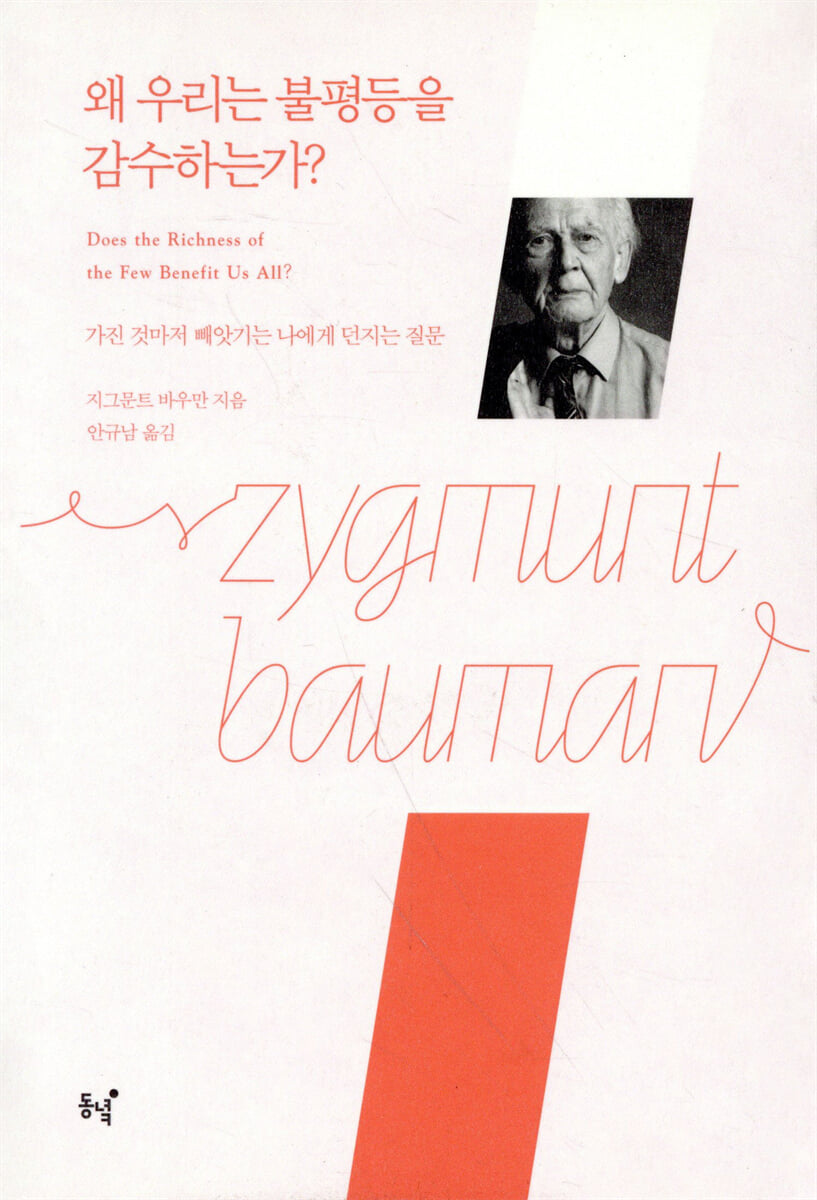 |
Description
Book Introduction
Revisit Zygmunt Bauman's key works!
The Selection Series corrects mistranslations and unifies terminology.
The books of sociologist Zygmunt Bauman, who passed away on January 9, 2017, at the age of 91, have been competitively translated in Korea for several years, proving Bauman's popularity.
These books include his so-called 'liquid modern' series, such as 'Liquid Modernity', 'Liquid Fear', and 'Liquid Love'.
However, as can be seen from the title of the book, Bauman's unique concept of 'liquid' has been translated into various ways such as 'liquid' and 'flowing', and there are also books that simply use 'liquid' because it was difficult to translate.
Bauman used 'liquid' as the counterpart of 'solid', meaning fixed, and translated the former as 'solid' and the latter as 'liquid'. One of Bauman's representative works, 『Liquid Modernity』(2000), was translated into Korean in 2009 under the title 『Liquid Modernity』.
Bauman is a famous scholar who described today's culture as a 'liquid modern world' and described it as its key characteristic.
Although scholars have differing opinions on whether to translate 'liquid' in Bauman's important concept of 'liquid modern' as 'liquid' or 'flowing', it has been consistently pointed out that translating 'modern' to modern times is clearly a mistake.
May Spring Publishing, which published Bauman's book Culture in a Liquid Modern World in 2013, said in a press release that "there are certainly cases where Bauman's 'modern' refers to modern times.
However, Bauman clearly distinguishes between two aspects of 'modernity', making it clear that the correct translation is 'modernity'.
The translation 'modern' is correct only when it refers to the first phase of 'modernity'.
And in the first phase of modernity, the world was solid, not liquid.
Therefore, the expressions 'fluid' or 'liquid' can never be used to decorate the word 'modern'.
He stated that the word ‘modern’ is an expression that refers to ‘the era after the 17th and 18th centuries when capitalism was formed and civil society was established,’ as Bauman intended, and that he would correct the previous incorrect translation.
The [Bauman Selection Series], published by Dongnyok Publishing House, has consistently unified Bauman's key concepts, which have been the subject of controversy, through discussions with scholars who have studied Bauman for a long time.
The controversial term 'liquid modern' was also translated as 'fluid modern' in this series.
We also corrected mistranslations and unified terminology.
This series plans to retranslate Bauman's important works that are out of print in Korea, such as 『Work, Consumerism and the New Poor』, and republish Bauman's books published by Dongnyok, which have been criticized for their translation problems, such as 『44 Letters from the Liquid Modern World』, after retranslating or supplementing them.
The Selection Series corrects mistranslations and unifies terminology.
The books of sociologist Zygmunt Bauman, who passed away on January 9, 2017, at the age of 91, have been competitively translated in Korea for several years, proving Bauman's popularity.
These books include his so-called 'liquid modern' series, such as 'Liquid Modernity', 'Liquid Fear', and 'Liquid Love'.
However, as can be seen from the title of the book, Bauman's unique concept of 'liquid' has been translated into various ways such as 'liquid' and 'flowing', and there are also books that simply use 'liquid' because it was difficult to translate.
Bauman used 'liquid' as the counterpart of 'solid', meaning fixed, and translated the former as 'solid' and the latter as 'liquid'. One of Bauman's representative works, 『Liquid Modernity』(2000), was translated into Korean in 2009 under the title 『Liquid Modernity』.
Bauman is a famous scholar who described today's culture as a 'liquid modern world' and described it as its key characteristic.
Although scholars have differing opinions on whether to translate 'liquid' in Bauman's important concept of 'liquid modern' as 'liquid' or 'flowing', it has been consistently pointed out that translating 'modern' to modern times is clearly a mistake.
May Spring Publishing, which published Bauman's book Culture in a Liquid Modern World in 2013, said in a press release that "there are certainly cases where Bauman's 'modern' refers to modern times.
However, Bauman clearly distinguishes between two aspects of 'modernity', making it clear that the correct translation is 'modernity'.
The translation 'modern' is correct only when it refers to the first phase of 'modernity'.
And in the first phase of modernity, the world was solid, not liquid.
Therefore, the expressions 'fluid' or 'liquid' can never be used to decorate the word 'modern'.
He stated that the word ‘modern’ is an expression that refers to ‘the era after the 17th and 18th centuries when capitalism was formed and civil society was established,’ as Bauman intended, and that he would correct the previous incorrect translation.
The [Bauman Selection Series], published by Dongnyok Publishing House, has consistently unified Bauman's key concepts, which have been the subject of controversy, through discussions with scholars who have studied Bauman for a long time.
The controversial term 'liquid modern' was also translated as 'fluid modern' in this series.
We also corrected mistranslations and unified terminology.
This series plans to retranslate Bauman's important works that are out of print in Korea, such as 『Work, Consumerism and the New Poor』, and republish Bauman's books published by Dongnyok, which have been criticized for their translation problems, such as 『44 Letters from the Liquid Modern World』, after retranslating or supplementing them.
- You can preview some of the book's contents.
Preview
index
Introduction
Chapter 1: Exactly How Unequal Are We Today?
Chapter 2 Why Do We Tolerate Inequality?
Chapter 3: A Lie That's Bright Red, and a Lie That's Even Brighter
Chapter 4: The Gap Between Words and Actions
main
Translator's Note
Chapter 1: Exactly How Unequal Are We Today?
Chapter 2 Why Do We Tolerate Inequality?
Chapter 3: A Lie That's Bright Red, and a Lie That's Even Brighter
Chapter 4: The Gap Between Words and Actions
main
Translator's Note
Into the book
Despite the world's desperate push for economic growth fundamentalism, poverty persists and refuses to disappear.
Any thoughtful person cannot help but pause and think about the direct victims as well as the collateral victims of wealth redistribution.
The fact that the abyss between the poor and the futureless and the rich, the optimistic, the confident and the energetic—an abyss so deep that even the most fearless climber with iron constitution cannot cross it—is growing deeper by the day is certainly enough to warrant serious concern.
--- pp.10~11
The rich get richer simply because they are rich, and the poor get poorer simply because they are poor.
Today, inequality continues to deepen by its own logic and driving force.
It doesn't require any outside help or drive.
There is absolutely no need for any external stimulus, pressure, or shock.
Today, social inequality seems to be becoming a permanent institution for the first time in history.
--- pp.22-23
'Economic growth' means increased wealth for a few, but for the vast majority it means a sharp decline in social status and self-esteem.
"Economic growth," as we encounter it through the collective experience of increasingly harmful consequences, does not appear to be a universal solution to the dire social problems evident everywhere, but rather a primary cause that perpetuates and exacerbates them.
--- pp.66~67
It goes without saying that it is irrational to blame oneself for the world.
Nevertheless, to accept responsibility for the world, even if it means taking responsibility for both the decisions and the consequences, is the last chance to save the logic of the world from the blindness it has wrought, from the consequences that lead others and ourselves to death.
--- p.132
The sentence of social inferiority imposed on the weak by themselves does not stop at the sentence itself; it not only suppresses opposition to the unjust inequality itself, but even whispers of mild discontent, and even accepts pity and sympathy from the victors.
Now, objections to the status quo and the way of life that sustains it are no longer considered legitimate defenses of lost and stolen (but ostensibly inalienable) human rights, human rights that must be respected, their principles recognized, and their equal access to them.
--- p.84
It goes without saying that it is irrational to blame oneself for the world.
Nevertheless, to accept responsibility for the world, even if it means taking responsibility for both the decisions and the consequences, is the last chance to save the logic of the world from the blindness it has wrought, from the consequences that lead others and ourselves to death.
Any thoughtful person cannot help but pause and think about the direct victims as well as the collateral victims of wealth redistribution.
The fact that the abyss between the poor and the futureless and the rich, the optimistic, the confident and the energetic—an abyss so deep that even the most fearless climber with iron constitution cannot cross it—is growing deeper by the day is certainly enough to warrant serious concern.
--- pp.10~11
The rich get richer simply because they are rich, and the poor get poorer simply because they are poor.
Today, inequality continues to deepen by its own logic and driving force.
It doesn't require any outside help or drive.
There is absolutely no need for any external stimulus, pressure, or shock.
Today, social inequality seems to be becoming a permanent institution for the first time in history.
--- pp.22-23
'Economic growth' means increased wealth for a few, but for the vast majority it means a sharp decline in social status and self-esteem.
"Economic growth," as we encounter it through the collective experience of increasingly harmful consequences, does not appear to be a universal solution to the dire social problems evident everywhere, but rather a primary cause that perpetuates and exacerbates them.
--- pp.66~67
It goes without saying that it is irrational to blame oneself for the world.
Nevertheless, to accept responsibility for the world, even if it means taking responsibility for both the decisions and the consequences, is the last chance to save the logic of the world from the blindness it has wrought, from the consequences that lead others and ourselves to death.
--- p.132
The sentence of social inferiority imposed on the weak by themselves does not stop at the sentence itself; it not only suppresses opposition to the unjust inequality itself, but even whispers of mild discontent, and even accepts pity and sympathy from the victors.
Now, objections to the status quo and the way of life that sustains it are no longer considered legitimate defenses of lost and stolen (but ostensibly inalienable) human rights, human rights that must be respected, their principles recognized, and their equal access to them.
--- p.84
It goes without saying that it is irrational to blame oneself for the world.
Nevertheless, to accept responsibility for the world, even if it means taking responsibility for both the decisions and the consequences, is the last chance to save the logic of the world from the blindness it has wrought, from the consequences that lead others and ourselves to death.
--- p.132
Publisher's Review
Why are we silent on the wealth of the 1%?
Bauman, Ask the Silent 99%!
It is said that the wealth of the world's 20 richest people today is equal to the combined wealth of the poorest billion people.
According to Bauman, the 20-80 society is already a thing of the past.
It's not a 1 vs 99 society.
More precisely, a society of '0.1 to 99.9' has arrived.
Statistics published in 2018 also support this.
The World Inequality Report 2018 (http://wir2018.wid.world), written by about 100 economists from around the world, including Thomas Piketty and Emmanuel Saez, who collected income and wealth inequality data from almost every country, revealed that the wealth gained by the top 0.1% of the world's population, or 7.6 million people, over the past 37 years was equivalent to the share that went to the bottom 50%, or 3.8 billion people.
The '0.1:99.9' society that we had only heard of was unfolding in reality.
The gap between rich and poor around the world is growing increasingly severe, and in some countries, such as the Middle East and India, it has already reached extreme levels.
The report found that the world's richest 1% (about 76 million people) took home 27% of the wealth gained between 1980 and 2016.
Furthermore, the analysis showed that there is a large gap even among the wealthy, with the top 0.1% (7.6 million people) accounting for 13% and the top 0.001% (76,000 people) accounting for 4%, and that the phenomenon of wealth being concentrated in the hands of a very small number of people has been worsening.
What is noteworthy is that the growth rate of wealth achieved by the global middle class, which accounts for approximately 40% of the population between the bottom 50% and the top 1%, is converging to '0' during this period.
These results are significant in that they prove that the logic of mainstream growth theorists, who have argued for the need to increase the 'pie (economic growth)' by talking about the 'trickle-down effect', was close to fiction.
Sociologist Zygmunt Bauman, who has analyzed modern society with the unique concept of 'liquid,' questions the reason why, in a structure where the gap between the rich and the poor is widening day by day, voices of anger are not erupting among the victims.
What is shocking is that, rather than being angry, people are agreeing to tax cuts for the rich and cuts to welfare budgets.
Why are we not exploding with anger at this growing gap between the rich and the poor, but instead just praising the reality?
Why is this strange phenomenon of victims of inequality defending inequality and ridiculing cries for equality occurring?
Bauman finds the secret to this strange phenomenon in the false beliefs we implicitly accept.
We misunderstand this false belief as an 'obvious truth of the world' that cannot be confronted or reformed by human power.
The most recent example is the 'Trickle Down' theory.
The argument is that if large corporations do well, the benefits will also flow to small and medium-sized enterprises and consumers, a logic that the government always mobilizes when operating economic policies centered on large corporations.
Ultimately, the logic is that breaking this cycle of false beliefs and choosing a new way of life will halt the march of social inequality.
In this book, Bauman asks, “What is the state of our society today?
The rich are getting richer, and the rich at the top are getting richer.
On the other hand, the middle class is becoming hollowed out and the number of poor people is increasing.
He also emphasized that “social opportunities are monopolized by the privileged, and the deepening polarization and winner-take-all inequality have become common challenges that we must address.”
Consumption = Happiness, Competition = Social Justice…
Exposing the social reality that is rooted in false beliefs!
Bauman identifies the following four representative lies that are planted in us by the classes that benefit from inequality.
① The belief that economic growth is the only way to solve any problem, ② The belief that permanently increasing consumption fulfills happiness, ③ The belief that inequality among people is natural, ④ The belief that competition is a necessary and sufficient condition for the reproduction of social order and social justice.
Bauman points out that the reason people perceive the astronomical compensation of CEOs of large corporations as excessive while simultaneously accepting it as natural is because of a strong belief in the natural inequality of individual abilities.
In particular, because resisting this belief comes at a high cost, we find ourselves resigned and forced to find a way to cooperate voluntarily.
As a result, today's inequality continues to deepen by its own logic and driving force.
The author seeks to understand why inequality has been able to triumph so far within ourselves.
The point is that we have given ourselves a 'sentence of inferiority' that we "must inevitably accept inequality."
The moment the inequality we have pronounced becomes a 'just inequality,' inequality can no longer be something to be opposed or improved.
As the author points out, this is precisely the way to make inequality a 'perpetual motion machine' that will never stop.
Bauman also talks about the problem of 'polarization'.
The results of a comparison of average incomes show that “Qatar, the world’s richest country today, has a per capita income 428 times that of Zimbabwe, the poorest country.” He criticizes that “despite the world desperately pushing for economic growth fundamentalism, poverty persists and does not disappear.”
The problem is that we accept this widening polarization as our 'fate'.
Is there no way to dismantle this?
In response, Bauman raises his voice, saying, “We assume that different individuals are born with different abilities, not because they have different abilities to develop their potential due to different social conditions,” and “We are not billiard balls that move on a billiard table in the direction the cue points.”
The problem is still inequality.
How can we escape inequality?
Bauman suggests that one way to escape inequality is to lift the “sentence of inferiority” we have imposed on ourselves.
It is there that it becomes possible to oppose inequality and make it a target for improvement.
Bauman argues that we must break the chains of false beliefs that bind us and choose a new way of life.
The point is not to avoid the problem in any way, and not to compromise easily.
The author writes, “Defeat does not mean that there was no possibility of victory in the face of impending doom.
“It simply means that they failed to win due to ignorance and/or neglect,” he emphasizes.
However, simply discarding false beliefs does not change reality.
The power of structured reality, the power of 'fate', is immense.
However, breaking the chains that create and solidify the structured reality that is strangling us through wrong choices based on false beliefs and choosing a new way of life is the starting point for changing this unjust reality.
It takes superhuman effort to make these choices and maintain such a life.
In this book, Bauman does not hastily sing of hope.
It is not easy to accept reality.
Don't avoid the issue in any way! And, I emphasize that you shouldn't compromise easily, but think things through thoroughly.
It is fortunate that the current government is discussing agendas to resolve inequality, such as 'economic democratization' and 'welfare state.'
However, it seems that these agendas are not being sustained or realized in reality.
Could it be because we are still silent about inequality?
Could it be that we have turned a blind eye to the countless inequalities, saying, “There’s nothing we can do,” or “Blame ourselves,” and have failed to call for the “economic democratization” and “welfare state” that have since faded?
At the end of the book, Bauman tells us that even if this is the case, there is still something we can do.
“Just shout!” Bauman emphasizes that simply stating reality as it is and shouting it out can change a lot. As I reread this book, I miss him so much because of his seemingly simple shouting.
Bauman, Ask the Silent 99%!
It is said that the wealth of the world's 20 richest people today is equal to the combined wealth of the poorest billion people.
According to Bauman, the 20-80 society is already a thing of the past.
It's not a 1 vs 99 society.
More precisely, a society of '0.1 to 99.9' has arrived.
Statistics published in 2018 also support this.
The World Inequality Report 2018 (http://wir2018.wid.world), written by about 100 economists from around the world, including Thomas Piketty and Emmanuel Saez, who collected income and wealth inequality data from almost every country, revealed that the wealth gained by the top 0.1% of the world's population, or 7.6 million people, over the past 37 years was equivalent to the share that went to the bottom 50%, or 3.8 billion people.
The '0.1:99.9' society that we had only heard of was unfolding in reality.
The gap between rich and poor around the world is growing increasingly severe, and in some countries, such as the Middle East and India, it has already reached extreme levels.
The report found that the world's richest 1% (about 76 million people) took home 27% of the wealth gained between 1980 and 2016.
Furthermore, the analysis showed that there is a large gap even among the wealthy, with the top 0.1% (7.6 million people) accounting for 13% and the top 0.001% (76,000 people) accounting for 4%, and that the phenomenon of wealth being concentrated in the hands of a very small number of people has been worsening.
What is noteworthy is that the growth rate of wealth achieved by the global middle class, which accounts for approximately 40% of the population between the bottom 50% and the top 1%, is converging to '0' during this period.
These results are significant in that they prove that the logic of mainstream growth theorists, who have argued for the need to increase the 'pie (economic growth)' by talking about the 'trickle-down effect', was close to fiction.
Sociologist Zygmunt Bauman, who has analyzed modern society with the unique concept of 'liquid,' questions the reason why, in a structure where the gap between the rich and the poor is widening day by day, voices of anger are not erupting among the victims.
What is shocking is that, rather than being angry, people are agreeing to tax cuts for the rich and cuts to welfare budgets.
Why are we not exploding with anger at this growing gap between the rich and the poor, but instead just praising the reality?
Why is this strange phenomenon of victims of inequality defending inequality and ridiculing cries for equality occurring?
Bauman finds the secret to this strange phenomenon in the false beliefs we implicitly accept.
We misunderstand this false belief as an 'obvious truth of the world' that cannot be confronted or reformed by human power.
The most recent example is the 'Trickle Down' theory.
The argument is that if large corporations do well, the benefits will also flow to small and medium-sized enterprises and consumers, a logic that the government always mobilizes when operating economic policies centered on large corporations.
Ultimately, the logic is that breaking this cycle of false beliefs and choosing a new way of life will halt the march of social inequality.
In this book, Bauman asks, “What is the state of our society today?
The rich are getting richer, and the rich at the top are getting richer.
On the other hand, the middle class is becoming hollowed out and the number of poor people is increasing.
He also emphasized that “social opportunities are monopolized by the privileged, and the deepening polarization and winner-take-all inequality have become common challenges that we must address.”
Consumption = Happiness, Competition = Social Justice…
Exposing the social reality that is rooted in false beliefs!
Bauman identifies the following four representative lies that are planted in us by the classes that benefit from inequality.
① The belief that economic growth is the only way to solve any problem, ② The belief that permanently increasing consumption fulfills happiness, ③ The belief that inequality among people is natural, ④ The belief that competition is a necessary and sufficient condition for the reproduction of social order and social justice.
Bauman points out that the reason people perceive the astronomical compensation of CEOs of large corporations as excessive while simultaneously accepting it as natural is because of a strong belief in the natural inequality of individual abilities.
In particular, because resisting this belief comes at a high cost, we find ourselves resigned and forced to find a way to cooperate voluntarily.
As a result, today's inequality continues to deepen by its own logic and driving force.
The author seeks to understand why inequality has been able to triumph so far within ourselves.
The point is that we have given ourselves a 'sentence of inferiority' that we "must inevitably accept inequality."
The moment the inequality we have pronounced becomes a 'just inequality,' inequality can no longer be something to be opposed or improved.
As the author points out, this is precisely the way to make inequality a 'perpetual motion machine' that will never stop.
Bauman also talks about the problem of 'polarization'.
The results of a comparison of average incomes show that “Qatar, the world’s richest country today, has a per capita income 428 times that of Zimbabwe, the poorest country.” He criticizes that “despite the world desperately pushing for economic growth fundamentalism, poverty persists and does not disappear.”
The problem is that we accept this widening polarization as our 'fate'.
Is there no way to dismantle this?
In response, Bauman raises his voice, saying, “We assume that different individuals are born with different abilities, not because they have different abilities to develop their potential due to different social conditions,” and “We are not billiard balls that move on a billiard table in the direction the cue points.”
The problem is still inequality.
How can we escape inequality?
Bauman suggests that one way to escape inequality is to lift the “sentence of inferiority” we have imposed on ourselves.
It is there that it becomes possible to oppose inequality and make it a target for improvement.
Bauman argues that we must break the chains of false beliefs that bind us and choose a new way of life.
The point is not to avoid the problem in any way, and not to compromise easily.
The author writes, “Defeat does not mean that there was no possibility of victory in the face of impending doom.
“It simply means that they failed to win due to ignorance and/or neglect,” he emphasizes.
However, simply discarding false beliefs does not change reality.
The power of structured reality, the power of 'fate', is immense.
However, breaking the chains that create and solidify the structured reality that is strangling us through wrong choices based on false beliefs and choosing a new way of life is the starting point for changing this unjust reality.
It takes superhuman effort to make these choices and maintain such a life.
In this book, Bauman does not hastily sing of hope.
It is not easy to accept reality.
Don't avoid the issue in any way! And, I emphasize that you shouldn't compromise easily, but think things through thoroughly.
It is fortunate that the current government is discussing agendas to resolve inequality, such as 'economic democratization' and 'welfare state.'
However, it seems that these agendas are not being sustained or realized in reality.
Could it be because we are still silent about inequality?
Could it be that we have turned a blind eye to the countless inequalities, saying, “There’s nothing we can do,” or “Blame ourselves,” and have failed to call for the “economic democratization” and “welfare state” that have since faded?
At the end of the book, Bauman tells us that even if this is the case, there is still something we can do.
“Just shout!” Bauman emphasizes that simply stating reality as it is and shouting it out can change a lot. As I reread this book, I miss him so much because of his seemingly simple shouting.
GOODS SPECIFICS
- Date of issue: March 15, 2019
- Page count, weight, size: 144 pages | 212g | 128*188*12mm
- ISBN13: 9788972979333
- ISBN10: 8972979333
You may also like
카테고리
korean


korean

![GQ KOREA Mark (Monthly): December [2025]](http://librairie.coreenne.fr/cdn/shop/files/8ef265dbbfbf186523ed75ba7319009d.jpg?v=1765340328&width=3840)


