

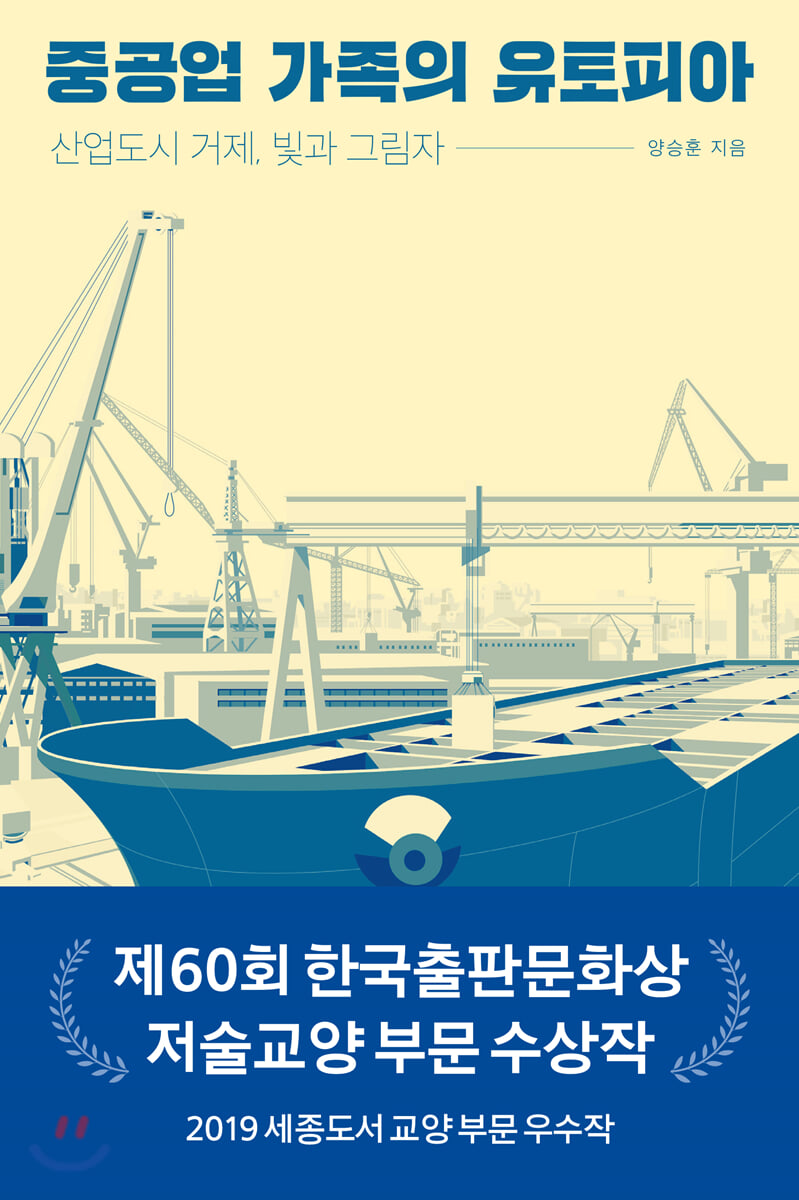
Utopia of the Heavy Industry Family
 |
Description
Book Introduction
Geoje Heavy Industries, which is fading away after its brilliant golden age,
Who left and who stayed?
The real story of the 'heavy industry family' that wasn't included in [Cheer Up Girls]!
Why did the 'Ddanpo Girls' family fall apart?
Why would young office workers and engineers at a shipyard leave Geoje for Seoul?
Is the 'next' for the industrial city of Geoje possible?
The first book to tell the story of the Geoje Island 'heavy industry family', which became known to the public through the 2016 hit film [Cheer Up!].
The author, a professor of sociology at Kyungnam University who has actively written about issues across the shipbuilding industry, has used his experience working at a shipyard to explore the shipbuilding industry in crisis, its base on Geoje Island, and the people at the shipyard.
The Korean shipbuilding industry, which had been enjoying a boom for nearly 20 years, began to experience difficulties starting with the management difficulties of Daewoo Shipbuilding & Marine Engineering in 2015.
With the perspective that the shipbuilding industry can use the current crisis as an opportunity to grow in a better direction, we have examined in detail the lives and culture of workers and their families working at shipyards.
While analyzing the causes of the crisis in detail within the history of the shipbuilding industry, which began in the 1960s, I also wanted to vividly convey how people in the field are experiencing the crisis, drawing on my experience working in shipyards.
In addition to the "heavy industry family" centered around the regular workers of the "aristocratic union," which is a symbol of the shipyard, the film delves into the essence of the crisis by examining the positions of many people who have previously received little attention, such as subcontractors, women in administrative support organizations, high school girls about to get jobs at the shipyard, young engineers rebelling against the shipyard's long-standing customs, and female engineers.
He also proposed several options for the direction Geoje Island and the shipbuilding industry should pursue after the crisis.
This will be a good reference for readers who are curious about the 'family crisis' that appears throughout [Then-Po Girls], and for readers who are imagining the next story of the 'Then-Po Girls'.
Who left and who stayed?
The real story of the 'heavy industry family' that wasn't included in [Cheer Up Girls]!
Why did the 'Ddanpo Girls' family fall apart?
Why would young office workers and engineers at a shipyard leave Geoje for Seoul?
Is the 'next' for the industrial city of Geoje possible?
The first book to tell the story of the Geoje Island 'heavy industry family', which became known to the public through the 2016 hit film [Cheer Up!].
The author, a professor of sociology at Kyungnam University who has actively written about issues across the shipbuilding industry, has used his experience working at a shipyard to explore the shipbuilding industry in crisis, its base on Geoje Island, and the people at the shipyard.
The Korean shipbuilding industry, which had been enjoying a boom for nearly 20 years, began to experience difficulties starting with the management difficulties of Daewoo Shipbuilding & Marine Engineering in 2015.
With the perspective that the shipbuilding industry can use the current crisis as an opportunity to grow in a better direction, we have examined in detail the lives and culture of workers and their families working at shipyards.
While analyzing the causes of the crisis in detail within the history of the shipbuilding industry, which began in the 1960s, I also wanted to vividly convey how people in the field are experiencing the crisis, drawing on my experience working in shipyards.
In addition to the "heavy industry family" centered around the regular workers of the "aristocratic union," which is a symbol of the shipyard, the film delves into the essence of the crisis by examining the positions of many people who have previously received little attention, such as subcontractors, women in administrative support organizations, high school girls about to get jobs at the shipyard, young engineers rebelling against the shipyard's long-standing customs, and female engineers.
He also proposed several options for the direction Geoje Island and the shipbuilding industry should pursue after the crisis.
This will be a good reference for readers who are curious about the 'family crisis' that appears throughout [Then-Po Girls], and for readers who are imagining the next story of the 'Then-Po Girls'.
- You can preview some of the book's contents.
Preview
index
Prologue: The Road to the Shipyard 7
Part 1: Shipyards, Creating Families 37
1.
Miracle of Okpo Bay 39
2.
The Birth of the "Heavy Industry Family" 55
Part 2: Old Habits, a Complicated World 115
1.
Learning and Growth as a Heavy Industry Engineer 117
2.
Dilemmas of the "Just Do It" Era 167
Part 3: People Leaving 217
1.
Tears of Okpo Bay 219
2.
278 at the crossroads
Epilogue: Drawing the "next" for the industrial city of Geoje 311
Acknowledgments 323
Part 1: Shipyards, Creating Families 37
1.
Miracle of Okpo Bay 39
2.
The Birth of the "Heavy Industry Family" 55
Part 2: Old Habits, a Complicated World 115
1.
Learning and Growth as a Heavy Industry Engineer 117
2.
Dilemmas of the "Just Do It" Era 167
Part 3: People Leaving 217
1.
Tears of Okpo Bay 219
2.
278 at the crossroads
Epilogue: Drawing the "next" for the industrial city of Geoje 311
Acknowledgments 323
Into the book
However, through the 2010s, people in industrial cities came to be represented as the 'top 10% aristocratic union'.
Envy quickly turned to criticism.
They began to be referred to as 'people who earn a lot of money, secure employment, and even pass down their jobs to their children.'
Labor unions that refuse to yield even when the company is on the verge of bankruptcy by receiving public funds or entering court receivership have become synonymous with selfish and shameless people who only engage in disputes.
For people working in industrial cities, such criticism is puzzling.
--- p.26
The shipbuilding industry is no longer what it used to be, and the outside world is not looking kindly on it either.
The people of Geoje, an industrial city closely tied to the shipbuilding industry, are now faced with a time when, after years of hardship, they must question everything they have become accustomed to.
Many of the shipyard's hard-working workers were forced to take voluntary retirement or be laid off, leaving them to find their next path.
The family's income decreased, and the wives, who had been the 'housekeepers', began to cut back on the consumption they had enjoyed until then and started looking for work to earn even a little money.
The crisis in the shipbuilding industry began to raise questions for everyone in the industrial city.
--- p.27
Geoje's heavy industry family has been constantly changing over a long period of time.
Since the 2000s, when regular employment was primarily focused on office work, the traditional family structure began to be challenged.
Most families live in nuclear families of 4-5 people, but recently, a large number of weekend couples have emerged, as well as young people who do not want to be integrated into either the organizational or regional culture.
There are a variety of people, including young people who live as "Seoulites" on weekends, attending academies or participating in study groups, or office workers who constantly try to get married through blind dates with women working in Seoul, but avoid "earning a living" in Geoje.
--- p.58
The process of sharply separating men's and women's work, organizing worker communities, and solidifying company employees may mean that the heavy industry family of the industrial city of Geoje has established its own ecosystem and become a single identity.
This is what happens when the shipbuilding industry booms, leading to rising wages for most workers and a qualitatively improved consumer lifestyle.
But that world is quite different from that of people in the metropolitan area or other regions.
For those who have settled down in Geoje, the world that is taken for granted is gradually becoming 'unfamiliar' through the experiences of people who have moved to other regions and come from other places.
The contradiction of cultural 'strangeness', which had been covered up by the continuous boom, began to reveal its true face as the economy began to decline.
In fact, the contradiction was already sprouting internally.
--- pp.72-73
The 'Heavy Industry Family Project' was a project that was initially premised on exclusion and inclusion.
This project reached its climax when regular employees who had moved to Geoje overcame the loneliness of living in a foreign land by forming families in the name of the company community, and formed immediate families through marriage and childbirth.
But the heavy industry family excluded subcontracted workers and confined the space of women and daughters to the realm of married life.
Above all, the heavy industry family has exposed its weaknesses to the younger generation, who have a completely different worldview from them.
--- p.113
The daughters betrayed their father's trust by leaving Geoje and not returning.
The workers' "simple life" was worthy of praise in its own right, but for those who were reluctant to remain within their families, it was nothing more than a conservative way of life.
In this way, the heavy industry family was criticized.
As the shipbuilding industry contracted, contradictions and tensions within the heavy industry family began to surface in earnest.
--- p.114
One of the things junior engineers sometimes hear from senior engineers is this:
“You shouldn’t build paper boats.” This saying epitomizes the “field-centered spirit” created by workshop engineers.
This means that the workshop engineers are looking at their drawings through the eyes of the site managers and workers.
To be more specific, this means frequently communicating with the field, or more directly, frequently going out to the yard to see how the drawings are implemented.
This means that you have a very 'close' relationship with the people on site.
--- pp.125-126
While workshop engineers used to draw drawings with drafting tools, this new generation began drawing with computers.
Once you get used to using the mouse and keyboard, you can implement a 3D screen, allowing you to explore various parts of the hull and draw drawings in three dimensions.
This way of working was clearly different from the way the engineers in the workshop lived as 'computer illiterate'.
The leadership in engineering was shifting from the MacGyver generation to the Bill Gates generation.
--- p.129
Now the way we learn and grow has changed.
If the methods of the workshop engineers who worked hard for the industrial defense of the country were based on a 'field-centered' ethos and the so-called 'fighter spirit,' today's excellent lab engineers are like hackers playing around in open source software, constantly learning new things and trying to get things done.
We aim to solve problems by coding our own areas online in a decentralized manner and through real-time online feedback.
--- p.152
People who are tired from hard and relentless work want to light a cigarette, drink coffee, eat a snack, or just lie down on a chair or the floor and rest.
Office workers have their own desks and can take a break after lunch, but in the densely populated marine plant construction sites, there is a severe lack of break spaces.
--- p.206
Subcontracted workers complain that whenever they go to borrow tools, direct workers often speak to them harshly or refuse to give them the tools.
The warehouse manager said he only complained because the subcontractors always tried to take more tools than they needed.
There are also ominous rumors circulating that subcontractors are stealing tools and materials and selling them as stolen goods.
--- p.208
Subcontracted workers want the union to look after their interests.
However, I have no expectations at all regarding issues such as conversion to regular employment.
This is because they realize that although it is an issue that always comes up at the negotiating table, it ultimately does not become the 'main issue'.
For the labor union, the most important issues are the wages, overtime pay, various welfare systems, performance bonuses, and vacation bonuses of direct regular workers.
--- p.210
Geoje, an industrial city, promotes a lifestyle that is clearly different from that of large cities.
Workplaces and living spaces are not separate, and all local residents live 'in harmony' through industry.
It can be said to be a community formed by outsiders.
But one thing must be clear.
Although intimacy and mutual assistance between neighbors are considered virtues, the fact is that this can only be maintained by shipyards that pay out 'salaries' 'regularly' rather than village-building or cooperatives by those who recently advocated for a social economy.
This is why the heavy industry families who have lived in Geoje for over 40 years cannot help but feel isolated from people outside.
--- pp.269-270
Geoje, an industrial city, is home to a diverse range of people.
It is not only the workers and their families who created the myth of the shipbuilding industry in the past, that is, the heavy industry families.
Young contract workers, numerous migrant workers, and foreign stakeholders sustain the city.
These are the people who have created the landscape of the industrial city of Geoje together.
As the shipbuilding industry took off, Geoje became a city that embraced many foreigners.
--- p.320
Who will be the next protagonist in Geoje?
Above all, shouldn't it be a city that our daughters, who have left to pursue a different life through higher education or employment, want to return to?
I hope that the city will become a place where the 'Dance Sports Girls', who wanted to keep the dance sports competition as their last memory from their school days after seeing their fathers who lost their jobs or left to find other jobs, can find various possibilities beyond the clerical support organization at the shipyard.
We also hope to become a city that can attract young engineers and office workers who have left the capital in search of higher salaries and life in the metropolitan area.
Envy quickly turned to criticism.
They began to be referred to as 'people who earn a lot of money, secure employment, and even pass down their jobs to their children.'
Labor unions that refuse to yield even when the company is on the verge of bankruptcy by receiving public funds or entering court receivership have become synonymous with selfish and shameless people who only engage in disputes.
For people working in industrial cities, such criticism is puzzling.
--- p.26
The shipbuilding industry is no longer what it used to be, and the outside world is not looking kindly on it either.
The people of Geoje, an industrial city closely tied to the shipbuilding industry, are now faced with a time when, after years of hardship, they must question everything they have become accustomed to.
Many of the shipyard's hard-working workers were forced to take voluntary retirement or be laid off, leaving them to find their next path.
The family's income decreased, and the wives, who had been the 'housekeepers', began to cut back on the consumption they had enjoyed until then and started looking for work to earn even a little money.
The crisis in the shipbuilding industry began to raise questions for everyone in the industrial city.
--- p.27
Geoje's heavy industry family has been constantly changing over a long period of time.
Since the 2000s, when regular employment was primarily focused on office work, the traditional family structure began to be challenged.
Most families live in nuclear families of 4-5 people, but recently, a large number of weekend couples have emerged, as well as young people who do not want to be integrated into either the organizational or regional culture.
There are a variety of people, including young people who live as "Seoulites" on weekends, attending academies or participating in study groups, or office workers who constantly try to get married through blind dates with women working in Seoul, but avoid "earning a living" in Geoje.
--- p.58
The process of sharply separating men's and women's work, organizing worker communities, and solidifying company employees may mean that the heavy industry family of the industrial city of Geoje has established its own ecosystem and become a single identity.
This is what happens when the shipbuilding industry booms, leading to rising wages for most workers and a qualitatively improved consumer lifestyle.
But that world is quite different from that of people in the metropolitan area or other regions.
For those who have settled down in Geoje, the world that is taken for granted is gradually becoming 'unfamiliar' through the experiences of people who have moved to other regions and come from other places.
The contradiction of cultural 'strangeness', which had been covered up by the continuous boom, began to reveal its true face as the economy began to decline.
In fact, the contradiction was already sprouting internally.
--- pp.72-73
The 'Heavy Industry Family Project' was a project that was initially premised on exclusion and inclusion.
This project reached its climax when regular employees who had moved to Geoje overcame the loneliness of living in a foreign land by forming families in the name of the company community, and formed immediate families through marriage and childbirth.
But the heavy industry family excluded subcontracted workers and confined the space of women and daughters to the realm of married life.
Above all, the heavy industry family has exposed its weaknesses to the younger generation, who have a completely different worldview from them.
--- p.113
The daughters betrayed their father's trust by leaving Geoje and not returning.
The workers' "simple life" was worthy of praise in its own right, but for those who were reluctant to remain within their families, it was nothing more than a conservative way of life.
In this way, the heavy industry family was criticized.
As the shipbuilding industry contracted, contradictions and tensions within the heavy industry family began to surface in earnest.
--- p.114
One of the things junior engineers sometimes hear from senior engineers is this:
“You shouldn’t build paper boats.” This saying epitomizes the “field-centered spirit” created by workshop engineers.
This means that the workshop engineers are looking at their drawings through the eyes of the site managers and workers.
To be more specific, this means frequently communicating with the field, or more directly, frequently going out to the yard to see how the drawings are implemented.
This means that you have a very 'close' relationship with the people on site.
--- pp.125-126
While workshop engineers used to draw drawings with drafting tools, this new generation began drawing with computers.
Once you get used to using the mouse and keyboard, you can implement a 3D screen, allowing you to explore various parts of the hull and draw drawings in three dimensions.
This way of working was clearly different from the way the engineers in the workshop lived as 'computer illiterate'.
The leadership in engineering was shifting from the MacGyver generation to the Bill Gates generation.
--- p.129
Now the way we learn and grow has changed.
If the methods of the workshop engineers who worked hard for the industrial defense of the country were based on a 'field-centered' ethos and the so-called 'fighter spirit,' today's excellent lab engineers are like hackers playing around in open source software, constantly learning new things and trying to get things done.
We aim to solve problems by coding our own areas online in a decentralized manner and through real-time online feedback.
--- p.152
People who are tired from hard and relentless work want to light a cigarette, drink coffee, eat a snack, or just lie down on a chair or the floor and rest.
Office workers have their own desks and can take a break after lunch, but in the densely populated marine plant construction sites, there is a severe lack of break spaces.
--- p.206
Subcontracted workers complain that whenever they go to borrow tools, direct workers often speak to them harshly or refuse to give them the tools.
The warehouse manager said he only complained because the subcontractors always tried to take more tools than they needed.
There are also ominous rumors circulating that subcontractors are stealing tools and materials and selling them as stolen goods.
--- p.208
Subcontracted workers want the union to look after their interests.
However, I have no expectations at all regarding issues such as conversion to regular employment.
This is because they realize that although it is an issue that always comes up at the negotiating table, it ultimately does not become the 'main issue'.
For the labor union, the most important issues are the wages, overtime pay, various welfare systems, performance bonuses, and vacation bonuses of direct regular workers.
--- p.210
Geoje, an industrial city, promotes a lifestyle that is clearly different from that of large cities.
Workplaces and living spaces are not separate, and all local residents live 'in harmony' through industry.
It can be said to be a community formed by outsiders.
But one thing must be clear.
Although intimacy and mutual assistance between neighbors are considered virtues, the fact is that this can only be maintained by shipyards that pay out 'salaries' 'regularly' rather than village-building or cooperatives by those who recently advocated for a social economy.
This is why the heavy industry families who have lived in Geoje for over 40 years cannot help but feel isolated from people outside.
--- pp.269-270
Geoje, an industrial city, is home to a diverse range of people.
It is not only the workers and their families who created the myth of the shipbuilding industry in the past, that is, the heavy industry families.
Young contract workers, numerous migrant workers, and foreign stakeholders sustain the city.
These are the people who have created the landscape of the industrial city of Geoje together.
As the shipbuilding industry took off, Geoje became a city that embraced many foreigners.
--- p.320
Who will be the next protagonist in Geoje?
Above all, shouldn't it be a city that our daughters, who have left to pursue a different life through higher education or employment, want to return to?
I hope that the city will become a place where the 'Dance Sports Girls', who wanted to keep the dance sports competition as their last memory from their school days after seeing their fathers who lost their jobs or left to find other jobs, can find various possibilities beyond the clerical support organization at the shipyard.
We also hope to become a city that can attract young engineers and office workers who have left the capital in search of higher salaries and life in the metropolitan area.
--- p.321
Publisher's Review
Inside and Outside the 'Heavy Industry Family': Dad, Mom, Daughter, and...
The 'heavy industry family', which became known to the public through the movie [Cheer Up Girls], is a product of that golden age.
Of course, Geoje's shipbuilding industry did not enjoy its heyday from the beginning.
There were many ups and downs within the shipbuilding industry before it conquered the world and achieved dazzling success.
The workers at the early shipyards were the ones who experienced the ups and downs firsthand.
Geoje is not a city of natives, but a city of immigrants.
As several shipyards, including Okpo Shipyard, were established in Geoje and work increased, people from all over the country flocked to Geoje and settled there.
As workers flocked to the shipyards, housing and entertainment facilities were built, and later, as workers began to marry and raise families, migration led to the development of various cultural facilities and educational institutions.
The 'heavy industry family' was born in that process.
However, in the context of 'heavy industry family', 'family' does not simply mean a family consisting of a couple and children.
Here, 'family' refers more strongly to the worker community and the employee community than to the worker's real family.
Within the tradition of labor unions that has continued since the Great Labor Struggle of 1987, on the other hand, a 'company-family community' was formed among workers through the name 'family' that the company used as a 'corporate culture' to unite its employees.
In fact, the company used to call its employees "Daewoo Family" or "Another Family, Samsung."
What the name 'heavy industry family' ultimately implies is a family where men are solely responsible for wage labor and women do housework to earn a living, i.e., a male breadwinner model.
This family or community was established by limiting women's sphere to the 'household', that is, the 'reproduction of the heavy industry family'.
The so-called most 'decent' option for women living in Geojedo Island is to get a job as an administrative assistant at a decent shipyard according to their father's request, work hard, meet a man introduced by their father, get married, and live a moderately consuming life while 'taking care' of their husband and children after marriage.
Unless you leave Geoje Island and become an outsider, there aren't many career paths available to single women like the "Ddanpo Girls."
It is a life that is quite different from that of Seoul and the metropolitan area, where a significant number of women build their careers around their jobs.
This male-dominated family culture is a source of pride and boast for the people of Geoje Island, but to outsiders, it is merely a target of ridicule and criticism.
The culture of the 'heavy industry family', which insisted on a 'patriarchal order', excluded not only women but also other members of heavy industry.
They are foreigners such as subcontractors and migrant workers.
It is a bittersweet scene to recall that even the workers at the early shipyards were all "foreigners" before the shipbuilding industry's industrial competitiveness improved by leaps and bounds.
They cannot become patriarchs who support their families' affluent 'consumption lifestyle' with stable wages.
It is rare and difficult for subcontracted workers to get married and start a family.
If the status of a 'subcontracted worker' is revealed at a meeting or event, the atmosphere immediately becomes cold.
If you reveal it in advance, you will most likely be rejected right away.
Even at work, they face noticeable discrimination.
A significant portion of the offshore plant work, which emerged as a powerful source of income for the shipbuilding industry in the 2000s, is performed by subcontracted workers, but they always occupy the lowest ranks in the shipyard's "caste."
These subcontracted workers, who do not have their own jobs in the shipyard, often eat their meals on the floor and cannot even use the basic tools they need for their work.
The shipyard site always revolves around direct, regular workers.
Even labor unions are unable to address the issues of subcontracted workers as a 'main issue'.
The days when “dogs carried ten thousand won bills in their mouths”
Before the 2015 crisis erupted, the shipbuilding industry, centered on Geoje Island, seemed to be on a path to peak success.
That's actually true.
Since the completion of Daewoo Shipbuilding & Marine Engineering's Okpo Shipyard during the Park Chung-hee administration, which promoted exports by fostering the heavy chemical industry, Geoje has been ablaze with the glow of welding.
Since the shipyards were built, Geoje has transformed from a city with little presence into the nation's leading shipbuilding city, focusing on the shipbuilding industry (heavy industry).
It has grown the Korean shipbuilding industry from a time when it was 'heading towards the bare ground' to a world-class level.
In this way, the people of Geoje Island achieved the so-called ‘Miracle of Okpo Bay’ and ‘Shipyard Dream.’
By achieving the feat of ultra-high-speed growth, the country rose to the top of the world in the late 1990s, and by inheriting that momentum, it entered a golden age in the 2000s.
Before Geoje's shipbuilding industry achieved global market dominance in the 1990s, the dominant powers in the shipbuilding industry were Europe and Japan.
Britain led the shipbuilding industry until 1950, building steel ships based on the infrastructure of the Victorian era when it was running the world, and the Scandinavian countries of Norway, Sweden, and Finland secured competitiveness through low wages.
In the 1970s, Japan's hegemony in the shipbuilding industry shifted to Asia as it achieved innovations such as assembling steel plates through welding and using cranes for loading.
It was after the 1980s that the Korean shipbuilding industry, led by Geoje Island, began to push out Japan.
At that time, Korea improved upon Japan's construction methods, achieving automation and mechanization in various processes as well as the enlargement and modularization of blocks, and moving the preliminary work that had been done in outdoor workshops to indoor factories.
Production efficiency was maximized by allowing blocks that take up a lot of yards to be assembled at an external block factory and then transported to perform the final process.
In Japan, ship design has become difficult due to a shortage of manpower as college students who avoid working in rural areas have increasingly avoided shipyards.
With these crucial opportunities—technological innovation and the decline of the Japanese shipbuilding industry—at their fingertips, the Korean shipbuilding industry and the workers of Geoje entered a golden age, a time when “dogs walk around carrying ten thousand won bills in their mouths.”
That too during the IMF crisis, which drove countless people into unemployment and death.
The "heavy industry family" scattered amidst the crisis.
However, the 'utopia of the heavy industry family' that seemed like it would last forever came to an end with the crisis that struck the shipyard.
The actions of the 'Big 3' shipyards (Hyundai Heavy Industries, Samsung Heavy Industries, and Daewoo Shipbuilding & Marine Engineering), which had won the competition with Japan in the 1990s and monopolized LNG carrier technology, have been halted.
Shipyards were put in a crisis when the 2008 economic crisis caused a decline in shipping volume and a sharp drop in orders.
We were stuck between ‘Japan’s technological prowess’ and ‘China’s labor costs’ and were unable to escape.
These large shipyards tried to overcome the crisis by taking advantage of the opportunity they found in the offshore plant business, but this new business was not easy.
In the end, the offshore plant boomeranged back into an even bigger crisis.
This book proposes that, in the face of the recession and crisis that has swept the shipbuilding industry, we question and question the solidly built community structure of the "heavy industry family" during a period of growth.
Regular workers, once known for their guaranteed retirement and high salaries, have become fossils in a world of flexibility and low growth.
Now is the time to bring to the surface the cracks that were not apparent during the growth phase and to reflect on the leap forward and growth of Geoje as a shipbuilding and industrial city.
Amidst several crises, the contradictions that had been simmering within the shipbuilding industry are now exploding.
Those who failed to join the 'heavy industry family' are also gradually being revealed.
The harsh realities of 'workplaces that do not properly treat subcontracted workers in charge of important tasks,' 'industries that do not hire female engineers,' and even ''male-dominated'' regions that confine women's work to the areas of housework or office assistance' were not even properly mentioned during the so-called 'golden age.'
All of this reality demonstrates that the 'shipyard dream' was, from the beginning, a story that only applied to a select few.
In that respect, the 'family in crisis' that occasionally appears in the movie [Cheers] may hint at the important homework that 'Shipyard Dream' has not been able to solve.
We see the dark shadow of Geoje's shipbuilding industry in the heavy industry families who have scattered in search of a way to survive.
An absent mother, a father forced into unstable work and self-employment, a daughter forced to take on the burden of earning a living at a time when she should be contemplating her future… All these scenes suggest a crisis.
Another Stranger: Engineers Heading to Seoul
On the other hand, there are those who voluntarily refuse to be incorporated into the 'heavy industry family'.
They are the 'lab engineers' who rebelled against the methods of the 'workshop engineers' who laid the cornerstone of the Korean shipbuilding industry.
They are expressing their resentment against the conservative culture of the "heavy industry family" and the "company community" and are leaving for the freer networks of the big city.
They were the first to leave the company during the crisis.
More specifically, it traces the generations of shipyard design engineers and examines the conflict between the "workshop engineers" from the 1960s and 1970s, who valued a field-oriented ethos, and the young "lab engineers" from engineering schools armed with cutting-edge engineering knowledge.
If the 'workshop engineer' is the MacGyver generation who entered the shipyard in the late 1960s and learned design by physically interacting with the workers on site, the new 'lab engineer' is equivalent to the Bill Gates generation who experienced numerous engineering experiments in school labs and drew blueprints using various programs.
In terms of rank within the company, they may be senior and junior or master and assistant master, but fundamentally, they look at design from very different perspectives.
Their conflict began to surface in the 2000s, when offshore plant work began to occupy a significant portion of the shipbuilding industry.
This is because, while lab engineers sat down and processed everything 'online', from material purchase requests to drawing drawings, their senior workshop engineers processed all feedback 'offline', face-to-face, i.e., through 'paperwork'.
Unlike shipbuilding, where a dozen or more ships can be built smoothly if the first ship is properly designed, offshore plants require the construction of just one ship that is suited to the sea conditions where the plant will be located.
So to speak, there is little in common between all offshore plants.
There is nothing special in common between an oil drilling rig in the North Sea and an oil refinery in the Gulf of Mexico other than the name offshore plant.
Because of this structure, which makes mass production impossible, all trial and error in the work process in marine plants becomes a pure cost.
While the lab engineers learned marine plant design by heading to the bare ground, they also wanted to build a "history" of the "engineering knowledge" they acquired upon completing a project. However, the actual work was not easy.
This is because the representative field-centered culture, that is, the culture of workshop engineers driven by 'offline' and 'paperwork', ultimately did not accept this new method.
Perhaps it was a natural choice for young lab engineers with a strong desire for new knowledge to reject the "heavy industry family" and head to Seoul.
They boarded buses to Seoul every weekend, fearing they would be stuck on Geoje Island for the rest of their lives.
The reason they headed to Seoul was because of the diverse learning and networking opportunities.
While early workshop engineers relied on field experience and a "hard-working spirit" as a source of growth and learning, today's lab engineers require a completely different source of nourishment.
They tend to pursue much more casual and open activities, such as external seminars, meetups, online communities, and venture projects where they can experience cutting-edge technologies.
By acquiring the latest knowledge and strengthening design capabilities through various sources, we are gradually expanding our scope.
Even at the company level, these people are key personnel.
All three major shipbuilding companies, Samsung Heavy Industries, Hyundai Heavy Industries, and Daewoo Shipbuilding & Marine Engineering, have taken the initiative to recruit young, bright engineers, building research and development centers in Seoul and the metropolitan area and transferring a large number of design engineers to Seoul.
Dreaming of a better future for Geoje
So how can we imagine Geoje's future now? Now that the crisis that rocked the industry from 2015 to 2017 has subsided, how much of the unresolved issues has the shipbuilding industry resolved? This book's diagnosis is that while the dire crisis has been overcome, many challenges remain.
There have been encouraging achievements, such as recapturing the title of "No. 1 in shipbuilding orders" from China after seven years and the two major shipyards in Geoje (Daewoo Shipbuilding and Samsung Heavy Industries) mostly recording profits in 2017 and 2018, but the market situation is by no means easy.
Even if the increased number of ship orders secures work, those ships do not guarantee the 10% profit margins they once did.
Even from a sales perspective, it will not be easy to receive orders and build ships worth more than 10 trillion won each year unless there is a huge boom.
So now we need to think not about how to grow further, but how to maintain it well.
It is difficult to expect the days when 'crisis is opportunity' to return, but at least we can use the crisis as an 'opportunity' to explore feasible alternatives.
For example, it is worth referring to the 'agile production method' devised by Hyundai Motor Company, which is a method that uses innovation in production technology to make small parts into standardized modules, outsource production, and simplify the final completion process so that even unskilled workers can perform the work.
Hyundai Motor Company has solved the problems of productivity and profitability through this.
Of course, this cannot be directly applied to the shipbuilding industry, where quality and productivity vary greatly depending on the skill level of the welder.
However, it will be difficult to sustain the industry unless we consider what kind of vision we should have for the subcontracted workers who make up a significant portion of the industry.
Only by considering the positions and interests of the diverse workforce within heavy industry can Geoje, the industrial city, and the shipbuilding industry dream of a new future.
Moreover, if Geoje is to develop in a different way than it has done so far, it must become a city where people who left oppressive environments in search of a different life want to return.
A city where the 'Dance Sports Girls', who wanted to keep the dance sports competition as their last memory from their school days after seeing their fathers who lost their jobs or left to find other jobs, could find various possibilities other than the office assistant position at the shipyard, or a city that could attract young engineers and office workers who left for a higher salary and life in the metropolitan area.
The 'heavy industry family', which became known to the public through the movie [Cheer Up Girls], is a product of that golden age.
Of course, Geoje's shipbuilding industry did not enjoy its heyday from the beginning.
There were many ups and downs within the shipbuilding industry before it conquered the world and achieved dazzling success.
The workers at the early shipyards were the ones who experienced the ups and downs firsthand.
Geoje is not a city of natives, but a city of immigrants.
As several shipyards, including Okpo Shipyard, were established in Geoje and work increased, people from all over the country flocked to Geoje and settled there.
As workers flocked to the shipyards, housing and entertainment facilities were built, and later, as workers began to marry and raise families, migration led to the development of various cultural facilities and educational institutions.
The 'heavy industry family' was born in that process.
However, in the context of 'heavy industry family', 'family' does not simply mean a family consisting of a couple and children.
Here, 'family' refers more strongly to the worker community and the employee community than to the worker's real family.
Within the tradition of labor unions that has continued since the Great Labor Struggle of 1987, on the other hand, a 'company-family community' was formed among workers through the name 'family' that the company used as a 'corporate culture' to unite its employees.
In fact, the company used to call its employees "Daewoo Family" or "Another Family, Samsung."
What the name 'heavy industry family' ultimately implies is a family where men are solely responsible for wage labor and women do housework to earn a living, i.e., a male breadwinner model.
This family or community was established by limiting women's sphere to the 'household', that is, the 'reproduction of the heavy industry family'.
The so-called most 'decent' option for women living in Geojedo Island is to get a job as an administrative assistant at a decent shipyard according to their father's request, work hard, meet a man introduced by their father, get married, and live a moderately consuming life while 'taking care' of their husband and children after marriage.
Unless you leave Geoje Island and become an outsider, there aren't many career paths available to single women like the "Ddanpo Girls."
It is a life that is quite different from that of Seoul and the metropolitan area, where a significant number of women build their careers around their jobs.
This male-dominated family culture is a source of pride and boast for the people of Geoje Island, but to outsiders, it is merely a target of ridicule and criticism.
The culture of the 'heavy industry family', which insisted on a 'patriarchal order', excluded not only women but also other members of heavy industry.
They are foreigners such as subcontractors and migrant workers.
It is a bittersweet scene to recall that even the workers at the early shipyards were all "foreigners" before the shipbuilding industry's industrial competitiveness improved by leaps and bounds.
They cannot become patriarchs who support their families' affluent 'consumption lifestyle' with stable wages.
It is rare and difficult for subcontracted workers to get married and start a family.
If the status of a 'subcontracted worker' is revealed at a meeting or event, the atmosphere immediately becomes cold.
If you reveal it in advance, you will most likely be rejected right away.
Even at work, they face noticeable discrimination.
A significant portion of the offshore plant work, which emerged as a powerful source of income for the shipbuilding industry in the 2000s, is performed by subcontracted workers, but they always occupy the lowest ranks in the shipyard's "caste."
These subcontracted workers, who do not have their own jobs in the shipyard, often eat their meals on the floor and cannot even use the basic tools they need for their work.
The shipyard site always revolves around direct, regular workers.
Even labor unions are unable to address the issues of subcontracted workers as a 'main issue'.
The days when “dogs carried ten thousand won bills in their mouths”
Before the 2015 crisis erupted, the shipbuilding industry, centered on Geoje Island, seemed to be on a path to peak success.
That's actually true.
Since the completion of Daewoo Shipbuilding & Marine Engineering's Okpo Shipyard during the Park Chung-hee administration, which promoted exports by fostering the heavy chemical industry, Geoje has been ablaze with the glow of welding.
Since the shipyards were built, Geoje has transformed from a city with little presence into the nation's leading shipbuilding city, focusing on the shipbuilding industry (heavy industry).
It has grown the Korean shipbuilding industry from a time when it was 'heading towards the bare ground' to a world-class level.
In this way, the people of Geoje Island achieved the so-called ‘Miracle of Okpo Bay’ and ‘Shipyard Dream.’
By achieving the feat of ultra-high-speed growth, the country rose to the top of the world in the late 1990s, and by inheriting that momentum, it entered a golden age in the 2000s.
Before Geoje's shipbuilding industry achieved global market dominance in the 1990s, the dominant powers in the shipbuilding industry were Europe and Japan.
Britain led the shipbuilding industry until 1950, building steel ships based on the infrastructure of the Victorian era when it was running the world, and the Scandinavian countries of Norway, Sweden, and Finland secured competitiveness through low wages.
In the 1970s, Japan's hegemony in the shipbuilding industry shifted to Asia as it achieved innovations such as assembling steel plates through welding and using cranes for loading.
It was after the 1980s that the Korean shipbuilding industry, led by Geoje Island, began to push out Japan.
At that time, Korea improved upon Japan's construction methods, achieving automation and mechanization in various processes as well as the enlargement and modularization of blocks, and moving the preliminary work that had been done in outdoor workshops to indoor factories.
Production efficiency was maximized by allowing blocks that take up a lot of yards to be assembled at an external block factory and then transported to perform the final process.
In Japan, ship design has become difficult due to a shortage of manpower as college students who avoid working in rural areas have increasingly avoided shipyards.
With these crucial opportunities—technological innovation and the decline of the Japanese shipbuilding industry—at their fingertips, the Korean shipbuilding industry and the workers of Geoje entered a golden age, a time when “dogs walk around carrying ten thousand won bills in their mouths.”
That too during the IMF crisis, which drove countless people into unemployment and death.
The "heavy industry family" scattered amidst the crisis.
However, the 'utopia of the heavy industry family' that seemed like it would last forever came to an end with the crisis that struck the shipyard.
The actions of the 'Big 3' shipyards (Hyundai Heavy Industries, Samsung Heavy Industries, and Daewoo Shipbuilding & Marine Engineering), which had won the competition with Japan in the 1990s and monopolized LNG carrier technology, have been halted.
Shipyards were put in a crisis when the 2008 economic crisis caused a decline in shipping volume and a sharp drop in orders.
We were stuck between ‘Japan’s technological prowess’ and ‘China’s labor costs’ and were unable to escape.
These large shipyards tried to overcome the crisis by taking advantage of the opportunity they found in the offshore plant business, but this new business was not easy.
In the end, the offshore plant boomeranged back into an even bigger crisis.
This book proposes that, in the face of the recession and crisis that has swept the shipbuilding industry, we question and question the solidly built community structure of the "heavy industry family" during a period of growth.
Regular workers, once known for their guaranteed retirement and high salaries, have become fossils in a world of flexibility and low growth.
Now is the time to bring to the surface the cracks that were not apparent during the growth phase and to reflect on the leap forward and growth of Geoje as a shipbuilding and industrial city.
Amidst several crises, the contradictions that had been simmering within the shipbuilding industry are now exploding.
Those who failed to join the 'heavy industry family' are also gradually being revealed.
The harsh realities of 'workplaces that do not properly treat subcontracted workers in charge of important tasks,' 'industries that do not hire female engineers,' and even ''male-dominated'' regions that confine women's work to the areas of housework or office assistance' were not even properly mentioned during the so-called 'golden age.'
All of this reality demonstrates that the 'shipyard dream' was, from the beginning, a story that only applied to a select few.
In that respect, the 'family in crisis' that occasionally appears in the movie [Cheers] may hint at the important homework that 'Shipyard Dream' has not been able to solve.
We see the dark shadow of Geoje's shipbuilding industry in the heavy industry families who have scattered in search of a way to survive.
An absent mother, a father forced into unstable work and self-employment, a daughter forced to take on the burden of earning a living at a time when she should be contemplating her future… All these scenes suggest a crisis.
Another Stranger: Engineers Heading to Seoul
On the other hand, there are those who voluntarily refuse to be incorporated into the 'heavy industry family'.
They are the 'lab engineers' who rebelled against the methods of the 'workshop engineers' who laid the cornerstone of the Korean shipbuilding industry.
They are expressing their resentment against the conservative culture of the "heavy industry family" and the "company community" and are leaving for the freer networks of the big city.
They were the first to leave the company during the crisis.
More specifically, it traces the generations of shipyard design engineers and examines the conflict between the "workshop engineers" from the 1960s and 1970s, who valued a field-oriented ethos, and the young "lab engineers" from engineering schools armed with cutting-edge engineering knowledge.
If the 'workshop engineer' is the MacGyver generation who entered the shipyard in the late 1960s and learned design by physically interacting with the workers on site, the new 'lab engineer' is equivalent to the Bill Gates generation who experienced numerous engineering experiments in school labs and drew blueprints using various programs.
In terms of rank within the company, they may be senior and junior or master and assistant master, but fundamentally, they look at design from very different perspectives.
Their conflict began to surface in the 2000s, when offshore plant work began to occupy a significant portion of the shipbuilding industry.
This is because, while lab engineers sat down and processed everything 'online', from material purchase requests to drawing drawings, their senior workshop engineers processed all feedback 'offline', face-to-face, i.e., through 'paperwork'.
Unlike shipbuilding, where a dozen or more ships can be built smoothly if the first ship is properly designed, offshore plants require the construction of just one ship that is suited to the sea conditions where the plant will be located.
So to speak, there is little in common between all offshore plants.
There is nothing special in common between an oil drilling rig in the North Sea and an oil refinery in the Gulf of Mexico other than the name offshore plant.
Because of this structure, which makes mass production impossible, all trial and error in the work process in marine plants becomes a pure cost.
While the lab engineers learned marine plant design by heading to the bare ground, they also wanted to build a "history" of the "engineering knowledge" they acquired upon completing a project. However, the actual work was not easy.
This is because the representative field-centered culture, that is, the culture of workshop engineers driven by 'offline' and 'paperwork', ultimately did not accept this new method.
Perhaps it was a natural choice for young lab engineers with a strong desire for new knowledge to reject the "heavy industry family" and head to Seoul.
They boarded buses to Seoul every weekend, fearing they would be stuck on Geoje Island for the rest of their lives.
The reason they headed to Seoul was because of the diverse learning and networking opportunities.
While early workshop engineers relied on field experience and a "hard-working spirit" as a source of growth and learning, today's lab engineers require a completely different source of nourishment.
They tend to pursue much more casual and open activities, such as external seminars, meetups, online communities, and venture projects where they can experience cutting-edge technologies.
By acquiring the latest knowledge and strengthening design capabilities through various sources, we are gradually expanding our scope.
Even at the company level, these people are key personnel.
All three major shipbuilding companies, Samsung Heavy Industries, Hyundai Heavy Industries, and Daewoo Shipbuilding & Marine Engineering, have taken the initiative to recruit young, bright engineers, building research and development centers in Seoul and the metropolitan area and transferring a large number of design engineers to Seoul.
Dreaming of a better future for Geoje
So how can we imagine Geoje's future now? Now that the crisis that rocked the industry from 2015 to 2017 has subsided, how much of the unresolved issues has the shipbuilding industry resolved? This book's diagnosis is that while the dire crisis has been overcome, many challenges remain.
There have been encouraging achievements, such as recapturing the title of "No. 1 in shipbuilding orders" from China after seven years and the two major shipyards in Geoje (Daewoo Shipbuilding and Samsung Heavy Industries) mostly recording profits in 2017 and 2018, but the market situation is by no means easy.
Even if the increased number of ship orders secures work, those ships do not guarantee the 10% profit margins they once did.
Even from a sales perspective, it will not be easy to receive orders and build ships worth more than 10 trillion won each year unless there is a huge boom.
So now we need to think not about how to grow further, but how to maintain it well.
It is difficult to expect the days when 'crisis is opportunity' to return, but at least we can use the crisis as an 'opportunity' to explore feasible alternatives.
For example, it is worth referring to the 'agile production method' devised by Hyundai Motor Company, which is a method that uses innovation in production technology to make small parts into standardized modules, outsource production, and simplify the final completion process so that even unskilled workers can perform the work.
Hyundai Motor Company has solved the problems of productivity and profitability through this.
Of course, this cannot be directly applied to the shipbuilding industry, where quality and productivity vary greatly depending on the skill level of the welder.
However, it will be difficult to sustain the industry unless we consider what kind of vision we should have for the subcontracted workers who make up a significant portion of the industry.
Only by considering the positions and interests of the diverse workforce within heavy industry can Geoje, the industrial city, and the shipbuilding industry dream of a new future.
Moreover, if Geoje is to develop in a different way than it has done so far, it must become a city where people who left oppressive environments in search of a different life want to return.
A city where the 'Dance Sports Girls', who wanted to keep the dance sports competition as their last memory from their school days after seeing their fathers who lost their jobs or left to find other jobs, could find various possibilities other than the office assistant position at the shipyard, or a city that could attract young engineers and office workers who left for a higher salary and life in the metropolitan area.
GOODS SPECIFICS
- Date of issue: January 24, 2019
- Page count, weight, size: 332 pages | 424g | 140*210*30mm
- ISBN13: 9791187373797
- ISBN10: 1187373796
You may also like
카테고리
korean


korean

![GQ KOREA Mark (Monthly): December [2025]](http://librairie.coreenne.fr/cdn/shop/files/8ef265dbbfbf186523ed75ba7319009d.jpg?v=1765340328&width=3840)


