

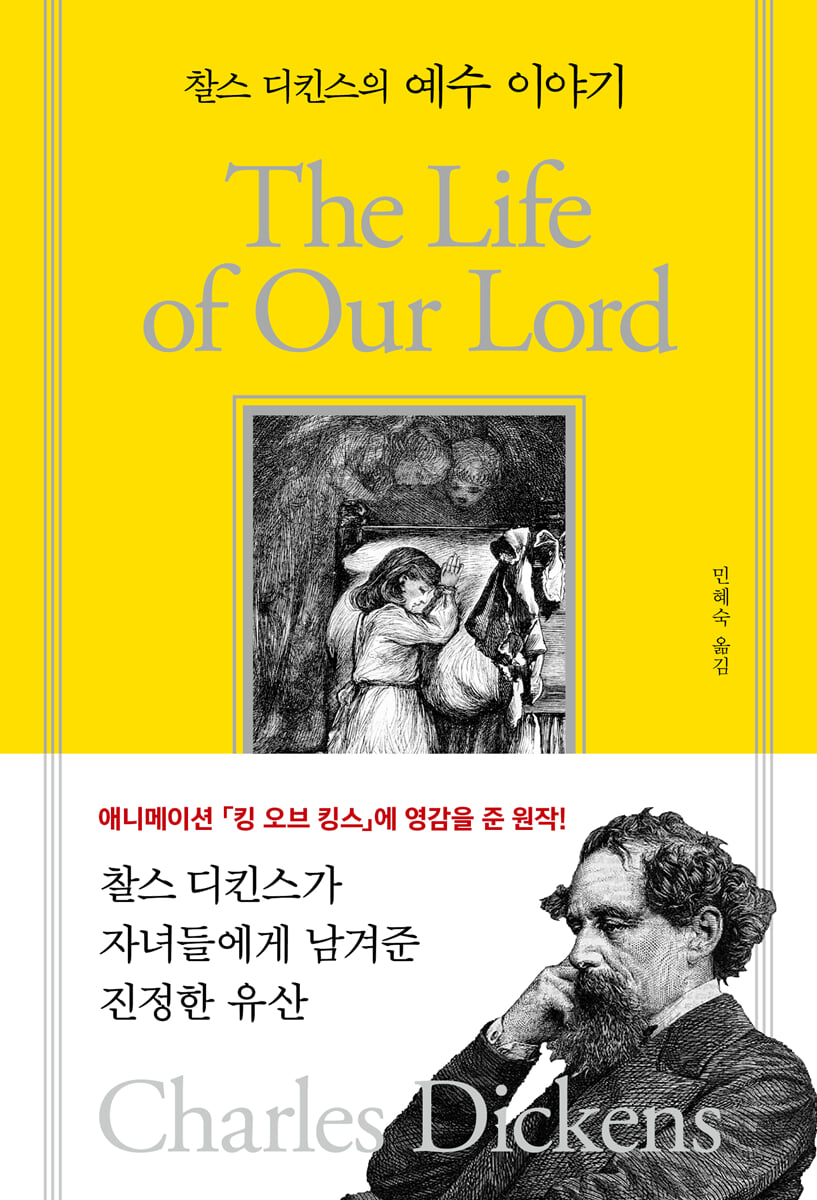
Charles Dickens's Jesus Story
 |
Description
Book Introduction
A manuscript that remained a precious family secret for 85 years!
Charles Dickens' last work published in 1934
A 'story' that anyone can read
Dickens's simple and concise reconstruction of Jesus' life!
The Life of Our Lord was written by the 19th-century British author Charles Dickens between 1846 and 1849 for his children.
It was three years after the publication of A Christmas Carol (1843), around the time he was completing David Copperfield (1850).
He wrote this simple story of the life of Jesus himself, hoping to raise his children according to the teachings of Christ and to answer their curious questions about religion and faith.
It goes without saying that Dickens himself was in awe of the New Testament.
This book was Dickens's last published work, as he did not want it published until 1934, long after his death in 1870.
The family decided to publish the manuscript in accordance with the will of Dickens' eighth son, Sir Henry Fielding, who had kept the manuscript, when he died in 1933.
As a writer, Dickens emphasized the 'story' in a way that was easy and concise for children to understand.
I can feel the author's intention to convey the words and lessons fully within detailed sentences.
“This manuscript reveals his heart and humanity, and of course his deep devotion to the Lord” (Marie Dickens, Preface to the First Edition).
It is edited in three dimensions, including beautiful Bible illustrations by Gustave Doré, a preface by Marie Dickens, a preface to the American edition, and prayers and letters written by Charles Dickens to his children.
Charles Dickens' last work published in 1934
A 'story' that anyone can read
Dickens's simple and concise reconstruction of Jesus' life!
The Life of Our Lord was written by the 19th-century British author Charles Dickens between 1846 and 1849 for his children.
It was three years after the publication of A Christmas Carol (1843), around the time he was completing David Copperfield (1850).
He wrote this simple story of the life of Jesus himself, hoping to raise his children according to the teachings of Christ and to answer their curious questions about religion and faith.
It goes without saying that Dickens himself was in awe of the New Testament.
This book was Dickens's last published work, as he did not want it published until 1934, long after his death in 1870.
The family decided to publish the manuscript in accordance with the will of Dickens' eighth son, Sir Henry Fielding, who had kept the manuscript, when he died in 1933.
As a writer, Dickens emphasized the 'story' in a way that was easy and concise for children to understand.
I can feel the author's intention to convey the words and lessons fully within detailed sentences.
“This manuscript reveals his heart and humanity, and of course his deep devotion to the Lord” (Marie Dickens, Preface to the First Edition).
It is edited in three dimensions, including beautiful Bible illustrations by Gustave Doré, a preface by Marie Dickens, a preface to the American edition, and prayers and letters written by Charles Dickens to his children.
- You can preview some of the book's contents.
Preview
index
Preface to the First Edition (Marie Dickens)
Preface to the First Edition (American Edition)
A letter to my son
Chapter 1
Chapter 2
Chapter 3
Chapter 4
Chapter 5
Chapter 6
Chapter 7
Chapter 8
Chapter 9
Chapter 10
Chapter 11
A prayer written by Charles Dickens for his children
Reading Jesus with a Child's Heart
Preface to the First Edition (American Edition)
A letter to my son
Chapter 1
Chapter 2
Chapter 3
Chapter 4
Chapter 5
Chapter 6
Chapter 7
Chapter 8
Chapter 9
Chapter 10
Chapter 11
A prayer written by Charles Dickens for his children
Reading Jesus with a Child's Heart
Detailed image

Into the book
Apart from its theme of God, this manuscript is particularly personal to the author.
And it is not so much a revelation of his spirit as it is a demonstration of his heart and humanity, and of course, his deep devotion to the Lord.
--- p.5
When your brothers left home, I wrote them each a letter like the one I am writing to you now, urging them to set aside human interpretations and inventions and to be guided by this Bible.
--- p.21
My beloved children, I earnestly desire that you may know even a little about the history of Jesus Christ.
Because everyone should know about him.
No one has ever lived as good, kind, and gentle as Jesus.
--- p.26
When the star stood still, the wise men went in and saw the baby with his mother Mary.
They loved the baby very much, gave him some gifts, and then left.
--- p.31
After that, Jesus Christ went into the wild and lonely wilderness.
He stayed there for forty days and forty nights, praying that he might be of use to people, teaching them to be better people, and that after his death he might be happy in heaven.
--- p.41
When people speak ill of the poor and unfortunate, think about this:
How Jesus Christ walked among them, taught them, and considered them worthy of care.
Always feel sorry for them and think of them in the best possible way.
--- p.47
Even if they don't come and apologize like that, we still have to forgive them.
If we want God to forgive us, we must not hate them or treat them harshly.
--- p.71
Jesus loved that child.
Of course he loved all children.
Yes, he loved the whole world.
No one has ever loved everyone so truly and completely as He has.
--- p.83
Other people would not have been so rich that they would have given nothing, but she was so poor that she put in two small coins, which would have bought her bread.
When we give charity, we must never forget what this poor widow did.
--- p.108
They abused Jesus in many cruel ways.
But Jesus endured all the suffering patiently and said,
“Father, forgive them! They don’t know what they’re doing!”
--- p.137
Remember, always doing good is Christianity.
Even to those who do us evil.
To love our neighbors as ourselves and to treat everyone as we would like to be treated.
…showing our love for God by always humbly striving to do the right thing in everything.
All of this is Christianity.
And it is not so much a revelation of his spirit as it is a demonstration of his heart and humanity, and of course, his deep devotion to the Lord.
--- p.5
When your brothers left home, I wrote them each a letter like the one I am writing to you now, urging them to set aside human interpretations and inventions and to be guided by this Bible.
--- p.21
My beloved children, I earnestly desire that you may know even a little about the history of Jesus Christ.
Because everyone should know about him.
No one has ever lived as good, kind, and gentle as Jesus.
--- p.26
When the star stood still, the wise men went in and saw the baby with his mother Mary.
They loved the baby very much, gave him some gifts, and then left.
--- p.31
After that, Jesus Christ went into the wild and lonely wilderness.
He stayed there for forty days and forty nights, praying that he might be of use to people, teaching them to be better people, and that after his death he might be happy in heaven.
--- p.41
When people speak ill of the poor and unfortunate, think about this:
How Jesus Christ walked among them, taught them, and considered them worthy of care.
Always feel sorry for them and think of them in the best possible way.
--- p.47
Even if they don't come and apologize like that, we still have to forgive them.
If we want God to forgive us, we must not hate them or treat them harshly.
--- p.71
Jesus loved that child.
Of course he loved all children.
Yes, he loved the whole world.
No one has ever loved everyone so truly and completely as He has.
--- p.83
Other people would not have been so rich that they would have given nothing, but she was so poor that she put in two small coins, which would have bought her bread.
When we give charity, we must never forget what this poor widow did.
--- p.108
They abused Jesus in many cruel ways.
But Jesus endured all the suffering patiently and said,
“Father, forgive them! They don’t know what they’re doing!”
--- p.137
Remember, always doing good is Christianity.
Even to those who do us evil.
To love our neighbors as ourselves and to treat everyone as we would like to be treated.
…showing our love for God by always humbly striving to do the right thing in everything.
All of this is Christianity.
--- p.163
Publisher's Review
The original work that inspired the anime "King of Kings"!
The True Legacy Charles Dickens Left His Children
A 'story' that anyone can read
Dickens's simple and concise reconstruction of Jesus' life!
Charles Dickens (1812-1870), the great 19th-century British writer, enjoyed popularity and fame comparable to Shakespeare's with numerous works that depicted the dark realities of capitalist British society, which had rapidly developed due to the Industrial Revolution, and the lives of the poor living under it, in a kaleidoscopic manner.
Between 1846 and 1849, the great author Dickens wrote a special manuscript called The Life of Our Lord for his children.
By then, three years had passed since the publication of A Christmas Carol (1843), and he was about to complete David Copperfield (1850).
A manuscript that remained a precious family secret for 85 years!
This humble manuscript stands out completely from all of Dickens's other works.
Because I wrote it for a very personal purpose, to answer the questions that curious young children have about religion and faith.
So Dickens had no intention of publishing it and forbade his children from publishing it either.
When Dickens died in 1870, the manuscript was left to his sister-in-law Georgina Hogarth, and later inherited by Dickens' eighth son, Sir Henry Fielding Dickens.
When Sir Henry died in 1933, he left his family to decide whether to donate the book to the British Museum or publish it, and it was finally published in May of the following year following the majority decision of the family.
With this, Charles Dickens' "The Jesus Story," which had been a precious family secret for 85 years, was made known to the world.
The best gift, the most precious legacy you can give your children
In this book, Dickens tried to pass on the Christian spirit he believed in and practiced to his children.
He believed that Jesus' teachings were the best gift and most precious legacy he could give his children.
He describes the life of Jesus in the Gospels in detail, as if he were writing a letter, in the form of a father telling his child a story.
This is because I believed that if I kept the spirit of the Gospel, I could live righteously in any era or any environment.
In this 11-chapter book, Dickens summarizes the life of Jesus in a simple and concise narrative that children can understand.
The birth of baby Jesus, his healings and miracles, his journey with the disciples, the Last Supper, his entry into Jerusalem, his death on the cross and resurrection, and Paul's subsequent conversion and preaching.
Gustave Dore's beautiful Bible illustrations are included to aid visual understanding.
The meaning of this book becomes clearer and richer when read together with Dickens' family stories.
It also includes Marie Dickens's preface, the American edition's preface, and Dickens' letters and prayers, allowing readers to learn about the story behind the book and its publication process.
The translation is based on the 1934 American first edition by Simon & Schuster and the 1970 Collins Clear-Type Press edition, which commemorated the 100th anniversary of Dickens's death.
A book that shows Dickens's heart and humanity, and his deep devotion to the Lord.
As his daughter-in-law, Marie Dickens, wrote in the preface to the first edition, this book “shows Dickens’s heart and humanity, and of course his deep devotion to the Lord.” Although Dickens was not a notable Christian writer or thinker, he had a special affection for the New Testament and the teachings of Jesus.
He said in a letter to critic John Maycomb:
“I have always tried to express my respect for the Lord’s life and teachings in my work.” The letter he wrote to his son as he was leaving home also clearly shows the figure of a believer.
“Do not abandon the healthy habit of praying your own prayers morning and evening.
“I, too, have never abandoned the habit of prayer, and I know well the comfort it brings.”
The life of Jesus, healing, giving, and forgiving… A book imbued with Dickens's spirit of charity.
Almost all of Dickens's novels feature poor and suffering people.
It is also closely related to Dickens' own unfortunate experience of working in a shoe polish factory from the age of twelve.
He understood and sympathized with the lives of the common people who were driven to poverty and harsh labor more than anyone else.
This is also why he particularly emphasized Jesus' charity of healing the sick, showing mercy to the weak, and forgiving sinners in 'The Story of Jesus'.
Although he frequently criticized the clergy in his works, his purpose was fundamentally to reveal the social spirit and role of Christianity for the weak, including children, who suffer from poverty, disease, and labor.
Dickens donated to over 43 charities throughout his life and encouraged wealthy people to give.
Perhaps that is why, after Dickens died, his tombstone was inscribed with the words “Advocate of the poor, suffering and persecuted.”
Reading Jesus with a Child's Heart
What Dickens wanted to leave most precious to his children was the life of Jesus Christ.
At the end of the book, Dickens says:
“Remember! Always doing good is Christianity.
…showing our love for God by always humbly striving to do the right thing in everything.
“All this is Christianity,” Dickens said of The Jesus Story, adding, “This book is an inseparable part of my children’s childhood memories.”
This is why we must first read this book with a childlike mind and read it with children.
The True Legacy Charles Dickens Left His Children
A 'story' that anyone can read
Dickens's simple and concise reconstruction of Jesus' life!
Charles Dickens (1812-1870), the great 19th-century British writer, enjoyed popularity and fame comparable to Shakespeare's with numerous works that depicted the dark realities of capitalist British society, which had rapidly developed due to the Industrial Revolution, and the lives of the poor living under it, in a kaleidoscopic manner.
Between 1846 and 1849, the great author Dickens wrote a special manuscript called The Life of Our Lord for his children.
By then, three years had passed since the publication of A Christmas Carol (1843), and he was about to complete David Copperfield (1850).
A manuscript that remained a precious family secret for 85 years!
This humble manuscript stands out completely from all of Dickens's other works.
Because I wrote it for a very personal purpose, to answer the questions that curious young children have about religion and faith.
So Dickens had no intention of publishing it and forbade his children from publishing it either.
When Dickens died in 1870, the manuscript was left to his sister-in-law Georgina Hogarth, and later inherited by Dickens' eighth son, Sir Henry Fielding Dickens.
When Sir Henry died in 1933, he left his family to decide whether to donate the book to the British Museum or publish it, and it was finally published in May of the following year following the majority decision of the family.
With this, Charles Dickens' "The Jesus Story," which had been a precious family secret for 85 years, was made known to the world.
The best gift, the most precious legacy you can give your children
In this book, Dickens tried to pass on the Christian spirit he believed in and practiced to his children.
He believed that Jesus' teachings were the best gift and most precious legacy he could give his children.
He describes the life of Jesus in the Gospels in detail, as if he were writing a letter, in the form of a father telling his child a story.
This is because I believed that if I kept the spirit of the Gospel, I could live righteously in any era or any environment.
In this 11-chapter book, Dickens summarizes the life of Jesus in a simple and concise narrative that children can understand.
The birth of baby Jesus, his healings and miracles, his journey with the disciples, the Last Supper, his entry into Jerusalem, his death on the cross and resurrection, and Paul's subsequent conversion and preaching.
Gustave Dore's beautiful Bible illustrations are included to aid visual understanding.
The meaning of this book becomes clearer and richer when read together with Dickens' family stories.
It also includes Marie Dickens's preface, the American edition's preface, and Dickens' letters and prayers, allowing readers to learn about the story behind the book and its publication process.
The translation is based on the 1934 American first edition by Simon & Schuster and the 1970 Collins Clear-Type Press edition, which commemorated the 100th anniversary of Dickens's death.
A book that shows Dickens's heart and humanity, and his deep devotion to the Lord.
As his daughter-in-law, Marie Dickens, wrote in the preface to the first edition, this book “shows Dickens’s heart and humanity, and of course his deep devotion to the Lord.” Although Dickens was not a notable Christian writer or thinker, he had a special affection for the New Testament and the teachings of Jesus.
He said in a letter to critic John Maycomb:
“I have always tried to express my respect for the Lord’s life and teachings in my work.” The letter he wrote to his son as he was leaving home also clearly shows the figure of a believer.
“Do not abandon the healthy habit of praying your own prayers morning and evening.
“I, too, have never abandoned the habit of prayer, and I know well the comfort it brings.”
The life of Jesus, healing, giving, and forgiving… A book imbued with Dickens's spirit of charity.
Almost all of Dickens's novels feature poor and suffering people.
It is also closely related to Dickens' own unfortunate experience of working in a shoe polish factory from the age of twelve.
He understood and sympathized with the lives of the common people who were driven to poverty and harsh labor more than anyone else.
This is also why he particularly emphasized Jesus' charity of healing the sick, showing mercy to the weak, and forgiving sinners in 'The Story of Jesus'.
Although he frequently criticized the clergy in his works, his purpose was fundamentally to reveal the social spirit and role of Christianity for the weak, including children, who suffer from poverty, disease, and labor.
Dickens donated to over 43 charities throughout his life and encouraged wealthy people to give.
Perhaps that is why, after Dickens died, his tombstone was inscribed with the words “Advocate of the poor, suffering and persecuted.”
Reading Jesus with a Child's Heart
What Dickens wanted to leave most precious to his children was the life of Jesus Christ.
At the end of the book, Dickens says:
“Remember! Always doing good is Christianity.
…showing our love for God by always humbly striving to do the right thing in everything.
“All this is Christianity,” Dickens said of The Jesus Story, adding, “This book is an inseparable part of my children’s childhood memories.”
This is why we must first read this book with a childlike mind and read it with children.
GOODS SPECIFICS
- Date of issue: July 10, 2025
- Page count, weight, size: 176 pages | 206g | 129*189*11mm
- ISBN13: 9791198285058
- ISBN10: 1198285052
You may also like
카테고리
korean


korean

![GQ KOREA Mark (Monthly): December [2025]](http://librairie.coreenne.fr/cdn/shop/files/8ef265dbbfbf186523ed75ba7319009d.jpg?v=1765340328&width=3840)


