

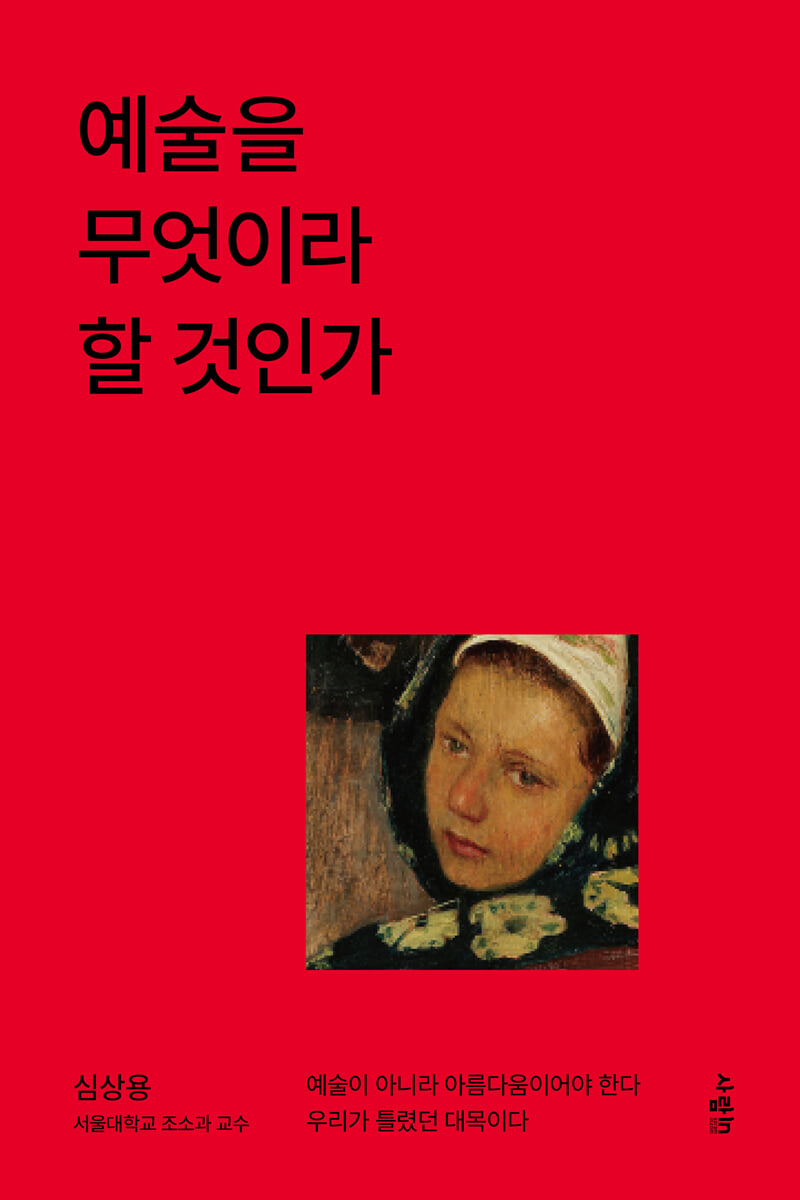
What should we call art?
 |
Description
Book Introduction
★The power of art must be beauty.
What kind of culture and system does art exist within today? A culture overflowing with art for the image-laundering benefit of international oil and energy companies, a system where people compete to win tickets to prestigious art fairs, a system where money and desire sweep the earth.
In today's world, where "global franchise business under an ideal central control system" has become the new name for art, what should we call art? Professor Sim Sang-yong, in "What Should We Call Art?", examines the true nature of the currents and power of art in this era and discusses other forces that "de-sacralize" that power.
In this way, we seek to find the starting point of beauty, freedom, and liberation, which are the true power of true art.
What kind of culture and system does art exist within today? A culture overflowing with art for the image-laundering benefit of international oil and energy companies, a system where people compete to win tickets to prestigious art fairs, a system where money and desire sweep the earth.
In today's world, where "global franchise business under an ideal central control system" has become the new name for art, what should we call art? Professor Sim Sang-yong, in "What Should We Call Art?", examines the true nature of the currents and power of art in this era and discusses other forces that "de-sacralize" that power.
In this way, we seek to find the starting point of beauty, freedom, and liberation, which are the true power of true art.
- You can preview some of the book's contents.
Preview
index
1 Art in the AI Age
Big Brother is watching you
What we lost
Will AI replace Van Gogh and Rembrandt?
Thalidomide Baby
Digital Fools and Art
2 When the party ends
When the party ends
How Oil Companies Are Ruining Art Museums
There is no art in the art fair.
“Everyone just wants a piece of his cake.”
Imitation Theory: Fear and Reward
Colorful monochrome
3 American Effect
Hobson's Choice
The sublime comes from the bread.
The Honeymoon of Art and Real Estate
They just want advertising!
Hustling Art
American Effect
4 The Law of Entropy in Art
Impossible future
Amor Party with Syrup
The parasite called art theory
What is everywhere is nowhere
The Entropy Law of Art
5. The Land of Artists
Marcel Duchamp's Country
Feminism that took aim at pop art
There is no country for artists
The Lament of an Insignificant Korean Modernist
About the Earth and Roots
6. Undamaged sense of beauty
What's gone and what's left
Have you reached the liberation of awareness?
God does not play dice
Undamaged sense of beauty
A painting that wouldn't be terrible to hang in a prisoner's room
Epilogue
The power of art should be beauty, not art.
Big Brother is watching you
What we lost
Will AI replace Van Gogh and Rembrandt?
Thalidomide Baby
Digital Fools and Art
2 When the party ends
When the party ends
How Oil Companies Are Ruining Art Museums
There is no art in the art fair.
“Everyone just wants a piece of his cake.”
Imitation Theory: Fear and Reward
Colorful monochrome
3 American Effect
Hobson's Choice
The sublime comes from the bread.
The Honeymoon of Art and Real Estate
They just want advertising!
Hustling Art
American Effect
4 The Law of Entropy in Art
Impossible future
Amor Party with Syrup
The parasite called art theory
What is everywhere is nowhere
The Entropy Law of Art
5. The Land of Artists
Marcel Duchamp's Country
Feminism that took aim at pop art
There is no country for artists
The Lament of an Insignificant Korean Modernist
About the Earth and Roots
6. Undamaged sense of beauty
What's gone and what's left
Have you reached the liberation of awareness?
God does not play dice
Undamaged sense of beauty
A painting that wouldn't be terrible to hang in a prisoner's room
Epilogue
The power of art should be beauty, not art.
Detailed image

Into the book
According to Bernard Cassen, professor at the Institute of European Studies at the University of Paris 8 and editor-in-chief of Le Monde diplomatique, the urgent priority is to reassess the magnitude and depth of the loss we face.
In a world driven by money and markets, what we have lost is humanity.
That is why the one who must be quickly recovered must also be human.
People just want the market boom to return.
We hope that high-yield, collateralized art will overcome the recession and once again lead to a magical rise in added value.
If only that could happen, the art would shed the light of grace upon humanity in its absence.
But the order was wrong.
Generating immediate high profits is just a variable that has nothing to do with rescuing humans from the garbage dump.
They want art to become myth, but it is the job of art to break myths.
---From "Everyone Just Wants a Piece of His Cake"
Despite its success in the market, questions remain unanswered: whether monochrome truly represents Korean beauty; if so, how should the aesthetics and traditions of Korean colors, such as the Palsaekjo, be explained; and how, as modern art, it digested and reflected the zeitgeist of the 1960s and 1970s, a period of great historical transition.
The monochrome craze, in its haste to portray itself as possessing a powerful inner force, committed the error of mixing the various branches of modern and contemporary Korean abstract painting with commercial thinking and perpetrating a historical dislocation.
The harm will not end with merely stifling discussion about the dynamic genesis of Korean art.
---From "Colorful Monochrome"
December 16, 1999, 4:00 PM.
There was an unusually long line to see the exhibition at the Brooklyn Museum.
It was to see the exhibition “Sensation,” which was planned based on the collection of Charles Saatchi, a British department store magnate and art dealer.
At the end of the line stood Dennis Heiner, a retired math teacher in his seventies.
As soon as he got his ticket, he headed straight to the exhibition hall on the 5th floor.
Then he stopped in front of Chris Ofili's painting, "The Holy Virgin Mary," took out a can of white paint from his coat pocket, spread it over the painting, and began to scribble something.
It was a text like 'Don't' or 'Stop'.
First on the face, then on the chest.
Within a quarter of the painting was covered with brushstrokes.
It was around 4:30 in the afternoon.
A security guard came running in a hurry and stopped him, and the police arrived later and arrested him.
When the police asked him why, he could barely manage to repeat in a trembling voice, “Blasphemy...”
---From "They just want advertising!"
Art has become something magical that can be accomplished in an instant.
However, side effects that even Duchamp could not have predicted appeared one after another.
Above all, it is the radical disappearance of the concept of artistic creation.
Without even leaving a will.
As art became an idea, all perceptions of dreams and imagination, of history and transcendence, of nature and society became meaningless.
It has become a lonely thing, unrelated to the temporal event of life and the spatial event of this land, without any signs of life or people.
It is a total break from mental ideals, moral nobility, and empathy with others.
Is this evolution? But humans cannot survive even a single moment in this state.
---From "Marcel Duchamp's Country"
When is prolonged contemplation possible? When there is inherent power in the unity of opposites.
In that sense, the agreement of opposites and the long gaze are like two sides of the same coin.
The beauty of the harmony of seemingly contradictory things and the long contemplation of them, when these two conditions are met, leads to art, which Weil likened to 'a picture that would not be terrible to hang in the room of a squire.'
---From "A Picture That Wouldn't Be Terrible Even If Hanged in a Weaponist's Room"
It is not art, but the art of beauty that has power.
Only with that power can we resist the various forms of violence that the current civilization, which is running wild, considers normal, and not retreat from the fight to move beyond the "wrong way of seeing" to the "right way of seeing."
'Proper Spring' is a vision that awakens our souls from a long slumber, allows us to intuitively approach truth, and advance to the essence of beauty.
In a world driven by money and markets, what we have lost is humanity.
That is why the one who must be quickly recovered must also be human.
People just want the market boom to return.
We hope that high-yield, collateralized art will overcome the recession and once again lead to a magical rise in added value.
If only that could happen, the art would shed the light of grace upon humanity in its absence.
But the order was wrong.
Generating immediate high profits is just a variable that has nothing to do with rescuing humans from the garbage dump.
They want art to become myth, but it is the job of art to break myths.
---From "Everyone Just Wants a Piece of His Cake"
Despite its success in the market, questions remain unanswered: whether monochrome truly represents Korean beauty; if so, how should the aesthetics and traditions of Korean colors, such as the Palsaekjo, be explained; and how, as modern art, it digested and reflected the zeitgeist of the 1960s and 1970s, a period of great historical transition.
The monochrome craze, in its haste to portray itself as possessing a powerful inner force, committed the error of mixing the various branches of modern and contemporary Korean abstract painting with commercial thinking and perpetrating a historical dislocation.
The harm will not end with merely stifling discussion about the dynamic genesis of Korean art.
---From "Colorful Monochrome"
December 16, 1999, 4:00 PM.
There was an unusually long line to see the exhibition at the Brooklyn Museum.
It was to see the exhibition “Sensation,” which was planned based on the collection of Charles Saatchi, a British department store magnate and art dealer.
At the end of the line stood Dennis Heiner, a retired math teacher in his seventies.
As soon as he got his ticket, he headed straight to the exhibition hall on the 5th floor.
Then he stopped in front of Chris Ofili's painting, "The Holy Virgin Mary," took out a can of white paint from his coat pocket, spread it over the painting, and began to scribble something.
It was a text like 'Don't' or 'Stop'.
First on the face, then on the chest.
Within a quarter of the painting was covered with brushstrokes.
It was around 4:30 in the afternoon.
A security guard came running in a hurry and stopped him, and the police arrived later and arrested him.
When the police asked him why, he could barely manage to repeat in a trembling voice, “Blasphemy...”
---From "They just want advertising!"
Art has become something magical that can be accomplished in an instant.
However, side effects that even Duchamp could not have predicted appeared one after another.
Above all, it is the radical disappearance of the concept of artistic creation.
Without even leaving a will.
As art became an idea, all perceptions of dreams and imagination, of history and transcendence, of nature and society became meaningless.
It has become a lonely thing, unrelated to the temporal event of life and the spatial event of this land, without any signs of life or people.
It is a total break from mental ideals, moral nobility, and empathy with others.
Is this evolution? But humans cannot survive even a single moment in this state.
---From "Marcel Duchamp's Country"
When is prolonged contemplation possible? When there is inherent power in the unity of opposites.
In that sense, the agreement of opposites and the long gaze are like two sides of the same coin.
The beauty of the harmony of seemingly contradictory things and the long contemplation of them, when these two conditions are met, leads to art, which Weil likened to 'a picture that would not be terrible to hang in the room of a squire.'
---From "A Picture That Wouldn't Be Terrible Even If Hanged in a Weaponist's Room"
It is not art, but the art of beauty that has power.
Only with that power can we resist the various forms of violence that the current civilization, which is running wild, considers normal, and not retreat from the fight to move beyond the "wrong way of seeing" to the "right way of seeing."
'Proper Spring' is a vision that awakens our souls from a long slumber, allows us to intuitively approach truth, and advance to the essence of beauty.
---From the "Epilogue"
Publisher's Review
★Where is the art?
Where is the art of our time? The astonishing growth of the Frieze Art Fair, the major patrons of art museums, international oil corporations and unscrupulous real estate owners, works of art with minimal artistic merit but sold out amidst the heated debate over blasphemy…
This book delves into the reality of art today, which has become exhausted, declining, and barren.
At the same time, it presents various examples of progress toward the beauty and liberation of true art.
For example, there's Nan Goldin, who became addicted to morphine after taking OxyContin, which was prescribed as a painkiller after wrist surgery.
Goldin, who barely escaped his addiction, learns of the truth behind the incident.
The Sackler family, which owns Purdue Pharma, a global pharmaceutical company that covered up the addictive nature of OxyContin, was at the center of it.
Sacklers used some of the money they made by encouraging drug abuse to be donated to art galleries, thereby laundering their corporate image and throwing parties disguised as art.
Goldin's story of exposing this and fighting to reveal the truth about the weak was captured in a documentary that won the Golden Lion Award at the Venice International Film Festival.
★“We need to put art back in its rightful place.”
Regarding art, which has become a devastated land, the author says that art must be put back in its place.
To achieve this, we must shatter myths and blind faith, rather than building false advertising and myths, remember the source of beauty, and recover the sense that comes from intact friendship and solidarity.
To restore art to its true place of beauty, we focus on the ecosystem of art discussed in this book.
What will this book mean to us? It will be the first step toward standing on the side of truth, continuing to question, debate, and critique art, confronting various forms of violence, and moving toward the essence of beauty.
Where is the art of our time? The astonishing growth of the Frieze Art Fair, the major patrons of art museums, international oil corporations and unscrupulous real estate owners, works of art with minimal artistic merit but sold out amidst the heated debate over blasphemy…
This book delves into the reality of art today, which has become exhausted, declining, and barren.
At the same time, it presents various examples of progress toward the beauty and liberation of true art.
For example, there's Nan Goldin, who became addicted to morphine after taking OxyContin, which was prescribed as a painkiller after wrist surgery.
Goldin, who barely escaped his addiction, learns of the truth behind the incident.
The Sackler family, which owns Purdue Pharma, a global pharmaceutical company that covered up the addictive nature of OxyContin, was at the center of it.
Sacklers used some of the money they made by encouraging drug abuse to be donated to art galleries, thereby laundering their corporate image and throwing parties disguised as art.
Goldin's story of exposing this and fighting to reveal the truth about the weak was captured in a documentary that won the Golden Lion Award at the Venice International Film Festival.
★“We need to put art back in its rightful place.”
Regarding art, which has become a devastated land, the author says that art must be put back in its place.
To achieve this, we must shatter myths and blind faith, rather than building false advertising and myths, remember the source of beauty, and recover the sense that comes from intact friendship and solidarity.
To restore art to its true place of beauty, we focus on the ecosystem of art discussed in this book.
What will this book mean to us? It will be the first step toward standing on the side of truth, continuing to question, debate, and critique art, confronting various forms of violence, and moving toward the essence of beauty.
GOODS SPECIFICS
- Date of issue: August 14, 2025
- Page count, weight, size: 304 pages | 140*210*30mm
- ISBN13: 9791171011780
- ISBN10: 1171011784
You may also like
카테고리
korean


korean

![GQ KOREA Mark (Monthly): December [2025]](http://librairie.coreenne.fr/cdn/shop/files/8ef265dbbfbf186523ed75ba7319009d.jpg?v=1765340328&width=3840)


