

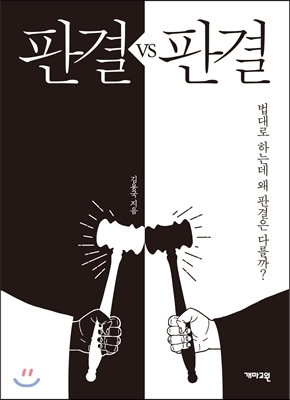
Verdict VS Verdict
 |
Description
Book Introduction
Different sentences for the same crime, looking for the reason
There is a man in his 60s.
He stole the envelope containing the wedding gift from the wedding hall.
The amount is 150,000 won.
He had multiple criminal records and was sentenced to three years in prison. There is another man in his 60s.
He caused billions of won in losses to the company through embezzlement and breach of trust.
He was also sentenced to three years in prison, but the sentence was suspended and he avoided actual imprisonment.
He also had several criminal records.
One is theft and the other is embezzlement and breach of trust, but both are the same in that they involve stealing other people's money.
And considering the magnitude of the sin, it seems the second man deserves a greater punishment.
But the verdict was the opposite.
Naturally, curiosity arises.
Why on earth did such different rulings come out, and what legal principles and logic are behind them?
It is also questionable whether there really is a tendency for verdicts like "innocent until proven guilty" and "guilty until proven guilty." (The second man is Kim Seung-yeon, chairman of Hanwha Group.) This book puts two verdicts together to confirm this curiosity.
By grouping similar judgments, such as those that are completely incomprehensible or those that have become important milestones in our society, we can understand the legal principles and meaning of the judgment that would otherwise be obscured when viewed alone.
This book's unique 'Judgment VS Judgment' structure is not only entertaining in itself, but also serves as a device that highlights the core of the judgment.
There is a man in his 60s.
He stole the envelope containing the wedding gift from the wedding hall.
The amount is 150,000 won.
He had multiple criminal records and was sentenced to three years in prison. There is another man in his 60s.
He caused billions of won in losses to the company through embezzlement and breach of trust.
He was also sentenced to three years in prison, but the sentence was suspended and he avoided actual imprisonment.
He also had several criminal records.
One is theft and the other is embezzlement and breach of trust, but both are the same in that they involve stealing other people's money.
And considering the magnitude of the sin, it seems the second man deserves a greater punishment.
But the verdict was the opposite.
Naturally, curiosity arises.
Why on earth did such different rulings come out, and what legal principles and logic are behind them?
It is also questionable whether there really is a tendency for verdicts like "innocent until proven guilty" and "guilty until proven guilty." (The second man is Kim Seung-yeon, chairman of Hanwha Group.) This book puts two verdicts together to confirm this curiosity.
By grouping similar judgments, such as those that are completely incomprehensible or those that have become important milestones in our society, we can understand the legal principles and meaning of the judgment that would otherwise be obscured when viewed alone.
This book's unique 'Judgment VS Judgment' structure is not only entertaining in itself, but also serves as a device that highlights the core of the judgment.
- You can preview some of the book's contents.
Preview
index
-| Preface | Judgment, Between 'Best' and 'Best'
Part 1: The verdict cannot be perfect.
Self-defense: What are the limits?
Robbery death vs. violent husband unconscious
Will justice be served if we just follow the law?
Death of a homeless person abandoned at Seoul Station vs. eviction of an elderly person from public rental housing
We have a suspect, but no evidence.
Live octopus suffocation death case vs. murder without a body
To be sexually assaulted or to be incestuous, that is the question.
Nightclub booking one-night stand vs. upstairs/downstairs home invasion and rape
Sleeping with a Minor: Love or Crime?
A man in his 40s living with a middle school girl vs. uncoerced sex with her stepfather.
Putting the 'right to die with dignity' on trial
Murder of a Father with Terminal Brain Cancer vs. Euthanasia at Severance Hospital
People driven to suicide
Apartment security guard commits suicide vs. bullied middle school student commits suicide
The verdict brought before the second trial court
Kang Ki-hoon, acquitted after 24 years
Guilty of ghostwriting in 1991 vs. not guilty in 2015 retrial
KTX female flight attendant's 10-year legal battle reaches its conclusion.
Lower court reinstatement win vs. Supreme Court reinstatement loss
Does hereditary innocence exist?
The unemployed man's 150,000 won theft vs. the conglomerate chairman's 150 billion won embezzlement.
The chairman's daily wage is 500 million won
"Imperial Labor" Worth 500 Million Won a Day vs. "Private Labor" Worth 50,000 Won a Day
Prosecutors stand in court as defendants
Benz is a "price for favors" VS Benz is a "symbol of love."
Citizen Participation Trials: Between Common Sense and Expertise
Overturning a Jury Verdict vs. Respecting a Jury Verdict
Society in the Courtroom, Part 3
Condemn state violence
Forced sterilization of Hansen's disease patients on Sorok Island vs. forced admission to Samcheong Training Corps? Assault.
Conspiracy of Rebellion, Between Kim Dae-jung and Lee Seok-ki
Kim Dae-jung's conspiracy to commit sedition vs. Lee Seok-ki's conspiracy to commit sedition
The biggest stigma in Korean society: pro-North Korea sentiment
Calls for the expulsion of pro-North Korean local government heads vs. condemnation of Lee Jung-hee and her husband as pro-North Korean.
For freedom of expression rather than the honor of the government
The Sewol ferry disaster: Hong Ga-hye vs. the Minerva incident
Insults from politicians, insults from ordinary people
Kang Yong-seok's insults to female announcer VS netizens' insults to "Who is Shin Ji-ho?"
Will the law recognize the vested interests of pro-Japanese collaborators?
Cancellation of Pro-Japanese Judge Decision vs. Search for Pro-Japanese Assets
Is a legal strike possible in Korea?
Hanjin Heavy Industries Strike vs. Ssangyong Motor Strike
-Case number
Part 1: The verdict cannot be perfect.
Self-defense: What are the limits?
Robbery death vs. violent husband unconscious
Will justice be served if we just follow the law?
Death of a homeless person abandoned at Seoul Station vs. eviction of an elderly person from public rental housing
We have a suspect, but no evidence.
Live octopus suffocation death case vs. murder without a body
To be sexually assaulted or to be incestuous, that is the question.
Nightclub booking one-night stand vs. upstairs/downstairs home invasion and rape
Sleeping with a Minor: Love or Crime?
A man in his 40s living with a middle school girl vs. uncoerced sex with her stepfather.
Putting the 'right to die with dignity' on trial
Murder of a Father with Terminal Brain Cancer vs. Euthanasia at Severance Hospital
People driven to suicide
Apartment security guard commits suicide vs. bullied middle school student commits suicide
The verdict brought before the second trial court
Kang Ki-hoon, acquitted after 24 years
Guilty of ghostwriting in 1991 vs. not guilty in 2015 retrial
KTX female flight attendant's 10-year legal battle reaches its conclusion.
Lower court reinstatement win vs. Supreme Court reinstatement loss
Does hereditary innocence exist?
The unemployed man's 150,000 won theft vs. the conglomerate chairman's 150 billion won embezzlement.
The chairman's daily wage is 500 million won
"Imperial Labor" Worth 500 Million Won a Day vs. "Private Labor" Worth 50,000 Won a Day
Prosecutors stand in court as defendants
Benz is a "price for favors" VS Benz is a "symbol of love."
Citizen Participation Trials: Between Common Sense and Expertise
Overturning a Jury Verdict vs. Respecting a Jury Verdict
Society in the Courtroom, Part 3
Condemn state violence
Forced sterilization of Hansen's disease patients on Sorok Island vs. forced admission to Samcheong Training Corps? Assault.
Conspiracy of Rebellion, Between Kim Dae-jung and Lee Seok-ki
Kim Dae-jung's conspiracy to commit sedition vs. Lee Seok-ki's conspiracy to commit sedition
The biggest stigma in Korean society: pro-North Korea sentiment
Calls for the expulsion of pro-North Korean local government heads vs. condemnation of Lee Jung-hee and her husband as pro-North Korean.
For freedom of expression rather than the honor of the government
The Sewol ferry disaster: Hong Ga-hye vs. the Minerva incident
Insults from politicians, insults from ordinary people
Kang Yong-seok's insults to female announcer VS netizens' insults to "Who is Shin Ji-ho?"
Will the law recognize the vested interests of pro-Japanese collaborators?
Cancellation of Pro-Japanese Judge Decision vs. Search for Pro-Japanese Assets
Is a legal strike possible in Korea?
Hanjin Heavy Industries Strike vs. Ssangyong Motor Strike
-Case number
Publisher's Review
The law lives and breathes in judgments.
'Kang Ki-hoon's ghostwriting conviction in 1991 vs. acquittal in a retrial in 2015.' The verdict in this case, which was guilty 20 years ago but now overturned to not guilty, reminds us of the dangers of political interference in judicial decisions.
"Burglar Assault Death VS Violent Husband Unconscious." We explore the requirements and limitations of self-defense through the stories of a young man who beat a burglar to death and a wife who rendered her husband brain-dead while trying to stop him from wielding violence.
'Forced sterilization of Hansen's disease patients on Sorok Island vs. forced admission and assault at Samcheong Training Corps.' In these two lawsuits against the state, we can see the crucial role of court rulings in condemning and correcting the state's unjust violence.
In this way, the author organizes 20 stories, each with its own theme, into 40 judgments.
While some decisions have significant social implications, such as the Minerva case, where a man was arrested for spreading false information, others are personal cases that spark significant legal debate, such as the case of a man who was acquitted of killing his lover for insurance money.
In these stories, the author explains conceptual legal principles such as the presumption of innocence, the prohibition of excessive punishment, the principle of proportionality, and the prohibition of retroactive legislation, using vivid, actual case studies.
This makes us keenly feel why those principles exist and how important they are.
Rotten verdict? Let's get proper critique, not just "shut up and criticize"!
“This country is going crazy lol. I guess they can just kill people lol” This is a comment on an article about the defendant in the ‘live octopus suffocation death case’ being ultimately found not guilty.
As the comments said, people's reaction was that the murderer had been released.
“Chief Justice Kim Shin.
I hope you think of her as your own daughter.
“I think the law is so flawed.” This is a comment on an article about the defendant in the case of a man in his 40s living with a middle school girl being acquitted of sexual assault.
People fiercely criticized the act of giving a free pass to a shameless criminal who deserved to be condemned.
In fact, if you look at the circumstances alone, you can't help but think that the defendants are guilty in both cases.
But let's not just criticize outright, but delve deeper into the verdict.
Why did judges, who supposedly know the law well, make rulings that differ from common sense? There may be some important principles and legal doctrines hidden behind the reason.
Knowing that will allow for more constructive criticism.
The author wrote this book in the hope that people will gain a deeper and richer perspective on judgment.
In reality, there will be no perfect judgment like the 'Judgment of Solomon'.
After all, judgment is something that people do.
Judges simply make the best decision possible, minimizing the possibility of a wrong answer.
This book allows readers to indirectly experience the process through which judges deliberate and arrive at answers.
As you read this book, it will be a more interesting read if you imagine and ponder what kind of verdict you would have made if you were a judge.
A judgment is the process by which a judge interprets this abstract law and applies it to reality.
The reason why the law comes to life is because of the ruling.
The judge is not someone who has seen or experienced the case firsthand.
In court, the truth of the case is discovered through the arguments of the parties and the evidence of the investigative agency, or through the testimony of witnesses and objective materials, like piecing together a puzzle.
Just because there are not enough puzzles doesn't mean you can avoid the answer.
Sometimes, even an incomplete puzzle is enough to raise one's hand.
It would be great if judges always gave the 'best answer,' but that's not the reality.
Perhaps it is the judges' job to provide the 'best answer' that minimizes the possibility of a wrong answer.
―From the preface
'Kang Ki-hoon's ghostwriting conviction in 1991 vs. acquittal in a retrial in 2015.' The verdict in this case, which was guilty 20 years ago but now overturned to not guilty, reminds us of the dangers of political interference in judicial decisions.
"Burglar Assault Death VS Violent Husband Unconscious." We explore the requirements and limitations of self-defense through the stories of a young man who beat a burglar to death and a wife who rendered her husband brain-dead while trying to stop him from wielding violence.
'Forced sterilization of Hansen's disease patients on Sorok Island vs. forced admission and assault at Samcheong Training Corps.' In these two lawsuits against the state, we can see the crucial role of court rulings in condemning and correcting the state's unjust violence.
In this way, the author organizes 20 stories, each with its own theme, into 40 judgments.
While some decisions have significant social implications, such as the Minerva case, where a man was arrested for spreading false information, others are personal cases that spark significant legal debate, such as the case of a man who was acquitted of killing his lover for insurance money.
In these stories, the author explains conceptual legal principles such as the presumption of innocence, the prohibition of excessive punishment, the principle of proportionality, and the prohibition of retroactive legislation, using vivid, actual case studies.
This makes us keenly feel why those principles exist and how important they are.
Rotten verdict? Let's get proper critique, not just "shut up and criticize"!
“This country is going crazy lol. I guess they can just kill people lol” This is a comment on an article about the defendant in the ‘live octopus suffocation death case’ being ultimately found not guilty.
As the comments said, people's reaction was that the murderer had been released.
“Chief Justice Kim Shin.
I hope you think of her as your own daughter.
“I think the law is so flawed.” This is a comment on an article about the defendant in the case of a man in his 40s living with a middle school girl being acquitted of sexual assault.
People fiercely criticized the act of giving a free pass to a shameless criminal who deserved to be condemned.
In fact, if you look at the circumstances alone, you can't help but think that the defendants are guilty in both cases.
But let's not just criticize outright, but delve deeper into the verdict.
Why did judges, who supposedly know the law well, make rulings that differ from common sense? There may be some important principles and legal doctrines hidden behind the reason.
Knowing that will allow for more constructive criticism.
The author wrote this book in the hope that people will gain a deeper and richer perspective on judgment.
In reality, there will be no perfect judgment like the 'Judgment of Solomon'.
After all, judgment is something that people do.
Judges simply make the best decision possible, minimizing the possibility of a wrong answer.
This book allows readers to indirectly experience the process through which judges deliberate and arrive at answers.
As you read this book, it will be a more interesting read if you imagine and ponder what kind of verdict you would have made if you were a judge.
A judgment is the process by which a judge interprets this abstract law and applies it to reality.
The reason why the law comes to life is because of the ruling.
The judge is not someone who has seen or experienced the case firsthand.
In court, the truth of the case is discovered through the arguments of the parties and the evidence of the investigative agency, or through the testimony of witnesses and objective materials, like piecing together a puzzle.
Just because there are not enough puzzles doesn't mean you can avoid the answer.
Sometimes, even an incomplete puzzle is enough to raise one's hand.
It would be great if judges always gave the 'best answer,' but that's not the reality.
Perhaps it is the judges' job to provide the 'best answer' that minimizes the possibility of a wrong answer.
―From the preface
GOODS SPECIFICS
- Date of issue: June 15, 2015
- Page count, weight, size: 296 pages | 416g | 152*210*20mm
- ISBN13: 9788957694992
- ISBN10: 8957694994
You may also like
카테고리
korean


korean

![GQ KOREA Mark (Monthly): December [2025]](http://librairie.coreenne.fr/cdn/shop/files/8ef265dbbfbf186523ed75ba7319009d.jpg?v=1765340328&width=3840)


