

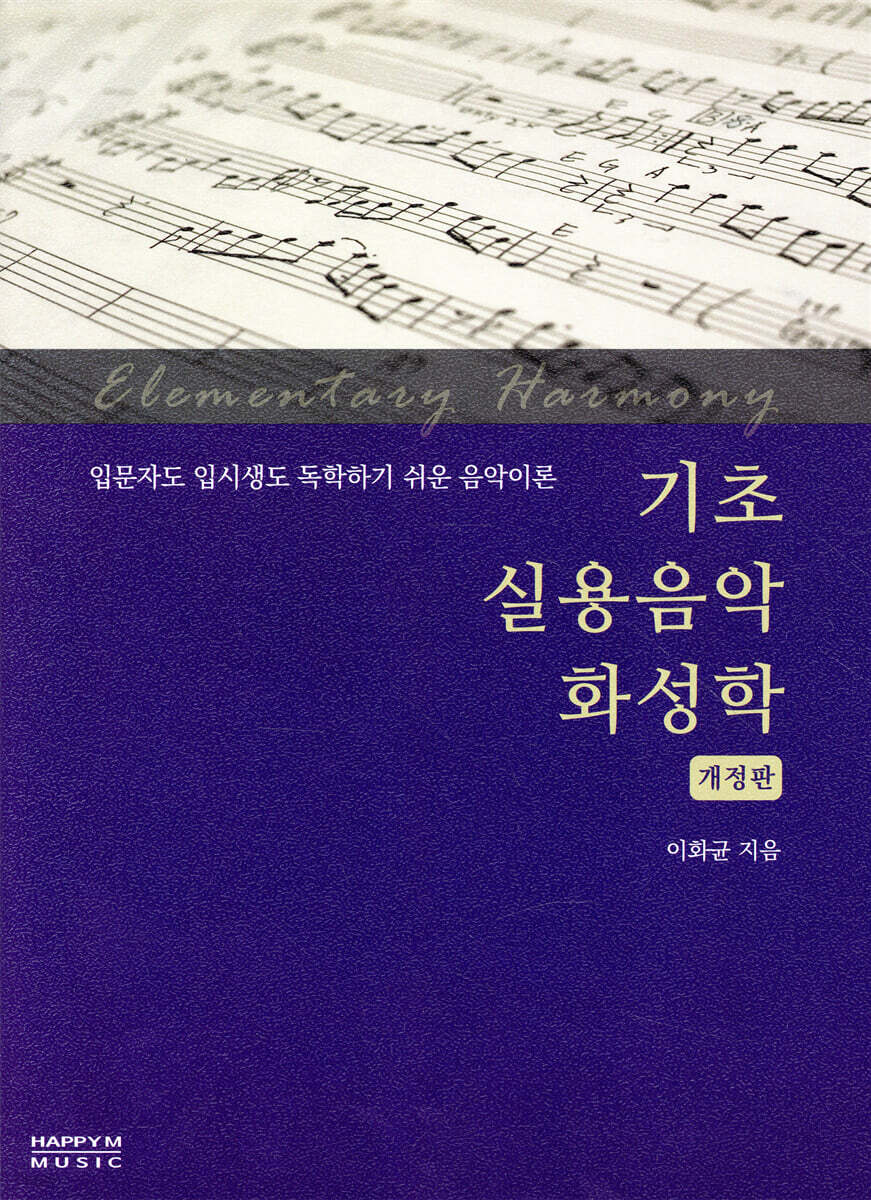
Basic Practical Music Harmony
 |
Description
Book Introduction
Music theory that is easy to learn on your own, even for beginners and college students. The author found it very difficult to move from enjoying music to studying it. There were many times when I was confused due to the Chinese character expressions used only in our country, old practices that had nothing to do with modern music, and the lack of information at the time. Things have gotten better these days, and there are many textbooks available, but most of them are still unsatisfactory because they are too difficult or contain a lot of unnecessary content, omitting basic parts. This is something I always feel when teaching students. Nowadays, with the development of various media and the popularity of Korean music, many people have become deeply interested in music and are trying to perfectly imitate the performances of many famous musicians. I found out that although these people seem to have great musical talent, many of them cannot even read the notes on a staff. This textbook provides a comprehensive introduction to the basic theory of music and harmony. I hope that many people will overcome their fear of music theory through this textbook. |
- You can preview some of the book's contents.
Preview
index
Chapter 1.
Basic music
The three elements of music
Staff
clef
Key and time signatures
musical symbol
Chapter 2.
Notes and rests
Min-eum-pyo and min-comma
Dotted and double dotted notes (rests)
consecutive notes
Glue and tie
Tailing a note
Utilizing notes and rests
Chapter 3.
Composition of joints
Notation
Various time signatures
Nodes and vertical lines
repeat symbol
Chapter 4.
Negative characteristics
Note names and key names
Keyboard structure
Semitones and whole tones
Change table
Tune and accidentals
Tinnitus
Chapter 5.
interval
pitch (1)
pitch (2)
Pitch length and variation
Application of change table
double intervals
Chapter 6.
Chinese pronunciation
What is harmony?
3rd chord
Suspended Chord
7th chord (1)
7th chord (2)
6th chord
Transposition of chords
Chapter 7.
furtherance
What is composition?
Tide signature
5th degree zone
Jeonjo and Yijo
Chapter 8.
scale
Major scale
Negative function
minor scale
Chapter 9.
Diatonic chord
Major diatonic chord
Functions of diatonic chords
minor diatonic chord
Chapter 10.
Tension
What is tension?
Tension code notation
Available tension
Tension of diatonic chords
Appendix 1.
acoustics
What is sound?
The three elements of yin
Sound characteristics
Audible frequency
interference of sound waves
Music and Sound
Appendix 2.
Various sheet music
staff
Sheet music of modern music
Appendix 3.
Practice Problem Answers
Basic music
The three elements of music
Staff
clef
Key and time signatures
musical symbol
Chapter 2.
Notes and rests
Min-eum-pyo and min-comma
Dotted and double dotted notes (rests)
consecutive notes
Glue and tie
Tailing a note
Utilizing notes and rests
Chapter 3.
Composition of joints
Notation
Various time signatures
Nodes and vertical lines
repeat symbol
Chapter 4.
Negative characteristics
Note names and key names
Keyboard structure
Semitones and whole tones
Change table
Tune and accidentals
Tinnitus
Chapter 5.
interval
pitch (1)
pitch (2)
Pitch length and variation
Application of change table
double intervals
Chapter 6.
Chinese pronunciation
What is harmony?
3rd chord
Suspended Chord
7th chord (1)
7th chord (2)
6th chord
Transposition of chords
Chapter 7.
furtherance
What is composition?
Tide signature
5th degree zone
Jeonjo and Yijo
Chapter 8.
scale
Major scale
Negative function
minor scale
Chapter 9.
Diatonic chord
Major diatonic chord
Functions of diatonic chords
minor diatonic chord
Chapter 10.
Tension
What is tension?
Tension code notation
Available tension
Tension of diatonic chords
Appendix 1.
acoustics
What is sound?
The three elements of yin
Sound characteristics
Audible frequency
interference of sound waves
Music and Sound
Appendix 2.
Various sheet music
staff
Sheet music of modern music
Appendix 3.
Practice Problem Answers
Detailed image

Publisher's Review
Check out Happy M Guitar's music theory lectures on YouTube in book form.
This is a basic theory textbook designed for those studying practical music.
1.
Music theory that is easy to learn on your own, even for beginners and college students.
This textbook is designed for people who have no knowledge of music theory.
And to help you organize what you've learned, we've included a summary of key points after each unit's detailed content.
2.
We have compiled a separate list of frequently asked questions during class.
Questions that you may have while studying music or questions that you may be curious about in real-life situations are explained separately in the Check! section.
3.
Summary of frequently used terms
Music theory often uses a mix of Korean and English notation.
This textbook uses both notations, but lists the notation that is more commonly used in practice first, and the notation that is less frequently used last.
4.
No more drawing keyboards to solve problems.
There are practice problems at the middle or end of each unit, and the answers to these are included in the final appendix.
And to help beginners understand more easily, keyboard images are included.
5.
Good to know information
Although less important than the main text of music theory, useful information for practical situations is included in the appendix.
This book explains things in the simplest possible way so that anyone can easily study them.
If you still have trouble understanding, try studying with the video lectures on YouTube's "Happy M Guitar."
This is a basic theory textbook designed for those studying practical music.
1.
Music theory that is easy to learn on your own, even for beginners and college students.
This textbook is designed for people who have no knowledge of music theory.
And to help you organize what you've learned, we've included a summary of key points after each unit's detailed content.
2.
We have compiled a separate list of frequently asked questions during class.
Questions that you may have while studying music or questions that you may be curious about in real-life situations are explained separately in the Check! section.
3.
Summary of frequently used terms
Music theory often uses a mix of Korean and English notation.
This textbook uses both notations, but lists the notation that is more commonly used in practice first, and the notation that is less frequently used last.
4.
No more drawing keyboards to solve problems.
There are practice problems at the middle or end of each unit, and the answers to these are included in the final appendix.
And to help beginners understand more easily, keyboard images are included.
5.
Good to know information
Although less important than the main text of music theory, useful information for practical situations is included in the appendix.
This book explains things in the simplest possible way so that anyone can easily study them.
If you still have trouble understanding, try studying with the video lectures on YouTube's "Happy M Guitar."
GOODS SPECIFICS
- Date of publication: December 7, 2020
- Page count, weight, size: 208 pages | 188*257*20mm
- ISBN13: 9791197094514
- ISBN10: 1197094512
You may also like
카테고리
korean


korean

![GQ KOREA Mark (Monthly): December [2025]](http://librairie.coreenne.fr/cdn/shop/files/8ef265dbbfbf186523ed75ba7319009d.jpg?v=1765340328&width=3840)


