

Psychopolitics
 |
Description
Book Introduction
A new work by Professor Han Byung-chul, a keen observer of our times who has demonstrated subversive thinking such as the "fatigued society" and the "transparent society"!
Han Byung-chul's fifth essay delves into the era of psychopolitics, where the mind itself is held hostage by capital.
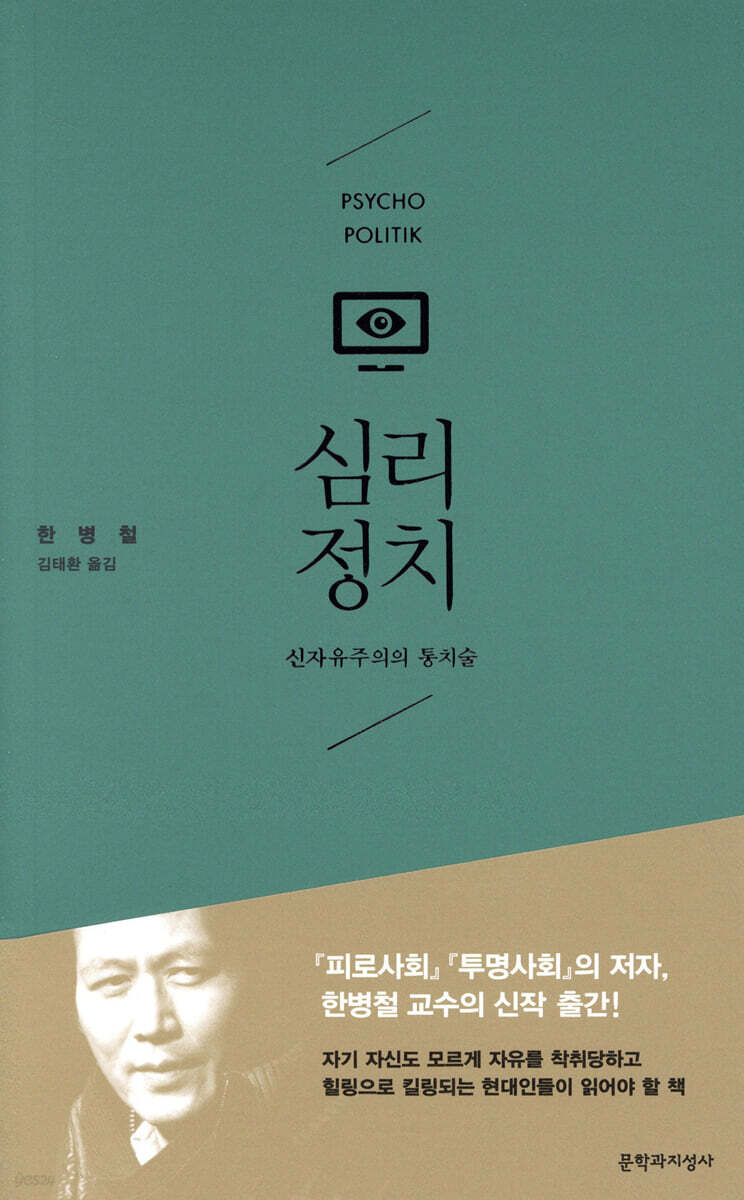
Professor Han Byeong-cheol, author of 『Fatigued Society』, which garnered significant attention and became a bestseller upon its publication and sparked a "?? Society" craze, has published his new book, 『Psychopolitics』 (translated by Kim Tae-hwan).
This book is his fifth to be introduced in Korea.
In his previous work, "The Fatigued Society," he critically observed the exhaustion of modern people under the command of a performance-based society that goes beyond "must do" to "can do," and in "Transparent Society," he pointed out that "transparency," once considered a positive value, is actually leading to a control society where everyone monitors everyone else. In this book, as an extension of those discussions, he delves deeper into the question of how neoliberalism dominates us.
A covert and sophisticated neoliberal art of governance that creates and exploits the desire to "want to" rather than "can", thereby voluntarily exploiting ourselves.
Han Byung-chul calls this ‘psychopolitics.’
Are our desires and will truly our own? Are we truly free? Neoliberal psychopolitics is a "smart power" that seeks to win favor and satisfy desires.
It reads and analyzes our conscious and unconscious thoughts, manipulates human free will to its own advantage, and makes us dependent on capital.
In this age of psychopolitics, domination is achieved automatically, and instead of social resistance, the number of depressed patients is increased.
In this way, Han Byung-chul diagnoses the problems of our times that we are usually unaware of and poses questions that shake up our thinking structures.
The motto of this book, put forward by Han Byeong-cheol, is as follows.
“Save me from what I want.”
★ Special supplement commemorating the publication of Psychopolitics: "Meeting Han Byung-chul, a fierce critic of the times"
The special supplement, "Meeting Han Byung-chul, a Fierce Critic of the Times," produced exclusively for the first edition of "Psychopolitics," provides an opportunity to delve deeper into Han Byung-chul's world of thought.
The interview in this booklet was conducted with the German newspaper Zeit in the summer of 2014, shortly after the publication of Psychopolitics in Germany.
The film explores a range of topics, including howl videos, which vividly portray consumption for consumption's sake, the relationship between sleek smartphones and politics, art, and the impossibility of love.
You can also get a glimpse into the author's life and worldview, including how he came to study philosophy and how he lives his daily life.
In this interview, Han Byung-chul is described as “a person who can tear down the houses of thought that support our daily lives with just a few sentences.”
Han Byung-chul's fifth essay delves into the era of psychopolitics, where the mind itself is held hostage by capital.
Professor Han Byeong-cheol, author of 『Fatigued Society』, which garnered significant attention and became a bestseller upon its publication and sparked a "?? Society" craze, has published his new book, 『Psychopolitics』 (translated by Kim Tae-hwan).
This book is his fifth to be introduced in Korea.
In his previous work, "The Fatigued Society," he critically observed the exhaustion of modern people under the command of a performance-based society that goes beyond "must do" to "can do," and in "Transparent Society," he pointed out that "transparency," once considered a positive value, is actually leading to a control society where everyone monitors everyone else. In this book, as an extension of those discussions, he delves deeper into the question of how neoliberalism dominates us.
A covert and sophisticated neoliberal art of governance that creates and exploits the desire to "want to" rather than "can", thereby voluntarily exploiting ourselves.
Han Byung-chul calls this ‘psychopolitics.’
Are our desires and will truly our own? Are we truly free? Neoliberal psychopolitics is a "smart power" that seeks to win favor and satisfy desires.
It reads and analyzes our conscious and unconscious thoughts, manipulates human free will to its own advantage, and makes us dependent on capital.
In this age of psychopolitics, domination is achieved automatically, and instead of social resistance, the number of depressed patients is increased.
In this way, Han Byung-chul diagnoses the problems of our times that we are usually unaware of and poses questions that shake up our thinking structures.
The motto of this book, put forward by Han Byeong-cheol, is as follows.
“Save me from what I want.”
★ Special supplement commemorating the publication of Psychopolitics: "Meeting Han Byung-chul, a fierce critic of the times"
The special supplement, "Meeting Han Byung-chul, a Fierce Critic of the Times," produced exclusively for the first edition of "Psychopolitics," provides an opportunity to delve deeper into Han Byung-chul's world of thought.
The interview in this booklet was conducted with the German newspaper Zeit in the summer of 2014, shortly after the publication of Psychopolitics in Germany.
The film explores a range of topics, including howl videos, which vividly portray consumption for consumption's sake, the relationship between sleek smartphones and politics, art, and the impossibility of love.
You can also get a glimpse into the author's life and worldview, including how he came to study philosophy and how he lives his daily life.
In this interview, Han Byung-chul is described as “a person who can tear down the houses of thought that support our daily lives with just a few sentences.”
- You can preview some of the book's contents.
Preview
index
Crisis of Freedom
Smart Power
Mole and Snake
biopolitics
Foucault's Dilemma
Healing or Killing
shock
Kind Big Brother
emotional capitalism
Gamification
Big data
Beyond the subject
idiot
Americas
Translator's Note
Smart Power
Mole and Snake
biopolitics
Foucault's Dilemma
Healing or Killing
shock
Kind Big Brother
emotional capitalism
Gamification
Big data
Beyond the subject
idiot
Americas
Translator's Note
Into the book
Today we no longer work for our own needs, but for capital.
We mistake the inherent needs of capital, which are generated by capital, for our own needs.
Capital is a new form of transcendence, a new form of subordination.
We are banished again from the immanence of life, from the dimension in which life remains solely as life itself, not subordinated to any external purpose.
(The Crisis of Freedom, pp. 17-18)
Neoliberalism turns citizens into consumers.
Civil liberty is replaced by consumer passivity.
Today's consumer-turned-voter has no real interest in politics.
In other words, there is no will to actively form a community.
He has neither the will nor the ability to take collective political action.
He just passively reacts to politics, mumbling and complaining.
He is just like a consumer who complains about a product or service he doesn't like.
(The Crisis of Freedom, pp. 22-23)
The power technique of inducing people to voluntarily enter into a relationship of domination is far more effective.
Instead of blocking and suppressing, it seeks to activate and stimulate people and make them the best they can be.
The effectiveness of such power techniques comes from their operation through favor and satisfaction, not through prohibition and deprivation.
The goal of neoliberal power technologies is not to make people docile, but to make them dependent.
(Smart Power, p. 29)
Psychopolitics becomes the ruling form of this system.
It “constantly spreads unavoidable competition,” which in turn triggers “a beneficial competitive spirit and a motivation for excellent performance.”
Motivation, projects, competition, optimization, and spontaneity are all part of the psychopolitical governance of the neoliberal system.
(The Mole and the Snake, p. 34)
Instead of being forced to confess through torture and threats, we confess voluntarily.
Smartphones replace torture chambers.
Big Brother now approaches with a friendly expression.
Big Brother's kindness makes surveillance incredibly effective.
Bentham's Big Brother is invisible, but omnipresent in the minds of the prisoners.
They internalize Big Brother.
In contrast, in the digital panopticon, no one feels watched or threatened.
Therefore, the term “surveillance state” is inappropriate to refer to the digital panopticon.
We feel free in it.
But it is precisely this feeling, this feeling of freedom that is completely absent from Orwell's surveillance state, that is the serious problem.
("Kind Big Brother," pp. 58-59)
Neoliberal economics promotes the emotionalization of the production process by increasingly dismantling continuity and introducing variable elements in order to increase productivity.
[… … ] Today, we ultimately consume feelings, not things.
Things cannot be consumed infinitely, but feelings can be consumed in abundance.
The feeling develops within the realm of use value.
This opens up a new world of consumption infinitely.
(Emotional Capitalism, pp. 68-69)
Nowadays, social communication is also being gamified based on reward logic, as revealed in “likes,” “friends,” and “followers.”
The gamification of communication is the flip side of the commercialization of communication.
But it leads to the destruction of human communication.
[… … ] The left not only exalted labor as the essence of humanity, but also mythologized it as the opposing principle of capital.
For the left, what is ugly is not labor itself, but the exploitation of labor by capital.
So, the platform of all workers' parties only advocates the liberation of labor, but does not talk about liberation from labor.
But labor and capital are two sides of the same coin.
(Gamification, pp. 72-73)
The subject of today is not only his own manager, his own exploiter, but also his own watchdog.
The subject who exploits himself carries around a labor camp with him, and in it he becomes both the perpetrator and the victim.
The subject who illuminates and monitors himself carries a panopticon around with him, acting as both a watcher and a prisoner within it.
The subject on the digitized web is his own panopticon.
Now the task of surveillance falls to the individual.
(Big Data, pp. 86-87)
Neoliberal psychopolitics is a governing technique that stably sustains the ruling system through psychological programming and control.
Therefore, the art of living, which can be called the practice of freedom, cannot help but pursue depsychology.
The art of living disarms the psychopolitics that are the medium of subjugation.
The subject is depsychologized and emptied.
This creates freedom for forms of life that do not yet have a name.
(Beyond the Subject, p. 110)
Fools are modern heretics.
Heresy originally meant choice.
In other words, a heretic is someone who has free choice.
He has the courage to break away from orthodoxy.
He bravely shakes off the pressure to conform.
The fool as a heretic is a figure of resistance against the violence of consent.
He preserves the magic of the Outsider.
In today's world, where the pressure to conform is ever-increasing, the need to forge a day of heretical consciousness is more urgent than ever.
(The Idiot, p. 114)
We mistake the inherent needs of capital, which are generated by capital, for our own needs.
Capital is a new form of transcendence, a new form of subordination.
We are banished again from the immanence of life, from the dimension in which life remains solely as life itself, not subordinated to any external purpose.
(The Crisis of Freedom, pp. 17-18)
Neoliberalism turns citizens into consumers.
Civil liberty is replaced by consumer passivity.
Today's consumer-turned-voter has no real interest in politics.
In other words, there is no will to actively form a community.
He has neither the will nor the ability to take collective political action.
He just passively reacts to politics, mumbling and complaining.
He is just like a consumer who complains about a product or service he doesn't like.
(The Crisis of Freedom, pp. 22-23)
The power technique of inducing people to voluntarily enter into a relationship of domination is far more effective.
Instead of blocking and suppressing, it seeks to activate and stimulate people and make them the best they can be.
The effectiveness of such power techniques comes from their operation through favor and satisfaction, not through prohibition and deprivation.
The goal of neoliberal power technologies is not to make people docile, but to make them dependent.
(Smart Power, p. 29)
Psychopolitics becomes the ruling form of this system.
It “constantly spreads unavoidable competition,” which in turn triggers “a beneficial competitive spirit and a motivation for excellent performance.”
Motivation, projects, competition, optimization, and spontaneity are all part of the psychopolitical governance of the neoliberal system.
(The Mole and the Snake, p. 34)
Instead of being forced to confess through torture and threats, we confess voluntarily.
Smartphones replace torture chambers.
Big Brother now approaches with a friendly expression.
Big Brother's kindness makes surveillance incredibly effective.
Bentham's Big Brother is invisible, but omnipresent in the minds of the prisoners.
They internalize Big Brother.
In contrast, in the digital panopticon, no one feels watched or threatened.
Therefore, the term “surveillance state” is inappropriate to refer to the digital panopticon.
We feel free in it.
But it is precisely this feeling, this feeling of freedom that is completely absent from Orwell's surveillance state, that is the serious problem.
("Kind Big Brother," pp. 58-59)
Neoliberal economics promotes the emotionalization of the production process by increasingly dismantling continuity and introducing variable elements in order to increase productivity.
[… … ] Today, we ultimately consume feelings, not things.
Things cannot be consumed infinitely, but feelings can be consumed in abundance.
The feeling develops within the realm of use value.
This opens up a new world of consumption infinitely.
(Emotional Capitalism, pp. 68-69)
Nowadays, social communication is also being gamified based on reward logic, as revealed in “likes,” “friends,” and “followers.”
The gamification of communication is the flip side of the commercialization of communication.
But it leads to the destruction of human communication.
[… … ] The left not only exalted labor as the essence of humanity, but also mythologized it as the opposing principle of capital.
For the left, what is ugly is not labor itself, but the exploitation of labor by capital.
So, the platform of all workers' parties only advocates the liberation of labor, but does not talk about liberation from labor.
But labor and capital are two sides of the same coin.
(Gamification, pp. 72-73)
The subject of today is not only his own manager, his own exploiter, but also his own watchdog.
The subject who exploits himself carries around a labor camp with him, and in it he becomes both the perpetrator and the victim.
The subject who illuminates and monitors himself carries a panopticon around with him, acting as both a watcher and a prisoner within it.
The subject on the digitized web is his own panopticon.
Now the task of surveillance falls to the individual.
(Big Data, pp. 86-87)
Neoliberal psychopolitics is a governing technique that stably sustains the ruling system through psychological programming and control.
Therefore, the art of living, which can be called the practice of freedom, cannot help but pursue depsychology.
The art of living disarms the psychopolitics that are the medium of subjugation.
The subject is depsychologized and emptied.
This creates freedom for forms of life that do not yet have a name.
(Beyond the Subject, p. 110)
Fools are modern heretics.
Heresy originally meant choice.
In other words, a heretic is someone who has free choice.
He has the courage to break away from orthodoxy.
He bravely shakes off the pressure to conform.
The fool as a heretic is a figure of resistance against the violence of consent.
He preserves the magic of the Outsider.
In today's world, where the pressure to conform is ever-increasing, the need to forge a day of heretical consciousness is more urgent than ever.
(The Idiot, p. 114)
--- From the text
Publisher's Review
It showed subversive ideas such as ‘fatigue society’ and ‘transparent society’.
A new work by Professor Han Byung-chul, a keen observer of our time!
The mind itself is held hostage by capital
Han Byung-chul's fifth essay delves into the era of psychopolitics.
Professor Han Byeong-cheol, author of 『Fatigued Society』, which garnered significant attention and became a bestseller upon its publication and sparked a "?? Society" craze, has published his new book, 『Psychopolitics』 (translated by Kim Tae-hwan).
This book is his fifth to be introduced in Korea.
In his previous work, "The Fatigued Society," he critically observed the exhaustion of modern people under the command of a performance-based society that goes beyond "must do" to "can do," and in "Transparent Society," he pointed out that "transparency," once considered a positive value, is actually leading to a control society where everyone monitors everyone else. In this book, as an extension of those discussions, he delves deeper into the question of how neoliberalism dominates us.
A covert and sophisticated neoliberal art of governance that creates and exploits the desire to "want to" rather than "can", thereby voluntarily exploiting ourselves.
Han Byung-chul calls this ‘psychopolitics.’
Are our desires and will truly our own? Are we truly free? Neoliberal psychopolitics is a "smart power" that seeks to win favor and satisfy desires.
It reads and analyzes our conscious and unconscious thoughts, manipulates human free will to its own advantage, and makes us dependent on capital.
In this age of psychopolitics, domination is achieved automatically, and instead of social resistance, the depressed are mass-produced.
In this way, Han Byung-chul diagnoses the problems of our times that we are usually unaware of and poses questions that shake up our thinking structures.
The motto of this book, put forward by Han Byeong-cheol, is as follows.
“Save me from what I want.”
The Birth of 'Like-Capitalism': A Tempting Appearance
― A sharp critique of the system that has taken away individuals' ability to act voluntarily!
Professor Han Byung-chul's (Berlin University of the Arts) books, with their keen observations, original thinking, and concise, elegant writing style, have been introduced in over 15 countries, including the United States, Italy, France, Turkey, and Greece, and have recently gained exceptional popularity in places like Spain.
In particular, in 『Psychopolitics』, he unfolds a clear-eyed thought that goes beyond the discussion in 『Fatigue Society』 and 『Transparent Society』.
We are entering an era of digital psychopolitics.
The public is now allowed and encouraged to do what they want, see what they want, wear what they want, and consume what they want.
We 'feel free.' But according to Han Byung-chul, that freedom is merely one of the exploitable freedoms provided by capital, commercialized freedoms, and 'ready-made options' created by capital.
More achievements promise more money, and more money promises more freedom.
We serve capital again by working hard to raise that money.
It is sacrificing freedom for freedom's sake.
Now we are not truly free, but rather enslaved to the freedom we enjoy.
Meanwhile, Han Byung-chul shows how effectively neoliberalism utilizes the 'psychology of freedom' and suggests that we use words such as emotion, mood, and excitement with strict distinction.
The 'psychology' of individuals exploited by the neoliberal system is not a continuous and objective 'emotion', but a temporary and subjective 'mood' and 'excitement'.
When the level of production exceeds a certain level, the scope of exploitation through rationality reaches its limit, so now the feeling of freedom and excitement of being able to 'do as I please' deeply intervenes in the personality, increasing the stimulus that impels purchase and creating more desires.
In other words, we don't consume things, we consume feelings.
In this book, Han Byung-chul also analyzes Apple's 1984 Macintosh advertisement.
In this ad, Apple contrasts the lack of freedom evoked by George Orwell's 1984 with the freedom that Apple's 1984 would bring.
However, Han Byung-chul reads this advertisement as a declaration that the total control system of Big Brother described by George Orwell has been replaced by a new paradigm of control system, a digital control system adorned with freedom, the 'digital panopticon'.
“In the digital panopticon, people aren’t being tortured, they’re tweeting and posting.
Transparency and information replace truth.
Psychopolitical manipulation is the new concept of power.” As people consume and communicate, as they click the “like” button, they insert themselves deeper into the system.
Neoliberalism is a new system, 'like-capitalism', fundamentally different from existing capitalism.
If we cannot escape the swamp of competition, self-optimization, motivation, and self-exploitation, our lives may ultimately end up in 'killing.'
Han Byung-chul's book will serve as a small spark on our journey to change the way we live and regain our freedom.
Big data, the most effective tool for psychological politics
It proclaims the end of humanity, the end of free will.
There is growing anticipation and enthusiasm that big data will open up a new world.
However, Han Byung-chul warns that big data is 'capital's most effective psychopolitical tool.'
Information collected through big data serves as knowledge for control, making it possible to penetrate and influence individuals' subconscious.
“Big data can completely cripple the mind.”
Han Byung-chul asserts that “humanities driven purely by the power of data are no longer humanities.”
Data and figures are nothing but empty, absolute ignorance that carries no narrative.
Big data makes it possible to predict human behavior, thereby making humans themselves quantifiable, measurable, and controllable.
A thing that is not free and more transparent than a human being.
Big data heralds the end of humanity, the end of free will.
It also warns of the new digital class society that big data will bring about through the case of the American big data company 'Axiom'.
Axiom rates humans on a scale from 'shooting star' to 'waste.'
The 'trash' class, with low economic value, is excluded and denied credit.
This establishes a new panopticon, or, as Bauman puts it, a 'banopticon' that stigmatizes and excludes those who are hostile to or outside the system.
Freedom is being exploited without one's knowledge,
A must-read for modern people who are dying for healing.
How can we truly make freedom, free time, our own? Can we achieve a form of freedom entirely different from capital's "ready-made options"? Han Byung-chul argues that in an age of psychopolitics, where our very minds are held hostage by capital and subject to exploitation, we must empty our inner selves and attain a state of ignorance.
An 'idiot' or 'fool' is someone who is not caught up in the network, someone who is uninformed, or a heretic.
Fools don't 'communicate'.
He does not get entangled in the net of freedom and temptation created by capital, but rather crosses it without any hesitation.
Through foolishness, a free space of silence, stillness, and solitude is created, a space where what is truly worth saying can be said.
To confront the circumstances that so subtly control us, we need the skills of an idiot.
Only this can create a new language, a new way of thinking, and open the way to a truly free life.
Building on Han Byung-chul's reflections, which make us aware of the subordination of freedom in capitalist society, we can gain the strength to pause and consider other possibilities before we rush headlong into the temptations of capital.
★ Special supplement commemorating the publication of Psychopolitics: "Meeting Han Byung-chul, a fierce critic of the times"
The special supplement, "Meeting Han Byung-chul, a Fierce Critic of the Times," produced exclusively for the first edition of "Psychopolitics," provides an opportunity to delve deeper into Han Byung-chul's world of thought.
The interview in this booklet was conducted with the German newspaper Zeit in the summer of 2014, shortly after the publication of Psychopolitics in Germany.
The film explores a range of topics, including howl videos, which vividly portray consumption for consumption's sake, the relationship between sleek smartphones and politics, art, and the impossibility of love.
You can also get a glimpse into the author's life and worldview, including how he came to study philosophy and how he lives his daily life.
In this interview, Han Byung-chul is described as “a person who can tear down the houses of thought that support our daily lives with just a few sentences.”
A new work by Professor Han Byung-chul, a keen observer of our time!
The mind itself is held hostage by capital
Han Byung-chul's fifth essay delves into the era of psychopolitics.
Professor Han Byeong-cheol, author of 『Fatigued Society』, which garnered significant attention and became a bestseller upon its publication and sparked a "?? Society" craze, has published his new book, 『Psychopolitics』 (translated by Kim Tae-hwan).
This book is his fifth to be introduced in Korea.
In his previous work, "The Fatigued Society," he critically observed the exhaustion of modern people under the command of a performance-based society that goes beyond "must do" to "can do," and in "Transparent Society," he pointed out that "transparency," once considered a positive value, is actually leading to a control society where everyone monitors everyone else. In this book, as an extension of those discussions, he delves deeper into the question of how neoliberalism dominates us.
A covert and sophisticated neoliberal art of governance that creates and exploits the desire to "want to" rather than "can", thereby voluntarily exploiting ourselves.
Han Byung-chul calls this ‘psychopolitics.’
Are our desires and will truly our own? Are we truly free? Neoliberal psychopolitics is a "smart power" that seeks to win favor and satisfy desires.
It reads and analyzes our conscious and unconscious thoughts, manipulates human free will to its own advantage, and makes us dependent on capital.
In this age of psychopolitics, domination is achieved automatically, and instead of social resistance, the depressed are mass-produced.
In this way, Han Byung-chul diagnoses the problems of our times that we are usually unaware of and poses questions that shake up our thinking structures.
The motto of this book, put forward by Han Byeong-cheol, is as follows.
“Save me from what I want.”
The Birth of 'Like-Capitalism': A Tempting Appearance
― A sharp critique of the system that has taken away individuals' ability to act voluntarily!
Professor Han Byung-chul's (Berlin University of the Arts) books, with their keen observations, original thinking, and concise, elegant writing style, have been introduced in over 15 countries, including the United States, Italy, France, Turkey, and Greece, and have recently gained exceptional popularity in places like Spain.
In particular, in 『Psychopolitics』, he unfolds a clear-eyed thought that goes beyond the discussion in 『Fatigue Society』 and 『Transparent Society』.
We are entering an era of digital psychopolitics.
The public is now allowed and encouraged to do what they want, see what they want, wear what they want, and consume what they want.
We 'feel free.' But according to Han Byung-chul, that freedom is merely one of the exploitable freedoms provided by capital, commercialized freedoms, and 'ready-made options' created by capital.
More achievements promise more money, and more money promises more freedom.
We serve capital again by working hard to raise that money.
It is sacrificing freedom for freedom's sake.
Now we are not truly free, but rather enslaved to the freedom we enjoy.
Meanwhile, Han Byung-chul shows how effectively neoliberalism utilizes the 'psychology of freedom' and suggests that we use words such as emotion, mood, and excitement with strict distinction.
The 'psychology' of individuals exploited by the neoliberal system is not a continuous and objective 'emotion', but a temporary and subjective 'mood' and 'excitement'.
When the level of production exceeds a certain level, the scope of exploitation through rationality reaches its limit, so now the feeling of freedom and excitement of being able to 'do as I please' deeply intervenes in the personality, increasing the stimulus that impels purchase and creating more desires.
In other words, we don't consume things, we consume feelings.
In this book, Han Byung-chul also analyzes Apple's 1984 Macintosh advertisement.
In this ad, Apple contrasts the lack of freedom evoked by George Orwell's 1984 with the freedom that Apple's 1984 would bring.
However, Han Byung-chul reads this advertisement as a declaration that the total control system of Big Brother described by George Orwell has been replaced by a new paradigm of control system, a digital control system adorned with freedom, the 'digital panopticon'.
“In the digital panopticon, people aren’t being tortured, they’re tweeting and posting.
Transparency and information replace truth.
Psychopolitical manipulation is the new concept of power.” As people consume and communicate, as they click the “like” button, they insert themselves deeper into the system.
Neoliberalism is a new system, 'like-capitalism', fundamentally different from existing capitalism.
If we cannot escape the swamp of competition, self-optimization, motivation, and self-exploitation, our lives may ultimately end up in 'killing.'
Han Byung-chul's book will serve as a small spark on our journey to change the way we live and regain our freedom.
Big data, the most effective tool for psychological politics
It proclaims the end of humanity, the end of free will.
There is growing anticipation and enthusiasm that big data will open up a new world.
However, Han Byung-chul warns that big data is 'capital's most effective psychopolitical tool.'
Information collected through big data serves as knowledge for control, making it possible to penetrate and influence individuals' subconscious.
“Big data can completely cripple the mind.”
Han Byung-chul asserts that “humanities driven purely by the power of data are no longer humanities.”
Data and figures are nothing but empty, absolute ignorance that carries no narrative.
Big data makes it possible to predict human behavior, thereby making humans themselves quantifiable, measurable, and controllable.
A thing that is not free and more transparent than a human being.
Big data heralds the end of humanity, the end of free will.
It also warns of the new digital class society that big data will bring about through the case of the American big data company 'Axiom'.
Axiom rates humans on a scale from 'shooting star' to 'waste.'
The 'trash' class, with low economic value, is excluded and denied credit.
This establishes a new panopticon, or, as Bauman puts it, a 'banopticon' that stigmatizes and excludes those who are hostile to or outside the system.
Freedom is being exploited without one's knowledge,
A must-read for modern people who are dying for healing.
How can we truly make freedom, free time, our own? Can we achieve a form of freedom entirely different from capital's "ready-made options"? Han Byung-chul argues that in an age of psychopolitics, where our very minds are held hostage by capital and subject to exploitation, we must empty our inner selves and attain a state of ignorance.
An 'idiot' or 'fool' is someone who is not caught up in the network, someone who is uninformed, or a heretic.
Fools don't 'communicate'.
He does not get entangled in the net of freedom and temptation created by capital, but rather crosses it without any hesitation.
Through foolishness, a free space of silence, stillness, and solitude is created, a space where what is truly worth saying can be said.
To confront the circumstances that so subtly control us, we need the skills of an idiot.
Only this can create a new language, a new way of thinking, and open the way to a truly free life.
Building on Han Byung-chul's reflections, which make us aware of the subordination of freedom in capitalist society, we can gain the strength to pause and consider other possibilities before we rush headlong into the temptations of capital.
★ Special supplement commemorating the publication of Psychopolitics: "Meeting Han Byung-chul, a fierce critic of the times"
The special supplement, "Meeting Han Byung-chul, a Fierce Critic of the Times," produced exclusively for the first edition of "Psychopolitics," provides an opportunity to delve deeper into Han Byung-chul's world of thought.
The interview in this booklet was conducted with the German newspaper Zeit in the summer of 2014, shortly after the publication of Psychopolitics in Germany.
The film explores a range of topics, including howl videos, which vividly portray consumption for consumption's sake, the relationship between sleek smartphones and politics, art, and the impossibility of love.
You can also get a glimpse into the author's life and worldview, including how he came to study philosophy and how he lives his daily life.
In this interview, Han Byung-chul is described as “a person who can tear down the houses of thought that support our daily lives with just a few sentences.”
GOODS SPECIFICS
- Date of issue: March 2, 2015
- Page count, weight, size: 146 pages | 178g | 125*200*10mm
- ISBN13: 9788932027227
- ISBN10: 8932027226
You may also like
카테고리
korean


korean

![GQ KOREA Mark (Monthly): December [2025]](http://librairie.coreenne.fr/cdn/shop/files/8ef265dbbfbf186523ed75ba7319009d.jpg?v=1765340328&width=3840)


