

Gorillas hate cell phones
 |
Description
Book Introduction
Why did gorillas hate cell phones?
The Earth Love Project by reporter Park Kyung-hwa, an environmental expert at Green Korea United!
The African Congo is a major producer of tantalum, which has properties that allow it to withstand high temperatures.
As tantalum became a key component of cell phones and its price soared twentyfold, people dreaming of making a fortune flocked to tantalum mines.
This resulted in significant damage to the Kahuzi-Biega National Park, where the mine is located, and the destruction of gorilla habitat within the park.
Ultimately, the world's rarest gorillas are now in danger of extinction because of cell phones.
The disappearance of a wild animal species doesn't end with adding a page to the extinction map.
It is said that the loss of the important role that this organism played in nature destroyed the balance and order of the ecosystem, and that humans who live with nature also suffered considerable damage.
This book is a popular textbook on environmental protection that has been republished in a revised edition.
This is an interesting explanation of what can be done to protect the global environment, written by reporter Park Kyung-hwa, an environmental expert at Green Korea United.
It tells us about the reality that the Earth, our precious home, is being gradually destroyed due to modern people's consumer lifestyles, and what can be done about it.
It provides an easy-to-understand explanation, using specific examples, of how objects closely related to human life, such as cell phones, washing machines, refrigerators, wooden chopsticks, and toilet paper, are fatally destroying the Earth.
It also shows how easy and enjoyable it is to solve these problems.
The Earth Love Project by reporter Park Kyung-hwa, an environmental expert at Green Korea United!
The African Congo is a major producer of tantalum, which has properties that allow it to withstand high temperatures.
As tantalum became a key component of cell phones and its price soared twentyfold, people dreaming of making a fortune flocked to tantalum mines.
This resulted in significant damage to the Kahuzi-Biega National Park, where the mine is located, and the destruction of gorilla habitat within the park.
Ultimately, the world's rarest gorillas are now in danger of extinction because of cell phones.
The disappearance of a wild animal species doesn't end with adding a page to the extinction map.
It is said that the loss of the important role that this organism played in nature destroyed the balance and order of the ecosystem, and that humans who live with nature also suffered considerable damage.
This book is a popular textbook on environmental protection that has been republished in a revised edition.
This is an interesting explanation of what can be done to protect the global environment, written by reporter Park Kyung-hwa, an environmental expert at Green Korea United.
It tells us about the reality that the Earth, our precious home, is being gradually destroyed due to modern people's consumer lifestyles, and what can be done about it.
It provides an easy-to-understand explanation, using specific examples, of how objects closely related to human life, such as cell phones, washing machines, refrigerators, wooden chopsticks, and toilet paper, are fatally destroying the Earth.
It also shows how easy and enjoyable it is to solve these problems.
- You can preview some of the book's contents.
Preview
index
Recommendation_ A life of joyfully enduring discomfort
Prologue_ 2106, A Letter from the Future
Part 1: Thoughts on Life
African gorillas hate cell phones
Don't interrupt the love affair of the mountain birds.
Polar bears are panting because they're hot?
The beautiful and special voyage of the gray whale
The eyes of living things are beautiful
Part 2: Thoughts on Our Neighbors
The Earth is always thirsty
Tears and sighs hidden in a T-shirt
Protect the Earth from being enveloped in plastic bags
Truth or Dare Game on a Sheet of Paper
How to Save the World with 10,000 Won
Part 3: Thoughts on Nature
If you want peace, wear underwear.
Disposable wooden chopsticks and yellow dust
Let's love rags and handkerchiefs
What happens when you turn the switch on?
Becoming Friends with Secondhand Goods
Part 4: Thoughts on Living
Problems at our dinner table
The city nights are so dazzling
Don't trust your refrigerator
Why I Don't Have a Washing Machine Yet
Let's cultivate a garden, the lifeblood of the city.
Appendix_ Environmental information is available here.
Prologue_ 2106, A Letter from the Future
Part 1: Thoughts on Life
African gorillas hate cell phones
Don't interrupt the love affair of the mountain birds.
Polar bears are panting because they're hot?
The beautiful and special voyage of the gray whale
The eyes of living things are beautiful
Part 2: Thoughts on Our Neighbors
The Earth is always thirsty
Tears and sighs hidden in a T-shirt
Protect the Earth from being enveloped in plastic bags
Truth or Dare Game on a Sheet of Paper
How to Save the World with 10,000 Won
Part 3: Thoughts on Nature
If you want peace, wear underwear.
Disposable wooden chopsticks and yellow dust
Let's love rags and handkerchiefs
What happens when you turn the switch on?
Becoming Friends with Secondhand Goods
Part 4: Thoughts on Living
Problems at our dinner table
The city nights are so dazzling
Don't trust your refrigerator
Why I Don't Have a Washing Machine Yet
Let's cultivate a garden, the lifeblood of the city.
Appendix_ Environmental information is available here.
Into the book
Cell phones have become a necessity of life. These small electronic devices that fit perfectly in the palm of your hand contain a sad story unfolding on the dark continent.
Congo, located in central Africa, is a country rich in mineral resources and produces a lot of coltan.
Coltan was treated as little more than gray sand, cheaper than tin.
But since a few years ago, it has been treated as precious as gold or diamonds.
Tantalum, a metal powder produced by refining coltan, has the property of withstanding high temperatures.
As tantalum began to be widely used as a raw material for cell phones, laptops, jet engines, and optical fibers, coltan became a rare commodity.
As demand for tantalum surged in the global high-tech device market, the price of coltan soared from 25,000 won per kg to 500,000 won in just a few months.
Unfortunately, Congo is currently in the midst of a civil war.
Government Hutu and anti-government Tutsi soldiers are pointing guns at each other.
The rebels are financing their war by selling coltan on the black market in Uganda and Rwanda.
The Congo civil war is not easily ending and has been going on for a long time because the war funding is abundant thanks to the expensive coltan.
In the 1990s, as many as 5 million people were killed in the civil war.
The only equipment given to workers in coltan mines is a shovel.
There is no other equipment to prevent accidents.
In 2001, a tunnel collapse killed more than 100 workers.
However, farmers who have witnessed the price of coltan soaring dozens of times are abandoning their land and flocking to the mines.
But no matter how hard they work, all they get is a pittance in wages.
Because powerful middlemen are pocketing the huge profits.
Coltan is not only exploiting miners, it is also destroying Kahuzi-Biega National Park, a World Heritage Site in eastern Congo.
Miners peel the bark off the coltan tree, cut a groove in the trunk, and use it to extract coltan from the mud.
The park's once spectacular forests, surrounded by two dormant volcanoes, were devastated by the work.
Kahuzi-Biega National Park is also the last remaining gorilla habitat on Earth.
Around 1996, there were about 280 gorillas living here.
But when news spread that the national park contained a huge deposit of coltan, tens of thousands of people flocked to the area.
They began to hunt wild animals in the mountains indiscriminately to find food.
Of the 350 elephants that once numbered 350, only two remained in 2000.
The number of gorillas living at altitudes of 2,000 to 2,500 meters has gradually decreased, and the few remaining gorillas have been forced to run away from humans.
Middlemen and multinational corporations, obsessed with making money, pay no attention to how Congolese miners are treated, how national parks are being destroyed, or how gorillas are dying.
It is said that the 'Cell Phone Finder Call Center (www.handphone.or.kr)' receives an average of 6,500 new cell phones per month.
It is said that the number of people who have lost their expensive cell phones and have not gone to look for them because they think, "Oh, good, I'll replace it with a new model now." has already exceeded 36,000.
People who visit say it's simply because their friends' phone numbers are saved.
While we're ogling the latest cell phone because of its color, camera and MP3 capabilities, gorillas in Congo, Africa, are losing their habitat and becoming extinct.
The innocent indigenous people are endangered for their lives by the endless civil war.
The fact that we cherish our cell phones for a long time is not limited to saving on communication costs and conserving materials.
It is a sacred task to protect precious lives on the other side of the Earth.
Furthermore, it is also a great task to bring an end to the war that is causing meaningless deaths as soon as possible and bring true peace to the world.
Congo, located in central Africa, is a country rich in mineral resources and produces a lot of coltan.
Coltan was treated as little more than gray sand, cheaper than tin.
But since a few years ago, it has been treated as precious as gold or diamonds.
Tantalum, a metal powder produced by refining coltan, has the property of withstanding high temperatures.
As tantalum began to be widely used as a raw material for cell phones, laptops, jet engines, and optical fibers, coltan became a rare commodity.
As demand for tantalum surged in the global high-tech device market, the price of coltan soared from 25,000 won per kg to 500,000 won in just a few months.
Unfortunately, Congo is currently in the midst of a civil war.
Government Hutu and anti-government Tutsi soldiers are pointing guns at each other.
The rebels are financing their war by selling coltan on the black market in Uganda and Rwanda.
The Congo civil war is not easily ending and has been going on for a long time because the war funding is abundant thanks to the expensive coltan.
In the 1990s, as many as 5 million people were killed in the civil war.
The only equipment given to workers in coltan mines is a shovel.
There is no other equipment to prevent accidents.
In 2001, a tunnel collapse killed more than 100 workers.
However, farmers who have witnessed the price of coltan soaring dozens of times are abandoning their land and flocking to the mines.
But no matter how hard they work, all they get is a pittance in wages.
Because powerful middlemen are pocketing the huge profits.
Coltan is not only exploiting miners, it is also destroying Kahuzi-Biega National Park, a World Heritage Site in eastern Congo.
Miners peel the bark off the coltan tree, cut a groove in the trunk, and use it to extract coltan from the mud.
The park's once spectacular forests, surrounded by two dormant volcanoes, were devastated by the work.
Kahuzi-Biega National Park is also the last remaining gorilla habitat on Earth.
Around 1996, there were about 280 gorillas living here.
But when news spread that the national park contained a huge deposit of coltan, tens of thousands of people flocked to the area.
They began to hunt wild animals in the mountains indiscriminately to find food.
Of the 350 elephants that once numbered 350, only two remained in 2000.
The number of gorillas living at altitudes of 2,000 to 2,500 meters has gradually decreased, and the few remaining gorillas have been forced to run away from humans.
Middlemen and multinational corporations, obsessed with making money, pay no attention to how Congolese miners are treated, how national parks are being destroyed, or how gorillas are dying.
It is said that the 'Cell Phone Finder Call Center (www.handphone.or.kr)' receives an average of 6,500 new cell phones per month.
It is said that the number of people who have lost their expensive cell phones and have not gone to look for them because they think, "Oh, good, I'll replace it with a new model now." has already exceeded 36,000.
People who visit say it's simply because their friends' phone numbers are saved.
While we're ogling the latest cell phone because of its color, camera and MP3 capabilities, gorillas in Congo, Africa, are losing their habitat and becoming extinct.
The innocent indigenous people are endangered for their lives by the endless civil war.
The fact that we cherish our cell phones for a long time is not limited to saving on communication costs and conserving materials.
It is a sacred task to protect precious lives on the other side of the Earth.
Furthermore, it is also a great task to bring an end to the war that is causing meaningless deaths as soon as possible and bring true peace to the world.
--- From the text
Publisher's Review
A book that has been recommended by authoritative organizations for five years since its publication!
A must-read for all Koreans as abnormal temperatures and environmental disasters continue!
Included in middle school ethics and Korean language textbooks!
A steady seller in the environmental field since its publication in 2006!
“Modern people’s consumer lifestyle has a huge impact on the Earth’s environment and future.
Items closely related to our lives, such as cell phones, washing machines, refrigerators, wooden chopsticks, and toilet paper, are fatally destroying the Earth.
The devastating natural disasters that occur around the world every year are all a result of this damage.
If environmental destruction continues at the current rate, the Earth will soon become a planet uninhabitable by any life form.
This book explains in an accessible and engaging way how everyday items are harming the Earth's environment and future, and how to address them.
2006 Korea Publication Ethics Commission Recommended Books for Youth
2006 Korea Publication Culture Promotion Foundation Youth Book of the Year
2006 Hanuri Reading Movement Headquarters Youth Selection Book
2006 Book Recommendations for Teachers Creating a Warm World through Books
2006 Ministry of Environment Designated Excellent Environmental Book
Books from the 2010 Busan Metropolitan Office of Education Youth Reading Ability Contest
2010 One City, One Book Selections for Bucheon and Bonghwa
2011 One City One Book Selection: Gimhae's Book
Why do gorillas hate cell phones?
The African Congo is a major producer of tantalum, which has properties that allow it to withstand high temperatures.
As tantalum became a key component of cell phones and its price soared twentyfold, people dreaming of making a fortune flocked to tantalum mines.
This resulted in significant damage to the Kahuzi-Biega National Park, where the mine is located, and the destruction of gorilla habitat within the park.
Ultimately, the world's rarest gorillas are now in danger of extinction because of cell phones.
The disappearance of a wild animal species doesn't end with adding a page to the extinction map.
As the important role that organism played in nature disappears, the balance and order of the ecosystem are destroyed, and humans who live together with nature also suffer considerable damage.
In our country, approximately 6,500 cell phones are piled up in lost and found centers every month.
Because of our tendency to chase new features and designs, we change our phones frequently and have a hard time finding them when we lose them.
If we use our cell phones with a little care, we can protect the natural ecosystem and keep our lives safe.
The cause of yellow dust is disposable wooden chopsticks!
Most disposable wooden chopsticks used in our country are made in China.
Forests are disappearing in China as countless trees are cut down to make these disposable chopsticks.
Because we don't restore lost forests, an area six times the size of Seoul is turning into desert every year.
On windy days, the sand from this desert blows across the continent and the Yellow Sea to our country.
This is yellow dust.
The yellow dust that came across the continent is mixed with heavy metals from Chinese cities suffering from industrialization, making the already polluted air on the Korean Peninsula even worse.
Yellow dust, an uninvited guest in spring, causes respiratory diseases such as asthma and aggravates atopic dermatitis, leading to the closure of elementary schools.
The dust and turbid air that accompanies yellow dust also cause disruptions in aviation and telecommunications services.
In this way, yellow dust causes serious damage to humans.
To prevent yellow dust, which causes enormous harm to our health and daily lives, we must first reduce the use of disposable wooden chopsticks.
Eco-friendly living makes the Earth beautiful
The Earth is something we are borrowing from our descendants for a short time.
We have a duty to leave our descendants a better Earth than the one we inherited.
No, at least it shouldn't make it worse.
However, damage to nature and destruction of the environment for small conveniences and profits still occur in many places.
If environmental destruction continues at the current rate, trees will soon disappear from the Earth and paper will no longer be available.
In addition, various types of pollution, including light, air, and noise, will become more severe, leading to the worst results that cannot even be imagined.
This terrible world is the future of our planet that we are creating.
It is everyone's wish to live a healthy life, breathing clean air in a beautiful and clean environment.
It is not that difficult to achieve this wish.
You can start by doing something very small right now.
"Gorillas Hate Cell Phones" explains environmental problems occurring around us in an easy-to-understand way with specific examples.
It also kindly guides us through how simple things we can do to solve these environmental problems, and how joyful it is to preserve this precious Earth and pass it on to future generations.
Through this book, we will learn how to easily practice an eco-friendly lifestyle in our daily lives.
That small action is the first step towards keeping our beautiful Earth cleaner.
Upgraded revised edition
Due to the nature of the book, which contains a wealth of environmental statistics and information, the content has been revised to bring it up to date with changes from five years ago.
Also, 'What Happens When You Turn On the Switch' deals heavily with nuclear power generation due to the Fukushima nuclear accident in March 2011, and 'The Joy of Making Things with My Own Hands', which begins with an episode where the short author tailors his clothes to fit him, is a new addition.
'Polar bears are panting because they're hot?' and 'The beautiful and special voyage of the gray whale' are narrated by a polar bear and a gray whale, respectively, and tell stories about the destruction of their habitat due to environmental pollution, making reading even more interesting.
Secondly, considering that this book will be used as a topic for discussions and essays by middle and high school students, it includes questions directly selected by essay experts to 'nurture thinking'.
This corner aims to broaden students' thinking by asking questions that summarize each topic at the end of each section, encouraging them to research materials to expand their knowledge in related fields, and encouraging them to logically write down their thoughts on what stance to take when personal or group interests conflict with environmental issues.
So, it can be used directly in educational settings such as school classes.
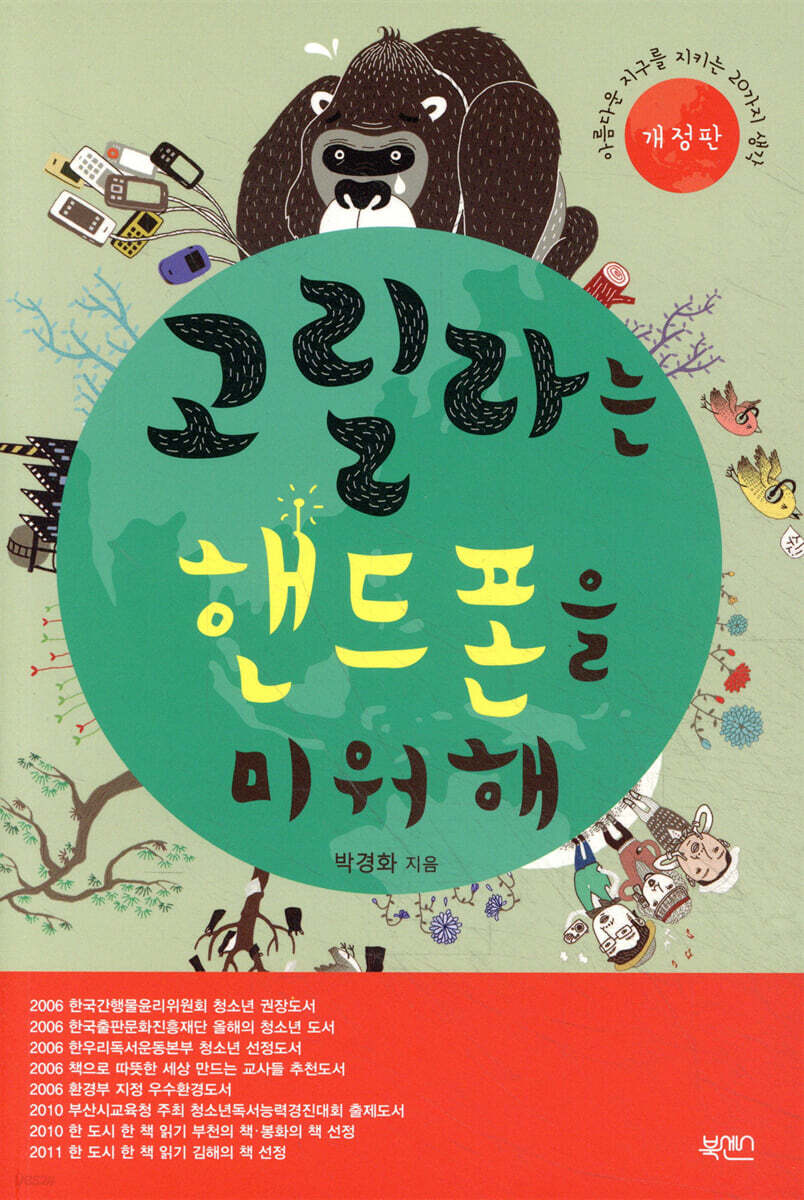
Finally, the cover has been redesigned to feature a picture of the people and animals appearing in the book coexisting in various forms around the Earth, and new illustrations that stimulate the imagination in connection with the 20 texts have also been included.
The book was printed on recycled paper (Green Light 80g) in line with the purpose of the book being published to protect the beauty of the Earth.
Author Interview
Q.
What prompted you to publish your first book?
A.
People have two thoughts about environmental issues.
There was a fear that if things continued this way, the Earth would soon be destroyed, and another was indifference, thinking that it was only a problem for people who were particularly interested in environmental issues, such as residents of the affected areas or environmental activists, and had nothing to do with me.
Environmental issues are always close to us, from the three meals we eat, the water we drink, the clothes we wear, and even the homes we live in.
Also, skin diseases such as atopy and acne, and hair loss, which many people worry about, are closely related to the environment.
Because we need clean water and air, healthy food, and a clean living space to be happy.
Through this book, I wanted to convey environmental issues in a friendly and easy-to-understand way through stories from our daily lives.
Q.
What has changed since the book was published?
A.
There is a prejudice that environmental books are difficult, so while I was writing, I worried whether anyone would read them.
However, I was surprised and grateful that so many people showed interest after the publication.
In particular, middle and high school students used this book for discussion classes, and essay academies also reported that they held discussions on the topic of the environment, where students logically explained their thoughts.
Recently, the book's contents were included in middle school Korean language and ethics textbooks, and I could feel that there was a lot of interest in the environment.
In cities such as Bucheon, Bonghwa, and Gimhae, the book was selected for the One Book in One City reading campaign and a reading relay campaign was launched.
I once thought environmental action was the responsibility of housewives, but now, I find it most rewarding that people of all ages, from office workers to college students and even teenagers, are realizing that taking action on environmental issues is just as important as being aware of them.
Also, hearing the story of someone who was planning to change to a new phone but ended up using it until it broke, made me realize that books can touch people's hearts.
Q.
I believe that many students and adults have read this book and will continue to do so in the future, to the point that it could be called a must-read for the entire nation.
Why did this book become an 'environmental book that anyone can easily read'?
A.
I often hear that the book's content is easy and tells one's own story, rather than being an introductory book that explains difficult environmental terms or environmental concepts.
It is said that we were able to learn about the connections between how everyday items we use at home, such as cell phones, wooden chopsticks, plastic bags, refrigerators, and washing machines, came into being, and what happens in their countries of origin.
Environmental issues are deeply connected to places like governments and corporations that set policies and operate large-scale factories.
But if you think about it, it's because we, as citizens and consumers, all support policies that cause environmental problems and enjoy using products made from materials that destroy the natural environment.
If we trace the causes of environmental problems occurring on the other side of the globe, we find that they are all connected to me, living on the Korean Peninsula.
I hope that we can all feel confident and certain that environmental issues can be addressed without feeling burdened, and that changes in our behavior can make a difference.
Q.
Why did you publish a revised edition after five years? What were the key changes you focused on in this revision?
A.
Environmental books are books whose lifespan ends when environmental problems are solved.
I am writing this book in the hope that its contents will become widely known, so that many people will become aware of it, and so that environmental problems can be quickly resolved.
Unfortunately, this book is still relevant.
Some topics are becoming increasingly serious.
The revised edition includes information on how environmental issues have progressed and what changes have occurred over the past five years.
Moreover, because environmental issues have no right answers, they are becoming topics for discussion classes where students can develop their own logic.
So, to make it easier to conduct discussions in school classes, I added a question called "Thinking Prompts" with the help of an essay writing expert, and I also revised and supplemented the Environmental Practice Act to fit the latest trends.
Also, we put a lot of effort into drawing new illustrations and revising the book cover and interior design several times.
The content of the environmental book is somewhat depressing and heavy-hearted, but the revised edition feels more refreshing.
Q.
I understand that you are giving lectures on this book.
Who do you mainly give lectures to, and are there any memorable lectures or people you met through lectures?
Most of the people who come to listen to my lectures are middle and high school students, and I also lecture at public libraries, book discussion groups, and housewife groups.
In the past, lecture requests were limited to members of environmental groups or housewives' groups at cooperatives, but lecture requests are becoming increasingly diverse.
At a book signing event held after a lecture at a youth reading camp in Busan, a female student asked if I had any plans to create and run a youth environmental club, and said that if such a club were created, she would join and participate.
Hearing that, I felt like I wanted to be more proactive with the students I met through the book, and I'm still thinking about how to run it.
Also, I remember someone who visited my blog every day to encourage me after giving a lecture at the Paju Library. The middle school librarian who was in charge of the author's lecture event actively promoted me to teachers at other schools, which led to a surge in requests for lectures from schools.
Q.
What would you like to say to the young people who are the main readers of this book?
A.
I hope you don't think of environmental issues as mere news items or common knowledge that appears on exam questions.
Everyone living on Earth must understand the environment and solve its problems to have a future and be happy.
Moreover, environmental problems are not limited to our country; they must be solved by other countries and the entire planet.
If you take an interest in environmental issues, your perspective on the world will naturally broaden.
I hope that young people will become interested in the environment, go on to higher education, and choose careers related to the environment.
If young people are interested in the environment, we can develop more efficient methods and technologies than we have today.
I believe that young people can bring forward the day when we can live without any awareness of environmental issues.
A must-read for all Koreans as abnormal temperatures and environmental disasters continue!
Included in middle school ethics and Korean language textbooks!
A steady seller in the environmental field since its publication in 2006!
“Modern people’s consumer lifestyle has a huge impact on the Earth’s environment and future.
Items closely related to our lives, such as cell phones, washing machines, refrigerators, wooden chopsticks, and toilet paper, are fatally destroying the Earth.
The devastating natural disasters that occur around the world every year are all a result of this damage.
If environmental destruction continues at the current rate, the Earth will soon become a planet uninhabitable by any life form.
This book explains in an accessible and engaging way how everyday items are harming the Earth's environment and future, and how to address them.
2006 Korea Publication Ethics Commission Recommended Books for Youth
2006 Korea Publication Culture Promotion Foundation Youth Book of the Year
2006 Hanuri Reading Movement Headquarters Youth Selection Book
2006 Book Recommendations for Teachers Creating a Warm World through Books
2006 Ministry of Environment Designated Excellent Environmental Book
Books from the 2010 Busan Metropolitan Office of Education Youth Reading Ability Contest
2010 One City, One Book Selections for Bucheon and Bonghwa
2011 One City One Book Selection: Gimhae's Book
Why do gorillas hate cell phones?
The African Congo is a major producer of tantalum, which has properties that allow it to withstand high temperatures.
As tantalum became a key component of cell phones and its price soared twentyfold, people dreaming of making a fortune flocked to tantalum mines.
This resulted in significant damage to the Kahuzi-Biega National Park, where the mine is located, and the destruction of gorilla habitat within the park.
Ultimately, the world's rarest gorillas are now in danger of extinction because of cell phones.
The disappearance of a wild animal species doesn't end with adding a page to the extinction map.
As the important role that organism played in nature disappears, the balance and order of the ecosystem are destroyed, and humans who live together with nature also suffer considerable damage.
In our country, approximately 6,500 cell phones are piled up in lost and found centers every month.
Because of our tendency to chase new features and designs, we change our phones frequently and have a hard time finding them when we lose them.
If we use our cell phones with a little care, we can protect the natural ecosystem and keep our lives safe.
The cause of yellow dust is disposable wooden chopsticks!
Most disposable wooden chopsticks used in our country are made in China.
Forests are disappearing in China as countless trees are cut down to make these disposable chopsticks.
Because we don't restore lost forests, an area six times the size of Seoul is turning into desert every year.
On windy days, the sand from this desert blows across the continent and the Yellow Sea to our country.
This is yellow dust.
The yellow dust that came across the continent is mixed with heavy metals from Chinese cities suffering from industrialization, making the already polluted air on the Korean Peninsula even worse.
Yellow dust, an uninvited guest in spring, causes respiratory diseases such as asthma and aggravates atopic dermatitis, leading to the closure of elementary schools.
The dust and turbid air that accompanies yellow dust also cause disruptions in aviation and telecommunications services.
In this way, yellow dust causes serious damage to humans.
To prevent yellow dust, which causes enormous harm to our health and daily lives, we must first reduce the use of disposable wooden chopsticks.
Eco-friendly living makes the Earth beautiful
The Earth is something we are borrowing from our descendants for a short time.
We have a duty to leave our descendants a better Earth than the one we inherited.
No, at least it shouldn't make it worse.
However, damage to nature and destruction of the environment for small conveniences and profits still occur in many places.
If environmental destruction continues at the current rate, trees will soon disappear from the Earth and paper will no longer be available.
In addition, various types of pollution, including light, air, and noise, will become more severe, leading to the worst results that cannot even be imagined.
This terrible world is the future of our planet that we are creating.
It is everyone's wish to live a healthy life, breathing clean air in a beautiful and clean environment.
It is not that difficult to achieve this wish.
You can start by doing something very small right now.
"Gorillas Hate Cell Phones" explains environmental problems occurring around us in an easy-to-understand way with specific examples.
It also kindly guides us through how simple things we can do to solve these environmental problems, and how joyful it is to preserve this precious Earth and pass it on to future generations.
Through this book, we will learn how to easily practice an eco-friendly lifestyle in our daily lives.
That small action is the first step towards keeping our beautiful Earth cleaner.
Upgraded revised edition
Due to the nature of the book, which contains a wealth of environmental statistics and information, the content has been revised to bring it up to date with changes from five years ago.
Also, 'What Happens When You Turn On the Switch' deals heavily with nuclear power generation due to the Fukushima nuclear accident in March 2011, and 'The Joy of Making Things with My Own Hands', which begins with an episode where the short author tailors his clothes to fit him, is a new addition.
'Polar bears are panting because they're hot?' and 'The beautiful and special voyage of the gray whale' are narrated by a polar bear and a gray whale, respectively, and tell stories about the destruction of their habitat due to environmental pollution, making reading even more interesting.
Secondly, considering that this book will be used as a topic for discussions and essays by middle and high school students, it includes questions directly selected by essay experts to 'nurture thinking'.
This corner aims to broaden students' thinking by asking questions that summarize each topic at the end of each section, encouraging them to research materials to expand their knowledge in related fields, and encouraging them to logically write down their thoughts on what stance to take when personal or group interests conflict with environmental issues.
So, it can be used directly in educational settings such as school classes.
Finally, the cover has been redesigned to feature a picture of the people and animals appearing in the book coexisting in various forms around the Earth, and new illustrations that stimulate the imagination in connection with the 20 texts have also been included.
The book was printed on recycled paper (Green Light 80g) in line with the purpose of the book being published to protect the beauty of the Earth.
Author Interview
Q.
What prompted you to publish your first book?
A.
People have two thoughts about environmental issues.
There was a fear that if things continued this way, the Earth would soon be destroyed, and another was indifference, thinking that it was only a problem for people who were particularly interested in environmental issues, such as residents of the affected areas or environmental activists, and had nothing to do with me.
Environmental issues are always close to us, from the three meals we eat, the water we drink, the clothes we wear, and even the homes we live in.
Also, skin diseases such as atopy and acne, and hair loss, which many people worry about, are closely related to the environment.
Because we need clean water and air, healthy food, and a clean living space to be happy.
Through this book, I wanted to convey environmental issues in a friendly and easy-to-understand way through stories from our daily lives.
Q.
What has changed since the book was published?
A.
There is a prejudice that environmental books are difficult, so while I was writing, I worried whether anyone would read them.
However, I was surprised and grateful that so many people showed interest after the publication.
In particular, middle and high school students used this book for discussion classes, and essay academies also reported that they held discussions on the topic of the environment, where students logically explained their thoughts.
Recently, the book's contents were included in middle school Korean language and ethics textbooks, and I could feel that there was a lot of interest in the environment.
In cities such as Bucheon, Bonghwa, and Gimhae, the book was selected for the One Book in One City reading campaign and a reading relay campaign was launched.
I once thought environmental action was the responsibility of housewives, but now, I find it most rewarding that people of all ages, from office workers to college students and even teenagers, are realizing that taking action on environmental issues is just as important as being aware of them.
Also, hearing the story of someone who was planning to change to a new phone but ended up using it until it broke, made me realize that books can touch people's hearts.
Q.
I believe that many students and adults have read this book and will continue to do so in the future, to the point that it could be called a must-read for the entire nation.
Why did this book become an 'environmental book that anyone can easily read'?
A.
I often hear that the book's content is easy and tells one's own story, rather than being an introductory book that explains difficult environmental terms or environmental concepts.
It is said that we were able to learn about the connections between how everyday items we use at home, such as cell phones, wooden chopsticks, plastic bags, refrigerators, and washing machines, came into being, and what happens in their countries of origin.
Environmental issues are deeply connected to places like governments and corporations that set policies and operate large-scale factories.
But if you think about it, it's because we, as citizens and consumers, all support policies that cause environmental problems and enjoy using products made from materials that destroy the natural environment.
If we trace the causes of environmental problems occurring on the other side of the globe, we find that they are all connected to me, living on the Korean Peninsula.
I hope that we can all feel confident and certain that environmental issues can be addressed without feeling burdened, and that changes in our behavior can make a difference.
Q.
Why did you publish a revised edition after five years? What were the key changes you focused on in this revision?
A.
Environmental books are books whose lifespan ends when environmental problems are solved.
I am writing this book in the hope that its contents will become widely known, so that many people will become aware of it, and so that environmental problems can be quickly resolved.
Unfortunately, this book is still relevant.
Some topics are becoming increasingly serious.
The revised edition includes information on how environmental issues have progressed and what changes have occurred over the past five years.
Moreover, because environmental issues have no right answers, they are becoming topics for discussion classes where students can develop their own logic.
So, to make it easier to conduct discussions in school classes, I added a question called "Thinking Prompts" with the help of an essay writing expert, and I also revised and supplemented the Environmental Practice Act to fit the latest trends.
Also, we put a lot of effort into drawing new illustrations and revising the book cover and interior design several times.
The content of the environmental book is somewhat depressing and heavy-hearted, but the revised edition feels more refreshing.
Q.
I understand that you are giving lectures on this book.
Who do you mainly give lectures to, and are there any memorable lectures or people you met through lectures?
Most of the people who come to listen to my lectures are middle and high school students, and I also lecture at public libraries, book discussion groups, and housewife groups.
In the past, lecture requests were limited to members of environmental groups or housewives' groups at cooperatives, but lecture requests are becoming increasingly diverse.
At a book signing event held after a lecture at a youth reading camp in Busan, a female student asked if I had any plans to create and run a youth environmental club, and said that if such a club were created, she would join and participate.
Hearing that, I felt like I wanted to be more proactive with the students I met through the book, and I'm still thinking about how to run it.
Also, I remember someone who visited my blog every day to encourage me after giving a lecture at the Paju Library. The middle school librarian who was in charge of the author's lecture event actively promoted me to teachers at other schools, which led to a surge in requests for lectures from schools.
Q.
What would you like to say to the young people who are the main readers of this book?
A.
I hope you don't think of environmental issues as mere news items or common knowledge that appears on exam questions.
Everyone living on Earth must understand the environment and solve its problems to have a future and be happy.
Moreover, environmental problems are not limited to our country; they must be solved by other countries and the entire planet.
If you take an interest in environmental issues, your perspective on the world will naturally broaden.
I hope that young people will become interested in the environment, go on to higher education, and choose careers related to the environment.
If young people are interested in the environment, we can develop more efficient methods and technologies than we have today.
I believe that young people can bring forward the day when we can live without any awareness of environmental issues.
GOODS SPECIFICS
- Date of issue: July 15, 2011
- Page count, weight, size: 222 pages | 354g | 148*210*20mm
- ISBN13: 9788993746068
- ISBN10: 8993746060
You may also like
카테고리
korean


korean

![GQ KOREA Mark (Monthly): December [2025]](http://librairie.coreenne.fr/cdn/shop/files/8ef265dbbfbf186523ed75ba7319009d.jpg?v=1765340328&width=3840)


