

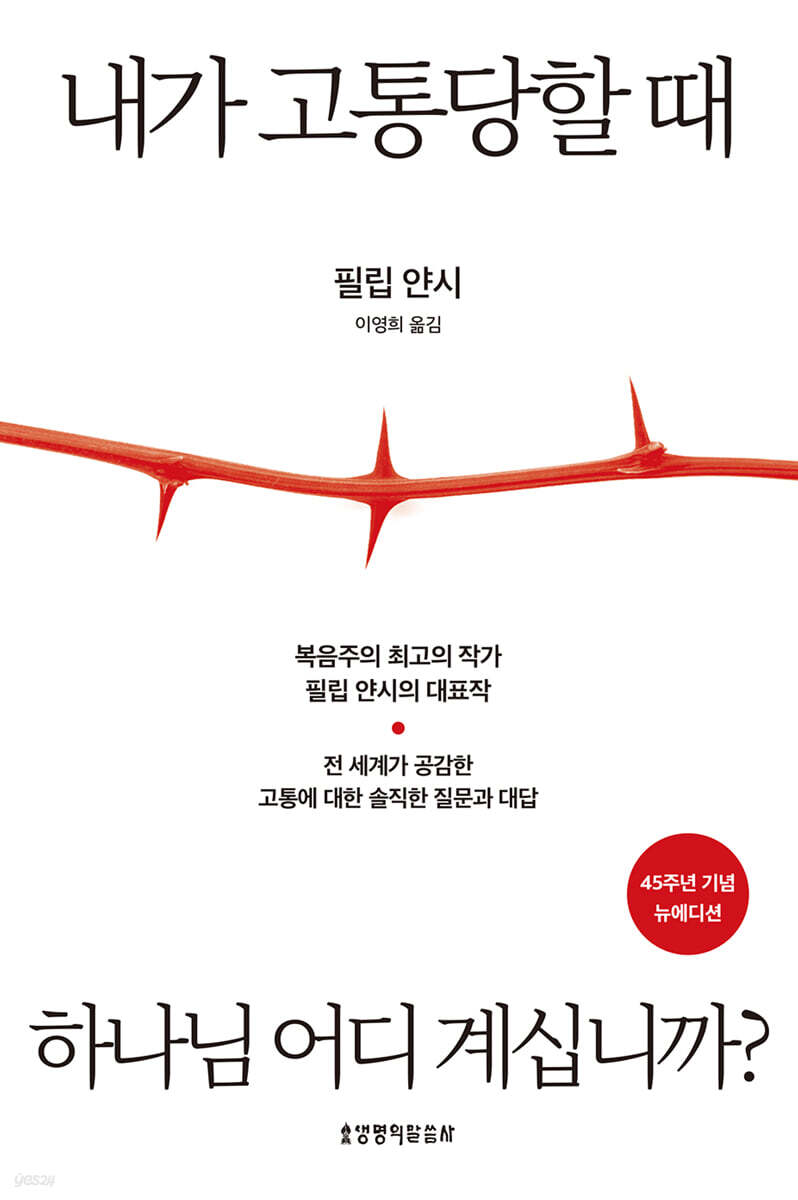
Where Is God When I Suffer? (45th Anniversary New Edition)
 |
Description
Book Introduction
ECPA Platinum Book Award Winner
The masterpiece of Philip Yancey, the greatest evangelical writer
45th Anniversary New Edition Released!
When the pain doesn't end even after praying
The only book you must read
“Why does God allow this to happen to me?”
“When will this suffering end?”
“If God is omnipotent, why doesn’t he solve this problem?
“Does God really love me?
Philip Yancey, whose profound explorations of suffering, faith, doubt, and grace have profoundly influenced millions of readers worldwide, addresses the unexplained pain with his signature deep theological insight, literary sensibility, and, above all, honest questioning.
The masterpiece of Philip Yancey, the greatest evangelical writer
45th Anniversary New Edition Released!
When the pain doesn't end even after praying
The only book you must read
“Why does God allow this to happen to me?”
“When will this suffering end?”
“If God is omnipotent, why doesn’t he solve this problem?
“Does God really love me?
Philip Yancey, whose profound explorations of suffering, faith, doubt, and grace have profoundly influenced millions of readers worldwide, addresses the unexplained pain with his signature deep theological insight, literary sensibility, and, above all, honest questioning.
- You can preview some of the book's contents.
Preview
index
1.
The reason for the pain that is more terrible than pain
Part 1 _ Why does suffering exist?
2.
A gift that is needed but no one wants
3.
People who have a hard time because there is no pain
4.
The Value of Suffering as God's Megaphone
5.
The deepest level of pain and pleasure
6.
A God who seems capricious and unfair
Part 2 _ What do people do when they encounter pain?
7.
Different attitudes toward pain
8.
A firm belief in miracles
9.
A new and wonderful life beyond pain
10.
People who have successfully coped with adversity
Part 3 _ How can we cope with pain?
11.
Fear and helplessness that lead to despair
12.
A special way to eliminate fear and helplessness
13.
Moments of pain where you are never alone
14.
Faith that believes in humans who are full of mistakes to the end
15.
God who never makes mistakes
main
The reason for the pain that is more terrible than pain
Part 1 _ Why does suffering exist?
2.
A gift that is needed but no one wants
3.
People who have a hard time because there is no pain
4.
The Value of Suffering as God's Megaphone
5.
The deepest level of pain and pleasure
6.
A God who seems capricious and unfair
Part 2 _ What do people do when they encounter pain?
7.
Different attitudes toward pain
8.
A firm belief in miracles
9.
A new and wonderful life beyond pain
10.
People who have successfully coped with adversity
Part 3 _ How can we cope with pain?
11.
Fear and helplessness that lead to despair
12.
A special way to eliminate fear and helplessness
13.
Moments of pain where you are never alone
14.
Faith that believes in humans who are full of mistakes to the end
15.
God who never makes mistakes
main
Detailed image

Into the book
In preparing this book, I spoke with people who suffered at a much more severe level than most of us will ever experience.
For some of them, suffering was life itself.
Pain was the first sensation to greet them in the morning, and the last before they drifted off to sleep.
Readers will get to know them in depth in this book.
I also spent time with leprosy patients, who, ironically, because they cannot feel pain physiologically, desperately wish they could.
If I ever get sick, all these words about the pain I'm sharing now might be of no comfort to me.
But as a Christian, I have learned a lot from trying to figure out what God is trying to do in this world.
My anger and bitterness toward God subsided when I realized why He allowed this world to be wounded and bleed.
--- 「1.
From “The Reason for Pain Worse than Pain”
The pain sensory organs function precisely.
They warn us of impending (or present) danger.
Painful sensations cause my body to focus on the problem area and react there.
Sometimes this reaction is almost unconscious.
For example, when you go to the doctor for a checkup and the doctor hits your knee with a rubber mallet, your leg will jerk forward.
Such an automatic reaction occurs because we know that the doctor's stimulation carries some risk.
The doctor's rubber mallet hits the very nerve that would be affected if my knee suddenly buckled while I was walking.
My body reacts quickly to prevent me from falling and causing more pain.
This reaction is so unconscious and fast that it doesn't give the brain time to figure out that there is no real risk of falling.
Christians really don't know how to interpret suffering.
If you push them to the edge and press them at any moment, most of them will probably say, “Suffering is a mistake God made.”
God should have tried harder and invented better ways to deal with the dangers of the world.
I'm sure suffering gets a bad rap.
But we must be able to see the benefit through suffering.
Are you wondering why I think this way? It's because the pain network under the microscope presents a completely different picture.
Our body's pain network is a masterpiece created by a creative genius.
My view on pain begins with looking at the human body.
Why does my body need pain? What does pain tell me when I'm hurt? Before turning our attention to those who suffer, let's begin by examining them closely, as if through a microscope.
--- 「2.
From "A Gift That's Needed But Nobody Wants"
The risk, especially for children, is that they may mistake pain signals for pleasure signals and harm themselves further.
One parent told the following bizarre story about her daughter, who had just grown four teeth and was congenitally insensible:
The mother heard the child giggling and having fun playing in the next room and went over to the child, thinking, 'I guess the child found something new to play with.'
But the child was playing with his finger, drawing with the blood that flowed out.
Because there was no pain, we lost our inherent sense of self-preservation.
How can we explain the dangers of knives and razor blades to children like these? They can undergo surgery without anesthesia and impress their friends with tricks like pricking their fingers with pins.
But their lives become very dangerous.
One woman almost lost her life because she did not notice the warning signs of her illness, a headache, and her illness worsened.
Most of them do not recognize the 'abuse' and thus cause great damage to their bones.
This is because you sprain your wrist without realizing it and continue to use it until it becomes seriously injured.
A sixteen-year-old girl lost all ten fingers due to this carelessness.
Those who are naturally insensitive must learn certain cues and rely on them.
They can feel sensations such as tickling, for example.
However, to produce a reaction, you must consciously focus your attention on the problem area.
Most of us would react immediately, but they need to focus for a long time to know what action to take.
Examples of 'hell without pain' are countless and miserable.
These examples force us all to abandon the common notion that pain is something unpleasant to be avoided at all costs.
In general, suffering does not make life sad.
Above all, suffering protects us so that we can enjoy our proper state on this planet called Earth.
Without suffering, we would live unbalanced and pathological lives, facing unknown dangers without even realizing that we are destroying ourselves.
--- 「3.
Among those who are suffering because there is no pain
Just as a wrong life does not always entail suffering, a good life does not exempt us from cruel suffering.
In fact, the Bible, especially the New Testament, contains few words of comfort and encouragement for Christians who want to live a life of less suffering and peace.
At least in this life, the fate of Christians is decided in a threatening way.
The epistles of James and Peter, as well as the book of Hebrews, all exhort Christians to “prepare to suffer.”
And in the 'Hall of Faith' in Hebrews 11, there are people who were beaten to death, whipped, imprisoned, stoned, and starved to death in the wilderness.
Some Christians, especially those who emphasize God's miraculous healing, are perplexed by these passages of Scripture that contradict their beliefs.
"Why didn't God intervene more in biblical times? Why doesn't God heal all Christians?" These questions reveal a desire to avoid suffering at any cost.
We emphasize our faith by featuring healing gifts in magazines and on television programs.
However, this has some common side effects.
It makes people who are not healed feel abandoned by God.
Faith includes supernatural phenomena, but it also includes daily reliance on trust, no matter what the outcome.
True faith means faith without solid evidence, the evidence of things not seen, the substance of things hoped for (Hebrews 11:1).
God is not just a simple magical force.
Recently, I saw a healing program on TV where viewers phoned in to participate.
A loud applause erupted when one participant said his leg had healed a week before it was scheduled to be amputated.
The audience cheered loudly and the host declared:
“This is the greatest miracle we’ve seen tonight!” At that moment, I couldn’t help but think about how many amputees were watching the program, their hearts heavy with sorrow, wondering where their faith had fallen.
Just because a person is sick doesn't mean he is unfaithful.
Nowhere in the Bible does it claim that Christians should live easier, more enjoyable, or safer lives than non-Christians.
--- 「6.
From “A God Who Seems Capricious and Unfair”
Likewise, as members of the body of Christ, we must learn to care for the suffering of the rest of us.
Just as the world cannot hear the gospel without our efforts, we become whole when we focus our attention and take on our role as agents of healing.
Dr. Paul Brand developed this concept into an important part of his personal philosophy.
Individual cells had to learn to give up individual behavior and share each other's suffering before effective multicellular organs could be produced and survive.
The same Designer created humanity with a new and higher purpose in mind.
Not only do the cells within an individual cooperate with one another, but individuals within a race are now brought into a new level of communal responsibility, into a new relationship with one another and with God.
As within the body, so too within this new relationship, the key to success lies in the sense of pain.
We all enjoy seeing the harmonious workings of the human body.
But when we look at the relationships between humans, we cannot help but feel sad.
Within human society, we suffer because we are not suffering enough.
Much of the suffering in the world is due to the selfishness of peripheral organs that do not care when the organs right next to them suffer.
When a single cell or a group of cells grows and thrives at the expense of the cells next to it, we call it cancer, and we are conscious that if we allow that cancer to spread throughout the body, the body is doomed.
But the only way to avoid cancer is for every cell to be completely loyal to the body, that is, to the head.
God is calling us today to learn from the lower creation, to rise to a higher level, and to participate in this community He is preparing for the salvation of the world.
For some of them, suffering was life itself.
Pain was the first sensation to greet them in the morning, and the last before they drifted off to sleep.
Readers will get to know them in depth in this book.
I also spent time with leprosy patients, who, ironically, because they cannot feel pain physiologically, desperately wish they could.
If I ever get sick, all these words about the pain I'm sharing now might be of no comfort to me.
But as a Christian, I have learned a lot from trying to figure out what God is trying to do in this world.
My anger and bitterness toward God subsided when I realized why He allowed this world to be wounded and bleed.
--- 「1.
From “The Reason for Pain Worse than Pain”
The pain sensory organs function precisely.
They warn us of impending (or present) danger.
Painful sensations cause my body to focus on the problem area and react there.
Sometimes this reaction is almost unconscious.
For example, when you go to the doctor for a checkup and the doctor hits your knee with a rubber mallet, your leg will jerk forward.
Such an automatic reaction occurs because we know that the doctor's stimulation carries some risk.
The doctor's rubber mallet hits the very nerve that would be affected if my knee suddenly buckled while I was walking.
My body reacts quickly to prevent me from falling and causing more pain.
This reaction is so unconscious and fast that it doesn't give the brain time to figure out that there is no real risk of falling.
Christians really don't know how to interpret suffering.
If you push them to the edge and press them at any moment, most of them will probably say, “Suffering is a mistake God made.”
God should have tried harder and invented better ways to deal with the dangers of the world.
I'm sure suffering gets a bad rap.
But we must be able to see the benefit through suffering.
Are you wondering why I think this way? It's because the pain network under the microscope presents a completely different picture.
Our body's pain network is a masterpiece created by a creative genius.
My view on pain begins with looking at the human body.
Why does my body need pain? What does pain tell me when I'm hurt? Before turning our attention to those who suffer, let's begin by examining them closely, as if through a microscope.
--- 「2.
From "A Gift That's Needed But Nobody Wants"
The risk, especially for children, is that they may mistake pain signals for pleasure signals and harm themselves further.
One parent told the following bizarre story about her daughter, who had just grown four teeth and was congenitally insensible:
The mother heard the child giggling and having fun playing in the next room and went over to the child, thinking, 'I guess the child found something new to play with.'
But the child was playing with his finger, drawing with the blood that flowed out.
Because there was no pain, we lost our inherent sense of self-preservation.
How can we explain the dangers of knives and razor blades to children like these? They can undergo surgery without anesthesia and impress their friends with tricks like pricking their fingers with pins.
But their lives become very dangerous.
One woman almost lost her life because she did not notice the warning signs of her illness, a headache, and her illness worsened.
Most of them do not recognize the 'abuse' and thus cause great damage to their bones.
This is because you sprain your wrist without realizing it and continue to use it until it becomes seriously injured.
A sixteen-year-old girl lost all ten fingers due to this carelessness.
Those who are naturally insensitive must learn certain cues and rely on them.
They can feel sensations such as tickling, for example.
However, to produce a reaction, you must consciously focus your attention on the problem area.
Most of us would react immediately, but they need to focus for a long time to know what action to take.
Examples of 'hell without pain' are countless and miserable.
These examples force us all to abandon the common notion that pain is something unpleasant to be avoided at all costs.
In general, suffering does not make life sad.
Above all, suffering protects us so that we can enjoy our proper state on this planet called Earth.
Without suffering, we would live unbalanced and pathological lives, facing unknown dangers without even realizing that we are destroying ourselves.
--- 「3.
Among those who are suffering because there is no pain
Just as a wrong life does not always entail suffering, a good life does not exempt us from cruel suffering.
In fact, the Bible, especially the New Testament, contains few words of comfort and encouragement for Christians who want to live a life of less suffering and peace.
At least in this life, the fate of Christians is decided in a threatening way.
The epistles of James and Peter, as well as the book of Hebrews, all exhort Christians to “prepare to suffer.”
And in the 'Hall of Faith' in Hebrews 11, there are people who were beaten to death, whipped, imprisoned, stoned, and starved to death in the wilderness.
Some Christians, especially those who emphasize God's miraculous healing, are perplexed by these passages of Scripture that contradict their beliefs.
"Why didn't God intervene more in biblical times? Why doesn't God heal all Christians?" These questions reveal a desire to avoid suffering at any cost.
We emphasize our faith by featuring healing gifts in magazines and on television programs.
However, this has some common side effects.
It makes people who are not healed feel abandoned by God.
Faith includes supernatural phenomena, but it also includes daily reliance on trust, no matter what the outcome.
True faith means faith without solid evidence, the evidence of things not seen, the substance of things hoped for (Hebrews 11:1).
God is not just a simple magical force.
Recently, I saw a healing program on TV where viewers phoned in to participate.
A loud applause erupted when one participant said his leg had healed a week before it was scheduled to be amputated.
The audience cheered loudly and the host declared:
“This is the greatest miracle we’ve seen tonight!” At that moment, I couldn’t help but think about how many amputees were watching the program, their hearts heavy with sorrow, wondering where their faith had fallen.
Just because a person is sick doesn't mean he is unfaithful.
Nowhere in the Bible does it claim that Christians should live easier, more enjoyable, or safer lives than non-Christians.
--- 「6.
From “A God Who Seems Capricious and Unfair”
Likewise, as members of the body of Christ, we must learn to care for the suffering of the rest of us.
Just as the world cannot hear the gospel without our efforts, we become whole when we focus our attention and take on our role as agents of healing.
Dr. Paul Brand developed this concept into an important part of his personal philosophy.
Individual cells had to learn to give up individual behavior and share each other's suffering before effective multicellular organs could be produced and survive.
The same Designer created humanity with a new and higher purpose in mind.
Not only do the cells within an individual cooperate with one another, but individuals within a race are now brought into a new level of communal responsibility, into a new relationship with one another and with God.
As within the body, so too within this new relationship, the key to success lies in the sense of pain.
We all enjoy seeing the harmonious workings of the human body.
But when we look at the relationships between humans, we cannot help but feel sad.
Within human society, we suffer because we are not suffering enough.
Much of the suffering in the world is due to the selfishness of peripheral organs that do not care when the organs right next to them suffer.
When a single cell or a group of cells grows and thrives at the expense of the cells next to it, we call it cancer, and we are conscious that if we allow that cancer to spread throughout the body, the body is doomed.
But the only way to avoid cancer is for every cell to be completely loyal to the body, that is, to the head.
God is calling us today to learn from the lower creation, to rise to a higher level, and to participate in this community He is preparing for the salvation of the world.
--- 「14.
From “Faith that believes in humans who are full of mistakes to the end”
From “Faith that believes in humans who are full of mistakes to the end”
Publisher's Review
Offering companionship rather than explanation
Leading recovery rather than solutions
A groundbreaking change in perception of pain
A modern classic and a must-read
pain.
Some days it's bearable, some days it's hopeless.
Some days I'm angry, some days I'm helpless.
What do those in pain really need?
Now a classic, this book changed many readers' perceptions of suffering immediately after its publication.
The author, speaking not as a theologian but as a sufferer, embraces our pain more closely than any explanation can.
From physical pain to mental pain… .
Among them, what kind of God's face did Philip Yancey encounter? Recovery begins with companionship, not explanation.
As you read this book, you will discover a God who walks with you through your suffering.
I recommend it!
- A Christian seeking God's will in the midst of unexplained suffering
- A church that wants to help believers who are suffering in pain
- A Christian looking for a book to give as a gift to a friend who is suffering from long-term pain.
- Christians who study the biblical perspective on suffering
Leading recovery rather than solutions
A groundbreaking change in perception of pain
A modern classic and a must-read
pain.
Some days it's bearable, some days it's hopeless.
Some days I'm angry, some days I'm helpless.
What do those in pain really need?
Now a classic, this book changed many readers' perceptions of suffering immediately after its publication.
The author, speaking not as a theologian but as a sufferer, embraces our pain more closely than any explanation can.
From physical pain to mental pain… .
Among them, what kind of God's face did Philip Yancey encounter? Recovery begins with companionship, not explanation.
As you read this book, you will discover a God who walks with you through your suffering.
I recommend it!
- A Christian seeking God's will in the midst of unexplained suffering
- A church that wants to help believers who are suffering in pain
- A Christian looking for a book to give as a gift to a friend who is suffering from long-term pain.
- Christians who study the biblical perspective on suffering
GOODS SPECIFICS
- Date of issue: May 26, 2025
- Page count, weight, size: 248 pages | 342g | 140*210*15mm
- ISBN13: 9788904169191
- ISBN10: 8904169194
You may also like
카테고리
korean


korean

![GQ KOREA Mark (Monthly): December [2025]](http://librairie.coreenne.fr/cdn/shop/files/8ef265dbbfbf186523ed75ba7319009d.jpg?v=1765340328&width=3840)


