

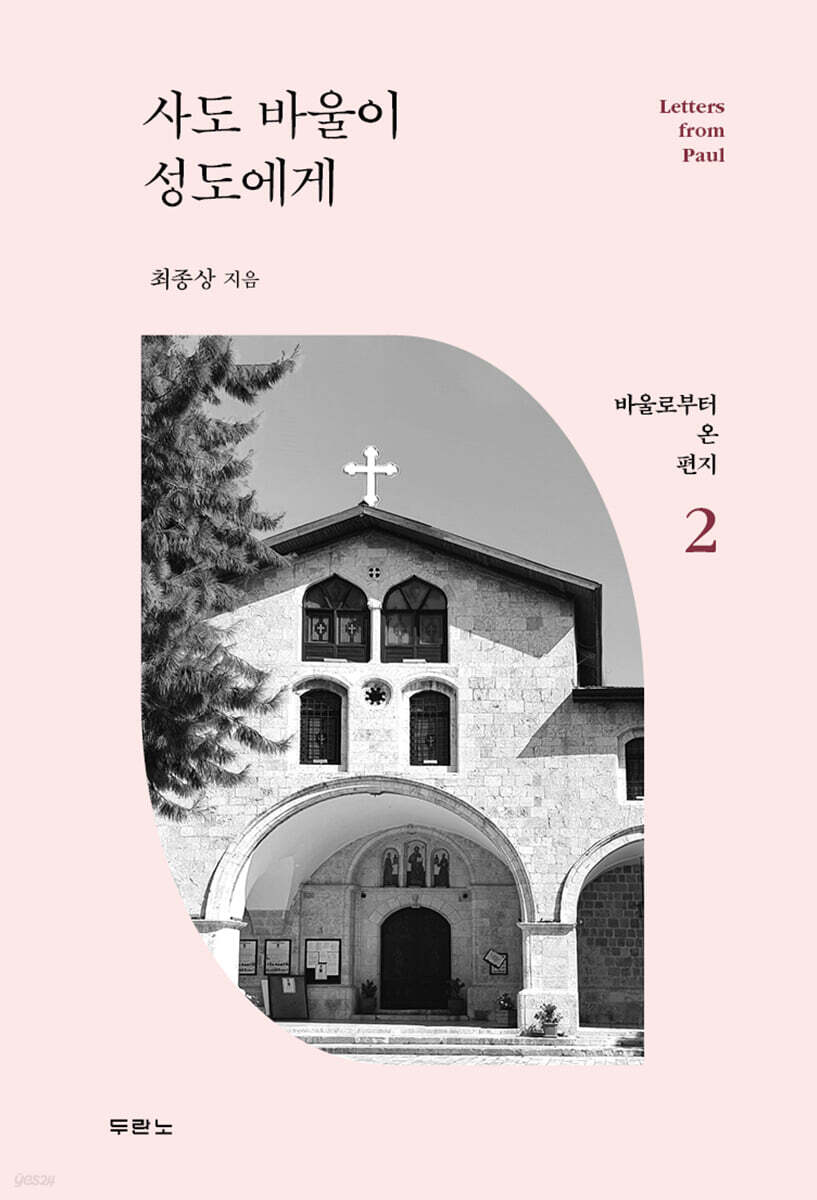
Apostle Paul to the saints
 |
Description
Book Introduction
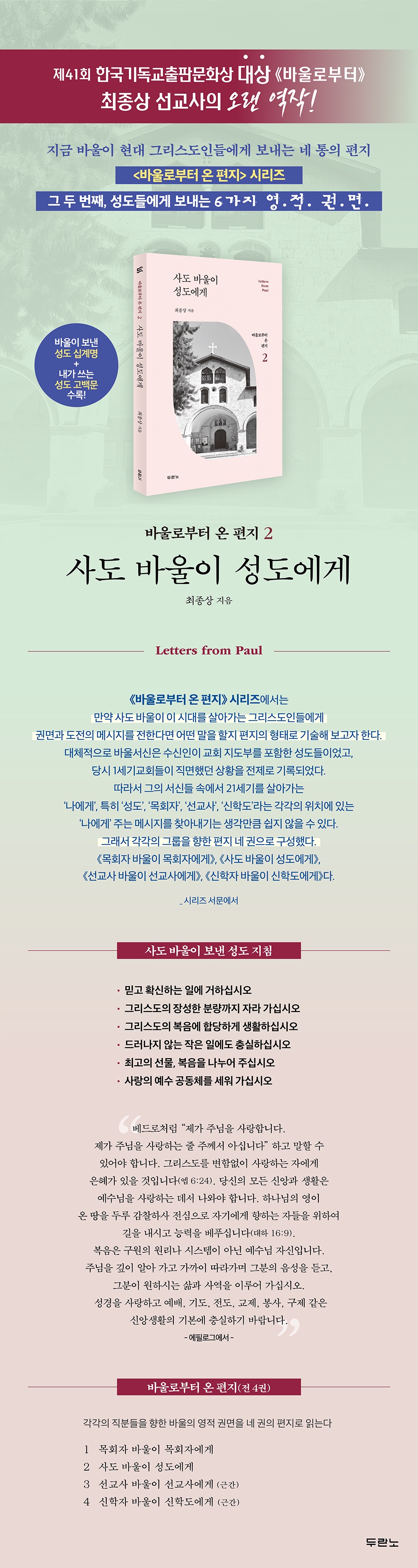
Grand Prize at the 41st Korea Christian Publishing Culture Awards
『From Paul』 Missionary Choi Jong-sang's long-standing masterpiece!
Four letters from Paul to modern Christians
The second, six spiritual exhortations to the saints
This book can be said to be an old masterpiece by missionary Choi Jong-sang, an expert on Paul.
The author, who received a doctorate in Pauline studies, planned to write a series of letters titled “From Paul to Us” that he had been contemplating while publishing the book “From Paul” last year.
Although it was a long-time plan, it was after the publication of “From Paul” that he began writing it, and while working on various projects, he received many questions asking, “What would the Apostle Paul say if he met us now?”
Even at the 41st Korea Christian Publishing Culture Awards ceremony, the author delved deeply into Paul, saying, “The Apostle Paul was a one-man publisher.”
In the sermon for the event, the author explained that after Paul received the mission of evangelism, he clearly learned through Paul's letters how crucial it was to spread the gospel through word and writing, even in times of persecution and crisis.
In this context, rather than highlighting Paul as a single person, the author seeks to highlight the mission of evangelism and Christians in this day and age through the letters and messages Paul left behind.
The author plans to compile the Pauline epistles into four volumes, and this book is the second in a series of stories, following "Pastor Paul to Pastors," and is filled with Paul's warm affection and earnest appeals for the believers living in this age.
In this book, which consists of six exhortations, Paul conveys the advice and exhortations necessary for each church and believers according to their circumstances and situations. These are also essential contents for today's believers to achieve a balance in their lives and faith.
Also, like the previous work, it provides 'meditation and sharing', making it easy to use in small group meetings within the community, and through 'Paul's Ten Commandments for the Saints', it allows you to once again confirm your faith as a saint and write a 'confession of the saints I write'.
Through the story of Paul, a senior in the faith who was a pastor, missionary, and writer, but above all, who first encountered Jesus on the road to Damascus and was reborn as a true Christian, I hope that this book will help us to grasp the true gospel again and receive the abundant grace to live out that gospel in our lives.
『From Paul』 Missionary Choi Jong-sang's long-standing masterpiece!
Four letters from Paul to modern Christians
The second, six spiritual exhortations to the saints
This book can be said to be an old masterpiece by missionary Choi Jong-sang, an expert on Paul.
The author, who received a doctorate in Pauline studies, planned to write a series of letters titled “From Paul to Us” that he had been contemplating while publishing the book “From Paul” last year.
Although it was a long-time plan, it was after the publication of “From Paul” that he began writing it, and while working on various projects, he received many questions asking, “What would the Apostle Paul say if he met us now?”
Even at the 41st Korea Christian Publishing Culture Awards ceremony, the author delved deeply into Paul, saying, “The Apostle Paul was a one-man publisher.”
In the sermon for the event, the author explained that after Paul received the mission of evangelism, he clearly learned through Paul's letters how crucial it was to spread the gospel through word and writing, even in times of persecution and crisis.
In this context, rather than highlighting Paul as a single person, the author seeks to highlight the mission of evangelism and Christians in this day and age through the letters and messages Paul left behind.
The author plans to compile the Pauline epistles into four volumes, and this book is the second in a series of stories, following "Pastor Paul to Pastors," and is filled with Paul's warm affection and earnest appeals for the believers living in this age.
In this book, which consists of six exhortations, Paul conveys the advice and exhortations necessary for each church and believers according to their circumstances and situations. These are also essential contents for today's believers to achieve a balance in their lives and faith.
Also, like the previous work, it provides 'meditation and sharing', making it easy to use in small group meetings within the community, and through 'Paul's Ten Commandments for the Saints', it allows you to once again confirm your faith as a saint and write a 'confession of the saints I write'.
Through the story of Paul, a senior in the faith who was a pastor, missionary, and writer, but above all, who first encountered Jesus on the road to Damascus and was reborn as a true Christian, I hope that this book will help us to grasp the true gospel again and receive the abundant grace to live out that gospel in our lives.
- You can preview some of the book's contents.
Preview
index
| Series Preface |
| Prologue |
1_ Live in what you believe and are confident in.
2_ Grow to the full stature of Christ
3_ Live a life worthy of the gospel of Christ
4_ Be faithful even in small, unseen things.
5_ Share the best gift, the gospel.
6_ Build a community of Jesus' love
| Epilogue |
| Meditation and Sharing |
| The Ten Commandments Sent by Paul to the Saints |
| My Confession of Faith |
| Prologue |
1_ Live in what you believe and are confident in.
2_ Grow to the full stature of Christ
3_ Live a life worthy of the gospel of Christ
4_ Be faithful even in small, unseen things.
5_ Share the best gift, the gospel.
6_ Build a community of Jesus' love
| Epilogue |
| Meditation and Sharing |
| The Ten Commandments Sent by Paul to the Saints |
| My Confession of Faith |
Detailed image
Into the book
You too need to hear the gospel again.
You should meditate on it so that it does not remain in your head but fills your heart.
I hope you can experience again the excitement and first love you felt when you first believed in Jesus.
Here, we rewrite the gospel to share the love of Jesus with those who attend church but lack a strong desire for salvation, those who have a strong desire but do not know what to believe and have not yet personally accepted Jesus, those who do not attend church but desire to know the true essence of Christianity, and even those who are indifferent or opposed to it.
--- p.21
Christians are called to be light, salt, and catalysts, revealing God's image in a world clouded by sin.
Our goal is to be conformed to the image of Jesus (Romans 8:29).
To do this, we must demonstrate by living a life faithful to the gospel.
Imitate and practice the qualities Jesus himself demonstrated and taught: humility, gentleness, mercy, peace, reconciliation, truthfulness, and patience.
I have expressed this as the nine fruits of the Holy Spirit.
“But the fruit of the Spirit is love, joy, peace, patience, kindness, goodness, faithfulness, gentleness and self-control. Against such things there is no law” (Galatians 5:22-23).
If character and personality are transformed, that maturity will be evident to everyone (1 Timothy 4:15).
We must become like God in His holy image and be transformed into good and mature lives.
--- p.45
If you are a believer who believes in Jesus and has the assurance of salvation, you must maintain the faith that led to your rebirth and further develop your faith in God.
At the same time, we must thoroughly recognize that after being saved, our actions are very important, and we must do our best to live as light and salt in our lives, as the fragrance and letter of Christ.
Please live a life of unity between faith and practice.
Faith and works are both equally important.
The Bible emphasizes both, but we often make the mistake of not balancing them and choosing between the two, missing one important thing.
If you have been negligent in your actions until now, I urge you to strive to live a life worthy of the gospel.
--- p.67
Believing in Jesus should be more than just a decision to live as a Christian; it should be a decision to become His disciple out of gratitude for His love and sacrifice.
It means becoming a mature disciple in the world by imitating His personality and character.
We must strive to live a life worthy of His love and the gospel.
We must live a changed life in the areas of outlook on life, love, forgiveness, good deeds, and holiness.
We must live a life of humility, gentleness, mercy, peace, reconciliation, truth, patience, and tolerance, following the character of Jesus.
Children of light must live lives distinct from those of darkness.
This does not reduce the faith in Jesus to a religion of ethics and morality, but rather emphasizes that while faith (信), which is believing in the truth, clearly comes first in the principle of unity between faith and action (信行一致), action (行) must follow.
--- p.94
God wants to use you.
They want to give you a role.
But you use people with a willing spirit.
You are not the kind of person who just walks around the yard or warms up the church pews.
Don't just attend worship services as guests.
There is so much to do in the church and the kingdom of God, in Jesus' name and for His honor.
Even large churches often lack workers.
Make sure to take on at least one responsibility at the church you attend.
This will create a sense of belonging and lead to a more active faith.
Express your willingness to participate in service and volunteer to help and nurture people.
There is much work for you to do in the Lord's name outside of the church.
Pray and seek.
Break free from the consumer-centered religious life that seeks benefits from the church.
Don't be an anonymous religious person, be an active Christian.
--- p.108
Evangelism is the work that pleases God the most.
It is necessary and rewarding to spread the good news of salvation that Jesus accomplished through the cross and resurrection.
It is God's will that everyone who believes in Jesus should have eternal life (John 6:39-40).
Conversely, evangelism is also the thing that Satan hates the most.
The threat the Sanhedrin members made to Peter and John clearly shows how much Satan hates evangelism.
The council may have disliked prayer meetings, worship services, Bible study, and even belief in Jesus, but they did not strongly prohibit them.
They repeatedly threatened their lives and forbade them to speak, preach, or teach in the name of Jesus (Acts 4:17-18; 5:28, 40).
The apostles insisted that they could not stop speaking about what they had seen and heard, and even under threat of death, they did not stop teaching and proclaiming Jesus as the Christ (Acts 4:20, 5:42).
Because evangelism is a spiritual war, it involves suffering.
But do not be afraid to suffer for the gospel (2 Tim. 1:8).
--- p.132~133
Jesus died for all people, desiring that all people would be saved, and He set the condition of salvation through faith so that anyone could be saved.
Even when he was on this earth, he treated people equally.
He truly loved and was close to tax collectors, lepers, sinners, the disabled, and prostitutes, people whom the general public ignored and avoided, and even ate with them.
Even children were considered precious.
God does not judge or favor people based on their appearance (1 Sam. 16:7; Rom. 2:11; Gal. 2:6; Eph. 6:9).
He does not look at external conditions such as status, education, position, looks, or wealth, but rather at the inner qualities such as character, faith, motivation, and sincerity.
We too must look at each other through God's eyes.
--- p.148~149
Within the church community, there are not only those with positions such as apostles, prophets, pastors, elders, and deacons, but also believers who serve with various gifts and roles such as pastoring, preaching, counseling, education, praise, administration, evangelism, prayer, offerings, broadcasting, and various types of service.
Not all saints have the same gifts.
Not everyone can be an apostle, a prophet, a teacher, a worker of miracles, a healer, a speaker in tongues, or an interpreter, and that is natural (1 Corinthians 12:28-30; Romans 12:4-8).
It is wrong to compare each other's gifts and feel superior or inferior.
Those with outstanding talents should humbly use their gifts for the benefit of the Lord and the church, and those without such talents need not necessarily feel inferior.
We should recognize that no one is better or worse than another, but that we are all necessary and valuable members, and we should treat each other as such.
You should meditate on it so that it does not remain in your head but fills your heart.
I hope you can experience again the excitement and first love you felt when you first believed in Jesus.
Here, we rewrite the gospel to share the love of Jesus with those who attend church but lack a strong desire for salvation, those who have a strong desire but do not know what to believe and have not yet personally accepted Jesus, those who do not attend church but desire to know the true essence of Christianity, and even those who are indifferent or opposed to it.
--- p.21
Christians are called to be light, salt, and catalysts, revealing God's image in a world clouded by sin.
Our goal is to be conformed to the image of Jesus (Romans 8:29).
To do this, we must demonstrate by living a life faithful to the gospel.
Imitate and practice the qualities Jesus himself demonstrated and taught: humility, gentleness, mercy, peace, reconciliation, truthfulness, and patience.
I have expressed this as the nine fruits of the Holy Spirit.
“But the fruit of the Spirit is love, joy, peace, patience, kindness, goodness, faithfulness, gentleness and self-control. Against such things there is no law” (Galatians 5:22-23).
If character and personality are transformed, that maturity will be evident to everyone (1 Timothy 4:15).
We must become like God in His holy image and be transformed into good and mature lives.
--- p.45
If you are a believer who believes in Jesus and has the assurance of salvation, you must maintain the faith that led to your rebirth and further develop your faith in God.
At the same time, we must thoroughly recognize that after being saved, our actions are very important, and we must do our best to live as light and salt in our lives, as the fragrance and letter of Christ.
Please live a life of unity between faith and practice.
Faith and works are both equally important.
The Bible emphasizes both, but we often make the mistake of not balancing them and choosing between the two, missing one important thing.
If you have been negligent in your actions until now, I urge you to strive to live a life worthy of the gospel.
--- p.67
Believing in Jesus should be more than just a decision to live as a Christian; it should be a decision to become His disciple out of gratitude for His love and sacrifice.
It means becoming a mature disciple in the world by imitating His personality and character.
We must strive to live a life worthy of His love and the gospel.
We must live a changed life in the areas of outlook on life, love, forgiveness, good deeds, and holiness.
We must live a life of humility, gentleness, mercy, peace, reconciliation, truth, patience, and tolerance, following the character of Jesus.
Children of light must live lives distinct from those of darkness.
This does not reduce the faith in Jesus to a religion of ethics and morality, but rather emphasizes that while faith (信), which is believing in the truth, clearly comes first in the principle of unity between faith and action (信行一致), action (行) must follow.
--- p.94
God wants to use you.
They want to give you a role.
But you use people with a willing spirit.
You are not the kind of person who just walks around the yard or warms up the church pews.
Don't just attend worship services as guests.
There is so much to do in the church and the kingdom of God, in Jesus' name and for His honor.
Even large churches often lack workers.
Make sure to take on at least one responsibility at the church you attend.
This will create a sense of belonging and lead to a more active faith.
Express your willingness to participate in service and volunteer to help and nurture people.
There is much work for you to do in the Lord's name outside of the church.
Pray and seek.
Break free from the consumer-centered religious life that seeks benefits from the church.
Don't be an anonymous religious person, be an active Christian.
--- p.108
Evangelism is the work that pleases God the most.
It is necessary and rewarding to spread the good news of salvation that Jesus accomplished through the cross and resurrection.
It is God's will that everyone who believes in Jesus should have eternal life (John 6:39-40).
Conversely, evangelism is also the thing that Satan hates the most.
The threat the Sanhedrin members made to Peter and John clearly shows how much Satan hates evangelism.
The council may have disliked prayer meetings, worship services, Bible study, and even belief in Jesus, but they did not strongly prohibit them.
They repeatedly threatened their lives and forbade them to speak, preach, or teach in the name of Jesus (Acts 4:17-18; 5:28, 40).
The apostles insisted that they could not stop speaking about what they had seen and heard, and even under threat of death, they did not stop teaching and proclaiming Jesus as the Christ (Acts 4:20, 5:42).
Because evangelism is a spiritual war, it involves suffering.
But do not be afraid to suffer for the gospel (2 Tim. 1:8).
--- p.132~133
Jesus died for all people, desiring that all people would be saved, and He set the condition of salvation through faith so that anyone could be saved.
Even when he was on this earth, he treated people equally.
He truly loved and was close to tax collectors, lepers, sinners, the disabled, and prostitutes, people whom the general public ignored and avoided, and even ate with them.
Even children were considered precious.
God does not judge or favor people based on their appearance (1 Sam. 16:7; Rom. 2:11; Gal. 2:6; Eph. 6:9).
He does not look at external conditions such as status, education, position, looks, or wealth, but rather at the inner qualities such as character, faith, motivation, and sincerity.
We too must look at each other through God's eyes.
--- p.148~149
Within the church community, there are not only those with positions such as apostles, prophets, pastors, elders, and deacons, but also believers who serve with various gifts and roles such as pastoring, preaching, counseling, education, praise, administration, evangelism, prayer, offerings, broadcasting, and various types of service.
Not all saints have the same gifts.
Not everyone can be an apostle, a prophet, a teacher, a worker of miracles, a healer, a speaker in tongues, or an interpreter, and that is natural (1 Corinthians 12:28-30; Romans 12:4-8).
It is wrong to compare each other's gifts and feel superior or inferior.
Those with outstanding talents should humbly use their gifts for the benefit of the Lord and the church, and those without such talents need not necessarily feel inferior.
We should recognize that no one is better or worse than another, but that we are all necessary and valuable members, and we should treat each other as such.
--- p.162~163
Publisher's Review
In the series "Letters from Paul," we will describe in letter form what the Apostle Paul would say if he were to deliver a message of encouragement and challenge to Christians living in this age.
In general, the Pauline letters were addressed to believers, including church leaders, and were written based on the situation faced by the first-century churches.
Therefore, finding messages for "me" living in the 21st century in his letters, especially for "me" in each of the positions of "pastor," "believer," "missionary," and "theologian," may not be as easy as one might think. Therefore, I have organized the letters into four volumes, each addressing a specific role.
『Paul the Pastor to Pastors』, 『Paul the Apostle to Saints』, 『Paul the Missionary to Missionaries』, 『Paul the Theologian to Theology Students』.
In this series, we have collected the messages that the Apostle Paul shared with each ministry.
However, it was nearly impossible to clearly distinguish them by position.
Because the Apostle Paul alone assumed various roles, and because Paul's letters were pastoral, missionary, and theological at the same time, and because these elements were complexly intertwined, some overlap in content and subject matter was inevitable.
However, I wanted to focus on who I am talking to.
Reading all of the Epistles from Paul, as they are interconnected, will provide a comprehensive understanding of Paul's apostolic, pastoral, missionary, and theological teachings.
In general, the Pauline letters were addressed to believers, including church leaders, and were written based on the situation faced by the first-century churches.
Therefore, finding messages for "me" living in the 21st century in his letters, especially for "me" in each of the positions of "pastor," "believer," "missionary," and "theologian," may not be as easy as one might think. Therefore, I have organized the letters into four volumes, each addressing a specific role.
『Paul the Pastor to Pastors』, 『Paul the Apostle to Saints』, 『Paul the Missionary to Missionaries』, 『Paul the Theologian to Theology Students』.
In this series, we have collected the messages that the Apostle Paul shared with each ministry.
However, it was nearly impossible to clearly distinguish them by position.
Because the Apostle Paul alone assumed various roles, and because Paul's letters were pastoral, missionary, and theological at the same time, and because these elements were complexly intertwined, some overlap in content and subject matter was inevitable.
However, I wanted to focus on who I am talking to.
Reading all of the Epistles from Paul, as they are interconnected, will provide a comprehensive understanding of Paul's apostolic, pastoral, missionary, and theological teachings.
GOODS SPECIFICS
- Date of issue: May 21, 2025
- Page count, weight, size: 180 pages | 204g | 128*188*11mm
- ISBN13: 9788953151017
- ISBN10: 8953151015
You may also like
카테고리
korean


korean

![GQ KOREA Mark (Monthly): December [2025]](http://librairie.coreenne.fr/cdn/shop/files/8ef265dbbfbf186523ed75ba7319009d.jpg?v=1765340328&width=3840)


