

We lend you the museum: England
 |
Description
Book Introduction
As K-culture has recently captivated people around the world, awareness of 'museums' is also being renewed in Korea.
Now, the term 'hip place' is no longer awkward.
But once you actually enter the museum, you become lost among the numerous artifacts, not knowing where, what, and how to see them.
The 'Lending the Museum' series was planned with the hope that it would serve as a friendly guide for those who get lost in museums.
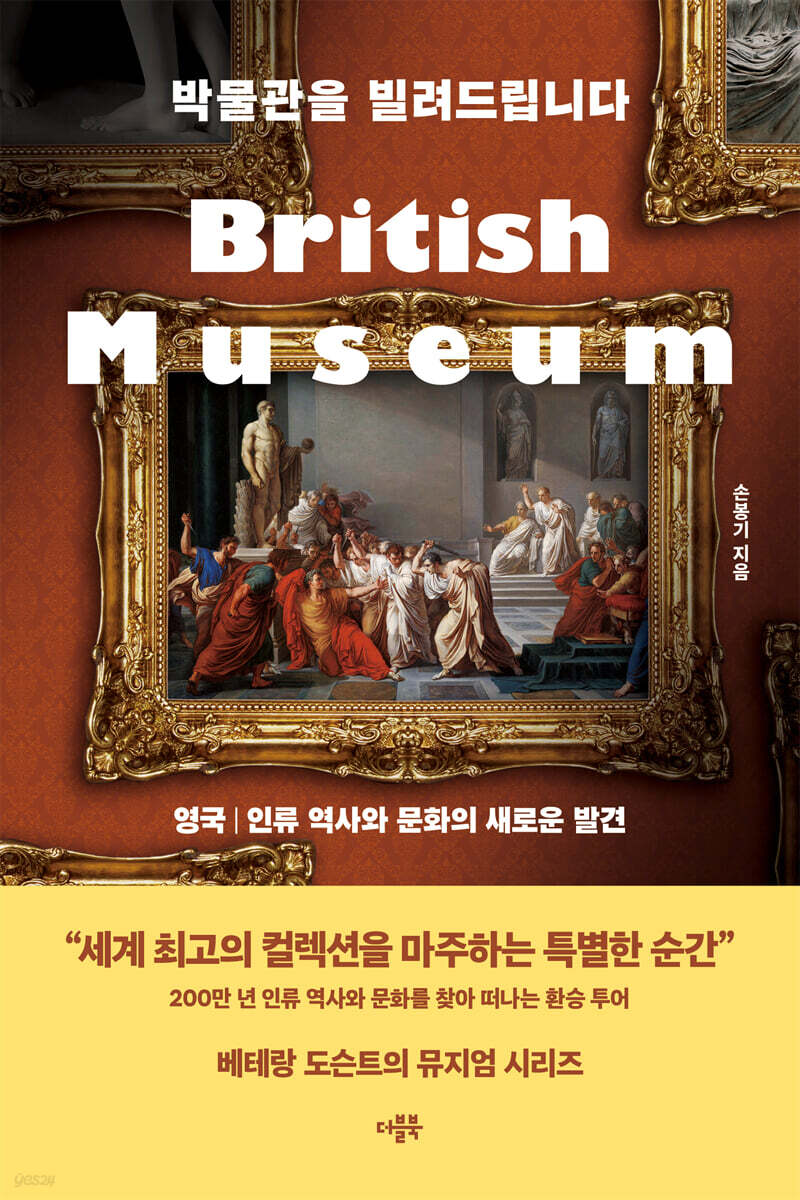
The first book in the series is "Museums for Rent: Britain," which introduces the British Museum and the Victoria and Albert Museum, two of the world's top three museums.
Docent Bong-gi Son, with 26 years of experience, carefully selected around 100 historically significant artifacts with interesting stories from among the 8 million and 2.8 million artifacts held by the two museums, respectively.
Thus, the historical narrative, cultural context, and artistic beauty contained in major relics that should not be missed, such as the Ashurbanipal Library, the world's first clay tablet library; the Rosetta Stone, which unveiled the veil on Egyptian civilization; the Elgin Marbles, the Parthenon that left Greece; the fun and intriguing Lewis Chess Pieces; the Trajan's Triumphal Monument, which is a replica of a replica; and Tipu's Tiger, which contains Sultan Tipu's wrath, are unraveled through detailed descriptions and friendly storytelling.
While reading this book, readers will feel as if they are meeting a docent at the entrance to a museum and moving along with him.
Now, the term 'hip place' is no longer awkward.
But once you actually enter the museum, you become lost among the numerous artifacts, not knowing where, what, and how to see them.
The 'Lending the Museum' series was planned with the hope that it would serve as a friendly guide for those who get lost in museums.
The first book in the series is "Museums for Rent: Britain," which introduces the British Museum and the Victoria and Albert Museum, two of the world's top three museums.
Docent Bong-gi Son, with 26 years of experience, carefully selected around 100 historically significant artifacts with interesting stories from among the 8 million and 2.8 million artifacts held by the two museums, respectively.
Thus, the historical narrative, cultural context, and artistic beauty contained in major relics that should not be missed, such as the Ashurbanipal Library, the world's first clay tablet library; the Rosetta Stone, which unveiled the veil on Egyptian civilization; the Elgin Marbles, the Parthenon that left Greece; the fun and intriguing Lewis Chess Pieces; the Trajan's Triumphal Monument, which is a replica of a replica; and Tipu's Tiger, which contains Sultan Tipu's wrath, are unraveled through detailed descriptions and friendly storytelling.
While reading this book, readers will feel as if they are meeting a docent at the entrance to a museum and moving along with him.
- You can preview some of the book's contents.
Preview
index
introduction
Part 1 The British Museum
British Museum entrance / donor plaque / Great Court
Middle East Exhibition Hall
Eternal Life and Present Happiness / The World's Oldest Artifact / Humanity's First Library / Peace in the midst of a turbulent life /
Human Folly / Persian Openness
Egyptian Exhibition Hall
King of the Underworld and the Earth / Book of the Dead / Carpe Diem / Memento Mori / Horus on the Horizon / Rosetta Stone /
For the mother crossing the river of death / The great king of Egypt / The most beautiful queen / The family that connects this world and the next world /
A fame that started with revenge
Greek Exhibition Hall
Amor Fati / Human-centered civilization / The Parthenon with its golden ratio / The birth of Athena / Procession of gods and humans /
Nereid, the Sea Nymph / Venus of the Lily / Lament for Her Husband
Roman Exhibition Hall
The Most Magnificent / The Crowned One, Bear the Weight / Portland Vase
Other major relics
Medieval Google Maps / Queen with a Toothache / Masterpieces of the Holy Roman Empire / Moai Statues / Two-Headed Serpent /
Thorn Reliquary
Part 2 Victoria and Albert Museum
Entrance and chandelier / Window tracery / Devonshire hunting tapestry / Caste coat / Samson slaying the Philistines /
Ardabil Carpet / Tipu's Tiger / Sculpture Gallery / Raphael's Cartoon Series / Fashion Gallery / Ware's Great Bed /
Hereford Screen / Jewellery Gallery / Painting Gallery / Tapestry Gallery / Central Garden / Ceramic Stairs / Restaurant
Appendix_ Things to see in London
Part 1 The British Museum
British Museum entrance / donor plaque / Great Court
Middle East Exhibition Hall
Eternal Life and Present Happiness / The World's Oldest Artifact / Humanity's First Library / Peace in the midst of a turbulent life /
Human Folly / Persian Openness
Egyptian Exhibition Hall
King of the Underworld and the Earth / Book of the Dead / Carpe Diem / Memento Mori / Horus on the Horizon / Rosetta Stone /
For the mother crossing the river of death / The great king of Egypt / The most beautiful queen / The family that connects this world and the next world /
A fame that started with revenge
Greek Exhibition Hall
Amor Fati / Human-centered civilization / The Parthenon with its golden ratio / The birth of Athena / Procession of gods and humans /
Nereid, the Sea Nymph / Venus of the Lily / Lament for Her Husband
Roman Exhibition Hall
The Most Magnificent / The Crowned One, Bear the Weight / Portland Vase
Other major relics
Medieval Google Maps / Queen with a Toothache / Masterpieces of the Holy Roman Empire / Moai Statues / Two-Headed Serpent /
Thorn Reliquary
Part 2 Victoria and Albert Museum
Entrance and chandelier / Window tracery / Devonshire hunting tapestry / Caste coat / Samson slaying the Philistines /
Ardabil Carpet / Tipu's Tiger / Sculpture Gallery / Raphael's Cartoon Series / Fashion Gallery / Ware's Great Bed /
Hereford Screen / Jewellery Gallery / Painting Gallery / Tapestry Gallery / Central Garden / Ceramic Stairs / Restaurant
Appendix_ Things to see in London
Detailed image

Into the book
If you go to Exhibition Room 10, you can see a relief mural depicting a lion hunting scene.
In the Nineveh Palace Wall Painting, created in 645 BC, King Ashurbanipal is shown hunting a lion that is running towards him.
The lions growl and rush at the king, but are hit by the king's spears and arrows, and fall here and there with blood spurting out and flesh torn.
A closer look at this mural, which excels in its detailed observation and realistic depiction of animals, including their angry eyes, splendid manes, and bulging leg muscles, reveals that the outlines of the objects being emphasized are deeply carved, preserving their vividness as if they were about to spring to life.
--- p.45
The Book of the Dead, a guide for the dead, contains the ancient Egyptian belief and hope that if you live a good life according to your conscience, even if reality is difficult, you can go to a peaceful afterlife.
So, what kind of peaceful afterlife would the Egyptians go to after death? The ancient Egyptians called the afterlife "Sekhet Iar," meaning "field of reeds."
This signifies a paradise rich in water and grain ruled by Osiris, and shows that the afterlife they dream of is not heaven, but the happiest time in this world.
--- p.67
The murals of Nebamun, which show ideal pleasure, are characteristic of ancient Egyptian painting.
In Egyptian painting, when depicting a human figure, the face was drawn in profile, the eyes and chest in front, and the feet in profile.
They believed that the face was most clearly revealed when viewed from the side, the eyes from the front, and the feet from the side.
The reason why the ancient Egyptians painted in a way that best showed the features of the person was so that they could easily find their own bodies after death and resurrection.
They believed that even if the body decayed, the essence and characteristics of the soul remained.
--- p.70
When the Greeks first encountered Egyptian culture, they were involuntarily discouraged.
They felt that their own culture was shabby compared to the splendid Egyptian culture.
So the Greeks disparaged Egyptian culture as an African civilization and gave the name of the Sphinx, a monster from Greek mythology, to the guardian deity in front of the pyramid.
The original name of the guardian deity who guards the pyramids, with the body of a lion symbolizing courage and the face of a king symbolizing wisdom, is 'Horus of the Horizon'.
Horus is the name of a god who symbolizes the pharaoh as the king of the earth in Egyptian mythology.
The relic with this magnificent name was given the name Sphinx, a Greek monster, purely due to the Greek inferiority complex.
--- p.82
The true value of the Ramses statue lies in the fact that it changed Europeans' perspective on human history.
Before the discovery of the Ramses statues, Europeans believed that great Western art and civilization originated in Greece.
But the Ramses statues proved that long-held beliefs and hypotheses of Europeans were wrong.
They learned that the Greek civilization, which they considered great, originated from the Egyptian and Mesopotamian civilizations.
--- p.98~100
The painting on the jar depicts Penthesilea just before she is killed by a spear thrown by the Greek hero Achilles during a duel with him.
Achilles' face is hidden by his helmet, while Penthesilea's helmet is removed and thrown out.
The queen's spear misses Achilles' chest, and Achilles' spear pierces her neck, causing blood to spurt from it.
At that very moment, their eyes met, and Achilles fell instantly in love with the Amazon queen's beauty.
In this work, which expresses a cruel yet fateful love, one can feel the essence of Greek civilization that centers on humans.
The sadness seen in this work contains human emotions that cannot be found in god-centered civilizations such as Egypt and Mesopotamia.
In Egyptian or Mesopotamian civilizations, enemies were merely objects to be killed, and it was unimaginable to depict scenes of loving one's enemies.
--- p.123~124
After a long civil war, the Roman citizens, who had tasted peace and abundance, worshipped him as a god and awarded him the title of 'Augustus', meaning 'the noble one'.
But he was not a god.
Having killed countless people in war and witnessed the deaths of many friends and soldiers, he had to endure everything for his own survival and the survival of the Roman Empire.
Also, remembering the death of his uncle Caesar, he could not trust anyone.
So, when he attended the Senate meeting, he wore armor under his toga and had ten bodyguards protect him.
We can get a glimpse of Octavianus' attitude toward life from the words he left just before his death, after divorcing Livia, the wife of a subordinate general he met at a banquet, and taking her as his wife and spending the rest of his life with her.
Was my acting worth watching?
If you liked the play of my life
Please give us a round of applause.
--- p.165
The Thorn Reliquary passed to the Habsburgs in Vienna in 1544, who were more interested in the gold and jewels surrounding the reliquary than in the thorns themselves.
From then on, the secularization of the reliquary took place.
In 1860, the royal family entrusted the reliquary to an antique dealer for restoration.
However, instead of restoring the reliquary, he made a fake, kept the original for himself, and returned the fake to the Habsburgs.
The original was later purchased in 1898 by the Vienna branch manager of the Rothschild Bank and donated to the British Museum.
--- p.201~203
The English word 'CAST' refers to an object made by melting iron, pouring it into a mold, and then hardening it, and means a copy, not an original.
In England, which had become wealthy through the Industrial Revolution in the 17th century, the Grand Tour became a fad, especially among the children of the nobility.
It was a kind of study abroad trip, visiting France, Italy, and even as far away as Greece, under the pretext of broadening one's horizons.
But in Britain, which was on the cultural periphery, only a few people could afford such a journey.
In response, the British government began creating replicas of major European historical sites and artifacts and exhibiting them for young people who could not study in other countries for physical or economic reasons.
The V&A exhibition room that houses such replicas is called Caste Court.
Popular works here include the triumphal monument of the Roman emperor Trajan and Michelangelo's David, an exact replica of a plaster cast gifted to Queen Victoria from Italy.
--- p.216~217
Sultan Tipu, who was defeated in the Third Anglo-Mysore War in 1792, was furious at having his two sons taken hostage by the British, so he composed this piece. It is said that he liked it so much that he kept it in the music room of his palace and showed it to visiting guests.
In the work, the tiger symbolizes Tipu Sultan.
The king often compared himself to a brave tiger, and identified himself with the tiger to the point of decorating his residence, carriage, clothes, and weapons with tiger motifs.
Less than a year after Tipu's tiger was taken into British hands, it was unveiled to the British public, and crowds of Britons flocked to the V&A.
This was the first Indian artifact to be exported from India to Britain.
The British are said to have enjoyed the pride of the British Empire as they watched Sultan Tipu, who had resisted the British, become a spoil of war and be displayed in the form of a savage tiger in London, the heart of the British Empire.
--- p.224~225
Jane Morris, the protagonist of "Dream of the Day," often posed for Dante Gabriel Rossetti, who painted the work.
She was the wife of Rossetti's friend William Morris, and at the time this picture was painted, Rossetti and Jane were having an affair.
Her hair shaded by leaves, the green trees around her, and the green clothes she is wearing make her look like a fairy who has just jumped out of the forest.
Her gaze, as if lost in a daydream, is fixed on something invisible, lost in it.
She is sitting on a fig tree branch and holding a branch of a honeysuckle vine.
Sweet-smelling twigs of honeysuckle symbolized secret love in Victorian times.
In the Nineveh Palace Wall Painting, created in 645 BC, King Ashurbanipal is shown hunting a lion that is running towards him.
The lions growl and rush at the king, but are hit by the king's spears and arrows, and fall here and there with blood spurting out and flesh torn.
A closer look at this mural, which excels in its detailed observation and realistic depiction of animals, including their angry eyes, splendid manes, and bulging leg muscles, reveals that the outlines of the objects being emphasized are deeply carved, preserving their vividness as if they were about to spring to life.
--- p.45
The Book of the Dead, a guide for the dead, contains the ancient Egyptian belief and hope that if you live a good life according to your conscience, even if reality is difficult, you can go to a peaceful afterlife.
So, what kind of peaceful afterlife would the Egyptians go to after death? The ancient Egyptians called the afterlife "Sekhet Iar," meaning "field of reeds."
This signifies a paradise rich in water and grain ruled by Osiris, and shows that the afterlife they dream of is not heaven, but the happiest time in this world.
--- p.67
The murals of Nebamun, which show ideal pleasure, are characteristic of ancient Egyptian painting.
In Egyptian painting, when depicting a human figure, the face was drawn in profile, the eyes and chest in front, and the feet in profile.
They believed that the face was most clearly revealed when viewed from the side, the eyes from the front, and the feet from the side.
The reason why the ancient Egyptians painted in a way that best showed the features of the person was so that they could easily find their own bodies after death and resurrection.
They believed that even if the body decayed, the essence and characteristics of the soul remained.
--- p.70
When the Greeks first encountered Egyptian culture, they were involuntarily discouraged.
They felt that their own culture was shabby compared to the splendid Egyptian culture.
So the Greeks disparaged Egyptian culture as an African civilization and gave the name of the Sphinx, a monster from Greek mythology, to the guardian deity in front of the pyramid.
The original name of the guardian deity who guards the pyramids, with the body of a lion symbolizing courage and the face of a king symbolizing wisdom, is 'Horus of the Horizon'.
Horus is the name of a god who symbolizes the pharaoh as the king of the earth in Egyptian mythology.
The relic with this magnificent name was given the name Sphinx, a Greek monster, purely due to the Greek inferiority complex.
--- p.82
The true value of the Ramses statue lies in the fact that it changed Europeans' perspective on human history.
Before the discovery of the Ramses statues, Europeans believed that great Western art and civilization originated in Greece.
But the Ramses statues proved that long-held beliefs and hypotheses of Europeans were wrong.
They learned that the Greek civilization, which they considered great, originated from the Egyptian and Mesopotamian civilizations.
--- p.98~100
The painting on the jar depicts Penthesilea just before she is killed by a spear thrown by the Greek hero Achilles during a duel with him.
Achilles' face is hidden by his helmet, while Penthesilea's helmet is removed and thrown out.
The queen's spear misses Achilles' chest, and Achilles' spear pierces her neck, causing blood to spurt from it.
At that very moment, their eyes met, and Achilles fell instantly in love with the Amazon queen's beauty.
In this work, which expresses a cruel yet fateful love, one can feel the essence of Greek civilization that centers on humans.
The sadness seen in this work contains human emotions that cannot be found in god-centered civilizations such as Egypt and Mesopotamia.
In Egyptian or Mesopotamian civilizations, enemies were merely objects to be killed, and it was unimaginable to depict scenes of loving one's enemies.
--- p.123~124
After a long civil war, the Roman citizens, who had tasted peace and abundance, worshipped him as a god and awarded him the title of 'Augustus', meaning 'the noble one'.
But he was not a god.
Having killed countless people in war and witnessed the deaths of many friends and soldiers, he had to endure everything for his own survival and the survival of the Roman Empire.
Also, remembering the death of his uncle Caesar, he could not trust anyone.
So, when he attended the Senate meeting, he wore armor under his toga and had ten bodyguards protect him.
We can get a glimpse of Octavianus' attitude toward life from the words he left just before his death, after divorcing Livia, the wife of a subordinate general he met at a banquet, and taking her as his wife and spending the rest of his life with her.
Was my acting worth watching?
If you liked the play of my life
Please give us a round of applause.
--- p.165
The Thorn Reliquary passed to the Habsburgs in Vienna in 1544, who were more interested in the gold and jewels surrounding the reliquary than in the thorns themselves.
From then on, the secularization of the reliquary took place.
In 1860, the royal family entrusted the reliquary to an antique dealer for restoration.
However, instead of restoring the reliquary, he made a fake, kept the original for himself, and returned the fake to the Habsburgs.
The original was later purchased in 1898 by the Vienna branch manager of the Rothschild Bank and donated to the British Museum.
--- p.201~203
The English word 'CAST' refers to an object made by melting iron, pouring it into a mold, and then hardening it, and means a copy, not an original.
In England, which had become wealthy through the Industrial Revolution in the 17th century, the Grand Tour became a fad, especially among the children of the nobility.
It was a kind of study abroad trip, visiting France, Italy, and even as far away as Greece, under the pretext of broadening one's horizons.
But in Britain, which was on the cultural periphery, only a few people could afford such a journey.
In response, the British government began creating replicas of major European historical sites and artifacts and exhibiting them for young people who could not study in other countries for physical or economic reasons.
The V&A exhibition room that houses such replicas is called Caste Court.
Popular works here include the triumphal monument of the Roman emperor Trajan and Michelangelo's David, an exact replica of a plaster cast gifted to Queen Victoria from Italy.
--- p.216~217
Sultan Tipu, who was defeated in the Third Anglo-Mysore War in 1792, was furious at having his two sons taken hostage by the British, so he composed this piece. It is said that he liked it so much that he kept it in the music room of his palace and showed it to visiting guests.
In the work, the tiger symbolizes Tipu Sultan.
The king often compared himself to a brave tiger, and identified himself with the tiger to the point of decorating his residence, carriage, clothes, and weapons with tiger motifs.
Less than a year after Tipu's tiger was taken into British hands, it was unveiled to the British public, and crowds of Britons flocked to the V&A.
This was the first Indian artifact to be exported from India to Britain.
The British are said to have enjoyed the pride of the British Empire as they watched Sultan Tipu, who had resisted the British, become a spoil of war and be displayed in the form of a savage tiger in London, the heart of the British Empire.
--- p.224~225
Jane Morris, the protagonist of "Dream of the Day," often posed for Dante Gabriel Rossetti, who painted the work.
She was the wife of Rossetti's friend William Morris, and at the time this picture was painted, Rossetti and Jane were having an affair.
Her hair shaded by leaves, the green trees around her, and the green clothes she is wearing make her look like a fairy who has just jumped out of the forest.
Her gaze, as if lost in a daydream, is fixed on something invisible, lost in it.
She is sitting on a fig tree branch and holding a branch of a honeysuckle vine.
Sweet-smelling twigs of honeysuckle symbolized secret love in Victorian times.
--- p.255~257
Publisher's Review
Not a museum trapped in the past
Discover an exciting and fascinating museum that takes you on a journey through time.
There is a place that is almost always left off the itinerary of people excitedly preparing for a trip to England.
These are the world's best museums, the British Museum and the Victoria and Albert Museum.
But when you actually tour the two museums and encounter the enormous collections, you inevitably feel a sense of regret.
At this time, the saying, 'You see as much as you know, and you feel as much as you see' naturally comes to mind.
And then comes the regret of 'I should have read something.'
《Museums for Rent: Britain》 was written with the hope that visitors to Britain's representative museums, the British Museum and the Victoria and Albert Museum, will enjoy their visits, not with regret, but with a sense of joy.
The author worked as a docent at the British Museum for 26 years, gaining the vivid experience of interacting with numerous visitors. Through that time, he has incorporated his unique perspective and friendly storytelling into this book.
He attempts to take us on a journey back in time to when the main relics existed.
It takes us to the battle site of Lachish, the afterlife that the Egyptians believed in, the site of the mummy-making ritual, the moment when the secret of the Rosetta Stone was revealed, the moment when Achilles fell in love, the site of the Panathenaic festival, and the Aztec temple in South America.
In this way, we can slowly stroll with him from the museum entrance through the main exhibition halls, and at the same time experience the feeling of standing at a vivid historical site.
This experience will provide profound humanistic enjoyment to travelers, art lovers, and sophisticated readers alike.
At the British Museum, which boasts the world's best collection
Containing human history and culture from ancient times to the present
The British Museum, which houses 8 million historical artifacts, is recognized by all as the greatest museum in the world.
None of the relics, which contain two million years of human history and culture, are unimportant.
But it is also true that we cannot see all 8 million artifacts.
Therefore, it is inevitable to decide which artifacts to select and how to find the optimal route.
This book will be an excellent guide to help you decide between these two.
The highlight of the British Museum is undoubtedly the Antiquities Gallery, which houses artifacts from the Middle East, Egypt, Greece, and Rome.
That is why this book devotes a lot of space to this part.
Among the most outstanding collections are the Ashurbanipal Library, the world's first clay tablet library; the Battle of Lakish relief murals that prove the foolishness of humankind; the Book of the Dead, a guide to the dead; the Rosetta Stone, which unveiled Egyptian civilization; the Ramses II statues that symbolize the greatness of the Pharaohs; the Elgin Marbles of the Parthenon, which left Greece; the Lewis chess pieces that arouse both fun and curiosity; the Hoa Hakananaia, a Moai statue with a powerful charisma; and the Thorn Reliquary, the epitome of medieval European metalworking.
Following the author's optimal route, you will be able to see the major collections with your own eyes and discover the history and culture engraved in them, which will be a truly enjoyable and memorable experience.
At the V&A Museum, which spans the Middle Ages and modern times,
Discover the essence of creative art and design.
Welcoming visitors with Dale Chihuly's massive 9.1-meter Murano chandelier, the Victoria and Albert Museum proclaims itself as the world's premier museum of art, design and crafts.
And, befittingly, it houses 2.8 million pieces of art from various fields, including fashion, furniture, sculpture, tapestry, jewelry, and paintings.
The author says the most unique room in the V&A is the 'Court of Castes', which houses a replica of Trajan's Triumphal Monument and Michelangelo's David.
This space was created in 1873 when the British government began creating replicas of major European historical sites and artifacts to display for young people who could not study abroad for physical or financial reasons.
The idea that even replicas can be art is refreshing.
In addition, you can see various relics and works of art, such as Tipu's Tiger, which depicts Sultan Tipu's anger, a series of cartoons by Raphael, which are the basis for a tapestry, the Victoria Crown, which shows the greatness and prosperity of the British Empire, and an evening dress by Cristóbal Balenciaga.
And the author recommends that if you visit the V&A Museum, you must visit the central garden, restaurant and cafe.
The world's first restaurant and café built inside a museum were created by renowned 19th-century designers William Morris, James Gamble, and Edward Poynter.
Today, the three restaurants and cafes are works of art in their own right.
The author, who visited famous museums in London, Paris, and Rome whenever he traveled to Europe in his youth, says, “When I stood before the artifacts and works of art in a museum, my daily worries disappeared and I was overwhelmed by the moment when beauty and truth met, and I lost track of time.”
I hope that this book, which contains the unforgettable impressions and wisdom that the artifacts and works of art from the British Museum and the Victoria and Albert Museum gave him throughout his life, will also provide the same impressions and wisdom to readers.
Discover an exciting and fascinating museum that takes you on a journey through time.
There is a place that is almost always left off the itinerary of people excitedly preparing for a trip to England.
These are the world's best museums, the British Museum and the Victoria and Albert Museum.
But when you actually tour the two museums and encounter the enormous collections, you inevitably feel a sense of regret.
At this time, the saying, 'You see as much as you know, and you feel as much as you see' naturally comes to mind.
And then comes the regret of 'I should have read something.'
《Museums for Rent: Britain》 was written with the hope that visitors to Britain's representative museums, the British Museum and the Victoria and Albert Museum, will enjoy their visits, not with regret, but with a sense of joy.
The author worked as a docent at the British Museum for 26 years, gaining the vivid experience of interacting with numerous visitors. Through that time, he has incorporated his unique perspective and friendly storytelling into this book.
He attempts to take us on a journey back in time to when the main relics existed.
It takes us to the battle site of Lachish, the afterlife that the Egyptians believed in, the site of the mummy-making ritual, the moment when the secret of the Rosetta Stone was revealed, the moment when Achilles fell in love, the site of the Panathenaic festival, and the Aztec temple in South America.
In this way, we can slowly stroll with him from the museum entrance through the main exhibition halls, and at the same time experience the feeling of standing at a vivid historical site.
This experience will provide profound humanistic enjoyment to travelers, art lovers, and sophisticated readers alike.
At the British Museum, which boasts the world's best collection
Containing human history and culture from ancient times to the present
The British Museum, which houses 8 million historical artifacts, is recognized by all as the greatest museum in the world.
None of the relics, which contain two million years of human history and culture, are unimportant.
But it is also true that we cannot see all 8 million artifacts.
Therefore, it is inevitable to decide which artifacts to select and how to find the optimal route.
This book will be an excellent guide to help you decide between these two.
The highlight of the British Museum is undoubtedly the Antiquities Gallery, which houses artifacts from the Middle East, Egypt, Greece, and Rome.
That is why this book devotes a lot of space to this part.
Among the most outstanding collections are the Ashurbanipal Library, the world's first clay tablet library; the Battle of Lakish relief murals that prove the foolishness of humankind; the Book of the Dead, a guide to the dead; the Rosetta Stone, which unveiled Egyptian civilization; the Ramses II statues that symbolize the greatness of the Pharaohs; the Elgin Marbles of the Parthenon, which left Greece; the Lewis chess pieces that arouse both fun and curiosity; the Hoa Hakananaia, a Moai statue with a powerful charisma; and the Thorn Reliquary, the epitome of medieval European metalworking.
Following the author's optimal route, you will be able to see the major collections with your own eyes and discover the history and culture engraved in them, which will be a truly enjoyable and memorable experience.
At the V&A Museum, which spans the Middle Ages and modern times,
Discover the essence of creative art and design.
Welcoming visitors with Dale Chihuly's massive 9.1-meter Murano chandelier, the Victoria and Albert Museum proclaims itself as the world's premier museum of art, design and crafts.
And, befittingly, it houses 2.8 million pieces of art from various fields, including fashion, furniture, sculpture, tapestry, jewelry, and paintings.
The author says the most unique room in the V&A is the 'Court of Castes', which houses a replica of Trajan's Triumphal Monument and Michelangelo's David.
This space was created in 1873 when the British government began creating replicas of major European historical sites and artifacts to display for young people who could not study abroad for physical or financial reasons.
The idea that even replicas can be art is refreshing.
In addition, you can see various relics and works of art, such as Tipu's Tiger, which depicts Sultan Tipu's anger, a series of cartoons by Raphael, which are the basis for a tapestry, the Victoria Crown, which shows the greatness and prosperity of the British Empire, and an evening dress by Cristóbal Balenciaga.
And the author recommends that if you visit the V&A Museum, you must visit the central garden, restaurant and cafe.
The world's first restaurant and café built inside a museum were created by renowned 19th-century designers William Morris, James Gamble, and Edward Poynter.
Today, the three restaurants and cafes are works of art in their own right.
The author, who visited famous museums in London, Paris, and Rome whenever he traveled to Europe in his youth, says, “When I stood before the artifacts and works of art in a museum, my daily worries disappeared and I was overwhelmed by the moment when beauty and truth met, and I lost track of time.”
I hope that this book, which contains the unforgettable impressions and wisdom that the artifacts and works of art from the British Museum and the Victoria and Albert Museum gave him throughout his life, will also provide the same impressions and wisdom to readers.
GOODS SPECIFICS
- Date of issue: September 25, 2025
- Page count, weight, size: 288 pages | 462g | 140*210*17mm
- ISBN13: 9791193153406
You may also like
카테고리
korean


korean

![GQ KOREA Mark (Monthly): December [2025]](http://librairie.coreenne.fr/cdn/shop/files/8ef265dbbfbf186523ed75ba7319009d.jpg?v=1765340328&width=3840)


