

Popular songs in our neighborhood
 |
Description
Book Introduction
Popular songs, or pop songs, mainly deal with love and breakups.
Because it is a universal emotion that people generally experience in their lives and that remains in their memories for a long time.
However, among popular songs, there are many songs that deal with regions as much as love and separation.
Of course, most of them are not just about the region, but are songs that combine love, separation, and life with the region as the background.
The significance of a song set in this area is enormous.
A song that represents a city may be its greatest cultural heritage, more valuable than any national treasure in a local museum.
Aren't 'Seoul's Hymn', 'Come Back to Busan Port', 'Tears of Mokpo', 'Daejeon Blues', 'Silla's Moonlight Night' (Gyeongju), 'Coastal Pier' (Incheon), and 'Soyang River Maiden' (Chuncheon) providing a regional promotional effect that local governments cannot achieve even if they spend hundreds of billions of won on promotion?
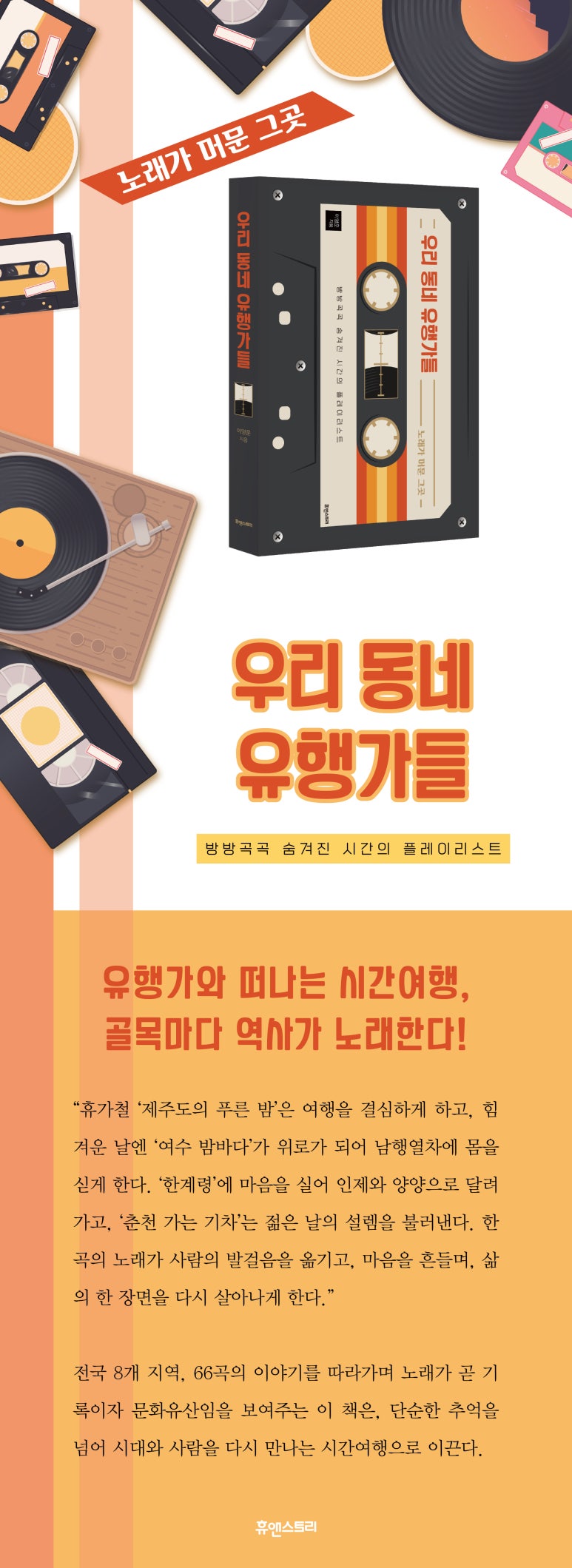
During the holiday season, the song "Jejudo's Blue Night" might influence your decision to travel to Jeju Island. Others might listen to "Yeosu Night Sea" when life feels daunting and exhausting, and take the southbound train to see the sea of Yeosu. Others might be so moved by the song "Han-gye-ryeong" that they drive to Inje or Yangyang. Many students might also choose to take the "Train to Chuncheon" to Gangwon-do when deciding on a location for a company retreat or outing.
This book contains a total of 66 song stories based on the eight regions: Seoul, Incheon/Gyeonggi, Busan/Ulsan/Gyeongnam, Daegu/Gyeongbuk, Gwangju/Jeonnam/Jeonbuk, Daejeon/Chungnam/Chungbuk, Gangwon, and Jeju.
In particular, it contains a lot of new and interesting content that was not well known to the public until then.
For example, the fact that the 'permeated' part of the lyrics 'Samhakdo waves seep deep~' in 'Mokpo's Tears' was originally written as 'eum-eo-deunde'; the fact that the legend that is said to be the background of 'Parkdaljae Crying and Crossing' did not exist before the song but was artificially created after the song came out; the fact that the original melody of the song 'Incheon's Match Factory Girl', which was known as an oral song until then, is a Japanese military song; the fact that the name of the pass 'Han-gye-ryeong' was established after the road expansion project led by Corps Commander Kim Jae-gyu in the early 1970s; the fact that the song 'Samdado News' was first released as a military song for soldiers; the fact that the singer Lee Dong-gi who sang 'Nongae' was a boxer before his debut as a singer; and the fact that the song with the most Seoul place names is not the previously known 'Cheerful Spring News' by Kim Jeong-gu, but 'Sool Seoul' by Illinit.
We delve into the landscape of an era where every step became a song, and the history of life engraved in every melody.
Because it is a universal emotion that people generally experience in their lives and that remains in their memories for a long time.
However, among popular songs, there are many songs that deal with regions as much as love and separation.
Of course, most of them are not just about the region, but are songs that combine love, separation, and life with the region as the background.
The significance of a song set in this area is enormous.
A song that represents a city may be its greatest cultural heritage, more valuable than any national treasure in a local museum.
Aren't 'Seoul's Hymn', 'Come Back to Busan Port', 'Tears of Mokpo', 'Daejeon Blues', 'Silla's Moonlight Night' (Gyeongju), 'Coastal Pier' (Incheon), and 'Soyang River Maiden' (Chuncheon) providing a regional promotional effect that local governments cannot achieve even if they spend hundreds of billions of won on promotion?
During the holiday season, the song "Jejudo's Blue Night" might influence your decision to travel to Jeju Island. Others might listen to "Yeosu Night Sea" when life feels daunting and exhausting, and take the southbound train to see the sea of Yeosu. Others might be so moved by the song "Han-gye-ryeong" that they drive to Inje or Yangyang. Many students might also choose to take the "Train to Chuncheon" to Gangwon-do when deciding on a location for a company retreat or outing.
This book contains a total of 66 song stories based on the eight regions: Seoul, Incheon/Gyeonggi, Busan/Ulsan/Gyeongnam, Daegu/Gyeongbuk, Gwangju/Jeonnam/Jeonbuk, Daejeon/Chungnam/Chungbuk, Gangwon, and Jeju.
In particular, it contains a lot of new and interesting content that was not well known to the public until then.
For example, the fact that the 'permeated' part of the lyrics 'Samhakdo waves seep deep~' in 'Mokpo's Tears' was originally written as 'eum-eo-deunde'; the fact that the legend that is said to be the background of 'Parkdaljae Crying and Crossing' did not exist before the song but was artificially created after the song came out; the fact that the original melody of the song 'Incheon's Match Factory Girl', which was known as an oral song until then, is a Japanese military song; the fact that the name of the pass 'Han-gye-ryeong' was established after the road expansion project led by Corps Commander Kim Jae-gyu in the early 1970s; the fact that the song 'Samdado News' was first released as a military song for soldiers; the fact that the singer Lee Dong-gi who sang 'Nongae' was a boxer before his debut as a singer; and the fact that the song with the most Seoul place names is not the previously known 'Cheerful Spring News' by Kim Jeong-gu, but 'Sool Seoul' by Illinit.
We delve into the landscape of an era where every step became a song, and the history of life engraved in every melody.
- You can preview some of the book's contents.
Preview
index
Entering
PART 1 Gwanghwamun Love Song Seoul
Track 1.
Gwanghwamun Love Song | Jeongdong-gil, Nostalgia for That Winter
Track 2.
Seoul Nocturne | Chungmuro… Myeongdong… The Romance of Tango Melodies
Track 3.
Mapo Terminal | Faint Memories of a Vanished Tram Terminal
Track 4.
The Returning Triangle | Memories of the City's Excellence and the Heartbreaking Heartbreak
Track 5.
The Captain's Mia-ri Pass | Forced Abduction, Heartbreaking Farewell Pass, and More
PART 2 Coastal Piers Incheon and Gyeonggi
Track 1.
Coastal Pier | "Incheon's National Anthem," Filled with the Sorrows of Sam, Cheong, Tae, and Hyeon
Track 2.
Cider Song | 'In the waters off Incheon...' The origin of Korean rap?
Track 3.
The Match Factory Girl of Incheon | Our Sisters' Sorrow Hidden in Obscenity
Track 4.
Tears of Yeonpyeong Island | A Tribute to the Fishermen Victims of Typhoon Sarah
Track 5.
Kang Hwa-do-ryeong | The young master of the mountain village who suddenly became king, etc.
PART 3 Return to Busan Port Busan, Ulsan, and Gyeongnam
Track 1.
Return to Busan Port | A Hometown of Longing, a Refuge for Koreans in Japan
Track 2.
Busan Station of Farewell | The Joys and Sorrows of Refugee Life in Busan's Provisional Capital
Track 3.
Ulsan Big Baby | A Wife's Heart Longing for Her Husband in Seoul
Track 4.
The Woman in the Mountain Lodge | Masan Tuberculosis Sanatorium: The Woman's Tears
Track 5.
Odongdong Taryeong | Dongdongju Sultaryeong, Memories of the Fairy Alley, etc.
PART 4 Silla's Moonlit Nights: Daegu and Gyeongbuk
Track 1.
Gomoryeong Pass in the Rain | A Song of Longing for a Mother Who Has Left Us in Weeping Departure
Track 2.
Song of the Mass | "Cross of Love" Dedicated to My Wife
Track 3.
Silla's Moonlit Night | Gyeongju, the "Millennium Capital," on a Moonlit Night
Track 4.
If the sea were land | Najeong-ri Beach in Gyeongju, the star of the sea
Track 5.
At Andong Station | On the first snowy day, where is that person... etc.
PART 5: Mokpo's Tears: Gwangju, South Jeolla, and North Jeolla
Track 1.
Rock | A song dedicated to a friend who died on May 18th
Track 2.
Tears of Mokpo | An Elegy Filled with the Sorrow and Grief of Honam
Track 3.
Yeosu Night Story | The first banned song that sang the pain of the Yeosu-Suncheon Rebellion
Track 4.
Yeongam Arirang | Arirang for the Moon, Arirang for the Lover
Track 5.
The Girl of Heuksando | A heart that was burned black while drawing the land, etc.
PART 6 Daejeon Blues Daejeon, South Chungcheong, North Chungcheong
Track 1.
Daejeon Blues | The 12:50 AM Daejeon Departure Train
Track 2.
The Tears of Bakdaljae | "Tearful Farewell" Contains the Legend of Bakdaljae
Track 3.
Dreaming of Baekma River | The Dream of Nakhwaam, the Sorrowful Dream of the Three Thousand Palace Ladies
Track 4.
Manripo Love | Tick tock line... Silver sand... Blue dream of the beach
Track 5.
Perfume | Collaborative harmony between vocalists and pop singers, etc.
PART 7 Soyang River Maiden Gangwon
Track 1.
Soyang River Maiden | The Pure Love of an Eighteen-Year-Old Chuncheon Maiden
Track 2.
Train to Chuncheon | Romance and Memories of the Gyeongchun Line in Those Days
Track 3.
Han-gye-ryeong | That mountain tells me to forget…
Track 4.
Cuckoos Cry at Cheongnyeongpo | The Ill-Fated King's Place of Exile: "Danjong's Aesa"
PART 8 The Blue Night of Jeju Island Jeju
Track 1.
Jeju Island's Blue Nights | Healing City Life Under the Stars
Track 2.
Samdado News | Jeju's Poetry Blossomed in the Midst of War
Track 3.
Purification | The Life of Kim Man-deok, a Merchant Who Practiced Sharing
Track 4.
Gamsugwang | Reinterpreting "Gasiri" in Jeju dialect
References
PART 1 Gwanghwamun Love Song Seoul
Track 1.
Gwanghwamun Love Song | Jeongdong-gil, Nostalgia for That Winter
Track 2.
Seoul Nocturne | Chungmuro… Myeongdong… The Romance of Tango Melodies
Track 3.
Mapo Terminal | Faint Memories of a Vanished Tram Terminal
Track 4.
The Returning Triangle | Memories of the City's Excellence and the Heartbreaking Heartbreak
Track 5.
The Captain's Mia-ri Pass | Forced Abduction, Heartbreaking Farewell Pass, and More
PART 2 Coastal Piers Incheon and Gyeonggi
Track 1.
Coastal Pier | "Incheon's National Anthem," Filled with the Sorrows of Sam, Cheong, Tae, and Hyeon
Track 2.
Cider Song | 'In the waters off Incheon...' The origin of Korean rap?
Track 3.
The Match Factory Girl of Incheon | Our Sisters' Sorrow Hidden in Obscenity
Track 4.
Tears of Yeonpyeong Island | A Tribute to the Fishermen Victims of Typhoon Sarah
Track 5.
Kang Hwa-do-ryeong | The young master of the mountain village who suddenly became king, etc.
PART 3 Return to Busan Port Busan, Ulsan, and Gyeongnam
Track 1.
Return to Busan Port | A Hometown of Longing, a Refuge for Koreans in Japan
Track 2.
Busan Station of Farewell | The Joys and Sorrows of Refugee Life in Busan's Provisional Capital
Track 3.
Ulsan Big Baby | A Wife's Heart Longing for Her Husband in Seoul
Track 4.
The Woman in the Mountain Lodge | Masan Tuberculosis Sanatorium: The Woman's Tears
Track 5.
Odongdong Taryeong | Dongdongju Sultaryeong, Memories of the Fairy Alley, etc.
PART 4 Silla's Moonlit Nights: Daegu and Gyeongbuk
Track 1.
Gomoryeong Pass in the Rain | A Song of Longing for a Mother Who Has Left Us in Weeping Departure
Track 2.
Song of the Mass | "Cross of Love" Dedicated to My Wife
Track 3.
Silla's Moonlit Night | Gyeongju, the "Millennium Capital," on a Moonlit Night
Track 4.
If the sea were land | Najeong-ri Beach in Gyeongju, the star of the sea
Track 5.
At Andong Station | On the first snowy day, where is that person... etc.
PART 5: Mokpo's Tears: Gwangju, South Jeolla, and North Jeolla
Track 1.
Rock | A song dedicated to a friend who died on May 18th
Track 2.
Tears of Mokpo | An Elegy Filled with the Sorrow and Grief of Honam
Track 3.
Yeosu Night Story | The first banned song that sang the pain of the Yeosu-Suncheon Rebellion
Track 4.
Yeongam Arirang | Arirang for the Moon, Arirang for the Lover
Track 5.
The Girl of Heuksando | A heart that was burned black while drawing the land, etc.
PART 6 Daejeon Blues Daejeon, South Chungcheong, North Chungcheong
Track 1.
Daejeon Blues | The 12:50 AM Daejeon Departure Train
Track 2.
The Tears of Bakdaljae | "Tearful Farewell" Contains the Legend of Bakdaljae
Track 3.
Dreaming of Baekma River | The Dream of Nakhwaam, the Sorrowful Dream of the Three Thousand Palace Ladies
Track 4.
Manripo Love | Tick tock line... Silver sand... Blue dream of the beach
Track 5.
Perfume | Collaborative harmony between vocalists and pop singers, etc.
PART 7 Soyang River Maiden Gangwon
Track 1.
Soyang River Maiden | The Pure Love of an Eighteen-Year-Old Chuncheon Maiden
Track 2.
Train to Chuncheon | Romance and Memories of the Gyeongchun Line in Those Days
Track 3.
Han-gye-ryeong | That mountain tells me to forget…
Track 4.
Cuckoos Cry at Cheongnyeongpo | The Ill-Fated King's Place of Exile: "Danjong's Aesa"
PART 8 The Blue Night of Jeju Island Jeju
Track 1.
Jeju Island's Blue Nights | Healing City Life Under the Stars
Track 2.
Samdado News | Jeju's Poetry Blossomed in the Midst of War
Track 3.
Purification | The Life of Kim Man-deok, a Merchant Who Practiced Sharing
Track 4.
Gamsugwang | Reinterpreting "Gasiri" in Jeju dialect
References
Detailed image
Into the book
This book is the final book in the trilogy on popular songs, following the previous works, “Popular Songs are History: Reading Modern Korean History through Songs” and “Why Was That Song Banned?”
The first is a story about a popular song based on a historical event, the second is a story about various banned songs, and the last is a story about a song based on a regional background, thus concluding the 'popular song series'.
This book contains a total of 66 song stories based on the eight regions: Seoul, Incheon/Gyeonggi, Busan/Ulsan/Gyeongnam, Daegu/Gyeongbuk, Gwangju/Jeonnam/Jeonbuk, Daejeon/Chungnam/Chungbuk, Gangwon, and Jeju.
In particular, it contains a lot of new and interesting content that was not well known to the public until then.
The fact that the original song's 'seeps in' in the lyrics of 'Tears of Mokpo', 'The waves of Samhakdo Island seep deep~' was 'hidden', and the fact that the legend known to be the background of 'Crying and Crossing Bakdaljae' did not exist before the song, but was artificially created after the song came out.
- Entering the middle
The first is a story about a popular song based on a historical event, the second is a story about various banned songs, and the last is a story about a song based on a regional background, thus concluding the 'popular song series'.
This book contains a total of 66 song stories based on the eight regions: Seoul, Incheon/Gyeonggi, Busan/Ulsan/Gyeongnam, Daegu/Gyeongbuk, Gwangju/Jeonnam/Jeonbuk, Daejeon/Chungnam/Chungbuk, Gangwon, and Jeju.
In particular, it contains a lot of new and interesting content that was not well known to the public until then.
The fact that the original song's 'seeps in' in the lyrics of 'Tears of Mokpo', 'The waves of Samhakdo Island seep deep~' was 'hidden', and the fact that the legend known to be the background of 'Crying and Crossing Bakdaljae' did not exist before the song, but was artificially created after the song came out.
- Entering the middle
--- From the text
Publisher's Review
"A story of that time, that place, contained in a single song."
Songs have always touched people's hearts.
Moments of love and parting, the joys and sorrows of life, and even the scenery of cities and towns are all imbued into the melody.
This book follows those songs and recalls forgotten times and spaces.
A song representing a city can be a cultural heritage more valuable than a national treasure.
Songs that bring back memories of the region, such as 'Come Back to Busan Port', 'Tears of Mokpo', 'Daejeon Blues', and 'Yeosu Night Sea', are connected to the memories of countless people.
Through 66 songs that have colored every corner of the country, the author shows how songs have gone beyond mere trends and have testified to the times and life.
This book records the landscapes and stories left behind in the places where songs have lingered, illuminating the times we have lived through in a different light.
As readers follow the old melody, they will encounter memories within themselves and feel the power of song anew.
Songs have always touched people's hearts.
Moments of love and parting, the joys and sorrows of life, and even the scenery of cities and towns are all imbued into the melody.
This book follows those songs and recalls forgotten times and spaces.
A song representing a city can be a cultural heritage more valuable than a national treasure.
Songs that bring back memories of the region, such as 'Come Back to Busan Port', 'Tears of Mokpo', 'Daejeon Blues', and 'Yeosu Night Sea', are connected to the memories of countless people.
Through 66 songs that have colored every corner of the country, the author shows how songs have gone beyond mere trends and have testified to the times and life.
This book records the landscapes and stories left behind in the places where songs have lingered, illuminating the times we have lived through in a different light.
As readers follow the old melody, they will encounter memories within themselves and feel the power of song anew.
GOODS SPECIFICS
- Date of issue: November 17, 2025
- Page count, weight, size: 368 pages | 148*215*30mm
- ISBN13: 9791193857267
- ISBN10: 1193857260
You may also like
카테고리
korean


korean

![GQ KOREA Mark (Monthly): December [2025]](http://librairie.coreenne.fr/cdn/shop/files/8ef265dbbfbf186523ed75ba7319009d.jpg?v=1765340328&width=3840)


