

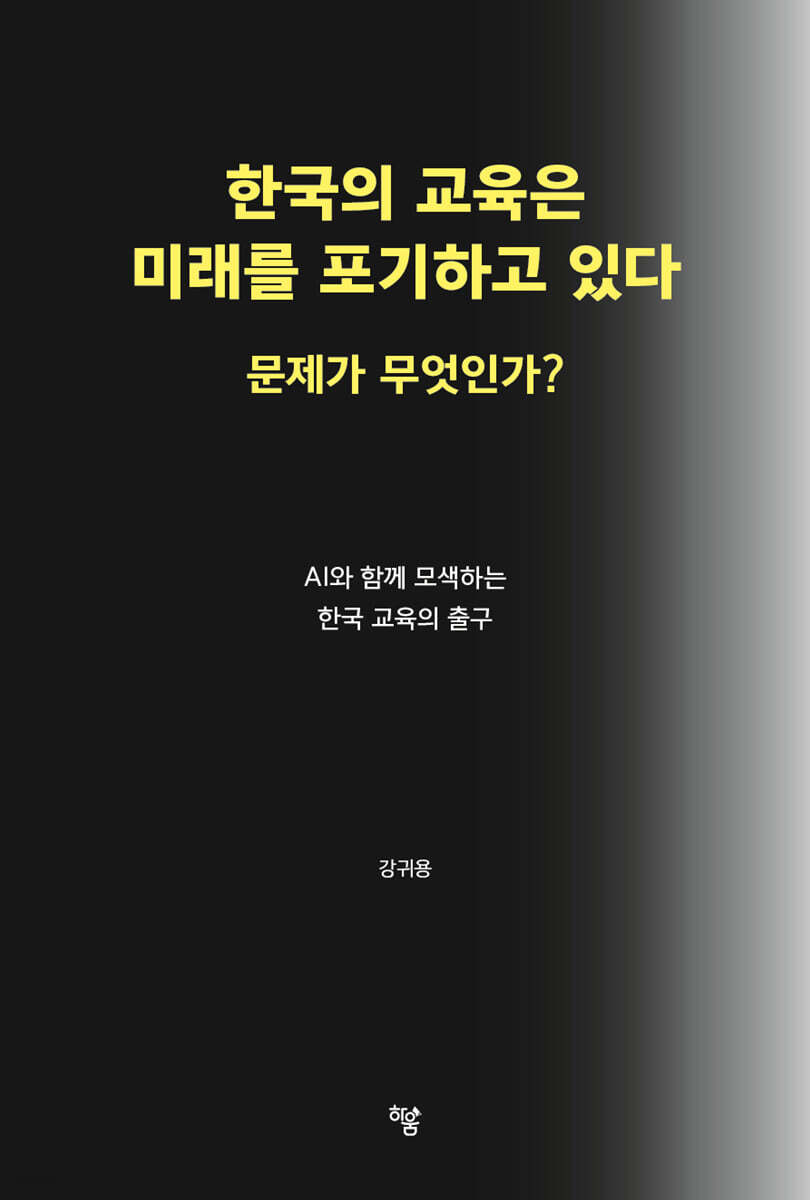
Korean education is abandoning the future. What's the problem?
 |
Description
Book Introduction
『Korean education is giving up on the future.
"What's the Problem?" is a book written by an education expert with over 40 years of experience in the field, which examines the problems in Korean education and leads to new innovations in the field of education.
"Why do we still evaluate students based on scores and rankings?" This book diagnoses the structural problems of Korean education, which is dependent on college entrance exams, and presents specific alternatives, such as "self-directed learning objectives" and "student-led classes."
The author argues that teachers should no longer be teachers, but rather facilitators who help students set and achieve their own goals.
Furthermore, by presenting concrete methods for students to independently explore topics within a single class and develop core competencies through feedback, it demonstrates a path toward realizing a "student-centered classroom." By incorporating insights gained through collaboration with AI technology, it offers a fresh perspective on the direction educational philosophy should take in the AI era.
This book will serve as a sound guide not only for educators, but also for parents, policymakers, and all those concerned about future generations.
"What's the Problem?" is a book written by an education expert with over 40 years of experience in the field, which examines the problems in Korean education and leads to new innovations in the field of education.
"Why do we still evaluate students based on scores and rankings?" This book diagnoses the structural problems of Korean education, which is dependent on college entrance exams, and presents specific alternatives, such as "self-directed learning objectives" and "student-led classes."
The author argues that teachers should no longer be teachers, but rather facilitators who help students set and achieve their own goals.
Furthermore, by presenting concrete methods for students to independently explore topics within a single class and develop core competencies through feedback, it demonstrates a path toward realizing a "student-centered classroom." By incorporating insights gained through collaboration with AI technology, it offers a fresh perspective on the direction educational philosophy should take in the AI era.
This book will serve as a sound guide not only for educators, but also for parents, policymakers, and all those concerned about future generations.
index
1.
Crisis in School Education 12
Scientific Advancement and AI-Based Society 12
- Living in a World of Rapid Change 12
- Schools that must adapt to change 18
But the reality of school education is 24
- Schools that fail to adapt to the changing world 24
- 30 elementary, middle, and high school education focused on college entrance exams
Does Current Education Have a Future? 37
- Students go to school every day, but 37
Still, school is the answer.
45
- Future education possible only at school 45
2.
What is school like? 54
The foundation of our country's school education is 54
- Laws and Regulations on School Education 54
57 schools operating the curriculum
- Currently operating the 2015 and 2022 revised curriculum 57
- The school's curriculum operation is 66
The achievement of one semester and one year of education is 70
- Student completion of 70 courses
The problem raised by such education is 77
- What kind of place is school becoming for students? 77
- So they are trying to reform education, but 86
Although the IB curriculum has been gaining prominence recently, 94
- The IB curriculum has many advantages 94
- But the limitations of the IB curriculum are 96
100 things schools need to do to become future-oriented
- Students are beings who will live in an uncertain future.
- Therefore, the direction of school education is 104
- To put such education into practice, 114
- Education that leverages the strengths of elementary, middle, and high school levels 119
Universities That Need to Change 121
3.
The problem is class 126
Why is this a problem? 126
- What time is the class? 126
- One class hour in our country's curriculum is 130
- What is a textbook? 137
- What the actual class looks like is 141
- Since it is such a class, 147
- Of course, teachers practice various classes, but 163
So what kind of class should it be? 171
- Class 171: A Major Shift in Perception
- 179 classes linked to each student's self-development
- Lesson 185: A Class That Should Be Reasonable to Teachers
- To make it such a class 187
Asking students to solve a problem? 207
- Various perspectives on the solution 207
- The basis for the student's solution is 210
- Can systematic learning be achieved? 226
4.
Learning Objectives: Self-Development Transforms Classes 233
Is student-led problem solving actually possible? 233
- Requires a solution to the learning topic 233
- Learning objectives must be given priority.
236
Learning Objective 243: Further Self-Development
- Learning objectives that should be the responsibility of each student 243
- To understand and internalize the learning objectives, 248
- But self-learning is not easy. 261
267 classes that change through self-learning
- When learning goals are personalized to each student 267
Rubric 273: Making Learning Goals Self-Developed
- 279 Comprehensive Evaluations with Changing Personalities
The Changing Role of Teachers 281
- Teachers who don't teach 281
In fact, an example of a class (based on 40 minutes for elementary school) is 287
- Pre-class activity 287
- 289 learning activities (based on 40 minutes for elementary school students)
- The meaning of evaluation in unit classes is 299
Learning Objectives: How Magnetization Changes School Education 305
- The changing nature of one hour of class is 305
- 311 Useful Evaluation Materials
5.
Is it possible to generalize such a class? 317
To generalize, 317
- Conditions to be considered are 317
- Elementary education is still possible.
323
When such education is established, 329
- 329 elementary, middle, and high school levels where meaningful education takes place
- Teachers with strong educational power 339
- Education with Parents' Trust 344
- University 349: Making Change Possible
- Establishing Korean-style classes 355
- The national education policy that needs to change is 360
6.
Final 376
Appendix 379
Appendix 1: Elementary School 2022 Revised Curriculum Time Allocation Standards 380
〈Appendix 2〉 Flowchart of the Analysis Process for Self-Development of Learning Objectives (Example) 381
Appendix 3: Tomorrow's Learning Objectives Provided to Students (Example) 382
Appendix 4: Examples of Learning Objectives and Their Results 383
Appendix 5: Examples of Acceptable Outputs 384
Appendix 6 Teacher Observation/Evaluation Rubric (Example) 385
〈Appendix 7〉 Rubric Evaluation Scale for Learning Topic Unit Classes ((Example) 386)
Appendix 8: Sample School Life Report Form 387
Appendix 9: Example of School Life Record Book 388
Appendix 10: Flowchart (Example) of Self-Development in Primary, Middle, and High School and College Major Selection 389
〈Appendix 11〉 Ratio of each major suitability evaluation factor related to elementary, middle, and high school education (example) 390
〈Appendix 12〉 Ratio of each major suitability evaluation factor related to elementary, middle, and high school education (example) 391
Crisis in School Education 12
Scientific Advancement and AI-Based Society 12
- Living in a World of Rapid Change 12
- Schools that must adapt to change 18
But the reality of school education is 24
- Schools that fail to adapt to the changing world 24
- 30 elementary, middle, and high school education focused on college entrance exams
Does Current Education Have a Future? 37
- Students go to school every day, but 37
Still, school is the answer.
45
- Future education possible only at school 45
2.
What is school like? 54
The foundation of our country's school education is 54
- Laws and Regulations on School Education 54
57 schools operating the curriculum
- Currently operating the 2015 and 2022 revised curriculum 57
- The school's curriculum operation is 66
The achievement of one semester and one year of education is 70
- Student completion of 70 courses
The problem raised by such education is 77
- What kind of place is school becoming for students? 77
- So they are trying to reform education, but 86
Although the IB curriculum has been gaining prominence recently, 94
- The IB curriculum has many advantages 94
- But the limitations of the IB curriculum are 96
100 things schools need to do to become future-oriented
- Students are beings who will live in an uncertain future.
- Therefore, the direction of school education is 104
- To put such education into practice, 114
- Education that leverages the strengths of elementary, middle, and high school levels 119
Universities That Need to Change 121
3.
The problem is class 126
Why is this a problem? 126
- What time is the class? 126
- One class hour in our country's curriculum is 130
- What is a textbook? 137
- What the actual class looks like is 141
- Since it is such a class, 147
- Of course, teachers practice various classes, but 163
So what kind of class should it be? 171
- Class 171: A Major Shift in Perception
- 179 classes linked to each student's self-development
- Lesson 185: A Class That Should Be Reasonable to Teachers
- To make it such a class 187
Asking students to solve a problem? 207
- Various perspectives on the solution 207
- The basis for the student's solution is 210
- Can systematic learning be achieved? 226
4.
Learning Objectives: Self-Development Transforms Classes 233
Is student-led problem solving actually possible? 233
- Requires a solution to the learning topic 233
- Learning objectives must be given priority.
236
Learning Objective 243: Further Self-Development
- Learning objectives that should be the responsibility of each student 243
- To understand and internalize the learning objectives, 248
- But self-learning is not easy. 261
267 classes that change through self-learning
- When learning goals are personalized to each student 267
Rubric 273: Making Learning Goals Self-Developed
- 279 Comprehensive Evaluations with Changing Personalities
The Changing Role of Teachers 281
- Teachers who don't teach 281
In fact, an example of a class (based on 40 minutes for elementary school) is 287
- Pre-class activity 287
- 289 learning activities (based on 40 minutes for elementary school students)
- The meaning of evaluation in unit classes is 299
Learning Objectives: How Magnetization Changes School Education 305
- The changing nature of one hour of class is 305
- 311 Useful Evaluation Materials
5.
Is it possible to generalize such a class? 317
To generalize, 317
- Conditions to be considered are 317
- Elementary education is still possible.
323
When such education is established, 329
- 329 elementary, middle, and high school levels where meaningful education takes place
- Teachers with strong educational power 339
- Education with Parents' Trust 344
- University 349: Making Change Possible
- Establishing Korean-style classes 355
- The national education policy that needs to change is 360
6.
Final 376
Appendix 379
Appendix 1: Elementary School 2022 Revised Curriculum Time Allocation Standards 380
〈Appendix 2〉 Flowchart of the Analysis Process for Self-Development of Learning Objectives (Example) 381
Appendix 3: Tomorrow's Learning Objectives Provided to Students (Example) 382
Appendix 4: Examples of Learning Objectives and Their Results 383
Appendix 5: Examples of Acceptable Outputs 384
Appendix 6 Teacher Observation/Evaluation Rubric (Example) 385
〈Appendix 7〉 Rubric Evaluation Scale for Learning Topic Unit Classes ((Example) 386)
Appendix 8: Sample School Life Report Form 387
Appendix 9: Example of School Life Record Book 388
Appendix 10: Flowchart (Example) of Self-Development in Primary, Middle, and High School and College Major Selection 389
〈Appendix 11〉 Ratio of each major suitability evaluation factor related to elementary, middle, and high school education (example) 390
〈Appendix 12〉 Ratio of each major suitability evaluation factor related to elementary, middle, and high school education (example) 391
Publisher's Review
『Korean education is giving up on the future.
"What is the problem?" is a desperate warning to Korean education from an educator who has been teaching for over 40 years, but it also contains a declaration of hope.
The author's unique perspective, which continues even after retirement and provides insight and direction for the education sector, stands out for its fundamental transformation of our education system.
Today's schools are still tied to the old standards of a "good university," limiting students' talents and potential.
Furthermore, it is an undeniable reality of our education that the competition for scores centered on Korean and math is taking away children's opportunities to experience the "growth system" that allows them to explore themselves and learn about the world.
The author focuses on this point and seeks to reestablish the fundamental structure of education.
We propose a shift from textbook- and teacher-centered classes to one where students proactively set learning goals, explore topics, and grow on their own through rubric-based assessment.
It is not a simple classroom innovation, but rather a “world-changing class revolution” that enables continuity in elementary, middle, and high school education and connections to universities and society.
In particular, rather than simply citing existing educational discourse, this book contains innovations in the educational field, emerging from the author's field experience and conversations with AI (ChatGPT, Gemini, Claude, etc.), and breaking new ground. It also appears to be an attempt to interpret the critical thinking and self-directedness required in the AI era in the language of the classroom.
As he said, "Education where every student becomes number one in their own way," this book presents the coordinates of a true future education that focuses on the growth of the "individual" rather than the "average."
"What is the problem?" is a desperate warning to Korean education from an educator who has been teaching for over 40 years, but it also contains a declaration of hope.
The author's unique perspective, which continues even after retirement and provides insight and direction for the education sector, stands out for its fundamental transformation of our education system.
Today's schools are still tied to the old standards of a "good university," limiting students' talents and potential.
Furthermore, it is an undeniable reality of our education that the competition for scores centered on Korean and math is taking away children's opportunities to experience the "growth system" that allows them to explore themselves and learn about the world.
The author focuses on this point and seeks to reestablish the fundamental structure of education.
We propose a shift from textbook- and teacher-centered classes to one where students proactively set learning goals, explore topics, and grow on their own through rubric-based assessment.
It is not a simple classroom innovation, but rather a “world-changing class revolution” that enables continuity in elementary, middle, and high school education and connections to universities and society.
In particular, rather than simply citing existing educational discourse, this book contains innovations in the educational field, emerging from the author's field experience and conversations with AI (ChatGPT, Gemini, Claude, etc.), and breaking new ground. It also appears to be an attempt to interpret the critical thinking and self-directedness required in the AI era in the language of the classroom.
As he said, "Education where every student becomes number one in their own way," this book presents the coordinates of a true future education that focuses on the growth of the "individual" rather than the "average."
GOODS SPECIFICS
- Date of issue: November 5, 2025
- Page count, weight, size: 392 pages | 569g | 152*225*30mm
- ISBN13: 9791173742149
- ISBN10: 117374214X
You may also like
카테고리
korean


korean

![GQ KOREA Mark (Monthly): December [2025]](http://librairie.coreenne.fr/cdn/shop/files/8ef265dbbfbf186523ed75ba7319009d.jpg?v=1765340328&width=3840)


