

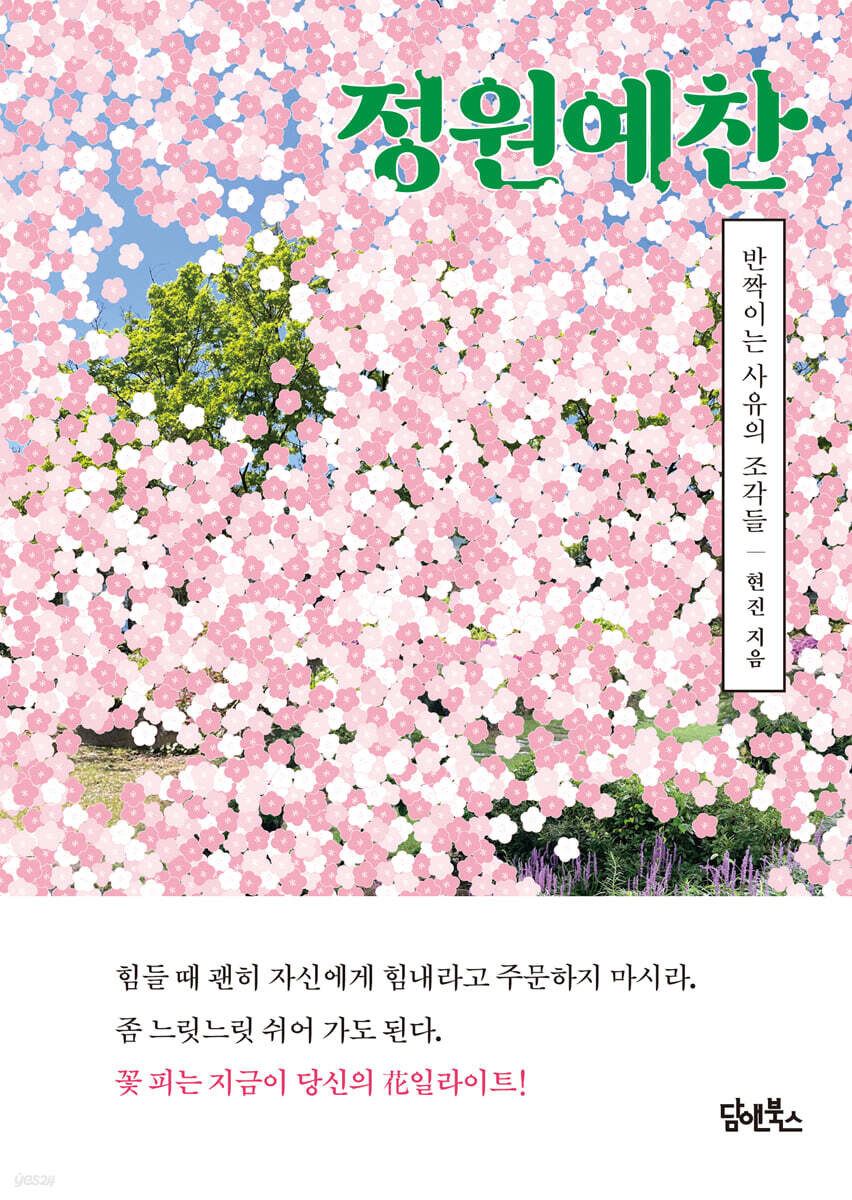
Praise of the Garden
 |
Description
Book Introduction
“Now, in your life too
“A small garden is blooming.”
The garden and flower sermons found in books,
And comfort and encouragement from the practitioner's garden
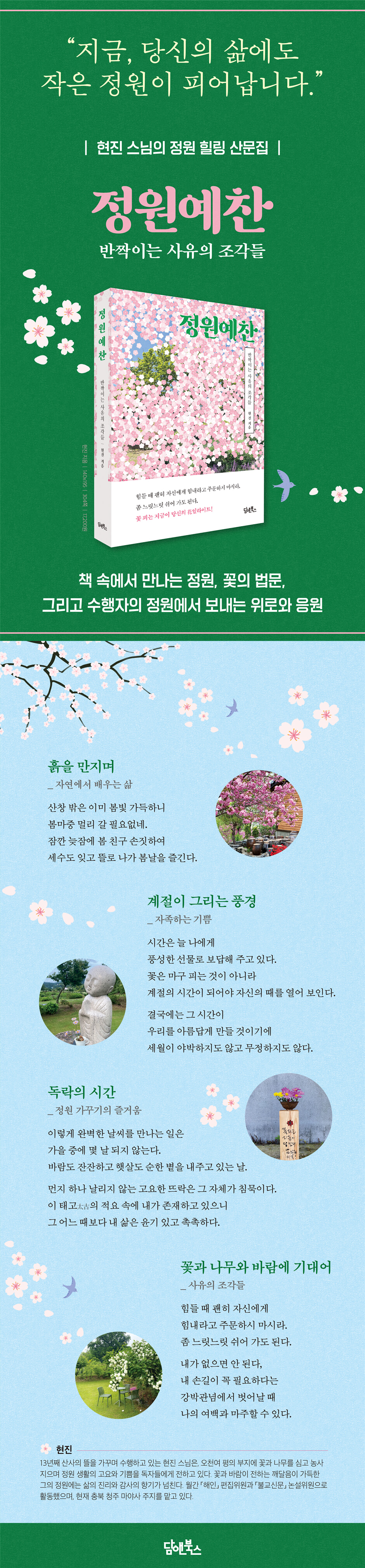
『In Praise of the Garden』, a collection of essays by Monk Hyeonjin, a leading Buddhist scholar, is like a small garden that is carefully tended, one by one.
Reading his book, you will find yourself spending one day pruning and weeding, another day transplanting trees, another day building a birdhouse, and another day walking along a field path with the sound of rain as your companion.
『Ode to the Garden』 is a book that clearly and warmly conveys the thoughts and enlightenment that Monk Hyeonjin experienced while cultivating the Mayasa garden for 13 years.
Gardening in the mountains is more than just touching the soil and growing flowers and trees. It is a simple practice for a monk to spend each day with, and a quiet conversation with the world.
Through the simple acts of leveling the soil, pulling out weeds, and growing flowers, the monk conveys the meaning of 'emptiness', 'staying', 'contentment', and 'natural law', and through the non-verbal dharma that nature speaks, he imparts wise enlightenment to us.
That realization is a message of self-sufficiency, comfort, and encouragement.
His sentences do not explain or persuade.
However, it brings about enlightenment through the natural change of seasons, the passing appearance of nature, and the mind of waiting and acceptance.
The author warmly conveys the tranquility and joy felt while gardening, the joy of labor, and the attitude toward life conveyed by nature, using his signature concise writing style, clear metaphors, and humorous expressions.
“A small garden is blooming.”
The garden and flower sermons found in books,
And comfort and encouragement from the practitioner's garden
『In Praise of the Garden』, a collection of essays by Monk Hyeonjin, a leading Buddhist scholar, is like a small garden that is carefully tended, one by one.
Reading his book, you will find yourself spending one day pruning and weeding, another day transplanting trees, another day building a birdhouse, and another day walking along a field path with the sound of rain as your companion.
『Ode to the Garden』 is a book that clearly and warmly conveys the thoughts and enlightenment that Monk Hyeonjin experienced while cultivating the Mayasa garden for 13 years.
Gardening in the mountains is more than just touching the soil and growing flowers and trees. It is a simple practice for a monk to spend each day with, and a quiet conversation with the world.
Through the simple acts of leveling the soil, pulling out weeds, and growing flowers, the monk conveys the meaning of 'emptiness', 'staying', 'contentment', and 'natural law', and through the non-verbal dharma that nature speaks, he imparts wise enlightenment to us.
That realization is a message of self-sufficiency, comfort, and encouragement.
His sentences do not explain or persuade.
However, it brings about enlightenment through the natural change of seasons, the passing appearance of nature, and the mind of waiting and acceptance.
The author warmly conveys the tranquility and joy felt while gardening, the joy of labor, and the attitude toward life conveyed by nature, using his signature concise writing style, clear metaphors, and humorous expressions.
- You can preview some of the book's contents.
Preview
index
Touching the Earth_Learning Life from Nature
The garden is a legacy of 'time'
How can life be fragrant?
Both blooming and falling flowers are part of the spring scenery.
If you wait for the wind to pass
Flowers don't get angry
Everything must go according to plan
Flowers bloom even when it rains
Trees are the history of time
On a morning after a storm
There is beauty in what has stood the test of time.
There is a time for everything
It's nice when it rains and it's nice when it's sunny
Listen to the wind playing
Landscapes Drawn by the Seasons_ The Joy of Self-Sufficiency
The fewer wishes you have, the happier you are.
Garden of Elegance
May life be comforted in front of flowers
How can only old wine make people drunk?
Love and be happy every moment
The place you sit is a flower bed
Heavy rain season
The best tool for weeding is a hoe
A giant who blossomed with a life and death struggle
Things you can only see when you sit down
September chrysanthemums bloom in September.
Moonlight Offering
Winter is a season of waiting
What kind of life will I have in my life?
Time for Solitude_The Joy of Gardening
Say hello to the spring flowers
Thoughts must be kept quiet and ripened.
Utapacho (rain-beating banana)
The flower of my life!
Deserves my bow
Nothing just happens
Please meet me instead of flowers
Money comes out, food comes out?
lawn garden
Summer Day's Complaints
Let my life only walk on a flower path
Flower Seed Map
Fall is more hectic
A place only those in the know visit
Autumn leaves are fleeting, but fallen leaves last a long time.
Less is more
The aesthetics of subtraction
Garden Addict
Leaning on flowers, trees, and the wind_ Pieces of thought
Neither unlucky nor unfortunate
Living simply
Happiness Reception Area
Old things get older
If it's hard, don't give up
The master resembles a tree
The amount of gratitude is the amount of happiness.
Today's fallen leaves are not the same as yesterday's.
Those who love flowers often kill them.
In the season when the river sleeps
The Art of Cleaning
I'm happy when I'm a little uncomfortable
The goal is to have no goal
The garden is a legacy of 'time'
How can life be fragrant?
Both blooming and falling flowers are part of the spring scenery.
If you wait for the wind to pass
Flowers don't get angry
Everything must go according to plan
Flowers bloom even when it rains
Trees are the history of time
On a morning after a storm
There is beauty in what has stood the test of time.
There is a time for everything
It's nice when it rains and it's nice when it's sunny
Listen to the wind playing
Landscapes Drawn by the Seasons_ The Joy of Self-Sufficiency
The fewer wishes you have, the happier you are.
Garden of Elegance
May life be comforted in front of flowers
How can only old wine make people drunk?
Love and be happy every moment
The place you sit is a flower bed
Heavy rain season
The best tool for weeding is a hoe
A giant who blossomed with a life and death struggle
Things you can only see when you sit down
September chrysanthemums bloom in September.
Moonlight Offering
Winter is a season of waiting
What kind of life will I have in my life?
Time for Solitude_The Joy of Gardening
Say hello to the spring flowers
Thoughts must be kept quiet and ripened.
Utapacho (rain-beating banana)
The flower of my life!
Deserves my bow
Nothing just happens
Please meet me instead of flowers
Money comes out, food comes out?
lawn garden
Summer Day's Complaints
Let my life only walk on a flower path
Flower Seed Map
Fall is more hectic
A place only those in the know visit
Autumn leaves are fleeting, but fallen leaves last a long time.
Less is more
The aesthetics of subtraction
Garden Addict
Leaning on flowers, trees, and the wind_ Pieces of thought
Neither unlucky nor unfortunate
Living simply
Happiness Reception Area
Old things get older
If it's hard, don't give up
The master resembles a tree
The amount of gratitude is the amount of happiness.
Today's fallen leaves are not the same as yesterday's.
Those who love flowers often kill them.
In the season when the river sleeps
The Art of Cleaning
I'm happy when I'm a little uncomfortable
The goal is to have no goal
Detailed image
Into the book
The process of flowers blooming and falling is both a peak and a continuation of life.
So, if you accept and understand anything, things will change.
There are no decisive problems on the path of life.
There is only a situation.
Therefore, there is no fundamental solution to the situation; you just have to respond to it.
The world is not fixed, but turns and turns, and the spring day tells us that situations can change at any time.
--- pp.34-35 From "Waiting for the Wind to Pass"
Looking at the old tree, the phrase “There is beauty in what has endured time” came to mind.
People and things are no different.
Only by crossing the river of time and overcoming the mountains of time can one stand tall as a being.
The reason that tree is beautiful is because it has the medal of time that it has endured silently through harsh times.
It is a feeling of awe that can never be felt in front of a young tree.
--- p.64 From “There is beauty in things that have endured time”
I want our garden to be the perfect place for a relaxing retreat.
So, I think that flowers and trees are nature's infinite teachings and encouragement for life.
When creating this garden, I thought about what form to take while visiting and visiting various nameplates.
In the end, I decided on the topic of 'comfort and meditation' and am developing it while expressing my own opinions.
--- p.77 From “Listen to the Sound of the Wind”
Getting old is not a sad or unfair thing.
Because time was fair and kind to everyone.
No one's time was omitted or shortened, and twenty-four hours a day were given equally.
And time has been generous to me and has often given me opportunities.
If you waste or waste that time, it is only your own fault.
Rather than saying that time passes by in vain, it would be more appropriate to say that we are letting time pass by in vain.
--- p.114 From "The Rainy Season"
If you keep the lawn well-maintained, the scenery will always be new.
It's like the refreshing feeling the day after shaving your head.
Would bricks or cement provide such change and joy?
There is nothing more pleasing to the eye than a well-kept green lawn, like a carpet.
--- p.188 From “The Lawn Garden”
Don't mortgage your happiness in old age to your children.
Older parents can't do everything, right?
Now is not the time to be Superman or Wonder Woman, but to be a lighthouse and a beacon.
All you have to do is lend a shoulder to your children who live far away when they are having a hard time, and light a light and wait for them so that the road home does not feel unfamiliar.
As you no longer have to wear multiple name tags, your life can become lighter as you lighten the weight of your responsibilities one by one.
--- p.261 From “If it’s hard, don’t try too hard”
I enjoy looking out at the yard like this every now and then, which is called 'yard-gazing'.
There is nothing more effective than this for purifying a complex mind and dizzy thoughts.
There is a saying that the most beautiful dance in the world is 'pause'.
It means to pause at the signal of life.
For example, don't set any plans or goals for today, but focus entirely on the state of being still.
When you focus on something, your mind's field of thought tends to expand.
When that is the case, recharging and resting are possible.
So, if you accept and understand anything, things will change.
There are no decisive problems on the path of life.
There is only a situation.
Therefore, there is no fundamental solution to the situation; you just have to respond to it.
The world is not fixed, but turns and turns, and the spring day tells us that situations can change at any time.
--- pp.34-35 From "Waiting for the Wind to Pass"
Looking at the old tree, the phrase “There is beauty in what has endured time” came to mind.
People and things are no different.
Only by crossing the river of time and overcoming the mountains of time can one stand tall as a being.
The reason that tree is beautiful is because it has the medal of time that it has endured silently through harsh times.
It is a feeling of awe that can never be felt in front of a young tree.
--- p.64 From “There is beauty in things that have endured time”
I want our garden to be the perfect place for a relaxing retreat.
So, I think that flowers and trees are nature's infinite teachings and encouragement for life.
When creating this garden, I thought about what form to take while visiting and visiting various nameplates.
In the end, I decided on the topic of 'comfort and meditation' and am developing it while expressing my own opinions.
--- p.77 From “Listen to the Sound of the Wind”
Getting old is not a sad or unfair thing.
Because time was fair and kind to everyone.
No one's time was omitted or shortened, and twenty-four hours a day were given equally.
And time has been generous to me and has often given me opportunities.
If you waste or waste that time, it is only your own fault.
Rather than saying that time passes by in vain, it would be more appropriate to say that we are letting time pass by in vain.
--- p.114 From "The Rainy Season"
If you keep the lawn well-maintained, the scenery will always be new.
It's like the refreshing feeling the day after shaving your head.
Would bricks or cement provide such change and joy?
There is nothing more pleasing to the eye than a well-kept green lawn, like a carpet.
--- p.188 From “The Lawn Garden”
Don't mortgage your happiness in old age to your children.
Older parents can't do everything, right?
Now is not the time to be Superman or Wonder Woman, but to be a lighthouse and a beacon.
All you have to do is lend a shoulder to your children who live far away when they are having a hard time, and light a light and wait for them so that the road home does not feel unfamiliar.
As you no longer have to wear multiple name tags, your life can become lighter as you lighten the weight of your responsibilities one by one.
--- p.261 From “If it’s hard, don’t try too hard”
I enjoy looking out at the yard like this every now and then, which is called 'yard-gazing'.
There is nothing more effective than this for purifying a complex mind and dizzy thoughts.
There is a saying that the most beautiful dance in the world is 'pause'.
It means to pause at the signal of life.
For example, don't set any plans or goals for today, but focus entirely on the state of being still.
When you focus on something, your mind's field of thought tends to expand.
When that is the case, recharging and resting are possible.
--- p.284 From “In the Season When the River Sleeps”
Publisher's Review
A series of works titled “The Practitioner and the Garden” that convey the teachings of flowers.
'Garden Strategy' activity
'Nature' contains the meaning of 'it is so by itself'.
And nature, which is 'such by itself', is powerful.
Even in the harsh winter that seems to never end, spring gives way in time, and one day is dazzling, but the next day it rains and the next day it clears up again.
Sometimes a storm blows and blows away a lot of things, but as time passes, things fall into place.
Leaves grow and fruit forms where flowers fall.
It is an unfailing law and cycle of nature.
It has been 13 years since Monk Hyeonjin started tending the Mayasa Garden.
『Ode to the Garden』 is a sequel to 『The Practitioner and the Garden』, which records the sermons on flowers in the four seasons while cultivating a garden over the past ten years.
And now, after 13 long years, the garden, with its flowers, trees, and rocks in their proper places, has gained more depth, and the monk's thoughts have also become a lush forest.
“When someone once asked me why I was so absorbed in gardening, I said, ‘It’s a way of teaching through the garden.’
“The so-called garden missionary work may still be unfamiliar, but it is a role that shows the way to rest and heal by leaning on nature while cultivating flowers and trees.”
Monk Hyunjin has always said that flowers and trees are important means of teaching, and that it is time to listen to the sounds of nature and be reverent to the teachings the forest conveys.
In that sense, his garden becomes another temple that conveys the teachings of nature and serves as a place of healing.
Comfort and Encouragement from the Garden of Enlightened Practitioners
His garden is full of enlightenment from nature, including flowers and wind.
The book is divided into four chapters, following the sparkling fragments of thought.
Chapter 1, “Touching the Soil,” contains “Life Learned from Nature,” and Chapter 2, “Landscapes Drawn by the Seasons,” sings of “the Joy of Self-Sufficiency.”
Chapter 3, “Time of Solitude,” describes the “joy of gardening,” and Chapter 4, “Leaning on Flowers, Trees, and the Wind,” warmly unfolds the “pieces of thought” that bloomed in the practitioner’s garden.
But the main thread running through the book is the tranquility and joy of garden life.
“If I had to describe my current joy, it would be facing the garden,” he said. He said that the joy of living alone is working without even realizing that the streetlights are on, leaning into the spring breeze, and spending quiet time listening to the sound of the rain. He also said that when he weeds under the shade of the mountain after the sun sets, his mind becomes quiet and comfortable.
“I draw a line in advance, thinking, ‘Let’s do this much today,’ but as I work, I find it fun and I end up crossing that line every time.
Some days, I forget I'm hungry and just fall into it." Self-sufficiency and self-indulgence are the energy that allows anyone to live a vibrant life.
And in this silence and joy, it awakens readers to how to live within the providence of nature.
“Paradoxically, flowers bloom again because they wither.
“If you cannot accept the changing circumstances, the flower cannot bloom again,” he says, and advises that we follow the natural flow of change, and that we should increase the proportion of concentration rather than obsession in our daily lives, saying, “Obsession can be painful, but concentration is a way to live diligently in the given moment.”
Furthermore, Venerable Hyeonjin conveys a message of self-sufficiency, comfort, and encouragement in all of these thoughts.
“Rest is not about stopping, but about walking slowly and adjusting the pace of life,” he said. “Now, when things get tough, stop telling yourself to cheer up.
It's an age where you can take it easy and rest a bit.
“When I break free from the obsession that I cannot be without you and that my touch is absolutely necessary, I can face my own space.” He sends warm comfort to all those who are burdened by their current lives.
“The place you always wanted to escape from, the place that was uncomfortable and unpleasant, actually turned out to be a beautiful flower bed.
Even if the road we live is difficult, when we stand at the end of time and look back, we realize that those times were a time of blossoming flowers.
Therefore, even if your current life is dissatisfying and boring, the place you are sitting will once be a flowery place.”
A practitioner who resembles nature
A simple and beautiful collection of prose
Monk Hyeonjin believed that “if anyone, young or old, can understand it correctly with simple sentences, then it is a famous text,” and he conveyed appreciation and enlightenment through simple, concise, and plain sentences.
Express your feelings without any embellishment or explanation.
His sentences are simple, plain, and sparkling with wit, which makes them attractive and moving to readers.
“There is an indescribable sense of fulfillment when you spend a quiet time admiring the raindrops soaking the stone steps.
“It’s a feeling of accomplishment even though I didn’t do anything,” or “Even now that I’ve finished the work, the scent of chrysanthemums still lingers on the back of my hands.”
I spent the whole day cutting off the flower stalks of the Chrysanthemum indica that bloomed and dried in the fall, and their fragrance still lingers.
When I read sentences like, “Until yesterday, my work clothes smelled like compost,” I feel like I’m in that situation with them.
Another characteristic of his writing is that he enjoys a concise style.
There is a glimpse of sparkling wisdom in it, and the light-hearted jokes make you chuckle.
Sentences like “The best book of all is a walk” or “The most beautiful dance in the world is ‘pause’”, dialogues like “These days, when I turn around, there is grass” or “Then don’t turn around”, “That’s why I often use the expression ‘super concentration’ as a joke.
“I have yet to find a class that increases concentration as much as sitting on the grass and pulling out weeds.”
“Perfection is achieved not when there is nothing more to add, but when there is nothing more to take away.” Monk Hyun Jin’s writings are full of sentences that have nothing more to take away.
As I read the prose collection of Monk Hyeonjin, I am also touched by the simple yet beautiful sentences.
'Garden Strategy' activity
'Nature' contains the meaning of 'it is so by itself'.
And nature, which is 'such by itself', is powerful.
Even in the harsh winter that seems to never end, spring gives way in time, and one day is dazzling, but the next day it rains and the next day it clears up again.
Sometimes a storm blows and blows away a lot of things, but as time passes, things fall into place.
Leaves grow and fruit forms where flowers fall.
It is an unfailing law and cycle of nature.
It has been 13 years since Monk Hyeonjin started tending the Mayasa Garden.
『Ode to the Garden』 is a sequel to 『The Practitioner and the Garden』, which records the sermons on flowers in the four seasons while cultivating a garden over the past ten years.
And now, after 13 long years, the garden, with its flowers, trees, and rocks in their proper places, has gained more depth, and the monk's thoughts have also become a lush forest.
“When someone once asked me why I was so absorbed in gardening, I said, ‘It’s a way of teaching through the garden.’
“The so-called garden missionary work may still be unfamiliar, but it is a role that shows the way to rest and heal by leaning on nature while cultivating flowers and trees.”
Monk Hyunjin has always said that flowers and trees are important means of teaching, and that it is time to listen to the sounds of nature and be reverent to the teachings the forest conveys.
In that sense, his garden becomes another temple that conveys the teachings of nature and serves as a place of healing.
Comfort and Encouragement from the Garden of Enlightened Practitioners
His garden is full of enlightenment from nature, including flowers and wind.
The book is divided into four chapters, following the sparkling fragments of thought.
Chapter 1, “Touching the Soil,” contains “Life Learned from Nature,” and Chapter 2, “Landscapes Drawn by the Seasons,” sings of “the Joy of Self-Sufficiency.”
Chapter 3, “Time of Solitude,” describes the “joy of gardening,” and Chapter 4, “Leaning on Flowers, Trees, and the Wind,” warmly unfolds the “pieces of thought” that bloomed in the practitioner’s garden.
But the main thread running through the book is the tranquility and joy of garden life.
“If I had to describe my current joy, it would be facing the garden,” he said. He said that the joy of living alone is working without even realizing that the streetlights are on, leaning into the spring breeze, and spending quiet time listening to the sound of the rain. He also said that when he weeds under the shade of the mountain after the sun sets, his mind becomes quiet and comfortable.
“I draw a line in advance, thinking, ‘Let’s do this much today,’ but as I work, I find it fun and I end up crossing that line every time.
Some days, I forget I'm hungry and just fall into it." Self-sufficiency and self-indulgence are the energy that allows anyone to live a vibrant life.
And in this silence and joy, it awakens readers to how to live within the providence of nature.
“Paradoxically, flowers bloom again because they wither.
“If you cannot accept the changing circumstances, the flower cannot bloom again,” he says, and advises that we follow the natural flow of change, and that we should increase the proportion of concentration rather than obsession in our daily lives, saying, “Obsession can be painful, but concentration is a way to live diligently in the given moment.”
Furthermore, Venerable Hyeonjin conveys a message of self-sufficiency, comfort, and encouragement in all of these thoughts.
“Rest is not about stopping, but about walking slowly and adjusting the pace of life,” he said. “Now, when things get tough, stop telling yourself to cheer up.
It's an age where you can take it easy and rest a bit.
“When I break free from the obsession that I cannot be without you and that my touch is absolutely necessary, I can face my own space.” He sends warm comfort to all those who are burdened by their current lives.
“The place you always wanted to escape from, the place that was uncomfortable and unpleasant, actually turned out to be a beautiful flower bed.
Even if the road we live is difficult, when we stand at the end of time and look back, we realize that those times were a time of blossoming flowers.
Therefore, even if your current life is dissatisfying and boring, the place you are sitting will once be a flowery place.”
A practitioner who resembles nature
A simple and beautiful collection of prose
Monk Hyeonjin believed that “if anyone, young or old, can understand it correctly with simple sentences, then it is a famous text,” and he conveyed appreciation and enlightenment through simple, concise, and plain sentences.
Express your feelings without any embellishment or explanation.
His sentences are simple, plain, and sparkling with wit, which makes them attractive and moving to readers.
“There is an indescribable sense of fulfillment when you spend a quiet time admiring the raindrops soaking the stone steps.
“It’s a feeling of accomplishment even though I didn’t do anything,” or “Even now that I’ve finished the work, the scent of chrysanthemums still lingers on the back of my hands.”
I spent the whole day cutting off the flower stalks of the Chrysanthemum indica that bloomed and dried in the fall, and their fragrance still lingers.
When I read sentences like, “Until yesterday, my work clothes smelled like compost,” I feel like I’m in that situation with them.
Another characteristic of his writing is that he enjoys a concise style.
There is a glimpse of sparkling wisdom in it, and the light-hearted jokes make you chuckle.
Sentences like “The best book of all is a walk” or “The most beautiful dance in the world is ‘pause’”, dialogues like “These days, when I turn around, there is grass” or “Then don’t turn around”, “That’s why I often use the expression ‘super concentration’ as a joke.
“I have yet to find a class that increases concentration as much as sitting on the grass and pulling out weeds.”
“Perfection is achieved not when there is nothing more to add, but when there is nothing more to take away.” Monk Hyun Jin’s writings are full of sentences that have nothing more to take away.
As I read the prose collection of Monk Hyeonjin, I am also touched by the simple yet beautiful sentences.
GOODS SPECIFICS
- Date of issue: April 21, 2025
- Page count, weight, size: 304 pages | 464g | 140*197*18mm
- ISBN13: 9791162015360
- ISBN10: 1162015365
You may also like
카테고리
korean


korean

![GQ KOREA Mark (Monthly): December [2025]](http://librairie.coreenne.fr/cdn/shop/files/8ef265dbbfbf186523ed75ba7319009d.jpg?v=1765340328&width=3840)


