

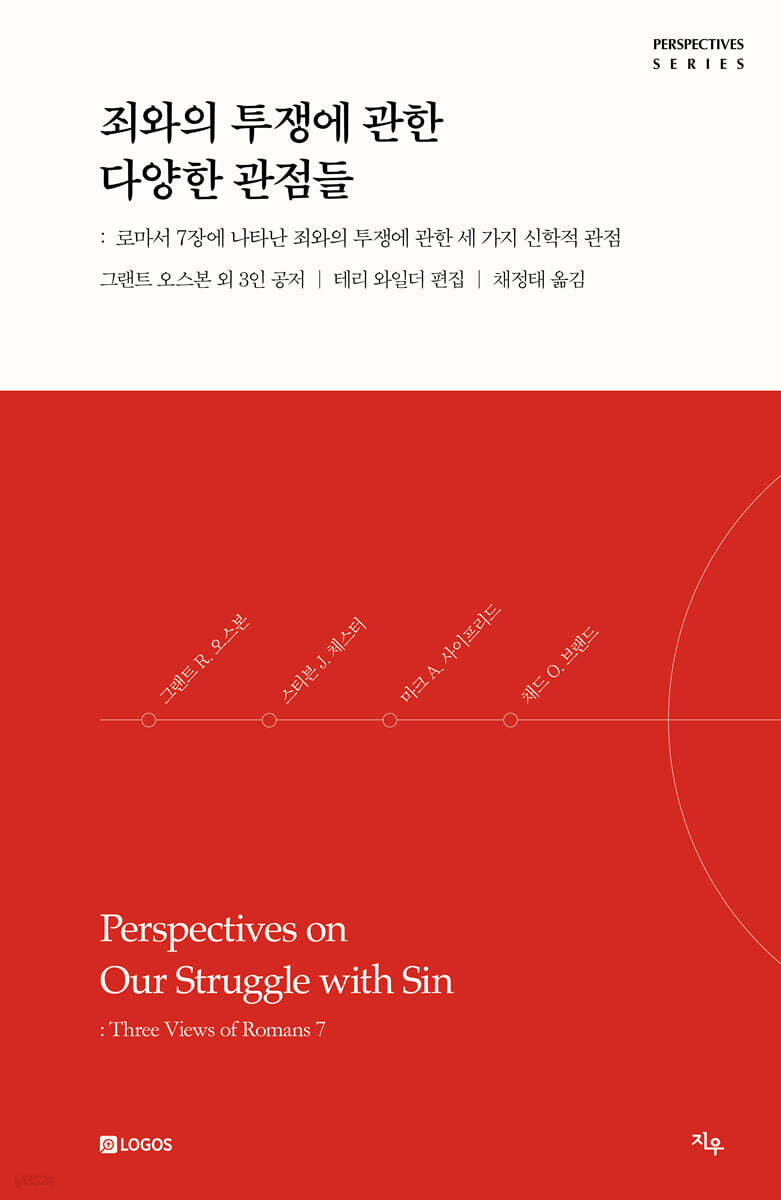
Different Perspectives on the Struggle with Sin
 |
Description
Book Introduction
This book introduces various interpretations of the “I” (‘ego’, ?γ?) in Romans 7, and through dialogue between these interpretations, helps us to understand Romans and its important theological discussions (sin, law, humanity, conversion, sanctification, etc.) more deeply.
The concluding section, which synthesizes and organizes the three discussions, contains practical and practical suggestions on how the preceding discussions can be applied to individual religious life and, especially, to pastoral ministry.
This book will be helpful to those who wish to meditate more deeply on the book of Romans and to those who preach on the book of Romans.
The concluding section, which synthesizes and organizes the three discussions, contains practical and practical suggestions on how the preceding discussions can be applied to individual religious life and, especially, to pastoral ministry.
This book will be helpful to those who wish to meditate more deeply on the book of Romans and to those who preach on the book of Romans.
- You can preview some of the book's contents.
Preview
index
Contributor Introduction 8
Acknowledgments 11
Introduction Terry L.
Wilder 15
Chapter 1: Living according to the flesh without the Holy Spirit
: Romans 7 and the Christian Experience Grant R.
Osborne 25
Stephen Chester's Commentary 95
Mark Seyfried's Commentary 105
Chapter 2: A Retrospective Reading of Romans 7
: Paul of the Present Speaks of Paul of the Past Stephen J.
Chester 109
Grant Osborne's Commentary 178
Mark Seyfried's Commentary 186
Chapter 3 Romans 7 The Voice of the Law,
A sad cry, a cry of gratitude Mark A.
Seyfried 191
Commentary by Stephen Chester 273
Grant Osborne's Commentary 282
Conclusion: Theological and Pastoral Issues Chad O.
Brand 291
Biographical Index 329
Subject Index 333
Bible Index 336
Acknowledgments 11
Introduction Terry L.
Wilder 15
Chapter 1: Living according to the flesh without the Holy Spirit
: Romans 7 and the Christian Experience Grant R.
Osborne 25
Stephen Chester's Commentary 95
Mark Seyfried's Commentary 105
Chapter 2: A Retrospective Reading of Romans 7
: Paul of the Present Speaks of Paul of the Past Stephen J.
Chester 109
Grant Osborne's Commentary 178
Mark Seyfried's Commentary 186
Chapter 3 Romans 7 The Voice of the Law,
A sad cry, a cry of gratitude Mark A.
Seyfried 191
Commentary by Stephen Chester 273
Grant Osborne's Commentary 282
Conclusion: Theological and Pastoral Issues Chad O.
Brand 291
Biographical Index 329
Subject Index 333
Bible Index 336
Into the book
We live in two eras simultaneously.
The old age of Adam, ruled by sin and the flesh, and the new age of Christ, ruled by the Holy Spirit and a renewed mind, overlap.
This conflict is a real experience, but Paul says earlier that it should not overwhelm the believer's entire life.
In the Lordship of Christ, God's people can be victorious.
--- p.91~92
Grand Osborne shows us an example of tolerance in interpretive practice.
While he is generally very thorough in demonstrating the accuracy of his views, basing his interpretive position on the essential character of Paul's argument, he is also careful to acknowledge several times that he lacks certainty regarding difficult passages such as Romans 7.
--- p.95
For Augustine and Wesley, their interpretation of Romans 7 contributed to building a Christian world in which later generations of believers embraced the truth of the gospel by reading Scripture more broadly.
The diverse contours of this world highlight areas where Romans 7 might raise questions for our time.
--- p.125
Interpreting Romans 7 from a retrospective perspective can be seen as entailing the following understanding of conversion:
That is, conversion produces a more active and gentle conscience, and the converted person is always prepared to ask himself whether his inner desires are justified.
--- p.174
Paul does not speak of the Christian's struggle with sin in Romans 7.
He describes a battle that was already lost long ago in Adam.
Yet, amazingly, God has decided to turn this long, defeat-filled battle to our advantage in Christ.
Therefore, Christians are called to walk the very narrow path where the new creation and the present fallen world intersect.
--- p.270~271
I am grateful to Professor Mark Seyfried for his thoughtful, thorough, and rich treatment of Romans 7.
In addition to his observations on Romans 7, Seyfried's approach of framing this passage within the context of Paul's treatment of the law within the overall flow of the argument in Romans was particularly helpful.
Another excellent approach was to use the rich background material of the Old Testament and intertestamental literature to emphasize the uniqueness of Paul's position by framing it in continuity with previous discussions of the law within Judaism.
--- p.273
My point here is that whatever interpretation you think is appropriate—whether it's pre-conversion, post-conversion, or humanity as a whole—Paul's point here is that sin is a very big problem for humanity in this world! In the letter to the Romans, the discussion of sin (and the law that encourages it) takes up as much space (1:20-3:20; 7:1-25) as justification and its benefits (3:21-6:23; 8:1-39).
The important point here, both for our theology and for our pastoral ministry, is that sin is a topic that must be part of our preaching...
If we are to be faithful to the example of Scripture, we must preach about sin.
The old age of Adam, ruled by sin and the flesh, and the new age of Christ, ruled by the Holy Spirit and a renewed mind, overlap.
This conflict is a real experience, but Paul says earlier that it should not overwhelm the believer's entire life.
In the Lordship of Christ, God's people can be victorious.
--- p.91~92
Grand Osborne shows us an example of tolerance in interpretive practice.
While he is generally very thorough in demonstrating the accuracy of his views, basing his interpretive position on the essential character of Paul's argument, he is also careful to acknowledge several times that he lacks certainty regarding difficult passages such as Romans 7.
--- p.95
For Augustine and Wesley, their interpretation of Romans 7 contributed to building a Christian world in which later generations of believers embraced the truth of the gospel by reading Scripture more broadly.
The diverse contours of this world highlight areas where Romans 7 might raise questions for our time.
--- p.125
Interpreting Romans 7 from a retrospective perspective can be seen as entailing the following understanding of conversion:
That is, conversion produces a more active and gentle conscience, and the converted person is always prepared to ask himself whether his inner desires are justified.
--- p.174
Paul does not speak of the Christian's struggle with sin in Romans 7.
He describes a battle that was already lost long ago in Adam.
Yet, amazingly, God has decided to turn this long, defeat-filled battle to our advantage in Christ.
Therefore, Christians are called to walk the very narrow path where the new creation and the present fallen world intersect.
--- p.270~271
I am grateful to Professor Mark Seyfried for his thoughtful, thorough, and rich treatment of Romans 7.
In addition to his observations on Romans 7, Seyfried's approach of framing this passage within the context of Paul's treatment of the law within the overall flow of the argument in Romans was particularly helpful.
Another excellent approach was to use the rich background material of the Old Testament and intertestamental literature to emphasize the uniqueness of Paul's position by framing it in continuity with previous discussions of the law within Judaism.
--- p.273
My point here is that whatever interpretation you think is appropriate—whether it's pre-conversion, post-conversion, or humanity as a whole—Paul's point here is that sin is a very big problem for humanity in this world! In the letter to the Romans, the discussion of sin (and the law that encourages it) takes up as much space (1:20-3:20; 7:1-25) as justification and its benefits (3:21-6:23; 8:1-39).
The important point here, both for our theology and for our pastoral ministry, is that sin is a topic that must be part of our preaching...
If we are to be faithful to the example of Scripture, we must preach about sin.
--- p.176
GOODS SPECIFICS
- Date of issue: April 9, 2025
- Page count, weight, size: 344 pages | 402g | 140*215*20mm
- ISBN13: 9791193664087
- ISBN10: 119366408X
You may also like
카테고리
korean


korean

![GQ KOREA Mark (Monthly): December [2025]](http://librairie.coreenne.fr/cdn/shop/files/8ef265dbbfbf186523ed75ba7319009d.jpg?v=1765340328&width=3840)


