

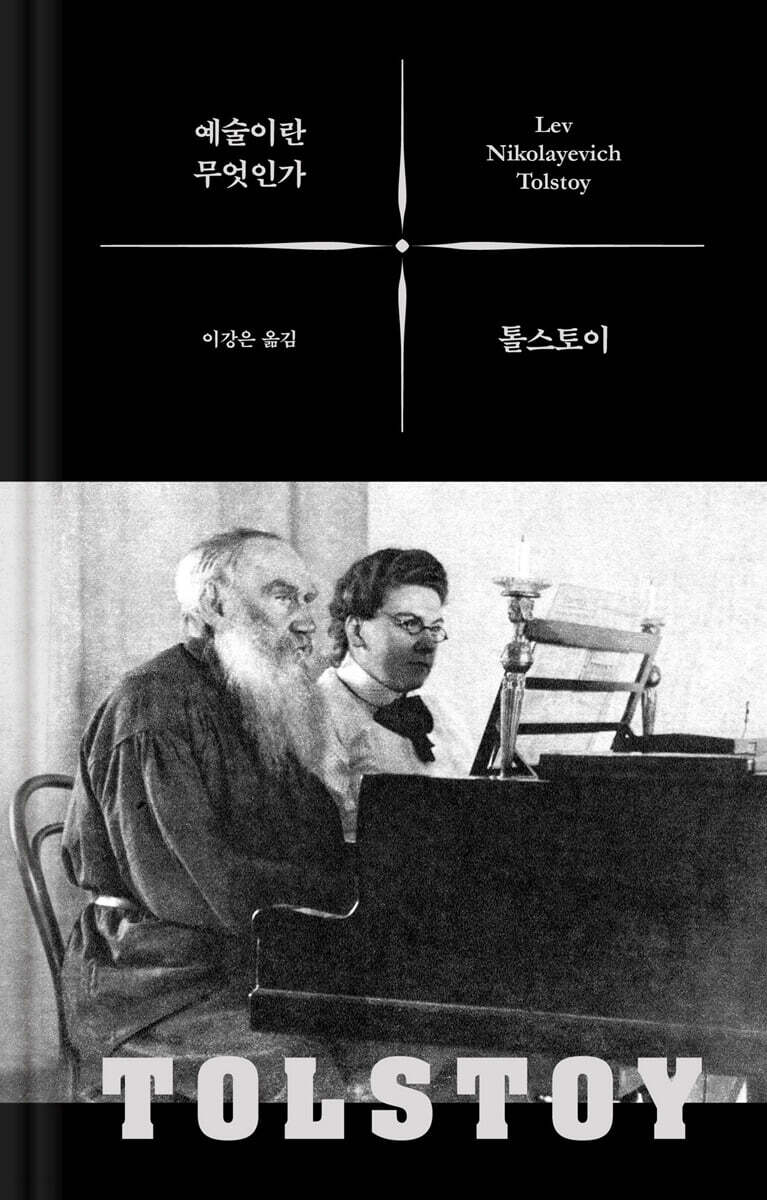
What is art?
 |
Description
Book Introduction
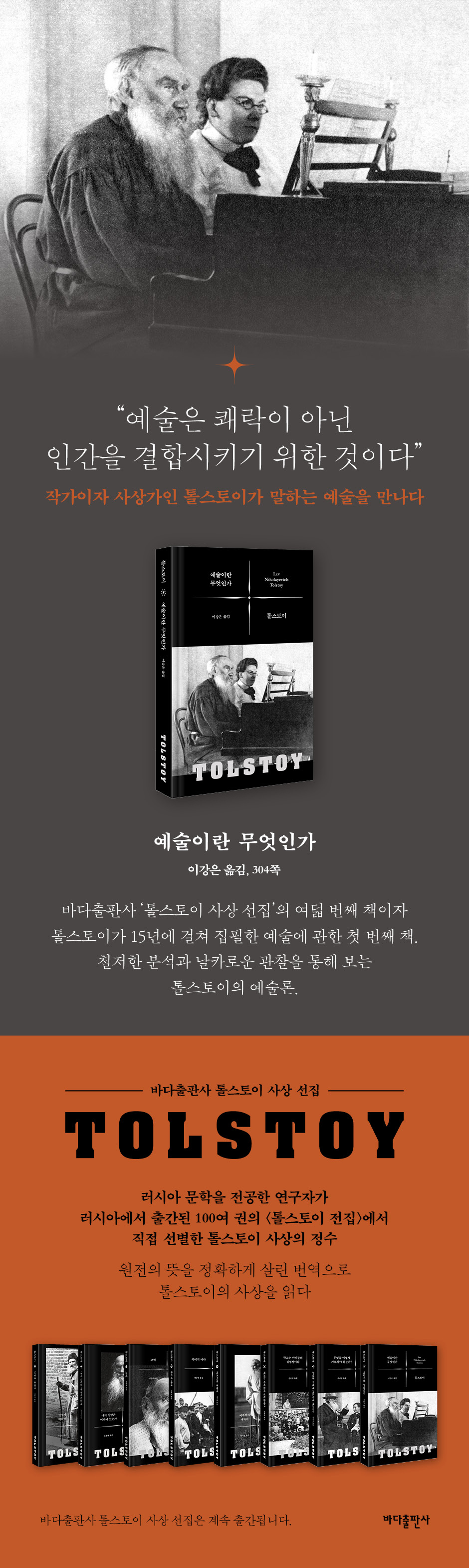
“Art is not about beauty or pleasure, but about uniting people.”
A story of art that Tolstoy completed over 15 years
"What is Art?" is the eighth book in the "Anthology of Tolstoy's Thought" series published by Badapublishing.
In this work, which took 15 years to write and complete, Tolstoy examines in detail various aesthetic theories and art movements from ancient Greece to contemporary Europe.
Tolstoy clearly reveals the essence of art and how modern art has gone astray, and suggests the path that true art should take.
Standing at the opposite end of the spectrum from the commercial and peripheral pleasure-seeking modern art trends, Tolstoy's unique and popular-oriented theory of art, which views art as an indispensable condition of human life, is presented in a new, clearer and more readable translation by Professor Lee Kang-eun of Kyungpook National University.
The eighth book in the "Anthology of Tolstoy's Thought" published by Badapublishing, "What is Art?", is a valuable work that allows readers to fully experience Tolstoy's strict and popular view of art.
A mental crisis suddenly struck after he had risen to become the greatest writer of his time with 『War and Peace』 and 『Anna Karenina』.
In deep doubt about the meaning of life and literature, Tolstoy embarks on fundamental reflections on faith and art.
If his answers to religion were Confessions (1880) and Where Is My Faith? (1883), his answer to art is this book, What Is Art? (1897).
Although they began writing at around the same time, it took a full 15 years to complete because they had to thoroughly review various aesthetic theories and art trends from ancient Greece to contemporary Europe.
Just as his conclusion on religion was to reject hypocritical church Christianity and return to the true spirit of Christ, Tolstoy also clearly reveals the essence of art and how modern art has gone astray, and suggests the path that true art should take.
Standing at the opposite end of the spectrum from the commercial and peripheral pleasure-seeking modern art movement, Tolstoy's unique theory of art, which views art as an indispensable condition of human life, is presented in a new, clearer and more readable translation by Professor Lee Kang-eun of Kyungpook National University.
A story of art that Tolstoy completed over 15 years
"What is Art?" is the eighth book in the "Anthology of Tolstoy's Thought" series published by Badapublishing.
In this work, which took 15 years to write and complete, Tolstoy examines in detail various aesthetic theories and art movements from ancient Greece to contemporary Europe.
Tolstoy clearly reveals the essence of art and how modern art has gone astray, and suggests the path that true art should take.
Standing at the opposite end of the spectrum from the commercial and peripheral pleasure-seeking modern art trends, Tolstoy's unique and popular-oriented theory of art, which views art as an indispensable condition of human life, is presented in a new, clearer and more readable translation by Professor Lee Kang-eun of Kyungpook National University.
The eighth book in the "Anthology of Tolstoy's Thought" published by Badapublishing, "What is Art?", is a valuable work that allows readers to fully experience Tolstoy's strict and popular view of art.
A mental crisis suddenly struck after he had risen to become the greatest writer of his time with 『War and Peace』 and 『Anna Karenina』.
In deep doubt about the meaning of life and literature, Tolstoy embarks on fundamental reflections on faith and art.
If his answers to religion were Confessions (1880) and Where Is My Faith? (1883), his answer to art is this book, What Is Art? (1897).
Although they began writing at around the same time, it took a full 15 years to complete because they had to thoroughly review various aesthetic theories and art trends from ancient Greece to contemporary Europe.
Just as his conclusion on religion was to reject hypocritical church Christianity and return to the true spirit of Christ, Tolstoy also clearly reveals the essence of art and how modern art has gone astray, and suggests the path that true art should take.
Standing at the opposite end of the spectrum from the commercial and peripheral pleasure-seeking modern art movement, Tolstoy's unique theory of art, which views art as an indispensable condition of human life, is presented in a new, clearer and more readable translation by Professor Lee Kang-eun of Kyungpook National University.
- You can preview some of the book's contents.
Preview
index
1.
The Folly of Modern Art
2.
How can art be an expression of beauty?
3.
All the struggles of aesthetics to define beauty
4.
The problem of defining metaphysical art
5.
The fallacy of the metaphysical definition of art
6.
The corruption of true religious consciousness and the vain sense of beauty
7.
The fiction of the Trinity of Truth, Goodness, and Beauty
8.
The deception of upper-class art
9.
Art steeped in pride, lust, and boredom
10.
Exclusive forms and contents that are increasingly difficult and bizarre
11.
Techniques of counterfeit art that have nothing to do with conveying genuine emotions
12.
Professionalization and Criticism of Art, Art Schools
13.
The epitome of counterfeit art? Wagner's "The Ring of the Nibelung"
14.
True artistic emotion
15.
Art is infection
16.
The content of good art
17.
The Fatal Consequences of Distorted Art
18.
True art based on religious ritual
19.
Art and Artistic Activities of the Future
20.
Conclusion: The Path Forward for Great Art
Translator's Note: A stern critique of art and culture and a passion for true art.
Leo Tolstoy Chronology
The Folly of Modern Art
2.
How can art be an expression of beauty?
3.
All the struggles of aesthetics to define beauty
4.
The problem of defining metaphysical art
5.
The fallacy of the metaphysical definition of art
6.
The corruption of true religious consciousness and the vain sense of beauty
7.
The fiction of the Trinity of Truth, Goodness, and Beauty
8.
The deception of upper-class art
9.
Art steeped in pride, lust, and boredom
10.
Exclusive forms and contents that are increasingly difficult and bizarre
11.
Techniques of counterfeit art that have nothing to do with conveying genuine emotions
12.
Professionalization and Criticism of Art, Art Schools
13.
The epitome of counterfeit art? Wagner's "The Ring of the Nibelung"
14.
True artistic emotion
15.
Art is infection
16.
The content of good art
17.
The Fatal Consequences of Distorted Art
18.
True art based on religious ritual
19.
Art and Artistic Activities of the Future
20.
Conclusion: The Path Forward for Great Art
Translator's Note: A stern critique of art and culture and a passion for true art.
Leo Tolstoy Chronology
Detailed image
Publisher's Review
Pleasure cannot be the purpose of art.
In the introduction to the book, Tolstoy tells of his experience observing an opera rehearsal.
Not only the singers, dancers, and orchestra on stage, but also the hundreds of staff members sweating silently behind the stage were repeating the same scene for hours on enduring the general director's verbal abuse.
Seeing this barbaric cruelty committed in the name of ‘for art’, Tolstoy asks:
“Is this art, and is art so important that it warrants such sacrifices?”
Despite the fact that many arts exist on the basis of horrific labor, sacrifice of life and morality, art itself is becoming increasingly ambiguous in people's consciousness, as each school of thought defines art differently.
Art is generally said to be an expression of beauty, but the question of what beauty is remains an unsolved mystery even 150 years after aesthetics was established by Baumgarten in 1750 (and even to this day).
In chapters 3 and 4, Tolstoy outlines the aesthetic theories of dozens of prominent German philosophers such as Baumgarten, Winckelmann, Kant, and Hegel, as well as of dozens of aestheticians of all ages from England, France, and Italy.
Their definitions of beauty fall into two main categories: a metaphysical definition, which states that beauty is an absolute and perfect thing that exists in itself, a manifestation of an idea, spirit, or God; and an empirical definition, which states that beauty is a subjective satisfaction, a special kind of pleasure that we accept without any selfish consideration.
However, since we derive a certain pleasure from recognizing and manifesting the absolute and perfect, both definitions of beauty ultimately lead to the conclusion that beauty is pleasure.
"What is art? All the answers we can glean from existing aesthetics to this question boil down to the assertion that art is beauty, beauty is the pleasure it brings, and the pleasure derived from art is something very important and excellent." But this is a tautology, the same as saying that pleasure is good because it is pleasure.
What numerous aesthetic theories say is “not the definition of art, but merely a scheme to justify the sacrifices [of the people] made in the name of art and the egoistic pleasure and immorality of existing art.”
But according to Tolstoy, pleasure or satisfaction cannot be the purpose of art.
We take food and do not think that the value of food lies in the pleasure it gives or the satisfaction of our taste.
And just as we come to realize that the true value of food lies in its nutrition only when we stop thinking of it that way, we can realize the true meaning of art only when we stop thinking of its purpose as beauty (i.e., pleasure).
Art is infection
Tolstoy breaks away from the concept of beauty that had previously confused aesthetic theory and views art as one of the conditions of human life.
According to Tolstoy, art is a means of communication that conveys emotions between people.
“Art is a human activity in which a human being consciously uses certain external signs to convey the emotions he has experienced to others, thereby causing them to be infected with those emotions and to experience those emotions as well.” “Art is an indispensable means of communication for the life and happiness of individual humans and of humanity as a whole, by uniting people with the same emotions.” Tolstoy’s famous thesis that “art is infection” is the essence of art in his view and the main characteristic that distinguishes genuine art from counterfeit art.
But today, the upper class recognizes anything as art as long as it provides pleasure.
As a result of those who did not believe in the deceptive church and did not follow the true spirit of Christ, and pursued only personal pleasure, art was almost destroyed.
Upper-class art has lost its profound religious content and fallen into old and hackneyed emotions such as vanity, sexual desire, and boredom (impoverishment of content); it has become a riddle that the public cannot understand at all due to its emphasis on formal beauty (obscuration of form); and above all, art has lost its truthfulness and become an artificially fabricated intellectual product (imitation of art).
In chapter 10, which criticizes the obscurity of modern art, Tolstoy cites as examples the works of symbolist and decadent poets such as Baudelaire, Verlaine, and Mallarmé, who were “almost great men” even at the time.
They “theorize a worldview saturated with shallow egoism, replacing morality with a vague, cloud-like concept of beauty, and replacing beauty with something endlessly artificial.” Their works “lack innocence, truth, and simplicity, and are full of artificial artifice, grotesque originality, and skepticism.”
Of course, Tolstoy says that we should not criticize new art simply because it is not understood.
But as art becomes more and more exclusive to the upper class, it becomes increasingly incomprehensible to the masses, and I believe that art that most people don't understand cannot be good art.
Saying, “The work of art is great, but I don’t understand it” is like saying, “The food is great, but I can’t eat it.” If contagiousness is the measure of good art, then art that people don’t understand and can’t feel (can’t be moved by) is either bad art or not art at all.
Fake Art vs. True Art
Today, so-called artists produce pseudo-art and counterfeit art that resemble genuine art by using techniques such as borrowing motifs from old works of art (borrowing), depicting reality in extreme detail (imitation), heightening the effect with sensational and peripheral descriptions (shock), and arousing intellectual interest by depicting the era or profession in detail or intricately twisting the composition (attraction).
“In every field of art, counterfeit products called art are produced according to pre-made prescriptions and are treated as genuine art by today’s upper-class people.”
Tolstoy says that the professionalization of artists, who receive excessive compensation, art criticism, which is inherently unnecessary and only distorts public taste (“To describe a work of art in words only proves that the art is incapable of infecting it”), and art schools, which claim to teach infectious powers that cannot be taught in the first place, are encouraging the spread of this fake art.
Tolstoy criticizes the Greek tragedians, Dante, Milton, Shakespeare, Goethe, Oscar Wilde, Ibsen, Raphael, the Impressionist painters, the later Beethoven, Liszt, Berlioz, Brahms, Richard Strauss, and most of all, Wagner, as counterfeit art, art contrived and contrived in the head.
(He even rates all his works, except for two, “The Prisoner of the Caucasus” and “God Sees Truth,” as bad art.) Of course, Tolstoy does not expect that his claim that “almost everything that is considered art or good art in our society is in reality neither true art nor good art, and far from being art, is only counterfeit art” will be seriously examined or accepted.
However, the experience of being infected by the emotions of others can be felt by ordinary people and even children, and it is clear that “the experience of sharing in the joys of others and the sorrows of others, and thus becoming one with the souls of others” is the characteristic that distinguishes true art from counterfeit art.
Art that unites all people with compassion, love, and brotherhood is truly good art.
Tolstoy cites as examples folk songs and tales imbued with the cheerfulness and gentleness of the people, the novels of Dickens, Hugo, and Dostoevsky that depict compassion for the poor and suffering, and the paintings of Millet, Langley, and Lermitte that contain respect and love for working people.
Tolstoy emphasizes that art should be for everyone, not just the entertainment of the upper class as it is now.
“If art does not become the art of all the people, then either it is not as important as people claim, or the art we call art is not important.”
The art of the future will be guided by works that convey not emotions exclusive to the wealthy class, but emotions that lead all people to a bond of brotherhood, universal emotions that unite all people, and the entire people will participate in artistic activities.
The artist of the future will not know “any depravity that seeks only technical perfection to conceal the absence of content,” and will “engage in art only when he feels an unbearable inner need.”
Ultimately, Tolstoy's theory of art is in a contradictory relationship with his social thought.
Tolstoy calls on humanity to establish a kingdom of love instead of a kingdom of violence, and for science in the realm of reason and art in the realm of emotion to contribute together to building a peaceful community where all are happy and united.
“Art is not pleasure, comfort, or entertainment.
Art is a great thing.
Art is an organ of human life that can transfer people's rational consciousness into emotions.
…the task of art is enormous.
The task of true art, guided by religion and assisted by science, is to ensure that the peaceful coexistence of mankind is brought about by the free and joyful activity of men.
…only art can do this.”
In the introduction to the book, Tolstoy tells of his experience observing an opera rehearsal.
Not only the singers, dancers, and orchestra on stage, but also the hundreds of staff members sweating silently behind the stage were repeating the same scene for hours on enduring the general director's verbal abuse.
Seeing this barbaric cruelty committed in the name of ‘for art’, Tolstoy asks:
“Is this art, and is art so important that it warrants such sacrifices?”
Despite the fact that many arts exist on the basis of horrific labor, sacrifice of life and morality, art itself is becoming increasingly ambiguous in people's consciousness, as each school of thought defines art differently.
Art is generally said to be an expression of beauty, but the question of what beauty is remains an unsolved mystery even 150 years after aesthetics was established by Baumgarten in 1750 (and even to this day).
In chapters 3 and 4, Tolstoy outlines the aesthetic theories of dozens of prominent German philosophers such as Baumgarten, Winckelmann, Kant, and Hegel, as well as of dozens of aestheticians of all ages from England, France, and Italy.
Their definitions of beauty fall into two main categories: a metaphysical definition, which states that beauty is an absolute and perfect thing that exists in itself, a manifestation of an idea, spirit, or God; and an empirical definition, which states that beauty is a subjective satisfaction, a special kind of pleasure that we accept without any selfish consideration.
However, since we derive a certain pleasure from recognizing and manifesting the absolute and perfect, both definitions of beauty ultimately lead to the conclusion that beauty is pleasure.
"What is art? All the answers we can glean from existing aesthetics to this question boil down to the assertion that art is beauty, beauty is the pleasure it brings, and the pleasure derived from art is something very important and excellent." But this is a tautology, the same as saying that pleasure is good because it is pleasure.
What numerous aesthetic theories say is “not the definition of art, but merely a scheme to justify the sacrifices [of the people] made in the name of art and the egoistic pleasure and immorality of existing art.”
But according to Tolstoy, pleasure or satisfaction cannot be the purpose of art.
We take food and do not think that the value of food lies in the pleasure it gives or the satisfaction of our taste.
And just as we come to realize that the true value of food lies in its nutrition only when we stop thinking of it that way, we can realize the true meaning of art only when we stop thinking of its purpose as beauty (i.e., pleasure).
Art is infection
Tolstoy breaks away from the concept of beauty that had previously confused aesthetic theory and views art as one of the conditions of human life.
According to Tolstoy, art is a means of communication that conveys emotions between people.
“Art is a human activity in which a human being consciously uses certain external signs to convey the emotions he has experienced to others, thereby causing them to be infected with those emotions and to experience those emotions as well.” “Art is an indispensable means of communication for the life and happiness of individual humans and of humanity as a whole, by uniting people with the same emotions.” Tolstoy’s famous thesis that “art is infection” is the essence of art in his view and the main characteristic that distinguishes genuine art from counterfeit art.
But today, the upper class recognizes anything as art as long as it provides pleasure.
As a result of those who did not believe in the deceptive church and did not follow the true spirit of Christ, and pursued only personal pleasure, art was almost destroyed.
Upper-class art has lost its profound religious content and fallen into old and hackneyed emotions such as vanity, sexual desire, and boredom (impoverishment of content); it has become a riddle that the public cannot understand at all due to its emphasis on formal beauty (obscuration of form); and above all, art has lost its truthfulness and become an artificially fabricated intellectual product (imitation of art).
In chapter 10, which criticizes the obscurity of modern art, Tolstoy cites as examples the works of symbolist and decadent poets such as Baudelaire, Verlaine, and Mallarmé, who were “almost great men” even at the time.
They “theorize a worldview saturated with shallow egoism, replacing morality with a vague, cloud-like concept of beauty, and replacing beauty with something endlessly artificial.” Their works “lack innocence, truth, and simplicity, and are full of artificial artifice, grotesque originality, and skepticism.”
Of course, Tolstoy says that we should not criticize new art simply because it is not understood.
But as art becomes more and more exclusive to the upper class, it becomes increasingly incomprehensible to the masses, and I believe that art that most people don't understand cannot be good art.
Saying, “The work of art is great, but I don’t understand it” is like saying, “The food is great, but I can’t eat it.” If contagiousness is the measure of good art, then art that people don’t understand and can’t feel (can’t be moved by) is either bad art or not art at all.
Fake Art vs. True Art
Today, so-called artists produce pseudo-art and counterfeit art that resemble genuine art by using techniques such as borrowing motifs from old works of art (borrowing), depicting reality in extreme detail (imitation), heightening the effect with sensational and peripheral descriptions (shock), and arousing intellectual interest by depicting the era or profession in detail or intricately twisting the composition (attraction).
“In every field of art, counterfeit products called art are produced according to pre-made prescriptions and are treated as genuine art by today’s upper-class people.”
Tolstoy says that the professionalization of artists, who receive excessive compensation, art criticism, which is inherently unnecessary and only distorts public taste (“To describe a work of art in words only proves that the art is incapable of infecting it”), and art schools, which claim to teach infectious powers that cannot be taught in the first place, are encouraging the spread of this fake art.
Tolstoy criticizes the Greek tragedians, Dante, Milton, Shakespeare, Goethe, Oscar Wilde, Ibsen, Raphael, the Impressionist painters, the later Beethoven, Liszt, Berlioz, Brahms, Richard Strauss, and most of all, Wagner, as counterfeit art, art contrived and contrived in the head.
(He even rates all his works, except for two, “The Prisoner of the Caucasus” and “God Sees Truth,” as bad art.) Of course, Tolstoy does not expect that his claim that “almost everything that is considered art or good art in our society is in reality neither true art nor good art, and far from being art, is only counterfeit art” will be seriously examined or accepted.
However, the experience of being infected by the emotions of others can be felt by ordinary people and even children, and it is clear that “the experience of sharing in the joys of others and the sorrows of others, and thus becoming one with the souls of others” is the characteristic that distinguishes true art from counterfeit art.
Art that unites all people with compassion, love, and brotherhood is truly good art.
Tolstoy cites as examples folk songs and tales imbued with the cheerfulness and gentleness of the people, the novels of Dickens, Hugo, and Dostoevsky that depict compassion for the poor and suffering, and the paintings of Millet, Langley, and Lermitte that contain respect and love for working people.
Tolstoy emphasizes that art should be for everyone, not just the entertainment of the upper class as it is now.
“If art does not become the art of all the people, then either it is not as important as people claim, or the art we call art is not important.”
The art of the future will be guided by works that convey not emotions exclusive to the wealthy class, but emotions that lead all people to a bond of brotherhood, universal emotions that unite all people, and the entire people will participate in artistic activities.
The artist of the future will not know “any depravity that seeks only technical perfection to conceal the absence of content,” and will “engage in art only when he feels an unbearable inner need.”
Ultimately, Tolstoy's theory of art is in a contradictory relationship with his social thought.
Tolstoy calls on humanity to establish a kingdom of love instead of a kingdom of violence, and for science in the realm of reason and art in the realm of emotion to contribute together to building a peaceful community where all are happy and united.
“Art is not pleasure, comfort, or entertainment.
Art is a great thing.
Art is an organ of human life that can transfer people's rational consciousness into emotions.
…the task of art is enormous.
The task of true art, guided by religion and assisted by science, is to ensure that the peaceful coexistence of mankind is brought about by the free and joyful activity of men.
…only art can do this.”
GOODS SPECIFICS
- Date of issue: June 23, 2023
- Page count, weight, size: 304 pages | 118*188*30mm
- ISBN13: 9791166891694
- ISBN10: 1166891690
You may also like
카테고리
korean


korean

![GQ KOREA Mark (Monthly): December [2025]](http://librairie.coreenne.fr/cdn/shop/files/8ef265dbbfbf186523ed75ba7319009d.jpg?v=1765340328&width=3840)


