

Color photo studio
 |
Description
Book Introduction
It was the past for us, but the present for them. A photo book that summons those who lived in a colorless world into the real world of color. A photo of the past, but also a photo of us living in harmony with the times. There's an amazing channel on YouTube that shows the process of restoring black and white photos to color. The main character is the 'Restoration King'. The author of this book, Restoration King, began restoring black-and-white photos to color out of curiosity: "What if we restored old, faded photos to the colors people would have seen them in at the time?" From the late Joseon Dynasty, when photography began to be introduced, to the Korean Empire, and the Japanese colonial period, to the 1970s, when color photography began to appear, rare photographs are filled with vivid colors, as if they were being hand-embroidered one by one. Watching a video of an old black-and-white photograph taken a hundred years ago being transformed into a color photograph, the historical photos we would have only seen in history books come right before our eyes as if we were watching a drama. In the newly created 'color' photographs, we can clearly see various aspects of our history and culture, including objects, buildings, means of transportation, clothing, and occupations that are difficult to find now. It is full of human stories that cannot be felt in black and white photographs that have been frozen in time. So, this book is an interesting 'photo book' that returns black and white photos to the colors of reality, and at the same time, it is a 'history book' for unknown people like us who do not appear in history books. Through this photo book, readers will be able to use their historical imagination to imagine what it must have been like for people back then to live surrounded by these colors. |
- You can preview some of the book's contents.
Preview
index
Entering
Part 1
~1909
They lived in a vivid world of color just like us.
-Willard Straight Collection
-Stereograph
-Hermann Sander's photo album
-The first photograph of the volunteer army
-Photo album of Emperor Sunjong's Northwest Tour
-Joseon royal family
Part 2
~1945
'Then', brought back to life in the colors of reality, connects to 'now'
-Seoul during the Japanese colonial period
-Suwon during the Japanese colonial period
-Collection of missionary Sydney Gamble
-Photos by Donald Kingley O'Brien
-Hero, restored in color
-tank
-parasitism
Part 3
Korean War
Unsung heroes, thanks to you we are here today.
-Incheon Landing Operation
-Battle of Chosin Reservoir
-Hungnam evacuation
-1·4 retreat
Part 4
~1969
I hope to feel the atmosphere of the times rather than reminisce about the past.
-Seoul, where things are being done here and there
-New and bright
-Sewage truck
-People still
-Baekma Unit Farewell Ceremony, August 29, 1966
-Busan after liberation
Part 5
1970~
A drama created by gathering moments from the past while imagining the future.
-It was right then, but it's different now?
-If I had known in advance
[Q&A] Questions About Color Restoration
References
Photo source
Part 1
~1909
They lived in a vivid world of color just like us.
-Willard Straight Collection
-Stereograph
-Hermann Sander's photo album
-The first photograph of the volunteer army
-Photo album of Emperor Sunjong's Northwest Tour
-Joseon royal family
Part 2
~1945
'Then', brought back to life in the colors of reality, connects to 'now'
-Seoul during the Japanese colonial period
-Suwon during the Japanese colonial period
-Collection of missionary Sydney Gamble
-Photos by Donald Kingley O'Brien
-Hero, restored in color
-tank
-parasitism
Part 3
Korean War
Unsung heroes, thanks to you we are here today.
-Incheon Landing Operation
-Battle of Chosin Reservoir
-Hungnam evacuation
-1·4 retreat
Part 4
~1969
I hope to feel the atmosphere of the times rather than reminisce about the past.
-Seoul, where things are being done here and there
-New and bright
-Sewage truck
-People still
-Baekma Unit Farewell Ceremony, August 29, 1966
-Busan after liberation
Part 5
1970~
A drama created by gathering moments from the past while imagining the future.
-It was right then, but it's different now?
-If I had known in advance
[Q&A] Questions About Color Restoration
References
Photo source
Detailed image

Into the book
In cases where color photographs remain, I used them as a reference and colored them. In cases where they have disappeared or are becoming increasingly difficult to find, I colored them in similar colors so as not to deviate too far from current common sense, but added a little imagination to enrich the colors.
For example, I added colors with small wishes like, 'I hope the child wears warm colored clothes.'
Photography is not only a record, but also a genre of art.
Even if it is a photo of our land, or of people who resemble us, there will certainly be errors in the process of restoring color.
Please understand that this book is not a photo book for historical verification.
It would be better if people who lived in Joseon during the Enlightenment period could provide accurate information.
Whether the color we restored is correct or not.
:)
Now it's time to travel back in time with these color-restored photos.
---From "Entering"
This photo is titled 'Wood Firewood Market'.
When I actually looked closely at it to restore it, I was more amazed by the 'gunma' than the market itself.
The sight of a soldier leading a horse somewhere is impressive.
The road seems to have become a solid dirt road with carriages, horses, and people walking on it, and the sky is clear.
They say that since the colors of the earth and the sky are similar now as they were then, and since we cannot know the weather in the past, it is relatively easy to color them.
It's not exactly easy.
Check the brightness difference between black and white and apply color.
If the brightness difference is clear, we assume it was a clear day, and if not, we imagine it was a cloudy day.
Do you see the utility poles and streetlights? In 1883, King Gojong heard about Western civilization from Min Yeong-ik, who had returned from a trip to the United States to work for the Edison Electric Light Company. He signed a contract with the Edison Electric Light Company and held a ceremony to install the lights at Geoncheonggung Palace within Gyeongbokgung Palace on March 6, 1887.
This was just eight years after Thomas Edison created the carbon filament light bulb in 1879.
---From "Part 1 ~1909 They too lived in a vivid world of color like us"
This is the first photo of the volunteer army taken in Yangpyeong in 1907.
Except for one person wearing the uniform of the Korean Empire Army, which was disbanded that year, all the other volunteer soldiers are wearing different clothes.
I think he probably wore the clothes he thought were the most military-like of all the clothes he owned.
Although their attire is shabby and their weapons appear poor, their dignified posture and gaze seem to be sufficiently armed with patriotism.
If you've seen the drama [Mr. Sunshine], you might recognize it.
This photo of the volunteer soldiers became the motif for a scene in a drama.
This photo is included in the book “The Tragedy of Korea” by Frederick Arthur Mackenzie (1869---1931), a war correspondent for the Daily Mail.
Mackenzie risked his life to find places where the militia was said to be active in order to cover the story.
He met and talked with the volunteers two or three times.
The anonymous volunteers in this photo were the last volunteers he met.
They mistook Mackenzie for a Japanese man and tried to shoot him.
I stopped when I heard a shout of “British!” with both hands raised in the air.
Mackenzie, who had the courage to confront them without incident, took a photograph of them, which became the first surviving photograph of the volunteers.
---From "Part 1 ~1909 They too lived in a vivid world of color like us"
This is the opening ceremony of Korea's first tram, held at Heunginjimun Gate in Seoul on May 4, 1899.
It is said that at the time of the opening ceremony, it consisted of eight 40-seater open-top cars and one VIP car exclusively for the imperial family.
I counted the number of tanks in the photo and there are 8 in total.
Looking at the large crowd surrounding Heunginjimun Gate, I could see that there was a great interest in the modern artifact called the tram.
You can also see the Taegeukgi flag here and there in the middle.
If we were to translate it into modern terms, we could say, 'The server crashed.'
It is said that at that time, trams ran at speeds of less than 10 kilometers per hour.
In the early days of operation, there were many incidents and accidents due to lack of awareness.
It is said that some people lost their entire fortune buying expensive tram tickets because the tram ride was so much fun.
May 26th, a few days after opening.
An accident occurs in front of Pagoda Park (now Tapgol Park) where a child is hit by a tram and dies.
The boy's father and other people were so angry that they destroyed the tram and burned it.
At that time, the weather was very dry, and it is said that two tanks were overturned and burned, saying that the cause of the drought was the tanks.
There is a newspaper article from the time that says that Japanese tram drivers and conductors fled to Japan out of fear of riots.
---From "Part 2 ~ 1945: 'That Time' Revived in Real Color Connects to 'Now'"
If I had to choose just one photo to show the Battle of Chosin Reservoir, it would be this one.
Cold wind and icy roads in sub-zero weather.
The entire field is covered in white snow.
Soldiers, who have become snowmen with snow piled up on their hats and clothes, are frozen still, and snowflakes are falling.
They say it was minus 40 degrees at the time.
It is said that more people froze to death than died in battle.
At the beginning of the battle, the US forces were victorious and advanced north, but soon encountered the Chinese forces and were forced to retreat.
It was reported that the Chinese army won the battle because the US troops withdrew, but in fact, it is said that the Chinese army may have suffered more damage.
The Chinese army probably didn't know much about the harsh winters of the Korean Peninsula.
---From "Part 3: The Unsung Heroes of the Korean War, Thanks to You, We Are Here Now"
A view of Gwanghwamun from City Hall on October 29, 1966.
This is the Gwanghwamun intersection after the Sejong-ro underpass construction was completed.
The place where you can see four white ceilings is the underpass.
In front of the underpass, they have planted flowers on the lawn and put a lot of effort into landscaping.
Where Sejong Center for the Performing Arts now stands, there is a 'Citizen's Hall', and the Dong-A Ilbo building on the right was a five-story building at the time.
Currently, this building is used as the Ilmin Museum of Art, and there is a tall building behind it.
Across from it, you can see the ‘Seoul King Gojong Royal Drama 40th Anniversary Commemorative Monument.’
After that, there is now Kyobo Bookstore and Kyobo Building.
You can also see the Government-General of Korea building, which was demolished in 1995 and was used as the National Museum at the time.
Let's compare it to the current situation, like a game of spot the difference. What else has changed? Gwanghwamun is no longer visible.
During the Japanese colonial period, Japan destroyed the front yard of Gyeongbokgung Palace to build the Government-General of Korea. At that time, they tried to tear down Gwanghwamun Gate, claiming that it was blocking the Government-General of Korea building.
However, as there was strong opposition from Koreans and even some Japanese, it was left for the time being.
Then, perhaps because they didn't like the idea of blocking the Government-General of Korea, they dismantled Gwanghwamun and moved it to the north of Geunchunmun (the east gate of Gyeongbokgung Palace), away from its original location.
After being severely damaged by shells during the Korean War, Gwanghwamun was restored to its original location in 1968.
---From "Part 4 ~ 1969, I hope to feel the atmosphere of the times rather than reminisce about the past"
Jamsil public apartment house floor plan.
It was so funny that I laughed for a long time.
I drew the apartment floor plan directly on the ground.
The place where it says "toilet" means that there will be a "toilet" all the way up, right? This is a very intuitive floor plan that goes all the way up.
There probably weren't model houses back then, so you had to imagine it by looking at the floor plan.
Oh, and don't step on gold.
---From "Part 5 1970~ A drama created by gathering moments from the past while imagining the future"
Since the photo is black and white, white is not a problem, but other colors should be added properly.
So, instead of saying 'color it', we use the expression 'add color' or 'color it'.
If it's a painting, you color it, but if it's a photograph, you add color to it.
For example, drawing on oil paper and then adding color underneath the oil paper.
The oil paper with the picture on it is on top, and the colored oil papers are layered underneath.
When you want to express more detail, add colors in layers like stacking a tower.
To express deeper colors, you need to properly adjust the saturation and contrast ratio.
If you simply colorize a black and white photo, the photo itself becomes a painting and loses its charm.
By adding double and triple layers of color, the black and white original on top should be preserved, while the colors overlapped underneath should be visible through the top.
This way, the colors will appear naturally while preserving the beauty of the photo.
Now, have your curiosity been somewhat satisfied? The process of color restoration is a "path to finding color."
The colors shown in the photo may vary depending on the light at the time of shooting.
So, I am working while thinking about the contemporary atmosphere as naturally as possible.
Because if you add the same colors as today to an old photo, the atmosphere itself changes completely.
What we want to show is not facts or a documentary, but a drama that shows 'how people lived back then.'
So, if you recall and reminisce about the past, you will naturally become interested in history, and I think this will create a virtuous cycle that connects the past, present, and future.
For example, I added colors with small wishes like, 'I hope the child wears warm colored clothes.'
Photography is not only a record, but also a genre of art.
Even if it is a photo of our land, or of people who resemble us, there will certainly be errors in the process of restoring color.
Please understand that this book is not a photo book for historical verification.
It would be better if people who lived in Joseon during the Enlightenment period could provide accurate information.
Whether the color we restored is correct or not.
:)
Now it's time to travel back in time with these color-restored photos.
---From "Entering"
This photo is titled 'Wood Firewood Market'.
When I actually looked closely at it to restore it, I was more amazed by the 'gunma' than the market itself.
The sight of a soldier leading a horse somewhere is impressive.
The road seems to have become a solid dirt road with carriages, horses, and people walking on it, and the sky is clear.
They say that since the colors of the earth and the sky are similar now as they were then, and since we cannot know the weather in the past, it is relatively easy to color them.
It's not exactly easy.
Check the brightness difference between black and white and apply color.
If the brightness difference is clear, we assume it was a clear day, and if not, we imagine it was a cloudy day.
Do you see the utility poles and streetlights? In 1883, King Gojong heard about Western civilization from Min Yeong-ik, who had returned from a trip to the United States to work for the Edison Electric Light Company. He signed a contract with the Edison Electric Light Company and held a ceremony to install the lights at Geoncheonggung Palace within Gyeongbokgung Palace on March 6, 1887.
This was just eight years after Thomas Edison created the carbon filament light bulb in 1879.
---From "Part 1 ~1909 They too lived in a vivid world of color like us"
This is the first photo of the volunteer army taken in Yangpyeong in 1907.
Except for one person wearing the uniform of the Korean Empire Army, which was disbanded that year, all the other volunteer soldiers are wearing different clothes.
I think he probably wore the clothes he thought were the most military-like of all the clothes he owned.
Although their attire is shabby and their weapons appear poor, their dignified posture and gaze seem to be sufficiently armed with patriotism.
If you've seen the drama [Mr. Sunshine], you might recognize it.
This photo of the volunteer soldiers became the motif for a scene in a drama.
This photo is included in the book “The Tragedy of Korea” by Frederick Arthur Mackenzie (1869---1931), a war correspondent for the Daily Mail.
Mackenzie risked his life to find places where the militia was said to be active in order to cover the story.
He met and talked with the volunteers two or three times.
The anonymous volunteers in this photo were the last volunteers he met.
They mistook Mackenzie for a Japanese man and tried to shoot him.
I stopped when I heard a shout of “British!” with both hands raised in the air.
Mackenzie, who had the courage to confront them without incident, took a photograph of them, which became the first surviving photograph of the volunteers.
---From "Part 1 ~1909 They too lived in a vivid world of color like us"
This is the opening ceremony of Korea's first tram, held at Heunginjimun Gate in Seoul on May 4, 1899.
It is said that at the time of the opening ceremony, it consisted of eight 40-seater open-top cars and one VIP car exclusively for the imperial family.
I counted the number of tanks in the photo and there are 8 in total.
Looking at the large crowd surrounding Heunginjimun Gate, I could see that there was a great interest in the modern artifact called the tram.
You can also see the Taegeukgi flag here and there in the middle.
If we were to translate it into modern terms, we could say, 'The server crashed.'
It is said that at that time, trams ran at speeds of less than 10 kilometers per hour.
In the early days of operation, there were many incidents and accidents due to lack of awareness.
It is said that some people lost their entire fortune buying expensive tram tickets because the tram ride was so much fun.
May 26th, a few days after opening.
An accident occurs in front of Pagoda Park (now Tapgol Park) where a child is hit by a tram and dies.
The boy's father and other people were so angry that they destroyed the tram and burned it.
At that time, the weather was very dry, and it is said that two tanks were overturned and burned, saying that the cause of the drought was the tanks.
There is a newspaper article from the time that says that Japanese tram drivers and conductors fled to Japan out of fear of riots.
---From "Part 2 ~ 1945: 'That Time' Revived in Real Color Connects to 'Now'"
If I had to choose just one photo to show the Battle of Chosin Reservoir, it would be this one.
Cold wind and icy roads in sub-zero weather.
The entire field is covered in white snow.
Soldiers, who have become snowmen with snow piled up on their hats and clothes, are frozen still, and snowflakes are falling.
They say it was minus 40 degrees at the time.
It is said that more people froze to death than died in battle.
At the beginning of the battle, the US forces were victorious and advanced north, but soon encountered the Chinese forces and were forced to retreat.
It was reported that the Chinese army won the battle because the US troops withdrew, but in fact, it is said that the Chinese army may have suffered more damage.
The Chinese army probably didn't know much about the harsh winters of the Korean Peninsula.
---From "Part 3: The Unsung Heroes of the Korean War, Thanks to You, We Are Here Now"
A view of Gwanghwamun from City Hall on October 29, 1966.
This is the Gwanghwamun intersection after the Sejong-ro underpass construction was completed.
The place where you can see four white ceilings is the underpass.
In front of the underpass, they have planted flowers on the lawn and put a lot of effort into landscaping.
Where Sejong Center for the Performing Arts now stands, there is a 'Citizen's Hall', and the Dong-A Ilbo building on the right was a five-story building at the time.
Currently, this building is used as the Ilmin Museum of Art, and there is a tall building behind it.
Across from it, you can see the ‘Seoul King Gojong Royal Drama 40th Anniversary Commemorative Monument.’
After that, there is now Kyobo Bookstore and Kyobo Building.
You can also see the Government-General of Korea building, which was demolished in 1995 and was used as the National Museum at the time.
Let's compare it to the current situation, like a game of spot the difference. What else has changed? Gwanghwamun is no longer visible.
During the Japanese colonial period, Japan destroyed the front yard of Gyeongbokgung Palace to build the Government-General of Korea. At that time, they tried to tear down Gwanghwamun Gate, claiming that it was blocking the Government-General of Korea building.
However, as there was strong opposition from Koreans and even some Japanese, it was left for the time being.
Then, perhaps because they didn't like the idea of blocking the Government-General of Korea, they dismantled Gwanghwamun and moved it to the north of Geunchunmun (the east gate of Gyeongbokgung Palace), away from its original location.
After being severely damaged by shells during the Korean War, Gwanghwamun was restored to its original location in 1968.
---From "Part 4 ~ 1969, I hope to feel the atmosphere of the times rather than reminisce about the past"
Jamsil public apartment house floor plan.
It was so funny that I laughed for a long time.
I drew the apartment floor plan directly on the ground.
The place where it says "toilet" means that there will be a "toilet" all the way up, right? This is a very intuitive floor plan that goes all the way up.
There probably weren't model houses back then, so you had to imagine it by looking at the floor plan.
Oh, and don't step on gold.
---From "Part 5 1970~ A drama created by gathering moments from the past while imagining the future"
Since the photo is black and white, white is not a problem, but other colors should be added properly.
So, instead of saying 'color it', we use the expression 'add color' or 'color it'.
If it's a painting, you color it, but if it's a photograph, you add color to it.
For example, drawing on oil paper and then adding color underneath the oil paper.
The oil paper with the picture on it is on top, and the colored oil papers are layered underneath.
When you want to express more detail, add colors in layers like stacking a tower.
To express deeper colors, you need to properly adjust the saturation and contrast ratio.
If you simply colorize a black and white photo, the photo itself becomes a painting and loses its charm.
By adding double and triple layers of color, the black and white original on top should be preserved, while the colors overlapped underneath should be visible through the top.
This way, the colors will appear naturally while preserving the beauty of the photo.
Now, have your curiosity been somewhat satisfied? The process of color restoration is a "path to finding color."
The colors shown in the photo may vary depending on the light at the time of shooting.
So, I am working while thinking about the contemporary atmosphere as naturally as possible.
Because if you add the same colors as today to an old photo, the atmosphere itself changes completely.
What we want to show is not facts or a documentary, but a drama that shows 'how people lived back then.'
So, if you recall and reminisce about the past, you will naturally become interested in history, and I think this will create a virtuous cycle that connects the past, present, and future.
---From “[Q&A] Questions about color restoration”
Publisher's Review
YouTuber "Restoration King" restores century-old photos in color.
What we want to show is a drama that says, 'This is how people lived back then.'
A porter carrying a heavy load walks beside a boy with a ponytail, staring intently straight ahead, and a tram passes between the round arches of Sungnyemun Gate, which leads to the city wall.
Also, a Joseon gentleman wearing sunglasses and holding a bear stick in his hand is walking down a street lined with electric poles, his overcoat fluttering in the wind.
This is what it looks like in a black and white photograph taken during the late Joseon Dynasty and the Korean Empire.
What colors did people wear back then, and what colors did they ride on trams? Was the world, as we see it through black-and-white photographs, achromatic to the eyes of those times? I understand the limitations of photographic technology at the time, but I'm curious. What colors are the worlds we remember filled with?
“We restore the memories we remember in color, so we restore them in color.” With this motto, YouTuber ‘Restoration King’ has been working to restore black and white photos from the past into the vivid colors of reality.
Interestingly, when you look at the 'colored' black and white photos they restored, the stuffed figures and backgrounds appear close and familiar.
Of course, not all of that work is easy.
Even a simple-looking black-and-white photo can take anywhere from 4 to 5 hours to over 20 hours to restore to color.
The preliminary research, which involves finding countless materials to describe now-vanished objects, buildings, clothing, transportation, and occupations, is perhaps more difficult than the restoration of photographs.
The 'color' photographs, completed through the arduous and tedious process of finding materials and adding colors, tell us many stories.
This feeling will be conveyed to readers as well, just like the countless subscribers to the YouTube channel who have already sympathized with it.
It's a place we live in, but it's a time we've never lived in.
A color photo album made from black and white photos
『Color Photography Studio』 adds the meaning of learning about history to the fun of looking at photos.
It is interesting to see photographs that transform achromatic colors into the natural colors of reality, but it is also meaningful to learn about the records that the photographer intended to leave behind through his or her gaze, and the small pieces of history discovered from places, people, and objects that were included even though they were not intended.
A photo of the crowds that gathered to see the tram that opened in May 1899, a photo of the first volunteer army taken in 1907 that became the motif for the drama [Mr. Sunshine], a photo of the Incheon Landing Operation showing the Allied forces arriving at the shore from a landing ship and crossing the seawall, etc. In these black and white photos where time stands still? The countless Mr. and Mrs. who became the background in the name of 'history', their history comes to us with even more meaning.
This book contains stories of people like us who, like us, are struggling through the times and trying their best to fill their lives.
Just like the YouTube comments about watching the book with your parents and talking about it, you might find your grandparents, dad, and mom's childhood in the book, or you might find yourself running around and playing in the alley.
Nowadays, anyone can easily take pictures anywhere.
However, in the past, cameras were heavy and difficult to carry, and they did not click, so photographers had to stay in the same position for a long time, and photographers also needed skills.
Even after film cameras came out, there was a time when developing photos took a long time and even if the film was full, photos that weren't good weren't developed.
This book is an album that was carefully created one by one to find the colors of the surviving black and white photographs.
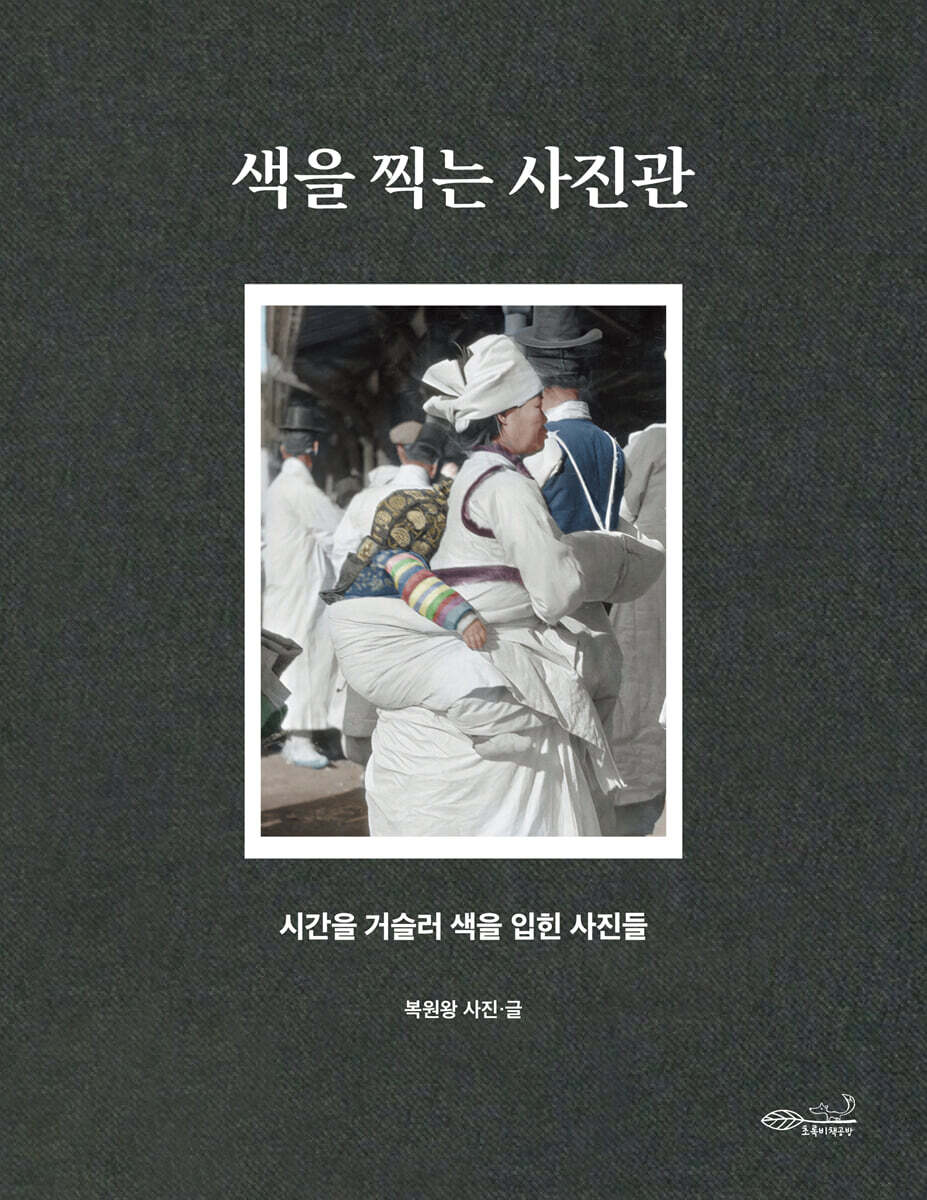
The baby's 'colorful jacket' in the book cover photo is made with the five cardinal colors to symbolize good health.
I hope that when readers touch the book cover and turn the pages, their hearts will spread like a rainbow.
And if there are any gaps in the photo, I hope you will fill in the remaining blank spaces.
When you remember the past, you become interested in history.
Wouldn't this process become a virtuous cycle connecting the past, present, and future?
This book presents photographs divided into five major periods.
From the late Joseon Dynasty, when photography was introduced as a new medium, to the Korean Empire, the Japanese colonial period, the Korean War, the 1960s, and the 1970s, when color photography began to become common.
Readers of this book become observers of the photographs and spectators of the world, and can enjoy a drama that brings a smile to their face but is also a bit heartbreaking.
Part 1) ~1909_They too lived in a vividly colored world like ours.
What must it have been like for those who first encountered the new medium of photography? The unfamiliar expressions of these unknown subjects, which must have been a wonder not only to the camera but also to the photographer, are fascinating. The expressions of wonder and a sly smile, the intense stare, are all part of the joy of reading photographs.
The photos from this time were mainly donated by missionaries, soldiers, and reporters who visited the Korean Peninsula.
Part 2) ~1945_'Then' brought back to life in the colors of reality is connected to 'now'
These are photographs that may belong to the realm of 'history', as they capture the places we live in during a time we have never lived in.
These photos were taken by foreign missionaries, soldiers, or Japanese photographers who traveled to the Korean Peninsula at the request of the Japanese Government-General of Korea.
Even in these dark times, we see people like us who live in harmony with the times.
Part 3) Korean War - Unsung Heroes, Thanks to You, We Are Here Today
These are photos taken by the US Allied Forces' photographers, capturing every aspect of the war.
Although photographs are evidence of the times, they will inevitably fade from memory someday.
Let's find out the remaining stories contained in the photographs recorded while time stood still.
Part 4) ~1969_I hope to feel the atmosphere of the times rather than reminisce about the past.
It mainly depicts the process of reconstruction after the war as a public record of the nation and society.
Rather than our desire for economic development, our image of quietly staying put is conveyed more strongly.
These photos give us hope that we can create today and tomorrow with our own hands.
Part 5) 1970~_A drama created by gathering moments from the past while imagining the future.
This is a photo that shows a scene where people are doing their best to live a comfortable life.
These photos, which show a similar yet different landscape to the present, convey the message to us of the past and to us of the future that 'tomorrow's photos will be different.'
What we want to show is a drama that says, 'This is how people lived back then.'
A porter carrying a heavy load walks beside a boy with a ponytail, staring intently straight ahead, and a tram passes between the round arches of Sungnyemun Gate, which leads to the city wall.
Also, a Joseon gentleman wearing sunglasses and holding a bear stick in his hand is walking down a street lined with electric poles, his overcoat fluttering in the wind.
This is what it looks like in a black and white photograph taken during the late Joseon Dynasty and the Korean Empire.
What colors did people wear back then, and what colors did they ride on trams? Was the world, as we see it through black-and-white photographs, achromatic to the eyes of those times? I understand the limitations of photographic technology at the time, but I'm curious. What colors are the worlds we remember filled with?
“We restore the memories we remember in color, so we restore them in color.” With this motto, YouTuber ‘Restoration King’ has been working to restore black and white photos from the past into the vivid colors of reality.
Interestingly, when you look at the 'colored' black and white photos they restored, the stuffed figures and backgrounds appear close and familiar.
Of course, not all of that work is easy.
Even a simple-looking black-and-white photo can take anywhere from 4 to 5 hours to over 20 hours to restore to color.
The preliminary research, which involves finding countless materials to describe now-vanished objects, buildings, clothing, transportation, and occupations, is perhaps more difficult than the restoration of photographs.
The 'color' photographs, completed through the arduous and tedious process of finding materials and adding colors, tell us many stories.
This feeling will be conveyed to readers as well, just like the countless subscribers to the YouTube channel who have already sympathized with it.
It's a place we live in, but it's a time we've never lived in.
A color photo album made from black and white photos
『Color Photography Studio』 adds the meaning of learning about history to the fun of looking at photos.
It is interesting to see photographs that transform achromatic colors into the natural colors of reality, but it is also meaningful to learn about the records that the photographer intended to leave behind through his or her gaze, and the small pieces of history discovered from places, people, and objects that were included even though they were not intended.
A photo of the crowds that gathered to see the tram that opened in May 1899, a photo of the first volunteer army taken in 1907 that became the motif for the drama [Mr. Sunshine], a photo of the Incheon Landing Operation showing the Allied forces arriving at the shore from a landing ship and crossing the seawall, etc. In these black and white photos where time stands still? The countless Mr. and Mrs. who became the background in the name of 'history', their history comes to us with even more meaning.
This book contains stories of people like us who, like us, are struggling through the times and trying their best to fill their lives.
Just like the YouTube comments about watching the book with your parents and talking about it, you might find your grandparents, dad, and mom's childhood in the book, or you might find yourself running around and playing in the alley.
Nowadays, anyone can easily take pictures anywhere.
However, in the past, cameras were heavy and difficult to carry, and they did not click, so photographers had to stay in the same position for a long time, and photographers also needed skills.
Even after film cameras came out, there was a time when developing photos took a long time and even if the film was full, photos that weren't good weren't developed.
This book is an album that was carefully created one by one to find the colors of the surviving black and white photographs.
The baby's 'colorful jacket' in the book cover photo is made with the five cardinal colors to symbolize good health.
I hope that when readers touch the book cover and turn the pages, their hearts will spread like a rainbow.
And if there are any gaps in the photo, I hope you will fill in the remaining blank spaces.
When you remember the past, you become interested in history.
Wouldn't this process become a virtuous cycle connecting the past, present, and future?
This book presents photographs divided into five major periods.
From the late Joseon Dynasty, when photography was introduced as a new medium, to the Korean Empire, the Japanese colonial period, the Korean War, the 1960s, and the 1970s, when color photography began to become common.
Readers of this book become observers of the photographs and spectators of the world, and can enjoy a drama that brings a smile to their face but is also a bit heartbreaking.
Part 1) ~1909_They too lived in a vividly colored world like ours.
What must it have been like for those who first encountered the new medium of photography? The unfamiliar expressions of these unknown subjects, which must have been a wonder not only to the camera but also to the photographer, are fascinating. The expressions of wonder and a sly smile, the intense stare, are all part of the joy of reading photographs.
The photos from this time were mainly donated by missionaries, soldiers, and reporters who visited the Korean Peninsula.
Part 2) ~1945_'Then' brought back to life in the colors of reality is connected to 'now'
These are photographs that may belong to the realm of 'history', as they capture the places we live in during a time we have never lived in.
These photos were taken by foreign missionaries, soldiers, or Japanese photographers who traveled to the Korean Peninsula at the request of the Japanese Government-General of Korea.
Even in these dark times, we see people like us who live in harmony with the times.
Part 3) Korean War - Unsung Heroes, Thanks to You, We Are Here Today
These are photos taken by the US Allied Forces' photographers, capturing every aspect of the war.
Although photographs are evidence of the times, they will inevitably fade from memory someday.
Let's find out the remaining stories contained in the photographs recorded while time stood still.
Part 4) ~1969_I hope to feel the atmosphere of the times rather than reminisce about the past.
It mainly depicts the process of reconstruction after the war as a public record of the nation and society.
Rather than our desire for economic development, our image of quietly staying put is conveyed more strongly.
These photos give us hope that we can create today and tomorrow with our own hands.
Part 5) 1970~_A drama created by gathering moments from the past while imagining the future.
This is a photo that shows a scene where people are doing their best to live a comfortable life.
These photos, which show a similar yet different landscape to the present, convey the message to us of the past and to us of the future that 'tomorrow's photos will be different.'
GOODS SPECIFICS
- Date of issue: May 30, 2023
- Format: Hardcover book binding method guide
- Page count, weight, size: 320 pages | 1,054g | 170*220*28mm
- ISBN13: 9791191266795
- ISBN10: 1191266796
You may also like
카테고리
korean


korean

![GQ KOREA Mark (Monthly): December [2025]](http://librairie.coreenne.fr/cdn/shop/files/8ef265dbbfbf186523ed75ba7319009d.jpg?v=1765340328&width=3840)


