

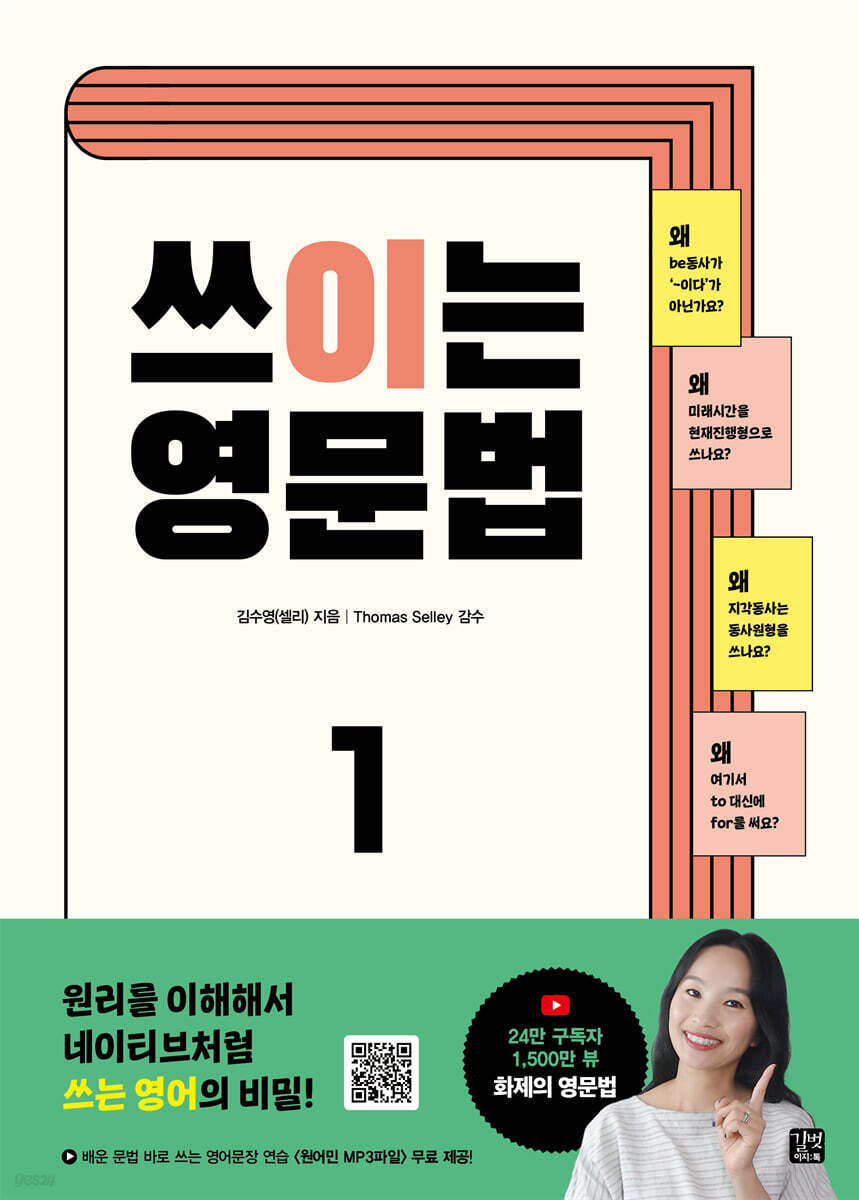
English Grammar in Use 1
 |
Description
Book Introduction
240,000 subscribers! 15 million views! The popular English grammar lecture is finally published as a book!! {The Secret to Writing English Like a Native by Understanding the Principles} Adult English learning requires going beyond "What?" to "Why?" before it can be fully absorbed as knowledge. Even if you learn grammar, you can't actually use it in real life because you just memorized the formulas without understanding the why? This book clearly explains the principles of English, such as “why this grammar rule should be applied here,” so you can learn English grammar that is actually used in English conversation and writing. It provides refreshing answers to the questions, “Why are we suddenly using the present perfect here?” instead of “What is the present perfect?”, “Why do we use the infinitive for the verb of perception?” instead of “What is the verb of perception?”, and “Why do we use for instead of to?” instead of “What is the preposition used here?” The author, who used to be a star instructor at a large academy in Gangnam and runs the English education YouTube channel “Writing English” with 240,000 subscribers, has accumulated “big data on English mistakes” among Koreans by editing 100 to 200 English writing assignments every day and answering various English questions from students. As a veteran surgeon with extensive surgical experience, I have learned through 15 years of teaching experience, over 200,000 English mistakes, and countless questions received in class, via email, and through social media that I know where English learners are most vulnerable and what English is truly useful to them. Based on this, I compiled and organized 'English grammar that is actually used when speaking and writing English' in an easy and detailed manner, and, together with American linguist Thomas Selley, analyzed the differences between English and Korean from a linguistic and cultural perspective to complete a grammar book that contains 'the secret to writing English like a native by understanding the principles.' I highly recommend this to anyone who wants to learn grammar from the basics and has had difficulty applying the grammar they have learned in real life. The English Grammar Used consists of Volumes 1 and 2. Volume 1 covers understanding English sentences and verbs, English tenses, moods, voices, verb changes, and auxiliary verbs. Volume 2 covers conjunctions, articles and nouns, adjectives, adverbs, comparatives, and prepositions. If you search for the title of the book (English Grammar Used) on the publisher's website (www.gilbut.co.kr), you will be provided with a free "Native Speaker MP3 file" that allows you to practice using English sentences using the grammar you have learned. You can also listen to the file by scanning the QR code in the text of the book. |
- You can preview some of the book's contents.
Preview
index
{ CHAPTER 1.
Understanding English Sentences and Verbs
LESSON 1_ The Differences Between Korean and English That Will Make English Easier to Understand
Point 1 | In Korean, it's waist, in English, it's tail!
〈Tip〉The most basic way to expand your English sentences is with the "Tick-Tick" technique.
Review 1 I Practice English by Using Grammar You've Learned
Point 2 | The position of words is extremely important in English.
〈Tip〉Verbs without objects and verbs with objects
Review 2 I Practice English by Using Grammar You've Learned
LESSON 2_ Blocks that make up the word "English" that is different from Korean
Point 1 | Sentence Components
Point 2 | English Parts of Speech
Point 3 | What is a phrase?
Point 4 | What is a clause?
Review I English practice using the grammar you learned
LESSON 3_ The true meaning and role of the verb "be" that will solve half of your English frustrations
Point 1 | Don't memorize 'be verb = ~'
Point 2 | The Unique Role of the "Be" Verb
Point 3 | Things you can only understand after learning the verb "be"
Point 4 | The Pros and Cons of the "be" Verb Finally Revealed
Point 5 | How to overcome the shortcomings of the "be" verb
Point 6 | Things to be careful of when using regular verbs as linking verbs
〈Tip〉The verb be fills the empty space of a verb, and the pronoun it fills the empty space of a noun.
Review I English practice using the grammar you learned
LESSON 4_ 5 New Types of Understanding That Will Open Your Eyes to English
Point 1 | You are perfect even without an object, Form 1: Subject + Intransitive Verb
Point 2 | The unique 2-form with the verb "be": subject + linking verb + nominative complement
Review 1 I Practice English by Using Grammar You've Learned
Point 3 | The three-form sentence that requires an object to be complete: Subject + Transitive Verb + Object
〈Tip〉'~을/를' is not a word that indicates an object!
Point 4 | 4th form with two objects in a row: Subject + transitive verb + (indirect) object + (direct) object
Review 2 I Practice English by Using Grammar You've Learned
Point 5 | Form 5, which fills in the gaps of Form 3: Subject + Transitive Verb + Object + Objective Complement
Review 3 I English practice using the grammar you learned
LESSON 5_ Understanding the Real Principles Makes English Practical: Understanding Perceptual Verbs
Point 1 | The Special Features of Verbs of Perception
Point 2 | Why the sentence structure of perceptual verbs must be 〈subject + verb + object + verb infinitive〉
Point 3 | Changes in sentence structure due to differences in meaning
Point 4 | Subject + Verb + Object + Infinitive vs.
Subject + verb + object + present participle (Ving)
Point 5 | Subject + Verb + Object + Past Participle
Review I English practice using the grammar you learned
LESSON 6_ Understanding the Real Principles Makes English Practical: Understanding Causative Verbs
Point 1 | What is the exact meaning of 'causative verb' in English?
Point 2 | Why do causative verbs have the sentence structure of “subject + verb + object + verb infinitive”?
Point 3 | Why You Shouldn't Memorize the Verb "Have" as "Sikida"
Point 4 | Comparing the Nuance Differences of the Causative Verbs Have, Make, Let, and Help
Point 5 | Common verbs that can be used in place of have to mean 'to order'
Review I English practice using the grammar you learned
{ CHAPTER 2.
English tenses
LESSON 1_ A general understanding of English tenses that will deepen your understanding of English.
Point 1 | There are two tenses in English.
Point 2 | How to Express Future Events in English
Point 3 | So what does 'hyung (progressive, perfect)' mean in English?
Point 4 | When the tense and time do not match
Review I English practice using the grammar you learned
LESSON 2_ There are only two tenses in English: present and past tense.
Point 1 | The Core of the Simple Present Tense
Point 2 | Various Uses of the Simple Present Tense
Point 3 | The Core of the Simple Past Tense
Point 4 | Various Uses of the Simple Past Tense
〈Tip〉How to Create Polite and Courteous Expressions in English
〈Tip〉Tense agreement: something you should have learned a long time ago
Review I English practice using the grammar you learned
LESSON 3_ will vs.
be going to V vs.
be Ving Devices indicating future time
Point 1 | The most common verb to indicate future events, will
Point 2 | be going to V indicating future events
Point 3 | be going to V vs. to indicate planned future events
be Ving
Point 4 | will vs.
be going to V vs.
be Ving meaning difference
Point 5 | Will be Ving indicating future time
Review I English practice using the grammar you learned
LESSON 4_ Understanding the 'aspect' of English makes writing in English much easier.
Point 1 | There are two types of 'hyeong' in English: progressive and perfect.
Point 2 | The Principle of 'Progressive' Sentence Structure
Point 3 | Core Concepts of the Present Progressive Tense
〈Tip〉There are cases where the progressive tense is not possible.
Point 4 | Comparison of the Simple Present Tense and the Present Progressive Tense
Point 5 | Various Uses of the Present Progressive Tense
〈Tip〉〈be+adjective〉 can also be in the progressive tense!
Point 6 | Core Concepts of the Past Progressive Tense
Point 7 | Comparison of Simple Past Tense and Past Progressive Tense
Point 8 | Various Uses of the Past Progressive Tense
Review 1 I Practice English by Using Grammar You've Learned
Point 9 | Core Concepts of the Present Perfect Tense
POINT 10 I Comparison of Simple Past Tense and Present Perfect
〈Tip〉The Difference Between the Past Tense and Present Perfect Tense Used by Native Speakers, Which Confuses Koreans
POINT 11 I Various uses of the present perfect tense
POINT 12 I Core Concepts of the Present Perfect Progressive
〈FAQ〉I'm so confused about when to use the present perfect tense and when to use the present perfect progressive tense.
POINT 13 I Core Concepts of the Past Perfect Tense
〈Tip〉Be sure to remember this when using the past perfect tense!
POINT 14 I Various uses of the past perfect tense
Review 2 I Practice English by Using Grammar You've Learned
{ CHAPTER 3.
English 'law'}
LESSON 1_ There are three types of "laws" in English: Indicative, Imperative, and Subjunctive.
Point 1 | What is the English word 'law'?
Point 2 | The indicative mood that matches facts and tenses
Point 3 | Imperative sentences that assume the other person will follow what I say.
Point 4 | The subjunctive mood, which shows that the possibility is low by dropping the tense
〈Tip〉Why Koreans are often mistaken for being rude when speaking English
Review I English practice using the grammar you learned
LESSON 2_ Understanding the burdensome conditional sentences used in real life
Point 1 | Not all sentences with an if clause are conditional.
Point 2 | Conditional Mood: When stating the opposite of the present fact
Point 3 | Conditional Mood: When recounting past events in reverse
Point 4 | Subjunctive: When the Opposite of a Past Fact Has Present Implications
Point 5 | Sometimes the if clause is omitted in the conditional sentence.
〈Tip〉Not all hopes are the same! hope vs.
wish
Review I English practice using the grammar you learned
{ CHAPTER 4.
English 'tae'
LESSON 1: What is 'Voice' in English? Active and Passive Voice
Point 1 | What is 'tae' in English?
Point 2 | Characteristics of Verbs Used in the Passive Voice
Point 3 | Even the same verb can change its active/passive voice depending on its meaning.
〈Tip〉worry vs. worry
be worried
Review I English practice using the grammar you learned
LESSON 2_ Understanding the passive voice: When to use it
Point 1 | Passive Sentence Structure Principles
Point 2 | Diversifying the Passive Voice's Meaning by Using Linking Verbs Instead of the "Be" Verb
Point 3 | Don't just memorize "be+pp+by noun"
Point 4 | There's a reason for using the passive voice.
Point 5 | Passive voice in a four-form sentence structure with two objects
〈Tip〉When creating passive voice, please consider whether there is any possibility of misunderstanding in the meaning.
Point 6 | Passive voice in sentence structure 5 with objective complement
〈Tip〉Understanding the Passive Voice of Causative Verbs That No One Taught You
Review I English practice using the grammar you learned
{ CHAPTER 5.
} Conjugation of verbs
LESSON 1_ A quick overview of the English part of speech transformations for eating and frying what you have
Point 1 | Various Ways to Change Parts of Speech
LESSON 2_ Understanding the ubiquitous to-infinitive
Point 1 | Understanding the Basic Concept of the To-Infinitive
Point 2 | To-Infinitive as a Noun: Subject Role
〈Tip〉Don't just memorize formulas, understand sentence structure!
Point 3 | To-Infinitive as a Noun: Acting as an Object
〈Tip〉If the object is too long, you can move it to the back.
Point 4 | To-Infinitive as a Noun: Functioning as a Complement
Point 5 | The to-infinitive as an adjective: Modifying nouns
Point 6 | To-infinitive used with interrogatives: interrogative + to-infinitive
〈Tip〉How to say 'method' in English how to V vs.
to V vs.
a way vs.
method
Point 7 | The to-infinitive as an adverb: Expressing the purpose of an action
〈Tip〉The in order to V is too important to be simply emphasized as a purpose.
Point 8 | To-infinitive as an adverb: Expressing result, reason, or degree
Review I English practice using the grammar you learned
LESSON 3_ Understanding the ubiquitous use of gerunds
Point 1 | Understanding the Basic Concept of Gerunds
Point 2 | Comparing the characteristics of infinitives and gerunds
Point 3 | Gerunds as Subjects
Point 4 | Gerunds as Nominative Complements
Point 5 | Gerunds as Objects
〈Tip〉Indicating the subject of a gerund according to its meaning
Point 6 | Changes in the meaning of to-infinitives and gerunds used as objects
〈Tip〉The objects of like, love, and hate must be chosen according to the meaning. 〈to-infinitive vs.
gerund>
Review I English practice using the grammar you learned
LESSON 4_ A Look at Participles Used in Various Places
Point 1 | Understanding the Basic Concept of Present Participles
Point 2 | Understanding the Basic Concept of Past Participles
〈Tip〉Direct action vs.
Actions done at the behest of one
Point 3 | Understanding the Core Concepts of Participle Phrases
〈Tip〉when/while Ving vs.
before/after Ving
Point 4 | Don't be confused by similar shapes! Distinguishing between gerunds and present participles
〈Tip〉~without vs.
~ as it is
Review I English practice using the grammar you learned
Point 5 | Irregular Verb Table
{ CHAPTER 6.
auxiliary verb}
LESSON 1_ English Features You Need to Know to Understand Auxiliary Verbs
Point 1 | English reflects a lower probability of occurrence by lowering the tense.
Point 2 | There are two main types of auxiliary verbs in English.
Review I English practice using the grammar you learned
LESSON 2_ You need to know the nuance to use it freely: auxiliary verbs of guessing and judging
Point 1 | The auxiliary verb must for logical inference and judgment
Point 2 | My guess should be correct for me to be normal
〈Tip〉The auxiliary verb will is different from the must in guessing.
〈Tip〉In the same situation, other auxiliary verbs are also used.
Point 3 | May and might, which are used to speculate on possible events and talk about possibilities.
Point 4 | Could suggests a possibility that could occur
Point 5 | The Basic Concept of Auxiliary Verbs that Reflect on Past Events and Make Inferences
Point 6 | The Use of Various Auxiliary Verbs to Infer Past Events
Review I English practice using the grammar you learned
LESSON 3_ You need to know the nuance to use it freely. Auxiliary verbs of psychological attitude.
Point 1 | Will, indicating strong will
Point 2 | must, indicating a strong obligation
Point 3 | The difference between must and have to V
Point 4 | The difference in meaning between "must not" and "don't have to"
〈Tip〉Purified expressions of must/have to V that can be unpleasant if said incorrectly
Point 5 | Should indicating a soft obligation
〈Tip〉Be supposed to V indicating obligation
〈Tip〉had better V indicating obligation
Point 6 | Can indicating ability
Point 7 | Limitations of can and Solutions
〈Tip〉Why do native speakers use could instead of can?
〈Tip〉can / be able to V / be capable of Organize in one go
Point 8 | Permission Auxiliary Verbs may/can/could
Point 9 | Basic Concepts of Auxiliary Verbs Expressing Present Psychological Attitudes About Past Events
I POINT 10 I The use of various auxiliary verbs to express present psychological attitudes toward past events
〈Tip〉Why is would, which has the same interpretation as will, used so often?
〈Tip〉Would you ~? is not an expression of request.
〈FAQ〉What is the difference between would and used to V, which indicate repetitive actions in the past?
Review I English practice using the grammar you learned
ANSWER Model Answer
Understanding English Sentences and Verbs
LESSON 1_ The Differences Between Korean and English That Will Make English Easier to Understand
Point 1 | In Korean, it's waist, in English, it's tail!
〈Tip〉The most basic way to expand your English sentences is with the "Tick-Tick" technique.
Review 1 I Practice English by Using Grammar You've Learned
Point 2 | The position of words is extremely important in English.
〈Tip〉Verbs without objects and verbs with objects
Review 2 I Practice English by Using Grammar You've Learned
LESSON 2_ Blocks that make up the word "English" that is different from Korean
Point 1 | Sentence Components
Point 2 | English Parts of Speech
Point 3 | What is a phrase?
Point 4 | What is a clause?
Review I English practice using the grammar you learned
LESSON 3_ The true meaning and role of the verb "be" that will solve half of your English frustrations
Point 1 | Don't memorize 'be verb = ~'
Point 2 | The Unique Role of the "Be" Verb
Point 3 | Things you can only understand after learning the verb "be"
Point 4 | The Pros and Cons of the "be" Verb Finally Revealed
Point 5 | How to overcome the shortcomings of the "be" verb
Point 6 | Things to be careful of when using regular verbs as linking verbs
〈Tip〉The verb be fills the empty space of a verb, and the pronoun it fills the empty space of a noun.
Review I English practice using the grammar you learned
LESSON 4_ 5 New Types of Understanding That Will Open Your Eyes to English
Point 1 | You are perfect even without an object, Form 1: Subject + Intransitive Verb
Point 2 | The unique 2-form with the verb "be": subject + linking verb + nominative complement
Review 1 I Practice English by Using Grammar You've Learned
Point 3 | The three-form sentence that requires an object to be complete: Subject + Transitive Verb + Object
〈Tip〉'~을/를' is not a word that indicates an object!
Point 4 | 4th form with two objects in a row: Subject + transitive verb + (indirect) object + (direct) object
Review 2 I Practice English by Using Grammar You've Learned
Point 5 | Form 5, which fills in the gaps of Form 3: Subject + Transitive Verb + Object + Objective Complement
Review 3 I English practice using the grammar you learned
LESSON 5_ Understanding the Real Principles Makes English Practical: Understanding Perceptual Verbs
Point 1 | The Special Features of Verbs of Perception
Point 2 | Why the sentence structure of perceptual verbs must be 〈subject + verb + object + verb infinitive〉
Point 3 | Changes in sentence structure due to differences in meaning
Point 4 | Subject + Verb + Object + Infinitive vs.
Subject + verb + object + present participle (Ving)
Point 5 | Subject + Verb + Object + Past Participle
Review I English practice using the grammar you learned
LESSON 6_ Understanding the Real Principles Makes English Practical: Understanding Causative Verbs
Point 1 | What is the exact meaning of 'causative verb' in English?
Point 2 | Why do causative verbs have the sentence structure of “subject + verb + object + verb infinitive”?
Point 3 | Why You Shouldn't Memorize the Verb "Have" as "Sikida"
Point 4 | Comparing the Nuance Differences of the Causative Verbs Have, Make, Let, and Help
Point 5 | Common verbs that can be used in place of have to mean 'to order'
Review I English practice using the grammar you learned
{ CHAPTER 2.
English tenses
LESSON 1_ A general understanding of English tenses that will deepen your understanding of English.
Point 1 | There are two tenses in English.
Point 2 | How to Express Future Events in English
Point 3 | So what does 'hyung (progressive, perfect)' mean in English?
Point 4 | When the tense and time do not match
Review I English practice using the grammar you learned
LESSON 2_ There are only two tenses in English: present and past tense.
Point 1 | The Core of the Simple Present Tense
Point 2 | Various Uses of the Simple Present Tense
Point 3 | The Core of the Simple Past Tense
Point 4 | Various Uses of the Simple Past Tense
〈Tip〉How to Create Polite and Courteous Expressions in English
〈Tip〉Tense agreement: something you should have learned a long time ago
Review I English practice using the grammar you learned
LESSON 3_ will vs.
be going to V vs.
be Ving Devices indicating future time
Point 1 | The most common verb to indicate future events, will
Point 2 | be going to V indicating future events
Point 3 | be going to V vs. to indicate planned future events
be Ving
Point 4 | will vs.
be going to V vs.
be Ving meaning difference
Point 5 | Will be Ving indicating future time
Review I English practice using the grammar you learned
LESSON 4_ Understanding the 'aspect' of English makes writing in English much easier.
Point 1 | There are two types of 'hyeong' in English: progressive and perfect.
Point 2 | The Principle of 'Progressive' Sentence Structure
Point 3 | Core Concepts of the Present Progressive Tense
〈Tip〉There are cases where the progressive tense is not possible.
Point 4 | Comparison of the Simple Present Tense and the Present Progressive Tense
Point 5 | Various Uses of the Present Progressive Tense
〈Tip〉〈be+adjective〉 can also be in the progressive tense!
Point 6 | Core Concepts of the Past Progressive Tense
Point 7 | Comparison of Simple Past Tense and Past Progressive Tense
Point 8 | Various Uses of the Past Progressive Tense
Review 1 I Practice English by Using Grammar You've Learned
Point 9 | Core Concepts of the Present Perfect Tense
POINT 10 I Comparison of Simple Past Tense and Present Perfect
〈Tip〉The Difference Between the Past Tense and Present Perfect Tense Used by Native Speakers, Which Confuses Koreans
POINT 11 I Various uses of the present perfect tense
POINT 12 I Core Concepts of the Present Perfect Progressive
〈FAQ〉I'm so confused about when to use the present perfect tense and when to use the present perfect progressive tense.
POINT 13 I Core Concepts of the Past Perfect Tense
〈Tip〉Be sure to remember this when using the past perfect tense!
POINT 14 I Various uses of the past perfect tense
Review 2 I Practice English by Using Grammar You've Learned
{ CHAPTER 3.
English 'law'}
LESSON 1_ There are three types of "laws" in English: Indicative, Imperative, and Subjunctive.
Point 1 | What is the English word 'law'?
Point 2 | The indicative mood that matches facts and tenses
Point 3 | Imperative sentences that assume the other person will follow what I say.
Point 4 | The subjunctive mood, which shows that the possibility is low by dropping the tense
〈Tip〉Why Koreans are often mistaken for being rude when speaking English
Review I English practice using the grammar you learned
LESSON 2_ Understanding the burdensome conditional sentences used in real life
Point 1 | Not all sentences with an if clause are conditional.
Point 2 | Conditional Mood: When stating the opposite of the present fact
Point 3 | Conditional Mood: When recounting past events in reverse
Point 4 | Subjunctive: When the Opposite of a Past Fact Has Present Implications
Point 5 | Sometimes the if clause is omitted in the conditional sentence.
〈Tip〉Not all hopes are the same! hope vs.
wish
Review I English practice using the grammar you learned
{ CHAPTER 4.
English 'tae'
LESSON 1: What is 'Voice' in English? Active and Passive Voice
Point 1 | What is 'tae' in English?
Point 2 | Characteristics of Verbs Used in the Passive Voice
Point 3 | Even the same verb can change its active/passive voice depending on its meaning.
〈Tip〉worry vs. worry
be worried
Review I English practice using the grammar you learned
LESSON 2_ Understanding the passive voice: When to use it
Point 1 | Passive Sentence Structure Principles
Point 2 | Diversifying the Passive Voice's Meaning by Using Linking Verbs Instead of the "Be" Verb
Point 3 | Don't just memorize "be+pp+by noun"
Point 4 | There's a reason for using the passive voice.
Point 5 | Passive voice in a four-form sentence structure with two objects
〈Tip〉When creating passive voice, please consider whether there is any possibility of misunderstanding in the meaning.
Point 6 | Passive voice in sentence structure 5 with objective complement
〈Tip〉Understanding the Passive Voice of Causative Verbs That No One Taught You
Review I English practice using the grammar you learned
{ CHAPTER 5.
} Conjugation of verbs
LESSON 1_ A quick overview of the English part of speech transformations for eating and frying what you have
Point 1 | Various Ways to Change Parts of Speech
LESSON 2_ Understanding the ubiquitous to-infinitive
Point 1 | Understanding the Basic Concept of the To-Infinitive
Point 2 | To-Infinitive as a Noun: Subject Role
〈Tip〉Don't just memorize formulas, understand sentence structure!
Point 3 | To-Infinitive as a Noun: Acting as an Object
〈Tip〉If the object is too long, you can move it to the back.
Point 4 | To-Infinitive as a Noun: Functioning as a Complement
Point 5 | The to-infinitive as an adjective: Modifying nouns
Point 6 | To-infinitive used with interrogatives: interrogative + to-infinitive
〈Tip〉How to say 'method' in English how to V vs.
to V vs.
a way vs.
method
Point 7 | The to-infinitive as an adverb: Expressing the purpose of an action
〈Tip〉The in order to V is too important to be simply emphasized as a purpose.
Point 8 | To-infinitive as an adverb: Expressing result, reason, or degree
Review I English practice using the grammar you learned
LESSON 3_ Understanding the ubiquitous use of gerunds
Point 1 | Understanding the Basic Concept of Gerunds
Point 2 | Comparing the characteristics of infinitives and gerunds
Point 3 | Gerunds as Subjects
Point 4 | Gerunds as Nominative Complements
Point 5 | Gerunds as Objects
〈Tip〉Indicating the subject of a gerund according to its meaning
Point 6 | Changes in the meaning of to-infinitives and gerunds used as objects
〈Tip〉The objects of like, love, and hate must be chosen according to the meaning. 〈to-infinitive vs.
gerund>
Review I English practice using the grammar you learned
LESSON 4_ A Look at Participles Used in Various Places
Point 1 | Understanding the Basic Concept of Present Participles
Point 2 | Understanding the Basic Concept of Past Participles
〈Tip〉Direct action vs.
Actions done at the behest of one
Point 3 | Understanding the Core Concepts of Participle Phrases
〈Tip〉when/while Ving vs.
before/after Ving
Point 4 | Don't be confused by similar shapes! Distinguishing between gerunds and present participles
〈Tip〉~without vs.
~ as it is
Review I English practice using the grammar you learned
Point 5 | Irregular Verb Table
{ CHAPTER 6.
auxiliary verb}
LESSON 1_ English Features You Need to Know to Understand Auxiliary Verbs
Point 1 | English reflects a lower probability of occurrence by lowering the tense.
Point 2 | There are two main types of auxiliary verbs in English.
Review I English practice using the grammar you learned
LESSON 2_ You need to know the nuance to use it freely: auxiliary verbs of guessing and judging
Point 1 | The auxiliary verb must for logical inference and judgment
Point 2 | My guess should be correct for me to be normal
〈Tip〉The auxiliary verb will is different from the must in guessing.
〈Tip〉In the same situation, other auxiliary verbs are also used.
Point 3 | May and might, which are used to speculate on possible events and talk about possibilities.
Point 4 | Could suggests a possibility that could occur
Point 5 | The Basic Concept of Auxiliary Verbs that Reflect on Past Events and Make Inferences
Point 6 | The Use of Various Auxiliary Verbs to Infer Past Events
Review I English practice using the grammar you learned
LESSON 3_ You need to know the nuance to use it freely. Auxiliary verbs of psychological attitude.
Point 1 | Will, indicating strong will
Point 2 | must, indicating a strong obligation
Point 3 | The difference between must and have to V
Point 4 | The difference in meaning between "must not" and "don't have to"
〈Tip〉Purified expressions of must/have to V that can be unpleasant if said incorrectly
Point 5 | Should indicating a soft obligation
〈Tip〉Be supposed to V indicating obligation
〈Tip〉had better V indicating obligation
Point 6 | Can indicating ability
Point 7 | Limitations of can and Solutions
〈Tip〉Why do native speakers use could instead of can?
〈Tip〉can / be able to V / be capable of Organize in one go
Point 8 | Permission Auxiliary Verbs may/can/could
Point 9 | Basic Concepts of Auxiliary Verbs Expressing Present Psychological Attitudes About Past Events
I POINT 10 I The use of various auxiliary verbs to express present psychological attitudes toward past events
〈Tip〉Why is would, which has the same interpretation as will, used so often?
〈Tip〉Would you ~? is not an expression of request.
〈FAQ〉What is the difference between would and used to V, which indicate repetitive actions in the past?
Review I English practice using the grammar you learned
ANSWER Model Answer
Detailed image

Publisher's Review
Composition and Usage
{Listen to the MP3 file: English Grammar for Listening and Speaking in English}
Grammar is not something you memorize; you have to be able to actually use it when speaking and writing English.
So, all the examples in this book were recorded by native English speakers.
Don't just look at it; study English grammar by listening to it with your ears and repeating it with your mouth.
{Challenge: Knowing yourself is the beginning of learning English!}
Before starting the lesson, we'll have a simple quiz to keep you focused and interested, and to check how well you understand the English grammar you'll be learning.
When a problem is difficult, it is a good idea to try it again after finishing the lesson.
{Why: Why should I learn this grammar rule?}
Adult English must satisfy Why.
Knowing why this grammar is necessary when writing English will definitely help you understand the concepts better than just memorizing the formulas.
Of course, learning efficiency improves because the purpose of learning becomes clear!
{Point: Understand the principles and use English grammar correctly}
A revolutionary English grammar that transforms your wardrobe English into practical English! Rather than listing obvious formulas, it logically and step-by-step explains the differences between Korean and English, starting with why native speakers use and utilize this grammar.
All examples are made up of sentences that native speakers frequently use in real life, so that you can immediately apply the grammar you've learned in real life.
{Tip&FAQ: English Grammar Tips to Avoid Mistakes and Solve Problems}
We've compiled the most confusing and frequently mistaken grammar mistakes Koreans make from a big data set of 200,000 English mistakes into tips with clear explanations.
We've compiled answers to the most common grammar-related questions English learners have in our FAQ.
{Review: Practice using the grammar you've learned in real-life English}
Even if you think you know everything when you read grammar explanations, when you try to apply them in real-life situations, it's not as easy as you'd like. Practice Makes Perfect! Through speaking and writing practice, you can turn your previously half-understood grammar into a fully functional and fluent part of your own!
* Study with the author's YouTube channel, "Writing English"!
With 240,000 subscribers and 15 million views, the popular English grammar YouTube channel "Writing English" offers a variety of grammar videos and additional learning content.
Recommendation
Have you ever been this focused during English class in school?
I feel a lightbulb go off in my head.
_Botari
Looking at Selysam's English grammar
After 40 years of graduation, the concept of English is clear!
_James
This is the answer from someone who studied linguistics.
I saw it twice!
There has never been a grammar like this before!!!
_Kwon Seok
What have I learned so far... That's why my English is always at the same levelㅠㅠ
Thank you so much for teaching me such great grammar!
_Angel Mark
Wow, I feel so relieved!
This is the first time in my life that I feel like studying!
_nami
The content is really good, and the essence of English is fully incorporated.
Easy to understand, grammar points and writing practice all in one place!
_Herb
* The following recommendations are excerpted and edited from the comments on the YouTube video “Writing English.”
* You can find conjunctions, articles and nouns, adjectives, adverbs, comparatives, and prepositions in 《English Grammar in Use 2》.
{Listen to the MP3 file: English Grammar for Listening and Speaking in English}
Grammar is not something you memorize; you have to be able to actually use it when speaking and writing English.
So, all the examples in this book were recorded by native English speakers.
Don't just look at it; study English grammar by listening to it with your ears and repeating it with your mouth.
{Challenge: Knowing yourself is the beginning of learning English!}
Before starting the lesson, we'll have a simple quiz to keep you focused and interested, and to check how well you understand the English grammar you'll be learning.
When a problem is difficult, it is a good idea to try it again after finishing the lesson.
{Why: Why should I learn this grammar rule?}
Adult English must satisfy Why.
Knowing why this grammar is necessary when writing English will definitely help you understand the concepts better than just memorizing the formulas.
Of course, learning efficiency improves because the purpose of learning becomes clear!
{Point: Understand the principles and use English grammar correctly}
A revolutionary English grammar that transforms your wardrobe English into practical English! Rather than listing obvious formulas, it logically and step-by-step explains the differences between Korean and English, starting with why native speakers use and utilize this grammar.
All examples are made up of sentences that native speakers frequently use in real life, so that you can immediately apply the grammar you've learned in real life.
{Tip&FAQ: English Grammar Tips to Avoid Mistakes and Solve Problems}
We've compiled the most confusing and frequently mistaken grammar mistakes Koreans make from a big data set of 200,000 English mistakes into tips with clear explanations.
We've compiled answers to the most common grammar-related questions English learners have in our FAQ.
{Review: Practice using the grammar you've learned in real-life English}
Even if you think you know everything when you read grammar explanations, when you try to apply them in real-life situations, it's not as easy as you'd like. Practice Makes Perfect! Through speaking and writing practice, you can turn your previously half-understood grammar into a fully functional and fluent part of your own!
* Study with the author's YouTube channel, "Writing English"!
With 240,000 subscribers and 15 million views, the popular English grammar YouTube channel "Writing English" offers a variety of grammar videos and additional learning content.
Recommendation
Have you ever been this focused during English class in school?
I feel a lightbulb go off in my head.
_Botari
Looking at Selysam's English grammar
After 40 years of graduation, the concept of English is clear!
_James
This is the answer from someone who studied linguistics.
I saw it twice!
There has never been a grammar like this before!!!
_Kwon Seok
What have I learned so far... That's why my English is always at the same levelㅠㅠ
Thank you so much for teaching me such great grammar!
_Angel Mark
Wow, I feel so relieved!
This is the first time in my life that I feel like studying!
_nami
The content is really good, and the essence of English is fully incorporated.
Easy to understand, grammar points and writing practice all in one place!
_Herb
* The following recommendations are excerpted and edited from the comments on the YouTube video “Writing English.”
* You can find conjunctions, articles and nouns, adjectives, adverbs, comparatives, and prepositions in 《English Grammar in Use 2》.
GOODS SPECIFICS
- Date of issue: May 30, 2023
- Page count, weight, size: 292 pages | 674g | 174*243*20mm
- ISBN13: 9791140703951
You may also like
카테고리
korean


korean

![GQ KOREA Mark (Monthly): December [2025]](http://librairie.coreenne.fr/cdn/shop/files/8ef265dbbfbf186523ed75ba7319009d.jpg?v=1765340328&width=3840)


