

Korean language book: middle school literature
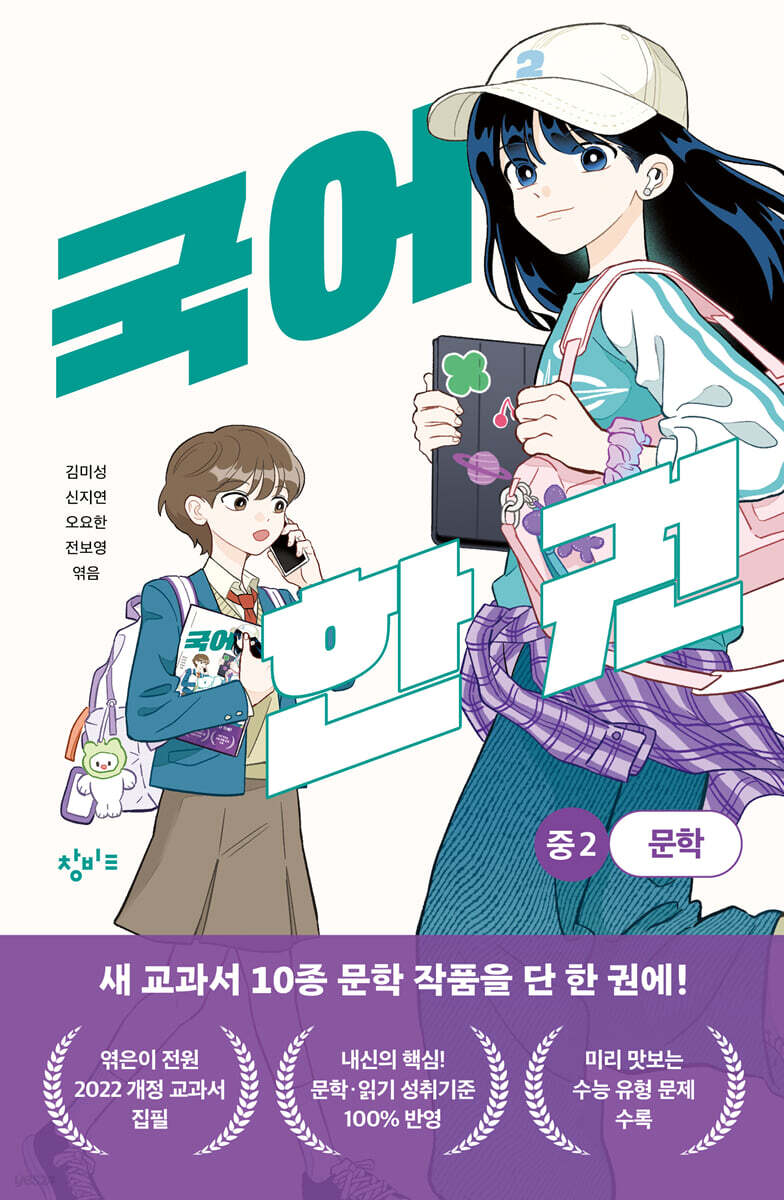 |
Description
Book Introduction
The authors of the comprehensively revised middle school Korean language textbook respond.
Studying Korean? Let's start with the textbooks!
In 2025, the textbooks changed.
Starting from the first year of middle school, students will study using newly compiled textbooks according to the 2022 revised curriculum.
In 2026, second-year middle school students will study using new textbooks.
For second-year middle school students and their parents, who are increasingly burdened by the demands of learning in a changing learning environment, the revised textbooks are bound to be another source of concern.
Accordingly, Changbi Education, a Korean language education publishing company that has continued the myth of 100% passing rate with its black textbooks, is introducing 'One Korean Book' to help middle school students easily prepare for middle school Korean language.
'One Korean Book' contains literary and non-literary works from 10 Korean language textbooks, one volume each.
Although the ten textbooks each contain different texts, the criteria for selecting the works are the same.
This is because any textbook must include works that meet the 'achievement standards' according to the changed curriculum.
'One Korean Book' took note of this and carefully selected hundreds of works from 10 textbooks to meet achievement standards.
Additionally, current Korean language teachers who compiled the revised middle school textbooks directly participated in selecting works, planning activities, and creating problems, further enhancing their expertise and practicality.
Studying Korean? Let's start with the textbooks!
In 2025, the textbooks changed.
Starting from the first year of middle school, students will study using newly compiled textbooks according to the 2022 revised curriculum.
In 2026, second-year middle school students will study using new textbooks.
For second-year middle school students and their parents, who are increasingly burdened by the demands of learning in a changing learning environment, the revised textbooks are bound to be another source of concern.
Accordingly, Changbi Education, a Korean language education publishing company that has continued the myth of 100% passing rate with its black textbooks, is introducing 'One Korean Book' to help middle school students easily prepare for middle school Korean language.
'One Korean Book' contains literary and non-literary works from 10 Korean language textbooks, one volume each.
Although the ten textbooks each contain different texts, the criteria for selecting the works are the same.
This is because any textbook must include works that meet the 'achievement standards' according to the changed curriculum.
'One Korean Book' took note of this and carefully selected hundreds of works from 10 textbooks to meet achievement standards.
Additionally, current Korean language teachers who compiled the revised middle school textbooks directly participated in selecting works, planning activities, and creating problems, further enhancing their expertise and practicality.
- You can preview some of the book's contents.
Preview
index
Part 1│Creating the theme or atmosphere of the work: The viewer and the speaker
Chapter 1: Rhyme
Strawberry (Lee Jae-moo)
The Tree's Dream (Son Taek-su)
Like a small but full-bodied silver fish (Kim Seon-woo)
Camellia (Kim Yoo-jung)
A painting of the Himalayas by me (by Seong Seok-je)
Where the train ran (Lee Ok-su)
Part 2│Shaping Experience: Individual Ideas and Expression
Pretend to be okay (Kim Eung)
Long time later (Kim So-wol)
Star (Jeong Jin-gyu)
Camel (Lee Jang-geun)
Every Wall is a Door (Jeong Ho-seung)
Toad biting a fly (author unknown)
Yangbanjeon (Park Ji-won)
I don't die unless something happens! (Park Lu-ah)
Part 3│Context Surrounding the Work: Social and Cultural Context
Haeyoga (Lee Bang-won)
Dansimga (Jeong Mong-ju)
Flower Bush (Sinsukjeong)
Su-nan-i-dae (Ha Geun-chan)
On the Mountain and the Hill (Shin Dong-yup)
The Well of the Heart (Yoo Byeong-rok)
Daily Bread (Yangguija)
Apartment Sherpa (Lee Ki-ho)
Part 4│A Preview of the CSAT
Chapter 1: Rhyme
Strawberry (Lee Jae-moo)
The Tree's Dream (Son Taek-su)
Like a small but full-bodied silver fish (Kim Seon-woo)
Camellia (Kim Yoo-jung)
A painting of the Himalayas by me (by Seong Seok-je)
Where the train ran (Lee Ok-su)
Part 2│Shaping Experience: Individual Ideas and Expression
Pretend to be okay (Kim Eung)
Long time later (Kim So-wol)
Star (Jeong Jin-gyu)
Camel (Lee Jang-geun)
Every Wall is a Door (Jeong Ho-seung)
Toad biting a fly (author unknown)
Yangbanjeon (Park Ji-won)
I don't die unless something happens! (Park Lu-ah)
Part 3│Context Surrounding the Work: Social and Cultural Context
Haeyoga (Lee Bang-won)
Dansimga (Jeong Mong-ju)
Flower Bush (Sinsukjeong)
Su-nan-i-dae (Ha Geun-chan)
On the Mountain and the Hill (Shin Dong-yup)
The Well of the Heart (Yoo Byeong-rok)
Daily Bread (Yangguija)
Apartment Sherpa (Lee Ki-ho)
Part 4│A Preview of the CSAT
Detailed image

Publisher's Review
For middle school students studying with the new Korean language textbook
All the works from 10 revised textbooks are included in one volume!
* Works carefully selected by the 2022 revised textbook writing team in line with the new curriculum
* Friendly and informative explanations of key concepts and post-reading activities
* Pre-study college entrance exam-style questions
In 2025, the textbooks changed.
Starting from the first year of middle school, students will study using newly compiled textbooks according to the 2022 revised curriculum.
In 2026, second-year middle school students will study using new textbooks.
For second-year middle school students and their parents, who are increasingly burdened by the demands of learning in a changing learning environment, the revised textbooks are bound to be another source of concern.
Accordingly, Changbi Education, a Korean language education publishing company that has continued the myth of 100% passing rate with its black textbooks, is introducing 'One Korean Book' to help middle school students easily prepare for middle school Korean language.
'One Korean Book' contains literary and non-literary works from 10 Korean language textbooks, one volume each.
Although the ten textbooks each contain different texts, the criteria for selecting the works are the same.
This is because any textbook must include works that meet the 'achievement standards' according to the changed curriculum.
'One Korean Book' took note of this and carefully selected hundreds of works from 10 textbooks to meet achievement standards.
Additionally, current Korean language teachers who compiled the revised middle school textbooks directly participated in selecting works, planning activities, and creating problems, further enhancing their expertise and practicality.
『Korean Language One Book: Middle School 2nd Grade Literature』groups various literary works, including poetry, novels, and essays, according to the achievement standards of the 'literature' area: 'viewer and speaker,' 'individual ideas and expression,' and 'social and cultural situation.'
In addition, by selecting and introducing works ranging from textbook staples like “Camellia,” “Yangbanjeon,” and “Sunanidae” to works that are being introduced for the first time in textbooks, such as “Tree’s Dream” by poet Son Taek-su and “Apartment Sherpa” by author Lee Ki-ho, we helped middle school students to broadly examine works and advance to higher education with confidence in literature.
『Korean Language One Volume: Non-Fiction for Middle School 2nd Graders』 is the first book to compile only non-fiction texts from middle school Korean language textbooks since the transition to Korean language textbook screening.
Texts from various fields, including humanities, social sciences, and science, were selected based on the achievement standards of the Korean language subject's 'Reading' area: 'Explanation and Argumentation,' 'Complex-Form Text,' and 'Reading Process Inspection and Adjustment.' At the beginning of each section, explanation and argumentation methods, how to read complex-form texts, and 'before, during, and after reading' were provided for your convenience.
Additionally, this method offers post-reading activities that can be applied to textbook texts, helping students develop reading comprehension skills that enable them to systematically read challenging, specialized texts. "One Korean Book: Middle School 3" is scheduled to be published in 2026, in time for the new textbook implementation.
*** Special features of 'Korean One Book' ***
① Compact ‘one volume’: Only the major works included in the middle school 2nd grade Korean language textbooks are selected and placed in one volume each for literature and non-literature, making them easy to read.
② Table of contents according to achievement standards: Various works under the same achievement standards are presented by branch and concept to help students naturally learn the flow of how achievement standards are applied in textbooks.
③ Friendly guidance from the 2022 revised textbook writers: For readers unfamiliar with the concepts of the subject, the current teachers who wrote the new textbook added friendly explanations at the beginning and end of each section and at the beginning of the work.
④ Post-reading activities to improve reading comprehension: For each work, activities that allow readers to check the content of the text and activities that allow readers to reach achievement standards are provided together to improve the quality of reading comprehension and strengthen Korean language learning skills.
⑤ A taste of the CSAT: The end of the book contains CSAT-style problems and explanations using the included works, to help relieve middle school students' vague curiosity and anxiety about the CSAT.
All the works from 10 revised textbooks are included in one volume!
* Works carefully selected by the 2022 revised textbook writing team in line with the new curriculum
* Friendly and informative explanations of key concepts and post-reading activities
* Pre-study college entrance exam-style questions
In 2025, the textbooks changed.
Starting from the first year of middle school, students will study using newly compiled textbooks according to the 2022 revised curriculum.
In 2026, second-year middle school students will study using new textbooks.
For second-year middle school students and their parents, who are increasingly burdened by the demands of learning in a changing learning environment, the revised textbooks are bound to be another source of concern.
Accordingly, Changbi Education, a Korean language education publishing company that has continued the myth of 100% passing rate with its black textbooks, is introducing 'One Korean Book' to help middle school students easily prepare for middle school Korean language.
'One Korean Book' contains literary and non-literary works from 10 Korean language textbooks, one volume each.
Although the ten textbooks each contain different texts, the criteria for selecting the works are the same.
This is because any textbook must include works that meet the 'achievement standards' according to the changed curriculum.
'One Korean Book' took note of this and carefully selected hundreds of works from 10 textbooks to meet achievement standards.
Additionally, current Korean language teachers who compiled the revised middle school textbooks directly participated in selecting works, planning activities, and creating problems, further enhancing their expertise and practicality.
『Korean Language One Book: Middle School 2nd Grade Literature』groups various literary works, including poetry, novels, and essays, according to the achievement standards of the 'literature' area: 'viewer and speaker,' 'individual ideas and expression,' and 'social and cultural situation.'
In addition, by selecting and introducing works ranging from textbook staples like “Camellia,” “Yangbanjeon,” and “Sunanidae” to works that are being introduced for the first time in textbooks, such as “Tree’s Dream” by poet Son Taek-su and “Apartment Sherpa” by author Lee Ki-ho, we helped middle school students to broadly examine works and advance to higher education with confidence in literature.
『Korean Language One Volume: Non-Fiction for Middle School 2nd Graders』 is the first book to compile only non-fiction texts from middle school Korean language textbooks since the transition to Korean language textbook screening.
Texts from various fields, including humanities, social sciences, and science, were selected based on the achievement standards of the Korean language subject's 'Reading' area: 'Explanation and Argumentation,' 'Complex-Form Text,' and 'Reading Process Inspection and Adjustment.' At the beginning of each section, explanation and argumentation methods, how to read complex-form texts, and 'before, during, and after reading' were provided for your convenience.
Additionally, this method offers post-reading activities that can be applied to textbook texts, helping students develop reading comprehension skills that enable them to systematically read challenging, specialized texts. "One Korean Book: Middle School 3" is scheduled to be published in 2026, in time for the new textbook implementation.
*** Special features of 'Korean One Book' ***
① Compact ‘one volume’: Only the major works included in the middle school 2nd grade Korean language textbooks are selected and placed in one volume each for literature and non-literature, making them easy to read.
② Table of contents according to achievement standards: Various works under the same achievement standards are presented by branch and concept to help students naturally learn the flow of how achievement standards are applied in textbooks.
③ Friendly guidance from the 2022 revised textbook writers: For readers unfamiliar with the concepts of the subject, the current teachers who wrote the new textbook added friendly explanations at the beginning and end of each section and at the beginning of the work.
④ Post-reading activities to improve reading comprehension: For each work, activities that allow readers to check the content of the text and activities that allow readers to reach achievement standards are provided together to improve the quality of reading comprehension and strengthen Korean language learning skills.
⑤ A taste of the CSAT: The end of the book contains CSAT-style problems and explanations using the included works, to help relieve middle school students' vague curiosity and anxiety about the CSAT.
GOODS SPECIFICS
- Date of issue: November 7, 2025
- Page count, weight, size: 232 pages | 404g | 147*225*15mm
- ISBN13: 9791165703684
- ISBN10: 1165703688
You may also like
카테고리
korean


korean

![GQ KOREA Mark (Monthly): December [2025]](http://librairie.coreenne.fr/cdn/shop/files/8ef265dbbfbf186523ed75ba7319009d.jpg?v=1765340328&width=3840)


