

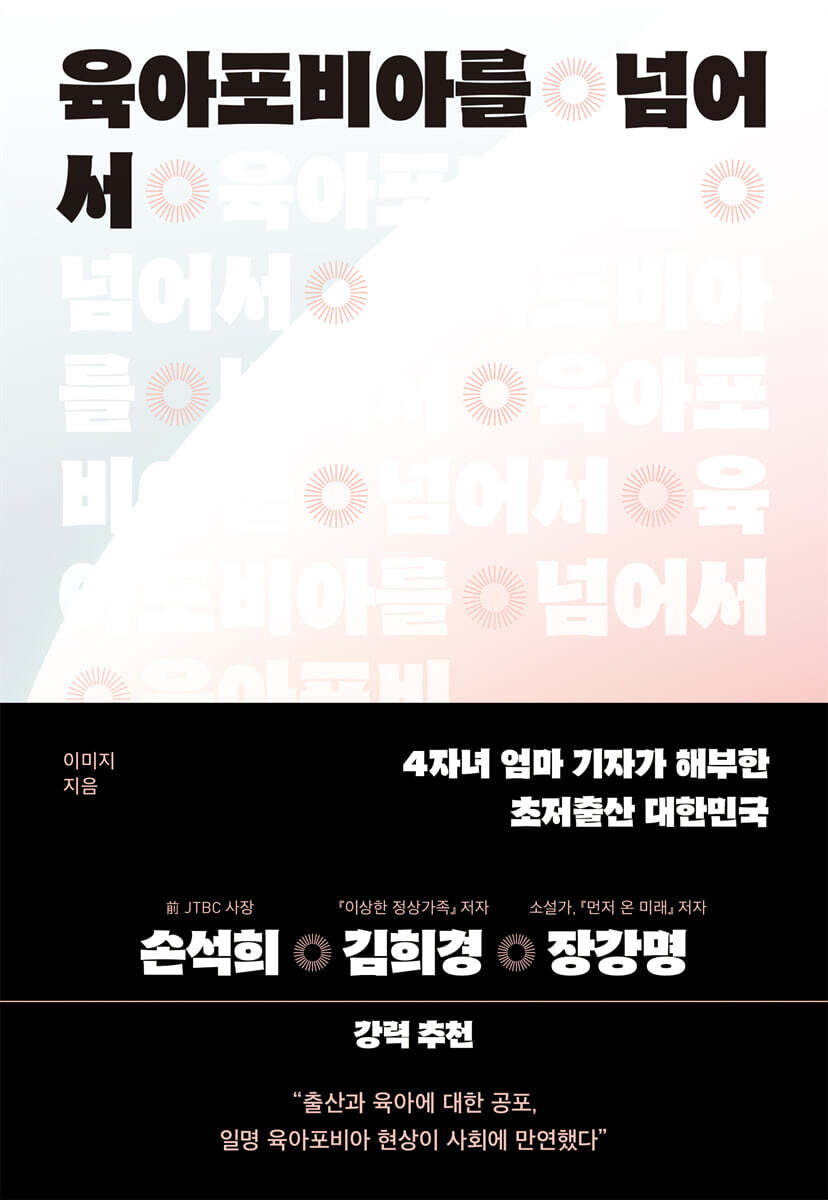
Beyond parenting phobia
 |
Description
Book Introduction
- A word from MD
-
South Korea, where having children is scarySouth Korea has the lowest birth rate.
A working mom of four, Image Journalist says money isn't the root cause.
Because our society is a country where it is more or less worth living in.
The real cause is psychology.
We analyzed the conditions that lead to parenting phobia, such as lack of time, child-hating atmosphere, perfectionism, and normal families.
September 23, 2025. Min-gyu Son, Social and Political PD
The low birth rate is driven by fear.
The Real Reason for South Korea's Ultra-Low Birth Rate
"Beyond Childcare Phobia: Korea's Ultra-Low Birth Rate Dissected by a Reporter with Four Children" is a book written by the author, Image, who worked as a social affairs reporter for 17 years while raising four children, and defined the crisis of childbirth and childcare in Korea as the phenomenon of "childcare phobia" based on her reporting on the low birth rate and interviews with 35 citizens, and organized the problems and solutions.
The author says that members of society no longer view childbirth as something they "want to do but cannot do," but rather something they "don't want to do and are afraid of."
Why are young people not only struggling with raising children but also "terrified" of it? And what should the government and society do now? This book goes beyond the socio-economic environment that has been the subject of much low birthrate discourse, focusing on the "fear" individuals feel surrounding childbirth and childcare. It explores the true causes of South Korea's ultra-low birth rate and clues to solutions.
Those who first encountered "Beyond Parenting Phobia" expressed their sympathy for the book's clear and vivid insights.
Novelist Jang Kang-myeong praised the author's efforts to "point out the phenomenon of 'fear breeding fear' through persistent interviews," and said, "It is an exciting reportage that cracks stereotypes and an excellent policy report in itself." Former JTBC president Son Seok-hee was struck by the part where he said, "I was struck by the part where it said that part of the cause of the low birth rate is the fault of the media that makes a fuss."
“I also contributed to that kind of ‘fuss’, so I see no room for objection,” he said in admiration.
Author Kim Hee-kyung also praised the book's authenticity, saying, "The author's perspective is credible, as she not only accurately points out the problem but also presents concrete alternatives that are not based on empty promises."
The Real Reason for South Korea's Ultra-Low Birth Rate
"Beyond Childcare Phobia: Korea's Ultra-Low Birth Rate Dissected by a Reporter with Four Children" is a book written by the author, Image, who worked as a social affairs reporter for 17 years while raising four children, and defined the crisis of childbirth and childcare in Korea as the phenomenon of "childcare phobia" based on her reporting on the low birth rate and interviews with 35 citizens, and organized the problems and solutions.
The author says that members of society no longer view childbirth as something they "want to do but cannot do," but rather something they "don't want to do and are afraid of."
Why are young people not only struggling with raising children but also "terrified" of it? And what should the government and society do now? This book goes beyond the socio-economic environment that has been the subject of much low birthrate discourse, focusing on the "fear" individuals feel surrounding childbirth and childcare. It explores the true causes of South Korea's ultra-low birth rate and clues to solutions.
Those who first encountered "Beyond Parenting Phobia" expressed their sympathy for the book's clear and vivid insights.
Novelist Jang Kang-myeong praised the author's efforts to "point out the phenomenon of 'fear breeding fear' through persistent interviews," and said, "It is an exciting reportage that cracks stereotypes and an excellent policy report in itself." Former JTBC president Son Seok-hee was struck by the part where he said, "I was struck by the part where it said that part of the cause of the low birth rate is the fault of the media that makes a fuss."
“I also contributed to that kind of ‘fuss’, so I see no room for objection,” he said in admiration.
Author Kim Hee-kyung also praised the book's authenticity, saying, "The author's perspective is credible, as she not only accurately points out the problem but also presents concrete alternatives that are not based on empty promises."
- You can preview some of the book's contents.
Preview
index
Recommendation ·004
Prologue - South Korea's Birth Rate Ranks 'Overwhelmingly Low': Young People Afraid of Having Children ·008
Part 1: A Country Where Raising Children Is Scary
Population declines and continues with a declining birth rate ·022
Aren't they all experiencing low birth rates? Why is Korea the only one experiencing them? ·033
Warning from a 2005 subway public service announcement ·045
Low Birth Rate: Ask a Thousand People, Get a Thousand Different Answers ·061
A world where raising children is not only difficult but also scary: Parenting Phobia ·071
Part 2: The Origins of Parenting Phobia
The fear of not having enough time to raise a child ·091
Winter is here, and youth stop reproducing ·102
Korean parents must become a village on their own ·120
Mom, I don't want to live like Dad ·138
The Persistent Terror of SeaWorld ·151
An Uncomfortable Society If You're Not Normal ·167
The Normal Marriage Period: The Pressures of the Right Age ·185
Mom's Club and No Kids Zones: A Society That Doesn't Welcome Children ·198
Low Birth Rates: The New Normal ·212
Part 3: For Parenting That's No Longer Fearful
Creating Time for Childcare: 'Compressed and Flexible' ·228
Parental leave alone isn't enough. ·238
How much would it be, how much would it be? ·249
Dadaikseon to Dadaikseon ·261
Lowering the threshold for family ·274
Saying "It's okay to have children" ·288
Epilogue - I've had as many babies as I could, and now it's time to start again. ·298
Acknowledgments ·302
Prologue - South Korea's Birth Rate Ranks 'Overwhelmingly Low': Young People Afraid of Having Children ·008
Part 1: A Country Where Raising Children Is Scary
Population declines and continues with a declining birth rate ·022
Aren't they all experiencing low birth rates? Why is Korea the only one experiencing them? ·033
Warning from a 2005 subway public service announcement ·045
Low Birth Rate: Ask a Thousand People, Get a Thousand Different Answers ·061
A world where raising children is not only difficult but also scary: Parenting Phobia ·071
Part 2: The Origins of Parenting Phobia
The fear of not having enough time to raise a child ·091
Winter is here, and youth stop reproducing ·102
Korean parents must become a village on their own ·120
Mom, I don't want to live like Dad ·138
The Persistent Terror of SeaWorld ·151
An Uncomfortable Society If You're Not Normal ·167
The Normal Marriage Period: The Pressures of the Right Age ·185
Mom's Club and No Kids Zones: A Society That Doesn't Welcome Children ·198
Low Birth Rates: The New Normal ·212
Part 3: For Parenting That's No Longer Fearful
Creating Time for Childcare: 'Compressed and Flexible' ·228
Parental leave alone isn't enough. ·238
How much would it be, how much would it be? ·249
Dadaikseon to Dadaikseon ·261
Lowering the threshold for family ·274
Saying "It's okay to have children" ·288
Epilogue - I've had as many babies as I could, and now it's time to start again. ·298
Acknowledgments ·302
Detailed image

Into the book
Programs showcasing the challenges of parenting, dramas depicting the fierce competition for private education for children, articles claiming that childcare costs exceed 300 million won per child, and reports that young people are reluctant to have children.
Childbirth and childcare were seen as scary and burdensome tasks.
I felt that these thoughts had become a widespread phenomenon and a social atmosphere.
The fear of childcare, also known as 'childcare phobia', has become widespread in society.
--- From the "Prologue"
Even if your economic circumstances are good, you may not have children for other reasons, and conversely, even if your circumstances are difficult, you may have children based on your beliefs.
Everyone has different standards for whether they are financially well off.
We've been saying in surveys that young people aren't having children because of housing and job issues, but that's actually not a specific or accurate factor.
--- From "Part 1: A Country Scary for Raising Children" "When I Asked a Thousand People, I Got a Thousand Answers"
Among the expressions used by many people, there is one that stands out.
Expressions such as “I dare”, “I’m scared”, and “I can’t even imagine”.
This is something you don't often hear when interviewing foreigners or Koreans raising children abroad.
Although there are cases where people express specific difficulties, such as “it’s hard” or “it costs a lot of money,” I have never seen anyone say that raising a child is scary or that it is something they cannot dare to do.
--- From "Part 1: A Country Scary to Raise Children" "A World That's Not Just Difficult to Raise Children, It's Scary to Raise Children: Childcare Phobia"
If the perception of childcare is negative, no matter how good the policy is, it will not be as effective as expected.
To slow the declining birth rate as much as possible and buy time to prepare for population decline, we must first and foremost eliminate excessive fear and aversion to childcare.
Above all, it is not desirable for the task of raising a child, which should be the happiest and most sacred thing, to become a scary task.
--- From "Part 1: A Country Scary to Raise Children" "A World That's Not Just Difficult to Raise Children, It's Scary to Raise Children: Childcare Phobia"
Parenting is a series of unexpected situations.
It is impossible to tell a child who has a stomachache, vomited, and is bedridden because Mom and Dad have to leave for work at 9 and get off at 6, “Don’t vomit anymore and wait until we get back at 7 p.m.,” or to ask the kindergarten, “Please hold the school festival before 8 a.m., when I go to work, or after 7 p.m., when I get off work.”
--- From "The Origin of Childcare Phobia in Part 2: The Fear of Not Having Time to Raise a Child Rather Than Money to Raise a Child"
Most young people would think the same way as Mr. Bae.
"Oh, what's so difficult? I feel like I'm not cut out to be a good parent in this life.
“If you can’t raise them well anyway, it’s better not to have children!” The high hurdles of becoming a parent are leading young people to give up on having children.
--- From "The Origin of Parenting Phobia in Part 2: Korean Parents Who Must Become a Village Alone"
They say the world has changed, but has everything really changed? Women still feel uneasy because they've seen so many instances in society where that isn't necessarily the case.
Even though there are no longer bosses who say “Miss Kim, coffee~” like in the past at work, if someone needs to make coffee for a customer, it is implicitly expected that a female employee should make it. Even in female-dominated occupations like teachers and flight attendants (occupations where women are the absolute majority), most managers are men.
--- From "The Origin of Childcare Phobia, Part 2: The Unwavering Fear of Sea World"
Parenting doesn't end in one or two years.
It's not possible to take a leave of absence every time to raise a child.
The practice of having someone take a leave of absence and focus solely on childcare also has the disadvantage of exacerbating the imbalance in the division of labor within the household.
When one parent takes a leave of absence to raise the child, one parent takes on the responsibility of raising the child alone, while the other parent takes on the responsibility of earning a living.
--- From "Childcare Leave Alone Is Not Enough" in Part 3, "For Parenting That Isn't Scary Anymore"
Now, we need to refrain from issuing warnings about low birth rates.
Our neighboring country, Taiwan, recorded a total fertility rate in the 0 range before us.
Taiwan's birth rate fell to 0.9 in the 2010s, and the Taiwanese government's stance at the time was not to sound a red alert about low birth rates throughout society, but to come up with countermeasures while "distracting excessive interest in childbirth."
Rather than warning people not to think about elephants, we are trying to erase elephants from people's minds as much as possible.
Since then, Taiwan's birth rate has risen slightly and returned to one.
--- From "Part 3: For a child-rearing experience that is no longer scary, "Saying 'It's okay to give birth'"
We have long considered the low birth rate problem a ‘national crisis.’
That's right.
As the number of births declines and the elderly population increases, the very sustainability of communities could be shaken.
And there are clearly structural and social factors behind this.
But ultimately, the person who is influenced by the structure and social factors is the ‘individual.’
Ultimately, the decision to have children or not is an individual decision.
In that sense, this book attempted to approach the causes of low birth rates from a slightly different perspective.
Rather than simply looking at the perspective of a country or policy, we wanted to look at the overall culture, emotions, and perceptions that influence individuals.
Childbirth and childcare were seen as scary and burdensome tasks.
I felt that these thoughts had become a widespread phenomenon and a social atmosphere.
The fear of childcare, also known as 'childcare phobia', has become widespread in society.
--- From the "Prologue"
Even if your economic circumstances are good, you may not have children for other reasons, and conversely, even if your circumstances are difficult, you may have children based on your beliefs.
Everyone has different standards for whether they are financially well off.
We've been saying in surveys that young people aren't having children because of housing and job issues, but that's actually not a specific or accurate factor.
--- From "Part 1: A Country Scary for Raising Children" "When I Asked a Thousand People, I Got a Thousand Answers"
Among the expressions used by many people, there is one that stands out.
Expressions such as “I dare”, “I’m scared”, and “I can’t even imagine”.
This is something you don't often hear when interviewing foreigners or Koreans raising children abroad.
Although there are cases where people express specific difficulties, such as “it’s hard” or “it costs a lot of money,” I have never seen anyone say that raising a child is scary or that it is something they cannot dare to do.
--- From "Part 1: A Country Scary to Raise Children" "A World That's Not Just Difficult to Raise Children, It's Scary to Raise Children: Childcare Phobia"
If the perception of childcare is negative, no matter how good the policy is, it will not be as effective as expected.
To slow the declining birth rate as much as possible and buy time to prepare for population decline, we must first and foremost eliminate excessive fear and aversion to childcare.
Above all, it is not desirable for the task of raising a child, which should be the happiest and most sacred thing, to become a scary task.
--- From "Part 1: A Country Scary to Raise Children" "A World That's Not Just Difficult to Raise Children, It's Scary to Raise Children: Childcare Phobia"
Parenting is a series of unexpected situations.
It is impossible to tell a child who has a stomachache, vomited, and is bedridden because Mom and Dad have to leave for work at 9 and get off at 6, “Don’t vomit anymore and wait until we get back at 7 p.m.,” or to ask the kindergarten, “Please hold the school festival before 8 a.m., when I go to work, or after 7 p.m., when I get off work.”
--- From "The Origin of Childcare Phobia in Part 2: The Fear of Not Having Time to Raise a Child Rather Than Money to Raise a Child"
Most young people would think the same way as Mr. Bae.
"Oh, what's so difficult? I feel like I'm not cut out to be a good parent in this life.
“If you can’t raise them well anyway, it’s better not to have children!” The high hurdles of becoming a parent are leading young people to give up on having children.
--- From "The Origin of Parenting Phobia in Part 2: Korean Parents Who Must Become a Village Alone"
They say the world has changed, but has everything really changed? Women still feel uneasy because they've seen so many instances in society where that isn't necessarily the case.
Even though there are no longer bosses who say “Miss Kim, coffee~” like in the past at work, if someone needs to make coffee for a customer, it is implicitly expected that a female employee should make it. Even in female-dominated occupations like teachers and flight attendants (occupations where women are the absolute majority), most managers are men.
--- From "The Origin of Childcare Phobia, Part 2: The Unwavering Fear of Sea World"
Parenting doesn't end in one or two years.
It's not possible to take a leave of absence every time to raise a child.
The practice of having someone take a leave of absence and focus solely on childcare also has the disadvantage of exacerbating the imbalance in the division of labor within the household.
When one parent takes a leave of absence to raise the child, one parent takes on the responsibility of raising the child alone, while the other parent takes on the responsibility of earning a living.
--- From "Childcare Leave Alone Is Not Enough" in Part 3, "For Parenting That Isn't Scary Anymore"
Now, we need to refrain from issuing warnings about low birth rates.
Our neighboring country, Taiwan, recorded a total fertility rate in the 0 range before us.
Taiwan's birth rate fell to 0.9 in the 2010s, and the Taiwanese government's stance at the time was not to sound a red alert about low birth rates throughout society, but to come up with countermeasures while "distracting excessive interest in childbirth."
Rather than warning people not to think about elephants, we are trying to erase elephants from people's minds as much as possible.
Since then, Taiwan's birth rate has risen slightly and returned to one.
--- From "Part 3: For a child-rearing experience that is no longer scary, "Saying 'It's okay to give birth'"
We have long considered the low birth rate problem a ‘national crisis.’
That's right.
As the number of births declines and the elderly population increases, the very sustainability of communities could be shaken.
And there are clearly structural and social factors behind this.
But ultimately, the person who is influenced by the structure and social factors is the ‘individual.’
Ultimately, the decision to have children or not is an individual decision.
In that sense, this book attempted to approach the causes of low birth rates from a slightly different perspective.
Rather than simply looking at the perspective of a country or policy, we wanted to look at the overall culture, emotions, and perceptions that influence individuals.
--- From "Epilogue"
Publisher's Review
Tracked by a mother of four and a social affairs reporter
Fear of childbirth and childcare: the phenomenon of child-rearing phobia
"I think the expression 'I can't even imagine' is exactly right.
Even now, I spend a lot of time working and developing myself, but with the little time I have left, I have to maintain my relationship with my husband and take good care of my child.
I have no idea how I can do all that."
-Kim Bae-ryeong, 29, female, working at a company in Seoul
There is no one who does not know that our country is in crisis.
It's a story about ultra-low birth rates.
Joanne Williams, professor emeritus at the University of California, was shocked when she heard about Korea's total fertility rate for 2023, clutching her head and saying, "South Korea is completely ruined."
With the total fertility rate in Korea falling to 0 and even reaching 0.75 in 2024, the first in the world, the low birth rate is hitting South Korea hard as a new pandemic.
『Beyond Childcare Phobia: Korea's Ultra-Low Birth Rate Dissected by a Reporter with Four Children』 is a book written by Image, a social affairs reporter who gave birth to and raised four children for 17 years, based on her reporting on the low birth rate and interviews with 35 citizens. It defines the crisis of childbirth and childcare in Korea as the phenomenon of 'childcare phobia' and analyzes the problems and solutions.
The book provides a completely different perspective that has not been previously highlighted in the low birth rate discourse.
This is the position of an 'individual' who is struggling at the crossroads of actual childbirth and childcare.
The author is a career woman who worked at the Dong-A Ilbo, a major domestic daily newspaper, for 17 years and raised four children.
Paradoxically, despite being a mother of multiple children, Image deeply sympathizes with the difficult reality of raising children in our country, and reveals the following in the book:
“I’ve had as many children as I could.
It was hard.
“Is there anyone here who has given birth to more children than me?”
What the author paid most attention to while conducting interviews with citizens about childbirth and childcare was the 'reality' of our society.
Is it even possible for women in our society to balance work and childcare? While our government hastily offers cash support and maternity benefits, urging women to "have children," does it truly understand the "reality" of the young people and women who make and implement these decisions? The author argues that in an era of rigid working hours and the prevalence of unpaid labor and overtime, people are experiencing a sense of "fear" even before they have children.
It's not just about working hours and work environment.
Based on interviews, the book faithfully depicts the various problems that are creating parenting phobia in our society and the landscape of spreading fear, using various statistical data, domestic and international case studies, and cultural and media analysis.
Furthermore, through this, the author emphasizes that “looking into the perceptions of the stakeholders in our society should be the starting point for all policies.”
Those who first encountered "Beyond Parenting Phobia" expressed their sympathy for the book's clear and vivid insights.
Novelist Jang Kang-myeong praised the author's efforts to "point out the phenomenon of 'fear breeding fear' through persistent interviews," and said, "It is an exciting reportage that cracks stereotypes and an excellent policy report in itself." Former JTBC president Son Seok-hee was struck by the part where he said, "I was struck by the part where it said that part of the cause of the low birth rate is the fault of the media that makes a fuss."
“I also contributed to that kind of ‘fuss’, so I see no room for objection,” he said in admiration.
Author Kim Hee-kyung also agreed with the book's sincerity, saying, "The author's perspective is credible, as she not only accurately points out the problem but also presents concrete alternatives that are not based on empty promises."
The book is divided into three parts.
Part 1, "A 'Scary' Country for Raising Children," discusses the severity of Korea's current low birth rate problem and explains the significance of the widespread child-rearing phobia confirmed through interviews.
Part 2, “The Origins of Childcare Phobia,” analyzes the nine causes of childcare phobia among young people in our society based on interview responses, and Part 3, “For Childcare That’s Not Scary Anymore,” proposes solutions based on the experience of covering the low birth rate issue and examining the causes of childcare phobia discovered in interviews.
The problem isn't money?
Childbirth is a matter of preference, not ability.
“Even among my acquaintances, there are three DINK couples.
Three out of ten.
One of them said this to me and it really resonated with me.
“I want to drive a Benz or a BMW, but after I have a child, I have to drive a Sorento.” That’s exactly it.”
Kim Chi-hwan, 41, male, startup CEO
As low birth rates became a hot topic of the times, numerous experts, citizens, media outlets, and broadcasters began to suggest causes and solutions.
There is no element that has not been addressed, from overcrowding in the metropolitan area, high housing prices, delayed employment, and gender conflict to analyses of it as a natural phenomenon resulting from industrialization.
All of these analyses are valid, but previous discourses have primarily approached the low birth rate issue from the perspective of the 'state.'
In these analyses, low birth rate was a functional problem that could be overcome naturally given the right environment.
This is why the government's current low birth rate response policy focuses on material benefits.
However, the author says, “Ultimately, having children is an individual’s decision, and since children are born and raised by individuals for their entire lives, it’s okay if an individual decides not to do it.”
In other words, avoiding childbirth is not simply a matter of ‘ability’ but also a matter of ‘preference’.
So why do members of our society not prefer to have children?
Image began her interview with 35 citizens out of curiosity, asking, "Why did I give birth while others didn't?" and discovered common perceptions about childbirth and childcare through her interviews with them.
Young people usually think of childbirth and childcare as burdensome and difficult tasks.
Rather than answers like “it’s hard” or “it costs a lot of money,” they mainly used expressions like “I dare not,” “it’s scary,” and “I can’t even imagine.”
“The idea that childcare is difficult, and even more so, that it is scary and something to be avoided, is widespread throughout society.”
Childbirth and childcare are no longer simply difficult choices, but rather something that is felt with vague reluctance rather than ability.
Why has childbirth, a seemingly natural human instinct, become such a terrifying and fearful thing? To uncover the roots of this fear, a phenomenon known as child-rearing phobia, the author examines how social issues fuel this fear, focusing on citizen reporting. She also explores ways to improve perceptions and preferences about childbirth.
This does not mean abandoning the discussion on the low birth rate problem that has been brought up so far and completely changing direction.
Rather, "Beyond Childcare Phobia" clearly reveals the realistic conditions that have obscured the "difficult, yet happy and meaningful" aspect of childbirth and childcare, which we may have missed while focusing on numerous discourses, and asks what we should do to return that happiness and meaning to individuals.
The origins of parenting phobia,
Korea: A 'Scary' Country for Raising Children
“It means that the very idea of getting a job and living a middle-class life has disappeared.
“Then, more than anything, the child would be in pain, so I thought, ‘Why should I do something like that (give birth)?’”
-Koseyoung Ko, 46, male, researcher at a large corporation
If fear is the problem, what is its cause? Can parental phobia be considered a real phenomenon? This book unravels the complex web of values and perceptions young people have about childbirth and childcare, which cannot be explained solely by economic considerations, clearly revealing the pressing issue at hand.
The author captured the emotions, sentiments, and values that are currently making people reluctant to have children and raise children, based on the responses of 35 citizen reporters. He then persuasively analyzed the causes and background of these emotions based on a wide range of data, including statistical surveys, research theories, overseas cases, and the media.
The institutional and social ills that have existed in our society to date have not only acted as obstacles to childbirth and childcare, but have also created a phenomenon called fear that makes people hesitate to have children.
The author summarized the causes of child-rearing phobia in our time into nine categories: lack of time, endless competition, the uniqueness of Korean-style child-rearing, rejection of parenting, lingering discrimination against women, pressure from normal families, stereotypes about the right age for children, negative perceptions of society, and problems with the media.
First, young people in our society were concerned about realistic conditions.
In a society where overtime and free labor are the norm, I was afraid that I would not be able to survive after having a child.
Our country's parenting culture of caring for a child's every move was also cited as a difficult reality to cope with.
Although not to the same extent as in the past, family culture and social perceptions that still force sacrifices on women also gave rise to phobia.
In addition to the lingering patriarchal notion that expects women to be the primary caregivers, hatred of children and mothers, represented by terms like "mamchung" and "no-kids zone," has become a mechanism that prevents women from having children.
Our country's unique culture of observing the situation and having a sense of norms has made those who are past the prime of life and those with diverse backgrounds hesitate to get married and have children.
The book vividly conveys how the current social conditions and culture surrounding childbirth and childcare pose a significant burden and difficulty to young people who want to live a life different from that of past generations.
Not a society where giving birth is 'scary'
Creating a society where it's okay to give birth
"This government's current low birth rate support motto seems to be 'Let's just have them have children first and see.'
"There's a lot of support before and after giving birth, and then it's 'I don't know.'"
-Lee Seung-geun, 53, male, working at a public interest corporation
"Beyond Childcare Phobia" closely analyzes the current national low birth rate policies and suggests ways to improve them.
The first area that needs to change is working hours.
The author argues that the current work system, which makes childcare impossible for dual-income couples, needs to be made more flexible, and examines the case of Germany, where flexible working hours are associated with high productivity.
It also points out the problem of low birth rate measures that focus only on expanding childcare leave.
Parental leave is a necessary system, but in the long run, it can encourage women to take a break from their careers by making them the primary caregivers.
In addition, based on her experience as a mother of four children, balancing work and childcare, she also raises issues with the current cash support policy and the multiple-child policy.
The core of the low birth rate countermeasures proposed by the author is creating a society that is friendly to childbirth and childcare.
Only when the government and our society can convey the message that “it’s okay to have children” can we alleviate the fears of society members about childbirth and childcare.
Therefore, as a journalist and reporter covering the issue of low birth rates, it is worth noting the part that reflects on the government and the media's 'low birth rate warnings' and reveals the side effects.
According to the author, the government campaigns and the media's excessive alarm about the low birth rate have actually strengthened the low birth rate trend in our society, which is obsessed with normalcy.
"Beyond Childcare Phobia," which examines and analyzes fears about childbirth and childcare based on multi-layered citizen interviews, may be the closest attempt to reaching the voices of individuals in our society at this very moment.
So, we can clearly see one aspect of the individual's perception, values, and emotions surrounding childbirth, such as familism, views on marriage, and views on generations in this era.
Above all, the book is the result of an effort to understand and empathize with the lives and positions of individuals, which until now had been limited to the motive for countermeasures to the low birth rate problem, based on the social environment.
Those with vague concerns about marriage and childbirth, and those seeking a multifaceted perspective and solutions to the low birth rate problem, will find relatable analysis and satisfying perspectives in "Beyond Childcare Phobia."
Fear of childbirth and childcare: the phenomenon of child-rearing phobia
"I think the expression 'I can't even imagine' is exactly right.
Even now, I spend a lot of time working and developing myself, but with the little time I have left, I have to maintain my relationship with my husband and take good care of my child.
I have no idea how I can do all that."
-Kim Bae-ryeong, 29, female, working at a company in Seoul
There is no one who does not know that our country is in crisis.
It's a story about ultra-low birth rates.
Joanne Williams, professor emeritus at the University of California, was shocked when she heard about Korea's total fertility rate for 2023, clutching her head and saying, "South Korea is completely ruined."
With the total fertility rate in Korea falling to 0 and even reaching 0.75 in 2024, the first in the world, the low birth rate is hitting South Korea hard as a new pandemic.
『Beyond Childcare Phobia: Korea's Ultra-Low Birth Rate Dissected by a Reporter with Four Children』 is a book written by Image, a social affairs reporter who gave birth to and raised four children for 17 years, based on her reporting on the low birth rate and interviews with 35 citizens. It defines the crisis of childbirth and childcare in Korea as the phenomenon of 'childcare phobia' and analyzes the problems and solutions.
The book provides a completely different perspective that has not been previously highlighted in the low birth rate discourse.
This is the position of an 'individual' who is struggling at the crossroads of actual childbirth and childcare.
The author is a career woman who worked at the Dong-A Ilbo, a major domestic daily newspaper, for 17 years and raised four children.
Paradoxically, despite being a mother of multiple children, Image deeply sympathizes with the difficult reality of raising children in our country, and reveals the following in the book:
“I’ve had as many children as I could.
It was hard.
“Is there anyone here who has given birth to more children than me?”
What the author paid most attention to while conducting interviews with citizens about childbirth and childcare was the 'reality' of our society.
Is it even possible for women in our society to balance work and childcare? While our government hastily offers cash support and maternity benefits, urging women to "have children," does it truly understand the "reality" of the young people and women who make and implement these decisions? The author argues that in an era of rigid working hours and the prevalence of unpaid labor and overtime, people are experiencing a sense of "fear" even before they have children.
It's not just about working hours and work environment.
Based on interviews, the book faithfully depicts the various problems that are creating parenting phobia in our society and the landscape of spreading fear, using various statistical data, domestic and international case studies, and cultural and media analysis.
Furthermore, through this, the author emphasizes that “looking into the perceptions of the stakeholders in our society should be the starting point for all policies.”
Those who first encountered "Beyond Parenting Phobia" expressed their sympathy for the book's clear and vivid insights.
Novelist Jang Kang-myeong praised the author's efforts to "point out the phenomenon of 'fear breeding fear' through persistent interviews," and said, "It is an exciting reportage that cracks stereotypes and an excellent policy report in itself." Former JTBC president Son Seok-hee was struck by the part where he said, "I was struck by the part where it said that part of the cause of the low birth rate is the fault of the media that makes a fuss."
“I also contributed to that kind of ‘fuss’, so I see no room for objection,” he said in admiration.
Author Kim Hee-kyung also agreed with the book's sincerity, saying, "The author's perspective is credible, as she not only accurately points out the problem but also presents concrete alternatives that are not based on empty promises."
The book is divided into three parts.
Part 1, "A 'Scary' Country for Raising Children," discusses the severity of Korea's current low birth rate problem and explains the significance of the widespread child-rearing phobia confirmed through interviews.
Part 2, “The Origins of Childcare Phobia,” analyzes the nine causes of childcare phobia among young people in our society based on interview responses, and Part 3, “For Childcare That’s Not Scary Anymore,” proposes solutions based on the experience of covering the low birth rate issue and examining the causes of childcare phobia discovered in interviews.
The problem isn't money?
Childbirth is a matter of preference, not ability.
“Even among my acquaintances, there are three DINK couples.
Three out of ten.
One of them said this to me and it really resonated with me.
“I want to drive a Benz or a BMW, but after I have a child, I have to drive a Sorento.” That’s exactly it.”
Kim Chi-hwan, 41, male, startup CEO
As low birth rates became a hot topic of the times, numerous experts, citizens, media outlets, and broadcasters began to suggest causes and solutions.
There is no element that has not been addressed, from overcrowding in the metropolitan area, high housing prices, delayed employment, and gender conflict to analyses of it as a natural phenomenon resulting from industrialization.
All of these analyses are valid, but previous discourses have primarily approached the low birth rate issue from the perspective of the 'state.'
In these analyses, low birth rate was a functional problem that could be overcome naturally given the right environment.
This is why the government's current low birth rate response policy focuses on material benefits.
However, the author says, “Ultimately, having children is an individual’s decision, and since children are born and raised by individuals for their entire lives, it’s okay if an individual decides not to do it.”
In other words, avoiding childbirth is not simply a matter of ‘ability’ but also a matter of ‘preference’.
So why do members of our society not prefer to have children?
Image began her interview with 35 citizens out of curiosity, asking, "Why did I give birth while others didn't?" and discovered common perceptions about childbirth and childcare through her interviews with them.
Young people usually think of childbirth and childcare as burdensome and difficult tasks.
Rather than answers like “it’s hard” or “it costs a lot of money,” they mainly used expressions like “I dare not,” “it’s scary,” and “I can’t even imagine.”
“The idea that childcare is difficult, and even more so, that it is scary and something to be avoided, is widespread throughout society.”
Childbirth and childcare are no longer simply difficult choices, but rather something that is felt with vague reluctance rather than ability.
Why has childbirth, a seemingly natural human instinct, become such a terrifying and fearful thing? To uncover the roots of this fear, a phenomenon known as child-rearing phobia, the author examines how social issues fuel this fear, focusing on citizen reporting. She also explores ways to improve perceptions and preferences about childbirth.
This does not mean abandoning the discussion on the low birth rate problem that has been brought up so far and completely changing direction.
Rather, "Beyond Childcare Phobia" clearly reveals the realistic conditions that have obscured the "difficult, yet happy and meaningful" aspect of childbirth and childcare, which we may have missed while focusing on numerous discourses, and asks what we should do to return that happiness and meaning to individuals.
The origins of parenting phobia,
Korea: A 'Scary' Country for Raising Children
“It means that the very idea of getting a job and living a middle-class life has disappeared.
“Then, more than anything, the child would be in pain, so I thought, ‘Why should I do something like that (give birth)?’”
-Koseyoung Ko, 46, male, researcher at a large corporation
If fear is the problem, what is its cause? Can parental phobia be considered a real phenomenon? This book unravels the complex web of values and perceptions young people have about childbirth and childcare, which cannot be explained solely by economic considerations, clearly revealing the pressing issue at hand.
The author captured the emotions, sentiments, and values that are currently making people reluctant to have children and raise children, based on the responses of 35 citizen reporters. He then persuasively analyzed the causes and background of these emotions based on a wide range of data, including statistical surveys, research theories, overseas cases, and the media.
The institutional and social ills that have existed in our society to date have not only acted as obstacles to childbirth and childcare, but have also created a phenomenon called fear that makes people hesitate to have children.
The author summarized the causes of child-rearing phobia in our time into nine categories: lack of time, endless competition, the uniqueness of Korean-style child-rearing, rejection of parenting, lingering discrimination against women, pressure from normal families, stereotypes about the right age for children, negative perceptions of society, and problems with the media.
First, young people in our society were concerned about realistic conditions.
In a society where overtime and free labor are the norm, I was afraid that I would not be able to survive after having a child.
Our country's parenting culture of caring for a child's every move was also cited as a difficult reality to cope with.
Although not to the same extent as in the past, family culture and social perceptions that still force sacrifices on women also gave rise to phobia.
In addition to the lingering patriarchal notion that expects women to be the primary caregivers, hatred of children and mothers, represented by terms like "mamchung" and "no-kids zone," has become a mechanism that prevents women from having children.
Our country's unique culture of observing the situation and having a sense of norms has made those who are past the prime of life and those with diverse backgrounds hesitate to get married and have children.
The book vividly conveys how the current social conditions and culture surrounding childbirth and childcare pose a significant burden and difficulty to young people who want to live a life different from that of past generations.
Not a society where giving birth is 'scary'
Creating a society where it's okay to give birth
"This government's current low birth rate support motto seems to be 'Let's just have them have children first and see.'
"There's a lot of support before and after giving birth, and then it's 'I don't know.'"
-Lee Seung-geun, 53, male, working at a public interest corporation
"Beyond Childcare Phobia" closely analyzes the current national low birth rate policies and suggests ways to improve them.
The first area that needs to change is working hours.
The author argues that the current work system, which makes childcare impossible for dual-income couples, needs to be made more flexible, and examines the case of Germany, where flexible working hours are associated with high productivity.
It also points out the problem of low birth rate measures that focus only on expanding childcare leave.
Parental leave is a necessary system, but in the long run, it can encourage women to take a break from their careers by making them the primary caregivers.
In addition, based on her experience as a mother of four children, balancing work and childcare, she also raises issues with the current cash support policy and the multiple-child policy.
The core of the low birth rate countermeasures proposed by the author is creating a society that is friendly to childbirth and childcare.
Only when the government and our society can convey the message that “it’s okay to have children” can we alleviate the fears of society members about childbirth and childcare.
Therefore, as a journalist and reporter covering the issue of low birth rates, it is worth noting the part that reflects on the government and the media's 'low birth rate warnings' and reveals the side effects.
According to the author, the government campaigns and the media's excessive alarm about the low birth rate have actually strengthened the low birth rate trend in our society, which is obsessed with normalcy.
"Beyond Childcare Phobia," which examines and analyzes fears about childbirth and childcare based on multi-layered citizen interviews, may be the closest attempt to reaching the voices of individuals in our society at this very moment.
So, we can clearly see one aspect of the individual's perception, values, and emotions surrounding childbirth, such as familism, views on marriage, and views on generations in this era.
Above all, the book is the result of an effort to understand and empathize with the lives and positions of individuals, which until now had been limited to the motive for countermeasures to the low birth rate problem, based on the social environment.
Those with vague concerns about marriage and childbirth, and those seeking a multifaceted perspective and solutions to the low birth rate problem, will find relatable analysis and satisfying perspectives in "Beyond Childcare Phobia."
GOODS SPECIFICS
- Date of issue: September 1, 2025
- Page count, weight, size: 300 pages | 514g | 147*210*18mm
- ISBN13: 9788962626766
You may also like
카테고리
korean


korean

![GQ KOREA Mark (Monthly): December [2025]](http://librairie.coreenne.fr/cdn/shop/files/8ef265dbbfbf186523ed75ba7319009d.jpg?v=1765340328&width=3840)


