

Landscape drawing with pencil
 |
Description
Book Introduction
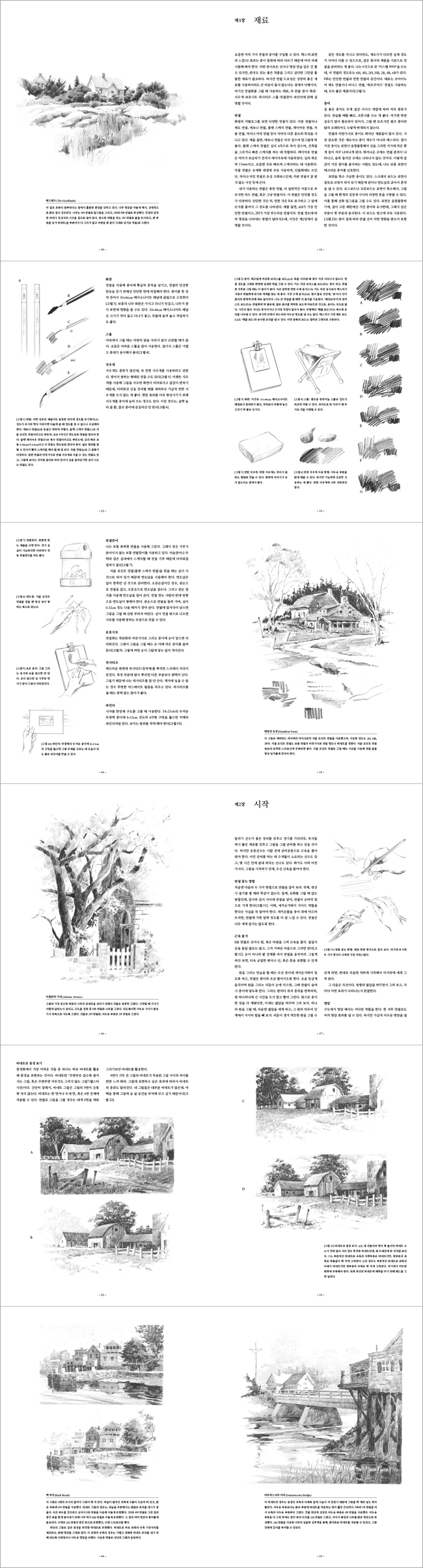
It provides step-by-step examples of how to draw the elements needed to draw landscapes with a pencil, such as the sea, trees, mountains, hills, rocks, buildings, ships, and ports, in an easy-to-understand way for anyone.
- You can preview some of the book's contents.
Preview
index
Preface 9
Chapter 1 Materials 11
Pencil 11
Paper 11
Drawing board 12
Stool 12
Eraser 12
Pencil Sharpener 14
Protective Sheet 14
Pixartif 14
Finder 14
Chapter 2: Beginning 17
How to Hold a Pencil 17
Muscle Relaxation 17
Light and shade 17
Form 21
Basic Stroke 22
Expressing Texture with Lines and Strokes 23
Pre-dye for tone 27
Viewing the Landscape in Light and Shadow 27
Viewing the Landscape with Vignettes 32
Chapter 3: Composing a Picture 36
Topic Selection 36
Looking at the topic 36
Pencil Sharpener 37
Light and shade sketch for preparation 37
Vignette Sketch for Preparation 37
Do's and Don'ts 37
Example 1.
Drawing Your First Picture 38
Detail of the finished painting 43
Chapter 4 Trees 44
Types of Trees 44
Step 44 of Drawing a Tree
Example 1.
Broadleaf trees 46
Hardwood Detail 49
Example 2.
Conifers 50
Conifer Detail 51
Example 3.
Palm tree 52
Palm Tree Detail 54
Chapter 5: Mountains, Hills, and Rocks 60
60 Light and Shadow Sketches for Preparation
Example 1.
Mountain 61
Mountain Detail 64
Example 2.
Hill 65
Hill Detail 69
Example 3.
Rock 70
Rock Detail 72
Chapter 6: Factories, Housing, and Cities 76
Light and shade sketch for preparation 76
Example 1.
Factory 77
Example 2.
House 81
Example 3.
City 85
Cityscape Detail 89
Chapter 7: Ships, Ports, and Water Shadows 94
Example 1.
Ship 95
How to Draw a Pear 98
Example 2.
Port 99
Port Details 101
Example 3.
Water Shadow 102
Chapter 8 Landscape Painting and Photography 108
109 Colonial Street
St. George Tucker House 110
Governor's Mansion 112
Printing House 114
Backyard 116
Gorton Pier 118
Rocky Sound 120
Quiet River Mouth 122
Rain River Estuary 124
126 Nicholson Street
Chapter 9: Mats and Frames 128
Choosing a Mat 128
Mat cutting 128
Choosing a Frame 128
Chapter 10: Pictures 130
Five Pound Island 130
Yacht Club 131
Gloucester Paint Company 132
Massachusetts Rockport Motif No. 1 133
Camden Falls, Maine 134
Granite Pier 135
Colonial-style house 136
137 Gloucester Street
Farm 138
Side by side 139
Puddle 140
Observation Deck 141
Pleasant Street Mansion 142
Index 143
Chapter 1 Materials 11
Pencil 11
Paper 11
Drawing board 12
Stool 12
Eraser 12
Pencil Sharpener 14
Protective Sheet 14
Pixartif 14
Finder 14
Chapter 2: Beginning 17
How to Hold a Pencil 17
Muscle Relaxation 17
Light and shade 17
Form 21
Basic Stroke 22
Expressing Texture with Lines and Strokes 23
Pre-dye for tone 27
Viewing the Landscape in Light and Shadow 27
Viewing the Landscape with Vignettes 32
Chapter 3: Composing a Picture 36
Topic Selection 36
Looking at the topic 36
Pencil Sharpener 37
Light and shade sketch for preparation 37
Vignette Sketch for Preparation 37
Do's and Don'ts 37
Example 1.
Drawing Your First Picture 38
Detail of the finished painting 43
Chapter 4 Trees 44
Types of Trees 44
Step 44 of Drawing a Tree
Example 1.
Broadleaf trees 46
Hardwood Detail 49
Example 2.
Conifers 50
Conifer Detail 51
Example 3.
Palm tree 52
Palm Tree Detail 54
Chapter 5: Mountains, Hills, and Rocks 60
60 Light and Shadow Sketches for Preparation
Example 1.
Mountain 61
Mountain Detail 64
Example 2.
Hill 65
Hill Detail 69
Example 3.
Rock 70
Rock Detail 72
Chapter 6: Factories, Housing, and Cities 76
Light and shade sketch for preparation 76
Example 1.
Factory 77
Example 2.
House 81
Example 3.
City 85
Cityscape Detail 89
Chapter 7: Ships, Ports, and Water Shadows 94
Example 1.
Ship 95
How to Draw a Pear 98
Example 2.
Port 99
Port Details 101
Example 3.
Water Shadow 102
Chapter 8 Landscape Painting and Photography 108
109 Colonial Street
St. George Tucker House 110
Governor's Mansion 112
Printing House 114
Backyard 116
Gorton Pier 118
Rocky Sound 120
Quiet River Mouth 122
Rain River Estuary 124
126 Nicholson Street
Chapter 9: Mats and Frames 128
Choosing a Mat 128
Mat cutting 128
Choosing a Frame 128
Chapter 10: Pictures 130
Five Pound Island 130
Yacht Club 131
Gloucester Paint Company 132
Massachusetts Rockport Motif No. 1 133
Camden Falls, Maine 134
Granite Pier 135
Colonial-style house 136
137 Gloucester Street
Farm 138
Side by side 139
Puddle 140
Observation Deck 141
Pleasant Street Mansion 142
Index 143
Detailed image
Into the book
One big rule I have when painting outdoors is to avoid choosing subjects that are too difficult or unusual.
I try to avoid houses with crooked roofs, trees that have grown strangely, or anything else that has problems with size, perspective, or design.
A topic that is confusing at first glance becomes even more confusing when you try to draw it.
There was a beautiful barn that wasn't a right angle, and I tried to draw it several times, but no matter how hard I tried, the perspective just wouldn't work.
If I were to draw this barn exactly as it is and exhibit it, I would probably be heavily criticized for my poor perspective.
It's no use chasing down critics one by one and claiming that's just how the barn was meant to be.
So I try to avoid such topics as much as possible.
(p.36 Topic selection)
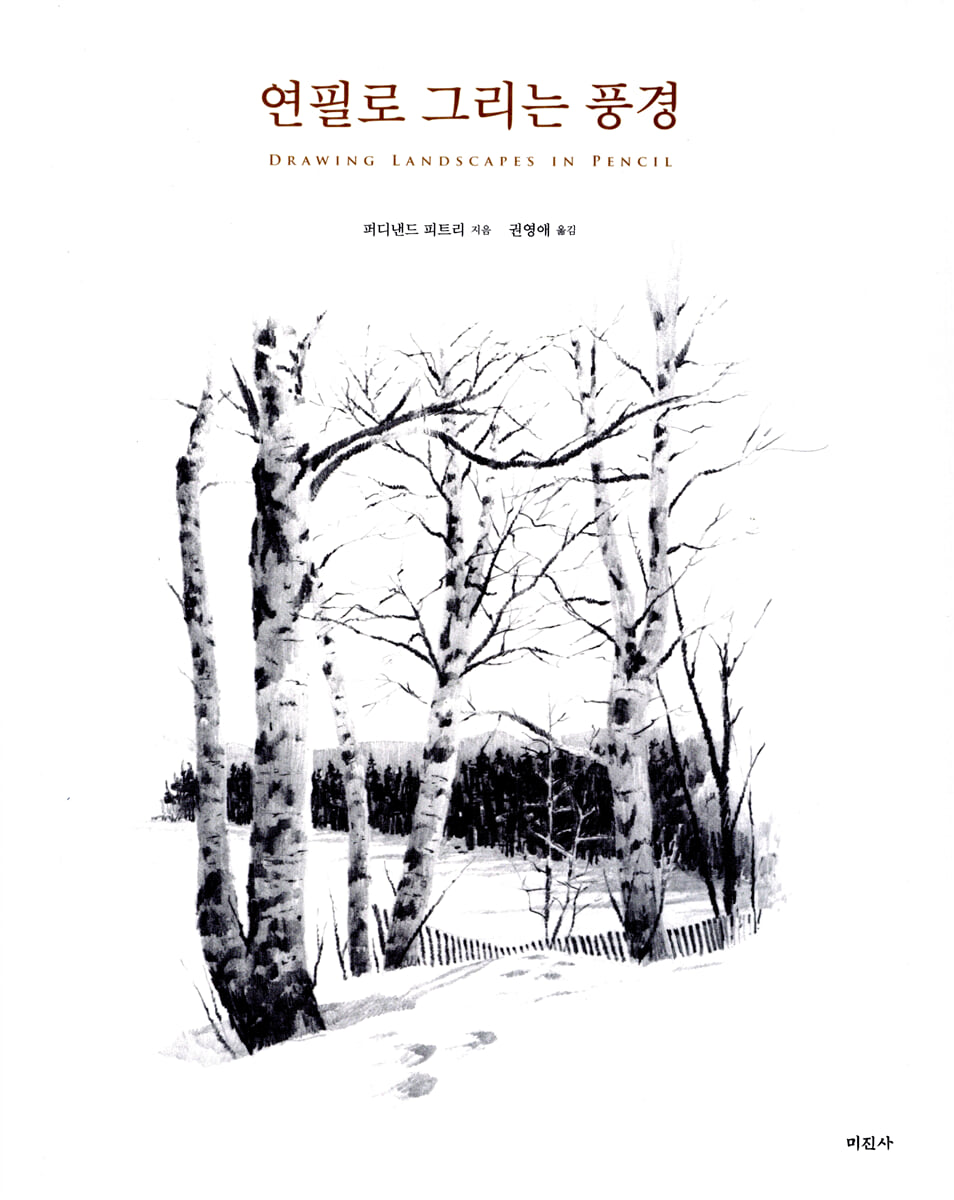
The white bark of the birch tree, peeling off here and there, is the focal point of this painting.
Although the tree is originally white, tone the trunk with a 6H pencil to balance it out against the pure white snow. Use an HB pencil to add darker areas throughout the tree, and use a 2H pencil to draw small branches.
To add interest to the drawing, draw the trees in the background and the footprints in the snow with a 4H pencil.
Movement is important in painting.
The movement of the footprints draws the viewer's gaze into the painting.
(p.59 Footprints in the Snow, cover illustration)
It would be a great mistake to think that water shadows are nothing more than objects turned upside down.
If you look at the picture of the boat, you can see that the water shadow is not just a boat turned upside down and drawn identically.
We look down at the boat from a high position, but when we look at the water's shadow, it's like looking up at the same object from a low position.
For example, when you look down at a cabin from above, you see the top of the roof, but when you look at the water shadow, you see the bottom of the roof.
(p.102 Water Shadow)
I try to avoid houses with crooked roofs, trees that have grown strangely, or anything else that has problems with size, perspective, or design.
A topic that is confusing at first glance becomes even more confusing when you try to draw it.
There was a beautiful barn that wasn't a right angle, and I tried to draw it several times, but no matter how hard I tried, the perspective just wouldn't work.
If I were to draw this barn exactly as it is and exhibit it, I would probably be heavily criticized for my poor perspective.
It's no use chasing down critics one by one and claiming that's just how the barn was meant to be.
So I try to avoid such topics as much as possible.
(p.36 Topic selection)
The white bark of the birch tree, peeling off here and there, is the focal point of this painting.
Although the tree is originally white, tone the trunk with a 6H pencil to balance it out against the pure white snow. Use an HB pencil to add darker areas throughout the tree, and use a 2H pencil to draw small branches.
To add interest to the drawing, draw the trees in the background and the footprints in the snow with a 4H pencil.
Movement is important in painting.
The movement of the footprints draws the viewer's gaze into the painting.
(p.59 Footprints in the Snow, cover illustration)
It would be a great mistake to think that water shadows are nothing more than objects turned upside down.
If you look at the picture of the boat, you can see that the water shadow is not just a boat turned upside down and drawn identically.
We look down at the boat from a high position, but when we look at the water's shadow, it's like looking up at the same object from a low position.
For example, when you look down at a cabin from above, you see the top of the roof, but when you look at the water shadow, you see the bottom of the roof.
(p.102 Water Shadow)
___From the text
Publisher's Review
0.
It explains almost everything you need to know about drawing landscapes with a pencil, in concise and clear sentences that anyone can understand.
1.
It explains all the know-how needed for the preparation stage, starting with how to choose materials such as pencils, paper, and erasers, how to hold a pencil, how to stretch hand muscles, how to imagine a picture with a landscape in front of you, and even how to choose a subject.
2.
How to draw lines, how to make strokes (short lines), how to express the texture of objects, how to compose a vignette (a work that leaves the surrounding white paper as is without drawing all the way to the end), how to arrange light and shade and elements, how to compose perspective, and even how to simply summarize a landscape - all the essential skills for anyone who draws landscapes with a pencil are explained concisely and easily by anyone.
3.
This book explains, step by step, in concise and precise sentences, with drawings and photographs, how to beautifully draw the elements that we can never leave out when drawing landscapes, such as water shadows, rocks, ports, seas, houses, trees, buildings, ships, and mountains.
The pencil is a tool familiar to us.
If you open a drawer in any home, there are bound to be one or two unused pencils.
This book teaches you how to create a complete landscape painting using only pencils, which are found in most homes, rather than expensive or fancy art supplies.
After encountering the beautiful illustrations and precise explanations in this book, you will realize that the pencil, which we have taken for granted until now, actually holds infinite possibilities.
It explains almost everything you need to know about drawing landscapes with a pencil, in concise and clear sentences that anyone can understand.
1.
It explains all the know-how needed for the preparation stage, starting with how to choose materials such as pencils, paper, and erasers, how to hold a pencil, how to stretch hand muscles, how to imagine a picture with a landscape in front of you, and even how to choose a subject.
2.
How to draw lines, how to make strokes (short lines), how to express the texture of objects, how to compose a vignette (a work that leaves the surrounding white paper as is without drawing all the way to the end), how to arrange light and shade and elements, how to compose perspective, and even how to simply summarize a landscape - all the essential skills for anyone who draws landscapes with a pencil are explained concisely and easily by anyone.
3.
This book explains, step by step, in concise and precise sentences, with drawings and photographs, how to beautifully draw the elements that we can never leave out when drawing landscapes, such as water shadows, rocks, ports, seas, houses, trees, buildings, ships, and mountains.
The pencil is a tool familiar to us.
If you open a drawer in any home, there are bound to be one or two unused pencils.
This book teaches you how to create a complete landscape painting using only pencils, which are found in most homes, rather than expensive or fancy art supplies.
After encountering the beautiful illustrations and precise explanations in this book, you will realize that the pencil, which we have taken for granted until now, actually holds infinite possibilities.
GOODS SPECIFICS
- Date of issue: June 5, 2015
- Page count, weight, size: 144 pages | 651g | 210*297*10mm
- ISBN13: 9788940805091
- ISBN10: 8940805097
You may also like
카테고리
korean


korean

![GQ KOREA Mark (Monthly): December [2025]](http://librairie.coreenne.fr/cdn/shop/files/8ef265dbbfbf186523ed75ba7319009d.jpg?v=1765340328&width=3840)


