

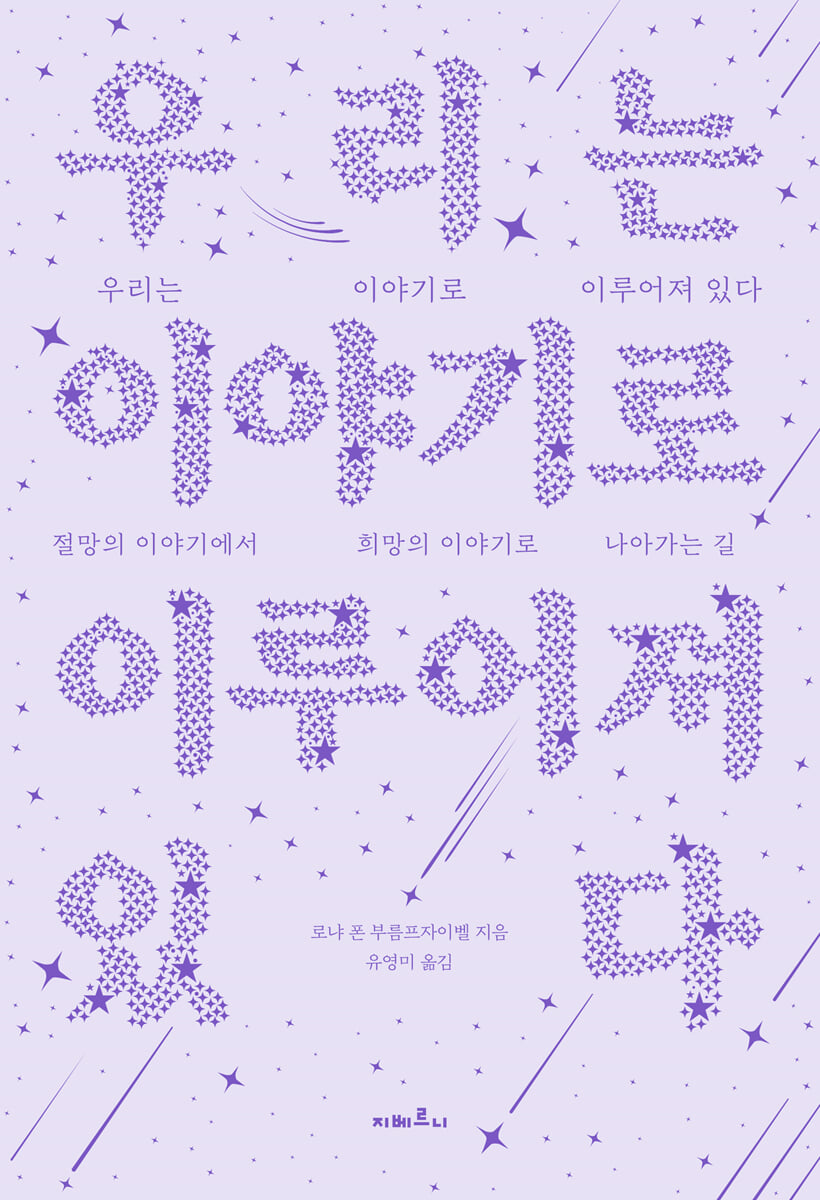
We are made of stories
 |
Description
Book Introduction
★Immediately after publication, it became a German Spiegel nonfiction bestseller!
★Insights and strategies to save the world from fake news, sensational news, and extreme news!
★Highly recommended by renowned German broadcaster/journalist Caroline Kebekus, Cubera Gumusai!
_ Choosing which story to tell is an act that determines not only the life of an individual but also the future of the community.
“Every year, little by little, the world is getting better.
This is not the case for all indicators in all years, but in general, this is the case.
It is true that we face enormous challenges, but it is also true that we have made tremendous progress.
“This is a fact-based worldview.” _ Hans Rosling, co-founder of Gapminder
What does the world that unfolds before our eyes look like now?
Aren't news of war, conflict, disaster, and crisis following us like a tag, filling our daily lives?
If the sense of helplessness and cynicism that "the world is getting worse" and "there is no hope" are eating away at our worldview, it's time to encounter the story of Ronja von Wurmpseibel.
The stories we choose, consume, and reproduce are crucial actions that determine not only our individual lives but also the future of our communities.
This suggests that, as Michel Foucault discussed the relationship between power and knowledge, ‘story’ can be a mechanism for forming and maintaining power relations beyond simply being a medium for conveying information.
This book urges readers to become aware of themselves as 'subjects of the story.'
Rather than being passive recipients of information, we are asked to actively reconstruct the narrative of our lives and the world.
As psychologist Jody Jackson said, “You are what you read,” and in the age of social media and YouTube, “You are what you see.”
★Insights and strategies to save the world from fake news, sensational news, and extreme news!
★Highly recommended by renowned German broadcaster/journalist Caroline Kebekus, Cubera Gumusai!
_ Choosing which story to tell is an act that determines not only the life of an individual but also the future of the community.
“Every year, little by little, the world is getting better.
This is not the case for all indicators in all years, but in general, this is the case.
It is true that we face enormous challenges, but it is also true that we have made tremendous progress.
“This is a fact-based worldview.” _ Hans Rosling, co-founder of Gapminder
What does the world that unfolds before our eyes look like now?
Aren't news of war, conflict, disaster, and crisis following us like a tag, filling our daily lives?
If the sense of helplessness and cynicism that "the world is getting worse" and "there is no hope" are eating away at our worldview, it's time to encounter the story of Ronja von Wurmpseibel.
The stories we choose, consume, and reproduce are crucial actions that determine not only our individual lives but also the future of our communities.
This suggests that, as Michel Foucault discussed the relationship between power and knowledge, ‘story’ can be a mechanism for forming and maintaining power relations beyond simply being a medium for conveying information.
This book urges readers to become aware of themselves as 'subjects of the story.'
Rather than being passive recipients of information, we are asked to actively reconstruct the narrative of our lives and the world.
As psychologist Jody Jackson said, “You are what you read,” and in the age of social media and YouTube, “You are what you see.”
- You can preview some of the book's contents.
Preview
index
1.
We are made of stories
Stories shape our identity.
People who talk about misfortune
The story of despair is self-destructive.
Now is the time to talk 'differently'
Experiment 1 for a 'different' story
2.
Political and biased stories
The news only shows 'selected' stories.
Fragmentary and uniform 'stories'
The brain sometimes can't distinguish between news and reality.
News stories that describe individuals as anonymous groups
How to break away from traditional storytelling
People who rely on heroic narratives
When blood flows, you become a top reporter.
Why write biased articles?
We don't notice slow, gradual progress.
Is the news an error report?
Experiment 2 for a 'different' story
3.
How hungry are we for bad stories?
A storytelling method that teaches helplessness
Lack of emotion is the most dangerous of all emotions.
How hungry are we for bad stories?
Whether positive or negative, emotions are contagious.
It's time to draw a new map of the world.
Optimism as a psychological shield
Experiment 3 for a 'different' story
4.
A moment when a story that provides direction is needed
Suggestions for Constructive Journalism
When you need to train yourself to see beyond the problem
You can't solve all problems at once
The ideal state is not the final goal, but a direction to move toward.
Experiment 4 for a 'different' story
5.
The first step toward writing another story
Start by asking the right questions.
Let us listen to the stories of those who have gone before us.
How to learn from past achievements
Pay attention to the stories that have already taken the first steps toward change.
The importance of envisioning an ideal future
To change reality, you must first change your perspective.
Change ultimately begins with yourself.
Experiment 5 for a 'different' story
6.
Bad news isn't the end of the story, it's just the beginning.
How to Break the "There Is No Alternative" Mindset
Why we shouldn't judge right and wrong too easily
Better questions lead to better answers
We need time to talk to each other.
Change and progress start from below.
Bad news isn't the end of the story, it's just the beginning.
Experiment 6 for a 'different' story
7.
When you change the way you see the world, the world changes too.
If you look for it, you will find it.
When you change the way you see the world, the world changes too.
How to Transform Your Story in Everyday Life
Ultimately, it's the 'question' that changes the flow of the story.
Experiment 7 for a 'different' story
8.
We're wrong about almost everything
The brain perceives too many risks
We're wrong about almost everything
The world is definitely getting better
Why We Need Milestones
Our perception creates our reality
Experiment 8 for a 'different' story
9.
We are not alone
The most important thing is to take the first step
Sometimes you have to be patient and wait.
We are not alone
If you ask me what kind of future I want to live in,
Epilogue: Fear Makes Us Courageous
Translator's Note: You are what you read.
References
We are made of stories
Stories shape our identity.
People who talk about misfortune
The story of despair is self-destructive.
Now is the time to talk 'differently'
Experiment 1 for a 'different' story
2.
Political and biased stories
The news only shows 'selected' stories.
Fragmentary and uniform 'stories'
The brain sometimes can't distinguish between news and reality.
News stories that describe individuals as anonymous groups
How to break away from traditional storytelling
People who rely on heroic narratives
When blood flows, you become a top reporter.
Why write biased articles?
We don't notice slow, gradual progress.
Is the news an error report?
Experiment 2 for a 'different' story
3.
How hungry are we for bad stories?
A storytelling method that teaches helplessness
Lack of emotion is the most dangerous of all emotions.
How hungry are we for bad stories?
Whether positive or negative, emotions are contagious.
It's time to draw a new map of the world.
Optimism as a psychological shield
Experiment 3 for a 'different' story
4.
A moment when a story that provides direction is needed
Suggestions for Constructive Journalism
When you need to train yourself to see beyond the problem
You can't solve all problems at once
The ideal state is not the final goal, but a direction to move toward.
Experiment 4 for a 'different' story
5.
The first step toward writing another story
Start by asking the right questions.
Let us listen to the stories of those who have gone before us.
How to learn from past achievements
Pay attention to the stories that have already taken the first steps toward change.
The importance of envisioning an ideal future
To change reality, you must first change your perspective.
Change ultimately begins with yourself.
Experiment 5 for a 'different' story
6.
Bad news isn't the end of the story, it's just the beginning.
How to Break the "There Is No Alternative" Mindset
Why we shouldn't judge right and wrong too easily
Better questions lead to better answers
We need time to talk to each other.
Change and progress start from below.
Bad news isn't the end of the story, it's just the beginning.
Experiment 6 for a 'different' story
7.
When you change the way you see the world, the world changes too.
If you look for it, you will find it.
When you change the way you see the world, the world changes too.
How to Transform Your Story in Everyday Life
Ultimately, it's the 'question' that changes the flow of the story.
Experiment 7 for a 'different' story
8.
We're wrong about almost everything
The brain perceives too many risks
We're wrong about almost everything
The world is definitely getting better
Why We Need Milestones
Our perception creates our reality
Experiment 8 for a 'different' story
9.
We are not alone
The most important thing is to take the first step
Sometimes you have to be patient and wait.
We are not alone
If you ask me what kind of future I want to live in,
Epilogue: Fear Makes Us Courageous
Translator's Note: You are what you read.
References
Detailed image

Into the book
I don't remember exactly how or why I stopped reading the news.
It was a sudden decision, but it was clearly a conscious one, and I clearly remember that from that moment on, I began to like the world around me more.
--- p.11
The media is full of bad news: floods, wildfires, earthquakes, traffic accidents, terrorism, war, pandemics.
We can hear such news everywhere in the world around us.
I hear such news in the car or on the train on my way to work in the morning, and I bring it up in conversations with my colleagues or family during lunchtime.
All day long, our eyes are filled with headlines from newspapers on newsstands, and all sorts of news are bombarded by social media on our smartphones.
No matter what job we have, what our daily routine is, or what kind of life we lead, news is always with us.
Most of the news is negative.
--- p.14
I had similar experiences over and over again during my year and a half in Kabul.
When so many bad things were happening around me, and I was overwhelmed by stories of despair that seemed to have no way out, I felt as if the ground beneath my feet was crumbling away.
As time went on, I developed the habit of slamming on the brakes when such moments came.
I canceled all my plans and stayed home for a few days, playing board games and watching nature documentaries.
At some point, I felt a little better and did that until I regained my belief that there are good things in the world.
A few months later, I began to intentionally seek out stories that inspired me.
It wasn't because there was some grand meaning behind it.
It was because I was afraid that if I didn't do it, I would go completely crazy.
I needed a story, and I needed a story that gave me courage and conviction.
--- p.25
Numerous studies have been conducted on how continuous consumption of negative news affects us.
Negative news evokes fear, shame, and guilt about not contributing to a better world.
Additionally, when we watch negative news, we become deenergized, apathetic, vulnerable to stress, and passive.
The desire to change the situation also decreases.
Instead of thinking of the negative situation unfolding before your eyes as temporary and changeable, you come to think of it as something that will never be changed.
--- p.30
There is nothing wrong with reporting on violent incidents.
Violence exists and is part of our reality.
But if we only talk about the incident itself without offering any way to overcome the violence, even if that was not our intention, we contribute to the continued spread of fear and suffering.
This can instill stereotypes in those who hear, read, or see that story, which can have long-term effects.
This is tolerating the arena of violence and giving it more power.
Even though what we want is exactly the opposite.
--- p.34
It's not just the news that focuses on negative stories.
This tendency permeates our entire storytelling culture.
Our conversations tend to move from one problem to another, from one difficulty to another, from one crisis to another.
Not only journalists, but we all influence those around us by delivering various messages and news every day.
--- p.37
News is a selection of events that occurred during a specific period of time, such as a day, a week, or a month.
What does it mean?
This means that news can never be perfect.
No matter how much news we consume, it doesn't show everything that's happening in the world.
It only shows 'selected' news.
Moreover, it is not a random selection.
Each journalist selects events that he or she deems worthy of reporting.
What are the selection criteria?
By what criteria do journalists decide whether something is worth reporting or not?
--- p.46
Some journalists deliberately hunt for these controversial and provocative articles, while others simply reflexively and habitually consume them.
A British study found that even when news articles reported a clear overall decrease in crime, headlines tended to highlight specific crimes that had increased.
Everyone knows the saying, 'The only bad news is good news.'
Many editorial offices have another rule:
The saying goes, 'If you have blood, you become a top reporter.'
--- p.77
There is another dynamic to understand.
News usually covers events that occur within a certain period of time.
Most of these things happen within a day.
But most things that are called social progress happen slowly over a long period of time.
It involves changes that are barely noticeable and rarely reaches a point where it seems clearly finished.
The way the news and our lives unfold is similar.
When something bad happens, we notice it right away.
On the other hand, the process of improving something is gradual and imperceptible.
It takes longer to build a house than to tear it down, and it takes longer to end a war than to start one.
Hans Rosling writes in Factfulness:
“Reports on slow, incremental improvements, no matter how widespread, rarely make the front page, even if they affect millions of people.”
--- p.82
We hear news about the devastating consequences of climate change, and politicians are doing little to mitigate or prevent the climate crisis.
But there's little coverage of what politicians in other countries are doing to slow climate change, what laws and policies they're enacting, and whether our own government could benefit from implementing them.
Moreover, there is little discussion of what progress such measures have made in the past, how the attempts that led to such progress initially seemed impossible and difficult, and what achievements were achieved despite those obstacles.
--- p.96
When we consume mostly negative news, we tend to view bad things as unchangeable, rather than temporary and changeable.
So at some point you fall into learned helplessness and feel like you can't change anything.
Not because that's the reality, but because that's how we were taught.
Even in situations where we can improve our own or others' circumstances, we feel unable to do so.
So instead of trying to bring about change, we end up taking a passive stance.
--- p.98
When people feel they can't make a difference in society, they become disillusioned with politics, they stop listening to the media, and they stop trying to envision the future they want.
“One of the main causes of the problems facing our world today is the belief that change is impossible,” says psychologist Michelle Gillan.
“Of course, there are millions of things we cannot control.
But the problems begin when we think that ‘everything’ is out of our control.”
--- p.99
In her book, You Are What You Read, Jody Jackson argues that consuming only negative news is no different than eating junk food.
Just as eating only French fries, hamburgers, and cola is not good for your health, consuming only negative news is not good for your health.
Just as you can eat a lot of food and still be nutritionally deficient, you can consume a lot of news and stories and still live a life without substance.
--- p.108
Change is possible, and social progress is possible.
I cannot emphasize this enough.
Because, whether we are conscious of it or not, deep down in our minds, most of us still harbor thoughts contrary to this.
--- p.114
I wanted to describe the direction of constructive journalism in a clear and concise manner, and after some thought, I came up with a simple formula.
This is precisely what is meant by 'problem + X = ideal state'.
Problem+X.
Here, 'problem' means anything we don't like.
At the social level, social injustice, oppression, crisis, injustice, disaster, war, etc.
On a personal level, there are worries, fights, professional difficulties, illness, insomnia, etc.
X represents things we can use as motivation to change direction towards the ideal state.
X is what is needed to reduce the problem, or with a little luck and patience, eliminate it completely.
--- p.132
We may feel that the ideal state seems so perfect that it's difficult to even talk about it, let alone set a concrete goal for it.
But don't worry.
There is no need to use the yardstick of whether the ideal state can actually be reached.
There is no need to use the yardstick of whether or not a dream will actually come true.
The important thing is to move towards the ideal state.
Rather than viewing it as a goal that must be achieved soon, think of it as a compass that tells us which direction we should go.
As a compass that tells us which way to go to change the situation around us.
--- p.141
Often we look at the various problems surrounding us and ask ourselves:
What do I do now? What can I do better here? What more can I ask for in the future? Sometimes, X isn't clearly identified, making it difficult to find.
This is especially true for long-standing issues, issues that we seem to have no influence over.
Even in these cases, there are tools that can help you find X.
The tool is the 'questions' that you can ask yourself.
Some questions force us to explore the problem at hand more closely, while others force us to reorient our thinking.
--- p.149
Another question we can ask in our search for X is whether our problem has already been solved in the past.
Just because we look to the past for clues about X doesn't mean we're saying everything was better back then.
The idea is to look at what measures worked in the past and use those principles as a guide to solve the current problem.
--- p.159
Looking back at the past, what would it look like in terms of reduced working hours?
If we knew when the eight-hour workday was introduced (in Germany it was first introduced in 1919 and, after several changes, was reintroduced in 1960), if we knew that it was a result of the labor movement, if we knew that this result meant working 'only' 48 hours a week without wage cuts, if we knew that this demand had been fought for over 90 years, it might help us recognize that the eight-hour workday need not last forever.
--- p.163
We can also find X through people working to achieve carbon neutrality in their own cities, separate from the government's half-hearted actions.
On May 2, 2019, Konstanz became the first city in Germany to declare a climate emergency.
Eleven more cities followed in the same month, bringing the total to 69 by the end of the year, including major cities such as Munich and Berlin.
All of these cities have pledged to achieve carbon neutrality by 2035, with some cities setting their targets even earlier.
Erlangen, for example, has set a goal of becoming carbon neutral by 2030 and has already committed to implementing more than 50 emergency measures.
--- p.168
I've been thinking about making a documentary film about the 40-year effort to bring peace to Afghanistan.
Just because peace was not ultimately achieved does not mean that efforts toward peace did not exist.
Just because such efforts fail to bring peace doesn't mean they are meaningless, nor does it mean we can't learn anything from them.
What good would it do humanity if we only talked about the successful, the powerful, and the victorious?
--- p.175
It doesn't help to close your eyes to the bad in order to see the good.
To grow and overcome the problems, challenges, and injustices that surround us, we must examine both.
What this means is that we need to look at both the problem and X.
--- p.189
We can shatter the notion that there are no alternatives by reporting, investigating, and discussing how to solve problems.
Confronting those in power with a constructive perspective is an effective way to ensure they fulfill their responsibilities.
The same is true in social and political debates.
We need to go beyond showing what's wrong and who's at fault, and discuss what possible solutions might be.
--- p.191
Constructive reporting also means asking additional and varied questions to each interlocutor, whether in a story or an interview.
When I interview politicians about a particular issue, I don't just ask them how the issue arose.
For example, the following questions might follow:
How can we prevent, or at least reduce, similar problems in the future? What can we do to address the immediate challenges? What are the next steps? What political processes are necessary to implement these steps? All of these questions are not about the past, but about the future.
It doesn't stop at 'how did this happen', but also asks 'what to do now and how to do it'.
--- p.197
What our society needs is not just information and new data that tells us what is wrong with the world.
We need to take the time to talk to each other about how to handle such information and data.
How do we cope with the countless injustices we encounter every day in the world? How can we avoid feeling powerless or losing control despite it all? How can we make the world a better place again? How can we find solutions? How can we empower each other?
--- p.204
Many journalists worry that if they don't write negatively about a particular topic, they'll be seen as unserious, naive, and uninformed.
I worry that if I write an article highlighting possible solutions, I'll be seen as uncritical, incapable of detaching myself from the issue, or as trivializing the problem.
--- p.209
Bad news is not the end of the story, it's just the beginning.
When disaster or misfortune strikes, no matter what, people have no choice but to respond to it.
The same goes for earthquakes, wars, pandemics, and even the death of a single person.
Where disaster strikes, there are helping hands; where injustice is committed, there are those striving for justice; where there are oppressed, there are those struggling for freedom.
We just have to find such people.
This applies to journalists and everyone else.
--- p.211
We only hear about violence.
I just feel helpless in the face of violence.
We learn nothing from news like this except that something bad has happened in the world again.
How will this help us?
I am convinced that today's journalists have the potential to do a better job.
(Omitted) By reporting on the problems as well as the successful solutions, we learn what we can do better in the future.
By reporting on disasters and catastrophes, as well as how people responded, we learn what we can do when we face such challenges.
Critical and constructive reporting doesn't just make us feel better; it makes us better prepared for everything.
It provides concrete ideas and advice on how to cope with difficulties, and where to get help.
Both individuals and society can benefit from such reporting.
--- p.213
Fear helps us survive, but only in situations where a tiger is actually present.
It only helps when there is a clear risk.
If you were walking along railroad tracks and saw a train coming, or approached a cliff and realized there was a drop right in front of you, or realized your house was on fire, or spotted a poisonous snake or crocodile by the river, you would be right to be afraid.
In all these moments, our fears are performing their natural, evolutionarily acquired function.
It alerts you to impending danger and helps you protect your precious life as best as possible.
But in most other situations we face in our daily lives, fear interferes with our lives.
Especially when we are ruled by fear.
Fear clouds our vision and then shows us a path that seems safe.
We may believe that we are gradually reaching our destination as we follow the path, but in reality we are just going in circles.
Our brain perceives too much risk for us to handle our daily lives.
--- p.240
Today, nuclear energy accounts for about 5 percent of global energy consumption.
Just because the numbers are lower than expected doesn't mean nuclear power isn't a problem or isn't dangerous.
Just 5 percent is enough to cause a serious nuclear accident.
However, the fact that the nuclear energy share is 5 percent means that abandoning nuclear power will not lead to the collapse of a significant portion of our energy supply.
Therefore, it is important to know these figures, even roughly.
88 percent of respondents, including myself, chose the incorrect answer of 25 percent or 45 percent.
Because there is so much discussion about nuclear power, there is a misconception that the actual amount used will also be large.
--- p.243
The number of refugees in most people's minds is ten times higher than the actual number of refugees.
The global school enrollment rate for girls is 60 percent, which is higher than most of us realize.
Only 9 percent of the world's population lives in low-income countries, less than we realize, and 70 percent have access to clean drinking water in their own homes or nearby neighborhoods.
The researchers conclude:
“If your mind is filled with such flawed judgments, you will never be able to create a sustainable future.”
--- p.245
Rosling's next sentence will always be helpful:
“Every year, little by little, the world is getting better.
This is not the case for all indicators in all years, but in general, this is the case.
It is true that we face enormous challenges, but it is also true that we have made tremendous progress.
This is a fact-based worldview." Why does all this matter? If we believe everything is getting worse, we will believe that the efforts of the past decades have been in vain, and we will lose the will to support and join those efforts.
That's how we lose faith in politics, in social progress.
In fact, it is because we do not recognize the progress of society.
--- p.252
The teacher gives each student a piece of paper and gives them a surprise test.
The task seems easy.
Just describe what you see on the paper I just gave you.
The paper is white with a black dot in the middle.
After the given time was over, the teacher collected the answer sheets and read them out. Almost all the students wrote about the size and color of the black dot.
The teacher said.
“No one has ever written about the blank space of paper, the white margins.
Everyone was focused only on the black dot.
It's the same in life.
We are given a blank sheet of paper to use and enjoy, but we only focus on the black spots.
Things like bad grades, difficult relationships, health problems, money problems, all sorts of worries, fears, and disappointments.
But we have every reason to embrace life as the wonderful gift it is.
There is always a reason to smile, a reason to celebrate, a reason to be happy.
The dark side of what we experience throughout life is very small.
Yet, we are so absorbed in it that we fail to truly enjoy the joys of life.
Be aware of the black dots, but also pay attention to the white paper.
“I’m talking about the many possibilities and happy moments in life.”
--- p.263
This isn't to say that life isn't difficult, unfair, or complicated.
The only thing is, focusing too much on the negative things doesn't help.
This ties in with a Cherokee legend I read recently about two wolves.
In this story, the grandfather tells his grandson about our inner selves through the parable of the two wolves.
The good wolf and the bad wolf are constantly fighting, with the bad wolf symbolizing emotions such as hatred, anger, jealousy, greed, impatience, worry, pain, envy, and pride, while the good wolf represents love, joy, peace, patience, hope, humility, compassion, cheerfulness, and generosity.
The grandson asks.
“Which wolf will win?” the grandfather answers.
“The wolf you feed wins.”
--- p.265
Of course, I know full well that such small changes cannot save the world.
But if you sit inside your house in despair, frowning, you can't do anything.
Who knows what kind of change the small steps taken by many people around the world will bring?
Who knows what valuable changes such small steps have already made possible?
Political scientist Natasha Strobl says:
“The future can be much better.
“It is worth fighting for.”
--- p.276
Demonstrations, movements, and protests about an issue do not necessarily have to lead to a solution to be successful.
The mere fact that so many people have come together, raised their voices, and demanded a better future is already a success.
Regardless of the outcome, the very act of working together to bring about change transforms individual lives.
It is the fear of failure that holds us back far more often than the failure itself.
How many times have we missed the opportunity to take the first step toward a big goal because we were afraid we wouldn't reach it?
--- p.277
I like the phrase “I am a part of everything I have met.”
Yes, that's right.
I firmly believe that I am a part of everything I encounter, and that every encounter leaves a mark on our lives.
Everyone we meet becomes a part of our history.
Some people play a significant role in our lives, forming long-term relationships, while others just pass through briefly.
Sometimes it takes decades before we realize how much of an impact someone has had on our lives.
We are not 'you' and 'me'.
We are 'we'.
It's been like that for a long time.
We have had and still have the power to change the future for a long time.
We just can't see it yet, we just can't feel it yet.
But the future is already brightly approaching us.
--- p.289
Most of us have a hard time imagining the future we want.
“We have forgotten how to dream,” says sociologist Harald Welzer.
We are more accustomed to being against something than for something.
Against climate change, against war, against racism and sexism, against nuclear power, against hate.
It is important to firmly reject and protest certain issues.
But that doesn't make us dream of a better world.
What if we just keep opposing it?
When we only talk about not wanting war, we are still only talking about war.
Instead of creating images in people's minds of peaceful coexistence, a process of reconciliation, safety and freedom, we end up imprinting only images of war.
While trying to overcome violence and oppression, we end up reinforcing the image of violence and oppression.
Within this narrative structure, we tend to see those who have experienced war or violence as victims, rather than as people who deserve to live safe lives like us.
--- p.291
Of course, it is also important to oppose something.
But it's also important to stand up for something and fight for it.
If we don't believe in the possibility of change ourselves, if we can't envision what change could look like, how can we demand change from those in charge?
If you want to move towards the future, you need a vision for the future.
The future begins with speaking differently, thinking differently, and listening differently.
It starts with shaking off the feeling of helplessness and freeing your thoughts.
A transformed future begins with realizing how much stronger we can be when we stop fighting alone and come together in solidarity.
When we help each other and trust each other, nothing can stop us.
--- p.292
Ronya not only gave me a name, she also became an example for me to live by.
'Ronya goes into the forest even though there are so many dangers lurking.
And it was a lot of fun!' It was brave enough to go into the forest without knowing the danger, but it was truly amazing to go into the forest knowing what dangers awaited, and how deadly they were.
--- p.299
If we were not afraid, if we were not vulnerable, we would not be courageous.
Fear helps us find courage.
Fear speaks to me.
'You can go this way.
'If you go this way, you can relax.' 'That one looks interesting, but if you go there, you might fail, you might lose everything.' Given the choice, I would choose the second path if possible, and I will continue to do so.
The road forces me to continually face emotions that I must overcome.
But along the way, I eventually experience amazing miracles and growth.
--- p.303
The journey began with Ronya, the daughter of a bandit.
Ronya's story has influenced who I should be, what goals I should set in life, and changed the way I view myself.
Ronya's character and life wisdom have merged with other stories and become part of my life experiences over the past 30 years.
Ronya's story still influences my decisions and the kind of person I become.
This is the 'power of story'.
Stories determine what we believe and who we become.
It determines our identity.
It was a sudden decision, but it was clearly a conscious one, and I clearly remember that from that moment on, I began to like the world around me more.
--- p.11
The media is full of bad news: floods, wildfires, earthquakes, traffic accidents, terrorism, war, pandemics.
We can hear such news everywhere in the world around us.
I hear such news in the car or on the train on my way to work in the morning, and I bring it up in conversations with my colleagues or family during lunchtime.
All day long, our eyes are filled with headlines from newspapers on newsstands, and all sorts of news are bombarded by social media on our smartphones.
No matter what job we have, what our daily routine is, or what kind of life we lead, news is always with us.
Most of the news is negative.
--- p.14
I had similar experiences over and over again during my year and a half in Kabul.
When so many bad things were happening around me, and I was overwhelmed by stories of despair that seemed to have no way out, I felt as if the ground beneath my feet was crumbling away.
As time went on, I developed the habit of slamming on the brakes when such moments came.
I canceled all my plans and stayed home for a few days, playing board games and watching nature documentaries.
At some point, I felt a little better and did that until I regained my belief that there are good things in the world.
A few months later, I began to intentionally seek out stories that inspired me.
It wasn't because there was some grand meaning behind it.
It was because I was afraid that if I didn't do it, I would go completely crazy.
I needed a story, and I needed a story that gave me courage and conviction.
--- p.25
Numerous studies have been conducted on how continuous consumption of negative news affects us.
Negative news evokes fear, shame, and guilt about not contributing to a better world.
Additionally, when we watch negative news, we become deenergized, apathetic, vulnerable to stress, and passive.
The desire to change the situation also decreases.
Instead of thinking of the negative situation unfolding before your eyes as temporary and changeable, you come to think of it as something that will never be changed.
--- p.30
There is nothing wrong with reporting on violent incidents.
Violence exists and is part of our reality.
But if we only talk about the incident itself without offering any way to overcome the violence, even if that was not our intention, we contribute to the continued spread of fear and suffering.
This can instill stereotypes in those who hear, read, or see that story, which can have long-term effects.
This is tolerating the arena of violence and giving it more power.
Even though what we want is exactly the opposite.
--- p.34
It's not just the news that focuses on negative stories.
This tendency permeates our entire storytelling culture.
Our conversations tend to move from one problem to another, from one difficulty to another, from one crisis to another.
Not only journalists, but we all influence those around us by delivering various messages and news every day.
--- p.37
News is a selection of events that occurred during a specific period of time, such as a day, a week, or a month.
What does it mean?
This means that news can never be perfect.
No matter how much news we consume, it doesn't show everything that's happening in the world.
It only shows 'selected' news.
Moreover, it is not a random selection.
Each journalist selects events that he or she deems worthy of reporting.
What are the selection criteria?
By what criteria do journalists decide whether something is worth reporting or not?
--- p.46
Some journalists deliberately hunt for these controversial and provocative articles, while others simply reflexively and habitually consume them.
A British study found that even when news articles reported a clear overall decrease in crime, headlines tended to highlight specific crimes that had increased.
Everyone knows the saying, 'The only bad news is good news.'
Many editorial offices have another rule:
The saying goes, 'If you have blood, you become a top reporter.'
--- p.77
There is another dynamic to understand.
News usually covers events that occur within a certain period of time.
Most of these things happen within a day.
But most things that are called social progress happen slowly over a long period of time.
It involves changes that are barely noticeable and rarely reaches a point where it seems clearly finished.
The way the news and our lives unfold is similar.
When something bad happens, we notice it right away.
On the other hand, the process of improving something is gradual and imperceptible.
It takes longer to build a house than to tear it down, and it takes longer to end a war than to start one.
Hans Rosling writes in Factfulness:
“Reports on slow, incremental improvements, no matter how widespread, rarely make the front page, even if they affect millions of people.”
--- p.82
We hear news about the devastating consequences of climate change, and politicians are doing little to mitigate or prevent the climate crisis.
But there's little coverage of what politicians in other countries are doing to slow climate change, what laws and policies they're enacting, and whether our own government could benefit from implementing them.
Moreover, there is little discussion of what progress such measures have made in the past, how the attempts that led to such progress initially seemed impossible and difficult, and what achievements were achieved despite those obstacles.
--- p.96
When we consume mostly negative news, we tend to view bad things as unchangeable, rather than temporary and changeable.
So at some point you fall into learned helplessness and feel like you can't change anything.
Not because that's the reality, but because that's how we were taught.
Even in situations where we can improve our own or others' circumstances, we feel unable to do so.
So instead of trying to bring about change, we end up taking a passive stance.
--- p.98
When people feel they can't make a difference in society, they become disillusioned with politics, they stop listening to the media, and they stop trying to envision the future they want.
“One of the main causes of the problems facing our world today is the belief that change is impossible,” says psychologist Michelle Gillan.
“Of course, there are millions of things we cannot control.
But the problems begin when we think that ‘everything’ is out of our control.”
--- p.99
In her book, You Are What You Read, Jody Jackson argues that consuming only negative news is no different than eating junk food.
Just as eating only French fries, hamburgers, and cola is not good for your health, consuming only negative news is not good for your health.
Just as you can eat a lot of food and still be nutritionally deficient, you can consume a lot of news and stories and still live a life without substance.
--- p.108
Change is possible, and social progress is possible.
I cannot emphasize this enough.
Because, whether we are conscious of it or not, deep down in our minds, most of us still harbor thoughts contrary to this.
--- p.114
I wanted to describe the direction of constructive journalism in a clear and concise manner, and after some thought, I came up with a simple formula.
This is precisely what is meant by 'problem + X = ideal state'.
Problem+X.
Here, 'problem' means anything we don't like.
At the social level, social injustice, oppression, crisis, injustice, disaster, war, etc.
On a personal level, there are worries, fights, professional difficulties, illness, insomnia, etc.
X represents things we can use as motivation to change direction towards the ideal state.
X is what is needed to reduce the problem, or with a little luck and patience, eliminate it completely.
--- p.132
We may feel that the ideal state seems so perfect that it's difficult to even talk about it, let alone set a concrete goal for it.
But don't worry.
There is no need to use the yardstick of whether the ideal state can actually be reached.
There is no need to use the yardstick of whether or not a dream will actually come true.
The important thing is to move towards the ideal state.
Rather than viewing it as a goal that must be achieved soon, think of it as a compass that tells us which direction we should go.
As a compass that tells us which way to go to change the situation around us.
--- p.141
Often we look at the various problems surrounding us and ask ourselves:
What do I do now? What can I do better here? What more can I ask for in the future? Sometimes, X isn't clearly identified, making it difficult to find.
This is especially true for long-standing issues, issues that we seem to have no influence over.
Even in these cases, there are tools that can help you find X.
The tool is the 'questions' that you can ask yourself.
Some questions force us to explore the problem at hand more closely, while others force us to reorient our thinking.
--- p.149
Another question we can ask in our search for X is whether our problem has already been solved in the past.
Just because we look to the past for clues about X doesn't mean we're saying everything was better back then.
The idea is to look at what measures worked in the past and use those principles as a guide to solve the current problem.
--- p.159
Looking back at the past, what would it look like in terms of reduced working hours?
If we knew when the eight-hour workday was introduced (in Germany it was first introduced in 1919 and, after several changes, was reintroduced in 1960), if we knew that it was a result of the labor movement, if we knew that this result meant working 'only' 48 hours a week without wage cuts, if we knew that this demand had been fought for over 90 years, it might help us recognize that the eight-hour workday need not last forever.
--- p.163
We can also find X through people working to achieve carbon neutrality in their own cities, separate from the government's half-hearted actions.
On May 2, 2019, Konstanz became the first city in Germany to declare a climate emergency.
Eleven more cities followed in the same month, bringing the total to 69 by the end of the year, including major cities such as Munich and Berlin.
All of these cities have pledged to achieve carbon neutrality by 2035, with some cities setting their targets even earlier.
Erlangen, for example, has set a goal of becoming carbon neutral by 2030 and has already committed to implementing more than 50 emergency measures.
--- p.168
I've been thinking about making a documentary film about the 40-year effort to bring peace to Afghanistan.
Just because peace was not ultimately achieved does not mean that efforts toward peace did not exist.
Just because such efforts fail to bring peace doesn't mean they are meaningless, nor does it mean we can't learn anything from them.
What good would it do humanity if we only talked about the successful, the powerful, and the victorious?
--- p.175
It doesn't help to close your eyes to the bad in order to see the good.
To grow and overcome the problems, challenges, and injustices that surround us, we must examine both.
What this means is that we need to look at both the problem and X.
--- p.189
We can shatter the notion that there are no alternatives by reporting, investigating, and discussing how to solve problems.
Confronting those in power with a constructive perspective is an effective way to ensure they fulfill their responsibilities.
The same is true in social and political debates.
We need to go beyond showing what's wrong and who's at fault, and discuss what possible solutions might be.
--- p.191
Constructive reporting also means asking additional and varied questions to each interlocutor, whether in a story or an interview.
When I interview politicians about a particular issue, I don't just ask them how the issue arose.
For example, the following questions might follow:
How can we prevent, or at least reduce, similar problems in the future? What can we do to address the immediate challenges? What are the next steps? What political processes are necessary to implement these steps? All of these questions are not about the past, but about the future.
It doesn't stop at 'how did this happen', but also asks 'what to do now and how to do it'.
--- p.197
What our society needs is not just information and new data that tells us what is wrong with the world.
We need to take the time to talk to each other about how to handle such information and data.
How do we cope with the countless injustices we encounter every day in the world? How can we avoid feeling powerless or losing control despite it all? How can we make the world a better place again? How can we find solutions? How can we empower each other?
--- p.204
Many journalists worry that if they don't write negatively about a particular topic, they'll be seen as unserious, naive, and uninformed.
I worry that if I write an article highlighting possible solutions, I'll be seen as uncritical, incapable of detaching myself from the issue, or as trivializing the problem.
--- p.209
Bad news is not the end of the story, it's just the beginning.
When disaster or misfortune strikes, no matter what, people have no choice but to respond to it.
The same goes for earthquakes, wars, pandemics, and even the death of a single person.
Where disaster strikes, there are helping hands; where injustice is committed, there are those striving for justice; where there are oppressed, there are those struggling for freedom.
We just have to find such people.
This applies to journalists and everyone else.
--- p.211
We only hear about violence.
I just feel helpless in the face of violence.
We learn nothing from news like this except that something bad has happened in the world again.
How will this help us?
I am convinced that today's journalists have the potential to do a better job.
(Omitted) By reporting on the problems as well as the successful solutions, we learn what we can do better in the future.
By reporting on disasters and catastrophes, as well as how people responded, we learn what we can do when we face such challenges.
Critical and constructive reporting doesn't just make us feel better; it makes us better prepared for everything.
It provides concrete ideas and advice on how to cope with difficulties, and where to get help.
Both individuals and society can benefit from such reporting.
--- p.213
Fear helps us survive, but only in situations where a tiger is actually present.
It only helps when there is a clear risk.
If you were walking along railroad tracks and saw a train coming, or approached a cliff and realized there was a drop right in front of you, or realized your house was on fire, or spotted a poisonous snake or crocodile by the river, you would be right to be afraid.
In all these moments, our fears are performing their natural, evolutionarily acquired function.
It alerts you to impending danger and helps you protect your precious life as best as possible.
But in most other situations we face in our daily lives, fear interferes with our lives.
Especially when we are ruled by fear.
Fear clouds our vision and then shows us a path that seems safe.
We may believe that we are gradually reaching our destination as we follow the path, but in reality we are just going in circles.
Our brain perceives too much risk for us to handle our daily lives.
--- p.240
Today, nuclear energy accounts for about 5 percent of global energy consumption.
Just because the numbers are lower than expected doesn't mean nuclear power isn't a problem or isn't dangerous.
Just 5 percent is enough to cause a serious nuclear accident.
However, the fact that the nuclear energy share is 5 percent means that abandoning nuclear power will not lead to the collapse of a significant portion of our energy supply.
Therefore, it is important to know these figures, even roughly.
88 percent of respondents, including myself, chose the incorrect answer of 25 percent or 45 percent.
Because there is so much discussion about nuclear power, there is a misconception that the actual amount used will also be large.
--- p.243
The number of refugees in most people's minds is ten times higher than the actual number of refugees.
The global school enrollment rate for girls is 60 percent, which is higher than most of us realize.
Only 9 percent of the world's population lives in low-income countries, less than we realize, and 70 percent have access to clean drinking water in their own homes or nearby neighborhoods.
The researchers conclude:
“If your mind is filled with such flawed judgments, you will never be able to create a sustainable future.”
--- p.245
Rosling's next sentence will always be helpful:
“Every year, little by little, the world is getting better.
This is not the case for all indicators in all years, but in general, this is the case.
It is true that we face enormous challenges, but it is also true that we have made tremendous progress.
This is a fact-based worldview." Why does all this matter? If we believe everything is getting worse, we will believe that the efforts of the past decades have been in vain, and we will lose the will to support and join those efforts.
That's how we lose faith in politics, in social progress.
In fact, it is because we do not recognize the progress of society.
--- p.252
The teacher gives each student a piece of paper and gives them a surprise test.
The task seems easy.
Just describe what you see on the paper I just gave you.
The paper is white with a black dot in the middle.
After the given time was over, the teacher collected the answer sheets and read them out. Almost all the students wrote about the size and color of the black dot.
The teacher said.
“No one has ever written about the blank space of paper, the white margins.
Everyone was focused only on the black dot.
It's the same in life.
We are given a blank sheet of paper to use and enjoy, but we only focus on the black spots.
Things like bad grades, difficult relationships, health problems, money problems, all sorts of worries, fears, and disappointments.
But we have every reason to embrace life as the wonderful gift it is.
There is always a reason to smile, a reason to celebrate, a reason to be happy.
The dark side of what we experience throughout life is very small.
Yet, we are so absorbed in it that we fail to truly enjoy the joys of life.
Be aware of the black dots, but also pay attention to the white paper.
“I’m talking about the many possibilities and happy moments in life.”
--- p.263
This isn't to say that life isn't difficult, unfair, or complicated.
The only thing is, focusing too much on the negative things doesn't help.
This ties in with a Cherokee legend I read recently about two wolves.
In this story, the grandfather tells his grandson about our inner selves through the parable of the two wolves.
The good wolf and the bad wolf are constantly fighting, with the bad wolf symbolizing emotions such as hatred, anger, jealousy, greed, impatience, worry, pain, envy, and pride, while the good wolf represents love, joy, peace, patience, hope, humility, compassion, cheerfulness, and generosity.
The grandson asks.
“Which wolf will win?” the grandfather answers.
“The wolf you feed wins.”
--- p.265
Of course, I know full well that such small changes cannot save the world.
But if you sit inside your house in despair, frowning, you can't do anything.
Who knows what kind of change the small steps taken by many people around the world will bring?
Who knows what valuable changes such small steps have already made possible?
Political scientist Natasha Strobl says:
“The future can be much better.
“It is worth fighting for.”
--- p.276
Demonstrations, movements, and protests about an issue do not necessarily have to lead to a solution to be successful.
The mere fact that so many people have come together, raised their voices, and demanded a better future is already a success.
Regardless of the outcome, the very act of working together to bring about change transforms individual lives.
It is the fear of failure that holds us back far more often than the failure itself.
How many times have we missed the opportunity to take the first step toward a big goal because we were afraid we wouldn't reach it?
--- p.277
I like the phrase “I am a part of everything I have met.”
Yes, that's right.
I firmly believe that I am a part of everything I encounter, and that every encounter leaves a mark on our lives.
Everyone we meet becomes a part of our history.
Some people play a significant role in our lives, forming long-term relationships, while others just pass through briefly.
Sometimes it takes decades before we realize how much of an impact someone has had on our lives.
We are not 'you' and 'me'.
We are 'we'.
It's been like that for a long time.
We have had and still have the power to change the future for a long time.
We just can't see it yet, we just can't feel it yet.
But the future is already brightly approaching us.
--- p.289
Most of us have a hard time imagining the future we want.
“We have forgotten how to dream,” says sociologist Harald Welzer.
We are more accustomed to being against something than for something.
Against climate change, against war, against racism and sexism, against nuclear power, against hate.
It is important to firmly reject and protest certain issues.
But that doesn't make us dream of a better world.
What if we just keep opposing it?
When we only talk about not wanting war, we are still only talking about war.
Instead of creating images in people's minds of peaceful coexistence, a process of reconciliation, safety and freedom, we end up imprinting only images of war.
While trying to overcome violence and oppression, we end up reinforcing the image of violence and oppression.
Within this narrative structure, we tend to see those who have experienced war or violence as victims, rather than as people who deserve to live safe lives like us.
--- p.291
Of course, it is also important to oppose something.
But it's also important to stand up for something and fight for it.
If we don't believe in the possibility of change ourselves, if we can't envision what change could look like, how can we demand change from those in charge?
If you want to move towards the future, you need a vision for the future.
The future begins with speaking differently, thinking differently, and listening differently.
It starts with shaking off the feeling of helplessness and freeing your thoughts.
A transformed future begins with realizing how much stronger we can be when we stop fighting alone and come together in solidarity.
When we help each other and trust each other, nothing can stop us.
--- p.292
Ronya not only gave me a name, she also became an example for me to live by.
'Ronya goes into the forest even though there are so many dangers lurking.
And it was a lot of fun!' It was brave enough to go into the forest without knowing the danger, but it was truly amazing to go into the forest knowing what dangers awaited, and how deadly they were.
--- p.299
If we were not afraid, if we were not vulnerable, we would not be courageous.
Fear helps us find courage.
Fear speaks to me.
'You can go this way.
'If you go this way, you can relax.' 'That one looks interesting, but if you go there, you might fail, you might lose everything.' Given the choice, I would choose the second path if possible, and I will continue to do so.
The road forces me to continually face emotions that I must overcome.
But along the way, I eventually experience amazing miracles and growth.
--- p.303
The journey began with Ronya, the daughter of a bandit.
Ronya's story has influenced who I should be, what goals I should set in life, and changed the way I view myself.
Ronya's character and life wisdom have merged with other stories and become part of my life experiences over the past 30 years.
Ronya's story still influences my decisions and the kind of person I become.
This is the 'power of story'.
Stories determine what we believe and who we become.
It determines our identity.
--- p.304
Publisher's Review
Asking humans as storytelling beings
What and how will you talk?
What stories do you want to fill your present and future with?
Yuval Harari cited the ability to create 'stories' as the biggest reason why Homo sapiens became the dominant species on Earth.
Since prehistoric times, humans have been creating, spreading, and sharing stories to connect and bond.
Stories not only play a crucial role in shaping the self-identity of each individual human being, but they also become the discipline, history, and myth of the group.
We don't have to go to the level of our species, Homo sapiens, or even the level of our species' history, to see how important stories are to us.
From the moment we are born and begin our lives as human beings until we die, we are always becoming stories ourselves, and through the interaction of countless such stories, we form the narrative of our lives as individuals and as a group.
It is no exaggeration to say that human life is made up of stories.
“We are made of stories” is a “story” about us as “storytelling beings.”
Author Ronja von Wurmpseibel is a journalist who collects and disseminates stories.
As he writes and tells stories, he realizes one very important fact.
The point is that we are exposed to too many 'negative stories'.
The author warns that when we are overwhelmed with negative stories like this, we give up hope or belief in a better world and fall into a sense of helplessness, feeling like we can't change anything.
The author, who realized how much harm a one-sided narrative of negativity can do to not only individual lives but also our society, asks us as storytellers:
"What will we talk about, and how will we talk about it?" "What kind of story do you want to see unfold in our future?"
Stories shape our identity.
_Stories influence everything in life, including voting tendencies, spending habits, interpersonal relationships, and beliefs.
We humans need stories.
It is necessary to store experiences as memories, and also to develop empathy, the ability to see the world and life through the eyes of others.
Stories create meaning and build community.
It also serves to bring together families, friends, communities, and even society as a whole.
Stories provide a foundation for life, and by simulating various situations, they help us train how to act in certain situations.
Stories not only shape our character, but also develop our perspectives on the world and ourselves.
Through stories, we may question everything we have believed so far.
Stories soon create our identity.
The stories we encounter and the stories we tell influence our lives more than we think.
The content of a story, and the way it is told, influences our decisions about who we vote for in elections, where we spend our money, and where we go on vacation.
And that's not all.
It affects how we treat people we meet on the street, on the subway, or while shopping, and it also affects who we trust and who we should be wary of and fear.
It also influences what we remember and what we let go of, what we ask our children, what we allow and what we forbid, and whether we have children and how we raise them if we do.
Every story changes our perspective on the world.
Although individual stories may not determine how we live our lives, over time they come together to form our beliefs.
Beliefs determine how we view the world.
It affects our decisions and actions.
Beliefs can be positive or negative.
The idea that "the world is unfair" is also a belief, and so are the ideas that "everyone only thinks of themselves" and "if you really want something, you can achieve it."
Beliefs often become self-fulfilling prophecies.
When we believe in something, we see facts in our daily lives that support that belief, and this leads us to believe that that belief is in line with the world.
But beliefs can change.
If we can change the stories we tell each other, we can change our beliefs.
How hungry are we for bad stories?
_ We almost instinctively seek out sensational and negative news.
If stories shape our identities, shape our beliefs, and influence the actions we take based on them, we might ask:
What are the stories that will lead our lives and our society in a better direction?
As a journalist, the author began to grasp this topic while reporting on Afghanistan, a country that had been in the throes of war for decades.
Things were clearly not going well in Afghanistan.
Exposed to the threat of unexpected terrorism, and struggling with post-war poverty, one family relied on drugs to survive each day.
But is that all?
What the author saw was not only a grim reality.
Life went on there too, and it wasn't all despair, as if looking out at the outside world from a distance.
As I went about my daily life, I dreamed of a better tomorrow.
But those who want to 'talk' about Afghanistan only want to talk about despair.
Because that is what becomes the so-called 'topic of conversation' and 'article'.
Today, we not only tend to listen to 'bad' news, 'negative' news, but we also often become the purveyors of negative news ourselves.
This tendency is also evident in purely personal matters.
When we feel anxious, we tend to gather information that further fuels our fears.
For example, even when we have a mild cold or viral gastroenteritis, we wonder if it could be cancer, a precursor to a heart attack, or some other fatal disease.
The author confesses that he himself experienced such moments painfully in Kabul.
After the terrorist attack, as I continued to read related news, at some point it felt like the entire city was engulfed in terrorism.
The biggest problem with a story that is all about denial is that it makes people feel helpless and believe that change is impossible.
Whether it's about war, crime, or social injustice, when we only talk about how bad and hopeless the world is, people end up feeling helpless and unable to improve the situation.
In this way, apathy and indifference take hold in places where there should be a will for change and progress.
Everything is getting worse anyway, so I wonder if there is any need to fight for change.
Turkish novelist Elif Shafak explains it this way:
“A prerequisite for lightning-fast, widespread, and savage violence is not necessarily that more people become immoral or evil.
All it takes is enough people becoming numb.
The dangerous moment is when we become so indifferent, isolated, and fragmented, so absorbed in our own lives that we don't care what happens to other people, when we become unconcerned and uninvolved in the suffering of others.
“The absence of emotion is the most dangerous of all emotions.” The collective indifference and coldness of individuals accustomed to bad news and negative stories is the most dangerous.
Now is the time for a story that provides direction.
_ Beyond the stories of denial and despair, we must talk about alternatives for setting a new direction.
So what should we do?
The author says that now is the time for a 'different story'.
There is a need to move away from the one-sided narrative of negativity and talk in a ‘different way.’
Another way he talks about it is by suggesting 'alternatives' and 'solutions'.
It's a stark reality that the world is overflowing with hopeless and pessimistic news, but that doesn't mean we should "never talk about" negative stories.
Rather than just talking 'negatively', and 'stopping' at delivering bad news, we must seek alternatives and suggest solutions to improve the situation and advance society in a better direction.
The author formalizes this as 'problem + X', where X can be a specific and direct 'solution', an 'idea' that will help us move towards a better situation, the 'effort itself' to improve the situation, or the 'subjects' who are working towards it.
Social progress happens 'gradually and slowly', so we may not be able to feel dramatic changes right away, but when looking at the mid- to long-term trend, the author believes that society has progressed in a better direction so far and will continue to do so in the future, and this is thanks to the numerous 'X's' that exist in the world.
What we need now is exactly that X.
The author actually continued his experiments to find X.
A prime example is that after returning to Germany from Afghanistan, he made a documentary film called True Warriors, screened it over 200 times, and held discussions for a better future.
The film features young refugees who escape Afghanistan and start new lives in Germany. Through their stories, it presents a story of overcoming despair and finding hope, rather than despair itself.
Those attending the screening not only discussed the lives of the refugee youth featured in the film, but also found inspiration in their stories to overcome challenges in their own lives.
The author says that 'a better situation than now' is not a 'goal to be achieved' but a 'direction' we must move towards.
That is why the author asserts that 'bad news' is not 'the end of the story' but 'the beginning'.
This means that it is a starting point for creating a new story.
The author's argument that "bad news is not the end of the story, but a new beginning" seems very persuasive even in light of the recent major events that have occurred in Korean society and the subsequent developments.
This is because the "story" our society has created since December 3, 2024 has clearly not ended in a bad way, but has shown that a new story of change, progress, and hope has begun.
All members of our society sought X for themselves in the face of the devastating events that struck like lightning, showed solidarity, and created new stories.
As the author of this book argues, a story of hope is not a goal with a final destination, but a direction, and the story we are creating is also a story about the aspiration to create a better Republic of Korea.
For an individual and a society to change and progress means that they are 'moving forward' in a better 'direction'.
When you change the way you see the world, the world changes too.
_ When you believe that the world has improved and can get better, you can create a new story.
What is needed to set a new 'direction' by seeking X to solve the problem?
It's about changing the way you see events, the way you see problems, the way you see the world.
People tend to focus only on the negative and sensational events themselves.
This can lead to despair, negative feelings that the world is not a good place to live in, and criticism that the world is full of evil people.
When we stop at criticizing people, events, and the world, we become mired in negative biased thinking, losing the power to change the narrative.
The author points out that it is important to first recognize that the world has been gradually 'progressing' and to have hope that it will continue to improve in the future.
That hope will soon lead to practical action and solidarity to find solutions to the problems we face and move towards a better world.
He suggests some of the 18 questions posed by the Swedish non-profit foundation Gapminder, which he says we are 'wrong about almost everything'.
For example, in response to the question, “How has the number of deaths from natural disasters changed over the past 100 years?”, three options are given: “More than doubled,” “Stayed the same,” and “Half.” The incorrect answer rate for this question is 84 percent.
The correct answer is 'it has been reduced by half', but 84 percent answered that it has remained the same or increased.
When asked questions in Gapminder, respondents usually choose the 'negative option'.
The point is that many people believe that the world has actually gotten worse, even though it has actually gotten better.
The author calls for a shift from the "pessimism" that the world is getting worse to the "optimism" that the world has actually been getting better and can get better in the future.
Additionally, he argues that optimism is not an unrealistic dream, nor is it a denial of reality, claiming that there are no problems. Rather, it is based on the belief that the current situation can be improved, and that we can influence the situation to improve.
In this regard, I quote a passage where poet Mary Oliver criticizes Edgar Allan Poe's pessimism.
“Pessimism (…) arises from a lack of emotional system and a lack of faith.
To elaborate, it is not a lack of self-confidence, but a lack of faith in the world as a whole, with all its possibilities, both good and bad.
Poe had no faith in a future that could be different from the past.”
Pessimism is the refusal to believe that the future can be better than the past.
Optimism doesn't mean sitting on a cozy bench in the sun with your arms folded, doing nothing in the comforting belief that everything will work out just fine.
Optimism is the belief that our actions matter in everything we do, and that together we can create the future.
I also believe that there is a big difference between giving up right away when faced with a problem and working to improve the situation.
We humans, our human society, are made of stories.
And it is up to us to choose what stories we fill ourselves and the society we belong to with.
That's what the author seems to want to say.
Let's not define our present and our future as stories of despair and pessimism, but rather let's make them stories of hope.
If you change the way you see the world, you can change the world.
What and how will you talk?
What stories do you want to fill your present and future with?
Yuval Harari cited the ability to create 'stories' as the biggest reason why Homo sapiens became the dominant species on Earth.
Since prehistoric times, humans have been creating, spreading, and sharing stories to connect and bond.
Stories not only play a crucial role in shaping the self-identity of each individual human being, but they also become the discipline, history, and myth of the group.
We don't have to go to the level of our species, Homo sapiens, or even the level of our species' history, to see how important stories are to us.
From the moment we are born and begin our lives as human beings until we die, we are always becoming stories ourselves, and through the interaction of countless such stories, we form the narrative of our lives as individuals and as a group.
It is no exaggeration to say that human life is made up of stories.
“We are made of stories” is a “story” about us as “storytelling beings.”
Author Ronja von Wurmpseibel is a journalist who collects and disseminates stories.
As he writes and tells stories, he realizes one very important fact.
The point is that we are exposed to too many 'negative stories'.
The author warns that when we are overwhelmed with negative stories like this, we give up hope or belief in a better world and fall into a sense of helplessness, feeling like we can't change anything.
The author, who realized how much harm a one-sided narrative of negativity can do to not only individual lives but also our society, asks us as storytellers:
"What will we talk about, and how will we talk about it?" "What kind of story do you want to see unfold in our future?"
Stories shape our identity.
_Stories influence everything in life, including voting tendencies, spending habits, interpersonal relationships, and beliefs.
We humans need stories.
It is necessary to store experiences as memories, and also to develop empathy, the ability to see the world and life through the eyes of others.
Stories create meaning and build community.
It also serves to bring together families, friends, communities, and even society as a whole.
Stories provide a foundation for life, and by simulating various situations, they help us train how to act in certain situations.
Stories not only shape our character, but also develop our perspectives on the world and ourselves.
Through stories, we may question everything we have believed so far.
Stories soon create our identity.
The stories we encounter and the stories we tell influence our lives more than we think.
The content of a story, and the way it is told, influences our decisions about who we vote for in elections, where we spend our money, and where we go on vacation.
And that's not all.
It affects how we treat people we meet on the street, on the subway, or while shopping, and it also affects who we trust and who we should be wary of and fear.
It also influences what we remember and what we let go of, what we ask our children, what we allow and what we forbid, and whether we have children and how we raise them if we do.
Every story changes our perspective on the world.
Although individual stories may not determine how we live our lives, over time they come together to form our beliefs.
Beliefs determine how we view the world.
It affects our decisions and actions.
Beliefs can be positive or negative.
The idea that "the world is unfair" is also a belief, and so are the ideas that "everyone only thinks of themselves" and "if you really want something, you can achieve it."
Beliefs often become self-fulfilling prophecies.
When we believe in something, we see facts in our daily lives that support that belief, and this leads us to believe that that belief is in line with the world.
But beliefs can change.
If we can change the stories we tell each other, we can change our beliefs.
How hungry are we for bad stories?
_ We almost instinctively seek out sensational and negative news.
If stories shape our identities, shape our beliefs, and influence the actions we take based on them, we might ask:
What are the stories that will lead our lives and our society in a better direction?
As a journalist, the author began to grasp this topic while reporting on Afghanistan, a country that had been in the throes of war for decades.
Things were clearly not going well in Afghanistan.
Exposed to the threat of unexpected terrorism, and struggling with post-war poverty, one family relied on drugs to survive each day.
But is that all?
What the author saw was not only a grim reality.
Life went on there too, and it wasn't all despair, as if looking out at the outside world from a distance.
As I went about my daily life, I dreamed of a better tomorrow.
But those who want to 'talk' about Afghanistan only want to talk about despair.
Because that is what becomes the so-called 'topic of conversation' and 'article'.
Today, we not only tend to listen to 'bad' news, 'negative' news, but we also often become the purveyors of negative news ourselves.
This tendency is also evident in purely personal matters.
When we feel anxious, we tend to gather information that further fuels our fears.
For example, even when we have a mild cold or viral gastroenteritis, we wonder if it could be cancer, a precursor to a heart attack, or some other fatal disease.
The author confesses that he himself experienced such moments painfully in Kabul.
After the terrorist attack, as I continued to read related news, at some point it felt like the entire city was engulfed in terrorism.
The biggest problem with a story that is all about denial is that it makes people feel helpless and believe that change is impossible.
Whether it's about war, crime, or social injustice, when we only talk about how bad and hopeless the world is, people end up feeling helpless and unable to improve the situation.
In this way, apathy and indifference take hold in places where there should be a will for change and progress.
Everything is getting worse anyway, so I wonder if there is any need to fight for change.
Turkish novelist Elif Shafak explains it this way:
“A prerequisite for lightning-fast, widespread, and savage violence is not necessarily that more people become immoral or evil.
All it takes is enough people becoming numb.
The dangerous moment is when we become so indifferent, isolated, and fragmented, so absorbed in our own lives that we don't care what happens to other people, when we become unconcerned and uninvolved in the suffering of others.
“The absence of emotion is the most dangerous of all emotions.” The collective indifference and coldness of individuals accustomed to bad news and negative stories is the most dangerous.
Now is the time for a story that provides direction.
_ Beyond the stories of denial and despair, we must talk about alternatives for setting a new direction.
So what should we do?
The author says that now is the time for a 'different story'.
There is a need to move away from the one-sided narrative of negativity and talk in a ‘different way.’
Another way he talks about it is by suggesting 'alternatives' and 'solutions'.
It's a stark reality that the world is overflowing with hopeless and pessimistic news, but that doesn't mean we should "never talk about" negative stories.
Rather than just talking 'negatively', and 'stopping' at delivering bad news, we must seek alternatives and suggest solutions to improve the situation and advance society in a better direction.
The author formalizes this as 'problem + X', where X can be a specific and direct 'solution', an 'idea' that will help us move towards a better situation, the 'effort itself' to improve the situation, or the 'subjects' who are working towards it.
Social progress happens 'gradually and slowly', so we may not be able to feel dramatic changes right away, but when looking at the mid- to long-term trend, the author believes that society has progressed in a better direction so far and will continue to do so in the future, and this is thanks to the numerous 'X's' that exist in the world.
What we need now is exactly that X.
The author actually continued his experiments to find X.
A prime example is that after returning to Germany from Afghanistan, he made a documentary film called True Warriors, screened it over 200 times, and held discussions for a better future.
The film features young refugees who escape Afghanistan and start new lives in Germany. Through their stories, it presents a story of overcoming despair and finding hope, rather than despair itself.
Those attending the screening not only discussed the lives of the refugee youth featured in the film, but also found inspiration in their stories to overcome challenges in their own lives.
The author says that 'a better situation than now' is not a 'goal to be achieved' but a 'direction' we must move towards.
That is why the author asserts that 'bad news' is not 'the end of the story' but 'the beginning'.
This means that it is a starting point for creating a new story.
The author's argument that "bad news is not the end of the story, but a new beginning" seems very persuasive even in light of the recent major events that have occurred in Korean society and the subsequent developments.
This is because the "story" our society has created since December 3, 2024 has clearly not ended in a bad way, but has shown that a new story of change, progress, and hope has begun.
All members of our society sought X for themselves in the face of the devastating events that struck like lightning, showed solidarity, and created new stories.
As the author of this book argues, a story of hope is not a goal with a final destination, but a direction, and the story we are creating is also a story about the aspiration to create a better Republic of Korea.
For an individual and a society to change and progress means that they are 'moving forward' in a better 'direction'.
When you change the way you see the world, the world changes too.
_ When you believe that the world has improved and can get better, you can create a new story.
What is needed to set a new 'direction' by seeking X to solve the problem?
It's about changing the way you see events, the way you see problems, the way you see the world.
People tend to focus only on the negative and sensational events themselves.
This can lead to despair, negative feelings that the world is not a good place to live in, and criticism that the world is full of evil people.
When we stop at criticizing people, events, and the world, we become mired in negative biased thinking, losing the power to change the narrative.
The author points out that it is important to first recognize that the world has been gradually 'progressing' and to have hope that it will continue to improve in the future.
That hope will soon lead to practical action and solidarity to find solutions to the problems we face and move towards a better world.
He suggests some of the 18 questions posed by the Swedish non-profit foundation Gapminder, which he says we are 'wrong about almost everything'.
For example, in response to the question, “How has the number of deaths from natural disasters changed over the past 100 years?”, three options are given: “More than doubled,” “Stayed the same,” and “Half.” The incorrect answer rate for this question is 84 percent.
The correct answer is 'it has been reduced by half', but 84 percent answered that it has remained the same or increased.
When asked questions in Gapminder, respondents usually choose the 'negative option'.
The point is that many people believe that the world has actually gotten worse, even though it has actually gotten better.
The author calls for a shift from the "pessimism" that the world is getting worse to the "optimism" that the world has actually been getting better and can get better in the future.
Additionally, he argues that optimism is not an unrealistic dream, nor is it a denial of reality, claiming that there are no problems. Rather, it is based on the belief that the current situation can be improved, and that we can influence the situation to improve.
In this regard, I quote a passage where poet Mary Oliver criticizes Edgar Allan Poe's pessimism.
“Pessimism (…) arises from a lack of emotional system and a lack of faith.
To elaborate, it is not a lack of self-confidence, but a lack of faith in the world as a whole, with all its possibilities, both good and bad.
Poe had no faith in a future that could be different from the past.”
Pessimism is the refusal to believe that the future can be better than the past.
Optimism doesn't mean sitting on a cozy bench in the sun with your arms folded, doing nothing in the comforting belief that everything will work out just fine.
Optimism is the belief that our actions matter in everything we do, and that together we can create the future.
I also believe that there is a big difference between giving up right away when faced with a problem and working to improve the situation.
We humans, our human society, are made of stories.
And it is up to us to choose what stories we fill ourselves and the society we belong to with.
That's what the author seems to want to say.
Let's not define our present and our future as stories of despair and pessimism, but rather let's make them stories of hope.
If you change the way you see the world, you can change the world.
GOODS SPECIFICS
- Date of issue: August 22, 2025
- Page count, weight, size: 316 pages | 430g | 145*212*23mm
- ISBN13: 9791198773449
- ISBN10: 1198773448
You may also like
카테고리
korean


korean

![GQ KOREA Mark (Monthly): December [2025]](http://librairie.coreenne.fr/cdn/shop/files/8ef265dbbfbf186523ed75ba7319009d.jpg?v=1765340328&width=3840)


