

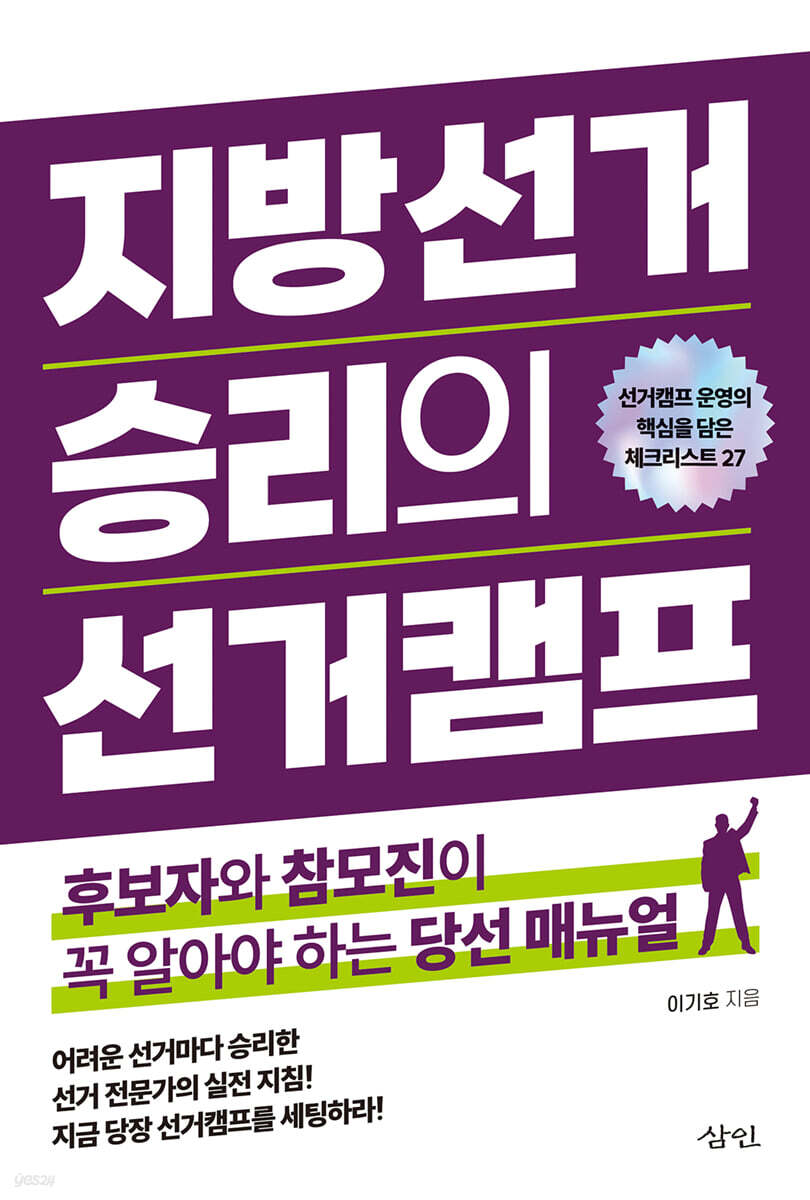
Local election victory campaign
 |
Description
Book Introduction
To be implemented in June 2026
9th Nationwide Simultaneous Local Elections
Campaign Manual for Candidates
In our country, the three major elections are the presidential election, the general election, and the local elections.
A presidential election is an election to choose one president.
The general election is an election to elect 300 members of the National Assembly.
So what about the local elections? These are elections that elect over 4,100 people, including mayors of metropolitan and basic local governments (based on the 8th local election).
It could be said to be a huge election.
Now that the presidential election is over, the number of people moving forward for next year's (2026) local elections is truly enormous nationwide.
This book, which is needed by so many people, has been published this time.
The author, who has contributed to the victory of election campaigns in all election fields, including the Gangnam District Office election, Gangwon Province Governor election, Seoul Mayor election, National Assembly election, party convention, and even the presidential election, has included in this book the A to Z of election know-how that candidates who wish to be elected in the 2026 local elections and their staff must know.
In particular, the author argues that the era of candidates being elected based on their individual abilities has long since passed, and emphasizes the importance of organizing an "election camp" with the attitude of running the country with a small number of people.
An 'election camp' in which not only the candidate but also the staff who will assist the candidate move nimbly as one organism can make the candidate the winner.
The moment you read the first page of this book, the campaign begins!
9th Nationwide Simultaneous Local Elections
Campaign Manual for Candidates
In our country, the three major elections are the presidential election, the general election, and the local elections.
A presidential election is an election to choose one president.
The general election is an election to elect 300 members of the National Assembly.
So what about the local elections? These are elections that elect over 4,100 people, including mayors of metropolitan and basic local governments (based on the 8th local election).
It could be said to be a huge election.
Now that the presidential election is over, the number of people moving forward for next year's (2026) local elections is truly enormous nationwide.
This book, which is needed by so many people, has been published this time.
The author, who has contributed to the victory of election campaigns in all election fields, including the Gangnam District Office election, Gangwon Province Governor election, Seoul Mayor election, National Assembly election, party convention, and even the presidential election, has included in this book the A to Z of election know-how that candidates who wish to be elected in the 2026 local elections and their staff must know.
In particular, the author argues that the era of candidates being elected based on their individual abilities has long since passed, and emphasizes the importance of organizing an "election camp" with the attitude of running the country with a small number of people.
An 'election camp' in which not only the candidate but also the staff who will assist the candidate move nimbly as one organism can make the candidate the winner.
The moment you read the first page of this book, the campaign begins!
- You can preview some of the book's contents.
Preview
index
Starting the book
A look at the South Korean elections
Before reading in earnest, let's first organize the flow and concepts!
Set up the candidates from Part 1
Chapter 1: Candidates' Self-Question and Answers
01.
Candidates look back at themselves first.
02.
Is the goal to get elected or to make it known?
03.
Building favorability and awareness
04.
Let's look back on our family
05.
Elections are a battle of 'strategy'
06 Understanding 'Zeitgeist and Frame' and 'People and Desire'
07.
Solomon Candidate and Zhuge Liang's Staff
08.
Establishing a decision-making group, the "control tower."
Chapter 2: Candidate Setting and Checkpoints
01.
It's never too early to start running.
02.
Creating and managing social media
03.
Central Party and Party Member Management
04.
Target major communities
05.
Let's take care of small groups, children, and teenagers too.
06.
Manage risk by phone rather than text, and in person rather than over the phone.
07.
Let's Smile! Positive Image Planning and Branding
08.
Use 'positive language'
09.
Don't spit! Negative images disappear in an instant.
10.
Sensitivity to adulthood that shakes up the election landscape
Chapter 3: Elections in the Era of the Fourth Industrial Revolution
01.
Media Strategies for the Fourth Industrial Revolution
02.
Mobile and online strategies are a priority
03.
Social media strategies vary by generation.
04.
Big data is easy to obtain.
05.
Election plans, policies, and pledges created with AI
After setting up the second round of candidates, it's time to set up the advance team.
Chapter 4: Election Basics Strategy and Initial Roadmap
01.
Basic principles of election campaigns
02.
Creating an advance party
03.
Plan your own roadmap
04.
Analyze past elections
05.
Policy Development, Experience the Field
06.
Essential public opinion poll analysis and utilization
Chapter 5: Comprehensively Analyze Everything Related to the Election
01.
SWOT Analysis of the candidate
02.
Constituency Analysis: By Generation, Issue, and Region
03.
Political and economic analysis to understand the situation
04.
Local issues, voters' top concerns
05.
GP, analyze your competitors
Chapter 6: Focus on Percentages
01.
Catch 30% and you'll win! Focus on the 10%.
02.
The target group is the subject of intensive management
03.
Voter Profiling: Mind Reading
04.
STP strategy targeting 10%
05.
From market segmentation to mobilization
Part 3: Setting up the advance team Next is setting up the first election camp.
Chapter 7: Organization of the First Election Campaign
01.
Essential Requirements for Organizing an Election Campaign
02.
The first election campaign should be structured like this.
03.
The office manager, the legal team, and the executive secretary
04.
The virtues of an executive secretary are sense and trust.
05.
Accounting Manager and Complaints Manager
06.
Establishment of a support group and fundraising plan
07.
The difference between election expenses and political funding
08.
Election fundraising and limit management
09.
Blind Spots in Political Funding Law: Campaign Funds and Book Launches
10.
Public Election System, a system to compensate for election expenses
11.
Five Conditions for an Election Office
Chapter 8: Messages and Communication
01.
Intensely and concisely
02.
Your message must have impact.
03.
The catchphrase is 8, 15
04.
Storytelling, how to convey it?
05.
Reach 3+, repeat the message
06.
"It's the economy, stupid": A successful messaging strategy
07.
The Art of Writing a Press Release That Gets Attention
Chapter 9: Crisis Management and Negative Strategies
01.
Various crisis management response strategies
02.
Creating a Crisis Management Manual
03.
Negatives are cautious and at the last minute
04.
Negative Success Stories and Push Polling
Part 4: First Election Camp Setting Next is the Second Election Camp Setting
Chapter 10: Time to expand the first election campaign into a second campaign.
01.
Drawing the organizational chart of the 'second election campaign'
02.
Don't be stingy with your appointment letter
03.
Election workers and volunteers also need training.
04.
'Professional' speakers and 'more for less' volunteers
05.
Treat your volunteers with respect
06.
Creating a natural internal communication culture
07.
Election worker allowances increased for the first time in 28 years
Chapter 11: "Smart Election Campaign" Begins in Full Swing
01.
Planning is also necessary for organizing campaign spaces.
02.
The campaign schedule is created in stages.
03.
Planning events and activities to maximize campaign effectiveness
04.
Campaign materials and promotional execution also require strategy.
Chapter 12: Maximizing Media Utilization through Public Opinion Leadership
01.
There must be a public relations team leader
02.
You must build good relationships with reporters.
03.
The Importance of Press Releases Tailored to Reporters' Eye Level
04.
Timing of press conferences and interviews
05.
Let's plan a media event
The primary is more intense than the main event.
Chapter 13: Preliminary Candidate System
01.
What you need to register as a preliminary candidate
02.
City and provincial governors have 120 days to live, county heads and county council members have 60 days to live.
03.
Proposal Material Production Strategy for Preliminary Candidates
Chapter 14: It's Time for the Online and Offline Organization Teams to Get Moving
01.
Role of the Organization Team
02.
Execution is done by an external organization.
03.
Functions of public and private organizations
04.
Synergy strategy with external organizations
Chapter 15: The Party Primary is a "National Team Selection Competition."
01.
A primary election that is more difficult than the general election
02.
First, let's catch the rabbit
03.
A look at each party's primary process
04.
Why public opinion manipulation is attempted
Part 6 is finally here
Chapter 16: The prepared campaign will not waver.
01.
Things to check before registering as a candidate
02.
D-20 Candidate Registration, Leaving the Archery Range
03.
Text messages can be sent up to 8 times!
Chapter 17: Seize the Initiative with Creative Campaigning
01.
Online and Offline Election Strategies Learned from the Classics
02.
Making a good election song
03.
Take the lead and preempt the issue
04.
"Old Palace is a Great Palace" banner project
Chapter 18: 1% viewership ratings, but still an important debate
01.
Whether it's studying or debating, 'normal skills' are the foundation.
02.
Still, a 'last minute' is necessary
03.
TV debates where nonverbal expressions are important
04.
How to deal with discussion meetings hosted by organizations of all levels
Part 7: A beautiful ending, a clean finish
Chapter 19: Always Maintain the Character of a Winner
01.
Seize the opportunity early and don't lose until the end.
02.
Election planning for 'D-7~D-1'
03.
A 'smiling candidate' and a 'smiling campaign' until the end
Chapter 20: Finally, D-Day! What to Do on Election Day
01.
Election Day Checklist and Voting Management
02.
Dispatch of election observers
03.
Setting up an election campaign for the media
Chapter 21: Election Analysis and Future Action Plans
01.
Create a white paper for results analysis and feedback
02.
What the elected and defeated candidates should do
A look at the South Korean elections
Before reading in earnest, let's first organize the flow and concepts!
Set up the candidates from Part 1
Chapter 1: Candidates' Self-Question and Answers
01.
Candidates look back at themselves first.
02.
Is the goal to get elected or to make it known?
03.
Building favorability and awareness
04.
Let's look back on our family
05.
Elections are a battle of 'strategy'
06 Understanding 'Zeitgeist and Frame' and 'People and Desire'
07.
Solomon Candidate and Zhuge Liang's Staff
08.
Establishing a decision-making group, the "control tower."
Chapter 2: Candidate Setting and Checkpoints
01.
It's never too early to start running.
02.
Creating and managing social media
03.
Central Party and Party Member Management
04.
Target major communities
05.
Let's take care of small groups, children, and teenagers too.
06.
Manage risk by phone rather than text, and in person rather than over the phone.
07.
Let's Smile! Positive Image Planning and Branding
08.
Use 'positive language'
09.
Don't spit! Negative images disappear in an instant.
10.
Sensitivity to adulthood that shakes up the election landscape
Chapter 3: Elections in the Era of the Fourth Industrial Revolution
01.
Media Strategies for the Fourth Industrial Revolution
02.
Mobile and online strategies are a priority
03.
Social media strategies vary by generation.
04.
Big data is easy to obtain.
05.
Election plans, policies, and pledges created with AI
After setting up the second round of candidates, it's time to set up the advance team.
Chapter 4: Election Basics Strategy and Initial Roadmap
01.
Basic principles of election campaigns
02.
Creating an advance party
03.
Plan your own roadmap
04.
Analyze past elections
05.
Policy Development, Experience the Field
06.
Essential public opinion poll analysis and utilization
Chapter 5: Comprehensively Analyze Everything Related to the Election
01.
SWOT Analysis of the candidate
02.
Constituency Analysis: By Generation, Issue, and Region
03.
Political and economic analysis to understand the situation
04.
Local issues, voters' top concerns
05.
GP, analyze your competitors
Chapter 6: Focus on Percentages
01.
Catch 30% and you'll win! Focus on the 10%.
02.
The target group is the subject of intensive management
03.
Voter Profiling: Mind Reading
04.
STP strategy targeting 10%
05.
From market segmentation to mobilization
Part 3: Setting up the advance team Next is setting up the first election camp.
Chapter 7: Organization of the First Election Campaign
01.
Essential Requirements for Organizing an Election Campaign
02.
The first election campaign should be structured like this.
03.
The office manager, the legal team, and the executive secretary
04.
The virtues of an executive secretary are sense and trust.
05.
Accounting Manager and Complaints Manager
06.
Establishment of a support group and fundraising plan
07.
The difference between election expenses and political funding
08.
Election fundraising and limit management
09.
Blind Spots in Political Funding Law: Campaign Funds and Book Launches
10.
Public Election System, a system to compensate for election expenses
11.
Five Conditions for an Election Office
Chapter 8: Messages and Communication
01.
Intensely and concisely
02.
Your message must have impact.
03.
The catchphrase is 8, 15
04.
Storytelling, how to convey it?
05.
Reach 3+, repeat the message
06.
"It's the economy, stupid": A successful messaging strategy
07.
The Art of Writing a Press Release That Gets Attention
Chapter 9: Crisis Management and Negative Strategies
01.
Various crisis management response strategies
02.
Creating a Crisis Management Manual
03.
Negatives are cautious and at the last minute
04.
Negative Success Stories and Push Polling
Part 4: First Election Camp Setting Next is the Second Election Camp Setting
Chapter 10: Time to expand the first election campaign into a second campaign.
01.
Drawing the organizational chart of the 'second election campaign'
02.
Don't be stingy with your appointment letter
03.
Election workers and volunteers also need training.
04.
'Professional' speakers and 'more for less' volunteers
05.
Treat your volunteers with respect
06.
Creating a natural internal communication culture
07.
Election worker allowances increased for the first time in 28 years
Chapter 11: "Smart Election Campaign" Begins in Full Swing
01.
Planning is also necessary for organizing campaign spaces.
02.
The campaign schedule is created in stages.
03.
Planning events and activities to maximize campaign effectiveness
04.
Campaign materials and promotional execution also require strategy.
Chapter 12: Maximizing Media Utilization through Public Opinion Leadership
01.
There must be a public relations team leader
02.
You must build good relationships with reporters.
03.
The Importance of Press Releases Tailored to Reporters' Eye Level
04.
Timing of press conferences and interviews
05.
Let's plan a media event
The primary is more intense than the main event.
Chapter 13: Preliminary Candidate System
01.
What you need to register as a preliminary candidate
02.
City and provincial governors have 120 days to live, county heads and county council members have 60 days to live.
03.
Proposal Material Production Strategy for Preliminary Candidates
Chapter 14: It's Time for the Online and Offline Organization Teams to Get Moving
01.
Role of the Organization Team
02.
Execution is done by an external organization.
03.
Functions of public and private organizations
04.
Synergy strategy with external organizations
Chapter 15: The Party Primary is a "National Team Selection Competition."
01.
A primary election that is more difficult than the general election
02.
First, let's catch the rabbit
03.
A look at each party's primary process
04.
Why public opinion manipulation is attempted
Part 6 is finally here
Chapter 16: The prepared campaign will not waver.
01.
Things to check before registering as a candidate
02.
D-20 Candidate Registration, Leaving the Archery Range
03.
Text messages can be sent up to 8 times!
Chapter 17: Seize the Initiative with Creative Campaigning
01.
Online and Offline Election Strategies Learned from the Classics
02.
Making a good election song
03.
Take the lead and preempt the issue
04.
"Old Palace is a Great Palace" banner project
Chapter 18: 1% viewership ratings, but still an important debate
01.
Whether it's studying or debating, 'normal skills' are the foundation.
02.
Still, a 'last minute' is necessary
03.
TV debates where nonverbal expressions are important
04.
How to deal with discussion meetings hosted by organizations of all levels
Part 7: A beautiful ending, a clean finish
Chapter 19: Always Maintain the Character of a Winner
01.
Seize the opportunity early and don't lose until the end.
02.
Election planning for 'D-7~D-1'
03.
A 'smiling candidate' and a 'smiling campaign' until the end
Chapter 20: Finally, D-Day! What to Do on Election Day
01.
Election Day Checklist and Voting Management
02.
Dispatch of election observers
03.
Setting up an election campaign for the media
Chapter 21: Election Analysis and Future Action Plans
01.
Create a white paper for results analysis and feedback
02.
What the elected and defeated candidates should do
Detailed image

Publisher's Review
I won every election I participated in.
Practical guidance from election experts!
Set up your campaign right now!
It has not even been two months since the presidential election, but the political world is already busy preparing for the local elections to be held in June next year (2026).
Even before the presidential election, there were rumors in some regions that there were movements related to the local elections.
If you are a candidate running in the 9th local elections, a member of the candidate's staff, or an election worker entering the campaign, what should you do going forward?
1.
Candidate Setting
Candidates must first examine themselves.
Let's look back as objectively as possible at the reasons for running in this election, your vision, values, strengths and weaknesses, etc.
In order to properly guide your campaign, you need to know a little about the district you're running in, what policies you'll pursue, and how you'll build awareness among the local population.
2.
Setting up the advance party
If you have decided to run for office, you must establish an advance team of no more than five key staff members to assist you.
A candidate cannot do everything alone.
We need to form a team of key advisors who will work in sync with the candidate and serve as his or her hands and feet, and create a detailed roadmap leading up to election day.
3.
Election campaign setup
Once the foundation for the election campaign has been laid with the advance team, the working-level personnel for the campaign, both domestically and internationally, are gathered and moved into action in earnest.
Based on the functions and roles essential to the election campaign, the organization is structured into a planning team, public relations team, and scheduling team, so that each team operates as one body.
4.
Primary election
There is a saying that the party primary is more difficult than the general election.
This is especially true in regions where a party's nomination means election.
A properly organized election campaign centered around the candidate and his staff focuses on passing the party primary without fail, based on thorough planning and execution.
5.
Main event
If you pass the primary, all that's left is the general election.
We must do our best until election day, actively responding to various external situations and variables, such as attacks from competing candidates and changes in public opinion.
The week before election day is especially important.
To get one more vote than the second place
We need to set up a proper election campaign!
The election process is the same, whether progressive or conservative.
So why are the results different? It all depends on who first organizes an "election campaign" where the candidate, his staff, and campaign staff work as one.
While previous election-related books have focused on the candidates, this book provides detailed, step-by-step guidance on how to properly organize such an important campaign from the beginning.
In particular, a checklist that only summarizes the key points will be a very useful guide in urgent situations.
Remember! Elections are battlegrounds where you absolutely must come in first.
This book, which neatly organizes the things to do from the time you run for office to election day, will teach you how to get one more vote than the second place.
Practical guidance from election experts!
Set up your campaign right now!
It has not even been two months since the presidential election, but the political world is already busy preparing for the local elections to be held in June next year (2026).
Even before the presidential election, there were rumors in some regions that there were movements related to the local elections.
If you are a candidate running in the 9th local elections, a member of the candidate's staff, or an election worker entering the campaign, what should you do going forward?
1.
Candidate Setting
Candidates must first examine themselves.
Let's look back as objectively as possible at the reasons for running in this election, your vision, values, strengths and weaknesses, etc.
In order to properly guide your campaign, you need to know a little about the district you're running in, what policies you'll pursue, and how you'll build awareness among the local population.
2.
Setting up the advance party
If you have decided to run for office, you must establish an advance team of no more than five key staff members to assist you.
A candidate cannot do everything alone.
We need to form a team of key advisors who will work in sync with the candidate and serve as his or her hands and feet, and create a detailed roadmap leading up to election day.
3.
Election campaign setup
Once the foundation for the election campaign has been laid with the advance team, the working-level personnel for the campaign, both domestically and internationally, are gathered and moved into action in earnest.
Based on the functions and roles essential to the election campaign, the organization is structured into a planning team, public relations team, and scheduling team, so that each team operates as one body.
4.
Primary election
There is a saying that the party primary is more difficult than the general election.
This is especially true in regions where a party's nomination means election.
A properly organized election campaign centered around the candidate and his staff focuses on passing the party primary without fail, based on thorough planning and execution.
5.
Main event
If you pass the primary, all that's left is the general election.
We must do our best until election day, actively responding to various external situations and variables, such as attacks from competing candidates and changes in public opinion.
The week before election day is especially important.
To get one more vote than the second place
We need to set up a proper election campaign!
The election process is the same, whether progressive or conservative.
So why are the results different? It all depends on who first organizes an "election campaign" where the candidate, his staff, and campaign staff work as one.
While previous election-related books have focused on the candidates, this book provides detailed, step-by-step guidance on how to properly organize such an important campaign from the beginning.
In particular, a checklist that only summarizes the key points will be a very useful guide in urgent situations.
Remember! Elections are battlegrounds where you absolutely must come in first.
This book, which neatly organizes the things to do from the time you run for office to election day, will teach you how to get one more vote than the second place.
GOODS SPECIFICS
- Date of issue: July 30, 2025
- Page count, weight, size: 412 pages | 614g | 152*225*20mm
- ISBN13: 9788964362860
- ISBN10: 8964362861
You may also like
카테고리
korean


korean

![GQ KOREA Mark (Monthly): December [2025]](http://librairie.coreenne.fr/cdn/shop/files/8ef265dbbfbf186523ed75ba7319009d.jpg?v=1765340328&width=3840)


