

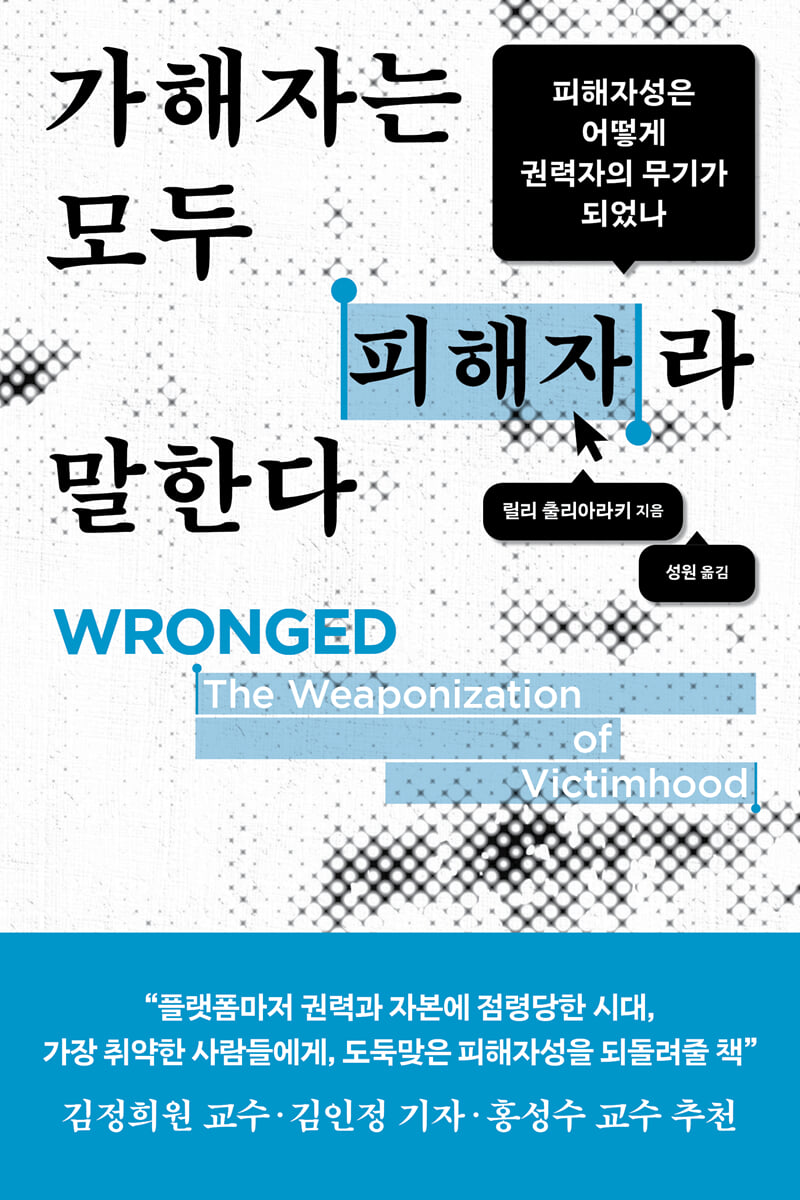
All perpetrators say they are victims
 |
Description
Book Introduction
- A word from MD
- Sexual offenders claim that they are the victims.
Both Russia and Israel, who recently started a war, insist that they were the victims.
Modern society is an era where people try to claim to be victims first.
When this victimhood becomes a weapon, can we truly empathize with the suffering of others? - Son Min-gyu, Social and Political PD
★ Recommended by Professor Kim Jeong-hee, Reporter Kim In-jeong, and Professor Hong Seong-su! ★
“The status of victim is now a privilege and a weapon.”
Everyone presents themselves as the 'true victim',
About a society of victims who have forgotten the suffering of others
“In an era where even platforms are occupied by power and capital,
“A book that will restore the stolen victimhood to the most vulnerable.”
Kim In-jeong (journalist, author of "A Society that Witnesses Suffering")
“How did powerful, privileged male perpetrators come to play the victim?
This important book offers new and compelling answers.”
Eva Illouz, author of Emotional Capitalism
“My reputation and my family’s reputation have been irreparably damaged by these vicious false accusations,” Brett Kavanaugh, the Supreme Court nominee accused of sexual assault, told the Senate Judiciary Committee through tears in the fall of 2018.
Trump and Republican lawmakers expressed sympathy for him, lamenting that “these are very difficult times for young men in America,” and social media was abuzz with calls for his case to be heard.
Christine Blasey Ford, who accused him, also received enthusiastic support from women around the world on social media, but suffered death threats from Kavanaugh supporters.
Three other women, including Blasey Ford, had the courage to give similar testimony, yet Kavanaugh was confirmed to the Supreme Court without even being investigated.
The scene of a person identified as the perpetrator shedding tears and passionately claiming to be an innocent victim, thereby escaping the situation, has become a familiar sight in our society.
But when did the perpetrators start claiming to be the wronged victims? How is this counterproductive behavior even possible? And above all, why do they claim to be the victims?
Lily Chouliaraki, a professor at the London School of Economics and Political Science, says that “the status of victim has now become a privilege and a weapon.” In “All Perpetrators Say They Are Victims,” she explores the history of victims and victimhood and the phenomenon of “weaponization.”
Modern society is a 'democracy of pain' where social media and the media are full of suffering.
The suffering of minorities such as female victims of sexual violence, black people suffering from racial discrimination, and people with disabilities deprived of their right to move is spreading, but at the same time, the suffering of men who feel wronged by ‘reverse discrimination,’ white people who lament ‘affirmative action policies,’ and perpetrators who plead ‘false accusations’ is also spreading indiscriminately.
All those who cry out in the name of human rights are seen as "victims" deserving of sympathy and compassion, and at first glance, listening to their voices feels like a civic duty.
Can it be ethical in principle to ignore the individual's voice, regardless of who claims it, saying, "I am wronged and in pain?" The author argues that in a society that places a high value on individual wounds and human rights, victims are granted empathy, compassion, legitimacy, and a voice, which can lead to victimhood being abused as a "weapon."
When victimhood becomes a useful political weapon, those in power who can raise their voices while suppressing the voices of others are the ones who rise to the position of victim.
Now that the status of victimhood is the most legitimate symbol of power, how can we discern the false victimization of perpetrators? Whose voices should we listen to and stand in solidarity with? The author historically analyzes "who has been recognized as a victim," delves into the contemporary "war on victimhood," and explores alternatives that can restore victimhood to vulnerable people.
“The status of victim is now a privilege and a weapon.”
Everyone presents themselves as the 'true victim',
About a society of victims who have forgotten the suffering of others
“In an era where even platforms are occupied by power and capital,
“A book that will restore the stolen victimhood to the most vulnerable.”
Kim In-jeong (journalist, author of "A Society that Witnesses Suffering")
“How did powerful, privileged male perpetrators come to play the victim?
This important book offers new and compelling answers.”
Eva Illouz, author of Emotional Capitalism
“My reputation and my family’s reputation have been irreparably damaged by these vicious false accusations,” Brett Kavanaugh, the Supreme Court nominee accused of sexual assault, told the Senate Judiciary Committee through tears in the fall of 2018.
Trump and Republican lawmakers expressed sympathy for him, lamenting that “these are very difficult times for young men in America,” and social media was abuzz with calls for his case to be heard.
Christine Blasey Ford, who accused him, also received enthusiastic support from women around the world on social media, but suffered death threats from Kavanaugh supporters.
Three other women, including Blasey Ford, had the courage to give similar testimony, yet Kavanaugh was confirmed to the Supreme Court without even being investigated.
The scene of a person identified as the perpetrator shedding tears and passionately claiming to be an innocent victim, thereby escaping the situation, has become a familiar sight in our society.
But when did the perpetrators start claiming to be the wronged victims? How is this counterproductive behavior even possible? And above all, why do they claim to be the victims?
Lily Chouliaraki, a professor at the London School of Economics and Political Science, says that “the status of victim has now become a privilege and a weapon.” In “All Perpetrators Say They Are Victims,” she explores the history of victims and victimhood and the phenomenon of “weaponization.”
Modern society is a 'democracy of pain' where social media and the media are full of suffering.
The suffering of minorities such as female victims of sexual violence, black people suffering from racial discrimination, and people with disabilities deprived of their right to move is spreading, but at the same time, the suffering of men who feel wronged by ‘reverse discrimination,’ white people who lament ‘affirmative action policies,’ and perpetrators who plead ‘false accusations’ is also spreading indiscriminately.
All those who cry out in the name of human rights are seen as "victims" deserving of sympathy and compassion, and at first glance, listening to their voices feels like a civic duty.
Can it be ethical in principle to ignore the individual's voice, regardless of who claims it, saying, "I am wronged and in pain?" The author argues that in a society that places a high value on individual wounds and human rights, victims are granted empathy, compassion, legitimacy, and a voice, which can lead to victimhood being abused as a "weapon."
When victimhood becomes a useful political weapon, those in power who can raise their voices while suppressing the voices of others are the ones who rise to the position of victim.
Now that the status of victimhood is the most legitimate symbol of power, how can we discern the false victimization of perpetrators? Whose voices should we listen to and stand in solidarity with? The author historically analyzes "who has been recognized as a victim," delves into the contemporary "war on victimhood," and explores alternatives that can restore victimhood to vulnerable people.
- You can preview some of the book's contents.
Preview
index
Recommendation
Preface and Acknowledgments
Chapter 1: Why Victimhood?
Chapter 2 Who were the victims in the past?
Chapter 3 Who are the victims today?
Chapter 4 How can we regain our sense of victimhood?
References
Americas
index
Preface and Acknowledgments
Chapter 1: Why Victimhood?
Chapter 2 Who were the victims in the past?
Chapter 3 Who are the victims today?
Chapter 4 How can we regain our sense of victimhood?
References
Americas
index
Detailed image

Into the book
First, as the fact that this story spread around the world and made international headlines suggests, victimhood claims are not a phenomenon confined to the United States, but a pervasive issue that captures the attention of Western culture as a whole.
This is not a new perspective.
Twenty-five years ago, American critic Robert Hughes said we live in a “democracy of suffering, where not everyone is rich and famous, but everyone suffers.”
A decade later, Didier Fassin and Richard Rechtman's seminal study of the “empire of trauma” saw victimhood as a central moral and political condition of contemporary life.
They said this:
“Trauma is not limited to the vocabulary of psychiatry.
Trauma is deeply ingrained in our everyday lives.
In effect, it created a new language for the event.” Carolyn Dean recently echoed this point, arguing that “the traumatized victim is at the heart of Western culture today.”
While these statements see victimhood as a dominant discourse in Western culture in general, they do not address the core issues raised by the stories of Blasey Ford and Kavanaugh.
What kind of world is this, a world overflowing with victims, where everyone competes to claim their suffering deserves recognition over that of others? How did the world become what it is today? What benefits does such a world bring to life? More importantly, what are the costs? This book explores these questions.
--- From "Why Victimhood?"
Within the framework of the politics of pain, we can better understand why victimhood is not a signifier that objectively bestows an essential identity on the self, but rather, to reiterate, a communicative act that borrows the language of pain developed in liberal modernity to utter, on behalf of the vulnerable self, “I am hurt” or “I feel wronged,” and to evoke feelings of pity.
In other words, the victim is not a fixed, specific person, but a repetitive speaker who is created as vulnerable in the very moment by claiming that the self is in distress.
What makes victimhood a kind of battleground in public discourse is the performative capacity to summon diverse communities of recognition around oneself by revealing a new self amidst the abundance of claims of trauma or injury.
Politics today is therefore largely a politics of suffering, insofar as it relies heavily on malleable acts of linguistic “articulations” that link suffering and the self in ways that provisionally determine the victim’s identity at various junctures over time, although, as Stuart Hall has said, “it is not always necessary, definitive, absolute, or essential.”
Therefore, who is created as a victim, with what claims of suffering, and to which community they belong, is not something to be taken for granted, but rather a matter related to political communication that demands a critical analysis of public discourse.
--- From "Why Victimhood?"
What lessons can we learn from reconsidering the past and present of the vocabulary of victimhood? A critical analysis of victimhood reveals that it's difficult to discern who is a victim and who is a perpetrator simply by looking at the "surface" of public discourse.
Since the claims of suffering and the conditions of the self are never a priori integrated when communicating suffering, research on victimhood must begin by acknowledging the fundamental contingency of the concept of victimhood.
In this context, I repeatedly distinguish between claims and conditions (or contexts), not because there is some fixed boundary “out there” that divides them, but because I can use that distinction as a heuristic device.
This heuristic can serve as a useful analytical framework for exploring the relationship between claims and conditions in a specific space-time.
Therefore, instead of asking questions that distinguish between “real” and “fake” victims, we should ask the most important questions in the pursuit of truth.
Under what conditions do claims of particular suffering lead certain selves to be perceived as victims? From what position of power do these selves speak? What benefits do these claims bring to them and to the communities they call forth? What kind of exclusions do these claims presuppose and solidify?
--- From "Why Victimhood?"
The vocabulary of victimhood we use today is grounded in this history of exclusion.
This forces us to ponder how vulnerability is not a “universal” human trait, but rather a privilege bestowed upon white men as the archetypal victims of 20th-century modernity.
White men suffer while fighting, suffer while killing, suffer while protecting and kill, and suffer while protecting.
It is clear that all these forms of suffering are inherent in the core goal of war, which is the practice of mutual harm.
But it also perpetuates and maintains the notion that the Western male ego is fundamentally good, only incidentally bad, and the only agent deserving of professional medical attention and empathy for all the violence it commits.
By privileging white male suffering and activating a cycle of horrific violence and healing, men have been granted, at least in part, a legacy of “witnessing.”
Thanks to this, men have gained credibility when they speak out about pain and suffering, unlike women who have historically had little recognition for their suffering.122 Similarly to women, non-white selves live, fight, and die without the power to speak out, without recognition or memorialization of their sacrifices, pain, and loss.
--- From "Who was the victim in the past?"
The use of the language of suffering by powerful people is already the subject of theoretical study, called “antivictimism.”
Allison Cole, studying American politics since September 11, 2001, succinctly summarizes the phenomenon of the far right weaponizing victimhood.
He says the far right promotes its own brand of victimhood by “inventing and propagating new victim groups” to “continue to tarnish the politics of race, feminism, and other forms of resistance.”
She adds, “This movement has been successful in enshrining the victim status of the unborn child in law by including the Unborn Victims of Violence Act of 2004 in recent amendments to laws designed to reduce violence against women.”
While Cole's study examines the rise of anti-victimism at the dawn of the twenty-first century, he and others trace its roots to reactionary discontent with the legal and social reforms that had been implemented in favor of previously excluded groups following the civil rights and feminist struggles of the mid-1960s in the United States.
Some conservative, white supremacist middle-class people resented the expansion of social structures to democratically include Black people and women thanks to these movements, and attacked the oppressed groups for playing the “victim card,” instead presenting themselves as the “true victims” of the system.
Robert Horwitz argues that “when white men began to lose some of their social and structural privileges, particularly in the wake of the rise of minority rights and the women’s revolution, they denounced that revolution as a politics of victimhood.”
In this sense, the case that overturned Roe v. Wade was a long-standing, but now fully realized, anti-victimization project.
Samuel J.
Because it has succeeded in making the partisan claims of the evangelical far right into legal fact in many states under the guise of resolving, as Justice Alito put it, “critical moral questions.”
--- From "How can we regain our victimhood?"
Originating in tweets from the Black community but now widely used elsewhere, the “Karen” metaphor describes a white female ego who uses their racial privilege to claim they are a victim of Black violence, aligning with the establishment-centric empathy of “HimPercy.”
The “Karen” trope, with its premise of possessing “white superiority and class privilege without regret,”49 has a longer history than “Him Percy,” but gained prominence in the spring of 2020 when Christian Cooper, a Black man, posted video evidence of a white woman pretending to feel threatened by him and reporting him to the police.
This was an example of weaponizing “white women’s tears” to induce the effect of cruelty toward racial others.50 Here, the vested interest-centered empathy constructs an anti-victimization argument centered around the stereotype of a black “thug” who poses a threat to white women by relying on the traditional gender role dichotomy of women in distress and men who inflict harm in the racist narrative that blacks are criminals.
--- From "How can we regain our victimhood?"
I can't challenge it.
To confront this form of violence, we need a narrative of collectivist justice that demands united action to change the conditions that created suffering in the first place, rather than individualistic explanations for social suffering.
In today's media landscape and viral-driven economies of attention, collectivist narratives might seem outdated.
Yet, a modernized collectivist narrative, adapted to the present age, is needed not only to combat the politics of anti-victimism and far-right brutality, but also to create a vision of a future-oriented social change that is so desperately needed.
As we saw in Chapter 1, today's media and political discourses have commercialized the communication of suffering and encroached upon by the "infotainment" genre. This tends to individualize narratives of trauma and human rights, reproducing people's suffering solely as personal struggles, while diluting or eliminating explanatory arguments centered on the structural causes of suffering.
Liberal discourse, in particular, favors a form of communication known as “irony,” in which the overall message is focused on injustice but not explicitly stated, often expressed through discourse imbued with “a know-it-all indifference, a self-conscious suspicion of all truth claims… a playful agnosticism.”
For example, contemporary humanitarian communication styles that brand human rights causes through NGO campaigns or celebrity endorsements have gained popularity among media users, but they also tend to promote public engagement as a private matter of consumer choice.
This cultivates an ambivalent model of the educated citizen who is “skeptical of any moral appeal to action for solidarity, but open to some action on behalf of those in distress.”
This is not a new perspective.
Twenty-five years ago, American critic Robert Hughes said we live in a “democracy of suffering, where not everyone is rich and famous, but everyone suffers.”
A decade later, Didier Fassin and Richard Rechtman's seminal study of the “empire of trauma” saw victimhood as a central moral and political condition of contemporary life.
They said this:
“Trauma is not limited to the vocabulary of psychiatry.
Trauma is deeply ingrained in our everyday lives.
In effect, it created a new language for the event.” Carolyn Dean recently echoed this point, arguing that “the traumatized victim is at the heart of Western culture today.”
While these statements see victimhood as a dominant discourse in Western culture in general, they do not address the core issues raised by the stories of Blasey Ford and Kavanaugh.
What kind of world is this, a world overflowing with victims, where everyone competes to claim their suffering deserves recognition over that of others? How did the world become what it is today? What benefits does such a world bring to life? More importantly, what are the costs? This book explores these questions.
--- From "Why Victimhood?"
Within the framework of the politics of pain, we can better understand why victimhood is not a signifier that objectively bestows an essential identity on the self, but rather, to reiterate, a communicative act that borrows the language of pain developed in liberal modernity to utter, on behalf of the vulnerable self, “I am hurt” or “I feel wronged,” and to evoke feelings of pity.
In other words, the victim is not a fixed, specific person, but a repetitive speaker who is created as vulnerable in the very moment by claiming that the self is in distress.
What makes victimhood a kind of battleground in public discourse is the performative capacity to summon diverse communities of recognition around oneself by revealing a new self amidst the abundance of claims of trauma or injury.
Politics today is therefore largely a politics of suffering, insofar as it relies heavily on malleable acts of linguistic “articulations” that link suffering and the self in ways that provisionally determine the victim’s identity at various junctures over time, although, as Stuart Hall has said, “it is not always necessary, definitive, absolute, or essential.”
Therefore, who is created as a victim, with what claims of suffering, and to which community they belong, is not something to be taken for granted, but rather a matter related to political communication that demands a critical analysis of public discourse.
--- From "Why Victimhood?"
What lessons can we learn from reconsidering the past and present of the vocabulary of victimhood? A critical analysis of victimhood reveals that it's difficult to discern who is a victim and who is a perpetrator simply by looking at the "surface" of public discourse.
Since the claims of suffering and the conditions of the self are never a priori integrated when communicating suffering, research on victimhood must begin by acknowledging the fundamental contingency of the concept of victimhood.
In this context, I repeatedly distinguish between claims and conditions (or contexts), not because there is some fixed boundary “out there” that divides them, but because I can use that distinction as a heuristic device.
This heuristic can serve as a useful analytical framework for exploring the relationship between claims and conditions in a specific space-time.
Therefore, instead of asking questions that distinguish between “real” and “fake” victims, we should ask the most important questions in the pursuit of truth.
Under what conditions do claims of particular suffering lead certain selves to be perceived as victims? From what position of power do these selves speak? What benefits do these claims bring to them and to the communities they call forth? What kind of exclusions do these claims presuppose and solidify?
--- From "Why Victimhood?"
The vocabulary of victimhood we use today is grounded in this history of exclusion.
This forces us to ponder how vulnerability is not a “universal” human trait, but rather a privilege bestowed upon white men as the archetypal victims of 20th-century modernity.
White men suffer while fighting, suffer while killing, suffer while protecting and kill, and suffer while protecting.
It is clear that all these forms of suffering are inherent in the core goal of war, which is the practice of mutual harm.
But it also perpetuates and maintains the notion that the Western male ego is fundamentally good, only incidentally bad, and the only agent deserving of professional medical attention and empathy for all the violence it commits.
By privileging white male suffering and activating a cycle of horrific violence and healing, men have been granted, at least in part, a legacy of “witnessing.”
Thanks to this, men have gained credibility when they speak out about pain and suffering, unlike women who have historically had little recognition for their suffering.122 Similarly to women, non-white selves live, fight, and die without the power to speak out, without recognition or memorialization of their sacrifices, pain, and loss.
--- From "Who was the victim in the past?"
The use of the language of suffering by powerful people is already the subject of theoretical study, called “antivictimism.”
Allison Cole, studying American politics since September 11, 2001, succinctly summarizes the phenomenon of the far right weaponizing victimhood.
He says the far right promotes its own brand of victimhood by “inventing and propagating new victim groups” to “continue to tarnish the politics of race, feminism, and other forms of resistance.”
She adds, “This movement has been successful in enshrining the victim status of the unborn child in law by including the Unborn Victims of Violence Act of 2004 in recent amendments to laws designed to reduce violence against women.”
While Cole's study examines the rise of anti-victimism at the dawn of the twenty-first century, he and others trace its roots to reactionary discontent with the legal and social reforms that had been implemented in favor of previously excluded groups following the civil rights and feminist struggles of the mid-1960s in the United States.
Some conservative, white supremacist middle-class people resented the expansion of social structures to democratically include Black people and women thanks to these movements, and attacked the oppressed groups for playing the “victim card,” instead presenting themselves as the “true victims” of the system.
Robert Horwitz argues that “when white men began to lose some of their social and structural privileges, particularly in the wake of the rise of minority rights and the women’s revolution, they denounced that revolution as a politics of victimhood.”
In this sense, the case that overturned Roe v. Wade was a long-standing, but now fully realized, anti-victimization project.
Samuel J.
Because it has succeeded in making the partisan claims of the evangelical far right into legal fact in many states under the guise of resolving, as Justice Alito put it, “critical moral questions.”
--- From "How can we regain our victimhood?"
Originating in tweets from the Black community but now widely used elsewhere, the “Karen” metaphor describes a white female ego who uses their racial privilege to claim they are a victim of Black violence, aligning with the establishment-centric empathy of “HimPercy.”
The “Karen” trope, with its premise of possessing “white superiority and class privilege without regret,”49 has a longer history than “Him Percy,” but gained prominence in the spring of 2020 when Christian Cooper, a Black man, posted video evidence of a white woman pretending to feel threatened by him and reporting him to the police.
This was an example of weaponizing “white women’s tears” to induce the effect of cruelty toward racial others.50 Here, the vested interest-centered empathy constructs an anti-victimization argument centered around the stereotype of a black “thug” who poses a threat to white women by relying on the traditional gender role dichotomy of women in distress and men who inflict harm in the racist narrative that blacks are criminals.
--- From "How can we regain our victimhood?"
I can't challenge it.
To confront this form of violence, we need a narrative of collectivist justice that demands united action to change the conditions that created suffering in the first place, rather than individualistic explanations for social suffering.
In today's media landscape and viral-driven economies of attention, collectivist narratives might seem outdated.
Yet, a modernized collectivist narrative, adapted to the present age, is needed not only to combat the politics of anti-victimism and far-right brutality, but also to create a vision of a future-oriented social change that is so desperately needed.
As we saw in Chapter 1, today's media and political discourses have commercialized the communication of suffering and encroached upon by the "infotainment" genre. This tends to individualize narratives of trauma and human rights, reproducing people's suffering solely as personal struggles, while diluting or eliminating explanatory arguments centered on the structural causes of suffering.
Liberal discourse, in particular, favors a form of communication known as “irony,” in which the overall message is focused on injustice but not explicitly stated, often expressed through discourse imbued with “a know-it-all indifference, a self-conscious suspicion of all truth claims… a playful agnosticism.”
For example, contemporary humanitarian communication styles that brand human rights causes through NGO campaigns or celebrity endorsements have gained popularity among media users, but they also tend to promote public engagement as a private matter of consumer choice.
This cultivates an ambivalent model of the educated citizen who is “skeptical of any moral appeal to action for solidarity, but open to some action on behalf of those in distress.”
--- From "How can we regain our victimhood?"
Publisher's Review
“White men are fundamentally good, only accidentally evil.”
Who is entitled to victim status?
If the victim's status is power, the most important question is 'who becomes the victim?'
In this case, the victim is not simply someone who has suffered injury or damage, but someone who has repeatedly claimed their suffering and received recognition for it.
Women who experience sexual violence but are unable to report it for fear of the prejudice of being a “false accuser” and the perpetrator do not become victims.
Victimhood is a status earned through the struggle for recognition, and is a concept derived from the history of those who have suffered.
The author examines the greatest hardships humanity has ever experienced: the American Revolutionary War and the two World Wars, which were fought as all-out wars, the Vietnam War during the Cold War, and the Iraq and Afghanistan Wars, which were touted as "humanitarian security wars," and examines "who was recognized as the victim."
He focuses on the complex position of soldiers, both perpetrators and victims of war, rather than on the civilian victims of war's violence.
Soldiers were noble victims who sacrificed themselves for a cause in the war of independence and the two world wars; in the Vietnam War, where there was no "cause," they were victims who were "forced to kill by ideology," and in the "security war," they were victims who had no choice but to fight for the "world peace" that Western countries desired.
In order to justify the war-making white men of Western nations, only white soldiers from Europe and the United States could occupy this position of victim, leaving no room for soldiers of color or even civilian victims, who were primarily women and children.
The author argues that in the process of justifying the cause of war in the 20th and 21st centuries, white men were positioned as the 'only' victims.
“The vocabulary of victimhood we use today is based on this history of exclusion.
This forces us to ponder how vulnerability is not a “universal” human trait, but rather a privilege bestowed upon white men as the archetypal victims of 20th-century modernity.
White men suffer while fighting, suffer while killing, suffer while protecting and kill, and suffer while protecting.
(…) maintains and perpetuates the notion that the Western male ego is fundamentally good, only incidentally bad, and the only agent deserving of professional medical attention and empathy for all the violence it commits.”
_〈Who was the victim in the past?〉
Meanwhile, the 20th century was also a time when many people were recognized as victims under the concept of universal human rights.
Social movements of black people, women, sexual minorities, the disabled, and workers have fought against patriarchy, racism, and capitalism, and have won the right to survive and civil rights.
By reframing their experiences as unjust violence, they have been granted a degree of victimhood that has previously been exclusively attributed to white men.
As this racist and sexist plan to place only the privileged class in the position of victims and the widespread resistance to it simultaneously unfolded, victimhood and victimhood became political concepts that changed through the competition of various positions.
“I am also an innocent victim!”
How is the victim's status taken away?
So who exactly is the "victim" today? As mentioned earlier, it's someone who has repeatedly claimed and received recognition for their suffering.
But in the age of social media, legitimacy alone is not enough to justify victims of unjust suffering.
The suffering that overflows on social media circulates and reaches random users regardless of the cause or context of the suffering.
Rather than examining the context of the suffering in detail, users sympathize with and re-spread the part they want to empathize with or justify.
Paradoxically, the more widespread the suffering, the more distant its causes become, and social media becomes a "victims' marketplace," where claims of suffering and empathy are competitively disseminated, disconnected from context.
In this marketplace, victims of sexual assault and alleged perpetrators alike demand empathy for their plight, and algorithms that don't ask whose story is more justified simply amplify the "more popular" argument.
The separation of the experience of suffering and its conditions is what the perpetrators and those in power want.
If we can erase the structural problems that underlie individual suffering, then all those who suffer become equal beings worthy of respect.
The trauma of a sexual assault victim and the tears of an 'unjust' perpetrator are merely human pain, and the social problem of power-based sexual assault is reduced to the conflict between two individuals: the perpetrator who hurts each other and the victim who has been hurt by each other.
The author calls this victimhood, which is claimed for the purpose of concealing the structure of violence and obtaining the status of a victim, ‘strategic victimhood.’
Strategic victimhood distorts corrective measures against discrimination as "reverse discrimination," lockdowns due to the COVID-19 pandemic as "oppression of freedom," and the bias against Black people as potential criminals as "rational fear," trampling on the powerless to voice their suffering and depriving them of their victim status.
“Pay attention to the structural suffering of the most vulnerable.”
How to Reclaim Our Stolen Victimhood
When everyone claims to be an innocent victim, we must choose whose suffering we will focus on.
While any individual's suffering should be respected, it is a different story when someone's appeal silences others who are suffering and sustains structures of violence and discrimination.
To distinguish between these strategic victimhoods, the author proposes an analytical tool called victimhood inquiry.
The victimhood inquiry method prevents victimhood from being used as a weapon by examining the detailed context in which the person claiming to be a victim speaks, from what social position and with what kind of power, whether his or her claims presuppose or perpetuate a specific form of exclusion or discrimination, and what emotions the claims evoke in the listener and what communities they unite.
So how do we distinguish strategic victimhood from the overflowing claims of suffering? At its core, strategic victimhood ignores and obscures the undeniable presence of discrimination, exaggerates the emotions and victimization felt by those in power, and silences victims.
The author presents six narratives of cruelty that argue for strategic victimhood.
These are the empathy centered on the vested interests (white, male, middle class, etc.), idealization (the illusion that 'victims must be pure and honest'), linguistic reversal (calling 'victims' of sexual violence as innocent 'perpetrators'), decontextualization (developing terms that disparage social movements such as 'feminazi'), euphemism (expressing non-Western civilian deaths during war as 'collateral damage'), temporary projection (exaggerating the fear of 'reverse discrimination'), and universalization (countering the 'Black Lives Matter' movement with 'All Lives Matter').
These narratives, along with the victim-centered inquiry method, are important concepts for strategically distinguishing and criticizing perpetrators who present themselves as victims, and instead focusing on the suffering of the “most vulnerable.”
Brett Kavanaugh, who became a Supreme Court justice despite being repeatedly accused of sexual assault, joined other justices in overturning Roe v. Wade, the ruling that recognized a woman's right to an abortion, in 2022.
He dismissed sexual assault accusations by claiming he was an innocent victim, and he likewise deprived women suffering from unwanted pregnancies of control over their own bodies by claiming that the fetus was the innocent victim.
When we respect the 'injustice' that the perpetrator is pleading for and maintain 'neutrality', and when we postpone our own judgment while waiting for the court's decision to determine the truth, the most vulnerable are increasingly pushed to the edge of a cliff.
Instead, when we discover the cries of the vulnerable among the flood of victims and we discern the lies of the perpetrators, we can reclaim the victimhood that has been contaminated with political weapons.
Who is entitled to victim status?
If the victim's status is power, the most important question is 'who becomes the victim?'
In this case, the victim is not simply someone who has suffered injury or damage, but someone who has repeatedly claimed their suffering and received recognition for it.
Women who experience sexual violence but are unable to report it for fear of the prejudice of being a “false accuser” and the perpetrator do not become victims.
Victimhood is a status earned through the struggle for recognition, and is a concept derived from the history of those who have suffered.
The author examines the greatest hardships humanity has ever experienced: the American Revolutionary War and the two World Wars, which were fought as all-out wars, the Vietnam War during the Cold War, and the Iraq and Afghanistan Wars, which were touted as "humanitarian security wars," and examines "who was recognized as the victim."
He focuses on the complex position of soldiers, both perpetrators and victims of war, rather than on the civilian victims of war's violence.
Soldiers were noble victims who sacrificed themselves for a cause in the war of independence and the two world wars; in the Vietnam War, where there was no "cause," they were victims who were "forced to kill by ideology," and in the "security war," they were victims who had no choice but to fight for the "world peace" that Western countries desired.
In order to justify the war-making white men of Western nations, only white soldiers from Europe and the United States could occupy this position of victim, leaving no room for soldiers of color or even civilian victims, who were primarily women and children.
The author argues that in the process of justifying the cause of war in the 20th and 21st centuries, white men were positioned as the 'only' victims.
“The vocabulary of victimhood we use today is based on this history of exclusion.
This forces us to ponder how vulnerability is not a “universal” human trait, but rather a privilege bestowed upon white men as the archetypal victims of 20th-century modernity.
White men suffer while fighting, suffer while killing, suffer while protecting and kill, and suffer while protecting.
(…) maintains and perpetuates the notion that the Western male ego is fundamentally good, only incidentally bad, and the only agent deserving of professional medical attention and empathy for all the violence it commits.”
_〈Who was the victim in the past?〉
Meanwhile, the 20th century was also a time when many people were recognized as victims under the concept of universal human rights.
Social movements of black people, women, sexual minorities, the disabled, and workers have fought against patriarchy, racism, and capitalism, and have won the right to survive and civil rights.
By reframing their experiences as unjust violence, they have been granted a degree of victimhood that has previously been exclusively attributed to white men.
As this racist and sexist plan to place only the privileged class in the position of victims and the widespread resistance to it simultaneously unfolded, victimhood and victimhood became political concepts that changed through the competition of various positions.
“I am also an innocent victim!”
How is the victim's status taken away?
So who exactly is the "victim" today? As mentioned earlier, it's someone who has repeatedly claimed and received recognition for their suffering.
But in the age of social media, legitimacy alone is not enough to justify victims of unjust suffering.
The suffering that overflows on social media circulates and reaches random users regardless of the cause or context of the suffering.
Rather than examining the context of the suffering in detail, users sympathize with and re-spread the part they want to empathize with or justify.
Paradoxically, the more widespread the suffering, the more distant its causes become, and social media becomes a "victims' marketplace," where claims of suffering and empathy are competitively disseminated, disconnected from context.
In this marketplace, victims of sexual assault and alleged perpetrators alike demand empathy for their plight, and algorithms that don't ask whose story is more justified simply amplify the "more popular" argument.
The separation of the experience of suffering and its conditions is what the perpetrators and those in power want.
If we can erase the structural problems that underlie individual suffering, then all those who suffer become equal beings worthy of respect.
The trauma of a sexual assault victim and the tears of an 'unjust' perpetrator are merely human pain, and the social problem of power-based sexual assault is reduced to the conflict between two individuals: the perpetrator who hurts each other and the victim who has been hurt by each other.
The author calls this victimhood, which is claimed for the purpose of concealing the structure of violence and obtaining the status of a victim, ‘strategic victimhood.’
Strategic victimhood distorts corrective measures against discrimination as "reverse discrimination," lockdowns due to the COVID-19 pandemic as "oppression of freedom," and the bias against Black people as potential criminals as "rational fear," trampling on the powerless to voice their suffering and depriving them of their victim status.
“Pay attention to the structural suffering of the most vulnerable.”
How to Reclaim Our Stolen Victimhood
When everyone claims to be an innocent victim, we must choose whose suffering we will focus on.
While any individual's suffering should be respected, it is a different story when someone's appeal silences others who are suffering and sustains structures of violence and discrimination.
To distinguish between these strategic victimhoods, the author proposes an analytical tool called victimhood inquiry.
The victimhood inquiry method prevents victimhood from being used as a weapon by examining the detailed context in which the person claiming to be a victim speaks, from what social position and with what kind of power, whether his or her claims presuppose or perpetuate a specific form of exclusion or discrimination, and what emotions the claims evoke in the listener and what communities they unite.
So how do we distinguish strategic victimhood from the overflowing claims of suffering? At its core, strategic victimhood ignores and obscures the undeniable presence of discrimination, exaggerates the emotions and victimization felt by those in power, and silences victims.
The author presents six narratives of cruelty that argue for strategic victimhood.
These are the empathy centered on the vested interests (white, male, middle class, etc.), idealization (the illusion that 'victims must be pure and honest'), linguistic reversal (calling 'victims' of sexual violence as innocent 'perpetrators'), decontextualization (developing terms that disparage social movements such as 'feminazi'), euphemism (expressing non-Western civilian deaths during war as 'collateral damage'), temporary projection (exaggerating the fear of 'reverse discrimination'), and universalization (countering the 'Black Lives Matter' movement with 'All Lives Matter').
These narratives, along with the victim-centered inquiry method, are important concepts for strategically distinguishing and criticizing perpetrators who present themselves as victims, and instead focusing on the suffering of the “most vulnerable.”
Brett Kavanaugh, who became a Supreme Court justice despite being repeatedly accused of sexual assault, joined other justices in overturning Roe v. Wade, the ruling that recognized a woman's right to an abortion, in 2022.
He dismissed sexual assault accusations by claiming he was an innocent victim, and he likewise deprived women suffering from unwanted pregnancies of control over their own bodies by claiming that the fetus was the innocent victim.
When we respect the 'injustice' that the perpetrator is pleading for and maintain 'neutrality', and when we postpone our own judgment while waiting for the court's decision to determine the truth, the most vulnerable are increasingly pushed to the edge of a cliff.
Instead, when we discover the cries of the vulnerable among the flood of victims and we discern the lies of the perpetrators, we can reclaim the victimhood that has been contaminated with political weapons.
GOODS SPECIFICS
- Date of issue: July 16, 2025
- Page count, weight, size: 312 pages | 498g | 140*210*20mm
- ISBN13: 9791167375674
- ISBN10: 116737567X
You may also like
카테고리
korean


korean

![GQ KOREA Mark (Monthly): December [2025]](http://librairie.coreenne.fr/cdn/shop/files/8ef265dbbfbf186523ed75ba7319009d.jpg?v=1765340328&width=3840)


