

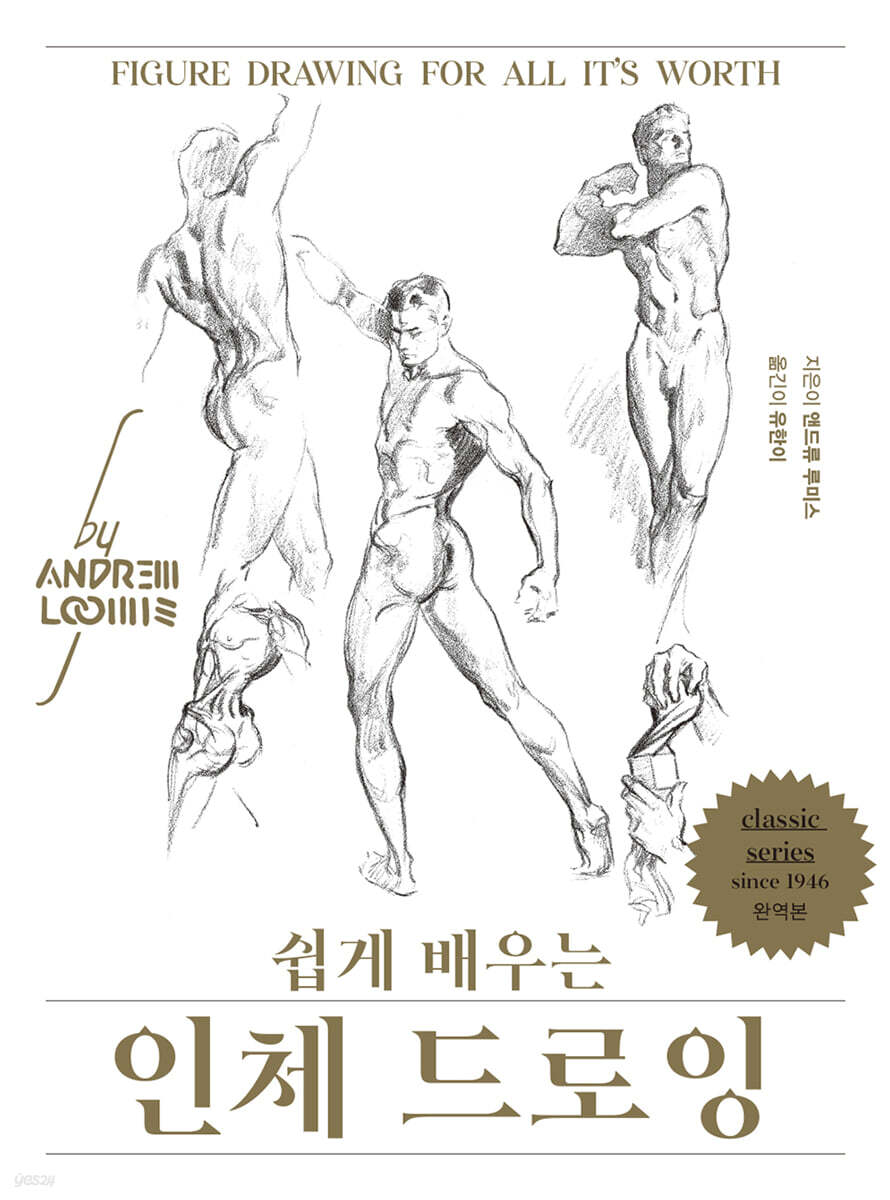
Easy Human Figure Drawing (Recover)
 |
Description
Book Introduction
2020 Recover Edition with New Cover
The books of portrait artist and educator Andrew Loomis are considered classics in the field of art and are used as textbooks in countless schools around the world.
"Easy to Learn Human Figure Drawing" helps both students and professionals solidify their foundation in drawing.
In this book, Andrew Loomis provides a clear understanding of human proportions, light and lighting, anatomy and perspective, depiction of movement, and how to create scenes that fit the characters and situations in a clothed manner.
It also contains specific situations you will experience when actually working, how to create a portfolio and organize materials, and the aesthetic and practical principles of being an artist.
If you master the technical skills the author teaches and have a sincere heart as an artist, you will be able to create your own unique paintings in any situation.
This complete translation of the original first edition from 1946 is faithful to the original, and its large, clear illustrations guide readers through Andrew Loomis's masterful works.
The books of portrait artist and educator Andrew Loomis are considered classics in the field of art and are used as textbooks in countless schools around the world.
"Easy to Learn Human Figure Drawing" helps both students and professionals solidify their foundation in drawing.
In this book, Andrew Loomis provides a clear understanding of human proportions, light and lighting, anatomy and perspective, depiction of movement, and how to create scenes that fit the characters and situations in a clothed manner.
It also contains specific situations you will experience when actually working, how to create a portfolio and organize materials, and the aesthetic and practical principles of being an artist.
If you master the technical skills the author teaches and have a sincere heart as an artist, you will be able to create your own unique paintings in any situation.
This complete translation of the original first edition from 1946 is faithful to the original, and its large, clear illustrations guide readers through Andrew Loomis's masterful works.
- You can preview some of the book's contents.
Preview
index
Introduction
Ⅰ.
Approaching portraiture
Let's observe our surroundings
Nude as a foundation
What is a line?
Beginner's drawing
human body model
Ⅱ.
skeleton and muscles
Necessary conditions for a good portrait
Ⅲ.
Blocks, planes, foreshortening, and light
Shortcuts and Light
Ⅳ.
How to draw real people and the order in which they are drawn
V.
standing figure
Various standing postures
Ⅵ.
Moving Figures: Turns and Twists
Ⅶ.
Forward motion: tilted central axis
Dynamics of movement
Ⅷ.
Balance, rhythm, and expressive techniques
Ⅸ.
A figure kneeling, crouching, or sitting
Ⅹ.
Lying figure
Ⅵ.
face, hands, feet
Ⅶ.
Full body figure dressed in clothes
Concluding remarks
How do artists work?
Running a studio
Pricing
Promote your own work
Find your own way
Ⅰ.
Approaching portraiture
Let's observe our surroundings
Nude as a foundation
What is a line?
Beginner's drawing
human body model
Ⅱ.
skeleton and muscles
Necessary conditions for a good portrait
Ⅲ.
Blocks, planes, foreshortening, and light
Shortcuts and Light
Ⅳ.
How to draw real people and the order in which they are drawn
V.
standing figure
Various standing postures
Ⅵ.
Moving Figures: Turns and Twists
Ⅶ.
Forward motion: tilted central axis
Dynamics of movement
Ⅷ.
Balance, rhythm, and expressive techniques
Ⅸ.
A figure kneeling, crouching, or sitting
Ⅹ.
Lying figure
Ⅵ.
face, hands, feet
Ⅶ.
Full body figure dressed in clothes
Concluding remarks
How do artists work?
Running a studio
Pricing
Promote your own work
Find your own way
Detailed image
.jpg)
Into the book
Pick up a pencil and swing it across the paper.
And put it down.
This is the 'free line' and the 'rhythmic line'.
Now, hold the pencil lightly between your thumb and index finger and draw a soft, delicate line.
Then, let's press down with all our might and draw.
This is a 'variable line'.
Let's draw a straight line and then draw another line parallel to it.
This is a 'planned line'.
There are so many varieties of a single line that you could spend a lifetime studying them.
Remember that lines are an element you can lean on when your drawing feels monotonous.
You can express your individuality depending on which line you use.
--- p.25
The biggest difference between the male and female skeletons is that women have relatively larger pelvises, while men have larger rib cages and ribs.
Because of these differences, men appear to have broader shoulders and narrower hips.
Women have wider hips and slightly twisted femurs.
The shape of the head and the features of the chest also clearly distinguish the female and male human bodies.
In other words, women are different from men from head to toe.
--- p.57
The most ideal simple lighting for drawing is when there is a single light source providing light, with reflections from the light source.
This lighting reveals the outlines and volume of the subject well.
Any other lighting does not properly express the sense of three-dimensionality.
If the light and shade of the object are not properly revealed, the shape becomes accurate.
--- p.79
Let's find out how the female body affects wrinkles.
The fabric falls from protruding parts of the body such as the shoulders, chest, hips, and knees.
If the fabric is loosely hung at these points, the wrinkles will start here and spread out to the next protruding point.
When clothes fit tightly, wrinkles form in the protruding parts and pull on the seams.
The male human body is similar.
--- p.189
It is a good idea to set aside a certain amount of time every day to draw.
Let's prepare the materials and location.
Always carry a sketchbook with you so you can draw with whatever materials are at hand.
Look for material that might interest you.
Let's write it down in a notebook and draw it.
If you don't know what to do, try drawing a fun still life.
If you do that, you'll probably find something that interests you.
And put it down.
This is the 'free line' and the 'rhythmic line'.
Now, hold the pencil lightly between your thumb and index finger and draw a soft, delicate line.
Then, let's press down with all our might and draw.
This is a 'variable line'.
Let's draw a straight line and then draw another line parallel to it.
This is a 'planned line'.
There are so many varieties of a single line that you could spend a lifetime studying them.
Remember that lines are an element you can lean on when your drawing feels monotonous.
You can express your individuality depending on which line you use.
--- p.25
The biggest difference between the male and female skeletons is that women have relatively larger pelvises, while men have larger rib cages and ribs.
Because of these differences, men appear to have broader shoulders and narrower hips.
Women have wider hips and slightly twisted femurs.
The shape of the head and the features of the chest also clearly distinguish the female and male human bodies.
In other words, women are different from men from head to toe.
--- p.57
The most ideal simple lighting for drawing is when there is a single light source providing light, with reflections from the light source.
This lighting reveals the outlines and volume of the subject well.
Any other lighting does not properly express the sense of three-dimensionality.
If the light and shade of the object are not properly revealed, the shape becomes accurate.
--- p.79
Let's find out how the female body affects wrinkles.
The fabric falls from protruding parts of the body such as the shoulders, chest, hips, and knees.
If the fabric is loosely hung at these points, the wrinkles will start here and spread out to the next protruding point.
When clothes fit tightly, wrinkles form in the protruding parts and pull on the seams.
The male human body is similar.
--- p.189
It is a good idea to set aside a certain amount of time every day to draw.
Let's prepare the materials and location.
Always carry a sketchbook with you so you can draw with whatever materials are at hand.
Look for material that might interest you.
Let's write it down in a notebook and draw it.
If you don't know what to do, try drawing a fun still life.
If you do that, you'll probably find something that interests you.
--- p.197
Publisher's Review
The classic in portraiture, a valuable guide for students and professionals alike!
Andrew Loomis's introductory art books have been beloved as representative books in the field of art since their publication.
In particular, 『Easy to Learn Human Figure Drawing』 helps those who are starting out as artists to understand the principles of human figure drawing and further find their own method of expression.
A book that systematically explains the entire process of drawing the human body!
There are common principles in drawing shapes.
To perfectly draw a portrait, you must have a comprehensive understanding of the basic principles.
In this book, the author systematically and easily explains the essential principles for drawing portraits, including the proportions and composition of the human body, anatomy and perspective, the characteristics of light and lighting, and the expression of rhythm and movement.
Let's prepare for situations that professional painters will experience!
Based on the author's extensive experience, you can learn tips you need to know when actually working as an artist.
You can learn things that most artists gain through trial and error, such as things to keep in mind when having your paintings published in media such as newspapers or magazines, relationships with clients and managers, and how to work with models.
A complete translation of the original first edition, faithful to the original!
This book is the most faithful original first edition translation of Andrew Loomis' original work, Figure Drawing For All It's Worth.
Loomis's drawings and sketches and other wonderful works have been reproduced in larger and clearer form.
Readers will be able to follow and modify the example works to suit their own practice.
Andrew Loomis's introductory art books have been beloved as representative books in the field of art since their publication.
In particular, 『Easy to Learn Human Figure Drawing』 helps those who are starting out as artists to understand the principles of human figure drawing and further find their own method of expression.
A book that systematically explains the entire process of drawing the human body!
There are common principles in drawing shapes.
To perfectly draw a portrait, you must have a comprehensive understanding of the basic principles.
In this book, the author systematically and easily explains the essential principles for drawing portraits, including the proportions and composition of the human body, anatomy and perspective, the characteristics of light and lighting, and the expression of rhythm and movement.
Let's prepare for situations that professional painters will experience!
Based on the author's extensive experience, you can learn tips you need to know when actually working as an artist.
You can learn things that most artists gain through trial and error, such as things to keep in mind when having your paintings published in media such as newspapers or magazines, relationships with clients and managers, and how to work with models.
A complete translation of the original first edition, faithful to the original!
This book is the most faithful original first edition translation of Andrew Loomis' original work, Figure Drawing For All It's Worth.
Loomis's drawings and sketches and other wonderful works have been reproduced in larger and clearer form.
Readers will be able to follow and modify the example works to suit their own practice.
GOODS SPECIFICS
- Date of issue: September 16, 2020
- Page count, weight, size: 204 pages | 860g | 225*305*20mm
- ISBN13: 9788994796086
You may also like
카테고리
korean


korean

![GQ KOREA Mark (Monthly): December [2025]](http://librairie.coreenne.fr/cdn/shop/files/8ef265dbbfbf186523ed75ba7319009d.jpg?v=1765340328&width=3840)


