

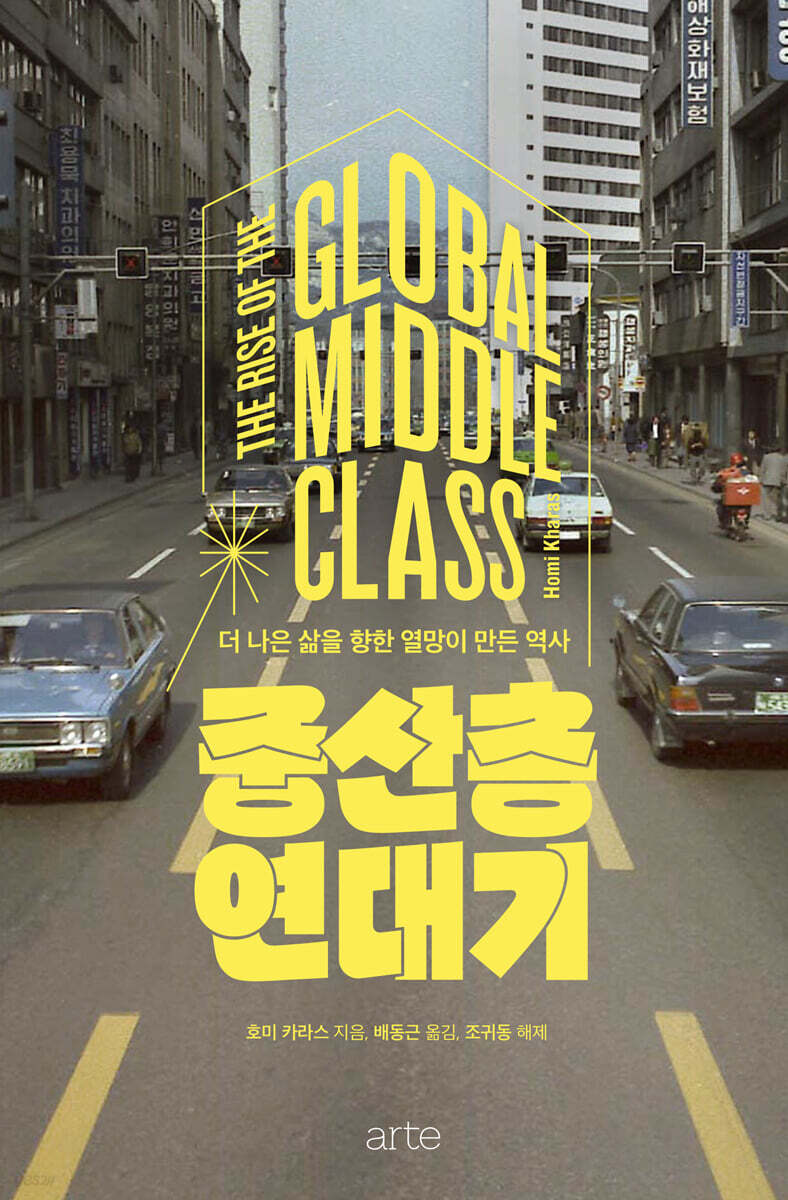
The Rise of the Global Middle Class
 |
Description
Book Introduction
“It is not kings or heroes who move the world,
“It was the aspiration of ordinary people who dreamed of a better tomorrow!”
From the Industrial Revolution to the present, the history and future of the middle class that has driven unprecedented transformation over the past 200 years.
The Era of a Middle Class of 5 Billion: Rereading World History Through Five Waves
『Chronicles of the Middle Class』 will be a key topic in all future discussions surrounding the global middle class.
This will be a must-read book.
— Moises Naim, former World Bank Executive Director and Venezuelan Minister of Trade and Industry
A masterpiece by world-renowned economist Homi Karas, who has dedicated himself to studying the middle class for over 40 years as an economist at institutions such as the World Bank and the Brookings Institution.
We redefine the middle class based on average daily spending, divide the 200-year economic history since the Industrial Revolution into five periods, and trace the trajectory of the middle class, which increased by 1 billion people in each period, to create a "middle class chronology."
It convincingly demonstrates that the true protagonists of history are the middle class, a class driven by aspirations and aspirations for a "better tomorrow." It also analyzes how today's structural problems, such as low birth rates, inequality, and the climate crisis, are intertwined with the disintegration of the middle class.
This explains why the recovery of the middle class is necessary to overcome the crisis and presents specific directions for moving toward a sustainable economic system.
This must-read for our times retraces the course of global economic history hidden within the rise and fall of the middle class, and examines the key challenges our society will face after the presidential election from the macroscopic perspective of the 200-year history of the middle class.
“It was the aspiration of ordinary people who dreamed of a better tomorrow!”
From the Industrial Revolution to the present, the history and future of the middle class that has driven unprecedented transformation over the past 200 years.
The Era of a Middle Class of 5 Billion: Rereading World History Through Five Waves
『Chronicles of the Middle Class』 will be a key topic in all future discussions surrounding the global middle class.
This will be a must-read book.
— Moises Naim, former World Bank Executive Director and Venezuelan Minister of Trade and Industry
A masterpiece by world-renowned economist Homi Karas, who has dedicated himself to studying the middle class for over 40 years as an economist at institutions such as the World Bank and the Brookings Institution.
We redefine the middle class based on average daily spending, divide the 200-year economic history since the Industrial Revolution into five periods, and trace the trajectory of the middle class, which increased by 1 billion people in each period, to create a "middle class chronology."
It convincingly demonstrates that the true protagonists of history are the middle class, a class driven by aspirations and aspirations for a "better tomorrow." It also analyzes how today's structural problems, such as low birth rates, inequality, and the climate crisis, are intertwined with the disintegration of the middle class.
This explains why the recovery of the middle class is necessary to overcome the crisis and presents specific directions for moving toward a sustainable economic system.
This must-read for our times retraces the course of global economic history hidden within the rise and fall of the middle class, and examines the key challenges our society will face after the presidential election from the macroscopic perspective of the 200-year history of the middle class.
- You can preview some of the book's contents.
Preview
index
How the "middle class" created today's world… 5
Preface: A Happy Life… 21
Chapter 1: People in the Middle Class… 37
Chapter 2: The First Billion: The Victorian Era and the Rise of the West, 1830–1975 … 65
Chapter 3: The Second Billion: Economic Growth and Globalization in the Third World, 1975–2006 … 135
Chapter 4: The Third Billion: The Chinese Dream and the West's Boundaries, 2006–2014 … 175
Chapter 5: The Fourth Billion: India's Unpredictable Giant, 2014–2022… 217
Chapter 6: The Fifth Billion: The Dangers Ahead, 2022–2030… 247
Chapter 7: A New Challenge for the Global Middle Class: Happiness for 5 Billion People… 295
Acknowledgments … 325
Translator's Note … 327
Week … 335
Search … 355
Preface: A Happy Life… 21
Chapter 1: People in the Middle Class… 37
Chapter 2: The First Billion: The Victorian Era and the Rise of the West, 1830–1975 … 65
Chapter 3: The Second Billion: Economic Growth and Globalization in the Third World, 1975–2006 … 135
Chapter 4: The Third Billion: The Chinese Dream and the West's Boundaries, 2006–2014 … 175
Chapter 5: The Fourth Billion: India's Unpredictable Giant, 2014–2022… 217
Chapter 6: The Fifth Billion: The Dangers Ahead, 2022–2030… 247
Chapter 7: A New Challenge for the Global Middle Class: Happiness for 5 Billion People… 295
Acknowledgments … 325
Translator's Note … 327
Week … 335
Search … 355
Detailed image

Into the book
-Jo Gwi-dong (Visiting Professor, Department of Economics, Myongji University, Author of "Hereditary Middle-Class Society")
Countries that have experienced middle-class growth outside the West are facing structural limitations.
East Asian countries are struggling with low birth rates and aging populations.
The main reason is that the relative and absolute costs of marriage and child rearing have increased rapidly as the middle class has disintegrated.
The fear of losing class status is intensifying the arms race over children's education.
On the other hand, the burden of growth on the environment is increasing, as evidenced by the massive electricity and water consumption of ultra-large data centers for artificial intelligence (AI) services.
With the middle class growing across South Asia and Africa, the ecological limits of growth have become a problem that everyone can feel.
The author focuses on how to create a new middle class in the latter part of the book because many of the challenges facing many countries are related to the middle class.
The middle class is a problem of growth, but it is also a problem of distribution.
And it's also a question of how communities can provide their members with hope and the means to improve their lives.
In the era following the "Long 20th Century," which began in 1870 and ended with the global financial crisis of 2010, if we are to ensure that everyone can enjoy the fruits of prosperity and development, we must ultimately provide a way for ordinary people to become happy.
This is a weighty question raised by 『Chronicle of the Middle Class』.
---From "Release"
It was not until the early to mid-1800s that a group of people who could aspire to a happy life—what we might call a global middle class—began to grow.
The group started in Europe, expanded to North America, Oceania, and Japan, and is now growing rapidly in developing countries, particularly in Asia.
(…) It is expected that within a few years, perhaps around 2030, the 5 billionth person will enter the middle class.
By then, in just two centuries, the middle class will have transformed from a group with virtually no political power to one that dominates politics and economic policy in virtually every country.
This book is about the changing social strata around the world, the tensions and contradictions inherent in the expansion of the middle class, and what this means for the economic, social, and political fate of future generations.
---From "Preface: A Happy Life"
For Victorians, being middle class meant that a household had the opportunity to live a better life through the efforts and hard work of its head.
For modern economic development researchers, the middle class represents a situation in which there is no immediate risk of falling into poverty.
For politicians in wealthy countries, middle class means not being poor.
No matter which perspective you take, the lower bound is the same.
To be middle class, you need to have resources to spend $12 per person per day.
---From "Chapter 1: People in the Middle Class"
The growing political power of the middle class does not mean that they have formed their own political parties or have established ties to traditional political parties.
The middle class could not be defined as leaning toward conservatism, progressivism, nationalism, or any other ideology or claim.
Rather, the political leanings of the middle class took on various identities depending on the time and place.
Despite these twists and turns, there was one thing in common.
With each twist and turn, the middle class emerged as a more powerful political force.
---From "Chapter 2: The First Billion"
No country has ever rapidly developed a middle class without a large number of women entering the workforce.
There are various interpretations of this fact.
The simplest and most direct interpretation is that women's economic contribution from work outside the home has become significant, allowing dual-income families to enjoy a much higher standard of living than before.
A more indirect but important analysis from a social perspective is that women's behavior changes as they work outside the home.
---From "Chapter 5: The Fourth Billion"
The question posed at the beginning of this chapter was, “Will the middle class continue to grow and reach 5 billion in the near future?”
The answer is “yes.”
But that is only possible if we address some of the anxieties that prevent the middle class from uniting around a common economic agenda.
The middle class must build solidarity to combat climate change and preserve nature.
This requires not only solidarity among current workers (and voters), but also solidarity across generations.
We must embrace science, technology, and creative jobs for the future, while at the same time caring for those who are left behind by these changes and left in a position of misfortune.
The middle class also needs to build new bridges between high-skilled and low-skilled knowledge workers to maintain its political power.
To do this, we need to reduce the wage gap between these types of jobs.
---From "Chapter 6: The Fifth Billion"
As the satisfaction and stability of the middle class are threatened, policymakers are scrambling to find ways to create a middle class that enjoys happiness in all aspects of life.
If they can achieve this, anyone—the United States, Europe, China, or any of the countries now waking up—could emerge victorious in this geopolitical competition.
The winner in this fight will not be the country with the greatest military power, nor the country with the greatest economic power.
It is a country where the majority of citizens are middle class, where citizens believe that the government is implementing various policies to meet their aspirations, and where middle classes in other countries are jealous and want to emulate.
That's the kind of happy country the middle class seeks, and it promises to bring about the changes needed to steer the global economy toward sustainable and inclusive growth.
Countries that have experienced middle-class growth outside the West are facing structural limitations.
East Asian countries are struggling with low birth rates and aging populations.
The main reason is that the relative and absolute costs of marriage and child rearing have increased rapidly as the middle class has disintegrated.
The fear of losing class status is intensifying the arms race over children's education.
On the other hand, the burden of growth on the environment is increasing, as evidenced by the massive electricity and water consumption of ultra-large data centers for artificial intelligence (AI) services.
With the middle class growing across South Asia and Africa, the ecological limits of growth have become a problem that everyone can feel.
The author focuses on how to create a new middle class in the latter part of the book because many of the challenges facing many countries are related to the middle class.
The middle class is a problem of growth, but it is also a problem of distribution.
And it's also a question of how communities can provide their members with hope and the means to improve their lives.
In the era following the "Long 20th Century," which began in 1870 and ended with the global financial crisis of 2010, if we are to ensure that everyone can enjoy the fruits of prosperity and development, we must ultimately provide a way for ordinary people to become happy.
This is a weighty question raised by 『Chronicle of the Middle Class』.
---From "Release"
It was not until the early to mid-1800s that a group of people who could aspire to a happy life—what we might call a global middle class—began to grow.
The group started in Europe, expanded to North America, Oceania, and Japan, and is now growing rapidly in developing countries, particularly in Asia.
(…) It is expected that within a few years, perhaps around 2030, the 5 billionth person will enter the middle class.
By then, in just two centuries, the middle class will have transformed from a group with virtually no political power to one that dominates politics and economic policy in virtually every country.
This book is about the changing social strata around the world, the tensions and contradictions inherent in the expansion of the middle class, and what this means for the economic, social, and political fate of future generations.
---From "Preface: A Happy Life"
For Victorians, being middle class meant that a household had the opportunity to live a better life through the efforts and hard work of its head.
For modern economic development researchers, the middle class represents a situation in which there is no immediate risk of falling into poverty.
For politicians in wealthy countries, middle class means not being poor.
No matter which perspective you take, the lower bound is the same.
To be middle class, you need to have resources to spend $12 per person per day.
---From "Chapter 1: People in the Middle Class"
The growing political power of the middle class does not mean that they have formed their own political parties or have established ties to traditional political parties.
The middle class could not be defined as leaning toward conservatism, progressivism, nationalism, or any other ideology or claim.
Rather, the political leanings of the middle class took on various identities depending on the time and place.
Despite these twists and turns, there was one thing in common.
With each twist and turn, the middle class emerged as a more powerful political force.
---From "Chapter 2: The First Billion"
No country has ever rapidly developed a middle class without a large number of women entering the workforce.
There are various interpretations of this fact.
The simplest and most direct interpretation is that women's economic contribution from work outside the home has become significant, allowing dual-income families to enjoy a much higher standard of living than before.
A more indirect but important analysis from a social perspective is that women's behavior changes as they work outside the home.
---From "Chapter 5: The Fourth Billion"
The question posed at the beginning of this chapter was, “Will the middle class continue to grow and reach 5 billion in the near future?”
The answer is “yes.”
But that is only possible if we address some of the anxieties that prevent the middle class from uniting around a common economic agenda.
The middle class must build solidarity to combat climate change and preserve nature.
This requires not only solidarity among current workers (and voters), but also solidarity across generations.
We must embrace science, technology, and creative jobs for the future, while at the same time caring for those who are left behind by these changes and left in a position of misfortune.
The middle class also needs to build new bridges between high-skilled and low-skilled knowledge workers to maintain its political power.
To do this, we need to reduce the wage gap between these types of jobs.
---From "Chapter 6: The Fifth Billion"
As the satisfaction and stability of the middle class are threatened, policymakers are scrambling to find ways to create a middle class that enjoys happiness in all aspects of life.
If they can achieve this, anyone—the United States, Europe, China, or any of the countries now waking up—could emerge victorious in this geopolitical competition.
The winner in this fight will not be the country with the greatest military power, nor the country with the greatest economic power.
It is a country where the majority of citizens are middle class, where citizens believe that the government is implementing various policies to meet their aspirations, and where middle classes in other countries are jealous and want to emulate.
That's the kind of happy country the middle class seeks, and it promises to bring about the changes needed to steer the global economy toward sustainable and inclusive growth.
---From "Chapter 7: New Challenges for the Global Middle Class"
Publisher's Review
“Your life today was someone's aspiration 200 years ago.”
The "Aspirational Class" or "Engine of Prosperity and Economic Growth"
The middle class, dreaming of a better life, became the center of the world.
· The history and future of the middle class, which has led unprecedented transformation over the past 200 years, from the Industrial Revolution to the present day.
· Clearly depicting global trends and expanding perspectives through five time periods
· A sustainable development direction presented by a global pioneer in middle-class research
The 39th book in the Philos series published by Book 21 Arte Publishing, "Chronicles of the Middle Class: A History Created by the Aspiration for a Better Life," has been published.
"Chronicles of the Middle Class" traces the history of the 5 billion middle class that has driven the world over the past 200 years, from the Industrial Revolution to the present day, divided into five periods, and seeks solutions to the economic crisis facing the world in a sustainable development model centered on the middle class.
Author Homi Kharas is a world-renowned economist who created the 'middle-income trap' theory (a theory that explains the phenomenon and structural causes of low-income countries succeeding in rising to middle-income status but failing to enter high-income status thereafter) in a World Bank report, and is a leading authority in this field who has been studying the global middle class for over 40 years.
Korea is a rare case in the world where economic growth and democratization were achieved simultaneously in a short period of time.
It rose from one of the poorest countries in the world, having endured colonial rule and war, to one of the world's top ten economies, and it ended military dictatorship and civil war, establishing a democratic system.
However, today, structural problems such as low birth rates, aging population, and inequality are casting a dark shadow, and there are even concerns that the current generation may become the first generation to be less well off than their parents.
So how can we continue the flow of prosperity and regain hope that life will inevitably get better?
『Chronicles of the Middle Class』 seeks a clue to the answer to this question in the social group known as the middle class.
Low birth rates, polarization, and youth anxiety are not unique to Korea.
In the United States, the despair of white youth has become the breeding ground for Trumpism, and East Asian countries are also struggling with collapsing birth rates and anxiety about the future.
The book diagnoses that at the heart of this common crisis emerging globally lies the disintegration of the middle class.
It is at this point that the concept of the 'middle class' comes into focus again.
Author Homi Karas is a world-renowned economist who has worked for over 40 years at institutions such as the World Bank and the Brookings Institution, and has long focused on the problem of middle-class growth in non-developed countries.
As the chief economist in charge of the Asia-Pacific region, he personally witnessed the economic leap forward of many developing countries, including Korea, and garnered attention for explaining the structural reasons why low-income countries cannot leap forward to become high-income countries through the theory of the "middle-income trap."
In this book, Karas divides the past 200 years of economic history into five historical waves and traces the expansion of the 5 billion middle class.
The large middle class that first emerged in the West during the Industrial Revolution (the first billion) has steadily expanded since then, centered around the four Asian tigers (the second billion), China (the third billion), and India (the fourth billion).
And now we stand at the starting point of the fifth billion.
The author persuasively demonstrates that the driving force behind all these trends was not kings or heroes, but the middle class, a class driven by aspirations for a better tomorrow.
"Chronicles of the Middle Class" sharply analyzes how all the structural problems we face today are directly linked to the disintegration of the middle class, and proposes concrete practical solutions through the reconstruction of the middle class.
It addresses the most pressing challenges of our time—achieving a new balance between growth and distribution, overcoming polarization, and designing a sustainable future—through the macroscopic perspective of the 200-year history of the middle class, finding clues of hope even in despair.
In particular, the Korean edition includes an insightful commentary by Cho Gwi-dong, author of "Hereditary Middle-Class Society" and visiting professor of economics at Myongji University, which helps readers understand the message the book conveys to Korean society more deeply.
A 200-Year Chronicle of the Middle Class: Rereading Economic History Through Five Waves
The expansion of the middle class: West → East Asia → China → India → 5 billion in the future, data proves.
The World Bank's Chief Economist Uncovers the Secrets of the Middle Class
"The Middle Class Chronicles" presents an insightful analysis of the middle class as the key to solving global problems, in a global context.
Why the middle class? What is the middle class? This book begins with these questions and traces the origins and growth of the middle class across five periods.
According to this, the 'middle class', which can be defined as a social class, emerged on a large scale in the West along with the Industrial Revolution in the 19th century (1830-1975) and, riding the wave of globalization and economic growth, expanded to East Asia, South America, and Eastern Europe (1975-2006), China (2006-2014), India (2014-2022), and then to the entire world (2022-2030).
The middle class is the group that has played a leading role in the 200-year history from 1830 to 2030, and is the group that created and leads today's world.
Although they have diverse occupations and backgrounds, they share similar lifestyles in that they aspire to and strive for higher income and social status.
So who constitutes the middle class? The middle class generally refers to the group nestled between the upper and lower classes. Because it's a relative concept, definitions and criteria vary slightly among scholars.
Author Homi Karas defines the middle class based on "average daily spending."
This is because ‘income’ is highly volatile, but ‘expenditure’ is difficult to change easily, so it is considered to reflect actual living standards and class affiliation more stably.
He sets the standard for a stable living for an individual in a developing country at $12 per day per person, up to $120 per day, which is 10 times that amount, and classifies all populations falling within this range as middle class.
By this standard, Korea is a middle-class society, with 90 percent of the total population belonging to the middle class since 2000.
Worldwide, it is estimated that 4 to 5 billion people, more than half of the total population, are middle class.
In just 200 years, the middle class has grown into the largest group, overwhelming the upper and lower classes, and without their spending power, modern capitalism, based on mass production and mass consumption, would not have been possible.
The middle class also has the properties of a social contract.
The belief that anyone can become middle class if they work hard, and the premise that such opportunities are available, acts as the glue that makes social cohesion possible.
Many people identify themselves as middle class or live with the expectation that they will soon be accepted into that class.
This belief is the core foundation that supports social stability and solidarity, and the middle class is the social, economic, and political core.
Based on world-historical analysis and conceptual organization, Homi Karas arrives at one important insight.
The central challenge we must address to sustain prosperity and restore hope that life will inevitably get better is the crisis of the middle class.
His conclusion is that if this class, which has driven human prosperity for the past 200 years, collapses, the future will inevitably be in jeopardy.
Now that half of humanity is middle class, what's next?
History made by aspiration, a future created by solidarity
In search of a sustainable middle class model that transcends the limits of growth
The question posed in the introduction to this chapter was, “Will the middle class continue to grow?”
“Will it reach 5 billion in the near future?”
The answer is “yes.”
But it does not unite the middle class under a common economic agenda.
This is only possible when some of the anxiety factors that are blocking it are resolved.
-In the text
"Chronicles of the Middle Class" compellingly demonstrates, through rich data and vivid case studies, that the nature of the crises facing many countries is closely linked to the disintegration of the middle class.
So how can we solve this problem? Karas devotes the latter two chapters of his book to the hopeful prospect of a "fifth billion middle class," emphasizing the urgent need for a sustainable development model centered on the middle class and the establishment of a new economic system.
Specifically, he emphasizes that the middle class must become not only workers and voters, but also an axis of intergenerational solidarity.
While actively embracing creative jobs for science, technology, and future industries, we must also embrace the socially disadvantaged who are left out of the changing landscape and build new bridges between highly skilled and low-skilled knowledge workers to reduce the wage gap.
Furthermore, it also significantly addresses the need for solidarity to address the climate crisis that threatens all of humanity.
His core argument is that the solidarity efforts of the middle class, the overwhelming majority, are what will enable a new growth model and economic system that will enable more people to live better lives.
Karas emphasizes that a sustainable future can only be achieved when the middle class becomes a "group that supports the common good."
It presents the possibility of becoming a group that not only seeks to live better, but also designs and takes responsibility for a better society.
This vision stands in stark contrast to far-right political currents around the world, including Trumpism, and presents a compelling alternative.
"Chronicles of the Middle Class" vividly shows how the aspirations of ordinary people who dreamed of a better tomorrow have shaped the world over the past 200 years, reminding us that we, today, are the ones writing the next chapter.
Can we truly create a history of hope once again? The answer lies in the hands of the readers who open this book.
The "Aspirational Class" or "Engine of Prosperity and Economic Growth"
The middle class, dreaming of a better life, became the center of the world.
· The history and future of the middle class, which has led unprecedented transformation over the past 200 years, from the Industrial Revolution to the present day.
· Clearly depicting global trends and expanding perspectives through five time periods
· A sustainable development direction presented by a global pioneer in middle-class research
The 39th book in the Philos series published by Book 21 Arte Publishing, "Chronicles of the Middle Class: A History Created by the Aspiration for a Better Life," has been published.
"Chronicles of the Middle Class" traces the history of the 5 billion middle class that has driven the world over the past 200 years, from the Industrial Revolution to the present day, divided into five periods, and seeks solutions to the economic crisis facing the world in a sustainable development model centered on the middle class.
Author Homi Kharas is a world-renowned economist who created the 'middle-income trap' theory (a theory that explains the phenomenon and structural causes of low-income countries succeeding in rising to middle-income status but failing to enter high-income status thereafter) in a World Bank report, and is a leading authority in this field who has been studying the global middle class for over 40 years.
Korea is a rare case in the world where economic growth and democratization were achieved simultaneously in a short period of time.
It rose from one of the poorest countries in the world, having endured colonial rule and war, to one of the world's top ten economies, and it ended military dictatorship and civil war, establishing a democratic system.
However, today, structural problems such as low birth rates, aging population, and inequality are casting a dark shadow, and there are even concerns that the current generation may become the first generation to be less well off than their parents.
So how can we continue the flow of prosperity and regain hope that life will inevitably get better?
『Chronicles of the Middle Class』 seeks a clue to the answer to this question in the social group known as the middle class.
Low birth rates, polarization, and youth anxiety are not unique to Korea.
In the United States, the despair of white youth has become the breeding ground for Trumpism, and East Asian countries are also struggling with collapsing birth rates and anxiety about the future.
The book diagnoses that at the heart of this common crisis emerging globally lies the disintegration of the middle class.
It is at this point that the concept of the 'middle class' comes into focus again.
Author Homi Karas is a world-renowned economist who has worked for over 40 years at institutions such as the World Bank and the Brookings Institution, and has long focused on the problem of middle-class growth in non-developed countries.
As the chief economist in charge of the Asia-Pacific region, he personally witnessed the economic leap forward of many developing countries, including Korea, and garnered attention for explaining the structural reasons why low-income countries cannot leap forward to become high-income countries through the theory of the "middle-income trap."
In this book, Karas divides the past 200 years of economic history into five historical waves and traces the expansion of the 5 billion middle class.
The large middle class that first emerged in the West during the Industrial Revolution (the first billion) has steadily expanded since then, centered around the four Asian tigers (the second billion), China (the third billion), and India (the fourth billion).
And now we stand at the starting point of the fifth billion.
The author persuasively demonstrates that the driving force behind all these trends was not kings or heroes, but the middle class, a class driven by aspirations for a better tomorrow.
"Chronicles of the Middle Class" sharply analyzes how all the structural problems we face today are directly linked to the disintegration of the middle class, and proposes concrete practical solutions through the reconstruction of the middle class.
It addresses the most pressing challenges of our time—achieving a new balance between growth and distribution, overcoming polarization, and designing a sustainable future—through the macroscopic perspective of the 200-year history of the middle class, finding clues of hope even in despair.
In particular, the Korean edition includes an insightful commentary by Cho Gwi-dong, author of "Hereditary Middle-Class Society" and visiting professor of economics at Myongji University, which helps readers understand the message the book conveys to Korean society more deeply.
A 200-Year Chronicle of the Middle Class: Rereading Economic History Through Five Waves
The expansion of the middle class: West → East Asia → China → India → 5 billion in the future, data proves.
The World Bank's Chief Economist Uncovers the Secrets of the Middle Class
"The Middle Class Chronicles" presents an insightful analysis of the middle class as the key to solving global problems, in a global context.
Why the middle class? What is the middle class? This book begins with these questions and traces the origins and growth of the middle class across five periods.
According to this, the 'middle class', which can be defined as a social class, emerged on a large scale in the West along with the Industrial Revolution in the 19th century (1830-1975) and, riding the wave of globalization and economic growth, expanded to East Asia, South America, and Eastern Europe (1975-2006), China (2006-2014), India (2014-2022), and then to the entire world (2022-2030).
The middle class is the group that has played a leading role in the 200-year history from 1830 to 2030, and is the group that created and leads today's world.
Although they have diverse occupations and backgrounds, they share similar lifestyles in that they aspire to and strive for higher income and social status.
So who constitutes the middle class? The middle class generally refers to the group nestled between the upper and lower classes. Because it's a relative concept, definitions and criteria vary slightly among scholars.
Author Homi Karas defines the middle class based on "average daily spending."
This is because ‘income’ is highly volatile, but ‘expenditure’ is difficult to change easily, so it is considered to reflect actual living standards and class affiliation more stably.
He sets the standard for a stable living for an individual in a developing country at $12 per day per person, up to $120 per day, which is 10 times that amount, and classifies all populations falling within this range as middle class.
By this standard, Korea is a middle-class society, with 90 percent of the total population belonging to the middle class since 2000.
Worldwide, it is estimated that 4 to 5 billion people, more than half of the total population, are middle class.
In just 200 years, the middle class has grown into the largest group, overwhelming the upper and lower classes, and without their spending power, modern capitalism, based on mass production and mass consumption, would not have been possible.
The middle class also has the properties of a social contract.
The belief that anyone can become middle class if they work hard, and the premise that such opportunities are available, acts as the glue that makes social cohesion possible.
Many people identify themselves as middle class or live with the expectation that they will soon be accepted into that class.
This belief is the core foundation that supports social stability and solidarity, and the middle class is the social, economic, and political core.
Based on world-historical analysis and conceptual organization, Homi Karas arrives at one important insight.
The central challenge we must address to sustain prosperity and restore hope that life will inevitably get better is the crisis of the middle class.
His conclusion is that if this class, which has driven human prosperity for the past 200 years, collapses, the future will inevitably be in jeopardy.
Now that half of humanity is middle class, what's next?
History made by aspiration, a future created by solidarity
In search of a sustainable middle class model that transcends the limits of growth
The question posed in the introduction to this chapter was, “Will the middle class continue to grow?”
“Will it reach 5 billion in the near future?”
The answer is “yes.”
But it does not unite the middle class under a common economic agenda.
This is only possible when some of the anxiety factors that are blocking it are resolved.
-In the text
"Chronicles of the Middle Class" compellingly demonstrates, through rich data and vivid case studies, that the nature of the crises facing many countries is closely linked to the disintegration of the middle class.
So how can we solve this problem? Karas devotes the latter two chapters of his book to the hopeful prospect of a "fifth billion middle class," emphasizing the urgent need for a sustainable development model centered on the middle class and the establishment of a new economic system.
Specifically, he emphasizes that the middle class must become not only workers and voters, but also an axis of intergenerational solidarity.
While actively embracing creative jobs for science, technology, and future industries, we must also embrace the socially disadvantaged who are left out of the changing landscape and build new bridges between highly skilled and low-skilled knowledge workers to reduce the wage gap.
Furthermore, it also significantly addresses the need for solidarity to address the climate crisis that threatens all of humanity.
His core argument is that the solidarity efforts of the middle class, the overwhelming majority, are what will enable a new growth model and economic system that will enable more people to live better lives.
Karas emphasizes that a sustainable future can only be achieved when the middle class becomes a "group that supports the common good."
It presents the possibility of becoming a group that not only seeks to live better, but also designs and takes responsibility for a better society.
This vision stands in stark contrast to far-right political currents around the world, including Trumpism, and presents a compelling alternative.
"Chronicles of the Middle Class" vividly shows how the aspirations of ordinary people who dreamed of a better tomorrow have shaped the world over the past 200 years, reminding us that we, today, are the ones writing the next chapter.
Can we truly create a history of hope once again? The answer lies in the hands of the readers who open this book.
GOODS SPECIFICS
- Date of issue: June 26, 2025
- Format: Hardcover book binding method guide
- Page count, weight, size: 372 pages | 524g | 138*210*26mm
- ISBN13: 9791173573354
- ISBN10: 1173573356
You may also like
카테고리
korean


korean

![GQ KOREA Mark (Monthly): December [2025]](http://librairie.coreenne.fr/cdn/shop/files/8ef265dbbfbf186523ed75ba7319009d.jpg?v=1765340328&width=3840)


