

Oedipus the King
 |
Description
Book Introduction
He perfected Greek tragedy, the predecessor of modern dramatic literature.
The great writer Sophocles
Includes representative works by Sophocles, considered one of the three greatest tragedians of Greece along with Aeschylus and Euripides.
Among the works whose full text has survived to the present day, four decisive works are included, including "Oedipus the King," which is considered the perfect example of Greek tragedy, as well as "Antigone," "Ajax," and "The Women of Trachis," which shine with outstanding composition, meticulous description, and profound thematic awareness.
In Sophocles' tragedy, misfortune, suffering, and death are never accidental or meaningless.
Misfortune, suffering, and death can in many ways bring about change (from a false life to a true life) or be signs of change.
Pain like death (mental or physical pain, or both) leads to an understanding of truth and at the same time to 'rebirth'.
For example, the Oedipus imagined by Sophocles is the contradictory Oedipus of legend, the happiest and most miserable of humans, a man who solves riddles that no one else has solved but does not know his own truth, a criminal who pursues criminals, and at the same time, aggressive yet generous, arrogant yet passionately devoted to finding the truth he has missed, and who regains his tenacity at the last moment when he has lost everything and is exiled, 'Sophocles' Oedipus'.
Ultimately, Sophocles, through his work, shows us a subjective human being who lives his life according to his own will in search of truth while fearing death.
The great writer Sophocles
Includes representative works by Sophocles, considered one of the three greatest tragedians of Greece along with Aeschylus and Euripides.
Among the works whose full text has survived to the present day, four decisive works are included, including "Oedipus the King," which is considered the perfect example of Greek tragedy, as well as "Antigone," "Ajax," and "The Women of Trachis," which shine with outstanding composition, meticulous description, and profound thematic awareness.
In Sophocles' tragedy, misfortune, suffering, and death are never accidental or meaningless.
Misfortune, suffering, and death can in many ways bring about change (from a false life to a true life) or be signs of change.
Pain like death (mental or physical pain, or both) leads to an understanding of truth and at the same time to 'rebirth'.
For example, the Oedipus imagined by Sophocles is the contradictory Oedipus of legend, the happiest and most miserable of humans, a man who solves riddles that no one else has solved but does not know his own truth, a criminal who pursues criminals, and at the same time, aggressive yet generous, arrogant yet passionately devoted to finding the truth he has missed, and who regains his tenacity at the last moment when he has lost everything and is exiled, 'Sophocles' Oedipus'.
Ultimately, Sophocles, through his work, shows us a subjective human being who lives his life according to his own will in search of truth while fearing death.
- You can preview some of the book's contents.
Preview
index
Translator's Preface
Oedipus the King
Antigone
Ajax
Women of Thrace
Commentary on the work
Author's chronology
Oedipus the King
Antigone
Ajax
Women of Thrace
Commentary on the work
Author's chronology
Publisher's Review
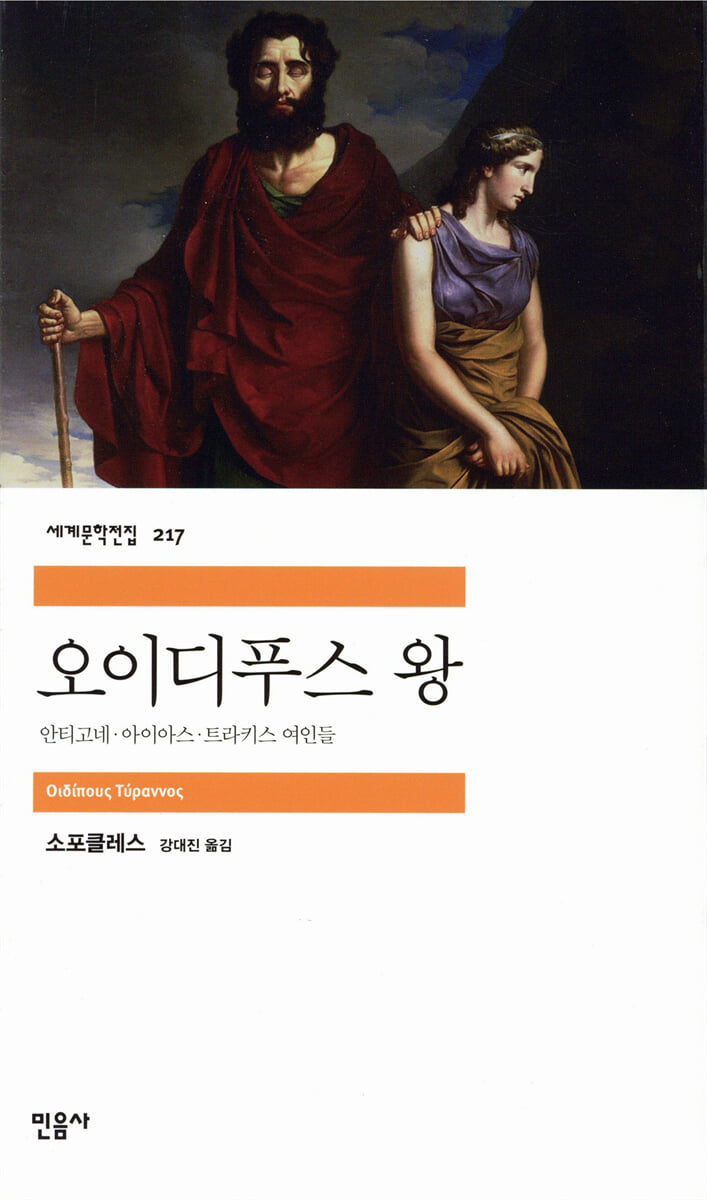
『Oedipus the King』, which includes the representative works of Sophocles, who is considered one of the three greatest tragedians of Greece along with Aeschylus and Euripides, has been published in the Minumsa World Literature Collection (217).
Sophocles portrayed the complex and contradictory experiences of the 5th century BC, when Athens was reaching its peak, with more profound insight than any other playwright of his time, and perfected Greek tragedy in many aspects, including technique and form, earning the highest respect for his plays throughout his long life.
He wrote over 120 tragedies throughout his life, and among the works whose complete works have survived to this day, he includes four decisive works that shine with outstanding composition, meticulous description, and profound thematic awareness: "Oedipus the King," which is called the perfect example of Greek tragedy, "Antigone," "Ajax," and "The Women of Trachis."
These works are translations of the Greek originals into Korean by Western classicist Kang Dae-jin.
As a translator who strives to correct mistranslations and errors in Western classics and mythology, rather than overly processed sentences for easy reading, the translator translated them as close to the original Greek text as possible so as not to damage the original meaning and inner meaning of the expressions, even if they are somewhat unfamiliar and rough. Through what the translator calls “sentences that make you stop and look back at every step,” you can encounter Sophocles’ masterpieces more deeply.
Sophocles, the comprehensive artist who perfected Greek tragedy
Greek tragedy can be said to be the predecessor of various modern dramatic literatures.
All of the works are plays intended for stage performance, and each sentence is a poem with a rhythm, and the chorus inserted between them easily brings to mind today's musicals or operas.
This multi-layered and complex form of Greek tragedy was finally perfected by Sophocles, passing through the hands of several writers during the Athenian Golden Age.
The time when Sophocles was active was an era in which all arts, including literature, flourished with unprecedented brilliance.
Athens held the annual Dionysian Festival, and Sophocles spent his entire life writing plays for the festival, devising music and dances for the plays, directing and training all the actors and chorus members who would appear in his plays, and sometimes even taking on roles himself.
At the age of twenty-eight, he defeated his senior Aeschylus in a tragedy contest. With his outstanding creativity, he was active for much longer than Aeschylus or the later Euripides, wrote more works, and won more contests.
Sophocles wrote about 120 tragedies throughout his life, and perfected the unique form of Greek tragedy, which exquisitely portrays the personalities and depth of thought of various characters in situations of constant tension while maintaining basic techniques and tone.
He transformed Aeschylus's trilogy into three fully formed plays, each with its own dialogue, and, unlike Aeschylus's two-actor approach, he added a third actor to broaden the scope of dramatic conflict.
It is precisely because of this perfect form that the philosopher Aristotle, in his Poetics, praised Sophocles above other tragic writers and praised Oedipus the King as a model of tragedy.
A work that provides insight into the complex and contradictory inner lives of humans who choose misfortune in search of truth.
Sophocles transformed the essential elements of classical civilization, such as the relationship between gods and humans (religion) and the interaction between humans (society), into great plays that have been reinterpreted over time and are remembered forever.
Even after thousands of years, Sophocles' tragedies continue to be performed on stage, often in different costumes, perhaps because the themes of his works penetrate the fundamental inner self of humanity, regardless of time and space.
Sophocles always speaks of crisis, especially the crisis of suffering or the culmination of that suffering, death.
In his plays, the interaction between representative human figures takes center stage rather than the actions of gods or natural forces.
While the gods, as incarnations of eternal power and the structure of reality, are all-knowing, humans live in dark ignorance, blocked by these powers and structures and subject to time, change, suffering, and death.
When viewed in this way, the characters in the work seem to symbolize weak humans who are swept away by the fate of unavoidable pain and death.
But if you look closely, you'll see that these people make risky choices to get the answers they want, and instead of living a humiliating life, they bravely accept the devastating consequences of their choices.
In Sophocles' tragedy, misfortune, suffering, and death are never accidental or meaningless.
Misfortune, suffering, and death can in many ways bring about change (a change from a false life to a true life) or be signs of change.
Death-like suffering (mental or physical suffering, or mental and physical suffering) leads to an understanding of truth and at the same time to 'rebirth'.
For example, the Oedipus imagined by Sophocles is the contradictory Oedipus of legend, the happiest and most miserable of humans, a man who solves riddles that no one else has solved but does not know his own truth, a criminal who pursues criminals, and at the same time, aggressive yet generous, arrogant yet passionately devoted to finding the truth he has missed, and who regains his tenacity at the last moment when he has lost everything and is exiled, 'Sophocles' Oedipus'.
Ultimately, Sophocles, through his work, shows us a subjective human being who lives his life according to his own will in search of truth while fearing death.
Sophocles freely adapted myths and intricately intertwined them with his own unique thematic consciousness, and by incorporating them into a perfect tragic form, he created plays so multi-layered that the true meaning behind them cannot be grasped just by looking at the superficial plot.
Oedipus the King
Oedipus, who became the king of Thebes after solving the Sphinx's riddle, makes every effort to find out who murdered his predecessor, King Laius, as the city suffers from famine and plague, as instructed by his brother-in-law Creon.
Meanwhile, it is revealed that the unfortunate oracle that was placed on him, a curse that would kill his father and marry his mother, has come true, intertwined with the case he is trying to solve.
It is Sophocles' most representative work and contains fundamental questions such as 'Who am I?' and 'What is a human being?'
Antigone
It depicts the tragedy that arises when Oedipus' daughter Antigone confronts her uncle Creon over her brother's funeral.
Creon commits the mistake of sending the living to the underworld instead of the dead by forbidding the funeral of Antigone's brother, Polynices, and then locking Antigone in a stone tomb for breaking the law.
As a result, Antigone and her fiancé, his own son, die, and as he mourns their deaths, his wife also dies, leaving him alone in this world, neither dead nor alive, just as he had done to Antigone.
The dramatic tension is outstanding due to the stark contrast between two characters representing the two extremes of the world: male and female, reason and emotion, political and kinship mindsets.
Ajax
Ajax, a hero of the Trojan War, is enraged by the humiliation he feels when he loses to Odysseus in a vote for the armour left behind by another hero, Achilles, when he dies.
Then, he falls into a trap set by the goddess Athena and mistakes the wild beasts of the field for Odysseus and other Greek soldiers, but after coming to his senses, he commits suicide out of shame.
When Teucer, Ajax's younger brother, tries to hold his funeral, Menelaus, the king of Sparta, and his brother Agamemnon, the military commander, oppose it. However, Odysseus, Ajax's arch-enemy, persuades them and helps hold the funeral.
The play begins uniquely with the protagonist having already committed the crime, and the death of the old-fashioned hero who desired constancy, the narrow-minded and shabby true nature of the 'winners' left behind, and the emergence of another hero who values change and tolerance follow in sequence, suggesting the revival of the human spirit with new virtues.
Women of Thrace
This work sharply depicts the different worlds of men and women, which are bound to intersect, and deals with the devastating catastrophe caused by the first decision of an extremely feminine and indecisive woman to win back her husband's love.
When Deianira hears that her husband Heracles has been taken to a foreign land as a slave and is returning after defeating the king there, she discovers that the new bride he has chosen is a foreign princess among the captives her husband sent away earlier.
In an attempt to win back her husband's love, she mistook poison for a love potion and sent it to him by putting it in his clothes. Wearing the clothes, Hercules was overcome by terrible pain, and when Deianira found out the truth, she committed suicide.
Sophocles portrayed the complex and contradictory experiences of the 5th century BC, when Athens was reaching its peak, with more profound insight than any other playwright of his time, and perfected Greek tragedy in many aspects, including technique and form, earning the highest respect for his plays throughout his long life.
He wrote over 120 tragedies throughout his life, and among the works whose complete works have survived to this day, he includes four decisive works that shine with outstanding composition, meticulous description, and profound thematic awareness: "Oedipus the King," which is called the perfect example of Greek tragedy, "Antigone," "Ajax," and "The Women of Trachis."
These works are translations of the Greek originals into Korean by Western classicist Kang Dae-jin.
As a translator who strives to correct mistranslations and errors in Western classics and mythology, rather than overly processed sentences for easy reading, the translator translated them as close to the original Greek text as possible so as not to damage the original meaning and inner meaning of the expressions, even if they are somewhat unfamiliar and rough. Through what the translator calls “sentences that make you stop and look back at every step,” you can encounter Sophocles’ masterpieces more deeply.
Sophocles, the comprehensive artist who perfected Greek tragedy
Greek tragedy can be said to be the predecessor of various modern dramatic literatures.
All of the works are plays intended for stage performance, and each sentence is a poem with a rhythm, and the chorus inserted between them easily brings to mind today's musicals or operas.
This multi-layered and complex form of Greek tragedy was finally perfected by Sophocles, passing through the hands of several writers during the Athenian Golden Age.
The time when Sophocles was active was an era in which all arts, including literature, flourished with unprecedented brilliance.
Athens held the annual Dionysian Festival, and Sophocles spent his entire life writing plays for the festival, devising music and dances for the plays, directing and training all the actors and chorus members who would appear in his plays, and sometimes even taking on roles himself.
At the age of twenty-eight, he defeated his senior Aeschylus in a tragedy contest. With his outstanding creativity, he was active for much longer than Aeschylus or the later Euripides, wrote more works, and won more contests.
Sophocles wrote about 120 tragedies throughout his life, and perfected the unique form of Greek tragedy, which exquisitely portrays the personalities and depth of thought of various characters in situations of constant tension while maintaining basic techniques and tone.
He transformed Aeschylus's trilogy into three fully formed plays, each with its own dialogue, and, unlike Aeschylus's two-actor approach, he added a third actor to broaden the scope of dramatic conflict.
It is precisely because of this perfect form that the philosopher Aristotle, in his Poetics, praised Sophocles above other tragic writers and praised Oedipus the King as a model of tragedy.
A work that provides insight into the complex and contradictory inner lives of humans who choose misfortune in search of truth.
Sophocles transformed the essential elements of classical civilization, such as the relationship between gods and humans (religion) and the interaction between humans (society), into great plays that have been reinterpreted over time and are remembered forever.
Even after thousands of years, Sophocles' tragedies continue to be performed on stage, often in different costumes, perhaps because the themes of his works penetrate the fundamental inner self of humanity, regardless of time and space.
Sophocles always speaks of crisis, especially the crisis of suffering or the culmination of that suffering, death.
In his plays, the interaction between representative human figures takes center stage rather than the actions of gods or natural forces.
While the gods, as incarnations of eternal power and the structure of reality, are all-knowing, humans live in dark ignorance, blocked by these powers and structures and subject to time, change, suffering, and death.
When viewed in this way, the characters in the work seem to symbolize weak humans who are swept away by the fate of unavoidable pain and death.
But if you look closely, you'll see that these people make risky choices to get the answers they want, and instead of living a humiliating life, they bravely accept the devastating consequences of their choices.
In Sophocles' tragedy, misfortune, suffering, and death are never accidental or meaningless.
Misfortune, suffering, and death can in many ways bring about change (a change from a false life to a true life) or be signs of change.
Death-like suffering (mental or physical suffering, or mental and physical suffering) leads to an understanding of truth and at the same time to 'rebirth'.
For example, the Oedipus imagined by Sophocles is the contradictory Oedipus of legend, the happiest and most miserable of humans, a man who solves riddles that no one else has solved but does not know his own truth, a criminal who pursues criminals, and at the same time, aggressive yet generous, arrogant yet passionately devoted to finding the truth he has missed, and who regains his tenacity at the last moment when he has lost everything and is exiled, 'Sophocles' Oedipus'.
Ultimately, Sophocles, through his work, shows us a subjective human being who lives his life according to his own will in search of truth while fearing death.
Sophocles freely adapted myths and intricately intertwined them with his own unique thematic consciousness, and by incorporating them into a perfect tragic form, he created plays so multi-layered that the true meaning behind them cannot be grasped just by looking at the superficial plot.
Oedipus the King
Oedipus, who became the king of Thebes after solving the Sphinx's riddle, makes every effort to find out who murdered his predecessor, King Laius, as the city suffers from famine and plague, as instructed by his brother-in-law Creon.
Meanwhile, it is revealed that the unfortunate oracle that was placed on him, a curse that would kill his father and marry his mother, has come true, intertwined with the case he is trying to solve.
It is Sophocles' most representative work and contains fundamental questions such as 'Who am I?' and 'What is a human being?'
Antigone
It depicts the tragedy that arises when Oedipus' daughter Antigone confronts her uncle Creon over her brother's funeral.
Creon commits the mistake of sending the living to the underworld instead of the dead by forbidding the funeral of Antigone's brother, Polynices, and then locking Antigone in a stone tomb for breaking the law.
As a result, Antigone and her fiancé, his own son, die, and as he mourns their deaths, his wife also dies, leaving him alone in this world, neither dead nor alive, just as he had done to Antigone.
The dramatic tension is outstanding due to the stark contrast between two characters representing the two extremes of the world: male and female, reason and emotion, political and kinship mindsets.
Ajax
Ajax, a hero of the Trojan War, is enraged by the humiliation he feels when he loses to Odysseus in a vote for the armour left behind by another hero, Achilles, when he dies.
Then, he falls into a trap set by the goddess Athena and mistakes the wild beasts of the field for Odysseus and other Greek soldiers, but after coming to his senses, he commits suicide out of shame.
When Teucer, Ajax's younger brother, tries to hold his funeral, Menelaus, the king of Sparta, and his brother Agamemnon, the military commander, oppose it. However, Odysseus, Ajax's arch-enemy, persuades them and helps hold the funeral.
The play begins uniquely with the protagonist having already committed the crime, and the death of the old-fashioned hero who desired constancy, the narrow-minded and shabby true nature of the 'winners' left behind, and the emergence of another hero who values change and tolerance follow in sequence, suggesting the revival of the human spirit with new virtues.
Women of Thrace
This work sharply depicts the different worlds of men and women, which are bound to intersect, and deals with the devastating catastrophe caused by the first decision of an extremely feminine and indecisive woman to win back her husband's love.
When Deianira hears that her husband Heracles has been taken to a foreign land as a slave and is returning after defeating the king there, she discovers that the new bride he has chosen is a foreign princess among the captives her husband sent away earlier.
In an attempt to win back her husband's love, she mistook poison for a love potion and sent it to him by putting it in his clothes. Wearing the clothes, Hercules was overcome by terrible pain, and when Deianira found out the truth, she committed suicide.
GOODS SPECIFICS
- Date of issue: August 21, 2009
- Page count, weight, size: 387 pages | 488g | 132*224*30mm
- ISBN13: 9788937462177
- ISBN10: 8937462176
You may also like
카테고리
korean


korean

![GQ KOREA Mark (Monthly): December [2025]](http://librairie.coreenne.fr/cdn/shop/files/8ef265dbbfbf186523ed75ba7319009d.jpg?v=1765340328&width=3840)


