

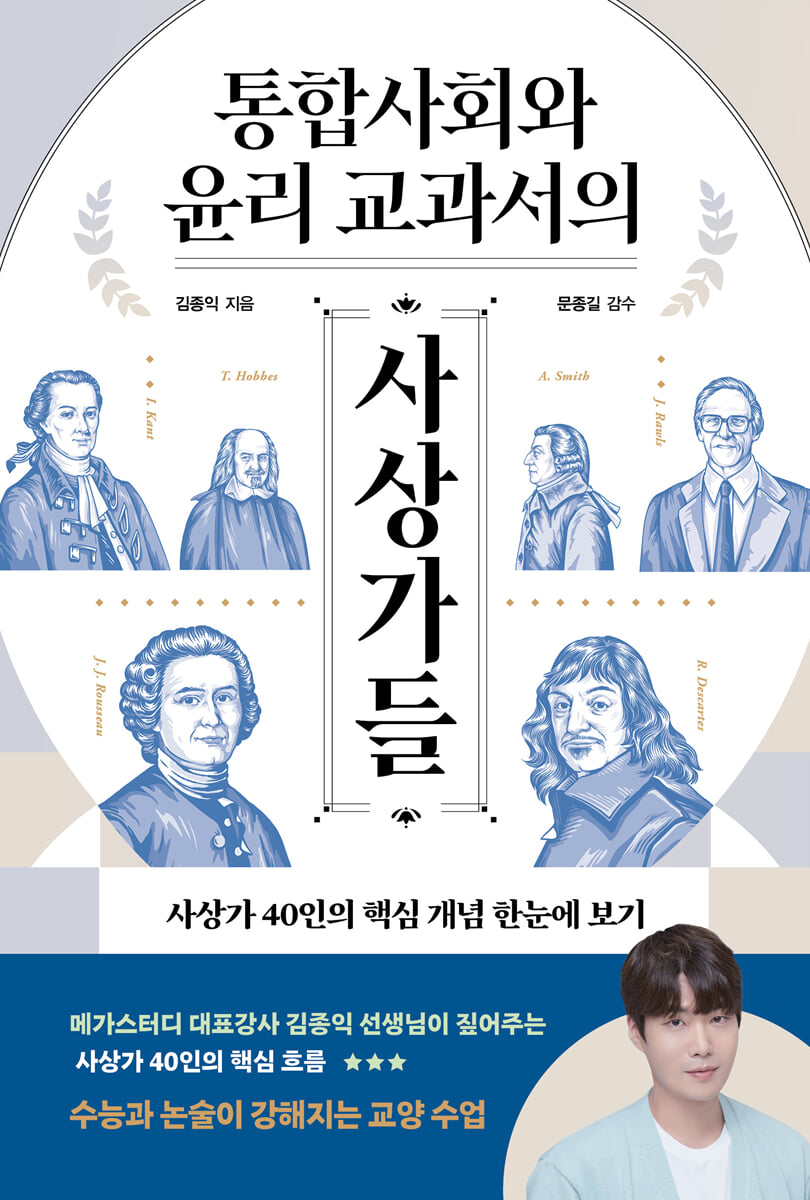
Thinkers in the Integrated Society and Ethics Textbook
 |
Description
Book Introduction
An introductory book on ethics and ideology from Megastudy's representative instructor, Mr. Kim Jong-ik!
"Thinkers of the Integrated Social Studies and Ethics Textbook" is an introductory book that helps students learn ethics and ideology more easily and accurately in preparation for the CSAT and essay writing.
Each thinker is introduced as a standalone unit, with brief and clear explanations of key concepts and quotes that could appear on actual exams.
We tried to explain the concepts in an easy-to-understand manner while maintaining philosophical depth, and we also included summaries at the end of each unit to facilitate review.
It focuses on Western philosophy, while adding essential Eastern thought.
In the Western world, it touches on essential thinkers such as Socrates' ethics, Plato's ideas and philosopher-politics, Kant's deontological categorical imperative, the political thought of Hobbes, Locke, and Rousseau, the ideological contrast between Rawls and Nozick, and the clash between the two axes of economic thought represented by Keynes and Hayek.
In addition, in Eastern philosophy, the flow of East Asian philosophy is organized through the thoughts of Confucius, Mencius, Xunzi, Laozi, Zhuangzi, Jeong Yak-yong, and Sakyamuni.
I believe that the experience of following the thoughts of great thinkers will provide an opportunity for fundamental insight into life and help shape and maintain one's own identity.
"Thinkers of the Integrated Social Studies and Ethics Textbook" is an introductory book that helps students learn ethics and ideology more easily and accurately in preparation for the CSAT and essay writing.
Each thinker is introduced as a standalone unit, with brief and clear explanations of key concepts and quotes that could appear on actual exams.
We tried to explain the concepts in an easy-to-understand manner while maintaining philosophical depth, and we also included summaries at the end of each unit to facilitate review.
It focuses on Western philosophy, while adding essential Eastern thought.
In the Western world, it touches on essential thinkers such as Socrates' ethics, Plato's ideas and philosopher-politics, Kant's deontological categorical imperative, the political thought of Hobbes, Locke, and Rousseau, the ideological contrast between Rawls and Nozick, and the clash between the two axes of economic thought represented by Keynes and Hayek.
In addition, in Eastern philosophy, the flow of East Asian philosophy is organized through the thoughts of Confucius, Mencius, Xunzi, Laozi, Zhuangzi, Jeong Yak-yong, and Sakyamuni.
I believe that the experience of following the thoughts of great thinkers will provide an opportunity for fundamental insight into life and help shape and maintain one's own identity.
- You can preview some of the book's contents.
Preview
index
Entering
Ancient West
1. Socrates
2. Protagoras / Thrasymachos / Callicles / Gorgias
3. Platon
4. Aristotle
5. Epicurus
6. Marcus Aurelius / Epictetus
Medieval West
7. Augustine A.
Augustinus
8. Thomas Aquinas T.
Aquinas
"Modern West"
9. Bacon F.
Bacon
10. Descartes R.
Descartes
11. Hume D.
Hume
12. Spinoza B.
Spinoza
13. Kant I.
Kant
14. Bentham J.
Bentham
15. Mill J.
S. Mill
16. Soren Aabye Kierkegaard
"Modern Western"
17. Jean-Paul Sartre
18. Perth C.
S. Peirce / James W.
James / Dewey J.
Dewey
"Modern West"
19. Hobbes T.
Hobbes
20. Locke J.
Locke
21.Jean Jacques Rousseau
22. Adam SmithA.
Smith
23. Karl Heinrich Marx
"Modern Western"
24.John Maynard Keynes VS
25. Friedrich August von Hayek
26. Rolls J.
Rawls
27. Nojik R.
Nozick
28. Jonas Hans Jonas
29. Viroli M.
Viroli / Petit P.
Pettit
Ancient China
30. Confucius
31. Mencius
32. Xunzi
33.Mozi
34. Han Feizi
35. Lao Tzu
36. Zhuangzi
37.Joo Hee Joo-hee
"korea"
38. Yi Hwang
39. Lee I / Jeong Yak-yong
"India"
40. Shakyamuni
References
Ancient West
1. Socrates
2. Protagoras / Thrasymachos / Callicles / Gorgias
3. Platon
4. Aristotle
5. Epicurus
6. Marcus Aurelius / Epictetus
Medieval West
7. Augustine A.
Augustinus
8. Thomas Aquinas T.
Aquinas
"Modern West"
9. Bacon F.
Bacon
10. Descartes R.
Descartes
11. Hume D.
Hume
12. Spinoza B.
Spinoza
13. Kant I.
Kant
14. Bentham J.
Bentham
15. Mill J.
S. Mill
16. Soren Aabye Kierkegaard
"Modern Western"
17. Jean-Paul Sartre
18. Perth C.
S. Peirce / James W.
James / Dewey J.
Dewey
"Modern West"
19. Hobbes T.
Hobbes
20. Locke J.
Locke
21.Jean Jacques Rousseau
22. Adam SmithA.
Smith
23. Karl Heinrich Marx
"Modern Western"
24.John Maynard Keynes VS
25. Friedrich August von Hayek
26. Rolls J.
Rawls
27. Nojik R.
Nozick
28. Jonas Hans Jonas
29. Viroli M.
Viroli / Petit P.
Pettit
Ancient China
30. Confucius
31. Mencius
32. Xunzi
33.Mozi
34. Han Feizi
35. Lao Tzu
36. Zhuangzi
37.Joo Hee Joo-hee
"korea"
38. Yi Hwang
39. Lee I / Jeong Yak-yong
"India"
40. Shakyamuni
References
Into the book
The most widely known nicknames associated with Hobbes (1588-1679) are 'the seven-year-old' and 'the twin of fear'.
This was so named because his mother, alarmed by the rumors of the Spanish Armada invading Malmesbury in southwestern England, gave birth prematurely in her seventh month of pregnancy.
Although there is no logical connection, there is a curious resemblance between Hobbes's argument for peace under the 'Leviathan', that is, peace and security under an absolute monarch rather than unbearable fear.
--- p.124
There is an interesting anecdote related to the publication of The Wealth of Nations, which Smith completed after ten years of passion.
Although the book was translated into six European countries upon its publication, it was reportedly dismissed as worthless at Oxford University.
But his friend Hume said of this book, “This is a book that not only you but also your friends and the public have been eagerly waiting for.
I, too, was thrilled when this book came out, having waited so long.
I'm so glad to see the results of my hard work.
After reading the book, all my worries disappeared.
“It is clearly a profound, faithful, and insightful work.” Hume, who was nearing death at the time, is also famous for sending this friendly reply to Smith.
--- p.152
Here's a quick note: Marx used to play a game of "confession" with his daughters, among which were these:
Your (Marx's) favorite virtue is (simplicity).
What you hate most is (slave mentality).
Your favorite thing to do is (get buried in a book).
Your favorite color is (red).
Your favorite motto is (Question everything).
--- p.160
Paul Samuelson, who is considered the father of modern economics, said of Keynes's The General Theory of Employment, Interest and Money (1936): "It is a badly written book, a mixture of brilliant insights and intuitions with tedious formulas, awkward definitions followed by flowery statements that suddenly strike you, but once you get the hang of it, you find its analysis both obvious and new."
In short, he evaluated it as “a book written by a genius.”
This was so named because his mother, alarmed by the rumors of the Spanish Armada invading Malmesbury in southwestern England, gave birth prematurely in her seventh month of pregnancy.
Although there is no logical connection, there is a curious resemblance between Hobbes's argument for peace under the 'Leviathan', that is, peace and security under an absolute monarch rather than unbearable fear.
--- p.124
There is an interesting anecdote related to the publication of The Wealth of Nations, which Smith completed after ten years of passion.
Although the book was translated into six European countries upon its publication, it was reportedly dismissed as worthless at Oxford University.
But his friend Hume said of this book, “This is a book that not only you but also your friends and the public have been eagerly waiting for.
I, too, was thrilled when this book came out, having waited so long.
I'm so glad to see the results of my hard work.
After reading the book, all my worries disappeared.
“It is clearly a profound, faithful, and insightful work.” Hume, who was nearing death at the time, is also famous for sending this friendly reply to Smith.
--- p.152
Here's a quick note: Marx used to play a game of "confession" with his daughters, among which were these:
Your (Marx's) favorite virtue is (simplicity).
What you hate most is (slave mentality).
Your favorite thing to do is (get buried in a book).
Your favorite color is (red).
Your favorite motto is (Question everything).
--- p.160
Paul Samuelson, who is considered the father of modern economics, said of Keynes's The General Theory of Employment, Interest and Money (1936): "It is a badly written book, a mixture of brilliant insights and intuitions with tedious formulas, awkward definitions followed by flowery statements that suddenly strike you, but once you get the hang of it, you find its analysis both obvious and new."
In short, he evaluated it as “a book written by a genius.”
--- p.164
Publisher's Review
ㆍ Let's start with the major thinkers carefully selected by Megastudy's representative instructor, Mr. Kim Jong-ik!
This introductory book to philosophy is based on the integrated social studies, life and ethics (modern society and ethics), and ethics and ideology subjects of the College Scholastic Ability Test. It organizes the core concepts of 40 major thinkers included in the textbook in an easy and clear manner while maintaining depth of content.
The author, Megastudy's representative instructor, Mr. Kim Jong-ik, is a veteran instructor who has worked with numerous students in the field of college entrance exams and internal assessments.
Professor Moon Jong-gil, a doctor of philosophy and expert in ethics education, supervised the book, further enhancing the appropriateness of the selection of thinkers and the reliability of the content.
Rather than presenting the complex history of philosophy in a linear fashion, this book organizes each thinker into independent chapters, allowing students to select and study the content they feel is relevant.
ㆍ Easy explanations and in-depth communication, the best answer for understanding ethics and ideology.
The author focuses on the goal of “making concepts easy while maintaining depth.”
By providing intuitive explanations and summaries tailored to the reader's level, concepts and quotes frequently tested on actual exams, and appropriately presenting the original texts of thinkers, we aim to convey the depth of philosophical thought.
This allows readers to directly encounter difficult sentences and develop a practical sense.
Additionally, at the end of each unit, a summary corner is provided to recapitulate key concepts, allowing readers to review the thinker's arguments. When necessary, the thinker's concepts are provided in parentheses to facilitate easy access to the thinker's original intentions.
If you've ever felt vaguely daunted by the concepts of integrated society, modern society and ethics, or ethics and ideology, or if you've found the concept of ethics complex, or if you're preparing for an essay or interview, this book will serve as a helpful and reliable guide.
Additionally, we expect that it will be of great help to the general public who desires in-depth knowledge and culture, as well as to students who dream of becoming ethics teachers at universities.
This introductory book to philosophy is based on the integrated social studies, life and ethics (modern society and ethics), and ethics and ideology subjects of the College Scholastic Ability Test. It organizes the core concepts of 40 major thinkers included in the textbook in an easy and clear manner while maintaining depth of content.
The author, Megastudy's representative instructor, Mr. Kim Jong-ik, is a veteran instructor who has worked with numerous students in the field of college entrance exams and internal assessments.
Professor Moon Jong-gil, a doctor of philosophy and expert in ethics education, supervised the book, further enhancing the appropriateness of the selection of thinkers and the reliability of the content.
Rather than presenting the complex history of philosophy in a linear fashion, this book organizes each thinker into independent chapters, allowing students to select and study the content they feel is relevant.
ㆍ Easy explanations and in-depth communication, the best answer for understanding ethics and ideology.
The author focuses on the goal of “making concepts easy while maintaining depth.”
By providing intuitive explanations and summaries tailored to the reader's level, concepts and quotes frequently tested on actual exams, and appropriately presenting the original texts of thinkers, we aim to convey the depth of philosophical thought.
This allows readers to directly encounter difficult sentences and develop a practical sense.
Additionally, at the end of each unit, a summary corner is provided to recapitulate key concepts, allowing readers to review the thinker's arguments. When necessary, the thinker's concepts are provided in parentheses to facilitate easy access to the thinker's original intentions.
If you've ever felt vaguely daunted by the concepts of integrated society, modern society and ethics, or ethics and ideology, or if you've found the concept of ethics complex, or if you're preparing for an essay or interview, this book will serve as a helpful and reliable guide.
Additionally, we expect that it will be of great help to the general public who desires in-depth knowledge and culture, as well as to students who dream of becoming ethics teachers at universities.
GOODS SPECIFICS
- Date of issue: May 9, 2025
- Page count, weight, size: 278 pages | 152*225*20mm
- ISBN13: 9791167526052
- ISBN10: 1167526058
You may also like
카테고리
korean


korean

![GQ KOREA Mark (Monthly): December [2025]](http://librairie.coreenne.fr/cdn/shop/files/8ef265dbbfbf186523ed75ba7319009d.jpg?v=1765340328&width=3840)


