

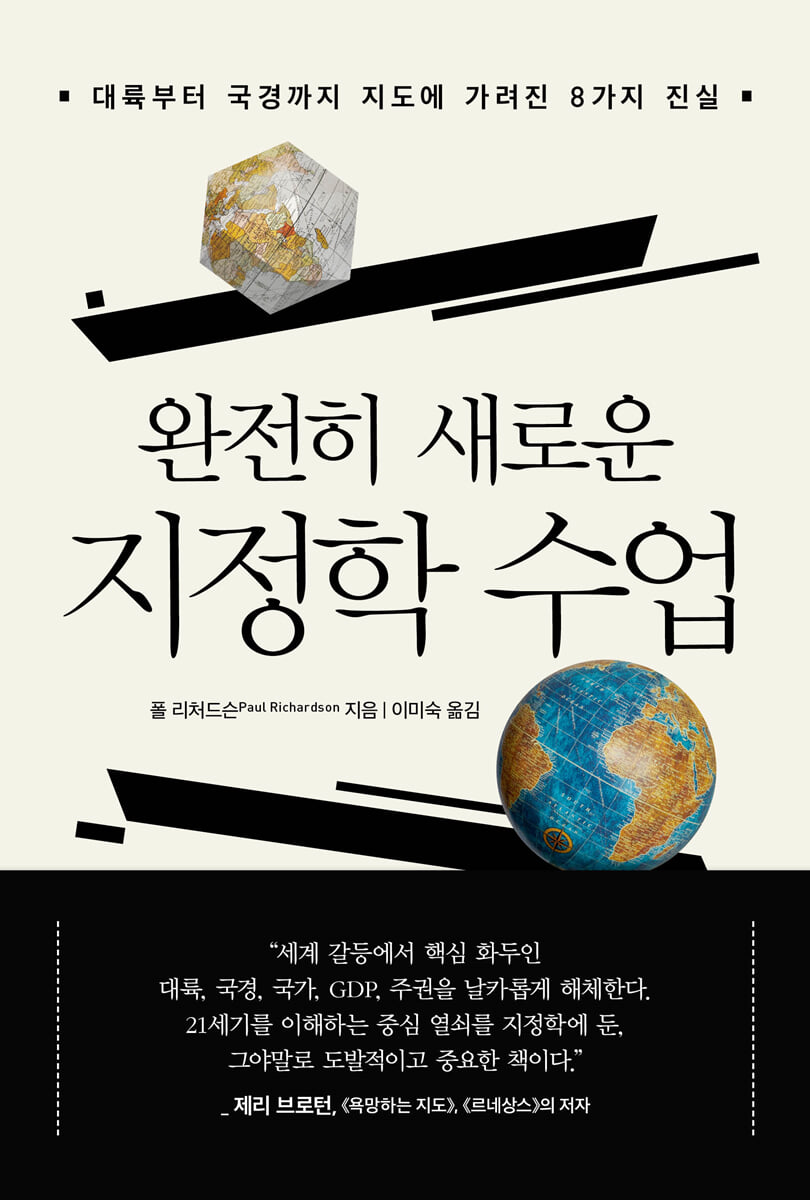
A whole new geopolitics lesson
 |
Description
Book Introduction
“To solve the world’s problems,
We must break free from the geographical prison we have imagined until now.”
“A provocative and important book for understanding 21st-century geopolitics.”
Jerry Broughton, author of The Map of Desire and The Renaissance
"Who, when, and why drew the lines on Earth's land and sea?" "A Whole New Geopolitics Lesson" poses questions about things we have taken for granted so far.
The aim is to deeply analyze how humanity has understood the world through various geopolitical factors such as geography, politics, and history, and to suggest alternatives for dealing with global problems.
It explores how human-created and used concepts like nation, sovereignty, and GDP, as well as visible geographical elements like continents and borders, have blinded us.
Based on these truths, it helps us to understand Russia, China, and Africa, which are major countries that always attract attention in global geopolitics.
Break free from the geographical prison you've always imagined with this book, which offers a completely new and accurate understanding of geopolitics from the very first chapter.
We must break free from the geographical prison we have imagined until now.”
“A provocative and important book for understanding 21st-century geopolitics.”
Jerry Broughton, author of The Map of Desire and The Renaissance
"Who, when, and why drew the lines on Earth's land and sea?" "A Whole New Geopolitics Lesson" poses questions about things we have taken for granted so far.
The aim is to deeply analyze how humanity has understood the world through various geopolitical factors such as geography, politics, and history, and to suggest alternatives for dealing with global problems.
It explores how human-created and used concepts like nation, sovereignty, and GDP, as well as visible geographical elements like continents and borders, have blinded us.
Based on these truths, it helps us to understand Russia, China, and Africa, which are major countries that always attract attention in global geopolitics.
Break free from the geographical prison you've always imagined with this book, which offers a completely new and accurate understanding of geopolitics from the very first chapter.
- You can preview some of the book's contents.
Preview
index
introduction.
A World Map Drawn Through Imagination_In Search of the Truth About the Five Oceans and Six Continents
Part 1.
A reality not based on reality
Chapter 1.
Continents_How many continents exist?
Chapter 2.
Why are border barriers useless?
Part 2.
Fiction upon fiction
Chapter 3.
Nation_What is a nation?
Chapter 4.
Sovereignty: a vague claim of unknown substance
Chapter 5. GDP_Wealth, Health, or Happiness?
Part 3.
The myth still continues
Chapter 6.
Russia_How Putin Became Caught Up in Revanchism
Chapter 7.
China's New Silk Road: Why Not All Roads Lead to China
Chapter 8.
Africa: The Lost History of a Cinematic Empire
Conclusion.
Beyond Myth: A New World Geography
A World Map Drawn Through Imagination_In Search of the Truth About the Five Oceans and Six Continents
Part 1.
A reality not based on reality
Chapter 1.
Continents_How many continents exist?
Chapter 2.
Why are border barriers useless?
Part 2.
Fiction upon fiction
Chapter 3.
Nation_What is a nation?
Chapter 4.
Sovereignty: a vague claim of unknown substance
Chapter 5. GDP_Wealth, Health, or Happiness?
Part 3.
The myth still continues
Chapter 6.
Russia_How Putin Became Caught Up in Revanchism
Chapter 7.
China's New Silk Road: Why Not All Roads Lead to China
Chapter 8.
Africa: The Lost History of a Cinematic Empire
Conclusion.
Beyond Myth: A New World Geography
Detailed image

Into the book
No matter how the vast metaspace of the continent is structured, the map of the continent always precedes its territory.
In any case, the continental structure inevitably reduces the richness and diversity of human and natural worlds to four to seven arbitrary and artificial spatial masses, which are then filled with their outlines and contents.
As with other myths covered in this book, the continent conceals far more than it reveals.
Only by shaking off the scales of continentality from our eyes can we hope to see the world and other human beings in a new way.
Until that happens, the countless connections, encounters, and interrelationships that define our world will remain hidden from view across continents.
--- 「Chapter 1.
Continents_How many continents exist?
There may be some benefit to be gained from this barrier.
But what will humanity have to offer in return? We seem trapped in a worldview where there's only one solution: expanding borders.
We are so obsessed with the idea that borders are the solution that we project our modern interpretation of barriers onto the Great Wall of China.
But borders are not always what they seem.
These days, the notion that borders are for protection and security seems increasingly to be a myth.
Arming border walls would exacerbate everyday violence, solidify authoritarian control, and heighten insecurity throughout communities.
As a result, the most vulnerable are further marginalized.
If more border walls make the world feel less safe, and higher walls create more fear, what's the point of building and expanding more border walls?
--- 「Chapter 2.
From "Why are border barriers useless?"
It's worth recalling that only a few decades ago, the concept of empire was a widely accepted framework for understanding how the world was always kept in order.
Britain claimed to be the empire on which the sun never set, but that empire eventually disappeared.
The idea that colonial 'natives' had the capacity for self-government went from 'inconceivable to commonplace'.
The lens of the 'empire' through which we viewed the world was cracked and shattered in the blink of an eye, replaced by the lens of the 'state'.
--- Chapter 3.
From "What is a Nation?"
By emphasizing our relationships and connections on a local, national, and transnational scale, our sense of belonging can become more harmonious.
As people experience, they always recognize a more flexible identity, but nation-states that grant privileges only to their own people have greatly damaged this flexible identity.
If we integrate this scale of identity, the community will have a sense of balance and equilibrium, and will not be divided along national, ethnic, religious, or tribal lines.
Because it is when nationalist politicians foment such divisions that the myth of the nation is perhaps most clearly revealed.
This unstable, unchangeable, and illusory concept is so fragile that it requires a strong leader to protect it, and strong leaders have always been those who identify themselves with the state, saying, "I am the state."
--- 「Chapter 3.
From "What is a Nation?"
In June 2016, the British government announced that it would hold a referendum on whether to remain in the EU.
A subsequent, unprecedented experiment in this area revealed the complex implications of sovereignty in the modern world.
One central figure in this experiment is Dominic Cummings, the leader of the Vote Leave campaign and later Boris Johnson's chief of staff when he became prime minister in 2019.
Cummings had been trying to understand what sovereignty really meant for years before the referendum.
He ran focus groups discussing Britain's relationship with Europe, asking people to write down what "sovereignty" meant to them, hoping to find a message that would resonate with the public.
When one focus group reported that “everyone, unanimously, answered ‘royalty,’” Cummings quickly concluded that the concept of sovereignty alone was not enough to get the message across.
A newer, more intuitive slogan was needed.
As he listened to various focus groups and tried various variations, the slogan "Let's take back control" began to emerge.
Cummings judged the slogan to capture the essence of the campaign to leave the UK.
The reason this slogan succeeded was its simplicity, and it encapsulated the myth of 'sovereignty'.
That is, it is a myth that makes control over people and territory seem natural, self-evident, and clearly distinguishable and exercisable.
In this myth, the world is simplified as if some territory is either completely 'inside' or completely 'outside' the control of the state. --- 「Chapter 4.
From “Sovereignty_A vague claim whose substance is unknown”
Although it is difficult to quantify subjective factors like happiness, the growing recognition that it is important to evaluate progress beyond GDP has led the United Nations Sustainable Development Solutions Network to publish the World Happiness Report.
The report assesses the state of happiness in most parts of the world through a series of annual surveys since 2012.
In the 2019 World Happiness Report, Bhutan ranked 95th out of 156 countries.
Even though the ranking is relatively low, it still scores high in happiness compared to GDP.
In 2019, the World Bank gave Bhutan an economic ranking of 174 out of 203.
The second place in the World Bank rankings was taken by China, whose GDP is 5,851 times that of Bhutan.
Even on a per capita basis, China's GDP was about 35 percent higher than Bhutan's.
However, in the 2019 World Happiness Report, China ranked 93rd, only slightly higher than Bhutan.
For Bhutan, which is guided by the philosophy of happiness, a ranking of 95th might not seem all that impressive.
But judging by the example of China, even if a country becomes very wealthy and its economy grows rapidly, happiness is not easily bought.
--- From "Chapter 5. GDP_Wealth, Health, or Happiness?"
Now, more than two decades into Putin's presidency, the obsession with portraying Russia as a victim of Western aggression, the veneration of the Soviet victory in World War II, the restoration of Russian influence, and the denigration of Western liberal values have all become defining features of his tenure.
The primary goal of foreign policy is no longer to advance Russia's national interests (whatever those may be).
Instead, Putin has only a desire to preserve himself and protect himself from legal prosecution and worse.
For this purpose, accumulating power and wealth is important to him.
This is not so much an agenda for expansionism as it is an agenda for the survival of an authoritarian regime wearing the black mask of revanchism.
The direction of the war in Ukraine depends not on geographical determinism, but on Putin's fate.
This war will deal a fatal blow to Putin's false claim that Russia is a great power and will divide Russia and Ukraine for generations to come.
Putin's wars have cost Russia trade and influence with Europe, but have also given it the status of a junior partner to China.
It will take some time for Putin and the rest of the elite in this new Russia to get used to the reality that their country has little influence over the political, military, and economic powers of the East and West.
--- Chapter 6.
From "Russia_How Putin Became Caught Up in Revanchism"
China's strategy appears less like a grand geopolitical strategy to dominate Eurasia and more like a preemptive bid to secure open markets and new regions for Chinese goods and capital.
However, it is not easy to separate the economic logic and strategic elements of this project.
The reshaping of world geography through the Silk Road is complex and contradictory, as even Chinese officials have estimated that investments in the Silk Road project could result in losses of up to 80 percent in Pakistan, 50 percent in Myanmar, and 30 percent in Central Asia.
Port projects in the Indian Ocean were also assessed as having little chance of financial success.
Judging by the scale of the losses, it seems that there are more important interests at stake than simply the return on investment.
The question of how to untangle the intertwined real investment opportunities and political challenges is even more confusing.
Because "Chinese investment" encompasses everything from central state-owned enterprises and policy banks, including the Export-Import Bank of China and the China Development Bank, to regional state-owned enterprises and private enterprises of various sizes, as well as individual and family-run businesses with an entrepreneurial nature.
This creates diverse and competitive investment objectives that demand national, strategic, and profit-driven interests from diverse actors.
It is difficult to categorize the New Silk Road and its projects, as its meaning varies depending on the region and the people.
Moreover, it is virtually impossible to find a comprehensive organizing principle, origin, or destination that runs through the New Silk Road.
--- Chapter 7.
From "China's New Silk Road: Why Not All Roads Lead to China"
To insist on a 'balanced' approach to empire is simply another way of sidestepping the age-old tricks of African mythology, while also revealing the deep insecurities of former colonial powers about their own identities and histories.
Rather than viewing Africa through the monochromatic lens of empire, or as a poverty-stricken land in desperate need of compassionate intervention and charity, Africa should be seen as a vibrant, vibrant, multi-colored, living, breathing, complex place.
Africa is the birthplace of some of the greatest and most wondrous world civilizations and the ultimate origin of humanity.
This is a region where bold innovations in the form of post-state sovereignty emerged in the post-colonial era.
In any case, the continental structure inevitably reduces the richness and diversity of human and natural worlds to four to seven arbitrary and artificial spatial masses, which are then filled with their outlines and contents.
As with other myths covered in this book, the continent conceals far more than it reveals.
Only by shaking off the scales of continentality from our eyes can we hope to see the world and other human beings in a new way.
Until that happens, the countless connections, encounters, and interrelationships that define our world will remain hidden from view across continents.
--- 「Chapter 1.
Continents_How many continents exist?
There may be some benefit to be gained from this barrier.
But what will humanity have to offer in return? We seem trapped in a worldview where there's only one solution: expanding borders.
We are so obsessed with the idea that borders are the solution that we project our modern interpretation of barriers onto the Great Wall of China.
But borders are not always what they seem.
These days, the notion that borders are for protection and security seems increasingly to be a myth.
Arming border walls would exacerbate everyday violence, solidify authoritarian control, and heighten insecurity throughout communities.
As a result, the most vulnerable are further marginalized.
If more border walls make the world feel less safe, and higher walls create more fear, what's the point of building and expanding more border walls?
--- 「Chapter 2.
From "Why are border barriers useless?"
It's worth recalling that only a few decades ago, the concept of empire was a widely accepted framework for understanding how the world was always kept in order.
Britain claimed to be the empire on which the sun never set, but that empire eventually disappeared.
The idea that colonial 'natives' had the capacity for self-government went from 'inconceivable to commonplace'.
The lens of the 'empire' through which we viewed the world was cracked and shattered in the blink of an eye, replaced by the lens of the 'state'.
--- Chapter 3.
From "What is a Nation?"
By emphasizing our relationships and connections on a local, national, and transnational scale, our sense of belonging can become more harmonious.
As people experience, they always recognize a more flexible identity, but nation-states that grant privileges only to their own people have greatly damaged this flexible identity.
If we integrate this scale of identity, the community will have a sense of balance and equilibrium, and will not be divided along national, ethnic, religious, or tribal lines.
Because it is when nationalist politicians foment such divisions that the myth of the nation is perhaps most clearly revealed.
This unstable, unchangeable, and illusory concept is so fragile that it requires a strong leader to protect it, and strong leaders have always been those who identify themselves with the state, saying, "I am the state."
--- 「Chapter 3.
From "What is a Nation?"
In June 2016, the British government announced that it would hold a referendum on whether to remain in the EU.
A subsequent, unprecedented experiment in this area revealed the complex implications of sovereignty in the modern world.
One central figure in this experiment is Dominic Cummings, the leader of the Vote Leave campaign and later Boris Johnson's chief of staff when he became prime minister in 2019.
Cummings had been trying to understand what sovereignty really meant for years before the referendum.
He ran focus groups discussing Britain's relationship with Europe, asking people to write down what "sovereignty" meant to them, hoping to find a message that would resonate with the public.
When one focus group reported that “everyone, unanimously, answered ‘royalty,’” Cummings quickly concluded that the concept of sovereignty alone was not enough to get the message across.
A newer, more intuitive slogan was needed.
As he listened to various focus groups and tried various variations, the slogan "Let's take back control" began to emerge.
Cummings judged the slogan to capture the essence of the campaign to leave the UK.
The reason this slogan succeeded was its simplicity, and it encapsulated the myth of 'sovereignty'.
That is, it is a myth that makes control over people and territory seem natural, self-evident, and clearly distinguishable and exercisable.
In this myth, the world is simplified as if some territory is either completely 'inside' or completely 'outside' the control of the state. --- 「Chapter 4.
From “Sovereignty_A vague claim whose substance is unknown”
Although it is difficult to quantify subjective factors like happiness, the growing recognition that it is important to evaluate progress beyond GDP has led the United Nations Sustainable Development Solutions Network to publish the World Happiness Report.
The report assesses the state of happiness in most parts of the world through a series of annual surveys since 2012.
In the 2019 World Happiness Report, Bhutan ranked 95th out of 156 countries.
Even though the ranking is relatively low, it still scores high in happiness compared to GDP.
In 2019, the World Bank gave Bhutan an economic ranking of 174 out of 203.
The second place in the World Bank rankings was taken by China, whose GDP is 5,851 times that of Bhutan.
Even on a per capita basis, China's GDP was about 35 percent higher than Bhutan's.
However, in the 2019 World Happiness Report, China ranked 93rd, only slightly higher than Bhutan.
For Bhutan, which is guided by the philosophy of happiness, a ranking of 95th might not seem all that impressive.
But judging by the example of China, even if a country becomes very wealthy and its economy grows rapidly, happiness is not easily bought.
--- From "Chapter 5. GDP_Wealth, Health, or Happiness?"
Now, more than two decades into Putin's presidency, the obsession with portraying Russia as a victim of Western aggression, the veneration of the Soviet victory in World War II, the restoration of Russian influence, and the denigration of Western liberal values have all become defining features of his tenure.
The primary goal of foreign policy is no longer to advance Russia's national interests (whatever those may be).
Instead, Putin has only a desire to preserve himself and protect himself from legal prosecution and worse.
For this purpose, accumulating power and wealth is important to him.
This is not so much an agenda for expansionism as it is an agenda for the survival of an authoritarian regime wearing the black mask of revanchism.
The direction of the war in Ukraine depends not on geographical determinism, but on Putin's fate.
This war will deal a fatal blow to Putin's false claim that Russia is a great power and will divide Russia and Ukraine for generations to come.
Putin's wars have cost Russia trade and influence with Europe, but have also given it the status of a junior partner to China.
It will take some time for Putin and the rest of the elite in this new Russia to get used to the reality that their country has little influence over the political, military, and economic powers of the East and West.
--- Chapter 6.
From "Russia_How Putin Became Caught Up in Revanchism"
China's strategy appears less like a grand geopolitical strategy to dominate Eurasia and more like a preemptive bid to secure open markets and new regions for Chinese goods and capital.
However, it is not easy to separate the economic logic and strategic elements of this project.
The reshaping of world geography through the Silk Road is complex and contradictory, as even Chinese officials have estimated that investments in the Silk Road project could result in losses of up to 80 percent in Pakistan, 50 percent in Myanmar, and 30 percent in Central Asia.
Port projects in the Indian Ocean were also assessed as having little chance of financial success.
Judging by the scale of the losses, it seems that there are more important interests at stake than simply the return on investment.
The question of how to untangle the intertwined real investment opportunities and political challenges is even more confusing.
Because "Chinese investment" encompasses everything from central state-owned enterprises and policy banks, including the Export-Import Bank of China and the China Development Bank, to regional state-owned enterprises and private enterprises of various sizes, as well as individual and family-run businesses with an entrepreneurial nature.
This creates diverse and competitive investment objectives that demand national, strategic, and profit-driven interests from diverse actors.
It is difficult to categorize the New Silk Road and its projects, as its meaning varies depending on the region and the people.
Moreover, it is virtually impossible to find a comprehensive organizing principle, origin, or destination that runs through the New Silk Road.
--- Chapter 7.
From "China's New Silk Road: Why Not All Roads Lead to China"
To insist on a 'balanced' approach to empire is simply another way of sidestepping the age-old tricks of African mythology, while also revealing the deep insecurities of former colonial powers about their own identities and histories.
Rather than viewing Africa through the monochromatic lens of empire, or as a poverty-stricken land in desperate need of compassionate intervention and charity, Africa should be seen as a vibrant, vibrant, multi-colored, living, breathing, complex place.
Africa is the birthplace of some of the greatest and most wondrous world civilizations and the ultimate origin of humanity.
This is a region where bold innovations in the form of post-state sovereignty emerged in the post-colonial era.
--- Chapter 8.
From "Africa_The Lost History of the Cinematic Empire"
From "Africa_The Lost History of the Cinematic Empire"
Publisher's Review
What kind of geopolitics can solve today's world problems?
A starting point for understanding today's geopolitics
“The moment you ask the most basic question
“The continent will soon begin to disintegrate”
Will Trump's national wall ensure security or exacerbate violence?
Why did Ukraine apply to join the EU, unlike the UK, which left?
What is the real reason why Russia, which even ceded territory to China, invaded Ukraine?
Is the New Silk Road Strategy China's quest for global hegemony?
Most of us can tell which continent we're on, but where the boundaries between continents lie is unclear. GDP is high, but life remains arduous, and the global economy centered around Trump and the international conflict centered around Russia show no signs of ending.
Meanwhile, China dreams of global domination through its New Silk Road project, while the African continent continues to be plagued by debates and risks surrounding nation-states, sovereignty, and borders.
Even a quick look around us reveals that geopolitical concepts we took for granted become confusing.
The author dismantles the myths one by one, saying that the world we live in now is “not a world that actually exists, but a world we have imagined.”
Starting from the perspective of how the greatest cartographers of our time once drew the world "upside down," this book goes beyond simply providing geographical and geopolitical information.
It offers keen insight into whether the geopolitics of that era, discovered in medieval maps, helped us understand that time, whether the geopolitics of today, discovered in modern maps, helped humanity create a better world, or, conversely, whether the geopolitics of the past and present have continuously pushed human civilization and the world to the brink.
The basic concepts of borders, continents, nations, GDP, and sovereignty, which we have believed without question, are intertwined and appear in the battlegrounds of global politics, economy, and geography: Russia, China, and Africa.
The geopolitical debate surrounding these countries is not new, but it continues because it is based on an “imagined world.”
Instead of just arguing noisily, this book asks different questions to address the problem.
These are fundamental questions, but they are the quickest way to understand current geopolitics, which is different from the geopolitics of the past.
Are the five oceans and six continents divided according to natural topography?
Asia and Europe are connected, so why are they different continents?
When did national territory and sovereignty come into being?
Who said Russia always wanted a warm-water port?
Part 1, 'Reality Not Grounded in Reality', discusses continents and borders as two fundamental concepts.
These two concepts are more likely to be demarcated by political purposes and human will than by geographical accuracy.
Part 2, “Fiction on Fiction,” discusses the state, sovereignty, and GDP.
These concepts, which feel timeless, are relatively recent creations of humans.
The process of developing and disseminating additional tools to solidify this seems like a castle built on sand.
Part 3 reveals the truth that geopolitics has obscured through the battlegrounds of global politics, economy, and geography—Russia, China, and Africa—and shows that imaginary myths continue to exist in modern society.
The author, a senior lecturer in geography at the University of Birmingham in the UK and a renowned scholar in the field of geography research, guides readers on the path to change based on a wealth of physical and geographical evidence.
From the dawn of the continent to the rise of China and the war in Ukraine, readers travel through time and space, traveling to Korea, Japan, Bhutan, Zimbabwe, China, Russia, Mexico, the United States, Antarctica, the Sahara, the South China Sea, and Central Asia.
Following the author's meticulous guidance, which delves into everything from the reality we stand on to the intangible realm of perception, you will feel that your way of looking at the world is changing, and that it must change.
Unlike the geopolitics of the past, which only made a fuss but did not provide answers, what kind of answers can the geopolitics discussed in this book provide?
In fact, the world already seems to have a clue to change.
The Sovereign Knights of Malta, which have passports but no territory; the Bir Tawil, which no country claims as its sovereignty; the emperor penguin of Antarctica, which no penguin claims as its own space; the Australian referendum that granted greater political rights to indigenous peoples; the online global community to ensure environmental justice; and the transnational mechanisms that will emerge in the future are enough to inspire those seeking new paths.
Change will begin in this world, seen from a new perspective.
A starting point for understanding today's geopolitics
“The moment you ask the most basic question
“The continent will soon begin to disintegrate”
Will Trump's national wall ensure security or exacerbate violence?
Why did Ukraine apply to join the EU, unlike the UK, which left?
What is the real reason why Russia, which even ceded territory to China, invaded Ukraine?
Is the New Silk Road Strategy China's quest for global hegemony?
Most of us can tell which continent we're on, but where the boundaries between continents lie is unclear. GDP is high, but life remains arduous, and the global economy centered around Trump and the international conflict centered around Russia show no signs of ending.
Meanwhile, China dreams of global domination through its New Silk Road project, while the African continent continues to be plagued by debates and risks surrounding nation-states, sovereignty, and borders.
Even a quick look around us reveals that geopolitical concepts we took for granted become confusing.
The author dismantles the myths one by one, saying that the world we live in now is “not a world that actually exists, but a world we have imagined.”
Starting from the perspective of how the greatest cartographers of our time once drew the world "upside down," this book goes beyond simply providing geographical and geopolitical information.
It offers keen insight into whether the geopolitics of that era, discovered in medieval maps, helped us understand that time, whether the geopolitics of today, discovered in modern maps, helped humanity create a better world, or, conversely, whether the geopolitics of the past and present have continuously pushed human civilization and the world to the brink.
The basic concepts of borders, continents, nations, GDP, and sovereignty, which we have believed without question, are intertwined and appear in the battlegrounds of global politics, economy, and geography: Russia, China, and Africa.
The geopolitical debate surrounding these countries is not new, but it continues because it is based on an “imagined world.”
Instead of just arguing noisily, this book asks different questions to address the problem.
These are fundamental questions, but they are the quickest way to understand current geopolitics, which is different from the geopolitics of the past.
Are the five oceans and six continents divided according to natural topography?
Asia and Europe are connected, so why are they different continents?
When did national territory and sovereignty come into being?
Who said Russia always wanted a warm-water port?
Part 1, 'Reality Not Grounded in Reality', discusses continents and borders as two fundamental concepts.
These two concepts are more likely to be demarcated by political purposes and human will than by geographical accuracy.
Part 2, “Fiction on Fiction,” discusses the state, sovereignty, and GDP.
These concepts, which feel timeless, are relatively recent creations of humans.
The process of developing and disseminating additional tools to solidify this seems like a castle built on sand.
Part 3 reveals the truth that geopolitics has obscured through the battlegrounds of global politics, economy, and geography—Russia, China, and Africa—and shows that imaginary myths continue to exist in modern society.
The author, a senior lecturer in geography at the University of Birmingham in the UK and a renowned scholar in the field of geography research, guides readers on the path to change based on a wealth of physical and geographical evidence.
From the dawn of the continent to the rise of China and the war in Ukraine, readers travel through time and space, traveling to Korea, Japan, Bhutan, Zimbabwe, China, Russia, Mexico, the United States, Antarctica, the Sahara, the South China Sea, and Central Asia.
Following the author's meticulous guidance, which delves into everything from the reality we stand on to the intangible realm of perception, you will feel that your way of looking at the world is changing, and that it must change.
Unlike the geopolitics of the past, which only made a fuss but did not provide answers, what kind of answers can the geopolitics discussed in this book provide?
In fact, the world already seems to have a clue to change.
The Sovereign Knights of Malta, which have passports but no territory; the Bir Tawil, which no country claims as its sovereignty; the emperor penguin of Antarctica, which no penguin claims as its own space; the Australian referendum that granted greater political rights to indigenous peoples; the online global community to ensure environmental justice; and the transnational mechanisms that will emerge in the future are enough to inspire those seeking new paths.
Change will begin in this world, seen from a new perspective.
GOODS SPECIFICS
- Date of issue: June 16, 2025
- Page count, weight, size: 328 pages | 582g | 152*225*23mm
- ISBN13: 9791193638675
- ISBN10: 1193638674
You may also like
카테고리
korean


korean

![GQ KOREA Mark (Monthly): December [2025]](http://librairie.coreenne.fr/cdn/shop/files/8ef265dbbfbf186523ed75ba7319009d.jpg?v=1765340328&width=3840)


