

I don't know the sweetness of chocolate
 |
Description
Book Introduction
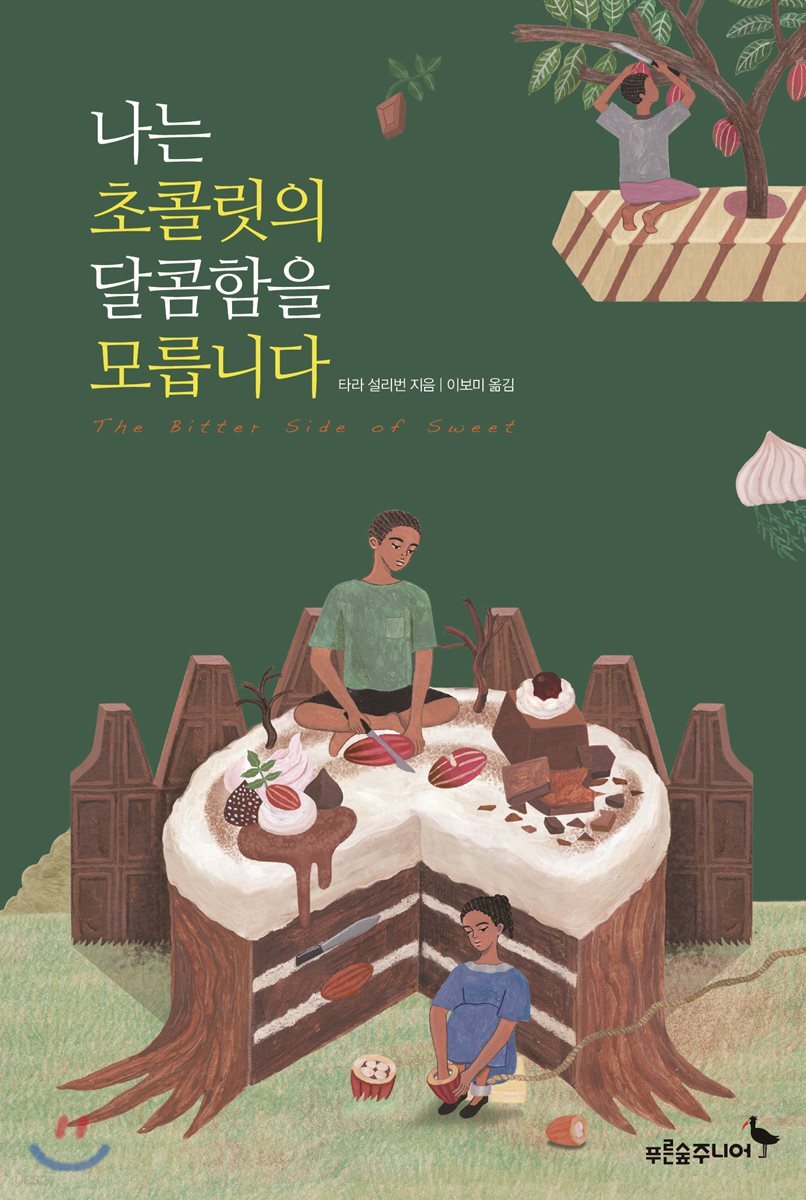
The young adult novel "I Don't Know the Sweetness of Chocolate" delves into the food chain structure of the chocolate industry from the perspective of a young laborer working on a cocoa farm.
Three boys and girls escape from a cocoa farm and embark on a ten-day adventure, depicting the lives of modern-day slaves—a world marked by human trafficking, forced labor, hunger, and violence—and how their lives connect to our own rich lives on the other side of the globe.
The author vividly depicts the reality of forced labor among children and adolescents.
Not only is the spatial description, such as referring to the tire marks left by delivery men's (Pisters) trucks as "yellow-brown scars" (p. 11) amidst "lush trees and lush bushes stretching out endlessly like a green sea," but even the psychological description, in which the beautiful fragrance of cocoa beverage changes into the nauseating smell of pain and fear (p. 234), is persistent and poignant.
Although we've heard about the realities of the chocolate industry through numerous media outlets, we haven't had many opportunities to hear the voices of the child and adolescent workers who groan at the very bottom.
In that sense, this novel, which captures Amadou's voice, represents the closed mouths of thousands of people who have, until now, existed only as numbers in various statistical data.
Perhaps the author's own childhood, in which he experienced the realities of the Third World firsthand while following his parents who worked for international relief organizations, is the source of these powerful sentences.
Publisher's Weekly's rave review, which called it "a masterful work that illuminates the modern world's slavery with a restrained voice," illustrates this well.
Three boys and girls escape from a cocoa farm and embark on a ten-day adventure, depicting the lives of modern-day slaves—a world marked by human trafficking, forced labor, hunger, and violence—and how their lives connect to our own rich lives on the other side of the globe.
The author vividly depicts the reality of forced labor among children and adolescents.
Not only is the spatial description, such as referring to the tire marks left by delivery men's (Pisters) trucks as "yellow-brown scars" (p. 11) amidst "lush trees and lush bushes stretching out endlessly like a green sea," but even the psychological description, in which the beautiful fragrance of cocoa beverage changes into the nauseating smell of pain and fear (p. 234), is persistent and poignant.
Although we've heard about the realities of the chocolate industry through numerous media outlets, we haven't had many opportunities to hear the voices of the child and adolescent workers who groan at the very bottom.
In that sense, this novel, which captures Amadou's voice, represents the closed mouths of thousands of people who have, until now, existed only as numbers in various statistical data.
Perhaps the author's own childhood, in which he experienced the realities of the Third World firsthand while following his parents who worked for international relief organizations, is the source of these powerful sentences.
Publisher's Weekly's rave review, which called it "a masterful work that illuminates the modern world's slavery with a restrained voice," illustrates this well.
- You can preview some of the book's contents.
Preview
index
Wishes don't always come true
severe penalties
Pain is the same as sadness
ominous thoughts
Last chance
Operation commencement
scary memories
The reason I have to live
arrive
The smell of pain
The meaning of numbers
Author's Note
severe penalties
Pain is the same as sadness
ominous thoughts
Last chance
Operation commencement
scary memories
The reason I have to live
arrive
The smell of pain
The meaning of numbers
Author's Note
Publisher's Review
The cacao we have grown with blood, sweat, and tears on our farm
Was it for city kids who can't sleep?
Now that you know the secret of sweet and bitter cocoa,
This was no longer the sweet scent that soothed sleepless nights.
The smell of suffering from harsh labor without receiving a single penny,
It was the smell of fear that could not be avoided no matter how hard one worked.
A story of little heroes who uncover the scary truth about chocolate.
_ Kirkus Review
Unraveling the global capitalist system in crisp sentences.
_ Booklist
Bold adventures, thrilling descriptions! _ School Library Journal
A masterful work that illuminates the slavery of modern society with a restrained voice! _ Publisher's Weekly
A sweet piece of luxury for us,
But for this boy, chocolate means nothing but terrible fear.
A sweet indulgence, a slice of luxury you can enjoy with your pocket money! For some time now, a craze for high-end chocolate has been sweeping Korea.
The supermarket shelves are filled with imported chocolates, and stores that are considered one of the world's top three chocolate franchises are opening on the streets.
Meanwhile, the media has been reporting that since 2012, the global supply of cocoa has not been able to keep up with chocolate consumption.
At this rate, won't chocolate become a luxury snack that only the rich can enjoy?
"No, a world where only the rich can eat chocolate? How could such an injustice happen?!"
Someone might cry like this.
Even at this very moment, chocolate is made with a rather absurd secret, either unaware or oblivious to the fact…
The young adult novel "I Don't Know the Sweetness of Chocolate" delves into the food chain structure of the chocolate industry from the perspective of a young laborer working on a cocoa farm.
Three boys and girls escape from a cocoa farm and embark on a ten-day adventure, depicting the lives of modern-day slaves—a world marked by human trafficking, forced labor, hunger, and violence—and how their lives connect to our own rich lives on the other side of the globe.
The novel's narrator is Amadou, a teenage boy from Mali.
Amadou left home two years ago with his younger brother Seydou to earn money.
In the wealthy country of Côte d'Ivoire, it was said that gold nuggets hung from every tree, so he thought he could go there and make a fortune.
However, he was tricked by a broker who sold boys to cocoa farms and became a slave overnight.
Two small meals a day, consisting of watery soup or underripe bananas.
Even though they risk their lives picking cacao beans in the dangerous wild forest, they often end up starving or being beaten with clubs in the evening.
At night, the farm owners would herd their workers into a hut and lock it from the outside.
This is a cruel daily routine that repeats itself 365 days a year, but Amadou endures it, doing the work of two people and taking the beatings of two people, thinking that he must protect his younger brother Seydou, who is only eight years old.
Death is common, whether from illness, snake bites, or beatings, but no one here remembers it.
And since no one has ever managed to escape, it seems the only way to avoid death is to become a cunning slave.
I only count what's important.
Strike, twist, throw, check.
Strike again, twist, throw, check.
This is only the 25th fruit.
(Omitted) I walked and walked, passing countless trees.
The cacao beans hanging in clusters seemed to be mocking us.
It wasn't the color we wanted yet.
I can't count how many cocoa trees I've just passed by.
Because we don't count things that aren't important anyway.
Don't even count unripe cocoa beans.
I don't even count the number of times I got beaten up for not meeting my quota.
I don't even count how many days have passed since I gave up hope of ever going home.
Pages 7-9
The author vividly depicts the reality of forced labor among children and adolescents.
Not only is the spatial description, such as referring to the tire marks left by delivery men's (Pisters) trucks as "yellow-brown scars" (p. 11) amidst "lush trees and lush bushes stretching out endlessly like a green sea," but even the psychological description, in which the beautiful fragrance of cocoa beverage changes into the nauseating smell of pain and fear (p. 234), is persistent and poignant.
Although we've heard about the realities of the chocolate industry through numerous media outlets, we haven't had many opportunities to hear the voices of the child and adolescent workers who groan at the very bottom.
In that sense, this novel, which captures Amadou's voice, represents the closed mouths of thousands of people who have, until now, existed only as numbers in various statistical data.
Perhaps the author's own childhood, in which he experienced the realities of the Third World firsthand while following his parents who worked for international relief organizations, is the source of these powerful sentences.
Publisher's Weekly's rave review, which called it "a masterful work that illuminates the modern world's slavery with a restrained voice," illustrates this well.
A daring ten-day adventure that follows the vast food chain of the chocolate industry.
And the painful truth lurking at the end
One day, a girl (Hadija) who looks like a wild cat is brought to a farm where only men live.
Their ferocious behavior, like that of wild animals, is so unsettling that even the farm owners find them unsettling, and they end up causing a commotion by escaping from the very first day.
Amadou, who had stepped forward to protect his younger brother (Seydo) who was caught in this incident, was forced to run away whenever he had the chance and be punished and watch over the girl who was caught, and was no longer able to look after Seydo closely.
One day, Seydoux, who had gone out to work alone without Amadou, returned covered in blood.
He was injured in the arm while working.
When the fever did not go down for two days, the farm owner decided to take action himself, but little did he know that it would mean cutting off the arm…
It was already too late.
Realizing that “living here is nothing more than a slow killing of Seydoux,” Amadou decides to escape. (p. 108)
Amadou, Seydu, and Hadiza, who were hiding in a cacao seed delivery truck, are discovered by the truck driver, but he tells them to take them to a city in the southeast.
Amadou finds it hard to believe that his good intentions are genuine, and argues that they should flee from the knight, citing the fact that their homeland, Mali, is north, not south.
But Hadija confesses that she is Ivorian and must go south to return home.
The fact that Hadija is Ivorian like the farm owners confuses Amadou, and he reveals all the secrets he has kept hidden until then.
Hadija lived with her mother in Abidjan, a major city in Côte d'Ivoire.
My mother, a journalist, received threatening phone calls every day while covering something 'important'.
The mother and daughter packed only their belongings and moved as if they were being chased, but Hadija was eventually kidnapped by unknown assailants and taken to a farm, and to this day she does not know why she was kidnapped.
Hadidza promises to take responsibility for Amadou and Seydou and ensure their safe return to Mali if they accompany her home. Amadou is shocked to discover that Hadidza, whom he thought was his compatriot, is actually a hated Ivorian! Will they be able to reach their respective homes safely?
What's interesting is that the story follows the entire food chain of the chocolate industry, from producers to ultimate beneficiaries, from the boy and girl's escape from the cocoa farm, through the unloading dock, and finally to the discovery of the true nature of multinational corporations and the existence of chocolate consumers.
And when the story reaches its climax, the reader will find himself, along with Hadiza, at the very bottom of the food chain.
“The reality of the chocolate industry is that large corporations make huge profits, middlemen get rich without paying a single penny in taxes, and the farmers get almost nothing” (p. 235) Poor farms need low-paying workers, and in the process, the brutal atrocities of child kidnapping are repeated.
Through this powerful narrative, the author provides insight into the complexities of global capitalism, a time when it is difficult to attribute the evils of any one individual.
It imprints deep within our hearts that the small luxuries of everyday life are hand in hand with unspeakable suffering on the other side of the globe.
From the mind of a slave to the mind of a human being… …
Can we once again place our hopes in this world without compassion?
Amadou and Hadiza are teenagers who grew up in different environments, like poles of a magnet, with different nationalities and classes.
As Hadija moves with the single-minded determination to escape, regardless of the dangers of life, she comes into countless conflicts with Amadou, who knows the ins and outs of farm life all too well.
Hadiza's repeated attempts at escape strike Amadou's frozen heart like an axe at first, and then ultimately shake it.
Amadou, a slave boy who had been trying to suppress all his senses and emotions like a mindless machine, denying the goodwill of others and the value of hope.
Amadou, who is like a wild animal, meets Khadija, who has a spirit that cannot be tamed, and gradually begins to listen to his inner self and open his eyes to hope.
A glimmer of hope that humans might exist to love, rather than to be tools for other humans.
It would be nothing less than a process of recovering the human mind from the mind of a slave.
In this way, the material, which could easily have flowed into tearful melodrama, progresses into a desperate but beautiful coming-of-age story.
Chocolate has long been responsible for the happiness of childhood, the sugar content of students preparing for exams, and the love of couples.
And that's not all.
From Leslie Cheung to Park Bo-gum, chocolate commercials have always featured handsome men, proving just how beautiful sweetness can be.
It's such a blessing that chocolate is a regular supporting character in our sweet memories.
But knowing the truth that this wealth was achieved by forcing someone to refuse to be human and become a slave is the bare minimum of literacy in the age of globalization.
Was it for city kids who can't sleep?
Now that you know the secret of sweet and bitter cocoa,
This was no longer the sweet scent that soothed sleepless nights.
The smell of suffering from harsh labor without receiving a single penny,
It was the smell of fear that could not be avoided no matter how hard one worked.
A story of little heroes who uncover the scary truth about chocolate.
_ Kirkus Review
Unraveling the global capitalist system in crisp sentences.
_ Booklist
Bold adventures, thrilling descriptions! _ School Library Journal
A masterful work that illuminates the slavery of modern society with a restrained voice! _ Publisher's Weekly
A sweet piece of luxury for us,
But for this boy, chocolate means nothing but terrible fear.
A sweet indulgence, a slice of luxury you can enjoy with your pocket money! For some time now, a craze for high-end chocolate has been sweeping Korea.
The supermarket shelves are filled with imported chocolates, and stores that are considered one of the world's top three chocolate franchises are opening on the streets.
Meanwhile, the media has been reporting that since 2012, the global supply of cocoa has not been able to keep up with chocolate consumption.
At this rate, won't chocolate become a luxury snack that only the rich can enjoy?
"No, a world where only the rich can eat chocolate? How could such an injustice happen?!"
Someone might cry like this.
Even at this very moment, chocolate is made with a rather absurd secret, either unaware or oblivious to the fact…
The young adult novel "I Don't Know the Sweetness of Chocolate" delves into the food chain structure of the chocolate industry from the perspective of a young laborer working on a cocoa farm.
Three boys and girls escape from a cocoa farm and embark on a ten-day adventure, depicting the lives of modern-day slaves—a world marked by human trafficking, forced labor, hunger, and violence—and how their lives connect to our own rich lives on the other side of the globe.
The novel's narrator is Amadou, a teenage boy from Mali.
Amadou left home two years ago with his younger brother Seydou to earn money.
In the wealthy country of Côte d'Ivoire, it was said that gold nuggets hung from every tree, so he thought he could go there and make a fortune.
However, he was tricked by a broker who sold boys to cocoa farms and became a slave overnight.
Two small meals a day, consisting of watery soup or underripe bananas.
Even though they risk their lives picking cacao beans in the dangerous wild forest, they often end up starving or being beaten with clubs in the evening.
At night, the farm owners would herd their workers into a hut and lock it from the outside.
This is a cruel daily routine that repeats itself 365 days a year, but Amadou endures it, doing the work of two people and taking the beatings of two people, thinking that he must protect his younger brother Seydou, who is only eight years old.
Death is common, whether from illness, snake bites, or beatings, but no one here remembers it.
And since no one has ever managed to escape, it seems the only way to avoid death is to become a cunning slave.
I only count what's important.
Strike, twist, throw, check.
Strike again, twist, throw, check.
This is only the 25th fruit.
(Omitted) I walked and walked, passing countless trees.
The cacao beans hanging in clusters seemed to be mocking us.
It wasn't the color we wanted yet.
I can't count how many cocoa trees I've just passed by.
Because we don't count things that aren't important anyway.
Don't even count unripe cocoa beans.
I don't even count the number of times I got beaten up for not meeting my quota.
I don't even count how many days have passed since I gave up hope of ever going home.
Pages 7-9
The author vividly depicts the reality of forced labor among children and adolescents.
Not only is the spatial description, such as referring to the tire marks left by delivery men's (Pisters) trucks as "yellow-brown scars" (p. 11) amidst "lush trees and lush bushes stretching out endlessly like a green sea," but even the psychological description, in which the beautiful fragrance of cocoa beverage changes into the nauseating smell of pain and fear (p. 234), is persistent and poignant.
Although we've heard about the realities of the chocolate industry through numerous media outlets, we haven't had many opportunities to hear the voices of the child and adolescent workers who groan at the very bottom.
In that sense, this novel, which captures Amadou's voice, represents the closed mouths of thousands of people who have, until now, existed only as numbers in various statistical data.
Perhaps the author's own childhood, in which he experienced the realities of the Third World firsthand while following his parents who worked for international relief organizations, is the source of these powerful sentences.
Publisher's Weekly's rave review, which called it "a masterful work that illuminates the modern world's slavery with a restrained voice," illustrates this well.
A daring ten-day adventure that follows the vast food chain of the chocolate industry.
And the painful truth lurking at the end
One day, a girl (Hadija) who looks like a wild cat is brought to a farm where only men live.
Their ferocious behavior, like that of wild animals, is so unsettling that even the farm owners find them unsettling, and they end up causing a commotion by escaping from the very first day.
Amadou, who had stepped forward to protect his younger brother (Seydo) who was caught in this incident, was forced to run away whenever he had the chance and be punished and watch over the girl who was caught, and was no longer able to look after Seydo closely.
One day, Seydoux, who had gone out to work alone without Amadou, returned covered in blood.
He was injured in the arm while working.
When the fever did not go down for two days, the farm owner decided to take action himself, but little did he know that it would mean cutting off the arm…
It was already too late.
Realizing that “living here is nothing more than a slow killing of Seydoux,” Amadou decides to escape. (p. 108)
Amadou, Seydu, and Hadiza, who were hiding in a cacao seed delivery truck, are discovered by the truck driver, but he tells them to take them to a city in the southeast.
Amadou finds it hard to believe that his good intentions are genuine, and argues that they should flee from the knight, citing the fact that their homeland, Mali, is north, not south.
But Hadija confesses that she is Ivorian and must go south to return home.
The fact that Hadija is Ivorian like the farm owners confuses Amadou, and he reveals all the secrets he has kept hidden until then.
Hadija lived with her mother in Abidjan, a major city in Côte d'Ivoire.
My mother, a journalist, received threatening phone calls every day while covering something 'important'.
The mother and daughter packed only their belongings and moved as if they were being chased, but Hadija was eventually kidnapped by unknown assailants and taken to a farm, and to this day she does not know why she was kidnapped.
Hadidza promises to take responsibility for Amadou and Seydou and ensure their safe return to Mali if they accompany her home. Amadou is shocked to discover that Hadidza, whom he thought was his compatriot, is actually a hated Ivorian! Will they be able to reach their respective homes safely?
What's interesting is that the story follows the entire food chain of the chocolate industry, from producers to ultimate beneficiaries, from the boy and girl's escape from the cocoa farm, through the unloading dock, and finally to the discovery of the true nature of multinational corporations and the existence of chocolate consumers.
And when the story reaches its climax, the reader will find himself, along with Hadiza, at the very bottom of the food chain.
“The reality of the chocolate industry is that large corporations make huge profits, middlemen get rich without paying a single penny in taxes, and the farmers get almost nothing” (p. 235) Poor farms need low-paying workers, and in the process, the brutal atrocities of child kidnapping are repeated.
Through this powerful narrative, the author provides insight into the complexities of global capitalism, a time when it is difficult to attribute the evils of any one individual.
It imprints deep within our hearts that the small luxuries of everyday life are hand in hand with unspeakable suffering on the other side of the globe.
From the mind of a slave to the mind of a human being… …
Can we once again place our hopes in this world without compassion?
Amadou and Hadiza are teenagers who grew up in different environments, like poles of a magnet, with different nationalities and classes.
As Hadija moves with the single-minded determination to escape, regardless of the dangers of life, she comes into countless conflicts with Amadou, who knows the ins and outs of farm life all too well.
Hadiza's repeated attempts at escape strike Amadou's frozen heart like an axe at first, and then ultimately shake it.
Amadou, a slave boy who had been trying to suppress all his senses and emotions like a mindless machine, denying the goodwill of others and the value of hope.
Amadou, who is like a wild animal, meets Khadija, who has a spirit that cannot be tamed, and gradually begins to listen to his inner self and open his eyes to hope.
A glimmer of hope that humans might exist to love, rather than to be tools for other humans.
It would be nothing less than a process of recovering the human mind from the mind of a slave.
In this way, the material, which could easily have flowed into tearful melodrama, progresses into a desperate but beautiful coming-of-age story.
Chocolate has long been responsible for the happiness of childhood, the sugar content of students preparing for exams, and the love of couples.
And that's not all.
From Leslie Cheung to Park Bo-gum, chocolate commercials have always featured handsome men, proving just how beautiful sweetness can be.
It's such a blessing that chocolate is a regular supporting character in our sweet memories.
But knowing the truth that this wealth was achieved by forcing someone to refuse to be human and become a slave is the bare minimum of literacy in the age of globalization.
GOODS SPECIFICS
- Date of issue: May 30, 2017
- Page count, weight, size: 264 pages | 324g | 138*205*20mm
- ISBN13: 9791156751410
- ISBN10: 1156751411
- KC Certification: Certification Type: Conformity Confirmation
You may also like
카테고리
korean


korean

![GQ KOREA Mark (Monthly): December [2025]](http://librairie.coreenne.fr/cdn/shop/files/8ef265dbbfbf186523ed75ba7319009d.jpg?v=1765340328&width=3840)


