

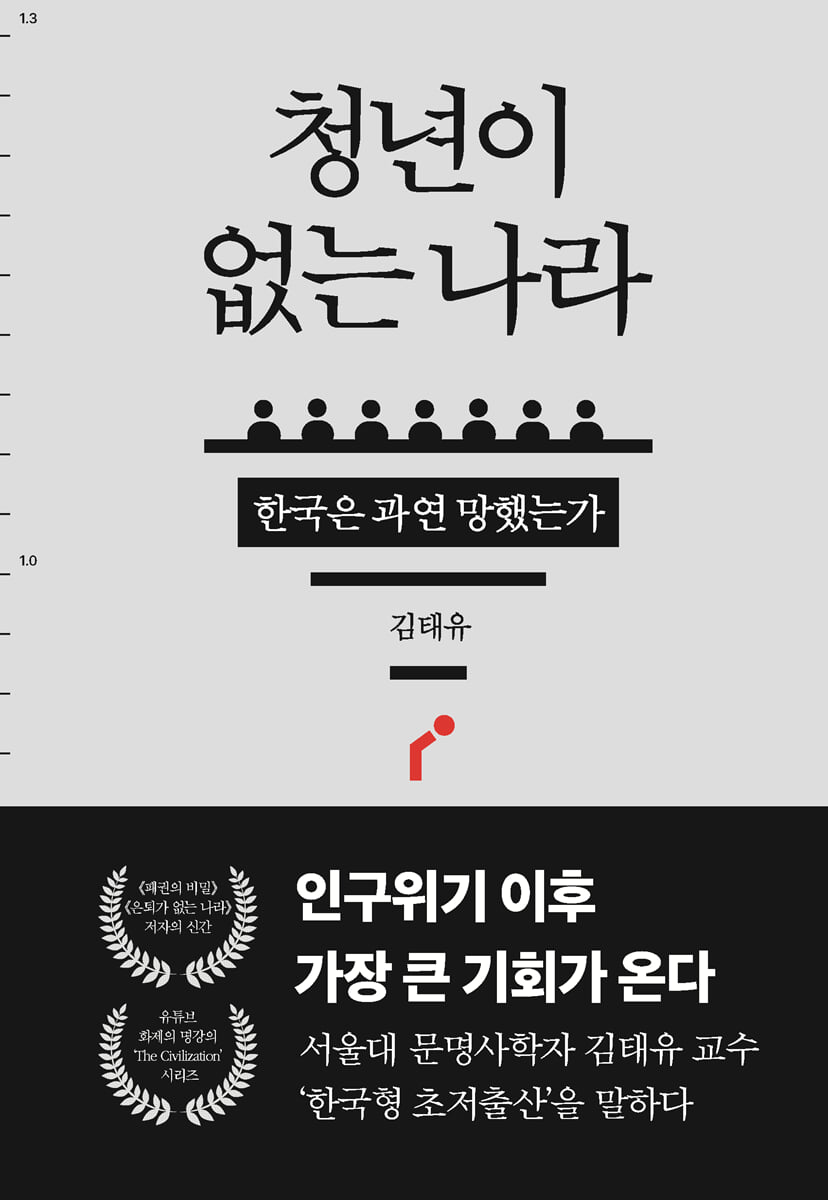
A country without youth
 |
Description
Book Introduction
“How can we overcome Korea’s population crisis?”
Survival strategies for the ultra-low birth rate era suggested by Professor Kim Tae-yu, a historian of civilization at Seoul National University.
There is one video that has captured the attention of viewers around the world.
This is a video titled 'South Korea is over' released by the German science content channel Kurzgesagt.
Based on the shocking figure of a birth rate of 0.7, the video presents a pessimistic outlook: by 2050, Korean society will be reorganized around the elderly, and the industrial and cultural assets accumulated to date will be virtually unsustainable.
The video garnered over 12 million views in just one month after its release, creating a huge stir both domestically and internationally.
Should we simply stand by and endure this situation? A book titled "A Country Without Youth" has been published to answer this question.
This book is a development of "A Country Without Retirement," published in 2013 by Professor Kim Tae-yu, a historian of civilization at Seoul National University, to suit the situation in 2025. It presents the fundamental causes of Korea's ultra-low birth rate, the flawed policies of the past, and solutions.
Professor Kim Tae-yu, who has studied the principles of national development throughout his life, diagnoses in this book that South Korea is facing both the greatest crisis in its history and the greatest opportunity in the history of civilization.
The question I pose is simple yet fundamental.
“Is it really inevitable that it will collapse like this?”
There is no future in a society where young people disappear.
"A Nation Without Youth" is not just about encouraging childbirth, but also a guidebook containing sustainable survival strategies for the society of the Republic of Korea. It is a must-read for politicians, the media, educators, policymakers, and all citizens concerned about the future.
Survival strategies for the ultra-low birth rate era suggested by Professor Kim Tae-yu, a historian of civilization at Seoul National University.
There is one video that has captured the attention of viewers around the world.
This is a video titled 'South Korea is over' released by the German science content channel Kurzgesagt.
Based on the shocking figure of a birth rate of 0.7, the video presents a pessimistic outlook: by 2050, Korean society will be reorganized around the elderly, and the industrial and cultural assets accumulated to date will be virtually unsustainable.
The video garnered over 12 million views in just one month after its release, creating a huge stir both domestically and internationally.
Should we simply stand by and endure this situation? A book titled "A Country Without Youth" has been published to answer this question.
This book is a development of "A Country Without Retirement," published in 2013 by Professor Kim Tae-yu, a historian of civilization at Seoul National University, to suit the situation in 2025. It presents the fundamental causes of Korea's ultra-low birth rate, the flawed policies of the past, and solutions.
Professor Kim Tae-yu, who has studied the principles of national development throughout his life, diagnoses in this book that South Korea is facing both the greatest crisis in its history and the greatest opportunity in the history of civilization.
The question I pose is simple yet fundamental.
“Is it really inevitable that it will collapse like this?”
There is no future in a society where young people disappear.
"A Nation Without Youth" is not just about encouraging childbirth, but also a guidebook containing sustainable survival strategies for the society of the Republic of Korea. It is a must-read for politicians, the media, educators, policymakers, and all citizens concerned about the future.
index
Introduction _Is the Republic of Korea really ruined?
Part 1.
Will it just disappear like this?
Chapter 1.
The birth of Korea's ultra-low birth rate
Is Korea finished?
Population decline is an opportunity, not a disaster.
Why Korea?
The most competitive country
Low growth that kills hope for the future
The screams of the youth
Chapter 2.
You idiot, the problem is child support.
Misdiagnosis, 380 trillion won lost
The birth rate is simply a result of the dependency ratio.
How to improve the support ratio
We need 'working seniors'
Are Senior Citizen Policies on the Right Track?
Part 2.
How to leap forward
Chapter 3.
Destroy the national economy
When an aunt-in-law society is needed
To find the right job for me
Division of labor, not competition
Youth to the future, baby boomers to the field
How to create a society of two-faced people?
Why Aunt's Life Can't Fail
Chapter 4.
We need a second megacity
The root of all problems: concentration in the metropolitan area
Busan as the second metropolitan area
When new roads open, new civilizations blossom.
A key port in the era of the Northern Sea Route
Completion of a megacity that will overcome the one-pole system of the metropolitan area.
In closing, only the President can do this.
main
Part 1.
Will it just disappear like this?
Chapter 1.
The birth of Korea's ultra-low birth rate
Is Korea finished?
Population decline is an opportunity, not a disaster.
Why Korea?
The most competitive country
Low growth that kills hope for the future
The screams of the youth
Chapter 2.
You idiot, the problem is child support.
Misdiagnosis, 380 trillion won lost
The birth rate is simply a result of the dependency ratio.
How to improve the support ratio
We need 'working seniors'
Are Senior Citizen Policies on the Right Track?
Part 2.
How to leap forward
Chapter 3.
Destroy the national economy
When an aunt-in-law society is needed
To find the right job for me
Division of labor, not competition
Youth to the future, baby boomers to the field
How to create a society of two-faced people?
Why Aunt's Life Can't Fail
Chapter 4.
We need a second megacity
The root of all problems: concentration in the metropolitan area
Busan as the second metropolitan area
When new roads open, new civilizations blossom.
A key port in the era of the Northern Sea Route
Completion of a megacity that will overcome the one-pole system of the metropolitan area.
In closing, only the President can do this.
main
Into the book
Is South Korea truly finished? If that were true, this book wouldn't have been necessary.
Our country has experienced numerous crises throughout history.
In the past 100 years alone, the country has been taken over by foreign powers and almost disappeared in war.
However, the problem of Korea's ultra-low birth rate today is more serious and important than any national crisis in the past thousand years.
A country that has been taken away can be regained, but a country that has disappeared cannot be recovered.
--- p.6
Just as dieting can restore health, the declining birth rate is a welcome phenomenon that will put human civilization back on a sustainable track.
However, if the OECD average total fertility rate of 1.6 is a 'diet' to restore health, Korea's 0.7 is equivalent to 'malnutrition' that could lead to death.
In other words, the low birth rate in our country is fundamentally different from that of other countries around the world.
This is why we cannot solve our country's low birth rate problem with only the low birth rate policies implemented in Japan, France, and Germany.
--- p.10
It is no exaggeration to say that the future of South Korea depends on how well it overcomes the current crisis of extremely low birth rates by improving the dependency ratio through a dual-cropping society and attracting ports along the Northern Sea Route.
We must seize this last opportunity.
A sound strategy and strong execution are needed to make this happen.
Any policy related to low birth rates should not become a subject of political strife.
At least on this issue, it is time for all citizens to unite with one mind and one heart.
--- p.19
The birth rate issue remains important.
But the real problem is not the ‘birth rate’ but the ‘dependency ratio’.
Even if the birth rate declines, society can be maintained if the population structure is adjusted accordingly.
However, Korea is now experiencing a collapse in its population structure, that is, a rapid deterioration in the dependency ratio.
In the past, it was a time when three people supported one person.
But now, the structure is changing to one where one person must support one other person.
This means that the working generation of young people can no longer support the country.
--- p.88
A double-cropped society is a society that divides life into two periods and works twice.
In the first period, from the ages of 25 to 54, when fluid intelligence is at its peak, people engage in 'one-job occupations' that require highly technical adaptability, such as science, technology, or manufacturing.
This is a society where you can live well for 60 years by working hard for the past 30 years.
After that, as they get older, they transition to 'second-hand jobs' such as administration, service, and education, where experience and judgment are important, from the age of 55 to 74, when their decision-making intelligence is high.
This is the concept of a two-person society where people can work for 50 years and live well until they are 100.
--- p.147
The Northern Sea Route is not an opportunity limited to Busan.
If we can attract a port that serves as a hub for trade between Europe and Northeast Asia, Busan, Ulsan, and Korea will have an opportunity for an economic leap forward that has never been experienced before in history.
This is a historical turning point that could lead to an industrial leap forward that goes beyond the "Miracle on the Han River," and could serve as an opportunity for South Korea to break away from its metropolitan-centered economic structure and leap forward as a global maritime power, reminiscent of Venice during the Renaissance, Lisbon in Portugal during the Age of Exploration, London in the United Kingdom, and today's Singapore, Hong Kong, and Dubai.
The problem is that there are many mountains to overcome and time is limited.
Our country has experienced numerous crises throughout history.
In the past 100 years alone, the country has been taken over by foreign powers and almost disappeared in war.
However, the problem of Korea's ultra-low birth rate today is more serious and important than any national crisis in the past thousand years.
A country that has been taken away can be regained, but a country that has disappeared cannot be recovered.
--- p.6
Just as dieting can restore health, the declining birth rate is a welcome phenomenon that will put human civilization back on a sustainable track.
However, if the OECD average total fertility rate of 1.6 is a 'diet' to restore health, Korea's 0.7 is equivalent to 'malnutrition' that could lead to death.
In other words, the low birth rate in our country is fundamentally different from that of other countries around the world.
This is why we cannot solve our country's low birth rate problem with only the low birth rate policies implemented in Japan, France, and Germany.
--- p.10
It is no exaggeration to say that the future of South Korea depends on how well it overcomes the current crisis of extremely low birth rates by improving the dependency ratio through a dual-cropping society and attracting ports along the Northern Sea Route.
We must seize this last opportunity.
A sound strategy and strong execution are needed to make this happen.
Any policy related to low birth rates should not become a subject of political strife.
At least on this issue, it is time for all citizens to unite with one mind and one heart.
--- p.19
The birth rate issue remains important.
But the real problem is not the ‘birth rate’ but the ‘dependency ratio’.
Even if the birth rate declines, society can be maintained if the population structure is adjusted accordingly.
However, Korea is now experiencing a collapse in its population structure, that is, a rapid deterioration in the dependency ratio.
In the past, it was a time when three people supported one person.
But now, the structure is changing to one where one person must support one other person.
This means that the working generation of young people can no longer support the country.
--- p.88
A double-cropped society is a society that divides life into two periods and works twice.
In the first period, from the ages of 25 to 54, when fluid intelligence is at its peak, people engage in 'one-job occupations' that require highly technical adaptability, such as science, technology, or manufacturing.
This is a society where you can live well for 60 years by working hard for the past 30 years.
After that, as they get older, they transition to 'second-hand jobs' such as administration, service, and education, where experience and judgment are important, from the age of 55 to 74, when their decision-making intelligence is high.
This is the concept of a two-person society where people can work for 50 years and live well until they are 100.
--- p.147
The Northern Sea Route is not an opportunity limited to Busan.
If we can attract a port that serves as a hub for trade between Europe and Northeast Asia, Busan, Ulsan, and Korea will have an opportunity for an economic leap forward that has never been experienced before in history.
This is a historical turning point that could lead to an industrial leap forward that goes beyond the "Miracle on the Han River," and could serve as an opportunity for South Korea to break away from its metropolitan-centered economic structure and leap forward as a global maritime power, reminiscent of Venice during the Renaissance, Lisbon in Portugal during the Age of Exploration, London in the United Kingdom, and today's Singapore, Hong Kong, and Dubai.
The problem is that there are many mountains to overcome and time is limited.
--- p.247
Publisher's Review
“How can we overcome Korea’s population crisis?”
Survival strategies for the ultra-low birth rate era proposed by Professor Kim Tae-yu, a historian of civilization at Seoul National University.
There is one video that has captured the attention of viewers around the world.
This is a video titled 'South Korea is over' released by the German science content channel Kurzgesagt.
Based on the shocking figure of a birth rate of 0.7, the video presents a pessimistic outlook: by 2050, Korean society will be reorganized around the elderly, and the industrial and cultural assets accumulated to date will be virtually unsustainable.
The video garnered over 12 million views in just one month after its release, creating a huge stir both domestically and internationally.
Should we simply stand by and endure this situation? A book titled "A Country Without Youth" has been published to answer this question.
This book is a development of "A Country Without Retirement," published in 2013 by Professor Kim Tae-yu, a historian of civilization at Seoul National University, to suit the situation in 2025. It presents the fundamental causes of Korea's ultra-low birth rate, the flawed policies of the past, and solutions.
Professor Kim Tae-yu, who has studied the principles of national development throughout his life, diagnoses in this book that South Korea is facing both the greatest crisis in its history and the greatest opportunity in the history of civilization.
The question I pose is simple yet fundamental.
“Is it really inevitable that it will collapse like this?”
“The diagnosis was wrong from the start.”
Why it failed even after spending 380 trillion won
Since 2005, the government has invested over 380 trillion won in an effort to address the low birth rate.
A variety of systems, including childcare leave, childcare allowances, and childbirth incentives, were introduced, and a system that was outwardly similar to a welfare state was established.
However, the birth rate did not rebound, but rather fell to the lowest level in the world.
What could have been the problem?
The author finds the core cause of the policy's failure in 'diagnosis errors.'
The birth rate of 1.4 and 0.7 may seem like just a difference in numbers, but the social context is completely different.
1.4 may be a recoverable level, but 0.7 indicates an irreversible structural collapse.
However, the Korean government has either copied the response measures of advanced countries overseas or relied on ineffective populist policies.
However, the younger generation does not decide to get married and have children based on ‘a few pennies.’
Because the foundation of life has collapsed.
This book asks the question again from the very beginning.
What makes Korea's ultra-low birth rate different? And why doesn't conventional methods work?
"The problem isn't the birth rate, it's the dependency ratio."
The 20-30 generation who cannot receive the national pension and an unsustainable society
The fact that the birth rate is low does not in itself shake the sustainability of society.
The problem is the demographic reversal phenomenon, where the youth population is decreasing while the elderly population is rapidly increasing.
In other words, Korean society is rapidly being reorganized into an 'inverted pyramid' structure, and the resulting 'worsening of the dependency ratio' is causing a critical crisis.
Dependency ratio refers to the number of economically inactive people that one working person must support.
In the past, three people supported one person, but in the future, we will enter a society where one person will have to support two or three people.
This has a domino effect not only on pension finances, but also across all sectors, including education, healthcare, local economies, and the housing market.
Many small and medium-sized cities in the provinces have already entered a phase of population decline, and the younger generation knows that the depletion of the national pension coincides precisely with their own retirement.
The author argues that:
Now, the goal of national policy should be not to boldly 'raise the birth rate' but to 'lower the dependency ratio'.
“50% concentration in the metropolitan area”
Structural competition that strangles young people's lives
Korea is one of the most competitive societies in the world.
Behind this lies the structural problem of ‘concentration in the metropolitan area.’
More than half of the total population is concentrated in Seoul and Gyeonggi Province, which is an extreme level compared to other advanced countries such as Japan (28%), France (18%), and the United Kingdom (13%).
This concentration is not simply a matter of administrative convenience; it is a real factor that is squeezing the lives of young people.
All resources, including jobs, education, culture, and medical care, are concentrated in the metropolitan area, and the competition for survival here is becoming increasingly fierce.
Amid high housing prices, soaring rents, and the burdensome cost of education and living, young people are giving up on dating, marriage, and having children.
Moreover, this structure is self-replicating.
As young people flock to the metropolitan area, companies move their headquarters back to the metropolitan area to follow the talent.
Regions that lose jobs lose more of their population and ultimately face extinction.
The government and local governments are trying to solve the problem by expanding the housing supply in the metropolitan area, but this only serves to reinforce the concentration of population in the metropolitan area, leading to a "repetition of imbalance."
Professor Kim says.
“The right policy should work toward reducing the concentration of population in the metropolitan area.”
"We need a society of aunts and uncles."
For a society where youth and old age coexist
As the first strategy to resolve the two axes of worsening dependency ratio and concentration in the metropolitan area, Professor Kim proposes a 'double-cropping society.'
He points out that while the introduction of foreign workers, extension of the retirement age, and introduction of artificial intelligence are being discussed, it is difficult to see results in the short term and the costs are high.
Instead, he emphasizes that we should focus on the potential resources that can be utilized immediately, namely the 'second career life' of the middle-aged generation (ages 55-74).
In the past, working for 30 years and retiring for 20 years was the common life structure.
But now, we live in an era where we have to work for 20 years and live for 30 to 40 more years.
If we do not change our systems and social perceptions to accommodate this change, the middle-aged generation will be reduced to an inefficient population of “healthy and capable people who do nothing.”
The author explains this by citing concepts from developmental psychology, namely the theory of fluid intelligence and crystallized intelligence.
Fluid intelligence, including problem-solving skills and creativity, peaks in the late 20s and then declines, while crystallized intelligence strengthens over time through experience and knowledge accumulation.
He suggests that young people should pursue creative and technical fields that require fluid intelligence, while older people should pursue fields that require crystallized intelligence, such as counseling, administration, education, and caregiving.
The dual-generation society is not simply about re-employment of the elderly, but rather about creating a structure that allows for division of labor rather than competition between generations.
The book also presents specific guidelines for corporate personnel strategies, government policy directions, and individual life planning to achieve this goal.
"In the era of the Arctic Route, we must create a second megacity in Busan, Ulsan, and Gyeongsang Province."
The Korean Peninsula's first and last opportunity has arrived.
The second solution is to build a 'second megacity' to break the unipolar system of the metropolitan area.
I think the best place is Busan, Ulsan, and Gyeongnam, or the Buulgyeong region.
The decisive reason is the historical change in civilization called the ‘Northern Sea Route’.
Due to global warming, the Arctic sea route is gradually opening up, and it is expected that year-round navigation will soon be possible.
Buulkyung, located on the Korea Strait, a key point in the Northern Sea Route, is strategically positioned to develop into a new maritime economic hub in an era of shifting global logistics flows.
This is not simply a regional development, but an opportunity to become a key player in the global supply chain.
Until now, balanced national development has attempted to develop the entire country evenly, but the effect has been minimal.
Professor Kim emphasizes that “a strategy of selection and concentration” is now necessary.
Only by fostering an economic and industrial center on par with Seoul in the southeastern part of the Korean Peninsula can we create a structure where young people can live, work, and love in the provinces.
If Busan, Ulsan, and Gyeongnam establish themselves as a hub port on the Northern Sea Route, a bipolar system could be formed between the metropolitan area and Busan, Ulsan, and Gyeongnam.
This could be a decisive strategy to overcome the two challenges of population crisis and low growth simultaneously.
There is no future in a society where young people disappear.
"A Nation Without Youth" is not simply a book about encouraging childbirth, but rather a guidebook containing sustainable survival strategies for the society of the Republic of Korea. It is a must-read for politicians, the media, educators, policymakers, and all citizens concerned about the future.
Survival strategies for the ultra-low birth rate era proposed by Professor Kim Tae-yu, a historian of civilization at Seoul National University.
There is one video that has captured the attention of viewers around the world.
This is a video titled 'South Korea is over' released by the German science content channel Kurzgesagt.
Based on the shocking figure of a birth rate of 0.7, the video presents a pessimistic outlook: by 2050, Korean society will be reorganized around the elderly, and the industrial and cultural assets accumulated to date will be virtually unsustainable.
The video garnered over 12 million views in just one month after its release, creating a huge stir both domestically and internationally.
Should we simply stand by and endure this situation? A book titled "A Country Without Youth" has been published to answer this question.
This book is a development of "A Country Without Retirement," published in 2013 by Professor Kim Tae-yu, a historian of civilization at Seoul National University, to suit the situation in 2025. It presents the fundamental causes of Korea's ultra-low birth rate, the flawed policies of the past, and solutions.
Professor Kim Tae-yu, who has studied the principles of national development throughout his life, diagnoses in this book that South Korea is facing both the greatest crisis in its history and the greatest opportunity in the history of civilization.
The question I pose is simple yet fundamental.
“Is it really inevitable that it will collapse like this?”
“The diagnosis was wrong from the start.”
Why it failed even after spending 380 trillion won
Since 2005, the government has invested over 380 trillion won in an effort to address the low birth rate.
A variety of systems, including childcare leave, childcare allowances, and childbirth incentives, were introduced, and a system that was outwardly similar to a welfare state was established.
However, the birth rate did not rebound, but rather fell to the lowest level in the world.
What could have been the problem?
The author finds the core cause of the policy's failure in 'diagnosis errors.'
The birth rate of 1.4 and 0.7 may seem like just a difference in numbers, but the social context is completely different.
1.4 may be a recoverable level, but 0.7 indicates an irreversible structural collapse.
However, the Korean government has either copied the response measures of advanced countries overseas or relied on ineffective populist policies.
However, the younger generation does not decide to get married and have children based on ‘a few pennies.’
Because the foundation of life has collapsed.
This book asks the question again from the very beginning.
What makes Korea's ultra-low birth rate different? And why doesn't conventional methods work?
"The problem isn't the birth rate, it's the dependency ratio."
The 20-30 generation who cannot receive the national pension and an unsustainable society
The fact that the birth rate is low does not in itself shake the sustainability of society.
The problem is the demographic reversal phenomenon, where the youth population is decreasing while the elderly population is rapidly increasing.
In other words, Korean society is rapidly being reorganized into an 'inverted pyramid' structure, and the resulting 'worsening of the dependency ratio' is causing a critical crisis.
Dependency ratio refers to the number of economically inactive people that one working person must support.
In the past, three people supported one person, but in the future, we will enter a society where one person will have to support two or three people.
This has a domino effect not only on pension finances, but also across all sectors, including education, healthcare, local economies, and the housing market.
Many small and medium-sized cities in the provinces have already entered a phase of population decline, and the younger generation knows that the depletion of the national pension coincides precisely with their own retirement.
The author argues that:
Now, the goal of national policy should be not to boldly 'raise the birth rate' but to 'lower the dependency ratio'.
“50% concentration in the metropolitan area”
Structural competition that strangles young people's lives
Korea is one of the most competitive societies in the world.
Behind this lies the structural problem of ‘concentration in the metropolitan area.’
More than half of the total population is concentrated in Seoul and Gyeonggi Province, which is an extreme level compared to other advanced countries such as Japan (28%), France (18%), and the United Kingdom (13%).
This concentration is not simply a matter of administrative convenience; it is a real factor that is squeezing the lives of young people.
All resources, including jobs, education, culture, and medical care, are concentrated in the metropolitan area, and the competition for survival here is becoming increasingly fierce.
Amid high housing prices, soaring rents, and the burdensome cost of education and living, young people are giving up on dating, marriage, and having children.
Moreover, this structure is self-replicating.
As young people flock to the metropolitan area, companies move their headquarters back to the metropolitan area to follow the talent.
Regions that lose jobs lose more of their population and ultimately face extinction.
The government and local governments are trying to solve the problem by expanding the housing supply in the metropolitan area, but this only serves to reinforce the concentration of population in the metropolitan area, leading to a "repetition of imbalance."
Professor Kim says.
“The right policy should work toward reducing the concentration of population in the metropolitan area.”
"We need a society of aunts and uncles."
For a society where youth and old age coexist
As the first strategy to resolve the two axes of worsening dependency ratio and concentration in the metropolitan area, Professor Kim proposes a 'double-cropping society.'
He points out that while the introduction of foreign workers, extension of the retirement age, and introduction of artificial intelligence are being discussed, it is difficult to see results in the short term and the costs are high.
Instead, he emphasizes that we should focus on the potential resources that can be utilized immediately, namely the 'second career life' of the middle-aged generation (ages 55-74).
In the past, working for 30 years and retiring for 20 years was the common life structure.
But now, we live in an era where we have to work for 20 years and live for 30 to 40 more years.
If we do not change our systems and social perceptions to accommodate this change, the middle-aged generation will be reduced to an inefficient population of “healthy and capable people who do nothing.”
The author explains this by citing concepts from developmental psychology, namely the theory of fluid intelligence and crystallized intelligence.
Fluid intelligence, including problem-solving skills and creativity, peaks in the late 20s and then declines, while crystallized intelligence strengthens over time through experience and knowledge accumulation.
He suggests that young people should pursue creative and technical fields that require fluid intelligence, while older people should pursue fields that require crystallized intelligence, such as counseling, administration, education, and caregiving.
The dual-generation society is not simply about re-employment of the elderly, but rather about creating a structure that allows for division of labor rather than competition between generations.
The book also presents specific guidelines for corporate personnel strategies, government policy directions, and individual life planning to achieve this goal.
"In the era of the Arctic Route, we must create a second megacity in Busan, Ulsan, and Gyeongsang Province."
The Korean Peninsula's first and last opportunity has arrived.
The second solution is to build a 'second megacity' to break the unipolar system of the metropolitan area.
I think the best place is Busan, Ulsan, and Gyeongnam, or the Buulgyeong region.
The decisive reason is the historical change in civilization called the ‘Northern Sea Route’.
Due to global warming, the Arctic sea route is gradually opening up, and it is expected that year-round navigation will soon be possible.
Buulkyung, located on the Korea Strait, a key point in the Northern Sea Route, is strategically positioned to develop into a new maritime economic hub in an era of shifting global logistics flows.
This is not simply a regional development, but an opportunity to become a key player in the global supply chain.
Until now, balanced national development has attempted to develop the entire country evenly, but the effect has been minimal.
Professor Kim emphasizes that “a strategy of selection and concentration” is now necessary.
Only by fostering an economic and industrial center on par with Seoul in the southeastern part of the Korean Peninsula can we create a structure where young people can live, work, and love in the provinces.
If Busan, Ulsan, and Gyeongnam establish themselves as a hub port on the Northern Sea Route, a bipolar system could be formed between the metropolitan area and Busan, Ulsan, and Gyeongnam.
This could be a decisive strategy to overcome the two challenges of population crisis and low growth simultaneously.
There is no future in a society where young people disappear.
"A Nation Without Youth" is not simply a book about encouraging childbirth, but rather a guidebook containing sustainable survival strategies for the society of the Republic of Korea. It is a must-read for politicians, the media, educators, policymakers, and all citizens concerned about the future.
GOODS SPECIFICS
- Date of issue: May 31, 2025
- Page count, weight, size: 304 pages | 494g | 145*210*20mm
- ISBN13: 9791198290564
- ISBN10: 1198290560
You may also like
카테고리
korean


korean

![GQ KOREA Mark (Monthly): December [2025]](http://librairie.coreenne.fr/cdn/shop/files/8ef265dbbfbf186523ed75ba7319009d.jpg?v=1765340328&width=3840)


