

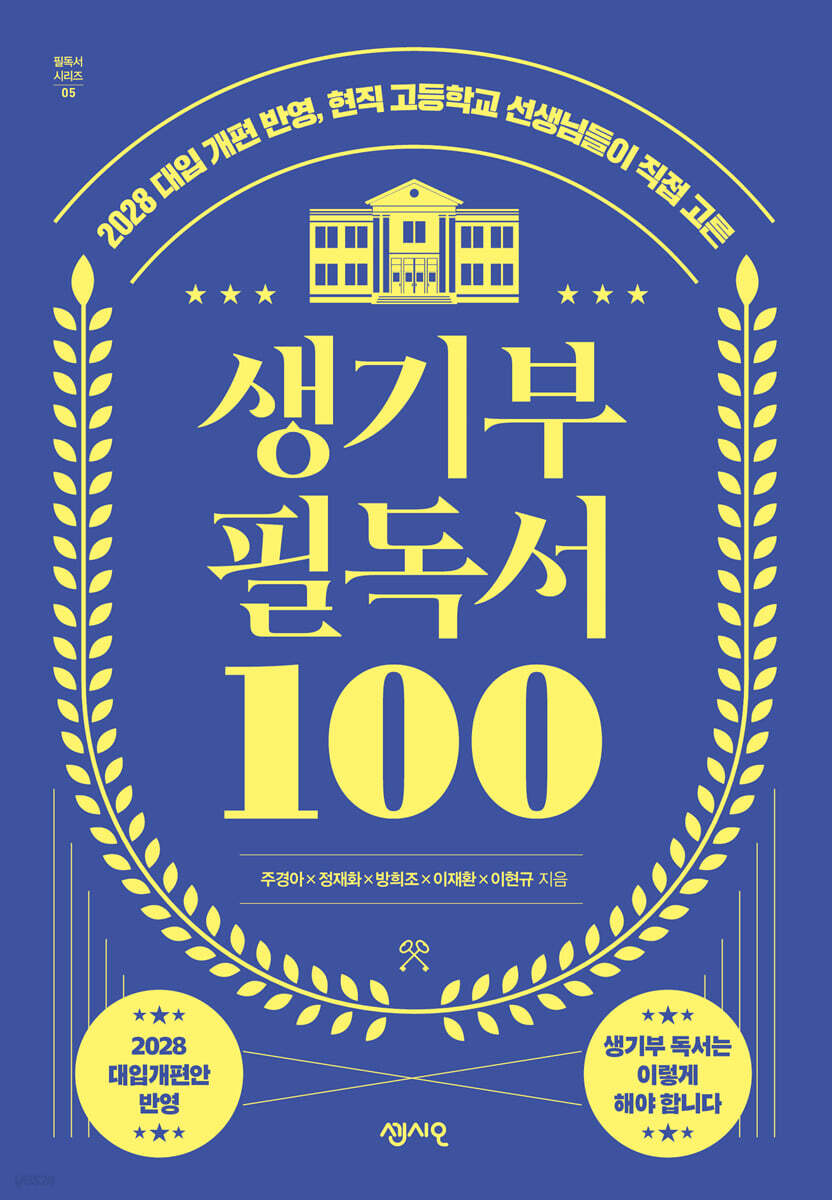
100 Must-Read Books for Life
 |
Description
Book Introduction
Reflecting the New 2028 College Entrance Exam Reform Plan
A perfect life-changing scenario filled with reading!
For this purpose, veteran and current teachers from each subject united.
Bestseller in the youth category for 100 consecutive weeks
The first must-read book that combines life and reading
The first book parents look for when preparing for tax special education
The book "100 Must-Read Books for Young Adults," which has been a bestseller in the youth category for two years since its publication, has been released in a revised edition that fully reflects the 2028 college entrance system reform plan.
There is a clear reason why this book has become a new trend among college entrance guide books.
This is because it presented in detail the most realistic and powerful method of 'reading' to countless test takers who were at a loss as to what and how to fill the special section of the life science department.
In particular, the prevailing opinion is that the direct advice given in real time by veteran teachers in the field was of great help to readers.
The authors of this book agree that the most effective way to demonstrate students' abilities and efforts in the life sciences department is through "expansion through reading."
This is because the type of resume that top universities and admissions officers want is one that demonstrates a process of self-directed inquiry, where students are curious in class, look up related books, and fill in the gaps.
The authors emphasize that reading is still the core keyword of the life science department, and that the key point of strategy is to incorporate it into more in-depth post-reading activities throughout the life science department.
The 100 Must-Read Books are carefully selected from among Seoul National University must-reads, bestsellers, books recommended by subject teachers, and books that students read frequently and responded well to in the classroom.
And each book presents specific follow-up, in-depth activities that will demonstrate creativity and competence after reading.
Additionally, examples of topic presentation activities, research projects, and career exploration activities in related departments that were conducted at schools were also introduced.
From students who struggle to decide which books to read right now to those who have read a significant amount but are struggling with ideas for in-depth post-reading activities, this book offers practical guidelines.
A perfect life-changing scenario filled with reading!
For this purpose, veteran and current teachers from each subject united.
Bestseller in the youth category for 100 consecutive weeks
The first must-read book that combines life and reading
The first book parents look for when preparing for tax special education
The book "100 Must-Read Books for Young Adults," which has been a bestseller in the youth category for two years since its publication, has been released in a revised edition that fully reflects the 2028 college entrance system reform plan.
There is a clear reason why this book has become a new trend among college entrance guide books.
This is because it presented in detail the most realistic and powerful method of 'reading' to countless test takers who were at a loss as to what and how to fill the special section of the life science department.
In particular, the prevailing opinion is that the direct advice given in real time by veteran teachers in the field was of great help to readers.
The authors of this book agree that the most effective way to demonstrate students' abilities and efforts in the life sciences department is through "expansion through reading."
This is because the type of resume that top universities and admissions officers want is one that demonstrates a process of self-directed inquiry, where students are curious in class, look up related books, and fill in the gaps.
The authors emphasize that reading is still the core keyword of the life science department, and that the key point of strategy is to incorporate it into more in-depth post-reading activities throughout the life science department.
The 100 Must-Read Books are carefully selected from among Seoul National University must-reads, bestsellers, books recommended by subject teachers, and books that students read frequently and responded well to in the classroom.
And each book presents specific follow-up, in-depth activities that will demonstrate creativity and competence after reading.
Additionally, examples of topic presentation activities, research projects, and career exploration activities in related departments that were conducted at schools were also introduced.
From students who struggle to decide which books to read right now to those who have read a significant amount but are struggling with ideas for in-depth post-reading activities, this book offers practical guidelines.
index
The Perfect Life-Saving Scenario Filled with Preface Reading
PART 1.
With the college entrance exam system drastically changing, reading determines the quality of your life.
Why You Shouldn't Forget Life and Reading, No Matter What Type of Entrepreneurship You Aim for
Streamlined Application Process: What Are Admissions Officers Focusing On?
PART 2.
There's a different kind of reading that universities really want.
A versatile tool that fills in all the gaps of your third year of high school.
Don't just read any book, choose the one that's essential for your life.
PART 3.
Reading books in the humanities and social sciences
BOOK 1: Living with Dignity How can we live humanely in a society that forces us to lose our dignity?
BOOK2: Will YouTube Eat Books? A Discussion on Literacy in Our Time
BOOK 3: The Tug-of-War of Language: Uncovering the Hidden Meanings Within Language
BOOK 4: The Joy of Immersion How beautiful is a life once immersed in something?
BOOK 5: Human Relations: How to Build Successful Relationships
BOOK6: "Books Are Axes": Our "axes" that shatter frozen sensibilities.
BOOK7 《The Laws of Human Nature》 If you want to get the key to deciphering the inner world of humans
BOOK 8: A History of Philosophy: From Socrates to Peter Singer, a look at the history of philosophy through the lens of 40 great philosophers.
BOOK9 "Kang Won-guk's Writing" Writing is living my own life.
BOOK 10 "I decided to become a person who thinks and speaks. A language sensitivity class that teaches 'correct speaking.'"
BOOK11 "If I had read books like this earlier" Productive reading that turns everything you read into learning
BOOK 12: The Joy of Reading Philosophical Poetry: When Our Poetry and Modern Philosophy Meet
BOOK 13: "Walking Through the Forest of Literature": Finding love and finding your path in life in the forest of literature.
BOOK 14: "Thirty-Three Encounters: Baek Seok and Dongju": An Exploration into the Connection Between Baek Seok and Yun Dong-ju
BOOK15: The Plague: A Classic that Encompasses the Era
BOOK 16 "The Square": The Anguish of a Man Standing Between a Closed Room and a Square
BOOK 17 "The Little Ball Shot by a Dwarf": A masterpiece of Korean literature that exposes the shadows of our society.
BOOK 18: "Farewell" A book that asks, "What is true humanity?"
BOOK19 "Sweaty Novel" A story filled with the sweat of young people living as "eul"
BOOK20 《The End of Average》 Education ruined by averageism.
How to discover your children's true talents?
BOOK21: "Between Teacher and Student" "Love Alone Isn't Enough." A book discussing the teaching skills teachers need.
BOOK22 《The Future of Study》 What if the study I'm doing now will be useless in 10 years?
BOOK23 Factfulness: A book that clearly explains why the world is better than you think.
BOOK24 "The Power of Tiny Habits" Changing just one habit can change your life.
BOOK25: Phono Sapiens: A New Human Race, Wielding Smartphones, Changes the World
BOOK26: The Benevolent Discriminationist: Awakening a Sensitive Sense to Discrimination
BOOK27: The Illusion of Fairness: A book that asks, "Are we all enjoying a fair opportunity?"
BOOK28 《World History Read Backwards》 The most turbulent 100 years of history, told by the best storytellers.
BOOK 29: The Story of Our Neighborhood's Independence Activists We've Passed By: 35 Years of Korean Independence History We Must Remember
BOOK 30: Chronicles of Poverty: A Serious Examination of "Why Do Poor Countries Remain Poor?"
BOOK31: "There Is No Ethical Consumption" What I Can Do for the Future of the Earth
BOOK32: Geography in Literature: A Collaboration of Korean and Geography: A Model of Curriculum Integration
BOOK33 The Great Animal Court What if endangered animals could pass judgment on humans?
BOOK34 《I never knew psychology could be this fun》 Why does Snow White keep opening the door to strangers?
BOOK35 《Klaus Schwab's Fourth Industrial Revolution THE NEXT》 The Fourth Industrial Revolution that humanity is facing.
What should we prepare and practice?
BOOK36: The Power of Geography: Studying the "land" where all things in life begin.
BOOK37 《Triumph of the City》 Why do people flock to cities? How do cities make people happy?
BOOK38: The Future of Space: A Story of "Relationships and Space" in the Post-COVID Era, Seen Through the Eyes of an Architect
BOOK39 Trend Korea 2023: Ten Keyword Forecasts for the New Year
BOOK 40: "Why Is the Law the Problem?" Understanding the Law, the Backbone of Our Society
BOOK41 《About the Boy I Met》 How should we view juvenile delinquency?
BOOK 42: The Constitution's Place: From Presidential Impeachment to Adultery, the Path Our Constitution Has Taken and Where It Should Go
BOOK 43: Thoughts, Concerning Thoughts: On the "thoughts" that govern human behavior.
BOOK44: Living Ideas from Dead Economists: Discover the wisdom of economists who have shaped the world.
BOOK45 《EBS Documentary Prime Capitalism》 The Dark Side of Capitalism We Never Knew
BOOK 46: What Makes Us Act? Exploring the living economics of business through original field experiments.
BOOK47: Art and Humanities: A Look at Ten Moments That Changed the Art Paradigm
A case study on how to improve your vitality through reading
PART 4.
Reading science books
BOOK48 《Teenagers Who Know a Little About the Anthropocene》 If we don't want to be the last generation on Earth,
BOOK49: Climate Change Databook for a Sustainable Future: An Objective Look at Climate Change Through Data
BOOK50: A Thousand Brains: New Insights into Brain Science and Artificial Intelligence
BOOK 51: The Gene of Cooperation: The Secret of Cooperation, the Driving Force Behind Human Evolution and Progress
BOOK52: "The World is All Chemistry": The Allure of Chemistry as Seen Through the Daily Routine of a Cheerful Chemist
BOOK 53: "Chemistry Stories for Worried Adults": A Guide to Safely Using Chemical Products
BOOK 54: Beaker and His Lab Friends: Learning Science Through Experimental Equipment, the Exciting Stars of the Lab
BOOK55 《Learning Life from Chemistry》 If you can live a life like 'chemistry' that is accurate and fair
BOOK 56: 11 Stories of Medicines Humanity Needs 12 Stories of Medicines that Saved Humanity The behind-the-scenes stories of essential medicines we can't live without
BOOK 57: A Guide to Future Medicine That Will Change the World: A World Transformed by the Convergence of Medicine and Engineering
BOOK 58: "The Moment When Imagination Becomes Reality" What science fiction writers invent today becomes reality tomorrow.
BOOK 59 《Strange Future Lab》 From space travel to brain science, a quirky and delightful imagination that looks into the future.
BOOK60: Jae-sik Kwak's Bacterial Expo: Looking into the vast and distant future through tiny bacteria.
BOOK61: The Scientist's Art Gallery: Art Through the Prism of Science
BOOK62: Falling in Love with Science, Not TV Shows: Interesting Science Facts Learned Through TV Shows
BOOK63: "Minerals, Opening the Door to Curiosity": A Mineral Collector's Guide to Beautiful Mineral Stories
BOOK64 《The Age of Space Hegemony, A Four-Dimensional Space Story》 Why are the world's major powers competing to focus on space development?
BOOK65 《Today's Astronomy》 A friendly introductory book for beginners who dream of astronomical observation.
BOOK66: "In Search of the End of the Universe": Become familiar with cosmology through the stories of scientists who have approached the secrets of the universe.
BOOK67 Physics Without Math: Understanding Physics Without Formulas
BOOK68 《Data Scientist's Work》 Where do data scientists work and what do they do?
BOOK69 《The Science of Everything That Moves Cities》 How does science move huge cities?
BOOK70 《SEASON Science Book Review Magazine》 A science book review magazine introducing good science books.
A case study on how to improve your vitality through reading
PART 5.
Reading math books
BOOK71: The Great Questions that Gave Birth to Mathematics: 20 Questions that Reveal the Colorful History of Mathematics
BOOK72 《Millennium Problems in Mathematics 7》 Seven math puzzles with a $1 million bounty
BOOK73 The Joy of Mathematics by Great Mathematicians From Pythagoras to Neumann, the lives and achievements of great mathematicians
BOOK74 "The Cheeky Math Book" Stimulates logical sensibility through stories and illustrations.
BOOK75 "Mathematics is Experimentation": Living Mathematics Learned Through Various Experiments
BOOK76: The Stranger Math Book: A Variety of Perspectives on Calculus
BOOK77: If Life Had Answers Like Math: Mathematical Modeling for Interpreting and Solving Real-World Problems
BOOK78 "Beautiful Stories of High School Mathematics" A treasure map-like book that provides concise proofs and fascinating formulas.
BOOK79 《Nighttime Engineering Student Comics》 A math comic that exquisitely combines knowledge and humor.
BOOK80 "Math Master is Everywhere" Meet "Math Master," who helps us from unseen places.
BOOK81: "The Usefulness of Mathematics": Ten Leading Korean Mathematicians
BOOK82: "Working Mathematics": The World of Mathematics Through 25 Occupations
BOOK83 《Encyclopedia of Mathematics》 Basic liberal arts mathematics that can be applied widely
BOOK84: "Calculus Made Easy": Connecting Calculus and Physics, Developing a Two-Tier Approach
BOOK85 《Seeing Mathematics in Korean History》 The charm of mathematics for liberal arts students, and humanities education for science students
BOOK86: The Mathematician at the Art Museum: Appreciating Mathematics Through Beautiful Paintings
BOOK87: "Programmers, Think Mathematical": The Mathematical Thinking Skills Required for Competent Programmers
BOOK88 "Again, the Moment We Need Math": A Liberal Arts Mathematics Seminar with a Mathematics Master
BOOK89 "A Day Seen Through Calculus": Calculus for Finding the Optimal Path in Everyday Life
BOOK90: Euler's Beloved Number e: Getting One Step Closer to the Great Number e
BOOK91 《The Joy of X》 I never knew knowing math could be this fun
BOOK92: The Usefulness of Mathematics: In the Age of Artificial Intelligence, We Still Need Mathematics
BOOK93 "Can You Solve This?" A Time of "Joyful Pain" with 125 Puzzles
BOOK94: Calculus Beyond the Math Book: A Book That Makes the Dreadful Calculus Easy
BOOK95 Fermat's Last Theorem: A Problem That Has Captivated Mathematicians Around the World for 350 Years
BOOK96 "Statistics for Beginners": Learn statistical concepts easily and enjoyably through comics.
BOOK97: Naked Statistics: Understanding the Two Faces of Probability and Statistics
BOOK98 "Statistics: A Bright Red Lie" A book that explains how statistics can deceive people.
BOOK99: How Mathematics Created Civilization: A History of Mathematics, a Great Human Achievement
BOOK100: Math That Makes You Love Math: Math Stories Told Through Pleasant Narratives
A case study on how to improve your vitality through reading
PART 1.
With the college entrance exam system drastically changing, reading determines the quality of your life.
Why You Shouldn't Forget Life and Reading, No Matter What Type of Entrepreneurship You Aim for
Streamlined Application Process: What Are Admissions Officers Focusing On?
PART 2.
There's a different kind of reading that universities really want.
A versatile tool that fills in all the gaps of your third year of high school.
Don't just read any book, choose the one that's essential for your life.
PART 3.
Reading books in the humanities and social sciences
BOOK 1: Living with Dignity How can we live humanely in a society that forces us to lose our dignity?
BOOK2: Will YouTube Eat Books? A Discussion on Literacy in Our Time
BOOK 3: The Tug-of-War of Language: Uncovering the Hidden Meanings Within Language
BOOK 4: The Joy of Immersion How beautiful is a life once immersed in something?
BOOK 5: Human Relations: How to Build Successful Relationships
BOOK6: "Books Are Axes": Our "axes" that shatter frozen sensibilities.
BOOK7 《The Laws of Human Nature》 If you want to get the key to deciphering the inner world of humans
BOOK 8: A History of Philosophy: From Socrates to Peter Singer, a look at the history of philosophy through the lens of 40 great philosophers.
BOOK9 "Kang Won-guk's Writing" Writing is living my own life.
BOOK 10 "I decided to become a person who thinks and speaks. A language sensitivity class that teaches 'correct speaking.'"
BOOK11 "If I had read books like this earlier" Productive reading that turns everything you read into learning
BOOK 12: The Joy of Reading Philosophical Poetry: When Our Poetry and Modern Philosophy Meet
BOOK 13: "Walking Through the Forest of Literature": Finding love and finding your path in life in the forest of literature.
BOOK 14: "Thirty-Three Encounters: Baek Seok and Dongju": An Exploration into the Connection Between Baek Seok and Yun Dong-ju
BOOK15: The Plague: A Classic that Encompasses the Era
BOOK 16 "The Square": The Anguish of a Man Standing Between a Closed Room and a Square
BOOK 17 "The Little Ball Shot by a Dwarf": A masterpiece of Korean literature that exposes the shadows of our society.
BOOK 18: "Farewell" A book that asks, "What is true humanity?"
BOOK19 "Sweaty Novel" A story filled with the sweat of young people living as "eul"
BOOK20 《The End of Average》 Education ruined by averageism.
How to discover your children's true talents?
BOOK21: "Between Teacher and Student" "Love Alone Isn't Enough." A book discussing the teaching skills teachers need.
BOOK22 《The Future of Study》 What if the study I'm doing now will be useless in 10 years?
BOOK23 Factfulness: A book that clearly explains why the world is better than you think.
BOOK24 "The Power of Tiny Habits" Changing just one habit can change your life.
BOOK25: Phono Sapiens: A New Human Race, Wielding Smartphones, Changes the World
BOOK26: The Benevolent Discriminationist: Awakening a Sensitive Sense to Discrimination
BOOK27: The Illusion of Fairness: A book that asks, "Are we all enjoying a fair opportunity?"
BOOK28 《World History Read Backwards》 The most turbulent 100 years of history, told by the best storytellers.
BOOK 29: The Story of Our Neighborhood's Independence Activists We've Passed By: 35 Years of Korean Independence History We Must Remember
BOOK 30: Chronicles of Poverty: A Serious Examination of "Why Do Poor Countries Remain Poor?"
BOOK31: "There Is No Ethical Consumption" What I Can Do for the Future of the Earth
BOOK32: Geography in Literature: A Collaboration of Korean and Geography: A Model of Curriculum Integration
BOOK33 The Great Animal Court What if endangered animals could pass judgment on humans?
BOOK34 《I never knew psychology could be this fun》 Why does Snow White keep opening the door to strangers?
BOOK35 《Klaus Schwab's Fourth Industrial Revolution THE NEXT》 The Fourth Industrial Revolution that humanity is facing.
What should we prepare and practice?
BOOK36: The Power of Geography: Studying the "land" where all things in life begin.
BOOK37 《Triumph of the City》 Why do people flock to cities? How do cities make people happy?
BOOK38: The Future of Space: A Story of "Relationships and Space" in the Post-COVID Era, Seen Through the Eyes of an Architect
BOOK39 Trend Korea 2023: Ten Keyword Forecasts for the New Year
BOOK 40: "Why Is the Law the Problem?" Understanding the Law, the Backbone of Our Society
BOOK41 《About the Boy I Met》 How should we view juvenile delinquency?
BOOK 42: The Constitution's Place: From Presidential Impeachment to Adultery, the Path Our Constitution Has Taken and Where It Should Go
BOOK 43: Thoughts, Concerning Thoughts: On the "thoughts" that govern human behavior.
BOOK44: Living Ideas from Dead Economists: Discover the wisdom of economists who have shaped the world.
BOOK45 《EBS Documentary Prime Capitalism》 The Dark Side of Capitalism We Never Knew
BOOK 46: What Makes Us Act? Exploring the living economics of business through original field experiments.
BOOK47: Art and Humanities: A Look at Ten Moments That Changed the Art Paradigm
A case study on how to improve your vitality through reading
PART 4.
Reading science books
BOOK48 《Teenagers Who Know a Little About the Anthropocene》 If we don't want to be the last generation on Earth,
BOOK49: Climate Change Databook for a Sustainable Future: An Objective Look at Climate Change Through Data
BOOK50: A Thousand Brains: New Insights into Brain Science and Artificial Intelligence
BOOK 51: The Gene of Cooperation: The Secret of Cooperation, the Driving Force Behind Human Evolution and Progress
BOOK52: "The World is All Chemistry": The Allure of Chemistry as Seen Through the Daily Routine of a Cheerful Chemist
BOOK 53: "Chemistry Stories for Worried Adults": A Guide to Safely Using Chemical Products
BOOK 54: Beaker and His Lab Friends: Learning Science Through Experimental Equipment, the Exciting Stars of the Lab
BOOK55 《Learning Life from Chemistry》 If you can live a life like 'chemistry' that is accurate and fair
BOOK 56: 11 Stories of Medicines Humanity Needs 12 Stories of Medicines that Saved Humanity The behind-the-scenes stories of essential medicines we can't live without
BOOK 57: A Guide to Future Medicine That Will Change the World: A World Transformed by the Convergence of Medicine and Engineering
BOOK 58: "The Moment When Imagination Becomes Reality" What science fiction writers invent today becomes reality tomorrow.
BOOK 59 《Strange Future Lab》 From space travel to brain science, a quirky and delightful imagination that looks into the future.
BOOK60: Jae-sik Kwak's Bacterial Expo: Looking into the vast and distant future through tiny bacteria.
BOOK61: The Scientist's Art Gallery: Art Through the Prism of Science
BOOK62: Falling in Love with Science, Not TV Shows: Interesting Science Facts Learned Through TV Shows
BOOK63: "Minerals, Opening the Door to Curiosity": A Mineral Collector's Guide to Beautiful Mineral Stories
BOOK64 《The Age of Space Hegemony, A Four-Dimensional Space Story》 Why are the world's major powers competing to focus on space development?
BOOK65 《Today's Astronomy》 A friendly introductory book for beginners who dream of astronomical observation.
BOOK66: "In Search of the End of the Universe": Become familiar with cosmology through the stories of scientists who have approached the secrets of the universe.
BOOK67 Physics Without Math: Understanding Physics Without Formulas
BOOK68 《Data Scientist's Work》 Where do data scientists work and what do they do?
BOOK69 《The Science of Everything That Moves Cities》 How does science move huge cities?
BOOK70 《SEASON Science Book Review Magazine》 A science book review magazine introducing good science books.
A case study on how to improve your vitality through reading
PART 5.
Reading math books
BOOK71: The Great Questions that Gave Birth to Mathematics: 20 Questions that Reveal the Colorful History of Mathematics
BOOK72 《Millennium Problems in Mathematics 7》 Seven math puzzles with a $1 million bounty
BOOK73 The Joy of Mathematics by Great Mathematicians From Pythagoras to Neumann, the lives and achievements of great mathematicians
BOOK74 "The Cheeky Math Book" Stimulates logical sensibility through stories and illustrations.
BOOK75 "Mathematics is Experimentation": Living Mathematics Learned Through Various Experiments
BOOK76: The Stranger Math Book: A Variety of Perspectives on Calculus
BOOK77: If Life Had Answers Like Math: Mathematical Modeling for Interpreting and Solving Real-World Problems
BOOK78 "Beautiful Stories of High School Mathematics" A treasure map-like book that provides concise proofs and fascinating formulas.
BOOK79 《Nighttime Engineering Student Comics》 A math comic that exquisitely combines knowledge and humor.
BOOK80 "Math Master is Everywhere" Meet "Math Master," who helps us from unseen places.
BOOK81: "The Usefulness of Mathematics": Ten Leading Korean Mathematicians
BOOK82: "Working Mathematics": The World of Mathematics Through 25 Occupations
BOOK83 《Encyclopedia of Mathematics》 Basic liberal arts mathematics that can be applied widely
BOOK84: "Calculus Made Easy": Connecting Calculus and Physics, Developing a Two-Tier Approach
BOOK85 《Seeing Mathematics in Korean History》 The charm of mathematics for liberal arts students, and humanities education for science students
BOOK86: The Mathematician at the Art Museum: Appreciating Mathematics Through Beautiful Paintings
BOOK87: "Programmers, Think Mathematical": The Mathematical Thinking Skills Required for Competent Programmers
BOOK88 "Again, the Moment We Need Math": A Liberal Arts Mathematics Seminar with a Mathematics Master
BOOK89 "A Day Seen Through Calculus": Calculus for Finding the Optimal Path in Everyday Life
BOOK90: Euler's Beloved Number e: Getting One Step Closer to the Great Number e
BOOK91 《The Joy of X》 I never knew knowing math could be this fun
BOOK92: The Usefulness of Mathematics: In the Age of Artificial Intelligence, We Still Need Mathematics
BOOK93 "Can You Solve This?" A Time of "Joyful Pain" with 125 Puzzles
BOOK94: Calculus Beyond the Math Book: A Book That Makes the Dreadful Calculus Easy
BOOK95 Fermat's Last Theorem: A Problem That Has Captivated Mathematicians Around the World for 350 Years
BOOK96 "Statistics for Beginners": Learn statistical concepts easily and enjoyably through comics.
BOOK97: Naked Statistics: Understanding the Two Faces of Probability and Statistics
BOOK98 "Statistics: A Bright Red Lie" A book that explains how statistics can deceive people.
BOOK99: How Mathematics Created Civilization: A History of Mathematics, a Great Human Achievement
BOOK100: Math That Makes You Love Math: Math Stories Told Through Pleasant Narratives
A case study on how to improve your vitality through reading
Detailed image

Into the book
Ultimately, what is reflected in college admissions are only 500 characters for each tax subject, 500 characters for general tax subjects, 500 characters for behavioral characteristics and overall opinions, 500 characters for autonomous activities, 500 characters for (regular) club activities, and 700 characters for career activities.
Since teacher recommendations and self-introductions have been abolished, the student record itself now functions as a teacher recommendation and self-introduction.
The life science department will play an increasingly crucial role in helping students discover their career paths and individuality.
In other words, the importance of items reflected in college admissions in the life history department can be seen to have relatively increased.
---p.43
In the special taxation section, teachers observe students' various aspects and write about them in a way that reveals 'motivation-process-result-deepening'. Since activities that individually reveal students' individuality are very important, it is no exaggeration to say that how to create these is the core axis of the life section.
To record tax-related special features, teachers conduct various educational activities such as project classes or report presentations. At these times, they help students naturally reveal their career paths, personalities, and areas of interest in their life records by using books of their own choosing.
In addition, in the area of performance evaluation, we plan various activities using books, such as ‘reading performance evaluation’ and ‘subject exploration performance evaluation’, and reflect these in the internal grades as well as record them in the tax special report card.
---p.62
Despite the importance of books in the life sciences, I have seen many students fail to fill their tax-related books with sufficient content because they are unable to choose the right books.
With the news that the student's "reading activity" will no longer be reflected in college admissions starting in the 2024 school year, you might be thinking, "Doesn't that mean I don't need to read books anymore?"
But in conclusion, I would say that reading has become even more important.
'Reading experience' is reflected in all other areas of the life record book, and more elaborate efforts are required because it must be related to follow-up activities after reading rather than simply including the book title.
---p.63
[An example of a life-saving book that you can take care of through reading]
- Reference book: Chemistry Stories for Worried Adults
1.
Through questions that explore common sense about chemical products, we identify the level of prejudice and common sense about chemical products in the class.
2.
Engage students actively through a game where they have to find objects that start with a consonant within a limited time.
Afterwards, we will select chemical products and spend time learning about ‘chemical products in the classroom’.
Have.
3. After explaining the MSDS and hazardous chemical labeling guidelines, we will conduct an exploratory activity to learn about the uses, hazards, and emergency measures of chemicals in chemical products by searching for MSDS.
4.
If time permits, have each group give a presentation introducing the chemical substances in chemical products.
Presentation activity on the topic "How to use chemical products correctly" ┃Example of tax exemption
Read 'Chemistry Stories for Worried Adults (Jeong-in Yoon)' to learn about the convenience that chemical products provide us, and explain the characteristics of chemicals and how to use them safely.
Based on our perceptions of chemical products, we conducted a chemical product knowledge test with several questions to identify prejudices against chemical products and generate interest in the presentation material.
It was striking that chemical products have both toxicity and effectiveness, and it was emphasized that it is important to be familiar with the safe use of chemical products based on an accurate understanding of chemical substances.
(…) This book will be used to directly apply the information gained from this book to experimental activities, leading students to search for MSDSs for the chemical samples they will use in their experiments. It will explain MSDSs, how to search them, and how to label hazardous chemicals.
Through this activity, other friends can learn firsthand about chemicals, potential accidents, emergency response in case of a hazardous situation, and storage and disposal methods, thereby contributing to creating a safe laboratory.
---p.307-308
- Book to Use: The Power of Tiny Habits
Planning events at the school and class level to put what you read into practice┃Examples of special features for creative and autonomous activities
After reading 'The Power of Small Habits (James Clear)', I realized the importance of habits and started thinking about how to put them into practice.
Afterwards, I planned and implemented a ‘habit-building project’ with my classmates.
After recruiting friends to build habits together, create a group chatroom and announce what you will practice, and have them take a picture of themselves doing it every day to prove it.
Demonstrated leadership in encouraging friends and successfully leading projects, and through this activity, made a difference in the lives of classmates.
It is evaluated that it brought about positive changes overall.
Since teacher recommendations and self-introductions have been abolished, the student record itself now functions as a teacher recommendation and self-introduction.
The life science department will play an increasingly crucial role in helping students discover their career paths and individuality.
In other words, the importance of items reflected in college admissions in the life history department can be seen to have relatively increased.
---p.43
In the special taxation section, teachers observe students' various aspects and write about them in a way that reveals 'motivation-process-result-deepening'. Since activities that individually reveal students' individuality are very important, it is no exaggeration to say that how to create these is the core axis of the life section.
To record tax-related special features, teachers conduct various educational activities such as project classes or report presentations. At these times, they help students naturally reveal their career paths, personalities, and areas of interest in their life records by using books of their own choosing.
In addition, in the area of performance evaluation, we plan various activities using books, such as ‘reading performance evaluation’ and ‘subject exploration performance evaluation’, and reflect these in the internal grades as well as record them in the tax special report card.
---p.62
Despite the importance of books in the life sciences, I have seen many students fail to fill their tax-related books with sufficient content because they are unable to choose the right books.
With the news that the student's "reading activity" will no longer be reflected in college admissions starting in the 2024 school year, you might be thinking, "Doesn't that mean I don't need to read books anymore?"
But in conclusion, I would say that reading has become even more important.
'Reading experience' is reflected in all other areas of the life record book, and more elaborate efforts are required because it must be related to follow-up activities after reading rather than simply including the book title.
---p.63
[An example of a life-saving book that you can take care of through reading]
- Reference book: Chemistry Stories for Worried Adults
1.
Through questions that explore common sense about chemical products, we identify the level of prejudice and common sense about chemical products in the class.
2.
Engage students actively through a game where they have to find objects that start with a consonant within a limited time.
Afterwards, we will select chemical products and spend time learning about ‘chemical products in the classroom’.
Have.
3. After explaining the MSDS and hazardous chemical labeling guidelines, we will conduct an exploratory activity to learn about the uses, hazards, and emergency measures of chemicals in chemical products by searching for MSDS.
4.
If time permits, have each group give a presentation introducing the chemical substances in chemical products.
Presentation activity on the topic "How to use chemical products correctly" ┃Example of tax exemption
Read 'Chemistry Stories for Worried Adults (Jeong-in Yoon)' to learn about the convenience that chemical products provide us, and explain the characteristics of chemicals and how to use them safely.
Based on our perceptions of chemical products, we conducted a chemical product knowledge test with several questions to identify prejudices against chemical products and generate interest in the presentation material.
It was striking that chemical products have both toxicity and effectiveness, and it was emphasized that it is important to be familiar with the safe use of chemical products based on an accurate understanding of chemical substances.
(…) This book will be used to directly apply the information gained from this book to experimental activities, leading students to search for MSDSs for the chemical samples they will use in their experiments. It will explain MSDSs, how to search them, and how to label hazardous chemicals.
Through this activity, other friends can learn firsthand about chemicals, potential accidents, emergency response in case of a hazardous situation, and storage and disposal methods, thereby contributing to creating a safe laboratory.
---p.307-308
- Book to Use: The Power of Tiny Habits
Planning events at the school and class level to put what you read into practice┃Examples of special features for creative and autonomous activities
After reading 'The Power of Small Habits (James Clear)', I realized the importance of habits and started thinking about how to put them into practice.
Afterwards, I planned and implemented a ‘habit-building project’ with my classmates.
After recruiting friends to build habits together, create a group chatroom and announce what you will practice, and have them take a picture of themselves doing it every day to prove it.
Demonstrated leadership in encouraging friends and successfully leading projects, and through this activity, made a difference in the lives of classmates.
It is evaluated that it brought about positive changes overall.
---p.227
Publisher's Review
With the college entrance exam system drastically changing, reading determines the quality of your life.
According to the newly announced 2028 college entrance reform plan, the influence of both school grades and the CSAT, which are the core factors in college entrance, has been reduced.
In particular, the internal grades were simplified into a 5-grade system, which greatly reduced the discriminatory power of the internal grades.
So where should students replenish their influence? And what areas should be strengthened within the framework of public education to preserve the high school credit system's purpose? The answer lies in the Department of Life Sciences.
Now that the academic transcript itself has naturally come to serve as a teacher recommendation letter and a self-introduction, the core of the academic transcript, the 'taxation special', has emerged as the most important area of admission.
Each subject teacher writes a 500-character report on each student based on their observations during class and performance assessments. If this record is kept perfectly for three years, it will inevitably have an enormous amount and influence.
So, what can students demonstrate through their special talents? How can they make themselves more appealing to admissions officers? What aspects of special talents do universities focus on? Ultimately, these are the keys to determining "good special talents" and "good personality"—in other words, the success or failure of admissions.
The authors of this book, who have guided countless students to successful college entrance exams in schools, emphasize that there is no more attractive element in life sciences than "the expression of creativity through self-directed learning."
In fact, a 2020 joint study found that admissions officers cited "skills in inquiry-based activities linked to coursework" as the most useful factor in differentiating applicants during their special assessments.
In other words, admissions officers value most highly students who explore and practice specific inquiry activities related to their classes.
So, how can students demonstrate the process of formulating questions and exploring them based on their own interests and passions? This book suggests that the most effective method and resource is reading.
If you can actively seek out and read books on related subjects to further develop what you've learned in the curriculum and demonstrate your development based on that knowledge, you'll be able to demonstrate both proactive learning skills and creative efforts regarding your career path.
Reading that is easily accessible to any student and can be linked to a variety of activities.
This book provides consulting to help students build their own perfect life story over three years through 'Expansion through Reading.'
100 Must-Read Books to Share Your Stories and Ideas
The 100 must-read books for humanities, social sciences, science, and mathematics included in this book were carefully selected based on Seoul National University must-reads, bestsellers, books that students read frequently and received good responses from in-class students, and books recommended by subject teachers.
Instead of excluding books that are widely known as recommended reading for teenagers or required reading for college entrance exams, we carefully selected books that provide students with food for thought and that can be easily linked to in-depth activities that demonstrate creativity and ability.
Above all, we guided students not only to read the books given to them, but also to acquire the direction and principles for appropriately utilizing the books according to their own circumstances.
After each subject's author briefly introduces the core content and message of the 100 must-read books, they explain how the books can be expanded into follow-up activities, suggesting ways to utilize them in a variety of activities, including special education, autonomous activities, club activities, and career exploration.
In addition, we introduced examples of actual presentation activities, research projects, and career exploration activities in related departments that were carried out in the classroom, so that students could gain practical ideas and motivation.
When it comes to performance evaluations, simply creating a patchwork report based on internet searches will never lead to a good evaluation.
With advice from practicing teacher-authors, students will gain a thorough understanding of how to select books that align with their abilities and interests, draw inspiration from them to create their own stories and ideas, and connect with them beyond the classroom to explore further knowledge on their own.
There's a different kind of reading that universities really want.
This book guides students to avoid wasting valuable time by setting the wrong direction for their reading.
A common misconception among students is that they will receive a good evaluation only if they read books related to their career path and record them in their academic records.
However, rather than trying too hard to show off your specialized skills, it is much more effective to demonstrate your ability to think in an integrated manner across various fields.
The same goes for follow-up activities such as topic exploration presentations or research projects.
It is not important to conduct difficult experiments or activities beyond the curriculum and produce plausible results just for the sake of recording them in a life history book.
It is important to reveal the motivation for doing the activity, the process of exploration, and what was learned during the process.
This book carefully guides students to fully demonstrate their unique charm and capabilities through solid reading and follow-up activities.
Even as I write this book, I hope that through the reading consulting of veteran teachers who are engrossed in writing their life reports, the three years of hard work of all students who read the book can be strung together into a single, solid thread.
According to the newly announced 2028 college entrance reform plan, the influence of both school grades and the CSAT, which are the core factors in college entrance, has been reduced.
In particular, the internal grades were simplified into a 5-grade system, which greatly reduced the discriminatory power of the internal grades.
So where should students replenish their influence? And what areas should be strengthened within the framework of public education to preserve the high school credit system's purpose? The answer lies in the Department of Life Sciences.
Now that the academic transcript itself has naturally come to serve as a teacher recommendation letter and a self-introduction, the core of the academic transcript, the 'taxation special', has emerged as the most important area of admission.
Each subject teacher writes a 500-character report on each student based on their observations during class and performance assessments. If this record is kept perfectly for three years, it will inevitably have an enormous amount and influence.
So, what can students demonstrate through their special talents? How can they make themselves more appealing to admissions officers? What aspects of special talents do universities focus on? Ultimately, these are the keys to determining "good special talents" and "good personality"—in other words, the success or failure of admissions.
The authors of this book, who have guided countless students to successful college entrance exams in schools, emphasize that there is no more attractive element in life sciences than "the expression of creativity through self-directed learning."
In fact, a 2020 joint study found that admissions officers cited "skills in inquiry-based activities linked to coursework" as the most useful factor in differentiating applicants during their special assessments.
In other words, admissions officers value most highly students who explore and practice specific inquiry activities related to their classes.
So, how can students demonstrate the process of formulating questions and exploring them based on their own interests and passions? This book suggests that the most effective method and resource is reading.
If you can actively seek out and read books on related subjects to further develop what you've learned in the curriculum and demonstrate your development based on that knowledge, you'll be able to demonstrate both proactive learning skills and creative efforts regarding your career path.
Reading that is easily accessible to any student and can be linked to a variety of activities.
This book provides consulting to help students build their own perfect life story over three years through 'Expansion through Reading.'
100 Must-Read Books to Share Your Stories and Ideas
The 100 must-read books for humanities, social sciences, science, and mathematics included in this book were carefully selected based on Seoul National University must-reads, bestsellers, books that students read frequently and received good responses from in-class students, and books recommended by subject teachers.
Instead of excluding books that are widely known as recommended reading for teenagers or required reading for college entrance exams, we carefully selected books that provide students with food for thought and that can be easily linked to in-depth activities that demonstrate creativity and ability.
Above all, we guided students not only to read the books given to them, but also to acquire the direction and principles for appropriately utilizing the books according to their own circumstances.
After each subject's author briefly introduces the core content and message of the 100 must-read books, they explain how the books can be expanded into follow-up activities, suggesting ways to utilize them in a variety of activities, including special education, autonomous activities, club activities, and career exploration.
In addition, we introduced examples of actual presentation activities, research projects, and career exploration activities in related departments that were carried out in the classroom, so that students could gain practical ideas and motivation.
When it comes to performance evaluations, simply creating a patchwork report based on internet searches will never lead to a good evaluation.
With advice from practicing teacher-authors, students will gain a thorough understanding of how to select books that align with their abilities and interests, draw inspiration from them to create their own stories and ideas, and connect with them beyond the classroom to explore further knowledge on their own.
There's a different kind of reading that universities really want.
This book guides students to avoid wasting valuable time by setting the wrong direction for their reading.
A common misconception among students is that they will receive a good evaluation only if they read books related to their career path and record them in their academic records.
However, rather than trying too hard to show off your specialized skills, it is much more effective to demonstrate your ability to think in an integrated manner across various fields.
The same goes for follow-up activities such as topic exploration presentations or research projects.
It is not important to conduct difficult experiments or activities beyond the curriculum and produce plausible results just for the sake of recording them in a life history book.
It is important to reveal the motivation for doing the activity, the process of exploration, and what was learned during the process.
This book carefully guides students to fully demonstrate their unique charm and capabilities through solid reading and follow-up activities.
Even as I write this book, I hope that through the reading consulting of veteran teachers who are engrossed in writing their life reports, the three years of hard work of all students who read the book can be strung together into a single, solid thread.
GOODS SPECIFICS
- Date of issue: May 12, 2025
- Page count, weight, size: 400 pages | 140*200*30mm
- ISBN13: 9791166571985
- ISBN10: 116657198X
You may also like
카테고리
korean


korean

![GQ KOREA Mark (Monthly): December [2025]](http://librairie.coreenne.fr/cdn/shop/files/8ef265dbbfbf186523ed75ba7319009d.jpg?v=1765340328&width=3840)


