

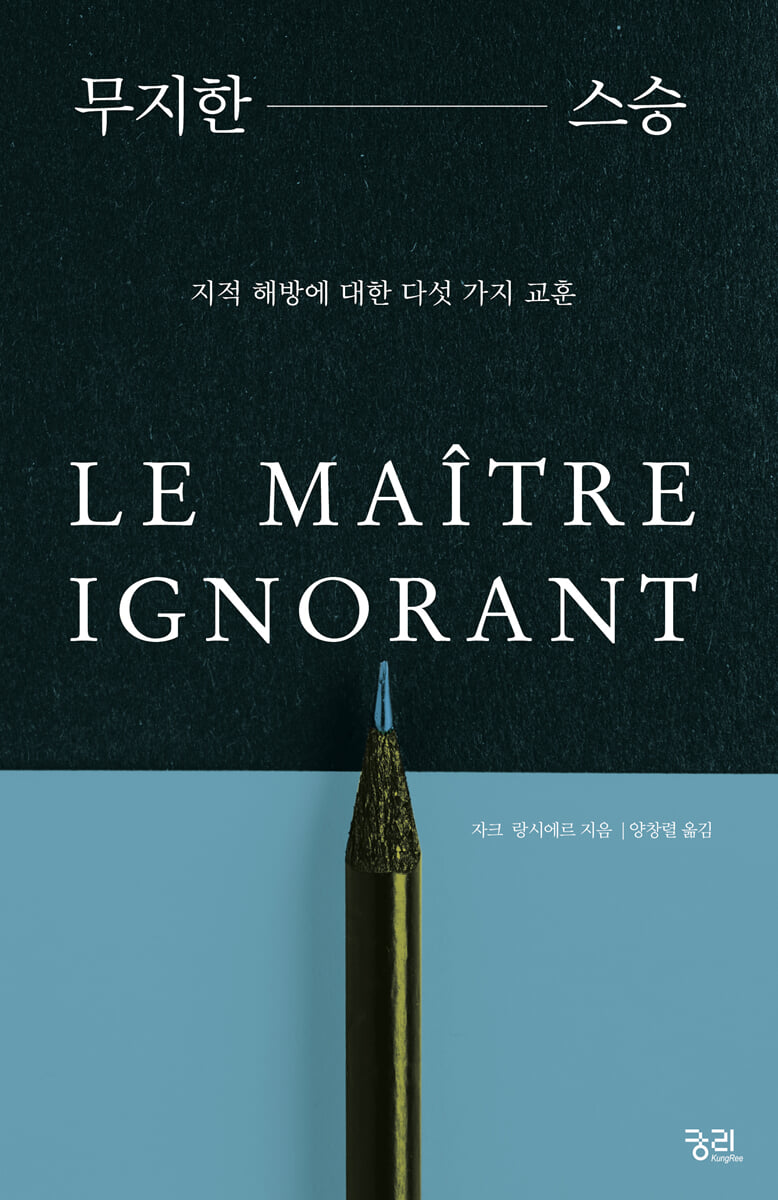
ignorant teacher
 |
Description
Book Introduction
“Anyone who wants to believe in the equality of intellectual capacity of all human beings
“You must read this book by Jacques Rancière.”
- Jin Eun-young (poet)
“George Orwell once said that imagination is like a wild animal; if you keep it in captivity, it won’t reproduce.
This is true not only of imagination but also of human intellectual abilities, called reason or intelligence.
This book follows the educational adventures of 19th-century educational philosopher Joseph Jacotot, demonstrating that human intellectual capacity cannot be fully realized as long as it is confined to a hierarchy of intelligence that divides the superior from the inferior.
Those who cannot learn anything without the guidance and explanation of a teacher, an authority, or a superior, lack the courage to use their own intelligence in the midst of self-doubt.
Such a person is mired in a swamp of self-deprecation, believing himself to be inferior.
Racine is said to have read Euripides and Virgil over and over again in search of great expressions, and I return to this book whenever I feel the desire to be a good artist, a kind teacher, or a free man.
'I am more authoritative, I am more expert, I am the one who leads.
"So keep your mouth shut and do as I say.' This book reveals how close the rhetoric of neutralizing the will of others is to war and oppression! Anyone tired of inequality and hierarchy, anyone suffering from self-doubt and misanthropy, anyone dreaming of a world where students, juniors, and subordinates aren't told what a novice like you can do alone, anyone who wants to believe in the equality of intellectual capacity of all humans must read this book by Jacques Rancière." - Jin Eun-young (poet)
“You must read this book by Jacques Rancière.”
- Jin Eun-young (poet)
“George Orwell once said that imagination is like a wild animal; if you keep it in captivity, it won’t reproduce.
This is true not only of imagination but also of human intellectual abilities, called reason or intelligence.
This book follows the educational adventures of 19th-century educational philosopher Joseph Jacotot, demonstrating that human intellectual capacity cannot be fully realized as long as it is confined to a hierarchy of intelligence that divides the superior from the inferior.
Those who cannot learn anything without the guidance and explanation of a teacher, an authority, or a superior, lack the courage to use their own intelligence in the midst of self-doubt.
Such a person is mired in a swamp of self-deprecation, believing himself to be inferior.
Racine is said to have read Euripides and Virgil over and over again in search of great expressions, and I return to this book whenever I feel the desire to be a good artist, a kind teacher, or a free man.
'I am more authoritative, I am more expert, I am the one who leads.
"So keep your mouth shut and do as I say.' This book reveals how close the rhetoric of neutralizing the will of others is to war and oppression! Anyone tired of inequality and hierarchy, anyone suffering from self-doubt and misanthropy, anyone dreaming of a world where students, juniors, and subordinates aren't told what a novice like you can do alone, anyone who wants to believe in the equality of intellectual capacity of all humans must read this book by Jacques Rancière." - Jin Eun-young (poet)
- You can preview some of the book's contents.
Preview
index
Note
Chapter 1: An Intellectual Adventure
Order of the explainer
Chance and will
The liberating teacher
Link of Competence
Chapter 2: Lessons from the Ignorant
Island of Books
Calypso and the Locksmith
The Teacher and Socrates
The power of ignorance
Each person's job
The Blind Man and His Dog
The whole is within the whole
Chapter 3: Reason/Reason of Equals
Brain and Leaves
careful animals
The will to be served by intelligence
The principle of truthfulness
Reason and language
Yeah, I'm angry too!
Lessons from the poets
community of equals
Chapter 4: A Society of Ignorance
Law of Gravity
Passion for inequality
Investigative madness
Superior inferiors
The Iron King and the People's Sovereign
How can I talk nonsense rationally?
Words spoken on the Aventine
Chapter 5: The Liberator and His Monkey
How to liberate and social methods
Human liberation and people's leadership
progressive people
Sheep and humans
The Progressives' Link
Above the heads of the people
Old-fashioned victory
A society treated like a child
Pankastic's skits
Tomb of Liberation
On the publication of the revised edition
Translator's Note
Search
Chapter 1: An Intellectual Adventure
Order of the explainer
Chance and will
The liberating teacher
Link of Competence
Chapter 2: Lessons from the Ignorant
Island of Books
Calypso and the Locksmith
The Teacher and Socrates
The power of ignorance
Each person's job
The Blind Man and His Dog
The whole is within the whole
Chapter 3: Reason/Reason of Equals
Brain and Leaves
careful animals
The will to be served by intelligence
The principle of truthfulness
Reason and language
Yeah, I'm angry too!
Lessons from the poets
community of equals
Chapter 4: A Society of Ignorance
Law of Gravity
Passion for inequality
Investigative madness
Superior inferiors
The Iron King and the People's Sovereign
How can I talk nonsense rationally?
Words spoken on the Aventine
Chapter 5: The Liberator and His Monkey
How to liberate and social methods
Human liberation and people's leadership
progressive people
Sheep and humans
The Progressives' Link
Above the heads of the people
Old-fashioned victory
A society treated like a child
Pankastic's skits
Tomb of Liberation
On the publication of the revised edition
Translator's Note
Search
Into the book
This was the revolution that a chance experiment brought about in Jacotot's mind.
Until then, he believed as all sincere teachers do:
The main task of a teacher is to impart his knowledge to his students and gradually raise them toward his own level of learning.
Jacotot, like other teachers, knew that the point was not to cram knowledge into students and have them repeat it like parrots.
I also found it important to help students avoid the path of chance.
Minds that cannot yet distinguish between the important and the secondary, the principle and the conclusion, are lost in the path of chance.
In short, the essential act of the teacher was to explain, to draw out simple elements from knowledge, and to reconcile the simple principles of knowledge with the simple facts which characterize the young and ignorant mind.
To teach was to impart knowledge, and at the same time to shape the mind by leading it from the simplest to the most complex in a well-organized, progressive sequence; and the two were truly one and the same movement.
By formalizing knowledge in this way and forming judgments and tastes, the student grows to the height required of him by social use.
And the student prepares to use it [knowledge, judgment, taste] for its intended purpose.
--- p.12~13
The revelation that captivated Joseph Jacotot resulted in the following:
The logic of the system that the explainer has to be overturned.
An explanation is not always necessary to correct an inability to understand.
On the contrary, this incompetence is a fiction created by the explainer's worldview.
It is the explainer who needs the incompetent, not the other way around.
That is, the explainer constitutes the incompetent as incompetent.
To explain something to someone is first to prove to them that they cannot understand it on their own.
Explanation is a myth created by pedagogy before it is an act of educator.
It is an allegory of a world divided into the educated and the ignorant, the mature and the immature, the competent and the incompetent, the intelligent and the foolish.
--- p.19
These are in fact the two fundamental actions of a master.
The teacher asks a question.
He commands the horse.
In other words, it commands the manifestation of intelligence, whether one is ignorant of oneself or has given up on oneself.
He verifies that what this intelligence does is done carefully, and that it is not just something that is picked up and swallowed haphazardly to avoid coercion.
Should we say that we need a more skilled and knowledgeable teacher? On the contrary, a knowledgeable teacher is likely to ruin the method due to his own erudition.
A knowledgeable teacher knows the answers, and his questions naturally lead the student to them.
This is the secret of the great masters.
Through questions, they carefully guide the student's intelligence.
Carefully enough to allow the student's intelligence to function, but not so carefully that it is left alone.
There is a sleeping Socrates within each of the explainers.
--- p.64
Of course, it is far from creating a masterpiece.
Even visitors who highly value the literary compositions written by Jacotot's students often express discomfort when confronted with the students' drawings and paintings.
But what's important is not creating great painters, but creating liberated people, people who can say, "Yes, I'm a painter too."
There is no arrogance in that formula.
On the contrary, there is a legitimate sense of power that all rational beings possess.
There is no arrogance in saying out loud, “Yes, I am angry too!”
Arrogance lies in quietly telling others that neither you nor I are painters.” Yes, I am a painter, I have a soul, I feel like I can communicate with others like myself.
--- p.131
So, the task for Joseph Jacotot's disciples is simple.
We must inform everyone, everywhere, of something new or beneficial—we can teach what we don't know.
Then the poor and ignorant father will be able to guide his children.
This map should give you the principles.
I have to learn something.
And it must be related to everything else according to the principle that all intelligences are equal.
We must participate in making the principle known and proving it.
Talk to the poor, make him tell who he is and what he knows.
To show how he can guide his children.
Transcribe the prayers your child memorizes.
Give your child The Adventures of Telemachus and have him memorize the first chapter of the book.
To respond to the requests of those who wish to learn from the Master of the Universal Teachings what the Master does not know.
Finally, to use every means to convince the ignorant that he too has power.
One of my students from Grenoble was having trouble persuading a poor, elderly woman to learn to read and write.
He paid money to get the woman's consent.
In five months she learned to read and write.
And now she frees her grandchildren.
Until then, he believed as all sincere teachers do:
The main task of a teacher is to impart his knowledge to his students and gradually raise them toward his own level of learning.
Jacotot, like other teachers, knew that the point was not to cram knowledge into students and have them repeat it like parrots.
I also found it important to help students avoid the path of chance.
Minds that cannot yet distinguish between the important and the secondary, the principle and the conclusion, are lost in the path of chance.
In short, the essential act of the teacher was to explain, to draw out simple elements from knowledge, and to reconcile the simple principles of knowledge with the simple facts which characterize the young and ignorant mind.
To teach was to impart knowledge, and at the same time to shape the mind by leading it from the simplest to the most complex in a well-organized, progressive sequence; and the two were truly one and the same movement.
By formalizing knowledge in this way and forming judgments and tastes, the student grows to the height required of him by social use.
And the student prepares to use it [knowledge, judgment, taste] for its intended purpose.
--- p.12~13
The revelation that captivated Joseph Jacotot resulted in the following:
The logic of the system that the explainer has to be overturned.
An explanation is not always necessary to correct an inability to understand.
On the contrary, this incompetence is a fiction created by the explainer's worldview.
It is the explainer who needs the incompetent, not the other way around.
That is, the explainer constitutes the incompetent as incompetent.
To explain something to someone is first to prove to them that they cannot understand it on their own.
Explanation is a myth created by pedagogy before it is an act of educator.
It is an allegory of a world divided into the educated and the ignorant, the mature and the immature, the competent and the incompetent, the intelligent and the foolish.
--- p.19
These are in fact the two fundamental actions of a master.
The teacher asks a question.
He commands the horse.
In other words, it commands the manifestation of intelligence, whether one is ignorant of oneself or has given up on oneself.
He verifies that what this intelligence does is done carefully, and that it is not just something that is picked up and swallowed haphazardly to avoid coercion.
Should we say that we need a more skilled and knowledgeable teacher? On the contrary, a knowledgeable teacher is likely to ruin the method due to his own erudition.
A knowledgeable teacher knows the answers, and his questions naturally lead the student to them.
This is the secret of the great masters.
Through questions, they carefully guide the student's intelligence.
Carefully enough to allow the student's intelligence to function, but not so carefully that it is left alone.
There is a sleeping Socrates within each of the explainers.
--- p.64
Of course, it is far from creating a masterpiece.
Even visitors who highly value the literary compositions written by Jacotot's students often express discomfort when confronted with the students' drawings and paintings.
But what's important is not creating great painters, but creating liberated people, people who can say, "Yes, I'm a painter too."
There is no arrogance in that formula.
On the contrary, there is a legitimate sense of power that all rational beings possess.
There is no arrogance in saying out loud, “Yes, I am angry too!”
Arrogance lies in quietly telling others that neither you nor I are painters.” Yes, I am a painter, I have a soul, I feel like I can communicate with others like myself.
--- p.131
So, the task for Joseph Jacotot's disciples is simple.
We must inform everyone, everywhere, of something new or beneficial—we can teach what we don't know.
Then the poor and ignorant father will be able to guide his children.
This map should give you the principles.
I have to learn something.
And it must be related to everything else according to the principle that all intelligences are equal.
We must participate in making the principle known and proving it.
Talk to the poor, make him tell who he is and what he knows.
To show how he can guide his children.
Transcribe the prayers your child memorizes.
Give your child The Adventures of Telemachus and have him memorize the first chapter of the book.
To respond to the requests of those who wish to learn from the Master of the Universal Teachings what the Master does not know.
Finally, to use every means to convince the ignorant that he too has power.
One of my students from Grenoble was having trouble persuading a poor, elderly woman to learn to read and write.
He paid money to get the woman's consent.
In five months she learned to read and write.
And now she frees her grandchildren.
--- p.189~190
Publisher's Review
The myth of education divides intelligence into inferior and superior intelligence.
The fundamental ‘inequality’ that educational logic presupposes
The 'agreement' of those who are ignorant about it is
It becomes an obstacle to exercising intellectual abilities.
The problem of education is a philosophical and political problem of equality of intellectual ability.
Rancière's intellectual adventure of moving thought!
Jacques Rancière's "The Ignorant Teacher," published in 2008 and consistently loved by many readers for reminding them of the true meaning of education, returns to readers with a new cover after 17 years.
The book begins with Joseph Jacotot, who was forced to go into exile in the Netherlands after the restoration of the Bourbon dynasty following the French Revolution, becoming a foreign lecturer in French literature at the University of Louvain in 1818 and teaching students.
The students didn't know French, and Jacotot didn't know Dutch.
He introduced the recently published French-Dutch edition of Fénelon's The Adventures of Telemachus and urged people to use this book to learn the French text.
He didn't explain to his students even the most basic French, not even spelling or verb conjugation.
Students independently figured out the French equivalents of the words they knew and how those words changed their endings.
This experiment, which started by chance, exceeded expectations.
Jacotot asked his students to write in French what they thought about what they had read.
Surprisingly, the students' French proficiency was almost at the writer's level.
Through this experiment, Jacotot made the following facts clear:
If we liberate the student, that is, if we allow him to use his unique intelligence, we can teach him what we do not know.
A teacher is someone who confines intelligence within arbitrary chains.
To liberate the ignorant, one must liberate oneself.
In other words, we must realize the true power of the human spirit.
Jacotot called his method of learning 'universal teaching'.
After hearing about Jacotot's class, many students flocked from all over the country to see him.
There has been a lot of debate about his methods over the years.
Why did Jacques Rancière, one of Althusser's disciples and a leading figure in French philosophy, mention this 1818 story first in his 1987 book, "The Ignorant Teacher"? It has to do with the situation in France at the time the book was published.
If we look at it, in 1981, François Mitterrand, a member of the Socialist Party, became president.
Sabari, who was appointed Minister of Education at the time, believed that the distinction of high culture, which the ruling class enjoyed as a privilege, was operating from schools, and that symbolic violence was reproduced from there.
To solve this problem, he said, holistic education is necessary, an equal and harmonious atmosphere must be created within the school, and the gap in academic achievement between classes must be reduced.
This was a progressive, socialist-oriented educational reform plan.
However, Jean-Pierre Chevennement, who succeeded Savary as Minister of Education in 1984, had strong 'republican' tendencies.
He advocated for strengthening basic French classes, strengthening the testing and selection system, and strengthening civic education.
This was supported by Jean-Claude Milner's book, On School (1984).
Milner's argument is as follows:
The unequal relationship between teacher and student actually arouses the students' desire to learn.
In the name of achieving equality in schools, we must not downgrade the teaching methods for children who are falling behind.
It is important to select students who have achieved excellent results by teaching them equally.
This is a plan based on republican elitism, the inequality of teacher and student, and the belief in the universality of knowledge.
Rancière inserts 'The Adventures of Jacotot' into this sharp debate between progressive socialists and republicans, thereby changing the very terrain of the debate.
Through Jacotot, Rancière says that there is no difference between socialists and republicans in that they both start from real inequality and aim for the goal of equality.
They also add that while both can indefinitely reduce inequalities in intellectual ability, they will never reach equality.
He says that we must start from equality, that equality of intellectual ability is an axiom that must be constantly proven.
In this way, Rancière shifts the terrain of the debate from the educational issues of France in the 1980s to the educational methods of Jacotot in the 19th century, and then to the philosophical and political issue of equality of intellectual ability.
Ignorant teacher, intellectual liberation, equality of intelligence
Joseph Jacotot, before his accidental experiment, believed that the most important thing a teacher could do was to impart his knowledge to his students and raise them to the same level as the teacher.
In other words, the traditional action of a teacher is to ‘explain.’
However, through a fortuitous experiment, Jacotot overturned the logic of the system that the explainer had.
He called the principle of explanation the principle of 'making a fool of oneself'.
Explanation is a myth created by pedagogy before it becomes an act of the educator, an allegory of a world divided into the educated and the ignorant, the mature and the immature, the competent and the incompetent.
Rancière also says that Socratism is a refined form of this fool-making.
Like all learned teachers, Socrates asks questions in order to guide.
However, he emphasizes that those who wish to liberate humans must question others in a human way, not in the way of intellectuals, and that they must ask questions in order to be guided, not in order to guide.
For example, a child may need a mentor when he or she is not strong enough willpower to continue on his or her own path.
But this subordination is purely the subordination of one will to another.
When subordination links one intelligence with another, it becomes foolishness.
There are two wills and two intelligences in the act of teaching and learning.
Their coincidence could be called fooling around.
In Jacotot's class, the student is connected to one will (Jacotot's will) and one intelligence (the intelligence of the book).
These two are entirely distinct.
Rancière calls the recognition and maintenance of the difference between the relationship of will and the relationship of intelligence ‘liberation.’
Even if the will is subject to another will, it is liberation when the act of one intelligence is subject only to its own intelligence.
The act of teaching/learning can be produced according to four limitations that can be combined in various ways.
Is he a liberating teacher or a foolish teacher, a knowledgeable teacher or an ignorant teacher?
Jacotot's experiment showed that the teacher's knowledge did not guide the student, nor did it prevent him from teaching what he did not know.
Rancière paradoxically combined this ‘master’ with the word ‘ignorant’ and called it ‘the ignorant master.’
An ignorant teacher is one who does not know what to teach his students.
He is a teacher who becomes the cause of knowledge for others without imparting any knowledge.
He is a master who does not know the reasons for inequality, but who claims to adjust the means to reduce inequality.
The universal teaching proposed by Jacotot is demonstrated daily and ceaselessly in all situations where an individual must make his own knowledge which he does not have the means to ask others to explain.
There is not a single person on earth who has not learned something on his own, without a teacher to explain it to him.
The act of teaching and learning is not fundamentally about conveying and explaining the teacher's knowledge or learning, but rather about forcing the student's intelligence to work tirelessly.
The teacher's will compels the student's will, but does not nullify it.
In the semi-authoritarian authority that the teacher has over the student, the student does not submit his intelligence to the teacher's intelligence, but instead autonomously wrestles with the intelligence of the book.
The teacher becomes the cause of the student's knowledge by commanding the student to continue seeking what he has been seeking.
Therefore, the teacher's will and the student's will are related, and the student's intelligence and the book's intelligence are related.
Rancière says that this separation of the relationship between will and intelligence is the starting point of ‘intellectual liberation.’
The ignorant teacher proposes intellectual liberation in a provocative way, and says that in order to argue for it, one must start with the opinion or axiom of the equality of intelligence.
What Rancière considers most important here is the idea of equality.
He says that the point today is not to ask who or what the ignorant master is, or to contrast the self-taught method of intellectual liberation of the individual with institutional education.
Rather, the key is to counter the logic that starts from the equality of intelligence with the logic of progressivism that assumes inequality of intelligence and says that it will infinitely reduce that inequality.
Also, in this book, Rancière says that the fundamental intellectual evil is ‘self-neglect.’
Saying, "I don't understand" is nothing more than saying, "I don't need it."
In other words, I am saying that I only need to know what fits the position that has been given to me as fate, and that I cannot know or care about anything else.
Conversely, it is important to recognize that the positions allocated in society are accidental and arbitrary, and that some are not born rulers and others are not born ruled.
Rancière expands the topic to include politics and democracy, saying that politics as 'democracy' is possible only when it is based on equal ability and equality of ability.
Of course, the position that institutional education can do nothing for equality or liberation, and that all reform attempts by progressives ultimately serve only to maintain the distance between the superior and the inferior, the rulers and the ruled, is baffling.
But this book says, “The founder had already prophesied it.
Universal teachings will not take root.
He actually added:
It ends with the sentence, “The universal teachings will not disappear.”
Rancière seems to be saying something similar.
“In a society dominated by an unequal order, it is always possible to operate a community of individuals different from that society.”
Arriving at a place where the program that promised to realize equality has collapsed is not an indication of the impossibility of liberation politics, but an urgent call to action here and now against the reasons for inequality that threaten the intellectual equality that already exists.
The fundamental ‘inequality’ that educational logic presupposes
The 'agreement' of those who are ignorant about it is
It becomes an obstacle to exercising intellectual abilities.
The problem of education is a philosophical and political problem of equality of intellectual ability.
Rancière's intellectual adventure of moving thought!
Jacques Rancière's "The Ignorant Teacher," published in 2008 and consistently loved by many readers for reminding them of the true meaning of education, returns to readers with a new cover after 17 years.
The book begins with Joseph Jacotot, who was forced to go into exile in the Netherlands after the restoration of the Bourbon dynasty following the French Revolution, becoming a foreign lecturer in French literature at the University of Louvain in 1818 and teaching students.
The students didn't know French, and Jacotot didn't know Dutch.
He introduced the recently published French-Dutch edition of Fénelon's The Adventures of Telemachus and urged people to use this book to learn the French text.
He didn't explain to his students even the most basic French, not even spelling or verb conjugation.
Students independently figured out the French equivalents of the words they knew and how those words changed their endings.
This experiment, which started by chance, exceeded expectations.
Jacotot asked his students to write in French what they thought about what they had read.
Surprisingly, the students' French proficiency was almost at the writer's level.
Through this experiment, Jacotot made the following facts clear:
If we liberate the student, that is, if we allow him to use his unique intelligence, we can teach him what we do not know.
A teacher is someone who confines intelligence within arbitrary chains.
To liberate the ignorant, one must liberate oneself.
In other words, we must realize the true power of the human spirit.
Jacotot called his method of learning 'universal teaching'.
After hearing about Jacotot's class, many students flocked from all over the country to see him.
There has been a lot of debate about his methods over the years.
Why did Jacques Rancière, one of Althusser's disciples and a leading figure in French philosophy, mention this 1818 story first in his 1987 book, "The Ignorant Teacher"? It has to do with the situation in France at the time the book was published.
If we look at it, in 1981, François Mitterrand, a member of the Socialist Party, became president.
Sabari, who was appointed Minister of Education at the time, believed that the distinction of high culture, which the ruling class enjoyed as a privilege, was operating from schools, and that symbolic violence was reproduced from there.
To solve this problem, he said, holistic education is necessary, an equal and harmonious atmosphere must be created within the school, and the gap in academic achievement between classes must be reduced.
This was a progressive, socialist-oriented educational reform plan.
However, Jean-Pierre Chevennement, who succeeded Savary as Minister of Education in 1984, had strong 'republican' tendencies.
He advocated for strengthening basic French classes, strengthening the testing and selection system, and strengthening civic education.
This was supported by Jean-Claude Milner's book, On School (1984).
Milner's argument is as follows:
The unequal relationship between teacher and student actually arouses the students' desire to learn.
In the name of achieving equality in schools, we must not downgrade the teaching methods for children who are falling behind.
It is important to select students who have achieved excellent results by teaching them equally.
This is a plan based on republican elitism, the inequality of teacher and student, and the belief in the universality of knowledge.
Rancière inserts 'The Adventures of Jacotot' into this sharp debate between progressive socialists and republicans, thereby changing the very terrain of the debate.
Through Jacotot, Rancière says that there is no difference between socialists and republicans in that they both start from real inequality and aim for the goal of equality.
They also add that while both can indefinitely reduce inequalities in intellectual ability, they will never reach equality.
He says that we must start from equality, that equality of intellectual ability is an axiom that must be constantly proven.
In this way, Rancière shifts the terrain of the debate from the educational issues of France in the 1980s to the educational methods of Jacotot in the 19th century, and then to the philosophical and political issue of equality of intellectual ability.
Ignorant teacher, intellectual liberation, equality of intelligence
Joseph Jacotot, before his accidental experiment, believed that the most important thing a teacher could do was to impart his knowledge to his students and raise them to the same level as the teacher.
In other words, the traditional action of a teacher is to ‘explain.’
However, through a fortuitous experiment, Jacotot overturned the logic of the system that the explainer had.
He called the principle of explanation the principle of 'making a fool of oneself'.
Explanation is a myth created by pedagogy before it becomes an act of the educator, an allegory of a world divided into the educated and the ignorant, the mature and the immature, the competent and the incompetent.
Rancière also says that Socratism is a refined form of this fool-making.
Like all learned teachers, Socrates asks questions in order to guide.
However, he emphasizes that those who wish to liberate humans must question others in a human way, not in the way of intellectuals, and that they must ask questions in order to be guided, not in order to guide.
For example, a child may need a mentor when he or she is not strong enough willpower to continue on his or her own path.
But this subordination is purely the subordination of one will to another.
When subordination links one intelligence with another, it becomes foolishness.
There are two wills and two intelligences in the act of teaching and learning.
Their coincidence could be called fooling around.
In Jacotot's class, the student is connected to one will (Jacotot's will) and one intelligence (the intelligence of the book).
These two are entirely distinct.
Rancière calls the recognition and maintenance of the difference between the relationship of will and the relationship of intelligence ‘liberation.’
Even if the will is subject to another will, it is liberation when the act of one intelligence is subject only to its own intelligence.
The act of teaching/learning can be produced according to four limitations that can be combined in various ways.
Is he a liberating teacher or a foolish teacher, a knowledgeable teacher or an ignorant teacher?
Jacotot's experiment showed that the teacher's knowledge did not guide the student, nor did it prevent him from teaching what he did not know.
Rancière paradoxically combined this ‘master’ with the word ‘ignorant’ and called it ‘the ignorant master.’
An ignorant teacher is one who does not know what to teach his students.
He is a teacher who becomes the cause of knowledge for others without imparting any knowledge.
He is a master who does not know the reasons for inequality, but who claims to adjust the means to reduce inequality.
The universal teaching proposed by Jacotot is demonstrated daily and ceaselessly in all situations where an individual must make his own knowledge which he does not have the means to ask others to explain.
There is not a single person on earth who has not learned something on his own, without a teacher to explain it to him.
The act of teaching and learning is not fundamentally about conveying and explaining the teacher's knowledge or learning, but rather about forcing the student's intelligence to work tirelessly.
The teacher's will compels the student's will, but does not nullify it.
In the semi-authoritarian authority that the teacher has over the student, the student does not submit his intelligence to the teacher's intelligence, but instead autonomously wrestles with the intelligence of the book.
The teacher becomes the cause of the student's knowledge by commanding the student to continue seeking what he has been seeking.
Therefore, the teacher's will and the student's will are related, and the student's intelligence and the book's intelligence are related.
Rancière says that this separation of the relationship between will and intelligence is the starting point of ‘intellectual liberation.’
The ignorant teacher proposes intellectual liberation in a provocative way, and says that in order to argue for it, one must start with the opinion or axiom of the equality of intelligence.
What Rancière considers most important here is the idea of equality.
He says that the point today is not to ask who or what the ignorant master is, or to contrast the self-taught method of intellectual liberation of the individual with institutional education.
Rather, the key is to counter the logic that starts from the equality of intelligence with the logic of progressivism that assumes inequality of intelligence and says that it will infinitely reduce that inequality.
Also, in this book, Rancière says that the fundamental intellectual evil is ‘self-neglect.’
Saying, "I don't understand" is nothing more than saying, "I don't need it."
In other words, I am saying that I only need to know what fits the position that has been given to me as fate, and that I cannot know or care about anything else.
Conversely, it is important to recognize that the positions allocated in society are accidental and arbitrary, and that some are not born rulers and others are not born ruled.
Rancière expands the topic to include politics and democracy, saying that politics as 'democracy' is possible only when it is based on equal ability and equality of ability.
Of course, the position that institutional education can do nothing for equality or liberation, and that all reform attempts by progressives ultimately serve only to maintain the distance between the superior and the inferior, the rulers and the ruled, is baffling.
But this book says, “The founder had already prophesied it.
Universal teachings will not take root.
He actually added:
It ends with the sentence, “The universal teachings will not disappear.”
Rancière seems to be saying something similar.
“In a society dominated by an unequal order, it is always possible to operate a community of individuals different from that society.”
Arriving at a place where the program that promised to realize equality has collapsed is not an indication of the impossibility of liberation politics, but an urgent call to action here and now against the reasons for inequality that threaten the intellectual equality that already exists.
GOODS SPECIFICS
- Date of issue: May 26, 2025
- Page count, weight, size: 288 pages | 446g | 142*214*20mm
- ISBN13: 9788958209096
- ISBN10: 8958209097
You may also like
카테고리
korean


korean

![GQ KOREA Mark (Monthly): December [2025]](http://librairie.coreenne.fr/cdn/shop/files/8ef265dbbfbf186523ed75ba7319009d.jpg?v=1765340328&width=3840)


