

Fifteen, that's the age
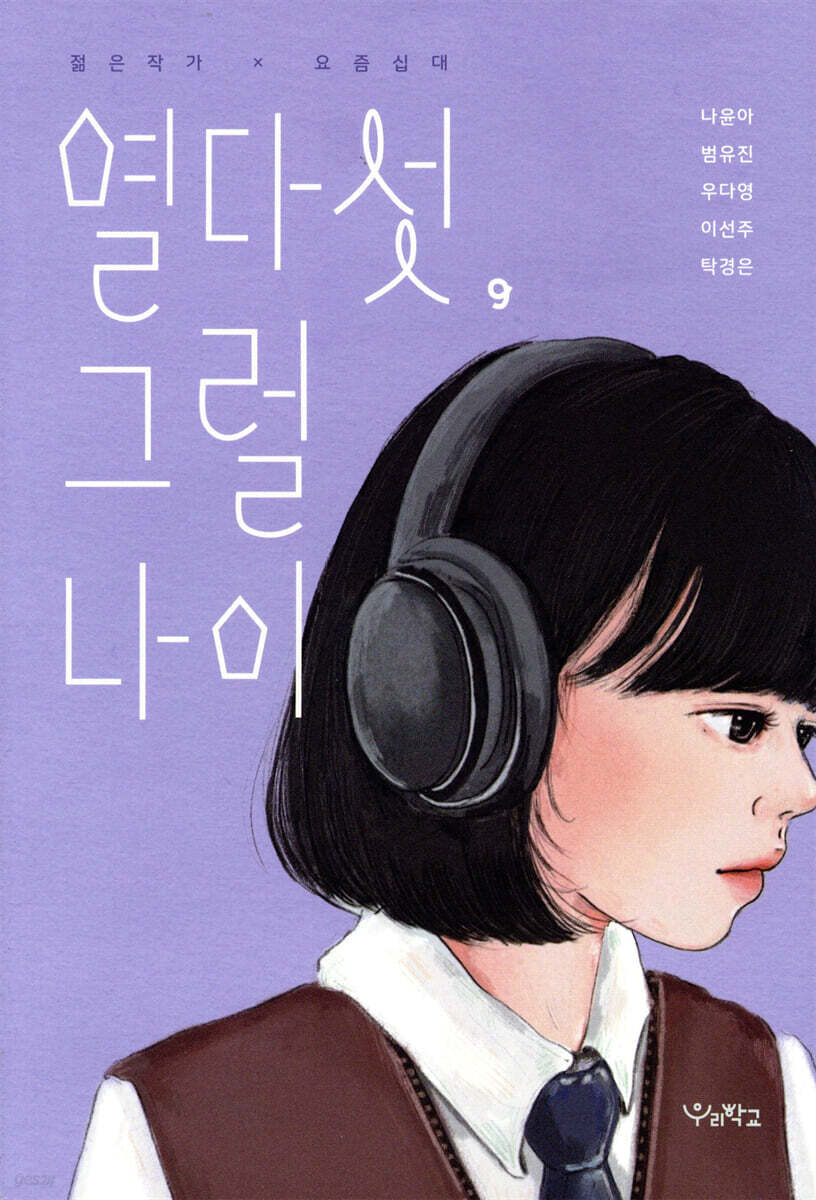 |
Description
Book Introduction
Stories of today's teenagers, told through five keywords by young writers.
Popular, Chatroom, This Life and This Might, Body Camping, Hero
Five young writers who are closely connected with teenagers unravel today's teenagers through five keywords.
Jun-young, who discovers his own hero very close to him; Yoon, who stands on the border between truth and lies because of an ordinary KakaoTalk message; Chan-sol, who looks back on his own life while living someone else's; Eun-jung, whose daily life is shattered by a sudden malice; Si-yeon, who gets to know 'that girl' that everyone likes but no one knows well; these works vividly capture the present and present of teenagers passing the age of fifteen.
Popular, Chatroom, This Life and This Might, Body Camping, Hero
Five young writers who are closely connected with teenagers unravel today's teenagers through five keywords.
Jun-young, who discovers his own hero very close to him; Yoon, who stands on the border between truth and lies because of an ordinary KakaoTalk message; Chan-sol, who looks back on his own life while living someone else's; Eun-jung, whose daily life is shattered by a sudden malice; Si-yeon, who gets to know 'that girl' that everyone likes but no one knows well; these works vividly capture the present and present of teenagers passing the age of fifteen.
- You can preview some of the book's contents.
Preview
index
Captain America is lonely too / Tak Kyung-eun… 7
Would you like to install the app? / Lee Seon-ju … 43
I Picked Up the Devil / Beom Yu-jin … 81
Malice and Malice / Na Yoon-ah … 119
That kid / Woo Da-young … 157
Would you like to install the app? / Lee Seon-ju … 43
I Picked Up the Devil / Beom Yu-jin … 81
Malice and Malice / Na Yoon-ah … 119
That kid / Woo Da-young … 157
Detailed image

Into the book
My dad told me never to do anything I would regret.
I have always lived by the saying that living a life without regrets, without failures or mistakes, is the shortcut to success.
But my uncle says something completely different.
They say that since you are still young, what's the point of doing things you will regret or fail at?
--- p.34
Bringing out a story within me that only I can write, one that no one can take away.
To do that, I had to be honest.
I decided to muster up a little courage to reveal everything I wanted to hide.
--- p.36
It's a dolphin symbol.
It's not like we have to do it through KakaoTalk, but it's more convenient, so how can I explain it any further? In the end, it was a fight between four people who said it was convenient and let's do it through KakaoTalk, and one person who didn't like KakaoTalk and wanted to do it through some other method.
Yun never thought he would be able to fight over something like this.
I thought if I did it and you did it, then we would all do it.
Everyone… … .
--- p.50
He turned his head again and this time his eyes met Hyeju's.
Hyeju had the look of someone who had been insulted.
The children thought Hyeju was insulting them, and Hyeju thought the children were insulting her.
It was like a game of ping pong.
The fog kept rising.
--- p.70
As expected, this life is ruined.
Arm wrestling was the problem.
For the past month, arm wrestling competitions have been held frequently among boys.
The ranking of power disguised as play was repeated every semester.
Every time, I would lie down on my desk and pretend to sleep.
The kids didn't even bother to include me in their list.
A weak bone that lays the floor.
That was my public position.
--- p.83
Han Seok-jin, a boy who works hard enough to endure taking medicine for the things he loves.
Am I qualified to call this child's life "ruined?" The image of Eun-ah hanging from the horizontal bar in the middle of the night kept coming to mind.
--- p.114
But it took less than three days for the provocative and questionable footage to spread to other classes.
As more people saw it, more suspicions arose.
Then, someone discovered a dot on a finger in the blurry picture quality.
Kim Tae-gang has been put on the chopping block for real.
If it was fish in a tank before, after the story of the fortune teller came out, it became sashimi on the chopping board.
Dozens of tongues sliced Kim Tae-gang.
--- p.124
“I just think that you and I are both caught up in some terrible malice.
I'm talking about someone's bad intentions that anyone can encounter in life.
“It’s something that someone plans on doing with malicious intent and rushes in, and you can’t help but get involved.”
--- p.151
Starting with the bag, I bought the same items as Yun-kyung, one by one.
The coral tint she wears, the round hand mirror she always carries around, the hand cream that smells like baby powder, the pastel-colored hair tie, the ballpoint pen that writes smoothly, the fit-flop slippers that all the other kids wear, the flat ethnic print pouch she carries her belongings in, the dark blue t-shirt she wears under her school uniform to make a statement.
--- p.169
If everyone sees Yoon-kyung as they want to see her, where is the real Yoon-kyung? To whom did she confide her feelings?
I have always lived by the saying that living a life without regrets, without failures or mistakes, is the shortcut to success.
But my uncle says something completely different.
They say that since you are still young, what's the point of doing things you will regret or fail at?
--- p.34
Bringing out a story within me that only I can write, one that no one can take away.
To do that, I had to be honest.
I decided to muster up a little courage to reveal everything I wanted to hide.
--- p.36
It's a dolphin symbol.
It's not like we have to do it through KakaoTalk, but it's more convenient, so how can I explain it any further? In the end, it was a fight between four people who said it was convenient and let's do it through KakaoTalk, and one person who didn't like KakaoTalk and wanted to do it through some other method.
Yun never thought he would be able to fight over something like this.
I thought if I did it and you did it, then we would all do it.
Everyone… … .
--- p.50
He turned his head again and this time his eyes met Hyeju's.
Hyeju had the look of someone who had been insulted.
The children thought Hyeju was insulting them, and Hyeju thought the children were insulting her.
It was like a game of ping pong.
The fog kept rising.
--- p.70
As expected, this life is ruined.
Arm wrestling was the problem.
For the past month, arm wrestling competitions have been held frequently among boys.
The ranking of power disguised as play was repeated every semester.
Every time, I would lie down on my desk and pretend to sleep.
The kids didn't even bother to include me in their list.
A weak bone that lays the floor.
That was my public position.
--- p.83
Han Seok-jin, a boy who works hard enough to endure taking medicine for the things he loves.
Am I qualified to call this child's life "ruined?" The image of Eun-ah hanging from the horizontal bar in the middle of the night kept coming to mind.
--- p.114
But it took less than three days for the provocative and questionable footage to spread to other classes.
As more people saw it, more suspicions arose.
Then, someone discovered a dot on a finger in the blurry picture quality.
Kim Tae-gang has been put on the chopping block for real.
If it was fish in a tank before, after the story of the fortune teller came out, it became sashimi on the chopping board.
Dozens of tongues sliced Kim Tae-gang.
--- p.124
“I just think that you and I are both caught up in some terrible malice.
I'm talking about someone's bad intentions that anyone can encounter in life.
“It’s something that someone plans on doing with malicious intent and rushes in, and you can’t help but get involved.”
--- p.151
Starting with the bag, I bought the same items as Yun-kyung, one by one.
The coral tint she wears, the round hand mirror she always carries around, the hand cream that smells like baby powder, the pastel-colored hair tie, the ballpoint pen that writes smoothly, the fit-flop slippers that all the other kids wear, the flat ethnic print pouch she carries her belongings in, the dark blue t-shirt she wears under her school uniform to make a statement.
--- p.169
If everyone sees Yoon-kyung as they want to see her, where is the real Yoon-kyung? To whom did she confide her feelings?
--- p.184
Publisher's Review
Beautiful because it's confusing
Capturing the day at fifteen
Everyone turns fifteen.
The ending is similar, but in fact, it is very different.
As we all know, fifteen is a confusing time.
Some people compare this period to the fresh and beautiful youth.
This is the age that serves as the standard for broadcast ratings, and it is also the age when Confucius long ago became interested in learning, but some shake their heads and call this period of boundless recklessness and impulsivity 'middle school syndrome.'
He seems to have grown quite a bit, but he is still very young.
An age where you hear the advice to prepare diligently for the future, but you are lost because you cannot imagine what that future will be like.
It is certain that this is a time that cannot be clearly characterized in a single word, not only by those who are going through it, but also by those who have already gone through it.
For children going through an unstable period of drifting and struggling to put down deep roots, the world's truths about life and the advice of adults often bounce off them rather than resonate with them.
Five young writers who closely interact with teenagers, who are excited yet awkward at the same time because many things are new, and mistakes are inevitable, have captured the moments around the age of fifteen in five works.
The works do not readily offer words of comfort or advice on success and relationships to readers.
It simply depicts today's teenagers clearly in the work, using five keywords that permeate children's lives today: 'popular', 'talk room', 'life and death', 'body camping', and 'hero'.
It is entirely up to the readers to decide what to find in it.
Fifteen stories, sometimes brutally realistic and tenacious, sometimes witty and hopeful, will captivate readers.
Endlessly wandering to find 'me'
Fifteen, the children around him
Fifteen is a time when you feel endlessly anxious about the future, but also full of hope that you can do anything.
Because I still don't know myself, others, or the world very well, I sometimes act childishly out of curiosity and passion, and sometimes I become so small that I resent myself and the world.
Among them, there are children who stumble and fall because they do not know themselves well, but still believe in themselves and get back up in the end.
They are Jun-young, the main character of "Captain America is Lonely Too" and Chan-sol, the main character of "I Picked Up the Devil."
Junyoung, who calls himself a "loner" who has all the qualities that his peers dislike, feels like he is just lacking because he is classified as a loser by his father's standards.
Junyoung, who was torn between his father and uncle who said such conflicting things about life and success, participates in the 'Novelist Project' and focuses on himself for the first time.
By asking himself questions he never asked himself before, such as what he likes and dislikes, and what he really wants to achieve, Junyoung slowly but steadily establishes his own standards.
And he realizes that there may be another hero other than his favorite hero, Captain America, who stands for principles and beliefs.
By building self-confidence and affection, the child becomes stronger.
Chansol, who says that his position is that of a 'weakling' who lays the groundwork, is frustrated by his weaknesses, such as physical shortcomings or innate abilities, which he cannot overcome no matter how hard he tries.
Chansol, who had been convinced that his life was ruined, accidentally encounters an amazing creature.
The 'talking sparrow' who suddenly comes to visit Chansol gives him three chances to live the life he wants.
Chansol could be a rapper who shines on stage, a basketball player who dunks, or a YouTuber with a million subscribers.
Chansol, who can freely choose any life he wants, decides his other life based on only one person.
And then you begin to discover yourself as someone who can truly comfort someone, truly trust someone, and love someone passionately.
You and I at fifteen,
What on earth do we mean?
For a fifteen-year-old, friendships have a tremendous impact, shaking not only their mood but also their self-esteem.
A careless word from a friend can leave a deep scar on your heart, leaving an indelible mark. A moment of distance can create a rift that can become a cliff you can't climb back up.
As children form complex and nuanced relationships that are intertwined with contempt and affection, they are gifted with beautiful, unforgettable memories, while others endure painful times, curled up in a state of physical and emotional wounds.
In a relationship that burns like fire and then freezes like cold water poured over it, children face cruel truths, witness good and evil, and realize the cold nature of relationships.
Yoon, the protagonist of "Would You Like to Install the App," witnesses the forced solidarity and intentional alienation hidden in the hearts of children who use KakaoTalk on a daily basis.
As he begins to question whether the actions he took for granted because everyone else was truly what he wanted to do, Yoon's once simple and clear thoughts begin to become more and more complicated.
Eun-jeong, the protagonist of "Malice and Malice," becomes an unjust victim of body phishing as she is caught up in the adults' vicious malice.
But what's even more frightening are the mouths and tongues of friends who thoughtlessly blame, judge, and spread rumors about someone.
The protagonist of "That Girl", Siyeon, is a girl who is used to being alone, but suddenly feels lonely as if her own existence has disappeared.
After catching the eye of Yoon-kyung, the popular girl who everyone knows exists and likes, Si-yeon begins to feel unfamiliar and afraid of Yoon-kyung, who everyone knows but in fact no one really knows.
In this way, the three works realistically depict the friendships and conflicts experienced by children, as well as the complex inner selves of each, with the keywords of 'talk room', 'body camping', and 'popular kid' as their respective themes.
The story unfolds with suspense, featuring the truth about relationships that children today have experienced or witnessed at least once, such as the truth about relationships that they had suspected but tried to ignore, conflicts with friends that shake their calm inner selves, and deep, intimate wounds that they could not tell anyone.
It's okay to wander, make mistakes, and fall
Fifteen is the age for that
The characters in 『Fifteen, That Age』, which moves between reality and fantasy, comedy and tragedy, could be me or someone around us.
Through these five stories, which could be the past, present, and future of me, you, or someone else hovering around the edge of fifteen, readers will be able to reflect on the meaning of today and experience an invisible but, above all, solidarity.
Realizing that I am not alone in feeling reckless and infinitely small because I cannot know my limits, and knowing that there are countless fifteen-year-olds who are stuck in their seats, unable to even begin to untangle the knots of their tangled relationships, brings me deep empathy and comfort.
Perhaps this book, "Fifteen, That Age," with its cover dyed in purple, which carries various meanings such as imagination, intuition, positivity, mystery, depression, anxiety, wounds, and love and hate, is the age of fifteen and youth itself.
I believe that this book will resonate with those passing through the colorful age of fifteen, a time when no definitive conclusions can be drawn, and become a special moment in life.
In the ever-flowing flow of time, someone who is about to turn fifteen will, like everyone else at fifteen, sink deeply into the darkness, then step out with a bright light, taking firm steps, and wander without rest, shaking.
Because fifteen is that age.
Capturing the day at fifteen
Everyone turns fifteen.
The ending is similar, but in fact, it is very different.
As we all know, fifteen is a confusing time.
Some people compare this period to the fresh and beautiful youth.
This is the age that serves as the standard for broadcast ratings, and it is also the age when Confucius long ago became interested in learning, but some shake their heads and call this period of boundless recklessness and impulsivity 'middle school syndrome.'
He seems to have grown quite a bit, but he is still very young.
An age where you hear the advice to prepare diligently for the future, but you are lost because you cannot imagine what that future will be like.
It is certain that this is a time that cannot be clearly characterized in a single word, not only by those who are going through it, but also by those who have already gone through it.
For children going through an unstable period of drifting and struggling to put down deep roots, the world's truths about life and the advice of adults often bounce off them rather than resonate with them.
Five young writers who closely interact with teenagers, who are excited yet awkward at the same time because many things are new, and mistakes are inevitable, have captured the moments around the age of fifteen in five works.
The works do not readily offer words of comfort or advice on success and relationships to readers.
It simply depicts today's teenagers clearly in the work, using five keywords that permeate children's lives today: 'popular', 'talk room', 'life and death', 'body camping', and 'hero'.
It is entirely up to the readers to decide what to find in it.
Fifteen stories, sometimes brutally realistic and tenacious, sometimes witty and hopeful, will captivate readers.
Endlessly wandering to find 'me'
Fifteen, the children around him
Fifteen is a time when you feel endlessly anxious about the future, but also full of hope that you can do anything.
Because I still don't know myself, others, or the world very well, I sometimes act childishly out of curiosity and passion, and sometimes I become so small that I resent myself and the world.
Among them, there are children who stumble and fall because they do not know themselves well, but still believe in themselves and get back up in the end.
They are Jun-young, the main character of "Captain America is Lonely Too" and Chan-sol, the main character of "I Picked Up the Devil."
Junyoung, who calls himself a "loner" who has all the qualities that his peers dislike, feels like he is just lacking because he is classified as a loser by his father's standards.
Junyoung, who was torn between his father and uncle who said such conflicting things about life and success, participates in the 'Novelist Project' and focuses on himself for the first time.
By asking himself questions he never asked himself before, such as what he likes and dislikes, and what he really wants to achieve, Junyoung slowly but steadily establishes his own standards.
And he realizes that there may be another hero other than his favorite hero, Captain America, who stands for principles and beliefs.
By building self-confidence and affection, the child becomes stronger.
Chansol, who says that his position is that of a 'weakling' who lays the groundwork, is frustrated by his weaknesses, such as physical shortcomings or innate abilities, which he cannot overcome no matter how hard he tries.
Chansol, who had been convinced that his life was ruined, accidentally encounters an amazing creature.
The 'talking sparrow' who suddenly comes to visit Chansol gives him three chances to live the life he wants.
Chansol could be a rapper who shines on stage, a basketball player who dunks, or a YouTuber with a million subscribers.
Chansol, who can freely choose any life he wants, decides his other life based on only one person.
And then you begin to discover yourself as someone who can truly comfort someone, truly trust someone, and love someone passionately.
You and I at fifteen,
What on earth do we mean?
For a fifteen-year-old, friendships have a tremendous impact, shaking not only their mood but also their self-esteem.
A careless word from a friend can leave a deep scar on your heart, leaving an indelible mark. A moment of distance can create a rift that can become a cliff you can't climb back up.
As children form complex and nuanced relationships that are intertwined with contempt and affection, they are gifted with beautiful, unforgettable memories, while others endure painful times, curled up in a state of physical and emotional wounds.
In a relationship that burns like fire and then freezes like cold water poured over it, children face cruel truths, witness good and evil, and realize the cold nature of relationships.
Yoon, the protagonist of "Would You Like to Install the App," witnesses the forced solidarity and intentional alienation hidden in the hearts of children who use KakaoTalk on a daily basis.
As he begins to question whether the actions he took for granted because everyone else was truly what he wanted to do, Yoon's once simple and clear thoughts begin to become more and more complicated.
Eun-jeong, the protagonist of "Malice and Malice," becomes an unjust victim of body phishing as she is caught up in the adults' vicious malice.
But what's even more frightening are the mouths and tongues of friends who thoughtlessly blame, judge, and spread rumors about someone.
The protagonist of "That Girl", Siyeon, is a girl who is used to being alone, but suddenly feels lonely as if her own existence has disappeared.
After catching the eye of Yoon-kyung, the popular girl who everyone knows exists and likes, Si-yeon begins to feel unfamiliar and afraid of Yoon-kyung, who everyone knows but in fact no one really knows.
In this way, the three works realistically depict the friendships and conflicts experienced by children, as well as the complex inner selves of each, with the keywords of 'talk room', 'body camping', and 'popular kid' as their respective themes.
The story unfolds with suspense, featuring the truth about relationships that children today have experienced or witnessed at least once, such as the truth about relationships that they had suspected but tried to ignore, conflicts with friends that shake their calm inner selves, and deep, intimate wounds that they could not tell anyone.
It's okay to wander, make mistakes, and fall
Fifteen is the age for that
The characters in 『Fifteen, That Age』, which moves between reality and fantasy, comedy and tragedy, could be me or someone around us.
Through these five stories, which could be the past, present, and future of me, you, or someone else hovering around the edge of fifteen, readers will be able to reflect on the meaning of today and experience an invisible but, above all, solidarity.
Realizing that I am not alone in feeling reckless and infinitely small because I cannot know my limits, and knowing that there are countless fifteen-year-olds who are stuck in their seats, unable to even begin to untangle the knots of their tangled relationships, brings me deep empathy and comfort.
Perhaps this book, "Fifteen, That Age," with its cover dyed in purple, which carries various meanings such as imagination, intuition, positivity, mystery, depression, anxiety, wounds, and love and hate, is the age of fifteen and youth itself.
I believe that this book will resonate with those passing through the colorful age of fifteen, a time when no definitive conclusions can be drawn, and become a special moment in life.
In the ever-flowing flow of time, someone who is about to turn fifteen will, like everyone else at fifteen, sink deeply into the darkness, then step out with a bright light, taking firm steps, and wander without rest, shaking.
Because fifteen is that age.
GOODS SPECIFICS
- Date of publication: December 7, 2020
- Page count, weight, size: 192 pages | 292g | 140*205*12mm
- ISBN13: 9791190337496
- ISBN10: 1190337495
You may also like
카테고리
korean


korean

![GQ KOREA Mark (Monthly): December [2025]](http://librairie.coreenne.fr/cdn/shop/files/8ef265dbbfbf186523ed75ba7319009d.jpg?v=1765340328&width=3840)


