

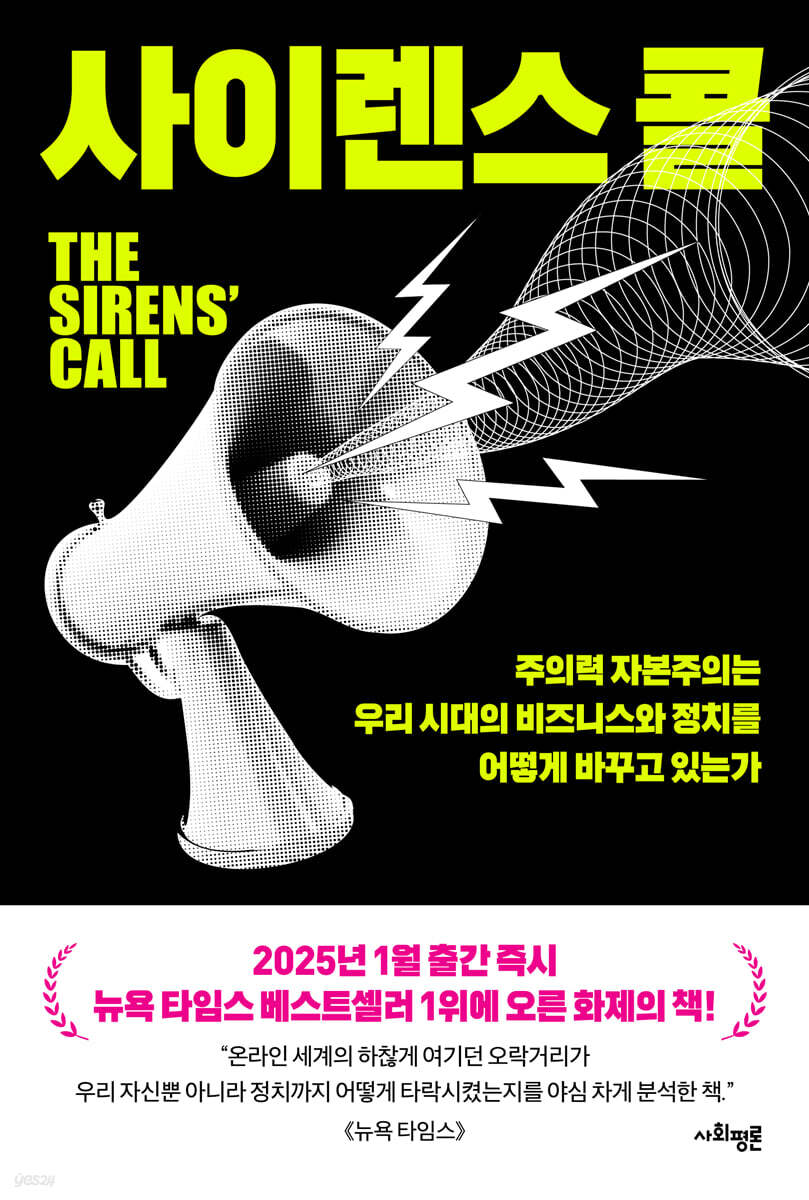
Siren call
 |
Description
Book Introduction
Without anyone knowing, our precious attention is being sold.
From television to social media and platform businesses
The one book to understand the era transformed by the attention industry!
Chris Hayes, an MSNBC anchor and New York Times bestselling author, calls the current era, in which human attention is bought and sold like a commodity, the "attention age," and analyzes how commodified attention is changing our times.
Tech companies use sophisticated technology to value the time users spend on their platforms and sell that value to advertisers, while influencers cash in on the attention they receive from others, amassing wealth.
In this era where the logic of 'attention capitalism' dominates, people begin to dig out attention from the human mind like drilling for oil.
We live in an age where people's only concern is how to grab other people's attention.
So what is the essence of this attentional age? What makes us value attention above all else? And where is this age headed?
In "The Siren's Call," which crosses history, philosophy, psychology, and political criticism, we delve into the true nature of the sirens that capture our attention!
Jennifer Szalay, nonfiction critic for the New York Times, praises Chris Hayes's "extensive citation of social science research on how human attention works," unlike previous books on attention, and praises his analytical power and original perspective that delves into practical, concrete issues.
From television to social media and platform businesses
The one book to understand the era transformed by the attention industry!
Chris Hayes, an MSNBC anchor and New York Times bestselling author, calls the current era, in which human attention is bought and sold like a commodity, the "attention age," and analyzes how commodified attention is changing our times.
Tech companies use sophisticated technology to value the time users spend on their platforms and sell that value to advertisers, while influencers cash in on the attention they receive from others, amassing wealth.
In this era where the logic of 'attention capitalism' dominates, people begin to dig out attention from the human mind like drilling for oil.
We live in an age where people's only concern is how to grab other people's attention.
So what is the essence of this attentional age? What makes us value attention above all else? And where is this age headed?
In "The Siren's Call," which crosses history, philosophy, psychology, and political criticism, we delve into the true nature of the sirens that capture our attention!
Jennifer Szalay, nonfiction critic for the New York Times, praises Chris Hayes's "extensive citation of social science research on how human attention works," unlike previous books on attention, and praises his analytical power and original perspective that delves into practical, concrete issues.
- You can preview some of the book's contents.
Preview
index
Chapter 1: The Prelude to a Great Transition: Understanding the New Order in the Age of Attention
11 Unprecedented Changes in Attention
How to Understand Human Attention 26
Chapter 2 Slot Machines and Uncle Sam
Definition of Attention 49
65 Strategies for Capturing Attention
Slot Machine Model 82 for Unlimited Fun
Attention! Uncle Sam is calling you 87
Chapter 3: The Birth of Boredom: The Root of Evil
Boredom as a Product of Modernity 95
The Human Mind: A Target for the Attention Industry 106
Chapter 4: Giant Industries, Interesting Businesses
Humans are social animals 127
A Short History of Solitude 129
Why Socialism Isn't Really Social 139
Duet of Gluttony and Deprivation 168
Chapter 5: The Commodification of Attention
The Structure of Attention Commodification 177
Uncovering the Roots of Alienation 198
From collective attention to isolated attention 215
Chapter 6: The Dawn of the Attention Age
What Attention Means in an Age of Information Overload 229
The Battle for Attention Has Become a Zero-Sum Game 246
Characteristics of the Attention Age 269
Chapter 7 Public Sphere and Attention: In the Gunfire of the Attention War
There are rules to paying attention:
Lincoln-Douglas Debates 285
The Collapse of the Attention Regime 299
Donald Trump: The Most Successful Attention-Grabber of Our Time 307
Platform 319
Three Trends Harming Public Discourse: Trolling, Whataboutism, and Conspiracy Theories 337
Chapter 8: Life After the Attention Age
What to Pay Attention to 367
Attention Direct Transaction Market 372
Imagination as a Non-Commercial Space 380
11 Unprecedented Changes in Attention
How to Understand Human Attention 26
Chapter 2 Slot Machines and Uncle Sam
Definition of Attention 49
65 Strategies for Capturing Attention
Slot Machine Model 82 for Unlimited Fun
Attention! Uncle Sam is calling you 87
Chapter 3: The Birth of Boredom: The Root of Evil
Boredom as a Product of Modernity 95
The Human Mind: A Target for the Attention Industry 106
Chapter 4: Giant Industries, Interesting Businesses
Humans are social animals 127
A Short History of Solitude 129
Why Socialism Isn't Really Social 139
Duet of Gluttony and Deprivation 168
Chapter 5: The Commodification of Attention
The Structure of Attention Commodification 177
Uncovering the Roots of Alienation 198
From collective attention to isolated attention 215
Chapter 6: The Dawn of the Attention Age
What Attention Means in an Age of Information Overload 229
The Battle for Attention Has Become a Zero-Sum Game 246
Characteristics of the Attention Age 269
Chapter 7 Public Sphere and Attention: In the Gunfire of the Attention War
There are rules to paying attention:
Lincoln-Douglas Debates 285
The Collapse of the Attention Regime 299
Donald Trump: The Most Successful Attention-Grabber of Our Time 307
Platform 319
Three Trends Harming Public Discourse: Trolling, Whataboutism, and Conspiracy Theories 337
Chapter 8: Life After the Attention Age
What to Pay Attention to 367
Attention Direct Transaction Market 372
Imagination as a Non-Commercial Space 380
Detailed image

Into the book
The attention economy is not like a bad new drug being forced on people, an addictive substance with widespread negative effects, or a disruptive new form of media with widespread social impact.
It is a much more profound and entirely different problem.
The most significant characteristic of our age is that our attention is our most important resource and at the same time, the essential element that makes us human.
Unlike external resources like land, coal, and capital, the primary resource of our time lies within our minds.
And to extract this, we must drill deep into our hearts.
--- From Chapter 1, "The Prelude to a Great Transformation"
At any given moment, the struggle to control where we pay attention reorders everything from our inner lives (who we listen to what, how and when we spend time with our loved ones) to our collective public life (which social concerns are discussed and legislated and which are ignored, which deaths are widely mourned and which are quietly forgotten).
All aspects of human life, encompassing the broadest categories of human organization, are being reorganized in the pursuit of interest.
--- From Chapter 1, "The Prelude to a Great Transformation"
Before you can communicate, insult, charm, or do anything else to anyone, you must first make sure your voice does not disappear into the muted background noise.
In fact, 99.9% of the utterances directed at us disappear like that.
Public discourse is now a struggle for the attention of everyone against everyone.
Commerce is also a struggle for attention.
Social life is also a struggle for attention.
Parenting is also a struggle for attention.
We are all tired of this struggle.
This book is an attempt to find peace.
--- From Chapter 1, "The Prelude to a Great Transformation"
The slot machine model has now become the dominant model in the attention-grabbing era.
Most popular social media platforms, including Facebook, X (formerly Twitter), Instagram, and TikTok, have adopted this approach.
It's no coincidence that the core structure of these platforms, the "feed," is designed to scroll endlessly, like a slot machine.
These apps are structured to maintain our attention through constant stimulation and constant intervention.
That's why it succeeds in holding our attention without much effort.
Cell phones are, so to speak, little slot machines in our pockets.
These devices, readily available for use, have maintained our attention for enormous periods of time simply by repeating the act of capturing our attention.
--- From Chapter 2, "The Slot Machine and Uncle Sam"
Lack of concentration, reduced attention span, and constant distraction are probably the most common complaints of our time.
We all try to avoid moments when our minds feel empty, but the more we try, the more difficult it becomes to find the reward we truly seek: something to immerse ourselves in or focus our full attention on.
--- From Chapter 3, "The Birth of Boredom: The Root of Evil"
Social media, with its combination of mass fame and mass surveillance, increasingly distorts our most basic impulses.
The act of loving and being loved, caring and being cared for, or making friends laugh with jokes, is now being transformed into a project to impress strangers.
By definition, this project can't fulfill our desires, but it feels so close to real human connection that we can't help but pursue it more and more compulsively.
--- From Chapter 4, "Giant Industries, Interesting Businesses"
Attention is as old as human history.
Attracting the attention of others for social purposes is as old as shamans, poets, and conversation.
But attention is now commodified, traded through sophisticated, instantaneous algorithmic auctions, available for buying and selling.
Every second our eyes are focused on is priced.
It's new, it's innovative, and it's alienating.
--- From Chapter 5, “Commodification of Attention”
The experience that defines the attention age is a particular kind of alienation.
It is the feeling that our inner life, the direction of our thoughts, is moving against our will.
This stems from the sophisticated development of attention markets that have found increasingly efficient ways to extract and commodify our attention.
But our attention is different from other commodities.
Attention is a virtual commodity.
It is a market commodity that can be priced, yet at the same time it is inseparable from our humanity.
The alienation we feel stems from the tension between attention as a market commodity and attention as the essence of our lives.
--- From Chapter 5, “Commodification of Attention”
Much of the current attention economy operates around the exchange of money and attention.
In other words, the trade-off between money and attention is a two-way street.
People gather attention and turn it into money.
For example, this is how Instagram influencers sign endorsement deals with high-profit brands.
Conversely, people also spend money to get attention.
Like Elon Musk, who spent $44 billion (approximately 62 trillion won at October 2022 exchange rates) to make his bad tweets readable to others.
--- From Chapter 6, "The Dawn of the Attention Age"
One thing that ties Elon Musk, Kanye West, and Donald Trump together is their remarkable ability to consistently command attention.
But that's not the whole story, is it? Taylor Swift, while also incredibly attention-grabbing, isn't part of this "cursed trinity."
Above all, she is excellent at attracting positive attention.
She is a star in the traditional sense.
On the other hand, Musk, West, and Trump are in a completely different category.
They are figures who cause extreme polarization and seem addicted to controversy.
The most important thing is that they are prime examples of people who constantly consume negative attention.
In other words, they are trolls.
--- From Chapter 7, “Attention and the Public Sphere: In the Gunfire of the Attention War”
As we live in the attention-based age, our anxiety and depression are increasing, our sense of isolation is deepening, and our social skills are becoming weaker.
The number of friends and the frequency of meeting friends also gradually decreased.
We are having more and more difficulty maintaining attention, reading deeply, and learning new things.
The political sphere is becoming more fragmented and polarized, and the information environment is becoming increasingly polluted.
This situation cannot be left unattended.
Isn't that right? I don't think this situation should continue.
There are several open, forward-looking, non-exclusive paths before us to reclaim collective control of our minds.
--- From Chapter 8, “Life After the Attention Age”
What do we want to focus on? If all the technologies and companies competing for our attention disappeared, and our attention was no longer commodified or extracted, what would we choose to focus on?
--- From Chapter 8, “Life After the Attention Age”
The gap between what we actually pay attention to and what we want to pay attention to creates alienation.
And the first step to solving this is to ask ourselves what we truly want.
Imagine that you have the ability to completely control your attention.
If you could focus on anything for as long as you wanted, with the power of an X-Man, what would you do with it?
--- From Chapter 8, “Life After the Attention Age”
We must use every tool and strategy imaginable to reclaim our will.
And as conscious beings with willpower, we must create a world where we can focus our attention where we want.
That world should be a place where we can fully function and thrive as whole human beings.
It should be a world where, as liberated souls, we can listen to the crashing waves with our ears open, untethered from the mast, shake off the lure of the sirens, and safely return to our loved ones.
It is a much more profound and entirely different problem.
The most significant characteristic of our age is that our attention is our most important resource and at the same time, the essential element that makes us human.
Unlike external resources like land, coal, and capital, the primary resource of our time lies within our minds.
And to extract this, we must drill deep into our hearts.
--- From Chapter 1, "The Prelude to a Great Transformation"
At any given moment, the struggle to control where we pay attention reorders everything from our inner lives (who we listen to what, how and when we spend time with our loved ones) to our collective public life (which social concerns are discussed and legislated and which are ignored, which deaths are widely mourned and which are quietly forgotten).
All aspects of human life, encompassing the broadest categories of human organization, are being reorganized in the pursuit of interest.
--- From Chapter 1, "The Prelude to a Great Transformation"
Before you can communicate, insult, charm, or do anything else to anyone, you must first make sure your voice does not disappear into the muted background noise.
In fact, 99.9% of the utterances directed at us disappear like that.
Public discourse is now a struggle for the attention of everyone against everyone.
Commerce is also a struggle for attention.
Social life is also a struggle for attention.
Parenting is also a struggle for attention.
We are all tired of this struggle.
This book is an attempt to find peace.
--- From Chapter 1, "The Prelude to a Great Transformation"
The slot machine model has now become the dominant model in the attention-grabbing era.
Most popular social media platforms, including Facebook, X (formerly Twitter), Instagram, and TikTok, have adopted this approach.
It's no coincidence that the core structure of these platforms, the "feed," is designed to scroll endlessly, like a slot machine.
These apps are structured to maintain our attention through constant stimulation and constant intervention.
That's why it succeeds in holding our attention without much effort.
Cell phones are, so to speak, little slot machines in our pockets.
These devices, readily available for use, have maintained our attention for enormous periods of time simply by repeating the act of capturing our attention.
--- From Chapter 2, "The Slot Machine and Uncle Sam"
Lack of concentration, reduced attention span, and constant distraction are probably the most common complaints of our time.
We all try to avoid moments when our minds feel empty, but the more we try, the more difficult it becomes to find the reward we truly seek: something to immerse ourselves in or focus our full attention on.
--- From Chapter 3, "The Birth of Boredom: The Root of Evil"
Social media, with its combination of mass fame and mass surveillance, increasingly distorts our most basic impulses.
The act of loving and being loved, caring and being cared for, or making friends laugh with jokes, is now being transformed into a project to impress strangers.
By definition, this project can't fulfill our desires, but it feels so close to real human connection that we can't help but pursue it more and more compulsively.
--- From Chapter 4, "Giant Industries, Interesting Businesses"
Attention is as old as human history.
Attracting the attention of others for social purposes is as old as shamans, poets, and conversation.
But attention is now commodified, traded through sophisticated, instantaneous algorithmic auctions, available for buying and selling.
Every second our eyes are focused on is priced.
It's new, it's innovative, and it's alienating.
--- From Chapter 5, “Commodification of Attention”
The experience that defines the attention age is a particular kind of alienation.
It is the feeling that our inner life, the direction of our thoughts, is moving against our will.
This stems from the sophisticated development of attention markets that have found increasingly efficient ways to extract and commodify our attention.
But our attention is different from other commodities.
Attention is a virtual commodity.
It is a market commodity that can be priced, yet at the same time it is inseparable from our humanity.
The alienation we feel stems from the tension between attention as a market commodity and attention as the essence of our lives.
--- From Chapter 5, “Commodification of Attention”
Much of the current attention economy operates around the exchange of money and attention.
In other words, the trade-off between money and attention is a two-way street.
People gather attention and turn it into money.
For example, this is how Instagram influencers sign endorsement deals with high-profit brands.
Conversely, people also spend money to get attention.
Like Elon Musk, who spent $44 billion (approximately 62 trillion won at October 2022 exchange rates) to make his bad tweets readable to others.
--- From Chapter 6, "The Dawn of the Attention Age"
One thing that ties Elon Musk, Kanye West, and Donald Trump together is their remarkable ability to consistently command attention.
But that's not the whole story, is it? Taylor Swift, while also incredibly attention-grabbing, isn't part of this "cursed trinity."
Above all, she is excellent at attracting positive attention.
She is a star in the traditional sense.
On the other hand, Musk, West, and Trump are in a completely different category.
They are figures who cause extreme polarization and seem addicted to controversy.
The most important thing is that they are prime examples of people who constantly consume negative attention.
In other words, they are trolls.
--- From Chapter 7, “Attention and the Public Sphere: In the Gunfire of the Attention War”
As we live in the attention-based age, our anxiety and depression are increasing, our sense of isolation is deepening, and our social skills are becoming weaker.
The number of friends and the frequency of meeting friends also gradually decreased.
We are having more and more difficulty maintaining attention, reading deeply, and learning new things.
The political sphere is becoming more fragmented and polarized, and the information environment is becoming increasingly polluted.
This situation cannot be left unattended.
Isn't that right? I don't think this situation should continue.
There are several open, forward-looking, non-exclusive paths before us to reclaim collective control of our minds.
--- From Chapter 8, “Life After the Attention Age”
What do we want to focus on? If all the technologies and companies competing for our attention disappeared, and our attention was no longer commodified or extracted, what would we choose to focus on?
--- From Chapter 8, “Life After the Attention Age”
The gap between what we actually pay attention to and what we want to pay attention to creates alienation.
And the first step to solving this is to ask ourselves what we truly want.
Imagine that you have the ability to completely control your attention.
If you could focus on anything for as long as you wanted, with the power of an X-Man, what would you do with it?
--- From Chapter 8, “Life After the Attention Age”
We must use every tool and strategy imaginable to reclaim our will.
And as conscious beings with willpower, we must create a world where we can focus our attention where we want.
That world should be a place where we can fully function and thrive as whole human beings.
It should be a world where, as liberated souls, we can listen to the crashing waves with our ears open, untethered from the mast, shake off the lure of the sirens, and safely return to our loved ones.
--- From Chapter 8, “Life After the Attention Age”
Publisher's Review
A major shift to the 21st century attentional age, comparable to the commodification of labor in the 19th century.
There have been attempts to analyze the phenomenon of the "attention crisis" and seek alternatives, such as "Stolen Concentration" and "The Anxious Generation."
But no author has delved as deeply into the essence of what the "Attention Age" means as Chris Hayes.
He argues that the situation in which everything in society is reorganized around attention is comparable to the great transformation of capitalism, where labor is standardized and commodified.
Today's capitalism commodifies human attention as labor.
Chris Hayes considers The Sun, which loses money on every copy sold but generates revenue from advertising while selling subscribers, a modern version of attention capitalism.
Now people's gazes are analyzed in nanoseconds and auctioned off.
The moment a web page loads or an Instagram Reels rolls, our attention is measured and sold by increasingly sophisticated technologies.
People who have relied on companies like Google and Meta (formerly Facebook) for their attention now feel frustrated and alienated when they can no longer give their attention voluntarily as they once did.
Who decides where to focus our attention?
Analyzing the Impact of Media Attention Wars on Civil Society
Drawing on his experience as a news anchor, who is inevitably sensitive to the ever-fluctuating viewership ratings, the author raises concerns about the impact of today's battle for attention on our society.
The Titan submarine, which departed for sightseeing in 2023, had five people on board, and when contact with the submarine was lost, a large-scale multinational rescue team was deployed to search for it.
The incident received worldwide attention.
But a tragic accident that occurred around the same time when a boat carrying hundreds of immigrants capsized in the Mediterranean Sea received little media attention.
For similar reasons, the climate crisis has not received much media attention.
The slow-moving global climate crisis is not enough to create a dramatic scene that will grab people's attention.
Ultimately, the war over attention, a limited resource, diverts us from what we should be paying attention to, leading to neglect of areas that truly require our attention and understanding.
This, the author argues, clearly has a profound impact on the health of civil society.
We are so caught up in the ubiquitous sirens that capture our attention that we lose sight of what truly matters.
The most successful attention hunter
Politics in the Attention Age: A Look at Donald Trump
The author, who has been a political critic covering important issues in American society for a long time, also sharply analyzes the impact of the shift to attention on politics.
According to his analysis, in an age where attention is commodified, the truth of what politicians say doesn't matter.
The more attention you get, the better, for better or worse.
All you have to do is grab the public's attention.
He cites Donald Trump, who won the 2024 US presidential election, as the person who has most quickly grasped this new logic of the attention age.
When he first ran for president in 2015, he spread fake news that the Mexican government was sending rapists and immigrants to the United States and made the outrageous claim that Muslims should be banned from entering the country.
What was the outcome for Trump, who made such an incredibly offensive and unconstitutional claim? Despite receiving 3 million fewer votes than his opponent, Hillary Clinton, in the first presidential election in 2016, he ultimately won the presidency, receiving more media and public attention than any other politician.
By sacrificing his own popularity to capture the public's attention, he was able to paradoxically shake up the political landscape on his own terms, while focusing voters' limited resources on one or two issues.
Since then, countless politicians have tried Trump-style attention-hunting tactics, but without much success.
Still, it's clear that Trump's approach sets a bad precedent for being the most effective way to capture public attention.
The public sphere in the attention-grabbing age, where democratic debate has disappeared
In the attention age, serious discussion cannot take place.
Nowadays, it is impossible to do something like Lincoln and Douglas debating for hours on the single topic of 'the slavery debate'.
Politicians increasingly use short, provocative statements to grab voters' attention, attracting attention from the press and social media.
In-depth discussions in the public sphere are no longer a rarity.
Today's policymakers' debates have become like a fighting game where the outcome is decided in 60 seconds.
Above all, voters' attention span is limited for long periods of time.
So what will replace the collapsed public sphere in the attention-grabbing age? Unfortunately, rather than paying attention to what others say, people resort to obnoxious behavior to grab public attention (trolling), obfuscate arguments (whataboutism), and spread fake news and misinformation (conspiracy theories).
These actions have a detrimental effect on public discourse and shatter all rules about where we should direct our attention.
What should I pay attention to in life?
Exploring Life After the Attention Age
In an age where everything is reduced to attention, we are filled with anxiety caused by growing depression, deepening isolation, and increasingly diminishing social connections.
The gap between what we want to pay attention to and what we actually pay attention to makes the attentional age feel like a labyrinth with no exit.
Is there really no way out of here?
Chris Hayes, who analyzed the attention age, points out several noticeable phenomena today and seeks clues to solving the problem.
First, there is the emergence of a new market that could be called the 'attention direct transaction market.'
It's about users voluntarily paying attention, rather than relying on tech companies' algorithms.
Examples include buying LP albums directly from stores and listening to them instead of using streaming sites, and subscribing to paper newspapers and reading articles instead of social media or newsletters.
In an unmediated state, we seek out objects to which we consciously pay attention.
Just because the buying and selling of attention dominates our time doesn't mean we have to take it for granted.
Thanks to the long-standing efforts of countless people to combat the evils of industrial capitalism, we have been able to institutionalize various mechanisms to guarantee labor rights, including a ban on child labor.
However entrenched the attention industry may seem, if those who are aware of the problem unite and work together, it is entirely possible to reclaim our attention.
And through the author's insightful analysis, we will find ways to navigate safely through the seas of modernity, where attention-grabbing sirens are everywhere.
There have been attempts to analyze the phenomenon of the "attention crisis" and seek alternatives, such as "Stolen Concentration" and "The Anxious Generation."
But no author has delved as deeply into the essence of what the "Attention Age" means as Chris Hayes.
He argues that the situation in which everything in society is reorganized around attention is comparable to the great transformation of capitalism, where labor is standardized and commodified.
Today's capitalism commodifies human attention as labor.
Chris Hayes considers The Sun, which loses money on every copy sold but generates revenue from advertising while selling subscribers, a modern version of attention capitalism.
Now people's gazes are analyzed in nanoseconds and auctioned off.
The moment a web page loads or an Instagram Reels rolls, our attention is measured and sold by increasingly sophisticated technologies.
People who have relied on companies like Google and Meta (formerly Facebook) for their attention now feel frustrated and alienated when they can no longer give their attention voluntarily as they once did.
Who decides where to focus our attention?
Analyzing the Impact of Media Attention Wars on Civil Society
Drawing on his experience as a news anchor, who is inevitably sensitive to the ever-fluctuating viewership ratings, the author raises concerns about the impact of today's battle for attention on our society.
The Titan submarine, which departed for sightseeing in 2023, had five people on board, and when contact with the submarine was lost, a large-scale multinational rescue team was deployed to search for it.
The incident received worldwide attention.
But a tragic accident that occurred around the same time when a boat carrying hundreds of immigrants capsized in the Mediterranean Sea received little media attention.
For similar reasons, the climate crisis has not received much media attention.
The slow-moving global climate crisis is not enough to create a dramatic scene that will grab people's attention.
Ultimately, the war over attention, a limited resource, diverts us from what we should be paying attention to, leading to neglect of areas that truly require our attention and understanding.
This, the author argues, clearly has a profound impact on the health of civil society.
We are so caught up in the ubiquitous sirens that capture our attention that we lose sight of what truly matters.
The most successful attention hunter
Politics in the Attention Age: A Look at Donald Trump
The author, who has been a political critic covering important issues in American society for a long time, also sharply analyzes the impact of the shift to attention on politics.
According to his analysis, in an age where attention is commodified, the truth of what politicians say doesn't matter.
The more attention you get, the better, for better or worse.
All you have to do is grab the public's attention.
He cites Donald Trump, who won the 2024 US presidential election, as the person who has most quickly grasped this new logic of the attention age.
When he first ran for president in 2015, he spread fake news that the Mexican government was sending rapists and immigrants to the United States and made the outrageous claim that Muslims should be banned from entering the country.
What was the outcome for Trump, who made such an incredibly offensive and unconstitutional claim? Despite receiving 3 million fewer votes than his opponent, Hillary Clinton, in the first presidential election in 2016, he ultimately won the presidency, receiving more media and public attention than any other politician.
By sacrificing his own popularity to capture the public's attention, he was able to paradoxically shake up the political landscape on his own terms, while focusing voters' limited resources on one or two issues.
Since then, countless politicians have tried Trump-style attention-hunting tactics, but without much success.
Still, it's clear that Trump's approach sets a bad precedent for being the most effective way to capture public attention.
The public sphere in the attention-grabbing age, where democratic debate has disappeared
In the attention age, serious discussion cannot take place.
Nowadays, it is impossible to do something like Lincoln and Douglas debating for hours on the single topic of 'the slavery debate'.
Politicians increasingly use short, provocative statements to grab voters' attention, attracting attention from the press and social media.
In-depth discussions in the public sphere are no longer a rarity.
Today's policymakers' debates have become like a fighting game where the outcome is decided in 60 seconds.
Above all, voters' attention span is limited for long periods of time.
So what will replace the collapsed public sphere in the attention-grabbing age? Unfortunately, rather than paying attention to what others say, people resort to obnoxious behavior to grab public attention (trolling), obfuscate arguments (whataboutism), and spread fake news and misinformation (conspiracy theories).
These actions have a detrimental effect on public discourse and shatter all rules about where we should direct our attention.
What should I pay attention to in life?
Exploring Life After the Attention Age
In an age where everything is reduced to attention, we are filled with anxiety caused by growing depression, deepening isolation, and increasingly diminishing social connections.
The gap between what we want to pay attention to and what we actually pay attention to makes the attentional age feel like a labyrinth with no exit.
Is there really no way out of here?
Chris Hayes, who analyzed the attention age, points out several noticeable phenomena today and seeks clues to solving the problem.
First, there is the emergence of a new market that could be called the 'attention direct transaction market.'
It's about users voluntarily paying attention, rather than relying on tech companies' algorithms.
Examples include buying LP albums directly from stores and listening to them instead of using streaming sites, and subscribing to paper newspapers and reading articles instead of social media or newsletters.
In an unmediated state, we seek out objects to which we consciously pay attention.
Just because the buying and selling of attention dominates our time doesn't mean we have to take it for granted.
Thanks to the long-standing efforts of countless people to combat the evils of industrial capitalism, we have been able to institutionalize various mechanisms to guarantee labor rights, including a ban on child labor.
However entrenched the attention industry may seem, if those who are aware of the problem unite and work together, it is entirely possible to reclaim our attention.
And through the author's insightful analysis, we will find ways to navigate safely through the seas of modernity, where attention-grabbing sirens are everywhere.
GOODS SPECIFICS
- Date of issue: May 20, 2025
- Page count, weight, size: 424 pages | 598g | 145*215*28mm
- ISBN13: 9791162733547
- ISBN10: 1162733543
You may also like
카테고리
korean


korean

![GQ KOREA Mark (Monthly): December [2025]](http://librairie.coreenne.fr/cdn/shop/files/8ef265dbbfbf186523ed75ba7319009d.jpg?v=1765340328&width=3840)


