

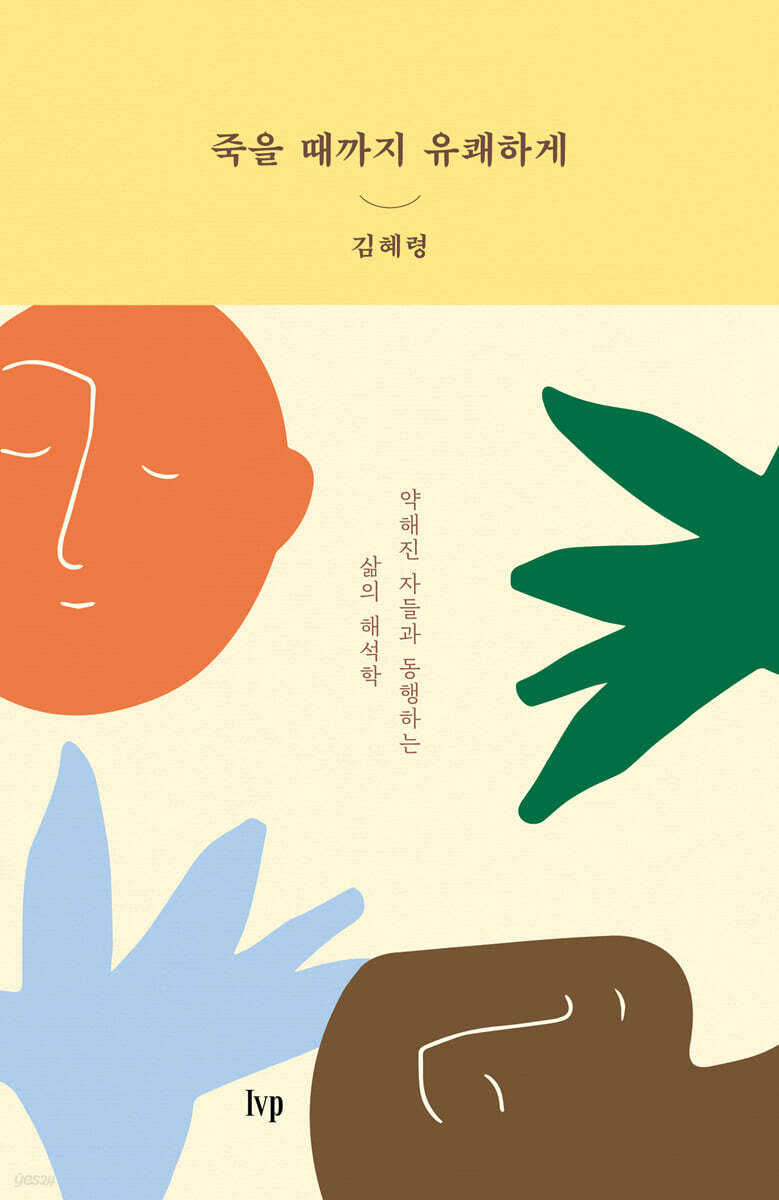
Cheerfully until death
 |
Description
Book Introduction
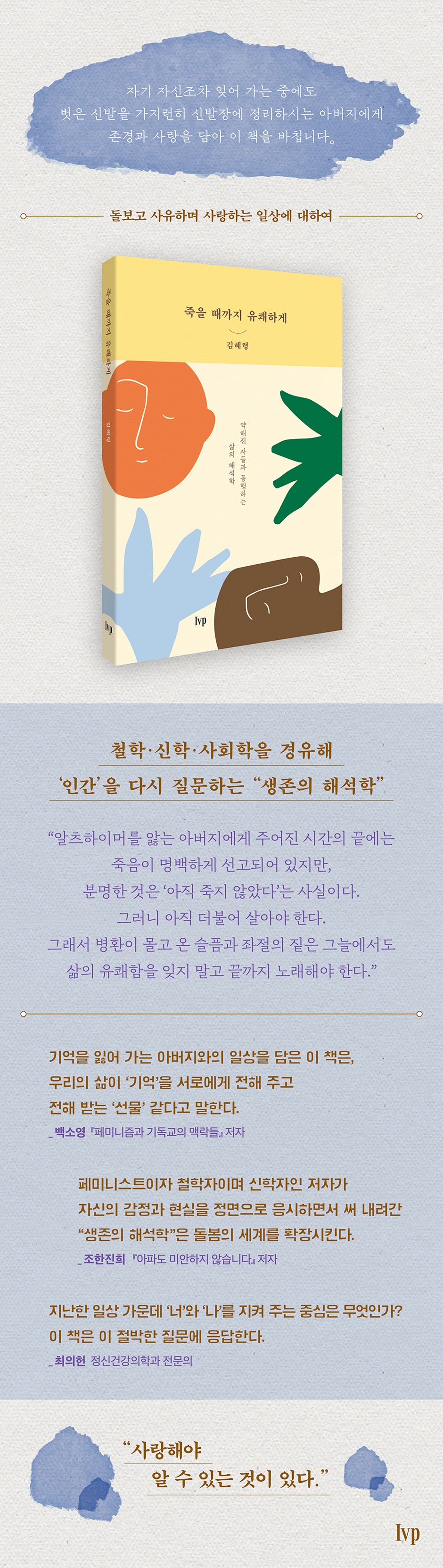
In old age, illness and weakness Re-questioning 'humanity' Jo Han-jin-hee (activist for 'Other Bodies'), Baek So-young (author of 'Contexts of Feminism and Christianity'), Recommended by Choi Ui-heon (psychiatrist) A journey of a father diagnosed with Alzheimer's and his daughter, who is also the author. In this journey, what is absolutely necessary for “both father and I to live” is none other than ‘hermeneutics.’ “Because ‘how we interpret life’ determines the way and quality of care we give to one another.” To this the author asks: "Why does my father wander outside without a destination?" "Is the aversion to incontinence justified?" "What is the ruling order that distinguishes between normal and abnormal?" Ultimately, these questions inevitably lead to the question, "What kind of being is a human?" Therefore, 『Cheerfully Until Death』 is a work of “hermeneutics of survival” that questions “humanity” through philosophy, theology, and sociology. It is a gesture of stepping out of the harsh daily life and engaging in philosophical thinking. The intense and enjoyable story begins. |
- You can preview some of the book's contents.
Preview
index
Introduction: A being that lives until death
1.
Wandering Disease Dementia: Circulating Inside and Out
2.
The ridiculous outfit makes me question things.
3.
Where all memories have vanished, patriarchy remains.
4.
The most sorry people, but we must ask again why they are sorry.
5.
Smart social life for dementia patients
6.
The people I'm most grateful for, but I have to ask myself again why I'm grateful.
7.
Theology of Caregivers: Understanding God Differently Can Help Us See People Differently
8.
Theology of Shit: Until You Allow Us to Contact
9.
If I get dementia
main
1.
Wandering Disease Dementia: Circulating Inside and Out
2.
The ridiculous outfit makes me question things.
3.
Where all memories have vanished, patriarchy remains.
4.
The most sorry people, but we must ask again why they are sorry.
5.
Smart social life for dementia patients
6.
The people I'm most grateful for, but I have to ask myself again why I'm grateful.
7.
Theology of Caregivers: Understanding God Differently Can Help Us See People Differently
8.
Theology of Shit: Until You Allow Us to Contact
9.
If I get dementia
main
Detailed image
Into the book
My father, whose cognitive and physical abilities have regressed to the level of a three or four year old, spends his waking hours looking pitiful and boring to others.
But I realize that my father is teaching me with his whole being the truth that there exists a humble stage in human life where there is not much one can do other than 'endure time'.
More than the brilliant achievements of my father in his youth, I will draw strength from the memory of the truth of life that my father testified to while enduring his illness until his death.
Theology is not just for Christians.
Theology as a hermeneutics of life is not only valid for those who are baptized, accept Christian doctrine, and attend Sunday worship.
This is because at the core of the language of theology lies the 'universal question' that asks whether our lives, which have easily ignored the vulnerabilities of others in order to survive in a world where competition operates under the highest logic, are truly justified.
--- From the "Introductory Note"
This article is not an appeal to those who do not understand dementia patients.
This essay is a hermeneutic of survival, examining the conflicts and violence that constantly arise in my mind as I struggle to live each day with my father, who has dementia, and seeking to understand my father and family again through a sense of awe for life itself.
In every moment of life, where frustration and hope intersect like an infinite dialectic, through this hermeneutics, I seek to understand my father's illness and endure my own shortcomings.
--- From "Chapter 1"
Until now, we have too easily accepted the death sentence handed down to dementia patients in their social lives, and have treated them as the most pitiful beings in the world.
They were so ashamed of him that they kept him hidden as a private person in the family.
However, humans cannot and should not exist outside of society until the day they die.
Humans have never been a 'social being' for even a single moment.
At the same time, humans do not remain fixed within a single society.
--- From Chapter 5
Growing old and needing to be cared for is something no one can avoid.
As Paul Ricoeur said, we are all “living until we die” and have a duty to take care of ourselves and each other.
The essence of this duty is not money, but sincerity.
--- From Chapter 6
On the basis of the ontology and theology of modern theology, which are rewritten in terms of changeability, vulnerability, and interrelationships, the existence of dementia patients can no longer be interpreted as cursed or inferior beings.
He is not a 'desperate being left with only death', but a 'being who lives until death'. His body and mind, which become more vulnerable day by day, give him the blessing of being able to depend on and be cared for, and give others the blessing of being able to depend on and provide care.
So on the way home, my father held my hand and I wasn't afraid, but I also held my father's hand and I wasn't able to show off to the world.
But I realize that my father is teaching me with his whole being the truth that there exists a humble stage in human life where there is not much one can do other than 'endure time'.
More than the brilliant achievements of my father in his youth, I will draw strength from the memory of the truth of life that my father testified to while enduring his illness until his death.
Theology is not just for Christians.
Theology as a hermeneutics of life is not only valid for those who are baptized, accept Christian doctrine, and attend Sunday worship.
This is because at the core of the language of theology lies the 'universal question' that asks whether our lives, which have easily ignored the vulnerabilities of others in order to survive in a world where competition operates under the highest logic, are truly justified.
--- From the "Introductory Note"
This article is not an appeal to those who do not understand dementia patients.
This essay is a hermeneutic of survival, examining the conflicts and violence that constantly arise in my mind as I struggle to live each day with my father, who has dementia, and seeking to understand my father and family again through a sense of awe for life itself.
In every moment of life, where frustration and hope intersect like an infinite dialectic, through this hermeneutics, I seek to understand my father's illness and endure my own shortcomings.
--- From "Chapter 1"
Until now, we have too easily accepted the death sentence handed down to dementia patients in their social lives, and have treated them as the most pitiful beings in the world.
They were so ashamed of him that they kept him hidden as a private person in the family.
However, humans cannot and should not exist outside of society until the day they die.
Humans have never been a 'social being' for even a single moment.
At the same time, humans do not remain fixed within a single society.
--- From Chapter 5
Growing old and needing to be cared for is something no one can avoid.
As Paul Ricoeur said, we are all “living until we die” and have a duty to take care of ourselves and each other.
The essence of this duty is not money, but sincerity.
--- From Chapter 6
On the basis of the ontology and theology of modern theology, which are rewritten in terms of changeability, vulnerability, and interrelationships, the existence of dementia patients can no longer be interpreted as cursed or inferior beings.
He is not a 'desperate being left with only death', but a 'being who lives until death'. His body and mind, which become more vulnerable day by day, give him the blessing of being able to depend on and be cared for, and give others the blessing of being able to depend on and provide care.
So on the way home, my father held my hand and I wasn't afraid, but I also held my father's hand and I wasn't able to show off to the world.
--- From Chapter 7
Publisher's Review
Accompanying a weakened father,
A journey toward change
"Cheerfully Until Death" is a book that contains the author's experiences and reflections after reuniting with his father, who was diagnosed with Alzheimer's disease.
Life together is bound to create many stories.
You will encounter new worlds, such as stories of fathers wandering outside, stories of families that have joined together, and stories of nursing assistants and care centers.
A life of companionship is a life of changing each other in that ‘new world.’
The author, too, had no choice but to change his thoughts and attitudes toward Alzheimer's and the weakened while accompanying his father.
The process of that change is honestly captured in the book.
There are many writings that discuss 'humanity' or talk about care, but 'Cheerfully Until Death' shows that there are writings that can only be written by those who are present.
The writing that passes through the body is so true and solid.
“There are things you can only understand through love.”
Many people fear getting Alzheimer's.
People with Alzheimer's disease and their families find it difficult to admit and disclose the disease.
Patients and other socially vulnerable people are easily subject to pity or disgust.
They are treated as beings who deviate from 'normal' humans.
But love does not tolerate that.
Love drives a new understanding of the Father and of the weak.
The author, a Christian ethicist, challenges "normality" by crossing the boundaries of philosophy and theology and proves that fathers still have dignity.
Because we love our father, we can understand him, and that understanding, in turn, allows us to affirm him.
In this way, love leads to knowledge, and knowledge perfects love.
This can be said to be a work of “hermeneutics of survival” and a work of “hermeneutics of love” to live together without falling into despair.
Until I die, cheerfully!
Why "pleasant"? Because the author and his father are still alive and sharing their lives.
Because we are creating stories as we live together.
The author's writing is powerful as he resists his father's gaze without pitying him.
This book is delightful, full of the energy of thought and love.
"Be Cheerful Until You Die" is a declaration that no matter how weak you become, you are still alive and still have dignity.
At the same time, this is a resistance against the dominant discourse that has defined ‘humanity.’
So we can say this:
Resistance is a celebration of life.
Therefore, resistance inevitably contains a certain ‘pleasure’.
Readers, too, will be able to read with power, encountering new language and new hermeneutics for the weakened.
Features of this book
ㆍIt contains a balanced mix of everyday stories and philosophical and theological discourses that interpret them.
ㆍYou can find language that explains the dignity of the ‘weakened.’
ㆍYou can examine the social context surrounding the disease (Alzheimer's).
ㆍQuestions about human existence are raised through personal and specific stories.
Main Readers
Readers seeking philosophical and theological essays filled with intense yet joyful life
Readers who want to learn about a new hermeneutics of 'humanity'
ㆍCaregivers and interested parties
A journey toward change
"Cheerfully Until Death" is a book that contains the author's experiences and reflections after reuniting with his father, who was diagnosed with Alzheimer's disease.
Life together is bound to create many stories.
You will encounter new worlds, such as stories of fathers wandering outside, stories of families that have joined together, and stories of nursing assistants and care centers.
A life of companionship is a life of changing each other in that ‘new world.’
The author, too, had no choice but to change his thoughts and attitudes toward Alzheimer's and the weakened while accompanying his father.
The process of that change is honestly captured in the book.
There are many writings that discuss 'humanity' or talk about care, but 'Cheerfully Until Death' shows that there are writings that can only be written by those who are present.
The writing that passes through the body is so true and solid.
“There are things you can only understand through love.”
Many people fear getting Alzheimer's.
People with Alzheimer's disease and their families find it difficult to admit and disclose the disease.
Patients and other socially vulnerable people are easily subject to pity or disgust.
They are treated as beings who deviate from 'normal' humans.
But love does not tolerate that.
Love drives a new understanding of the Father and of the weak.
The author, a Christian ethicist, challenges "normality" by crossing the boundaries of philosophy and theology and proves that fathers still have dignity.
Because we love our father, we can understand him, and that understanding, in turn, allows us to affirm him.
In this way, love leads to knowledge, and knowledge perfects love.
This can be said to be a work of “hermeneutics of survival” and a work of “hermeneutics of love” to live together without falling into despair.
Until I die, cheerfully!
Why "pleasant"? Because the author and his father are still alive and sharing their lives.
Because we are creating stories as we live together.
The author's writing is powerful as he resists his father's gaze without pitying him.
This book is delightful, full of the energy of thought and love.
"Be Cheerful Until You Die" is a declaration that no matter how weak you become, you are still alive and still have dignity.
At the same time, this is a resistance against the dominant discourse that has defined ‘humanity.’
So we can say this:
Resistance is a celebration of life.
Therefore, resistance inevitably contains a certain ‘pleasure’.
Readers, too, will be able to read with power, encountering new language and new hermeneutics for the weakened.
Features of this book
ㆍIt contains a balanced mix of everyday stories and philosophical and theological discourses that interpret them.
ㆍYou can find language that explains the dignity of the ‘weakened.’
ㆍYou can examine the social context surrounding the disease (Alzheimer's).
ㆍQuestions about human existence are raised through personal and specific stories.
Main Readers
Readers seeking philosophical and theological essays filled with intense yet joyful life
Readers who want to learn about a new hermeneutics of 'humanity'
ㆍCaregivers and interested parties
GOODS SPECIFICS
- Date of issue: December 30, 2024
- Page count, weight, size: 220 pages | 264g | 130*200*18mm
- ISBN13: 9788932823102
- ISBN10: 8932823103
You may also like
카테고리
korean


korean

![GQ KOREA Mark (Monthly): December [2025]](http://librairie.coreenne.fr/cdn/shop/files/8ef265dbbfbf186523ed75ba7319009d.jpg?v=1765340328&width=3840)


