

Great Democracy in a Dangerous Country
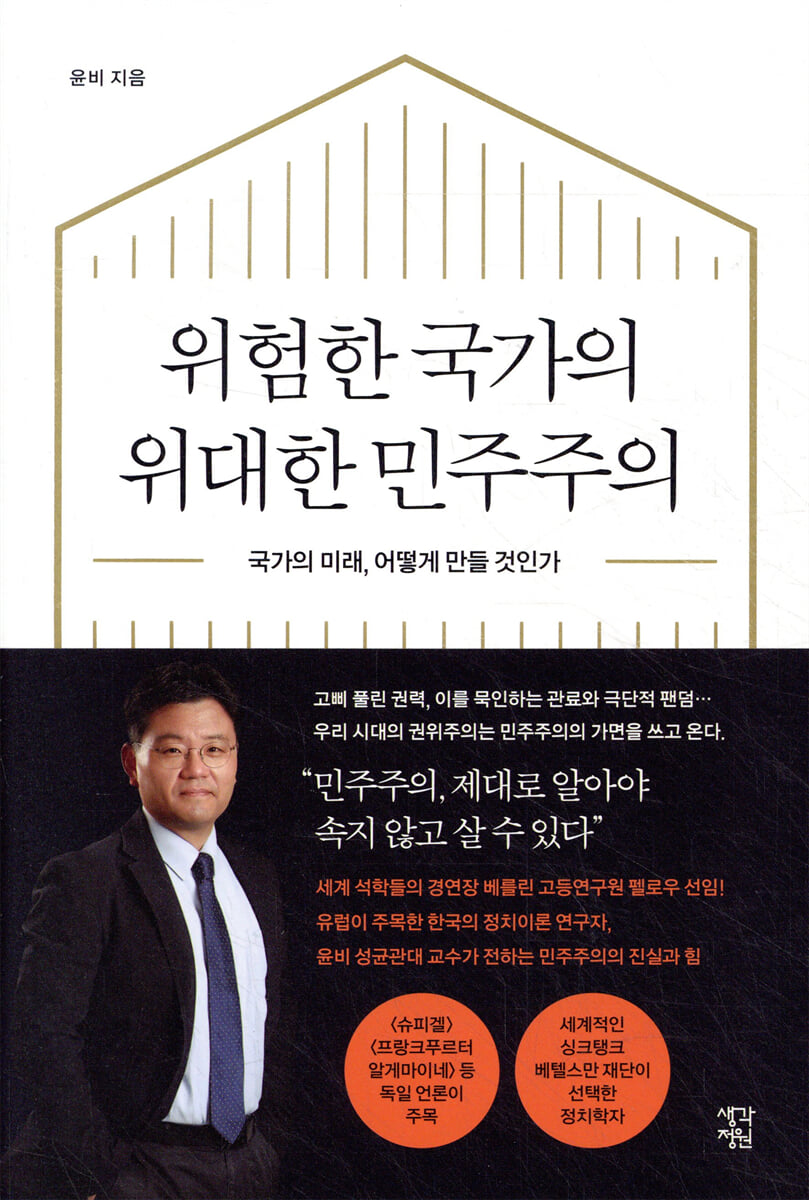 |
Description
Book Introduction
By whom and how will the country be governed?
A competition for world-renowned scholars: Fellows at the Berlin Institute for Advanced Study
The power of Korean democracy, as told by Professor Yoon Bi of Sungkyunkwan University!
There has never been a time in human history when the power of the state was stronger than it is now.
Today, the state exerts enormous influence not only on national defense but also on the economy and society as a whole.
The problem is that if the immense power of a state is misused, it can turn into something of the most fearsome.
So we ask:
“By whom and how should the state be governed?” Democracy is a system that emerged in history to answer this very question.
In the fall of 2023, Professor Yoonbi, the author of this book, was selected as a fellow at the Berlin Institute for Advanced Study, the "heart of global intellect," which has produced some of the greatest modern intellectuals, including Ulrich Beck and Pierre Bourdieu.
Here, he spent a year discussing the current state and crisis of global democracy, as well as solutions, with 30 leading social science and humanities scholars from the United States, Germany, Italy, and Korea.
Professor Yoon Bi concluded that “democracy is a system that constantly expands and evolves through the will and practice of citizens,” and that restoring democracy, which has been damaged by extreme authoritarian forces, is more urgent than ever.
This book, "The Great Democracy of a Dangerous State," contains the birth and growth of a "state" with immense power and the "democracy" that controls that power, as well as the conflicts and confrontations, and the roles and directions that the state and democracy will take.
The nation is the greatest creation of mankind for 'survival and security', and it is so powerful that no force exists today to replace the nation.
That is why the reality is that there are endless forces trying to monopolize state power.
History has recorded the forces that ignored democracy and the constitution and turned the nation into a monster.
Representative examples include Venezuela, where the two major political parties monopolize profits while ignoring the people; the worst tragedy of the Holocaust caused by “my-side politics”; and Japan’s “lost 30 years” brought about by the bureaucracy’s unchecked power.
Moreover, instances of violent seizure of power, such as Pinochet's military coup in Chile and Louis Napoleon's personal coup in France, remain warnings to democracy.
Thomas Hobbes likened the immense power of the state to the biblical monster, Leviathan.
The author argues that whether a nation truly becomes a monster or a benevolent guardian depends on the choices of each and every citizen.
He emphasizes that we are all beings riding on the back of Leviathan, and that we must monitor and keep the state in check, ultimately making the state a good guardian deity.
South Korea, unable to escape the global crisis of democracy, what kind of nation should it become after martial law on December 3, 2024? For South Korea to open up a bright future, it must begin with a renewed understanding of democracy.
Because democracy is the only force that can control a country from becoming a monster.
“In this book, I do not intend to argue that democracy is a legitimate system from the perspective of civic ethics, or that it is an expression of reason, or that it is an inevitability of history.
There are already enough books telling such stories to fill an entire bookshelf in my lab.
Instead, I ask this question:
“Are we perhaps forgetting the original urgency of democracy?” - From the author’s note
A competition for world-renowned scholars: Fellows at the Berlin Institute for Advanced Study
The power of Korean democracy, as told by Professor Yoon Bi of Sungkyunkwan University!
There has never been a time in human history when the power of the state was stronger than it is now.
Today, the state exerts enormous influence not only on national defense but also on the economy and society as a whole.
The problem is that if the immense power of a state is misused, it can turn into something of the most fearsome.
So we ask:
“By whom and how should the state be governed?” Democracy is a system that emerged in history to answer this very question.
In the fall of 2023, Professor Yoonbi, the author of this book, was selected as a fellow at the Berlin Institute for Advanced Study, the "heart of global intellect," which has produced some of the greatest modern intellectuals, including Ulrich Beck and Pierre Bourdieu.
Here, he spent a year discussing the current state and crisis of global democracy, as well as solutions, with 30 leading social science and humanities scholars from the United States, Germany, Italy, and Korea.
Professor Yoon Bi concluded that “democracy is a system that constantly expands and evolves through the will and practice of citizens,” and that restoring democracy, which has been damaged by extreme authoritarian forces, is more urgent than ever.
This book, "The Great Democracy of a Dangerous State," contains the birth and growth of a "state" with immense power and the "democracy" that controls that power, as well as the conflicts and confrontations, and the roles and directions that the state and democracy will take.
The nation is the greatest creation of mankind for 'survival and security', and it is so powerful that no force exists today to replace the nation.
That is why the reality is that there are endless forces trying to monopolize state power.
History has recorded the forces that ignored democracy and the constitution and turned the nation into a monster.
Representative examples include Venezuela, where the two major political parties monopolize profits while ignoring the people; the worst tragedy of the Holocaust caused by “my-side politics”; and Japan’s “lost 30 years” brought about by the bureaucracy’s unchecked power.
Moreover, instances of violent seizure of power, such as Pinochet's military coup in Chile and Louis Napoleon's personal coup in France, remain warnings to democracy.
Thomas Hobbes likened the immense power of the state to the biblical monster, Leviathan.
The author argues that whether a nation truly becomes a monster or a benevolent guardian depends on the choices of each and every citizen.
He emphasizes that we are all beings riding on the back of Leviathan, and that we must monitor and keep the state in check, ultimately making the state a good guardian deity.
South Korea, unable to escape the global crisis of democracy, what kind of nation should it become after martial law on December 3, 2024? For South Korea to open up a bright future, it must begin with a renewed understanding of democracy.
Because democracy is the only force that can control a country from becoming a monster.
“In this book, I do not intend to argue that democracy is a legitimate system from the perspective of civic ethics, or that it is an expression of reason, or that it is an inevitability of history.
There are already enough books telling such stories to fill an entire bookshelf in my lab.
Instead, I ask this question:
“Are we perhaps forgetting the original urgency of democracy?” - From the author’s note
index
Prologue│Why does a country need democracy?
Part 1 What is a State?
Chapter 1 Imagine a world without a state…
A nation full of words and troubles... Is a world without a nation possible? Was Hae-gap, who "fled south," truly happy? Why the nation must be used wisely.
Chapter 2: We Ride on Leviathan's Back
The story of an Iranian trapped in a Paris airport for 18 years│The state, a creation made by humans│Hobbes ponders the reason for the state's existence│How to stop the war of all against all│The birth of a monster... Will we handle it well or become prey?
Chapter 3: A Nation That Does Not Serve You Has No Need to Exist
Gilgamesh, the birth of an overwhelming human being│A leader's virtues are more important than great power│A nation is a means to address the needs of the community│Why did Bismarck, an iron-fisted conservative, introduce the world's first social security system?│'Sharing the cake' vs. 'Safety pins that block anxiety'│The greater the government's intervention, the less individual freedom?│What is the difference between good welfare and populism?│Welfare is a duty of a democratic nation.
Chapter 4 What is the most powerful weapon for controlling power in human history?
Americans Didn't Like Democracy│Ancient Greece: "Democracy is a corrupted form of politics"│"The people want what's good, but they don't always know what it is."│The Enlightenment philosophers loved democracy?│Revolution, war, and America... The secret to democracy's critical popularity│Democracy, the soil where insight and innovation grow
Part 2: How Democracy Collapses
Chapter 5: What Happens When Parliament Becomes a League of Its Own: The Rise of Oligarchy and the Fall of Representative Democracy
Congress can be transformed into a tool of oligarchy at any time. │ What's happening in Venezuela, where 94 percent live in poverty? │ The two major parties share the profits from oil. │ A diverse Congress is a prerequisite for democratic success. │ The power of democratic success: a thinking voter.
Chapter 6: A People Ready to Be Deceived by the Leader's Schemes: The Black-and-White Logic of the Factions
'There is only foul language and incitement, and deliberation and compromise have disappeared'│I was deceived.
But I was prepared to be deceived.│How does factional logic brainwash us?│YouTube, a rotten flower blooming on factional logic.│Fandom politics, blind love corrupts people.│Distrust those in power! But be wise!
Chapter 7: The True Nature of the Most Powerful Power, Uncontrollable Even by the Japanese Prime Minister: Bureaucratic Incompetence and Corruption
The narrow perspective and conservatism of bureaucracies│Why do they resist change│A country controlled by bureaucracies has no future│Why did bureaucrats say there was no liquidity crisis just before the IMF financial crisis?│Japan's lost 30 years... How did bureaucrats influence businesspeople and politicians?
Part 3: Countries that became monsters
Chapter 8: How Do Leaders Who Wield Absolute Power Overthrow Nations?: The Case of Venezuela
The Illusion of Strong Leadership│From Military Coup to Oligarchy, the World's Largest Oil Producer Becomes a Corrupt Paradise│Chavez: The Rise of Another Absolute Power│'My-Face Politics': Private Profits at the Cost of People's Lives
Chapter 9: Why Are Italian Youth Embarking on the Exodus?: The Case of Italy
An absurd daily life in Rome│The Mani Pulite scandal that shook Italy│Gang politics engulfs Italy│The prime minister who has become a laughing stock in Europe│The A3 motorway completed after 54 years│Young people with no future embark on an exodus│Korea's future is not the Italian way
Chapter 10: How Coups Destroy Democracy: The Cases of Chile and France
The atrocities of a monster state, a traumatized people│Chile's Pinochet bombs the presidential palace with fighter jets│Louis Napoleon's coup d'état, dreaming of absolute power│How authoritarian leaders seize power│How Korea must avoid regressing to authoritarianism
Part 4: What kind of country does Korea dream of becoming?
Chapter 11: Compete with a Vision for the Challenges of Our Times: The Role of Liberal and Conservative Forces
Lost Common Values and Visions│Living 'Long' with People with 'Different Memories'│How Has Korean Conservatism Grow?│Conservative Identity: Why We Must Transcend Anti-Communism and Authoritarianism│What Vision Does Conservatism Have for the Future of Korea?│The Democratic Party, the Biggest Beneficiary of the Two-Party System│Civil Society Can Leave the Democratic Party at Any Time│Find Freedom and Conservatism: Democratic Coexistence
Chapter 12: Why is 'consensus' important to 21st-century leaders?: The role and conditions of leadership.
In this rapidly changing era, what qualities does a good leader need? │Weber: Those who become zombies of power throw the world into chaos │Democracy: Choosing a safe national power │A leader who does not follow the law has no need to exist │How can we find common ground amidst 'differences'?
Chapter 13: What Determines Korea's Future Competitiveness?: Political, Social, and Economic Systems
Future Competitiveness ① Fairness and Participation│Future Competitiveness ② National System Reform│Future Competitiveness ③ Talent War and Openness
Epilogue│Democracy is the Path to a Nation's Future Competitiveness
Acknowledgments and References
Part 1 What is a State?
Chapter 1 Imagine a world without a state…
A nation full of words and troubles... Is a world without a nation possible? Was Hae-gap, who "fled south," truly happy? Why the nation must be used wisely.
Chapter 2: We Ride on Leviathan's Back
The story of an Iranian trapped in a Paris airport for 18 years│The state, a creation made by humans│Hobbes ponders the reason for the state's existence│How to stop the war of all against all│The birth of a monster... Will we handle it well or become prey?
Chapter 3: A Nation That Does Not Serve You Has No Need to Exist
Gilgamesh, the birth of an overwhelming human being│A leader's virtues are more important than great power│A nation is a means to address the needs of the community│Why did Bismarck, an iron-fisted conservative, introduce the world's first social security system?│'Sharing the cake' vs. 'Safety pins that block anxiety'│The greater the government's intervention, the less individual freedom?│What is the difference between good welfare and populism?│Welfare is a duty of a democratic nation.
Chapter 4 What is the most powerful weapon for controlling power in human history?
Americans Didn't Like Democracy│Ancient Greece: "Democracy is a corrupted form of politics"│"The people want what's good, but they don't always know what it is."│The Enlightenment philosophers loved democracy?│Revolution, war, and America... The secret to democracy's critical popularity│Democracy, the soil where insight and innovation grow
Part 2: How Democracy Collapses
Chapter 5: What Happens When Parliament Becomes a League of Its Own: The Rise of Oligarchy and the Fall of Representative Democracy
Congress can be transformed into a tool of oligarchy at any time. │ What's happening in Venezuela, where 94 percent live in poverty? │ The two major parties share the profits from oil. │ A diverse Congress is a prerequisite for democratic success. │ The power of democratic success: a thinking voter.
Chapter 6: A People Ready to Be Deceived by the Leader's Schemes: The Black-and-White Logic of the Factions
'There is only foul language and incitement, and deliberation and compromise have disappeared'│I was deceived.
But I was prepared to be deceived.│How does factional logic brainwash us?│YouTube, a rotten flower blooming on factional logic.│Fandom politics, blind love corrupts people.│Distrust those in power! But be wise!
Chapter 7: The True Nature of the Most Powerful Power, Uncontrollable Even by the Japanese Prime Minister: Bureaucratic Incompetence and Corruption
The narrow perspective and conservatism of bureaucracies│Why do they resist change│A country controlled by bureaucracies has no future│Why did bureaucrats say there was no liquidity crisis just before the IMF financial crisis?│Japan's lost 30 years... How did bureaucrats influence businesspeople and politicians?
Part 3: Countries that became monsters
Chapter 8: How Do Leaders Who Wield Absolute Power Overthrow Nations?: The Case of Venezuela
The Illusion of Strong Leadership│From Military Coup to Oligarchy, the World's Largest Oil Producer Becomes a Corrupt Paradise│Chavez: The Rise of Another Absolute Power│'My-Face Politics': Private Profits at the Cost of People's Lives
Chapter 9: Why Are Italian Youth Embarking on the Exodus?: The Case of Italy
An absurd daily life in Rome│The Mani Pulite scandal that shook Italy│Gang politics engulfs Italy│The prime minister who has become a laughing stock in Europe│The A3 motorway completed after 54 years│Young people with no future embark on an exodus│Korea's future is not the Italian way
Chapter 10: How Coups Destroy Democracy: The Cases of Chile and France
The atrocities of a monster state, a traumatized people│Chile's Pinochet bombs the presidential palace with fighter jets│Louis Napoleon's coup d'état, dreaming of absolute power│How authoritarian leaders seize power│How Korea must avoid regressing to authoritarianism
Part 4: What kind of country does Korea dream of becoming?
Chapter 11: Compete with a Vision for the Challenges of Our Times: The Role of Liberal and Conservative Forces
Lost Common Values and Visions│Living 'Long' with People with 'Different Memories'│How Has Korean Conservatism Grow?│Conservative Identity: Why We Must Transcend Anti-Communism and Authoritarianism│What Vision Does Conservatism Have for the Future of Korea?│The Democratic Party, the Biggest Beneficiary of the Two-Party System│Civil Society Can Leave the Democratic Party at Any Time│Find Freedom and Conservatism: Democratic Coexistence
Chapter 12: Why is 'consensus' important to 21st-century leaders?: The role and conditions of leadership.
In this rapidly changing era, what qualities does a good leader need? │Weber: Those who become zombies of power throw the world into chaos │Democracy: Choosing a safe national power │A leader who does not follow the law has no need to exist │How can we find common ground amidst 'differences'?
Chapter 13: What Determines Korea's Future Competitiveness?: Political, Social, and Economic Systems
Future Competitiveness ① Fairness and Participation│Future Competitiveness ② National System Reform│Future Competitiveness ③ Talent War and Openness
Epilogue│Democracy is the Path to a Nation's Future Competitiveness
Acknowledgments and References
Detailed image

Into the book
In this article, I wanted to rekindle that sense of urgency.
The state is the most powerful, complex, and enormous creation ever created by man.
No organization today, and no organization ever will, can mobilize more people and resources than a nation.
The reasons and processes for the creation of such a great power are diverse, but one thing is clear: if this power is misused, it can become the most terrifying thing.
Therefore, the question inevitably arises: “By whom and how will the state be controlled?”
Democracy has appeared in history from the beginning as an answer to these questions.
I said earlier, “We must understand what a nation is.
“You have to understand it to use it properly,” he said.
Now, we could rephrase this statement like this:
“We are riding on the back of Leviathan.
You must know how to properly handle monsters.
If you don't, you might fall off the monster's back and become food."
A nation that seems as natural as air is actually completely artificial.
It means that it was created by humans.
The greatest and most wonderful of human creations is the state.
In some sense, it could be called a miracle.
Especially the well-developed modern state is unrivaled in its scale and complexity by any human creation.
No institution or structure created by man has brought about as many benefits as the state.
Countless lives have been saved thanks to the state, and society has become safer and more orderly.
The word artificial also means that if left unattended, it could disappear.
The 17th century, when Hobbes lived, was a time when the modern state was gradually beginning to take shape.
And now, four centuries later, as he predicted, the state has become the most powerful entity in the world.
In 2023, the Stockholm International Peace Research Institute (SIPRI) compared the defense spending of each country in 2022.
According to this, the United States ranked first with 1,167 trillion won spent, followed by China with 338 trillion won, Japan with 61 trillion won, and South Korea with slightly more at 61.5 trillion won spent on defense.
This money shows the amount and level of violence the state can mobilize.
The heads of government in each country today, namely presidents and prime ministers, are the most capable of mobilizing violence in human history.
Italian politics clearly demonstrates what happens when cronyism, corruption, and factionalism take hold within a seemingly sound democratic system.
(Readers of this article will find many places in Italy where the experience is strikingly similar to ours.) But one thing is clear.
If we follow Italy's path, we have no future.
In 1995, German historian Jens Petersen titled his book Quo Vadis, Italia (Italy, Where Are You Going?).
Twenty years later, we can now say with certainty what path Italy has taken.
It was a path of division, decline, and disappointment.
Looking at Italy, shouldn't we also ask ourselves, "Quo Vadis, Korea?" Aren't we standing on the road to Italy?
January 6, 2021 was the day Congress officially certified the election of Joe Biden as the 46th President of the United States.
But on that day, a tragic event occurred that will forever be remembered in the history of American democracy.
Supporters of then-President Donald Trump violently occupied the U.S. Capitol in protest of the election results.
The one who incited this riot was none other than Trump himself.
Democracy and the rule of law are like reins that keep the state from becoming a monster and serve the lives of its citizens.
If these two principles are broken, the state can reveal its dangerous claws and devour its citizens.
The attack on the US Capitol by Trump supporters shows that such a nightmare scenario can become a reality even in today's democracy.
We must remember that those who brought the country to its knees through coups and authoritarianism did not threaten the people only with guns and swords.
The reason they were able to hold on to power for so long and bring down the country was because they had a lot of people supporting them.
Authoritarianism triumphed on the shoulders of those who believed it was okay to destroy constitutional order and the principles of democracy to achieve what they believed in.
In a situation where people not only advocate authoritarianism but also storm courts and threaten judges, no one can believe that democracy in Korean society will continue to thrive simply by punishing those responsible for martial law.
The greatest obstacle to the healthy development of conservatism is its regression to authoritarianism.
Conservatives must establish a vision that respects democratic values and allows them to coexist with political parties with different orientations and opinions, and then renew their agenda accordingly.
We need to rethink what conservatives think freedom, equality, and fairness are, and what their growth strategy is, within the framework of parliamentary democracy.
If conservatives continue to regress, it will not only be unfortunate for them.
This is because the deformity of conservatism causes distortion in the political landscape of Korea.
The greatest strength of Korean democracy is that a strong consensus on democracy exists within civil society.
Civil society has resisted strongly whenever Korean democracy has been challenged by authoritarianism.
But there is a fact that is overlooked here.
Korean civil society, like that of other advanced democratic countries, is a place where diverse interests, concerns, political, economic, and social visions coexist, become intertwined, and sometimes conflict.
A conservative party that fails to demonstrate anything beyond regression will naturally face increasing ostracism from civil society. Similarly, the Democratic Party, if it fails to reflect the changing times, could face severe criticism from the public.
12.3 Martial law originated from a leader who did not understand the meaning of the rule of law and pluralistic parliamentarism.
A leader who spent his life as a prosecutor and believed that anything was possible if he could justify it by stretching and twisting the wording of the law, a leader who immediately misinterpreted opposition and criticism from the opposition party as anti-state, has driven Korean democracy to the brink of ruin.
Responsibility for this also lies with the citizens who made such people leaders.
But just as important as punishment and discipline, if not more important, is not to repeat such mistakes.
I wrote this book for those who are concerned about democracy, especially the reality of Korean democracy.
I wanted to see how democracy could serve as a good guiding force in the face of the growing power of the state since its appearance on Earth about half a millennium ago.
As many people acknowledge, democracy is not perfect.
But there is no more effective way (at least not yet) to ensure that the powerful force of the state serves our well-being rather than destroying our lives than democracy.
Democracy remains a wonderful and attractive object in which to 'invest' our blood and sweat.
The state is the most powerful, complex, and enormous creation ever created by man.
No organization today, and no organization ever will, can mobilize more people and resources than a nation.
The reasons and processes for the creation of such a great power are diverse, but one thing is clear: if this power is misused, it can become the most terrifying thing.
Therefore, the question inevitably arises: “By whom and how will the state be controlled?”
Democracy has appeared in history from the beginning as an answer to these questions.
I said earlier, “We must understand what a nation is.
“You have to understand it to use it properly,” he said.
Now, we could rephrase this statement like this:
“We are riding on the back of Leviathan.
You must know how to properly handle monsters.
If you don't, you might fall off the monster's back and become food."
A nation that seems as natural as air is actually completely artificial.
It means that it was created by humans.
The greatest and most wonderful of human creations is the state.
In some sense, it could be called a miracle.
Especially the well-developed modern state is unrivaled in its scale and complexity by any human creation.
No institution or structure created by man has brought about as many benefits as the state.
Countless lives have been saved thanks to the state, and society has become safer and more orderly.
The word artificial also means that if left unattended, it could disappear.
The 17th century, when Hobbes lived, was a time when the modern state was gradually beginning to take shape.
And now, four centuries later, as he predicted, the state has become the most powerful entity in the world.
In 2023, the Stockholm International Peace Research Institute (SIPRI) compared the defense spending of each country in 2022.
According to this, the United States ranked first with 1,167 trillion won spent, followed by China with 338 trillion won, Japan with 61 trillion won, and South Korea with slightly more at 61.5 trillion won spent on defense.
This money shows the amount and level of violence the state can mobilize.
The heads of government in each country today, namely presidents and prime ministers, are the most capable of mobilizing violence in human history.
Italian politics clearly demonstrates what happens when cronyism, corruption, and factionalism take hold within a seemingly sound democratic system.
(Readers of this article will find many places in Italy where the experience is strikingly similar to ours.) But one thing is clear.
If we follow Italy's path, we have no future.
In 1995, German historian Jens Petersen titled his book Quo Vadis, Italia (Italy, Where Are You Going?).
Twenty years later, we can now say with certainty what path Italy has taken.
It was a path of division, decline, and disappointment.
Looking at Italy, shouldn't we also ask ourselves, "Quo Vadis, Korea?" Aren't we standing on the road to Italy?
January 6, 2021 was the day Congress officially certified the election of Joe Biden as the 46th President of the United States.
But on that day, a tragic event occurred that will forever be remembered in the history of American democracy.
Supporters of then-President Donald Trump violently occupied the U.S. Capitol in protest of the election results.
The one who incited this riot was none other than Trump himself.
Democracy and the rule of law are like reins that keep the state from becoming a monster and serve the lives of its citizens.
If these two principles are broken, the state can reveal its dangerous claws and devour its citizens.
The attack on the US Capitol by Trump supporters shows that such a nightmare scenario can become a reality even in today's democracy.
We must remember that those who brought the country to its knees through coups and authoritarianism did not threaten the people only with guns and swords.
The reason they were able to hold on to power for so long and bring down the country was because they had a lot of people supporting them.
Authoritarianism triumphed on the shoulders of those who believed it was okay to destroy constitutional order and the principles of democracy to achieve what they believed in.
In a situation where people not only advocate authoritarianism but also storm courts and threaten judges, no one can believe that democracy in Korean society will continue to thrive simply by punishing those responsible for martial law.
The greatest obstacle to the healthy development of conservatism is its regression to authoritarianism.
Conservatives must establish a vision that respects democratic values and allows them to coexist with political parties with different orientations and opinions, and then renew their agenda accordingly.
We need to rethink what conservatives think freedom, equality, and fairness are, and what their growth strategy is, within the framework of parliamentary democracy.
If conservatives continue to regress, it will not only be unfortunate for them.
This is because the deformity of conservatism causes distortion in the political landscape of Korea.
The greatest strength of Korean democracy is that a strong consensus on democracy exists within civil society.
Civil society has resisted strongly whenever Korean democracy has been challenged by authoritarianism.
But there is a fact that is overlooked here.
Korean civil society, like that of other advanced democratic countries, is a place where diverse interests, concerns, political, economic, and social visions coexist, become intertwined, and sometimes conflict.
A conservative party that fails to demonstrate anything beyond regression will naturally face increasing ostracism from civil society. Similarly, the Democratic Party, if it fails to reflect the changing times, could face severe criticism from the public.
12.3 Martial law originated from a leader who did not understand the meaning of the rule of law and pluralistic parliamentarism.
A leader who spent his life as a prosecutor and believed that anything was possible if he could justify it by stretching and twisting the wording of the law, a leader who immediately misinterpreted opposition and criticism from the opposition party as anti-state, has driven Korean democracy to the brink of ruin.
Responsibility for this also lies with the citizens who made such people leaders.
But just as important as punishment and discipline, if not more important, is not to repeat such mistakes.
I wrote this book for those who are concerned about democracy, especially the reality of Korean democracy.
I wanted to see how democracy could serve as a good guiding force in the face of the growing power of the state since its appearance on Earth about half a millennium ago.
As many people acknowledge, democracy is not perfect.
But there is no more effective way (at least not yet) to ensure that the powerful force of the state serves our well-being rather than destroying our lives than democracy.
Democracy remains a wonderful and attractive object in which to 'invest' our blood and sweat.
--- From the text
Publisher's Review
Is the state a monster or a benevolent guardian?
The only power that controls the country,
Pay attention to democracy
Today we live in an age where it is impossible to explain existence without leaving the country.
There is no space on Earth that is not part of a country's territory, except for the North and South Poles and the high seas, and you cannot even enter a foreign country without a passport that specifies your nationality.
Although the state is deeply intertwined with the lives of individuals, it is essentially a human-made artifact.
According to Thomas Hobbes, in order to stop the state of 'war of all against all', humans gave up their 'natural rights' and delegated that authority to an artificial person, the state.
Nations, strengthened by the combined power of individuals, have shaped human history by pursuing the safety and peace of the community.
Hobbes declared that there was nothing on earth that could stand against the state, and 400 years later, his prediction has come true.
If we look at defense spending today, we find that there is no entity capable of mobilizing greater military power than a nation.
According to the 2023 global defense budget data, the United States spends 1,167 trillion won annually, China 338 trillion won, South Korea 61.5 trillion won, and Japan 61 trillion won.
The reason the state has become so powerful is because of the positive role it plays.
While the early states guaranteed life from external enemies, the role of the state has become so sophisticated in modern times that there is no field beyond its reach, including not only the economy but also politics, diplomacy, and culture.
In particular, the government has contributed to the safety and well-being of its citizens by providing various services, such as investing in future technologies, redistributing wealth, expanding low-profit social infrastructure such as highway construction, and preparing facilities for epidemics and large-scale disasters such as pandemics and wildfires.
Despite these positive roles, however, predictions of the collapse of the state persist among political scientists and historians today.
In fact, the era in which one nation destroyed another by force, as in past history, is over.
As the 2021 war in Afghanistan and the current war in Ukraine demonstrate, the economic losses from war far outweigh the gains for the aggressor nation.
Why, then, does the national crisis persist? It arises when the state's immense power is not properly controlled.
When a few people monopolize power, political and economic corruption occurs, ultimately leading to paralysis of the country.
Citizens are forced into poverty or flee abroad as economic activity becomes difficult.
Ultimately, the fact that a minority monopolizes power means that the democracy that controls the country is not functioning properly.
The moment power escapes the checks and balances of the citizens, the state can turn into a 'dangerous' entity at any time.
“I said earlier, “We must understand what a nation is.
“You have to understand it to use it properly,” he said.
Now, we could rephrase this statement like this:
“We are riding on the back of Leviathan.
You must know how to properly handle monsters.
If you don't, you might fall off the monster's back and become food." - From the author's note
How does a nation become a monster?
From coups to corruption
How Unchecked Power Destroys Nations
Today, the world is experiencing a surge in threats to democracy.
In the US, Trump took office after the Capitol riot, and in Germany, the far-right Alternative for Germany (AfD) party became the second-largest political party.
In South Korea, the Constitutional Court unanimously dismissed the Yoon Seok-yeol administration, but protests by the opposition continue.
As history has proven, the actions of these authoritarian forces threaten democracy and ultimately turn the nation into a monster.
A nation that has become a monster paralyzes the legislative, judicial, and executive functions based on democracy and the constitution, and leads the economy to bankruptcy.
People are left to suffer from poverty or are forced to flee abroad.
The author identifies three enemies that can turn a democratic nation into a monster.
The first is the breakdown of representative democracy, that is, when parliament has degenerated into an oligarchy.
The voice of the people is silenced, and the two major parties divide power like pie.
The case of Venezuela is representative.
In October 1958, Venezuela's two major political parties, the Christian Socialist Party and the Democratic Action Party, signed a special agreement.
The agreement calls for the two parties to share the profits from the oil industry, with the winning party agreeing to hand out key government and related positions to its supporters.
Because its main source of income was oil, it had no need to worry about voters, and its administration was dominated by corruption, incompetence, and inefficiency from the two major parties.
The problem began to erupt in 1989 as international crude oil prices began to fall.
The exchange rate skyrocketed and prices soared.
As unemployment soared, citizens rose up, and the military suppressed them, resulting in the deaths of about 3,000 people.
Ultimately, Venezuela's GDP fell by more than 75 percent between 2013 and 2021, and 94 percent of the population fell into poverty in 2021.
The second is when dialogue and agreement disappear as camp logic prevails.
Camp logic divides all issues into good for one side and evil for the other.
This stimulates the human psyche, inducing brainwashing and ultimately inciting hatred and contempt for the other person, leading to violence.
Hitler and the Nazi Party are representative examples.
When the German military leadership lost World War I, they spread the lie that the defeat was due to the "Dolchlegende", the betrayal of the socialists and Jews.
A significant number of German citizens, their pride wounded by the defeat in the war, were deceived by these lies.
Hitler and his followers exploited this psychology of the German people and eventually seized power.
As a result, Hitler and the Nazi Party committed an atrocity that will be recorded in human history, murdering 6 million socialists and Jews over 12 years.
The third is the incompetence of the bureaucracy and the power-type corruption of bureaucrats.
Japan is a good example of what kind of difficulties a country faces when a bureaucracy mired in organizational egoism takes control of politics.
Japanese scholar Yoshimi Shunya, analyzing Japan's "lost 30 years," argues that Japanese politics was dominated by bureaucrats.
Unlike other countries, Japanese officials not only drafted laws but also held the authority to grant permits for various businesses, and had the power to order businesspeople to "do this" and "don't do that" under the guise of administrative guidance.
Regarding this, Sunya wrote, “It was politicians who performed the drama on stage, but it was usually bureaucrats who directed it.”
The most important cause of the country's downfall is its citizens.
The forces that led the nation to its downfall did not threaten its citizens only with guns and swords.
Because there were quite a few people who supported them in seizing power.
The victory of authoritarian forces was possible because there were those who believed that it was okay to destroy the constitutional order and the principles of democracy in order to achieve what they believed in.
Even today, democracy is threatened by numerous authoritarian forces around the world.
We must not forget that without citizen oversight and checks and balances, democracy can collapse at any time.
How will we shape the future of the Republic of Korea?
The key again is democracy!
A democratic system prevents power from being concentrated in the hands of a specific individual or group, preventing anyone from wielding dictatorial power.
The bureaucracy is controlled by a president or prime minister elected by the people and ministers appointed by them, and operates according to laws and principles established by the legislature.
In human history, it is very rare for state power to be institutionally controlled like this.
Amartya Sen, a Nobel Prize winner in economics, said that democracy has a positive effect on social development by controlling state power, and Acemoglu, a professor at MIT and author of Why Nations Fail, said that democracy makes a crucial contribution to the growth and prosperity of a country.
In a system of absolute power, one wrong decision can lead to the destruction of the entire community, but in a democratic system, the decentralization of power and mutual checks and balances relatively reduce such risk.
Moreover, in a democratic society, diverse opinions can be expressed, allowing important insights to be actively reflected and institutional innovation to flourish.
We take democracy for granted, but only 200 years ago, few would have predicted that this system would become mainstream.
According to the Federalist Message, published in 1787, even the leaders who laid the foundations of what is now the United States harbored deep doubts about democracy, especially about equal suffrage.
They worried that if the influence of ordinary citizens, such as farmers, self-employed people, and small business owners, grew too large, "tyranny of the majority" would become inevitable.
In fact, popular political participation has historically faced opposition for a long time.
The ancient Plato was critical of democracy, and even Rousseau, who had a great influence on the French Revolution, warned that the people's judgment was not always right.
John Stuart Mill went even further, proposing to differentiate suffrage based on education and wealth.
How did a democracy so fraught with discontent gain such global support? Revolution, war, and the influence of the United States played a significant role.
According to Acemoglu, the right to vote was first granted to adult men and women as a compromise to a series of revolutions that swept through 19th-century Europe, including the July Revolution and the February Revolution.
In fact, Lord Grey of England even stated that the expansion of the franchise in 1832 was a measure to prevent revolution.
Meanwhile, according to Casey, author of "The Right to Vote," the war played a decisive role in expanding the right to vote.
As the 20th century began, the scale of war grew and developed into total war, forcing not only soldiers but also women and children to work day and night at military factories, operating machines.
In this process, when the entire nation was mobilized for war, the ruling elites gave up their right to vote as compensation.
Finally, the influence of the United States cannot be overlooked in the background of the spread of democracy.
In 1917, when the United States entered World War I, President Wilson put forward "democracy" as a slogan symbolizing America's identity and ideology in opposition to German militarism.
He described the war as a "holy war" to protect and spread democracy around the world, and it brought the United States into the international spotlight.
Afterwards, as the system competed with the socialist bloc, including the Soviet Union, a global craze for democracy began to rise.
Democracy is not simply a system for controlling state power.
It is also the future competitiveness of the country today.
A sustainable future cannot exist in a society where corruption is rampant and individual rights are ignored.
Creativity, innovation, and fairness are only possible when democracy is guaranteed.
If democracy collapses, young talent will have no reason to stay in their country, and attracting talent from abroad will become impossible.
Moreover, no country would accept an authoritarian state as a partner in human rights and the environment.
In the end, even our right to pursue happiness cannot be guaranteed.
Because stability, abundance, and fulfillment of life can only be achieved through democracy.
“I wrote this book for those who are concerned about the reality of Korean democracy.
As many people acknowledge, democracy is not perfect.
But there is no more effective way (at least not yet) to ensure that the powerful force of the state serves our well-being rather than destroying our lives than democracy.
Democracy remains a wonderful and attractive object in which to 'invest' our blood and sweat.” - From the text
The only power that controls the country,
Pay attention to democracy
Today we live in an age where it is impossible to explain existence without leaving the country.
There is no space on Earth that is not part of a country's territory, except for the North and South Poles and the high seas, and you cannot even enter a foreign country without a passport that specifies your nationality.
Although the state is deeply intertwined with the lives of individuals, it is essentially a human-made artifact.
According to Thomas Hobbes, in order to stop the state of 'war of all against all', humans gave up their 'natural rights' and delegated that authority to an artificial person, the state.
Nations, strengthened by the combined power of individuals, have shaped human history by pursuing the safety and peace of the community.
Hobbes declared that there was nothing on earth that could stand against the state, and 400 years later, his prediction has come true.
If we look at defense spending today, we find that there is no entity capable of mobilizing greater military power than a nation.
According to the 2023 global defense budget data, the United States spends 1,167 trillion won annually, China 338 trillion won, South Korea 61.5 trillion won, and Japan 61 trillion won.
The reason the state has become so powerful is because of the positive role it plays.
While the early states guaranteed life from external enemies, the role of the state has become so sophisticated in modern times that there is no field beyond its reach, including not only the economy but also politics, diplomacy, and culture.
In particular, the government has contributed to the safety and well-being of its citizens by providing various services, such as investing in future technologies, redistributing wealth, expanding low-profit social infrastructure such as highway construction, and preparing facilities for epidemics and large-scale disasters such as pandemics and wildfires.
Despite these positive roles, however, predictions of the collapse of the state persist among political scientists and historians today.
In fact, the era in which one nation destroyed another by force, as in past history, is over.
As the 2021 war in Afghanistan and the current war in Ukraine demonstrate, the economic losses from war far outweigh the gains for the aggressor nation.
Why, then, does the national crisis persist? It arises when the state's immense power is not properly controlled.
When a few people monopolize power, political and economic corruption occurs, ultimately leading to paralysis of the country.
Citizens are forced into poverty or flee abroad as economic activity becomes difficult.
Ultimately, the fact that a minority monopolizes power means that the democracy that controls the country is not functioning properly.
The moment power escapes the checks and balances of the citizens, the state can turn into a 'dangerous' entity at any time.
“I said earlier, “We must understand what a nation is.
“You have to understand it to use it properly,” he said.
Now, we could rephrase this statement like this:
“We are riding on the back of Leviathan.
You must know how to properly handle monsters.
If you don't, you might fall off the monster's back and become food." - From the author's note
How does a nation become a monster?
From coups to corruption
How Unchecked Power Destroys Nations
Today, the world is experiencing a surge in threats to democracy.
In the US, Trump took office after the Capitol riot, and in Germany, the far-right Alternative for Germany (AfD) party became the second-largest political party.
In South Korea, the Constitutional Court unanimously dismissed the Yoon Seok-yeol administration, but protests by the opposition continue.
As history has proven, the actions of these authoritarian forces threaten democracy and ultimately turn the nation into a monster.
A nation that has become a monster paralyzes the legislative, judicial, and executive functions based on democracy and the constitution, and leads the economy to bankruptcy.
People are left to suffer from poverty or are forced to flee abroad.
The author identifies three enemies that can turn a democratic nation into a monster.
The first is the breakdown of representative democracy, that is, when parliament has degenerated into an oligarchy.
The voice of the people is silenced, and the two major parties divide power like pie.
The case of Venezuela is representative.
In October 1958, Venezuela's two major political parties, the Christian Socialist Party and the Democratic Action Party, signed a special agreement.
The agreement calls for the two parties to share the profits from the oil industry, with the winning party agreeing to hand out key government and related positions to its supporters.
Because its main source of income was oil, it had no need to worry about voters, and its administration was dominated by corruption, incompetence, and inefficiency from the two major parties.
The problem began to erupt in 1989 as international crude oil prices began to fall.
The exchange rate skyrocketed and prices soared.
As unemployment soared, citizens rose up, and the military suppressed them, resulting in the deaths of about 3,000 people.
Ultimately, Venezuela's GDP fell by more than 75 percent between 2013 and 2021, and 94 percent of the population fell into poverty in 2021.
The second is when dialogue and agreement disappear as camp logic prevails.
Camp logic divides all issues into good for one side and evil for the other.
This stimulates the human psyche, inducing brainwashing and ultimately inciting hatred and contempt for the other person, leading to violence.
Hitler and the Nazi Party are representative examples.
When the German military leadership lost World War I, they spread the lie that the defeat was due to the "Dolchlegende", the betrayal of the socialists and Jews.
A significant number of German citizens, their pride wounded by the defeat in the war, were deceived by these lies.
Hitler and his followers exploited this psychology of the German people and eventually seized power.
As a result, Hitler and the Nazi Party committed an atrocity that will be recorded in human history, murdering 6 million socialists and Jews over 12 years.
The third is the incompetence of the bureaucracy and the power-type corruption of bureaucrats.
Japan is a good example of what kind of difficulties a country faces when a bureaucracy mired in organizational egoism takes control of politics.
Japanese scholar Yoshimi Shunya, analyzing Japan's "lost 30 years," argues that Japanese politics was dominated by bureaucrats.
Unlike other countries, Japanese officials not only drafted laws but also held the authority to grant permits for various businesses, and had the power to order businesspeople to "do this" and "don't do that" under the guise of administrative guidance.
Regarding this, Sunya wrote, “It was politicians who performed the drama on stage, but it was usually bureaucrats who directed it.”
The most important cause of the country's downfall is its citizens.
The forces that led the nation to its downfall did not threaten its citizens only with guns and swords.
Because there were quite a few people who supported them in seizing power.
The victory of authoritarian forces was possible because there were those who believed that it was okay to destroy the constitutional order and the principles of democracy in order to achieve what they believed in.
Even today, democracy is threatened by numerous authoritarian forces around the world.
We must not forget that without citizen oversight and checks and balances, democracy can collapse at any time.
How will we shape the future of the Republic of Korea?
The key again is democracy!
A democratic system prevents power from being concentrated in the hands of a specific individual or group, preventing anyone from wielding dictatorial power.
The bureaucracy is controlled by a president or prime minister elected by the people and ministers appointed by them, and operates according to laws and principles established by the legislature.
In human history, it is very rare for state power to be institutionally controlled like this.
Amartya Sen, a Nobel Prize winner in economics, said that democracy has a positive effect on social development by controlling state power, and Acemoglu, a professor at MIT and author of Why Nations Fail, said that democracy makes a crucial contribution to the growth and prosperity of a country.
In a system of absolute power, one wrong decision can lead to the destruction of the entire community, but in a democratic system, the decentralization of power and mutual checks and balances relatively reduce such risk.
Moreover, in a democratic society, diverse opinions can be expressed, allowing important insights to be actively reflected and institutional innovation to flourish.
We take democracy for granted, but only 200 years ago, few would have predicted that this system would become mainstream.
According to the Federalist Message, published in 1787, even the leaders who laid the foundations of what is now the United States harbored deep doubts about democracy, especially about equal suffrage.
They worried that if the influence of ordinary citizens, such as farmers, self-employed people, and small business owners, grew too large, "tyranny of the majority" would become inevitable.
In fact, popular political participation has historically faced opposition for a long time.
The ancient Plato was critical of democracy, and even Rousseau, who had a great influence on the French Revolution, warned that the people's judgment was not always right.
John Stuart Mill went even further, proposing to differentiate suffrage based on education and wealth.
How did a democracy so fraught with discontent gain such global support? Revolution, war, and the influence of the United States played a significant role.
According to Acemoglu, the right to vote was first granted to adult men and women as a compromise to a series of revolutions that swept through 19th-century Europe, including the July Revolution and the February Revolution.
In fact, Lord Grey of England even stated that the expansion of the franchise in 1832 was a measure to prevent revolution.
Meanwhile, according to Casey, author of "The Right to Vote," the war played a decisive role in expanding the right to vote.
As the 20th century began, the scale of war grew and developed into total war, forcing not only soldiers but also women and children to work day and night at military factories, operating machines.
In this process, when the entire nation was mobilized for war, the ruling elites gave up their right to vote as compensation.
Finally, the influence of the United States cannot be overlooked in the background of the spread of democracy.
In 1917, when the United States entered World War I, President Wilson put forward "democracy" as a slogan symbolizing America's identity and ideology in opposition to German militarism.
He described the war as a "holy war" to protect and spread democracy around the world, and it brought the United States into the international spotlight.
Afterwards, as the system competed with the socialist bloc, including the Soviet Union, a global craze for democracy began to rise.
Democracy is not simply a system for controlling state power.
It is also the future competitiveness of the country today.
A sustainable future cannot exist in a society where corruption is rampant and individual rights are ignored.
Creativity, innovation, and fairness are only possible when democracy is guaranteed.
If democracy collapses, young talent will have no reason to stay in their country, and attracting talent from abroad will become impossible.
Moreover, no country would accept an authoritarian state as a partner in human rights and the environment.
In the end, even our right to pursue happiness cannot be guaranteed.
Because stability, abundance, and fulfillment of life can only be achieved through democracy.
“I wrote this book for those who are concerned about the reality of Korean democracy.
As many people acknowledge, democracy is not perfect.
But there is no more effective way (at least not yet) to ensure that the powerful force of the state serves our well-being rather than destroying our lives than democracy.
Democracy remains a wonderful and attractive object in which to 'invest' our blood and sweat.” - From the text
GOODS SPECIFICS
- Date of issue: April 11, 2025
- Page count, weight, size: 304 pages | 540g | 153*225*20mm
- ISBN13: 9791193811474
You may also like
카테고리
korean


korean

![GQ KOREA Mark (Monthly): December [2025]](http://librairie.coreenne.fr/cdn/shop/files/8ef265dbbfbf186523ed75ba7319009d.jpg?v=1765340328&width=3840)


