

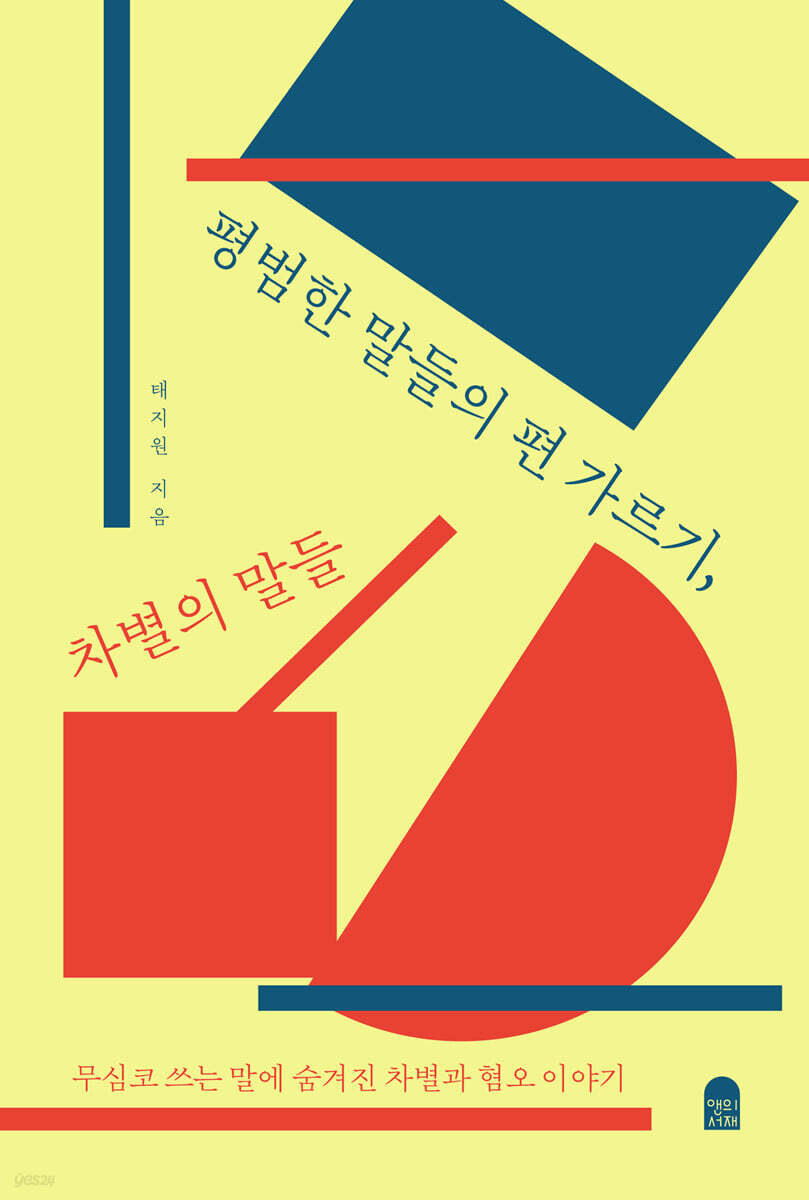
Ordinary words divide people, words of discrimination
 |
Description
Book Introduction
Dividing the world into 'us' and 'them',
About some words that build walls and fly like arrows
“Language has a strange power.
Some words or sentences cut between people like a sharp knife.
There was also talk of erecting a barrier between this side and that side.
My curiosity arose.
“Where did this saying come from?”
_ From the prologue
As Heidegger said, “Language is the house of being,” we learn about the world, communicate with others, and build relationships through language.
However, depending on how we use it, language can be a tool that embraces and welcomes others who are different from us, or it can become a material that divides and divides us into 'us' and 'them.'
The author, who has addressed and preached about current social and human rights issues in books such as "Is This Scene Uncomfortable Only for Me?" and "Bringing It From the Future," argues in this book that the more discriminatory words disguised as dialogue are casually used, and the more words that evaluate and judge others while disguising themselves as advice run rampant, the more exclusion and hatred are taken for granted and justified.
The author examines the ‘back side’ of common sayings that everyone uses, such as “He has a personality that shows that he grew up with a lot of love,” “Anyone can become what they want if they work hard,” “If you’re poor, don’t have children,” “If you keep receiving favors, you think it’s a right,” “You have to put up with that much while working for a salary,” and “That person has low self-esteem because he wasn’t loved,” and captures how these words become sharp knives that divide people and society.
In particular, we examine the social and historical context of eight words (normal, grade, perfect, poverty, rights, effort, self-esteem, and empathy) that can easily create stereotypes and prejudices, and consider and gain insight into the questions we must ask and the perspectives we must have to break free from psychological locks.
About some words that build walls and fly like arrows
“Language has a strange power.
Some words or sentences cut between people like a sharp knife.
There was also talk of erecting a barrier between this side and that side.
My curiosity arose.
“Where did this saying come from?”
_ From the prologue
As Heidegger said, “Language is the house of being,” we learn about the world, communicate with others, and build relationships through language.
However, depending on how we use it, language can be a tool that embraces and welcomes others who are different from us, or it can become a material that divides and divides us into 'us' and 'them.'
The author, who has addressed and preached about current social and human rights issues in books such as "Is This Scene Uncomfortable Only for Me?" and "Bringing It From the Future," argues in this book that the more discriminatory words disguised as dialogue are casually used, and the more words that evaluate and judge others while disguising themselves as advice run rampant, the more exclusion and hatred are taken for granted and justified.
The author examines the ‘back side’ of common sayings that everyone uses, such as “He has a personality that shows that he grew up with a lot of love,” “Anyone can become what they want if they work hard,” “If you’re poor, don’t have children,” “If you keep receiving favors, you think it’s a right,” “You have to put up with that much while working for a salary,” and “That person has low self-esteem because he wasn’t loved,” and captures how these words become sharp knives that divide people and society.
In particular, we examine the social and historical context of eight words (normal, grade, perfect, poverty, rights, effort, self-esteem, and empathy) that can easily create stereotypes and prejudices, and consider and gain insight into the questions we must ask and the perspectives we must have to break free from psychological locks.
- You can preview some of the book's contents.
Preview
index
prolog.
PART 1.
normal
'Madam' and 'Mother', familiar yet unfamiliar names
My Rude Question | The Words That Rigid Frameworks Bring | The Invocation of Being "Normal" | The Hidden "Golden Lines" and "Pushbacks"
The world of average raising
The Illusion of Average: "5 Million Won a Month is Basic" | How Average Became the Typical | The Magic of "That Sase" Being Packaged as "Ordinary" | Life Exists Beyond the Normal Distribution Curve
Am I abnormal?
The Birth of 'Normality' | Normality, a New Word of Exclusion | If Normality Doesn't Become the Norm
PART 2.
rating
'Lethe', a world of infinite tiering
From Shoes to Apartments: An Expanded Rating System | Ranking: In Search of Its Origins | There's No Golden Ticket
Mapo The Central Premium Forest
Ground access is prohibited | Their own locked-down world | The hidden desires in the question, "What neighborhood do you live in?"
PART 3.
Perfect
Hexagonal Man and the Old Money Look: The Birth of the Near-Perfect Human
The Old Money Look: The Desire for Innate Abilities | The Age of Perfection | The New Rules of Perfection
Are you also a newborn?
The obsession with living diligently, minute by minute | There's no one-size-fits-all answer.
PART 4.
poverty
The article 'Characteristics of a Poor Neighborhood'
An Era Where Poverty Becomes a Character | Chav Fighting Program | People Trapped in the Trap of Deprivation | Even the Poor Have Colorful Stories
The advice: "If you're poor, don't have children."
The Barriers of College Admission | The Collapse of the "Rise from Streams" Myth | The College Entrance Competition Is Not Over | Beyond Self-Deprecation and Hasty Advice
Poor man's long padding and pork cutlet
The Real Face of Poverty Porn | Subway Smell and the Subject of Life
PART 5.
right
Why are you going out and wandering around?
"Why is this happening to me?" | Subway transfers, a hellish race | "Citizens are hostage" | Street protests, 19 gang members | "If a favor continues, you think it's a right."
The Secret of a World Where the Customer is King
The Logic of Capitalism in "I Love You, Customer" | A Scene of Infinite Kindness
A world of misinterpretation of rights
"I'm getting paid with my own taxes" | The World of 'Nukalhyup' | Escaping the Misunderstanding of Rights
PART 6.
effort
I want to be treated as much as I put in effort
What's Hidden by Meritocracy | The Saying, "Money is a Skill" | A Base Camp for Ability and Effort
The stigma of being 'restless' and lacking effort
What keeps young people locked in their rooms | Rather than the advice that if you lower your eyes, there is nothing you cannot do
PART 7.
self-esteem
The era of self-esteem
The Effectiveness of Self-Esteem Training | Is Self-Esteem Really a Cheat Code?
A society of self-esteem and usefulness
On the Usefulness of a Capitalist Society | The Story of the House Talk | The Origins of the Concern for "Usefulness" | The Usefulness of Uselessness
PART 8.
Empathy
The age-old controversy surrounding the phrase "You are T"
How does emotional resonance occur? | Does empathy really solve everything? | The saying, "Empathy is the problem." | The discrimination brought on by too much empathy. | The world of filter bubbles. | When I realize my own inadequacy.
References
PART 1.
normal
'Madam' and 'Mother', familiar yet unfamiliar names
My Rude Question | The Words That Rigid Frameworks Bring | The Invocation of Being "Normal" | The Hidden "Golden Lines" and "Pushbacks"
The world of average raising
The Illusion of Average: "5 Million Won a Month is Basic" | How Average Became the Typical | The Magic of "That Sase" Being Packaged as "Ordinary" | Life Exists Beyond the Normal Distribution Curve
Am I abnormal?
The Birth of 'Normality' | Normality, a New Word of Exclusion | If Normality Doesn't Become the Norm
PART 2.
rating
'Lethe', a world of infinite tiering
From Shoes to Apartments: An Expanded Rating System | Ranking: In Search of Its Origins | There's No Golden Ticket
Mapo The Central Premium Forest
Ground access is prohibited | Their own locked-down world | The hidden desires in the question, "What neighborhood do you live in?"
PART 3.
Perfect
Hexagonal Man and the Old Money Look: The Birth of the Near-Perfect Human
The Old Money Look: The Desire for Innate Abilities | The Age of Perfection | The New Rules of Perfection
Are you also a newborn?
The obsession with living diligently, minute by minute | There's no one-size-fits-all answer.
PART 4.
poverty
The article 'Characteristics of a Poor Neighborhood'
An Era Where Poverty Becomes a Character | Chav Fighting Program | People Trapped in the Trap of Deprivation | Even the Poor Have Colorful Stories
The advice: "If you're poor, don't have children."
The Barriers of College Admission | The Collapse of the "Rise from Streams" Myth | The College Entrance Competition Is Not Over | Beyond Self-Deprecation and Hasty Advice
Poor man's long padding and pork cutlet
The Real Face of Poverty Porn | Subway Smell and the Subject of Life
PART 5.
right
Why are you going out and wandering around?
"Why is this happening to me?" | Subway transfers, a hellish race | "Citizens are hostage" | Street protests, 19 gang members | "If a favor continues, you think it's a right."
The Secret of a World Where the Customer is King
The Logic of Capitalism in "I Love You, Customer" | A Scene of Infinite Kindness
A world of misinterpretation of rights
"I'm getting paid with my own taxes" | The World of 'Nukalhyup' | Escaping the Misunderstanding of Rights
PART 6.
effort
I want to be treated as much as I put in effort
What's Hidden by Meritocracy | The Saying, "Money is a Skill" | A Base Camp for Ability and Effort
The stigma of being 'restless' and lacking effort
What keeps young people locked in their rooms | Rather than the advice that if you lower your eyes, there is nothing you cannot do
PART 7.
self-esteem
The era of self-esteem
The Effectiveness of Self-Esteem Training | Is Self-Esteem Really a Cheat Code?
A society of self-esteem and usefulness
On the Usefulness of a Capitalist Society | The Story of the House Talk | The Origins of the Concern for "Usefulness" | The Usefulness of Uselessness
PART 8.
Empathy
The age-old controversy surrounding the phrase "You are T"
How does emotional resonance occur? | Does empathy really solve everything? | The saying, "Empathy is the problem." | The discrimination brought on by too much empathy. | The world of filter bubbles. | When I realize my own inadequacy.
References
Detailed image

Into the book
Even when real indicators change, our perspective on the world doesn't change much, so the language we use often remains stagnant.
The same goes for the world's framework, such as laws and systems.
The surgical consent form required for emergency surgery at a hospital includes a section for 'guardian consent.'
Most hospitals limit the scope of this guardian to relatives such as parents, children, spouses, or siblings.
Those without relatives around them have difficulty receiving help from friends or unmarried cohabitants even when they are sick and need care.
Even when taking out a loan to purchase a house or applying for an apartment, conditions or special provisions targeting those within the scope of a normal family are the mainstream.
Single-person households, cohabiting families, and same-sex families have to endure disadvantages in many aspects of their daily lives.
‘Golden drawing’ and ‘pushing out’ are hidden all over the world.
--- From "'Madam' and 'Mother', Familiar and Unfamiliar Names"
We often think of the 'average' as a number that represents an entire group, but it has clear limitations.
It causes us to ignore the characteristics of individual data and sometimes leads to a distorted perception of reality.
The problem arises when this distorted average solidifies into a 'normal standard of living'.
The problem is especially acute in societies like South Korea, where a culture that enforces uniformity in life is prevalent.
Because there is a standard course of life that has homogeneity.
The rule that says that the right thing to do is to graduate from school with excellent grades, enter a so-called Seoul National University, get a job at a large company, get married, and have children.
Sometimes this is considered the minimum standard of living.
The average becomes 'ordinary', meaning 'middle of the road, neither excellent nor inferior', which breaks my heart.
--- From "The World of Average Raising"
When the world's shared norms and averages become the norm, another problem arises.
It becomes difficult to raise objections that there are fundamental problems with the norms.
The moment you deviate from the average values set by society, you can become an 'exception' or 'inferior' being, and the moment you protest against it, you are easily dismissed as 'exploding your inferiority complex'.
So most people try to fit into the standards of 'normal' set by society.
They continue to self-censor by asking themselves, 'Isn't this way of thinking (or behavior) abnormal?'
--- From "Am I Abnormal?"
The life of practice and recording is desirable in itself, but sometimes it acts as an implicit compulsion.
Because it is not appropriate to show off a lazy life where you just play, rest, or look good at home.
Society whispers quietly.
Anyone can become what they want if they try hard enough. It's just that you're lazy and lacking and can't get what you want.
Behind the lives of young people who aspire to be 'newbies', there exists a burden of having to work harder, and the resulting fatigue and lethargy.
There is also the problem of not respecting the lives of those on the other side, as much as we implicitly enforce a stereotypical image of a newborn.
A life that moves forward, a healthy and adventurous routine, may be desirable for some, but not for others.
People live their lives weighing different benefits and opportunity costs.
However, a life of playing or resting without considering these circumstances is transformed into a 'life of wasting time' or 'reckless and lazy behavior', and is also used as material to criticize the lives of others.
--- From "Are you also a newborn?"
In a world where inequality is rampant, not due to a lack of individual effort but rather to the system itself, the advice that if you're poor, you shouldn't have children seems persuasive at first glance.
This is because the perception that it is difficult to succeed despite hard work amidst layer upon layer of difficulties has become widespread among young people.
This realization led to self-mockery that this life was ruined.
And this self-help extends to advice to others in similar situations: if you're poor, don't have children.
The problem is that these arrows of self-help and resentment are ultimately directed at the 'poor'.
It is no longer surprising to hear people say things like, "Why do you have so many children when you're poor?" or to casually set a cutoff line for other people's happiness or desires and then give advice.
In a society where class inheritance continues, the advice people seek as a means of self-help paradoxically turns into a comment blaming the poor for their foolishness in having many children despite being poor.
It is justified to throw out sharp words that casually infringe on the freedom of individuals to have children.
--- From "Advice: 'If you're poor, don't have children'"
Behind the story of wanting to be treated as much as one has worked, there is a hidden desire that says, 'I have put in a lot of effort and built up my abilities until I got into college (or got a job).'
But there is a flaw in that desire and logic.
This is because entering a prestigious university or advancing to a local university is a result of various factors intertwined beyond one's individual ability and effort.
Overlooking this and engaging in unreasonable discrimination or a tight hierarchy can be considered a result of arrogance.
Koreans focus solely on competitively "improving their skills," but they need to realize that their skills may not have been achieved under fair conditions.
This is because I want to prevent the fairness I envision from being used as a tool to hastily judge and evaluate other people's lives.
--- From "I want to be treated as much as I put in effort"
As Martin Seligman, a pioneer in positive psychology, said, self-esteem is one of the necessary elements to live a happy and satisfying life.
We all know that self-affirmation gives us more motivation in life than self-loathing.
The problem is over-immersion.
When we consider it a panacea that can solve all of life's problems and judge ourselves and others by it, new problems arise.
For example, whenever I see someone being swayed by interpersonal relationships or the evaluations of others, I blame it on low self-esteem.
They often criticize celebrities or influencers for their mistakes, suggesting that their low self-esteem is the reason for their behavior, or offer advice to "raise your self-esteem" when listening to someone's concerns.
--- From "The Era of Self-Esteem"
I once gave a lecture at a high school on the topic of media literacy and bias.
During Q&A time, one student asked seriously.
“I want to get rid of all the stereotypes in my head, but it’s not going as planned.
When I encounter strangers on the street or in the subway, I unconsciously develop prejudices.
I feel like a hypocrite because my head and heart are separate.
“Can’t we just get rid of all the stereotypes in our minds?” I hesitated for a moment, wondering if I should give the textbook answer that we must overcome prejudice, but then I spoke honestly.
It is impossible to completely overcome the fixed ideas in our minds and the instinct to avoid unfamiliar things.
He answered that there is no one in the world with a heart like a blank sheet of paper.
I need to recognize the instinct within me to hate the unfamiliar, but I need to be wary of that instinct.
By recognizing the existence of a pitiful and filthy mind within me and facing that pitifulness, I will gain the courage to overcome the fixed ideas that are like instincts.
The same goes for the world's framework, such as laws and systems.
The surgical consent form required for emergency surgery at a hospital includes a section for 'guardian consent.'
Most hospitals limit the scope of this guardian to relatives such as parents, children, spouses, or siblings.
Those without relatives around them have difficulty receiving help from friends or unmarried cohabitants even when they are sick and need care.
Even when taking out a loan to purchase a house or applying for an apartment, conditions or special provisions targeting those within the scope of a normal family are the mainstream.
Single-person households, cohabiting families, and same-sex families have to endure disadvantages in many aspects of their daily lives.
‘Golden drawing’ and ‘pushing out’ are hidden all over the world.
--- From "'Madam' and 'Mother', Familiar and Unfamiliar Names"
We often think of the 'average' as a number that represents an entire group, but it has clear limitations.
It causes us to ignore the characteristics of individual data and sometimes leads to a distorted perception of reality.
The problem arises when this distorted average solidifies into a 'normal standard of living'.
The problem is especially acute in societies like South Korea, where a culture that enforces uniformity in life is prevalent.
Because there is a standard course of life that has homogeneity.
The rule that says that the right thing to do is to graduate from school with excellent grades, enter a so-called Seoul National University, get a job at a large company, get married, and have children.
Sometimes this is considered the minimum standard of living.
The average becomes 'ordinary', meaning 'middle of the road, neither excellent nor inferior', which breaks my heart.
--- From "The World of Average Raising"
When the world's shared norms and averages become the norm, another problem arises.
It becomes difficult to raise objections that there are fundamental problems with the norms.
The moment you deviate from the average values set by society, you can become an 'exception' or 'inferior' being, and the moment you protest against it, you are easily dismissed as 'exploding your inferiority complex'.
So most people try to fit into the standards of 'normal' set by society.
They continue to self-censor by asking themselves, 'Isn't this way of thinking (or behavior) abnormal?'
--- From "Am I Abnormal?"
The life of practice and recording is desirable in itself, but sometimes it acts as an implicit compulsion.
Because it is not appropriate to show off a lazy life where you just play, rest, or look good at home.
Society whispers quietly.
Anyone can become what they want if they try hard enough. It's just that you're lazy and lacking and can't get what you want.
Behind the lives of young people who aspire to be 'newbies', there exists a burden of having to work harder, and the resulting fatigue and lethargy.
There is also the problem of not respecting the lives of those on the other side, as much as we implicitly enforce a stereotypical image of a newborn.
A life that moves forward, a healthy and adventurous routine, may be desirable for some, but not for others.
People live their lives weighing different benefits and opportunity costs.
However, a life of playing or resting without considering these circumstances is transformed into a 'life of wasting time' or 'reckless and lazy behavior', and is also used as material to criticize the lives of others.
--- From "Are you also a newborn?"
In a world where inequality is rampant, not due to a lack of individual effort but rather to the system itself, the advice that if you're poor, you shouldn't have children seems persuasive at first glance.
This is because the perception that it is difficult to succeed despite hard work amidst layer upon layer of difficulties has become widespread among young people.
This realization led to self-mockery that this life was ruined.
And this self-help extends to advice to others in similar situations: if you're poor, don't have children.
The problem is that these arrows of self-help and resentment are ultimately directed at the 'poor'.
It is no longer surprising to hear people say things like, "Why do you have so many children when you're poor?" or to casually set a cutoff line for other people's happiness or desires and then give advice.
In a society where class inheritance continues, the advice people seek as a means of self-help paradoxically turns into a comment blaming the poor for their foolishness in having many children despite being poor.
It is justified to throw out sharp words that casually infringe on the freedom of individuals to have children.
--- From "Advice: 'If you're poor, don't have children'"
Behind the story of wanting to be treated as much as one has worked, there is a hidden desire that says, 'I have put in a lot of effort and built up my abilities until I got into college (or got a job).'
But there is a flaw in that desire and logic.
This is because entering a prestigious university or advancing to a local university is a result of various factors intertwined beyond one's individual ability and effort.
Overlooking this and engaging in unreasonable discrimination or a tight hierarchy can be considered a result of arrogance.
Koreans focus solely on competitively "improving their skills," but they need to realize that their skills may not have been achieved under fair conditions.
This is because I want to prevent the fairness I envision from being used as a tool to hastily judge and evaluate other people's lives.
--- From "I want to be treated as much as I put in effort"
As Martin Seligman, a pioneer in positive psychology, said, self-esteem is one of the necessary elements to live a happy and satisfying life.
We all know that self-affirmation gives us more motivation in life than self-loathing.
The problem is over-immersion.
When we consider it a panacea that can solve all of life's problems and judge ourselves and others by it, new problems arise.
For example, whenever I see someone being swayed by interpersonal relationships or the evaluations of others, I blame it on low self-esteem.
They often criticize celebrities or influencers for their mistakes, suggesting that their low self-esteem is the reason for their behavior, or offer advice to "raise your self-esteem" when listening to someone's concerns.
--- From "The Era of Self-Esteem"
I once gave a lecture at a high school on the topic of media literacy and bias.
During Q&A time, one student asked seriously.
“I want to get rid of all the stereotypes in my head, but it’s not going as planned.
When I encounter strangers on the street or in the subway, I unconsciously develop prejudices.
I feel like a hypocrite because my head and heart are separate.
“Can’t we just get rid of all the stereotypes in our minds?” I hesitated for a moment, wondering if I should give the textbook answer that we must overcome prejudice, but then I spoke honestly.
It is impossible to completely overcome the fixed ideas in our minds and the instinct to avoid unfamiliar things.
He answered that there is no one in the world with a heart like a blank sheet of paper.
I need to recognize the instinct within me to hate the unfamiliar, but I need to be wary of that instinct.
By recognizing the existence of a pitiful and filthy mind within me and facing that pitifulness, I will gain the courage to overcome the fixed ideas that are like instincts.
--- From "The age-old controversy surrounding the phrase "You are T""
Publisher's Review
"Words of Discrimination" Disguised as a Conversation, Read with "Eight Keywords"
A study of real adult language to change the language of division into the language of hospitality!
“This book examines the gaps in stereotypes and prejudices hidden within eight familiar yet divisive words: normal, grade, perfection, poverty, rights, effort, self-esteem, and empathy.
I often reflected on this while writing the manuscript.
Because I, too, realized that I had been stuck in a narrow frame of mind and had said the wrong thing many times.
Because they were embarrassed to ask someone's age directly, they would ask for their student number or look at pictures of celebrities online to determine if they were the perfect person.
There were also frequent instances of drawing a line between normal and abnormal, judging others by confining them to categories like MBTI or blood type, and pushing them to one side.
I took some time to reflect and explore new interpretations of words.
I wondered if there were any new words or perspectives that could change the narrow interpretation.
Because words have power.
“Language can create high barriers, but it can also break them down.”
_ From the prologue
In this book, the author focuses not on “words that are blatantly derogatory or contain bias,” but on “words that are so familiar that they divide people.”
It's words that everyone uses, like 'normal, grade, ordinary, perfect, self-esteem and empathy.'
These words are so familiar that they have already developed a biased interpretation, and neither the writer nor the listener is aware of the discrimination hidden behind them.
The author examines and reflects on familiar and seemingly ordinary words that “distinguish normal from abnormal, marginalize some in class divisions, and prematurely judge others based on their empathy or self-esteem” within a social and historical context.
As you read the author's sharp and nuanced writing, which examines the discrimination and hatred embedded in everyday language, you will find yourself exploring how to break down barriers, embrace, and offer welcoming language instead of using words that divide and push others away.
With the confidence that the painstaking process of groping through the book and world of others will become, as philosopher Deleuze said, “a puzzle that puts together the fragmented world of my self.”
ㆍNormal
"Madam" and "Mother": Familiar yet Unfamiliar Names | The World of Average-Ups | Am I Abnormal?
We delve into the hidden meaning behind the words "madam" and "mother" commonly heard in real estate offices, hospital waiting rooms, department stores, and shopping malls, as well as the "ideology of the normal family."
It captures the "gold-lining" and "pushing" that comes from a few titles and constant orders to belong to "normal" that begin with a linear and rigid framework, and reflects on the questions needed to establish a new framework for family and community.
ㆍRating
"Lethe," a world of infinite tiering | Mapo The Central Premium Forest
From 'academy level tests', 'university rankings', 'padding jumper rank charts', '□□ rank charts for fun', and 'pet names for luxury brand apartments', we examine the physical and psychological locks that have taken root within us in a world of infinite rank divisions.
In this process, the moment we realize that we are pursuing similar desires, we gain the insight that we can take the first step toward a different life.
ㆍPerfect
Hexagonal Man and the Old Money Look | Are You Living a New Life Too?
It delves into the birth of the hexagonal human, a perfect human with no flaws, who was born with good looks and a personality that was loved and raised in a good family, and the social structural problems that fueled the era of longing for 'perfection'.
Here, we examine the anxiety and discrimination hidden behind the "newbie" lifestyle, which can easily lead to over-immersion in the idea that life must be lived minute by minute and diligently, and seek a new perspective to move toward a society that respects diverse values and ways of living.
ㆍPoverty
"Characteristics of Poor Neighborhoods" | "If you're poor, don't have children" advice | The poor man's long padding and pork cutlet
'Humanity also comes from leisure.
There are people who judge someone's life and even character based on their poverty, saying things like, "The only solution to the problem is family education, but the poor don't make any effort, so nothing changes," and "If you're poor, don't have children."
They ignore the social structural problem of class inheritance and casually infringe on individual freedom by spewing out harsh words like, "Why have children when you can't even afford to send them to a private academy?"
This chapter examines the cold perspective on poverty that fuels poverty aversion from various angles and explores ways for diverse classes to coexist and thrive.
ㆍRights
Why do you go out and wander? | The secrets of a world where the customer is king | A world of misinterpretation of rights
We take a look at the misunderstanding of rights that is rampant in our society through the sharp gaze of the protests of disabled people's groups that took to the streets to secure the minimum right to mobility, the tyranny of some arrogant customers who treat even the personality of workers as a commodity transaction under the mindset of "the customer is king," civil servants and teachers suffering from chronic malicious complaints, and the cases of celebrities suffering from malicious comments because their work exposes them to others.
I also think about ways to expand the rights of myself and the community together.
ㆍEffort
Wanting to be treated as if you're working hard | The stigma of being "rested" and lacking effort
The statement, “I want to be treated as much as I work,” seems at first glance to be a reasonable and fair request.
However, if we overlook the fact that there are people who cannot reach the same starting line due to given circumstances and believe that only meritocracy is the standard for a fair life, fairness is reduced to a tool for evaluating the lives of others.
The author examines the case of the conversion of irregular workers at Incheon International Airport to regular workers, the derogatory expressions used against local universities such as "listless," and the gaze that labels isolated youth as lacking effort and dismisses them as mere personal problems, confronting the discrimination and prejudice inherent in the terms "effort" and "ability."
ㆍSelf-esteem
The Age of Self-Esteem | A Society of Self-Esteem and Usefulness
'That person has low self-esteem because they don't receive love.' 'I get hurt by things like this because I have low self-esteem.' We are in an era where self-esteem is all the rage.
It is no exaggeration to say that even an individual's happiness or unhappiness is determined by the presence or absence of 'self-esteem'.
The author criticizes some phenomena that blame everything on individuals without even mentioning the structural problems of society under the term self-esteem.
Along with this, I seek a way to avoid being swept away by one-sided self-esteem and to find my own value that cannot be reduced to numbers.
ㆍEmpathy
The age-old controversy surrounding the phrase "You are T"
Humans instinctively become more generous when they meet people from the same hometown, school, and personality.
This is called in-group bias, and this phenomenon can easily lead to group egoism.
This chapter examines the double standards and social divisions that in-group bias creates.
It also reminds us that it is important to have the ability to deeply empathize with those who share our views, as well as to strive to be welcoming to strangers in an unfamiliar world.
A study of real adult language to change the language of division into the language of hospitality!
“This book examines the gaps in stereotypes and prejudices hidden within eight familiar yet divisive words: normal, grade, perfection, poverty, rights, effort, self-esteem, and empathy.
I often reflected on this while writing the manuscript.
Because I, too, realized that I had been stuck in a narrow frame of mind and had said the wrong thing many times.
Because they were embarrassed to ask someone's age directly, they would ask for their student number or look at pictures of celebrities online to determine if they were the perfect person.
There were also frequent instances of drawing a line between normal and abnormal, judging others by confining them to categories like MBTI or blood type, and pushing them to one side.
I took some time to reflect and explore new interpretations of words.
I wondered if there were any new words or perspectives that could change the narrow interpretation.
Because words have power.
“Language can create high barriers, but it can also break them down.”
_ From the prologue
In this book, the author focuses not on “words that are blatantly derogatory or contain bias,” but on “words that are so familiar that they divide people.”
It's words that everyone uses, like 'normal, grade, ordinary, perfect, self-esteem and empathy.'
These words are so familiar that they have already developed a biased interpretation, and neither the writer nor the listener is aware of the discrimination hidden behind them.
The author examines and reflects on familiar and seemingly ordinary words that “distinguish normal from abnormal, marginalize some in class divisions, and prematurely judge others based on their empathy or self-esteem” within a social and historical context.
As you read the author's sharp and nuanced writing, which examines the discrimination and hatred embedded in everyday language, you will find yourself exploring how to break down barriers, embrace, and offer welcoming language instead of using words that divide and push others away.
With the confidence that the painstaking process of groping through the book and world of others will become, as philosopher Deleuze said, “a puzzle that puts together the fragmented world of my self.”
ㆍNormal
"Madam" and "Mother": Familiar yet Unfamiliar Names | The World of Average-Ups | Am I Abnormal?
We delve into the hidden meaning behind the words "madam" and "mother" commonly heard in real estate offices, hospital waiting rooms, department stores, and shopping malls, as well as the "ideology of the normal family."
It captures the "gold-lining" and "pushing" that comes from a few titles and constant orders to belong to "normal" that begin with a linear and rigid framework, and reflects on the questions needed to establish a new framework for family and community.
ㆍRating
"Lethe," a world of infinite tiering | Mapo The Central Premium Forest
From 'academy level tests', 'university rankings', 'padding jumper rank charts', '□□ rank charts for fun', and 'pet names for luxury brand apartments', we examine the physical and psychological locks that have taken root within us in a world of infinite rank divisions.
In this process, the moment we realize that we are pursuing similar desires, we gain the insight that we can take the first step toward a different life.
ㆍPerfect
Hexagonal Man and the Old Money Look | Are You Living a New Life Too?
It delves into the birth of the hexagonal human, a perfect human with no flaws, who was born with good looks and a personality that was loved and raised in a good family, and the social structural problems that fueled the era of longing for 'perfection'.
Here, we examine the anxiety and discrimination hidden behind the "newbie" lifestyle, which can easily lead to over-immersion in the idea that life must be lived minute by minute and diligently, and seek a new perspective to move toward a society that respects diverse values and ways of living.
ㆍPoverty
"Characteristics of Poor Neighborhoods" | "If you're poor, don't have children" advice | The poor man's long padding and pork cutlet
'Humanity also comes from leisure.
There are people who judge someone's life and even character based on their poverty, saying things like, "The only solution to the problem is family education, but the poor don't make any effort, so nothing changes," and "If you're poor, don't have children."
They ignore the social structural problem of class inheritance and casually infringe on individual freedom by spewing out harsh words like, "Why have children when you can't even afford to send them to a private academy?"
This chapter examines the cold perspective on poverty that fuels poverty aversion from various angles and explores ways for diverse classes to coexist and thrive.
ㆍRights
Why do you go out and wander? | The secrets of a world where the customer is king | A world of misinterpretation of rights
We take a look at the misunderstanding of rights that is rampant in our society through the sharp gaze of the protests of disabled people's groups that took to the streets to secure the minimum right to mobility, the tyranny of some arrogant customers who treat even the personality of workers as a commodity transaction under the mindset of "the customer is king," civil servants and teachers suffering from chronic malicious complaints, and the cases of celebrities suffering from malicious comments because their work exposes them to others.
I also think about ways to expand the rights of myself and the community together.
ㆍEffort
Wanting to be treated as if you're working hard | The stigma of being "rested" and lacking effort
The statement, “I want to be treated as much as I work,” seems at first glance to be a reasonable and fair request.
However, if we overlook the fact that there are people who cannot reach the same starting line due to given circumstances and believe that only meritocracy is the standard for a fair life, fairness is reduced to a tool for evaluating the lives of others.
The author examines the case of the conversion of irregular workers at Incheon International Airport to regular workers, the derogatory expressions used against local universities such as "listless," and the gaze that labels isolated youth as lacking effort and dismisses them as mere personal problems, confronting the discrimination and prejudice inherent in the terms "effort" and "ability."
ㆍSelf-esteem
The Age of Self-Esteem | A Society of Self-Esteem and Usefulness
'That person has low self-esteem because they don't receive love.' 'I get hurt by things like this because I have low self-esteem.' We are in an era where self-esteem is all the rage.
It is no exaggeration to say that even an individual's happiness or unhappiness is determined by the presence or absence of 'self-esteem'.
The author criticizes some phenomena that blame everything on individuals without even mentioning the structural problems of society under the term self-esteem.
Along with this, I seek a way to avoid being swept away by one-sided self-esteem and to find my own value that cannot be reduced to numbers.
ㆍEmpathy
The age-old controversy surrounding the phrase "You are T"
Humans instinctively become more generous when they meet people from the same hometown, school, and personality.
This is called in-group bias, and this phenomenon can easily lead to group egoism.
This chapter examines the double standards and social divisions that in-group bias creates.
It also reminds us that it is important to have the ability to deeply empathize with those who share our views, as well as to strive to be welcoming to strangers in an unfamiliar world.
GOODS SPECIFICS
- Date of issue: April 12, 2025
- Page count, weight, size: 280 pages | 344g | 135*200*20mm
- ISBN13: 9791190710978
- ISBN10: 1190710978
You may also like
카테고리
korean


korean

![GQ KOREA Mark (Monthly): December [2025]](http://librairie.coreenne.fr/cdn/shop/files/8ef265dbbfbf186523ed75ba7319009d.jpg?v=1765340328&width=3840)


