

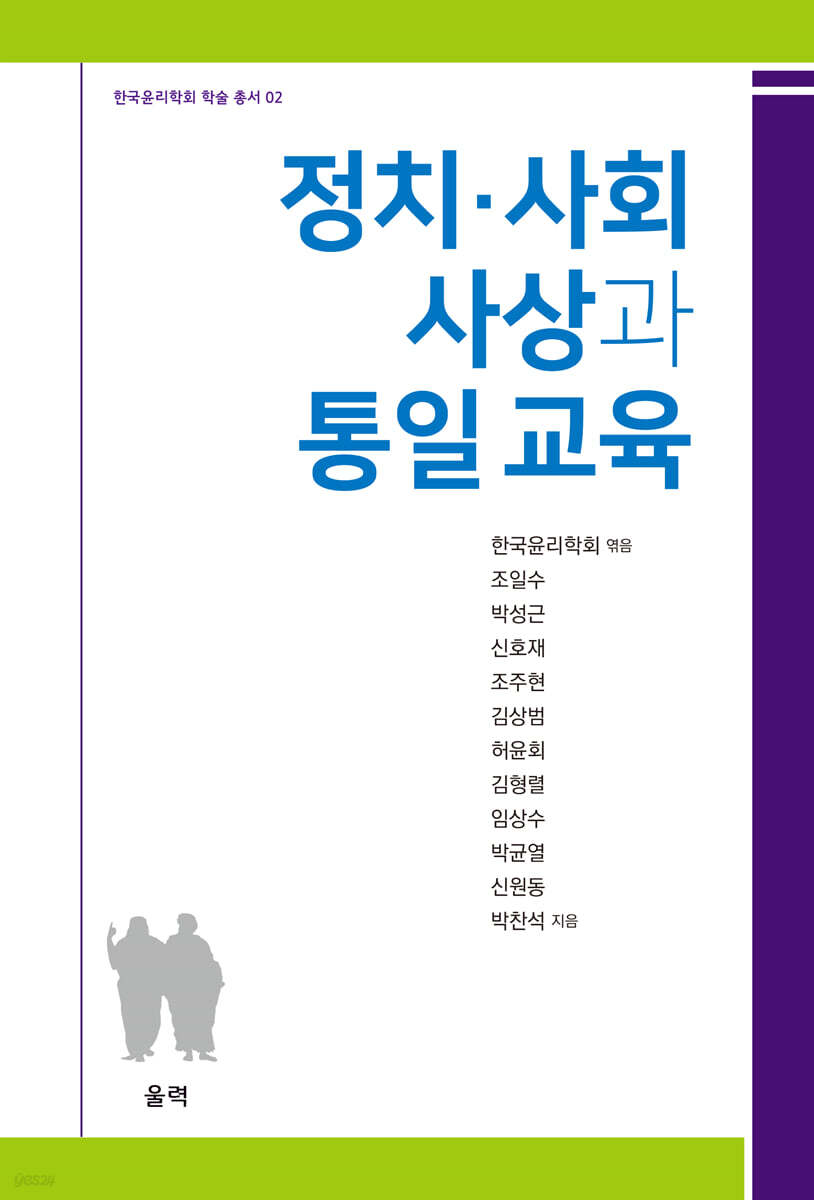
Political and social thought and unification education
 |
Description
Book Introduction
This book is “an optimal guidebook for a comprehensive approach and balanced understanding of political and social thought in general, with in-depth content and systematic organization that encompasses major political and social ideas that permeate modern and contemporary Western thought.” It is also “a guidebook for understanding the core of inter-Korean relations, unification issues, and unification education in schools that Korean society is facing.”
- You can preview some of the book's contents.
Preview
index
1.
Liberal and Communitarian Thoughts - Jo Il-su
2.
Republicanism from the Perspective of Moral Education - Park Seong-geun
3.
Representative and Participatory Democracy - Shin Ho-jae
4.
Habermas and Rawls' Deliberative Democracy ─ Jo Joo-hyun
5.
Rawls's Theory of Justice - Kim Sang-beom
6.
Distributive Justice - Heo Yun-hee
7.
Classical Social Contract Theory - Kim Hyeong-ryeol
8.
The Concerns of Liberal Democracy and the Rule of Law ─ Lim Sang-soo
9.
Ethical Issues and Alternatives in International Affairs - Park Gyun-yeol
10.
Understanding North Korea - Shin Won-dong
11.
The Direction of Unification Education - Park Chan-seok
Liberal and Communitarian Thoughts - Jo Il-su
2.
Republicanism from the Perspective of Moral Education - Park Seong-geun
3.
Representative and Participatory Democracy - Shin Ho-jae
4.
Habermas and Rawls' Deliberative Democracy ─ Jo Joo-hyun
5.
Rawls's Theory of Justice - Kim Sang-beom
6.
Distributive Justice - Heo Yun-hee
7.
Classical Social Contract Theory - Kim Hyeong-ryeol
8.
The Concerns of Liberal Democracy and the Rule of Law ─ Lim Sang-soo
9.
Ethical Issues and Alternatives in International Affairs - Park Gyun-yeol
10.
Understanding North Korea - Shin Won-dong
11.
The Direction of Unification Education - Park Chan-seok
Publisher's Review
Chapter 1.
liberal and communitarian ideology
This book deals with liberalism, one of the important ideologies pursued by our society today, and communitarianism as an alternative to the theoretical and practical problems of modern liberalism.
This chapter examines the flow of liberal thought, dividing it into classical liberalism, welfare liberalism, and modern liberalism.
And the communitarian thought develops around Sandel and MacIntyre, examining the debate between liberalism and communitarianism through five themes: the view of humanity, antisocial individualism, universalism, subjectivism/objectivism, anti-perfectionism, and neutrality.
Chapter 2.
Republicanism from the perspective of moral education
Republicanism demands of its citizens a high level of integrative capacity that presupposes social communication and dialogue.
This chapter explores the flow of thought by dividing this republicanism into 'ancient and modern republicanism' and 'modern republicanism.'
After providing an overview of the thoughts of major republican scholars, including Aristotle and Cicero in ancient times, Machiavelli and Rousseau in modern times, and Sandel, Viroli, and Pettit in contemporary times, the book focuses on organically understanding the relationships among the core concepts of republicanism: mixed government, freedom, rule of law, virtue, and patriotism.
And through this process, it helps to confirm and review the civic educational value of republicanism.
Chapter 3.
Representative and participatory democracy
This chapter explores the meaning and value of democracy by focusing on ‘representation’ and ‘participation.’
First, we will examine the theoretical implications of representative democracy and participatory democracy, focusing on the major thinkers and their development.
Representative democracy is examined in chronological order, from the positions of social contract theorists such as Hobbes and Locke, to the positions of utilitarians centered around John Stuart Mill, and even to the modern-day arguments of Schumpeter.
Participatory Democracy explores the arguments of Patman, Barber, and Dahl, which form important points of discussion for modern participatory democracy, starting with Athenian democracy.
Chapter 4.
Habermas and Rawls' Deliberative Democracy
This chapter explores the theories of two of the most influential scholars in deliberative democracy theory today: Habermas and Rawls.
Although the two share a common umbrella of deliberative democracy, there are significant differences in their theorization and conceptualization.
This chapter explores the two men's theories of deliberative democracy in depth, building on their concepts.
Chapter 5.
Rawls's theory of justice
This chapter examines Rawls's theory of justice, focusing on his three major works: A Theory of Justice, Political Liberalism, and The Law of Peoples.
Through this, we trace Rawls's ideological journey, from a domestic theory of justice to the realities of multiculturalism, advocating political liberalism, and finally reaching an international theory of justice that pursues the hope of world peace.
Chapter 6.
distributive justice
Rawls was a pioneer in the theory of justice and systematically established it.
Rolls proposed a contract theory that took fair distribution into account.
His difference principle means distributing the greatest share to the least advantaged, but Nozick and Walzer question whether the standard of distribution principle proposed by Rawls is fair.
This chapter examines the respective theories put forward by Nozick and Walzer to counter Rawls's theory of justice.
Nozick focuses on the minimal state theory and the theory of property rights, while Walzer focuses on the theory of pluralistic equality and the theory of just war.
Chapter 7.
Classical social contract theory
The social contract theory was initiated by Thomas Hobbes, John Locke, and Jean-Jacques Rousseau, who are considered to be thinkers who had a great influence on modern political philosophy, and has been newly developed by John Ross and Robert Nozick.
Although social contract theory differs in terms of logical development and specific content, it has sought to secure the priority of the rights of free and equal individuals by choosing a contractual structure as the basis for the legitimacy of political systems and the state.
This chapter examines the discussions surrounding the social contract theory of Hobbes, Locke, and Rousseau, who represent the classical social contract theory tradition, and examines the criticisms, implications, and modern significance of social contract theory.
Chapter 8.
The Dilemma of Liberal Democracy and the Rule of Law
This chapter theoretically examines why a state that advocates the rule of law and liberal democracy must be particularly careful in addressing "political obligations" and "civil disobedience" when it comes to gaining recognition for its political authority.
It emphasizes the need for a cautious approach to avoid the risk of the emphasis on the rule of law degenerating into the "politicization of the judiciary," and examines the relationship between civil disobedience and its functioning as a form of sound criticism.
Chapter 9.
Ethical Issues and Alternatives in International Affairs
This chapter explores how various actors within the international community think, feel, and act ethically.
This chapter examines various theories related to international affairs, such as realism, idealism, liberalism, just war theory, class conflict theory, constructivism, and functionalism, and examines ethical issues related to international affairs.
Furthermore, it presents a new type of international problem that is difficult to find a solution to through the traditional ethical perspective on international affairs, and discusses its ethical challenges.
Chapter 10.
Understanding North Korea
This chapter aims to provide a general understanding of North Korean society.
To properly understand North Korea from the perspective of overcoming division and promoting peace, we must recognize North Korea as a partner with whom we must form a community and live together, and we must understand it objectively.
To this end, we begin with North Korean research methodology and then provide an overview of North Korean society, segmenting it into North Korea's political system and ruling ideology, the characteristics and changes in the North Korean economic system, the lives and human rights of North Korean residents, and North Korea's education and culture.
Chapter 11.
The direction of unification education
Our unification education has changed its tone every time the government changes.
Nevertheless, unification education has shifted from an education that prioritized anti-communism and security to one that emphasizes overcoming division and peace.
However, our society is facing social changes such as not only the conflict between the North and the South, but also the conflict between South and North, the shift toward a multicultural society, and the entry into an aging society.
This chapter explores the direction in which our unification education should advance amidst these social changes.
liberal and communitarian ideology
This book deals with liberalism, one of the important ideologies pursued by our society today, and communitarianism as an alternative to the theoretical and practical problems of modern liberalism.
This chapter examines the flow of liberal thought, dividing it into classical liberalism, welfare liberalism, and modern liberalism.
And the communitarian thought develops around Sandel and MacIntyre, examining the debate between liberalism and communitarianism through five themes: the view of humanity, antisocial individualism, universalism, subjectivism/objectivism, anti-perfectionism, and neutrality.
Chapter 2.
Republicanism from the perspective of moral education
Republicanism demands of its citizens a high level of integrative capacity that presupposes social communication and dialogue.
This chapter explores the flow of thought by dividing this republicanism into 'ancient and modern republicanism' and 'modern republicanism.'
After providing an overview of the thoughts of major republican scholars, including Aristotle and Cicero in ancient times, Machiavelli and Rousseau in modern times, and Sandel, Viroli, and Pettit in contemporary times, the book focuses on organically understanding the relationships among the core concepts of republicanism: mixed government, freedom, rule of law, virtue, and patriotism.
And through this process, it helps to confirm and review the civic educational value of republicanism.
Chapter 3.
Representative and participatory democracy
This chapter explores the meaning and value of democracy by focusing on ‘representation’ and ‘participation.’
First, we will examine the theoretical implications of representative democracy and participatory democracy, focusing on the major thinkers and their development.
Representative democracy is examined in chronological order, from the positions of social contract theorists such as Hobbes and Locke, to the positions of utilitarians centered around John Stuart Mill, and even to the modern-day arguments of Schumpeter.
Participatory Democracy explores the arguments of Patman, Barber, and Dahl, which form important points of discussion for modern participatory democracy, starting with Athenian democracy.
Chapter 4.
Habermas and Rawls' Deliberative Democracy
This chapter explores the theories of two of the most influential scholars in deliberative democracy theory today: Habermas and Rawls.
Although the two share a common umbrella of deliberative democracy, there are significant differences in their theorization and conceptualization.
This chapter explores the two men's theories of deliberative democracy in depth, building on their concepts.
Chapter 5.
Rawls's theory of justice
This chapter examines Rawls's theory of justice, focusing on his three major works: A Theory of Justice, Political Liberalism, and The Law of Peoples.
Through this, we trace Rawls's ideological journey, from a domestic theory of justice to the realities of multiculturalism, advocating political liberalism, and finally reaching an international theory of justice that pursues the hope of world peace.
Chapter 6.
distributive justice
Rawls was a pioneer in the theory of justice and systematically established it.
Rolls proposed a contract theory that took fair distribution into account.
His difference principle means distributing the greatest share to the least advantaged, but Nozick and Walzer question whether the standard of distribution principle proposed by Rawls is fair.
This chapter examines the respective theories put forward by Nozick and Walzer to counter Rawls's theory of justice.
Nozick focuses on the minimal state theory and the theory of property rights, while Walzer focuses on the theory of pluralistic equality and the theory of just war.
Chapter 7.
Classical social contract theory
The social contract theory was initiated by Thomas Hobbes, John Locke, and Jean-Jacques Rousseau, who are considered to be thinkers who had a great influence on modern political philosophy, and has been newly developed by John Ross and Robert Nozick.
Although social contract theory differs in terms of logical development and specific content, it has sought to secure the priority of the rights of free and equal individuals by choosing a contractual structure as the basis for the legitimacy of political systems and the state.
This chapter examines the discussions surrounding the social contract theory of Hobbes, Locke, and Rousseau, who represent the classical social contract theory tradition, and examines the criticisms, implications, and modern significance of social contract theory.
Chapter 8.
The Dilemma of Liberal Democracy and the Rule of Law
This chapter theoretically examines why a state that advocates the rule of law and liberal democracy must be particularly careful in addressing "political obligations" and "civil disobedience" when it comes to gaining recognition for its political authority.
It emphasizes the need for a cautious approach to avoid the risk of the emphasis on the rule of law degenerating into the "politicization of the judiciary," and examines the relationship between civil disobedience and its functioning as a form of sound criticism.
Chapter 9.
Ethical Issues and Alternatives in International Affairs
This chapter explores how various actors within the international community think, feel, and act ethically.
This chapter examines various theories related to international affairs, such as realism, idealism, liberalism, just war theory, class conflict theory, constructivism, and functionalism, and examines ethical issues related to international affairs.
Furthermore, it presents a new type of international problem that is difficult to find a solution to through the traditional ethical perspective on international affairs, and discusses its ethical challenges.
Chapter 10.
Understanding North Korea
This chapter aims to provide a general understanding of North Korean society.
To properly understand North Korea from the perspective of overcoming division and promoting peace, we must recognize North Korea as a partner with whom we must form a community and live together, and we must understand it objectively.
To this end, we begin with North Korean research methodology and then provide an overview of North Korean society, segmenting it into North Korea's political system and ruling ideology, the characteristics and changes in the North Korean economic system, the lives and human rights of North Korean residents, and North Korea's education and culture.
Chapter 11.
The direction of unification education
Our unification education has changed its tone every time the government changes.
Nevertheless, unification education has shifted from an education that prioritized anti-communism and security to one that emphasizes overcoming division and peace.
However, our society is facing social changes such as not only the conflict between the North and the South, but also the conflict between South and North, the shift toward a multicultural society, and the entry into an aging society.
This chapter explores the direction in which our unification education should advance amidst these social changes.
GOODS SPECIFICS
- Date of issue: March 20, 2025
- Page count, weight, size: 428 pages | 152*224*30mm
- ISBN13: 9791185136776
- ISBN10: 1185136770
You may also like
카테고리
korean


korean

![GQ KOREA Mark (Monthly): December [2025]](http://librairie.coreenne.fr/cdn/shop/files/8ef265dbbfbf186523ed75ba7319009d.jpg?v=1765340328&width=3840)


