

Corporation Dictatorship
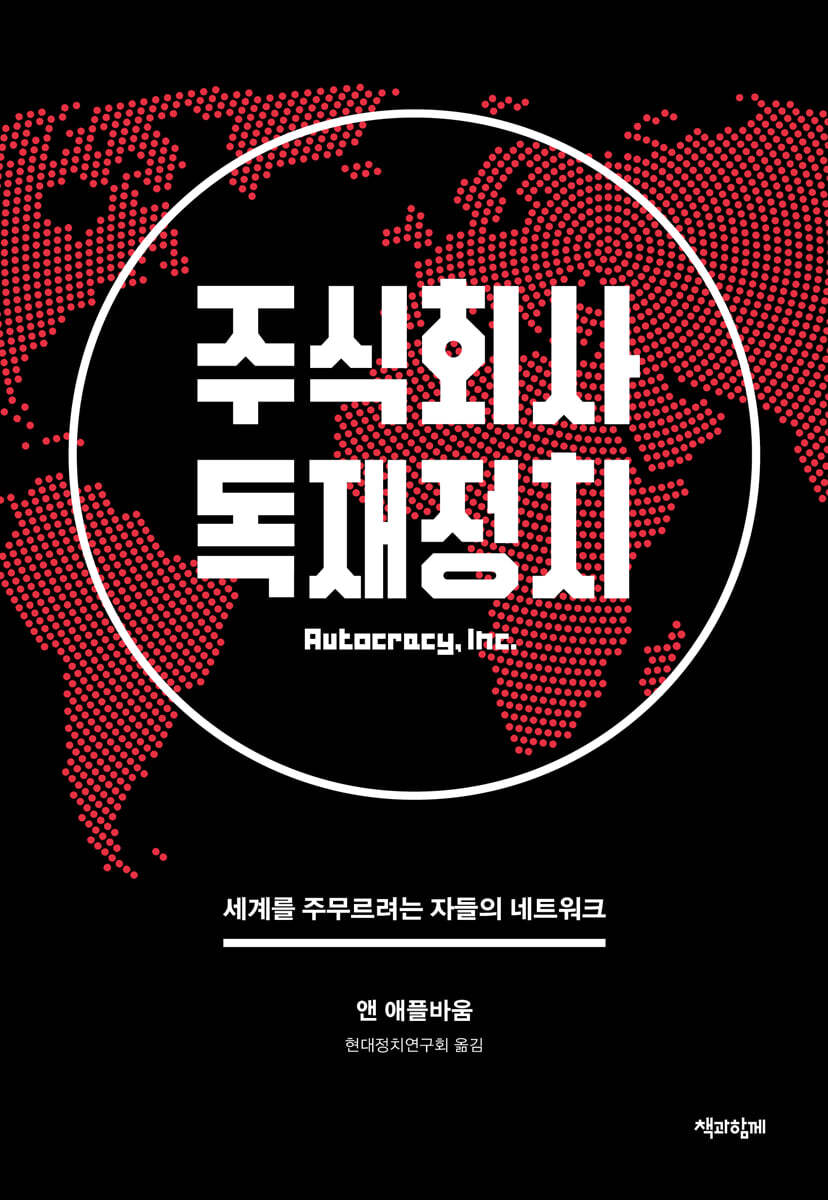 |
Description
Book Introduction
How did we arrive at an era where shamelessness and ignorance reign supreme?
Pulitzer Prize-winning author Ann Applebaum delves into
The Reality of the Global Dictatorship Network and Its Code of Conduct
Anne Applebaum, who has delved into the realities of authoritarian regimes, including the modern history of Russia and Eastern Europe, diagnoses today's turbulent world order.
Today's authoritarian states are not supported by a single evil person, but by a sophisticated network of kleptocracy-style financial structures, surveillance technologies, and professional propagandists operating in regimes like China, Russia, and Iran.
Members of this network are connected not only within one dictatorship, but also with other dictatorships and sometimes even with members of democratic states.
Unlike the 20th century, today's dictators are unconcerned with criticism of themselves or their countries, and they are not at all ashamed of their overt atrocities.
They dismiss foreign criticism as a vast imperialist conspiracy to destroy them.
This group operates similarly to a corporate conglomerate, bound together by a determined determination to maintain personal wealth and power.
This is the so-called ‘corporation dictatorship.’
United by mutually imitating technologies and tactics, shared economic interests, and a resolve not to give up power, dictators believe they have the upper hand.
Where this belief comes from, why it persists, and how the democratic world solidified it in the first place are the themes of this book.
Drawing on numerous international examples, it exposes the true nature of corporate dictatorship and its code of conduct, and discusses what we must do to combat it.
Pulitzer Prize-winning author Ann Applebaum delves into
The Reality of the Global Dictatorship Network and Its Code of Conduct
Anne Applebaum, who has delved into the realities of authoritarian regimes, including the modern history of Russia and Eastern Europe, diagnoses today's turbulent world order.
Today's authoritarian states are not supported by a single evil person, but by a sophisticated network of kleptocracy-style financial structures, surveillance technologies, and professional propagandists operating in regimes like China, Russia, and Iran.
Members of this network are connected not only within one dictatorship, but also with other dictatorships and sometimes even with members of democratic states.
Unlike the 20th century, today's dictators are unconcerned with criticism of themselves or their countries, and they are not at all ashamed of their overt atrocities.
They dismiss foreign criticism as a vast imperialist conspiracy to destroy them.
This group operates similarly to a corporate conglomerate, bound together by a determined determination to maintain personal wealth and power.
This is the so-called ‘corporation dictatorship.’
United by mutually imitating technologies and tactics, shared economic interests, and a resolve not to give up power, dictators believe they have the upper hand.
Where this belief comes from, why it persists, and how the democratic world solidified it in the first place are the themes of this book.
Drawing on numerous international examples, it exposes the true nature of corporate dictatorship and its code of conduct, and discusses what we must do to combat it.
- You can preview some of the book's contents.
Preview
index
Introduction: The Dictatorship of Corporations
Chapter 1: Tangled Greed
Chapter 2: The Transition of Thieves
Chapter 3: Controlling Discourse
Chapter 4 Reorganizing the Board
Chapter 5: Degrading Democrats
In conclusion: For the unity of democrats
Acknowledgements
main
Source of the article
Search
Chapter 1: Tangled Greed
Chapter 2: The Transition of Thieves
Chapter 3: Controlling Discourse
Chapter 4 Reorganizing the Board
Chapter 5: Degrading Democrats
In conclusion: For the unity of democrats
Acknowledgements
main
Source of the article
Search
Into the book
Rather than operating as an ideology or bloc, unlike the military or political alliances that existed in other times and places, this group operates more like a ruthless corporate group bound by a resolute determination to maintain personal wealth and power.
So to speak, it is an 'Autocracy Inc.'
Today's dictators differ in many ways from those of the 20th century.
The heirs, successors, and imitators of the leaders and thinkers of the old generation may espouse diverse ideologies, but they share one common enemy.
That enemy is us.
…contrary to what so-called “realists” and many international relations strategists still believe, the hostility that dictators now display toward the democratic world is not in the form of traditional geopolitical competition.
Their opposition is directed at the very essence of the democratic political system, expressed in words like 'responsibility', 'transparency', and 'democracy'.
They want to destroy both of these elements, because they hear these things in the democratic world and from dissidents.
--- From "Introduction: The Dictatorship of Corporations"
In a more open and interconnected world, everyone expected that democratic and liberal ideas would spread to dictatorships.
Rather, no one imagined that dictatorship and illiberalism would spread to the democratic world.
--- From "Chapter 1: Tangled Greed"
Many of the propagandists of corporate dictatorship have learned from the mistakes made in the 20th century.
They do not offer citizens a utopian vision or inspire them to build a better world.
Instead, it teaches us to be cynical and passive because we cannot create a better world.
Their goal is to convince people not to care about dictatorships, not to get involved in politics, and not to expect democratic alternatives.
“You could say we are corrupt.
But everyone else is corrupt too.
You may call our leaders bad.
But others are worse.
You may not like our society.
But at least we are strong, and the democratic world is weak, corrupt, divided and dying.”
--- From "Chapter 3: Controlling Discourse"
This tactic, the so-called "tinderbox of lies," breeds not anger but nihilism.
When you're presented with so many explanations, how can you possibly know what's really happening? What if you simply can't understand? If you can't understand what's happening around you, you might not join the movement for democracy, follow leaders who speak the truth, or listen to those who talk about positive political change.
And you will completely avoid politics.
Dictators have a tremendous incentive to spread this despair and cynicism not only in their own countries but throughout the world.
So to speak, it is an 'Autocracy Inc.'
Today's dictators differ in many ways from those of the 20th century.
The heirs, successors, and imitators of the leaders and thinkers of the old generation may espouse diverse ideologies, but they share one common enemy.
That enemy is us.
…contrary to what so-called “realists” and many international relations strategists still believe, the hostility that dictators now display toward the democratic world is not in the form of traditional geopolitical competition.
Their opposition is directed at the very essence of the democratic political system, expressed in words like 'responsibility', 'transparency', and 'democracy'.
They want to destroy both of these elements, because they hear these things in the democratic world and from dissidents.
--- From "Introduction: The Dictatorship of Corporations"
In a more open and interconnected world, everyone expected that democratic and liberal ideas would spread to dictatorships.
Rather, no one imagined that dictatorship and illiberalism would spread to the democratic world.
--- From "Chapter 1: Tangled Greed"
Many of the propagandists of corporate dictatorship have learned from the mistakes made in the 20th century.
They do not offer citizens a utopian vision or inspire them to build a better world.
Instead, it teaches us to be cynical and passive because we cannot create a better world.
Their goal is to convince people not to care about dictatorships, not to get involved in politics, and not to expect democratic alternatives.
“You could say we are corrupt.
But everyone else is corrupt too.
You may call our leaders bad.
But others are worse.
You may not like our society.
But at least we are strong, and the democratic world is weak, corrupt, divided and dying.”
--- From "Chapter 3: Controlling Discourse"
This tactic, the so-called "tinderbox of lies," breeds not anger but nihilism.
When you're presented with so many explanations, how can you possibly know what's really happening? What if you simply can't understand? If you can't understand what's happening around you, you might not join the movement for democracy, follow leaders who speak the truth, or listen to those who talk about positive political change.
And you will completely avoid politics.
Dictators have a tremendous incentive to spread this despair and cynicism not only in their own countries but throughout the world.
--- From "Chapter 3: Controlling Discourse"
Publisher's Review
How did we arrive at an era of shamelessness and ignorance?
A clear and profound insight into today's turbulent world order.
In recent years, not only the domestic political situation, but also the growing far-right sentiment around the world and Russia's imperialistic behavior have shaken the foundations we believed we should at least protect.
The democratic world order that was formed after the end of World War II and the dissolution of the Soviet Union no longer seems to be a given.
The world's most powerful figures, including Putin, Trump, and Xi Jinping, as well as the dictators of many countries, now do not hesitate to engage in blatantly shameless and senseless words and actions.
How did this come to be? Anne Applebaum, who has spent decades uncovering the true nature of authoritarian regimes, including the modern history of Russia and Eastern Europe, draws on numerous case studies to diagnose today's turbulent world order.
The core of the analysis is that authoritarian powers around the world are forming an elaborate international network that unites and supports one another.
This group operates similarly to a corporate conglomerate, bound together by a determined determination to maintain personal wealth and power.
This is the so-called ‘corporation dictatorship.’
How are today's dictatorships different from those of the 20th century?
When we think of a 'dictatorship', there is an image that comes to mind.
At the very top sits the evil one, who controls the military and the police.
The military and police threaten the people with force.
There may be evil collaborators, and there may also be some brave dissidents.
But in the 21st century, this image doesn't quite resemble reality.
Today's dictatorships are run not by a single villain, but by a network of kleptocracy-style financial structures, armies, paramilitary organizations, police, and other security agencies, and technical experts who provide surveillance, propaganda, and disinformation.
Members of this network are connected not only within one dictatorship, but also with other dictatorships and sometimes even with members of democratic states.
Dictatorships are willing to accept sanctions from wealthy democracies like the European Union and the United States.
This is because it has the support of China, the Soviet Union, Iran, etc.
Cuban and Venezuelan leaders present foreign criticism as evidence of a vast imperialist conspiracy orchestrated to destroy them.
The Russo-Ukrainian war was the first full-scale conflict between the world of corporate dictatorship and the world of democracy.
Putin and Xi Jinping have shown many around the world that treaties and conventions concerning war and genocide, as well as "civil liberties" and the "rule of law," are Western ideas and do not apply to them.
Their goal is to 'create a new world order'.
United by mutually imitating technologies and tactics, shared economic interests, and a resolve not to give up power, the members of this corporate dictatorship believe they have the upper hand.
Where this belief comes from, why it persists, how the democratic world solidified it in the first place, and how we can defeat it are the themes of "The Dictatorship of the Corporation."
The world of democracy that was complacent
The world of dictatorship, in turmoil
In this book, author Anne Applebaum, drawing on numerous international examples, exposes the true nature of corporate dictatorship and its code of conduct.
The author cites the 'paradox of success and failure' as the main reason for the current situation.
While the liberal democratic world, immersed in a sense of accomplishment following the collapse of communism in the late 20th century, remained optimistic, the dictatorial world grappled with the experience of failure and struggled to overcome it.
'Liberal democracy has triumphed, and everyone will want it, so the beneficial effects of trade and globalization will soon work their magic.' Many Americans and Europeans believed this, as they assumed that if they made countries like China and Russia richer through trade, they would naturally become more democratic.
No one imagined that dictatorship and illiberalism would spread to the democratic world in the opposite direction.
As a result, the democratic world has not only facilitated the growth of the dictatorial world, but has also come to the point of helping it.
Far from creating a freer society, the now-powerful dictatorships have formed a global network of dictatorships that cooperate with each other and are secretly intertwined with democratic nations.
This point also applies to the Internet and social networks.
In the early 2000s, there was great hope and expectation that democracy would further develop as citizens' political participation and communication became easier through the Internet.
But as we have seen, anonymity has led to the proliferation of indiscriminate hate speech and baseless fake news.
Members of the corporation's dictatorship understand this very well and are actively utilizing this attractive medium.
Dictators' Code of Conduct:
Change the language, redraw the board, and cut down your opponents.
This book also exposes in detail the specific code of conduct of the members of the dictatorship of the stock company and their actual cases.
The main principles are ‘Controlling the Discourse’ (Chapter 3), ‘Rewriting the Board’ (Chapter 4), and ‘Degrading Democrats’ (Chapter 5).
They promote the democratic world order itself as Western imperialist interference and invasion, and they incite political hatred and cynicism through media control and numerous fake news (such as the so-called "tinderbox of lies" strategy), and rather than harming their own democrats, they encourage division and alienation among their supporters by tarnishing them and casting them in a malicious frame.
Additionally, the Soviet Union and China have been working hard to promote their countries positively through various international broadcasts and social media.
The dictatorship of the stock company is trying to erase words like "democracy," "human rights," and "sense of responsibility" from the international stage and spread expressions like "right to development," "sovereignty," "coexistence and cooperation," "mutual respect," and "multipolarity."
These non-threatening and positively nuanced words are actually intended to prevent criticism and sanctions from other countries.
They hope that extreme voices will become more extreme and violent, encouraging people to question the state, question authority, and ultimately question democracy itself.
Thus, we hope to destroy the existing discourse and order and rewrite the rules of the world system.
For the unity of democrats
What must we do to protect a democratic, open, and free society? The author addresses this question in the conclusion.
The key is to reframe the problem, and the democratic world must also build sophisticated networks.
We must also learn to compete against their provocative propaganda campaigns, preserving and promoting our own values, and demonstrating how the fight for good information and truth can lead to change.
Above all, we must recognize that our democratic society is not something we can take for granted, and that it can only be maintained if we make efforts to protect and nurture it.
A clear and profound insight into today's turbulent world order.
In recent years, not only the domestic political situation, but also the growing far-right sentiment around the world and Russia's imperialistic behavior have shaken the foundations we believed we should at least protect.
The democratic world order that was formed after the end of World War II and the dissolution of the Soviet Union no longer seems to be a given.
The world's most powerful figures, including Putin, Trump, and Xi Jinping, as well as the dictators of many countries, now do not hesitate to engage in blatantly shameless and senseless words and actions.
How did this come to be? Anne Applebaum, who has spent decades uncovering the true nature of authoritarian regimes, including the modern history of Russia and Eastern Europe, draws on numerous case studies to diagnose today's turbulent world order.
The core of the analysis is that authoritarian powers around the world are forming an elaborate international network that unites and supports one another.
This group operates similarly to a corporate conglomerate, bound together by a determined determination to maintain personal wealth and power.
This is the so-called ‘corporation dictatorship.’
How are today's dictatorships different from those of the 20th century?
When we think of a 'dictatorship', there is an image that comes to mind.
At the very top sits the evil one, who controls the military and the police.
The military and police threaten the people with force.
There may be evil collaborators, and there may also be some brave dissidents.
But in the 21st century, this image doesn't quite resemble reality.
Today's dictatorships are run not by a single villain, but by a network of kleptocracy-style financial structures, armies, paramilitary organizations, police, and other security agencies, and technical experts who provide surveillance, propaganda, and disinformation.
Members of this network are connected not only within one dictatorship, but also with other dictatorships and sometimes even with members of democratic states.
Dictatorships are willing to accept sanctions from wealthy democracies like the European Union and the United States.
This is because it has the support of China, the Soviet Union, Iran, etc.
Cuban and Venezuelan leaders present foreign criticism as evidence of a vast imperialist conspiracy orchestrated to destroy them.
The Russo-Ukrainian war was the first full-scale conflict between the world of corporate dictatorship and the world of democracy.
Putin and Xi Jinping have shown many around the world that treaties and conventions concerning war and genocide, as well as "civil liberties" and the "rule of law," are Western ideas and do not apply to them.
Their goal is to 'create a new world order'.
United by mutually imitating technologies and tactics, shared economic interests, and a resolve not to give up power, the members of this corporate dictatorship believe they have the upper hand.
Where this belief comes from, why it persists, how the democratic world solidified it in the first place, and how we can defeat it are the themes of "The Dictatorship of the Corporation."
The world of democracy that was complacent
The world of dictatorship, in turmoil
In this book, author Anne Applebaum, drawing on numerous international examples, exposes the true nature of corporate dictatorship and its code of conduct.
The author cites the 'paradox of success and failure' as the main reason for the current situation.
While the liberal democratic world, immersed in a sense of accomplishment following the collapse of communism in the late 20th century, remained optimistic, the dictatorial world grappled with the experience of failure and struggled to overcome it.
'Liberal democracy has triumphed, and everyone will want it, so the beneficial effects of trade and globalization will soon work their magic.' Many Americans and Europeans believed this, as they assumed that if they made countries like China and Russia richer through trade, they would naturally become more democratic.
No one imagined that dictatorship and illiberalism would spread to the democratic world in the opposite direction.
As a result, the democratic world has not only facilitated the growth of the dictatorial world, but has also come to the point of helping it.
Far from creating a freer society, the now-powerful dictatorships have formed a global network of dictatorships that cooperate with each other and are secretly intertwined with democratic nations.
This point also applies to the Internet and social networks.
In the early 2000s, there was great hope and expectation that democracy would further develop as citizens' political participation and communication became easier through the Internet.
But as we have seen, anonymity has led to the proliferation of indiscriminate hate speech and baseless fake news.
Members of the corporation's dictatorship understand this very well and are actively utilizing this attractive medium.
Dictators' Code of Conduct:
Change the language, redraw the board, and cut down your opponents.
This book also exposes in detail the specific code of conduct of the members of the dictatorship of the stock company and their actual cases.
The main principles are ‘Controlling the Discourse’ (Chapter 3), ‘Rewriting the Board’ (Chapter 4), and ‘Degrading Democrats’ (Chapter 5).
They promote the democratic world order itself as Western imperialist interference and invasion, and they incite political hatred and cynicism through media control and numerous fake news (such as the so-called "tinderbox of lies" strategy), and rather than harming their own democrats, they encourage division and alienation among their supporters by tarnishing them and casting them in a malicious frame.
Additionally, the Soviet Union and China have been working hard to promote their countries positively through various international broadcasts and social media.
The dictatorship of the stock company is trying to erase words like "democracy," "human rights," and "sense of responsibility" from the international stage and spread expressions like "right to development," "sovereignty," "coexistence and cooperation," "mutual respect," and "multipolarity."
These non-threatening and positively nuanced words are actually intended to prevent criticism and sanctions from other countries.
They hope that extreme voices will become more extreme and violent, encouraging people to question the state, question authority, and ultimately question democracy itself.
Thus, we hope to destroy the existing discourse and order and rewrite the rules of the world system.
For the unity of democrats
What must we do to protect a democratic, open, and free society? The author addresses this question in the conclusion.
The key is to reframe the problem, and the democratic world must also build sophisticated networks.
We must also learn to compete against their provocative propaganda campaigns, preserving and promoting our own values, and demonstrating how the fight for good information and truth can lead to change.
Above all, we must recognize that our democratic society is not something we can take for granted, and that it can only be maintained if we make efforts to protect and nurture it.
GOODS SPECIFICS
- Date of issue: March 25, 2025
- Page count, weight, size: 268 pages | 370g | 145*210*17mm
- ISBN13: 9791194263302
- ISBN10: 1194263305
You may also like
카테고리
korean


korean

![GQ KOREA Mark (Monthly): December [2025]](http://librairie.coreenne.fr/cdn/shop/files/8ef265dbbfbf186523ed75ba7319009d.jpg?v=1765340328&width=3840)


