

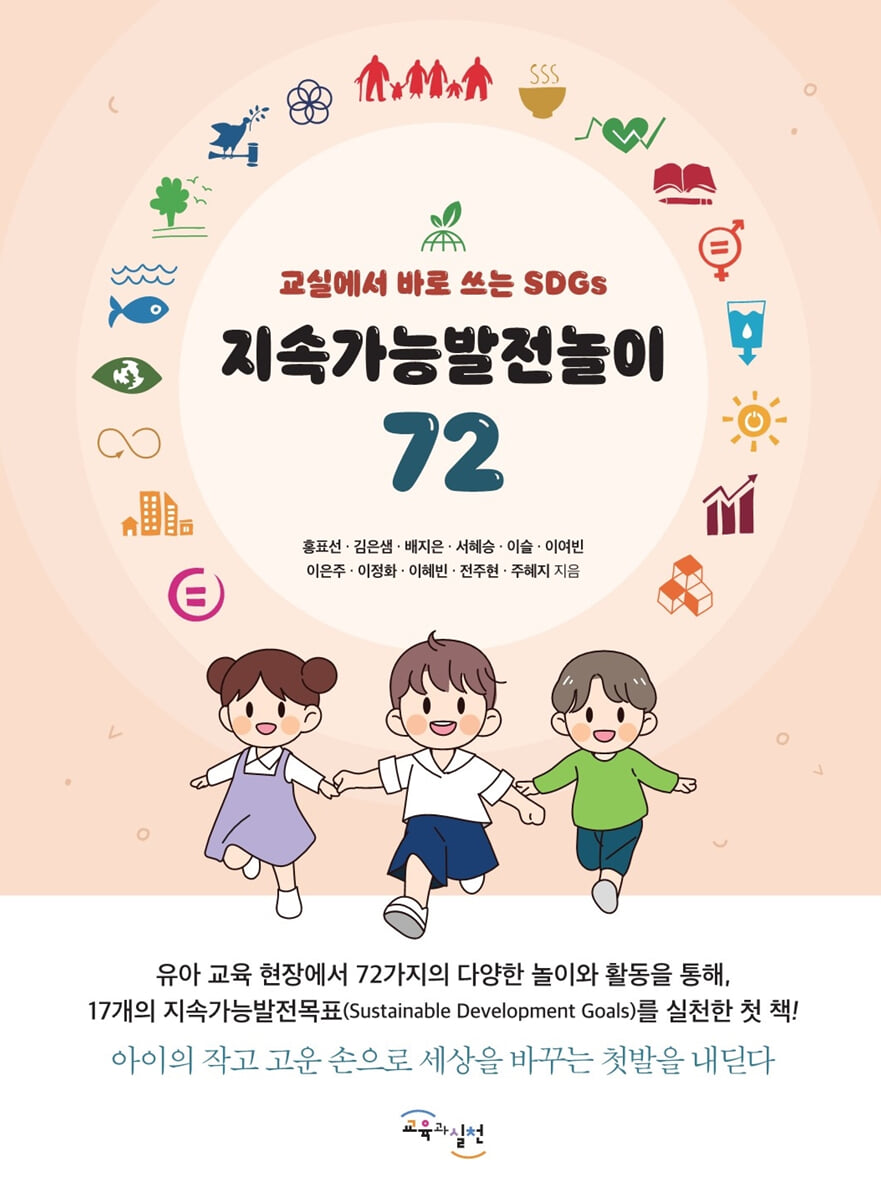
Sustainable Development Play 72
 |
Description
Book Introduction
Through 72 different types of play and activities in early childhood education,
The first book to put the 17 Sustainable Development Goals into practice!
Taking the first step toward changing the world with a child's small, delicate hands.
Education for Sustainable Development (ESD) is an education that helps learners of all ages acquire the knowledge, skills, values, and attitudes to address interconnected global challenges such as climate change, environmental problems, loss of biodiversity, poverty, and inequality.
Our education system, too, is shifting toward fostering children's ability to think and act independently and change the world, based on the core messages of Education for Sustainable Development (ESD).
Education for Sustainable Development (ESD) goes beyond simply addressing environmental issues; it encompasses education that reflects our entire lives and extends to future generations.
It is also a process in which children learn about sustainable living and how to live together.
This book contains more specific and practical content so that you can easily implement Education for Sustainable Development (ESD) in your daily life without fear.
Starting with what sustainable development education is and why it is necessary, it presents various 'play activities' that can be applied directly in educational settings from early childhood education institutions to elementary schools.
We are the perfect partner to begin your journey toward creating a sustainable life in the classroom, at home, and in your community.
The first book to put the 17 Sustainable Development Goals into practice!
Taking the first step toward changing the world with a child's small, delicate hands.
Education for Sustainable Development (ESD) is an education that helps learners of all ages acquire the knowledge, skills, values, and attitudes to address interconnected global challenges such as climate change, environmental problems, loss of biodiversity, poverty, and inequality.
Our education system, too, is shifting toward fostering children's ability to think and act independently and change the world, based on the core messages of Education for Sustainable Development (ESD).
Education for Sustainable Development (ESD) goes beyond simply addressing environmental issues; it encompasses education that reflects our entire lives and extends to future generations.
It is also a process in which children learn about sustainable living and how to live together.
This book contains more specific and practical content so that you can easily implement Education for Sustainable Development (ESD) in your daily life without fear.
Starting with what sustainable development education is and why it is necessary, it presents various 'play activities' that can be applied directly in educational settings from early childhood education institutions to elementary schools.
We are the perfect partner to begin your journey toward creating a sustainable life in the classroom, at home, and in your community.
- You can preview some of the book's contents.
Preview
index
Entering
Features of this book
How to use this book
Part 1.
Towards a sustainable development society
1.
Sustainable Development Goals (SDGs)
2.
Case studies of applying the Sustainable Development Goals (SDGs) in education
3.
The necessity and application of education for sustainable development (ESD)
4.
Sustainable Development Education through Q&A
Part 2.
For a sustainable development classroom
1.
Prepare it like this.
new semester
1) Teachers' meeting to learn and grow together
2) Parent Orientation to Move In Step Together
3) Take a look back at the classroom
2.
Let's make it together with the children.
Our class!
1) Organizing time we create together
2) Our class toys that we decide on together
3) Our class promise to make together
4) Small habits to practice in the bathroom
5) A special date that connects hearts
6) A harmonious day, a game to play together
7) The role of sharing, the guardian of our class
8) Voting is the power to express myself.
Part 3.
For sustainable development play
1.
Take a look again.
Play materials!
1) Recycle and use paper resources
2) The Rebirth of Abandoned Picture Books
3) Clay play that returns to nature
4) Earth Love Flower Shop Play
2.
Let's practice together.
Resource recycling!
1) Operation Save the Earth with Recycling
2) Upcycling reborn as play
3) Reborn toys
4) Our precious energy
3.
Let's do it together.
Special day!
1) We have rights too (Children's Day, May 5th)
2) A special gift for your family (Parents' Day, May 8th)
3) We need buzzing bees (May 20th, Bee Day)
4) Living with Birds (April 1st, Bird Day)
Part 4.
For sustainable development education
1.
Meet digital
1) Meet friends in new ways
2) Growing into a healthy digital citizen
2.
Meet the family and elementary school
1) Happiness that connects home and educational institutions
2) Transition from kindergarten to elementary school
3.
Meet the community
1) Living together with our region
2) Connecting Education for Sustainable Development (ESD) with the Community
Features of this book
How to use this book
Part 1.
Towards a sustainable development society
1.
Sustainable Development Goals (SDGs)
2.
Case studies of applying the Sustainable Development Goals (SDGs) in education
3.
The necessity and application of education for sustainable development (ESD)
4.
Sustainable Development Education through Q&A
Part 2.
For a sustainable development classroom
1.
Prepare it like this.
new semester
1) Teachers' meeting to learn and grow together
2) Parent Orientation to Move In Step Together
3) Take a look back at the classroom
2.
Let's make it together with the children.
Our class!
1) Organizing time we create together
2) Our class toys that we decide on together
3) Our class promise to make together
4) Small habits to practice in the bathroom
5) A special date that connects hearts
6) A harmonious day, a game to play together
7) The role of sharing, the guardian of our class
8) Voting is the power to express myself.
Part 3.
For sustainable development play
1.
Take a look again.
Play materials!
1) Recycle and use paper resources
2) The Rebirth of Abandoned Picture Books
3) Clay play that returns to nature
4) Earth Love Flower Shop Play
2.
Let's practice together.
Resource recycling!
1) Operation Save the Earth with Recycling
2) Upcycling reborn as play
3) Reborn toys
4) Our precious energy
3.
Let's do it together.
Special day!
1) We have rights too (Children's Day, May 5th)
2) A special gift for your family (Parents' Day, May 8th)
3) We need buzzing bees (May 20th, Bee Day)
4) Living with Birds (April 1st, Bird Day)
Part 4.
For sustainable development education
1.
Meet digital
1) Meet friends in new ways
2) Growing into a healthy digital citizen
2.
Meet the family and elementary school
1) Happiness that connects home and educational institutions
2) Transition from kindergarten to elementary school
3.
Meet the community
1) Living together with our region
2) Connecting Education for Sustainable Development (ESD) with the Community
Into the book
To solve the problems facing modern society and move toward a sustainable society, the 2015 UN Development Summit adopted the '2030 Agenda for Sustainable Development', selecting 17 Sustainable Development Goals (SDGs) and 169 detailed targets.
The Sustainable Development Goals (SDGs) are not limited to the present generation, but are goals of coexistence that extend to future generations. Therefore, each country around the world is making efforts tailored to its own circumstances to achieve the goals.
Our country is also striving to confront and resolve various problems facing our society in order to realize the Sustainable Development Goals (SDGs), and based on this, we have established 17 'National Sustainable Development Goals (K-SDGs)'.
--- p.19~20
When looking for ways to support children's play and growth in the field, one thing that always comes up is family connection.
It is most important for children, teachers, and parents to work together as one, but there are times when difficulties arise in the process of implementing home-school collaboration.
For family connections to work well, it must be based on the creation of a systematic and meaningful community for each child.
This foundation improves the quality of classroom management and provides opportunities for growth for both early childhood teachers and parents.
--- p.130
As time goes by, roles that are not noticeable even if you don't do them tend to fade away, and only noticeable roles like 'date keeper' are played.
In order for children to take responsibility for their roles and practice consistently, they need to be aware of when and how they should perform those roles.
Let's help children take responsibility for their role as guardians by thinking about when they should do their part and talking about it together.
--- p.142
In our society, children have been seen as protected beings rather than having the power to express their opinions.
We helped children experience a shift in perspective from “Voting is only for adults!” to “Why can only adults participate in elections?” and fostered a mindset of “We can do it too.”
Through this opportunity, I felt that children can now more confidently voice their opinions, both now and in the future, in a society where they make their own decisions and express their opinions.
After being elected, I thought about carrying out my promises on my own, and I felt like I was a valuable person as I carried out my mission to help my friends when they were having difficulties.
Children who were not elected are growing step by step, observing the challenges voters face and proposing pledges to address them, with the courage to say, "I'll try again next time."
--- p.159
Working hard doesn't make you successful.
If you work hard without thinking, you could fail quickly.
It means that you shouldn't just work hard without strategic thinking.
Working hard is important, but deep thinking is also necessary.
You have to be the one who thinks about what a good investment strategy is.
And you have to invest in places where you can clearly win.
This is the key to successful investing.
--- p.137
I've been thinking a lot about how to reuse picture books, which are collections of paper filled with the unique writing and illustrations of the authors.
Through various situations, I was able to change my perspective on picture books that were out of sight of children, rethink their usefulness, and find new ways to utilize them.
This provided an opportunity for children to become more familiar with picture books.
I learned that by writing down the stories in the picture books I read, a child who is interested in them becomes the new owner of the picture book, and that we can communicate with each other through sharing.
Rather than one-sided sharing, recognizing the heart of the giver and helping those in need choose books fosters a positive perspective on sharing and a love for picture books.
The Sustainable Development Goals (SDGs) are not limited to the present generation, but are goals of coexistence that extend to future generations. Therefore, each country around the world is making efforts tailored to its own circumstances to achieve the goals.
Our country is also striving to confront and resolve various problems facing our society in order to realize the Sustainable Development Goals (SDGs), and based on this, we have established 17 'National Sustainable Development Goals (K-SDGs)'.
--- p.19~20
When looking for ways to support children's play and growth in the field, one thing that always comes up is family connection.
It is most important for children, teachers, and parents to work together as one, but there are times when difficulties arise in the process of implementing home-school collaboration.
For family connections to work well, it must be based on the creation of a systematic and meaningful community for each child.
This foundation improves the quality of classroom management and provides opportunities for growth for both early childhood teachers and parents.
--- p.130
As time goes by, roles that are not noticeable even if you don't do them tend to fade away, and only noticeable roles like 'date keeper' are played.
In order for children to take responsibility for their roles and practice consistently, they need to be aware of when and how they should perform those roles.
Let's help children take responsibility for their role as guardians by thinking about when they should do their part and talking about it together.
--- p.142
In our society, children have been seen as protected beings rather than having the power to express their opinions.
We helped children experience a shift in perspective from “Voting is only for adults!” to “Why can only adults participate in elections?” and fostered a mindset of “We can do it too.”
Through this opportunity, I felt that children can now more confidently voice their opinions, both now and in the future, in a society where they make their own decisions and express their opinions.
After being elected, I thought about carrying out my promises on my own, and I felt like I was a valuable person as I carried out my mission to help my friends when they were having difficulties.
Children who were not elected are growing step by step, observing the challenges voters face and proposing pledges to address them, with the courage to say, "I'll try again next time."
--- p.159
Working hard doesn't make you successful.
If you work hard without thinking, you could fail quickly.
It means that you shouldn't just work hard without strategic thinking.
Working hard is important, but deep thinking is also necessary.
You have to be the one who thinks about what a good investment strategy is.
And you have to invest in places where you can clearly win.
This is the key to successful investing.
--- p.137
I've been thinking a lot about how to reuse picture books, which are collections of paper filled with the unique writing and illustrations of the authors.
Through various situations, I was able to change my perspective on picture books that were out of sight of children, rethink their usefulness, and find new ways to utilize them.
This provided an opportunity for children to become more familiar with picture books.
I learned that by writing down the stories in the picture books I read, a child who is interested in them becomes the new owner of the picture book, and that we can communicate with each other through sharing.
Rather than one-sided sharing, recognizing the heart of the giver and helping those in need choose books fosters a positive perspective on sharing and a love for picture books.
--- p.183
Publisher's Review
“Everyone receives two types of education.
“One is learning from others, and the other is learning on your own, which is much more important.”
_Edward Gibbon
Modern society faces a variety of problems, including environmental issues that threaten human survival, social inequality due to the widening gap between the rich and the poor, and imbalanced educational opportunities.
To address these issues, education must also begin with a sustainable perspective that extends to future generations.
As Mahatma Gandhi said, “The future depends on what we do in the present,” this question begins with the question, “What should we do now to ensure the future our children will live in?”
A meeting was held to examine the present in which children live, recognize that our present is connected to our future, and suggest a direction for education that will serve as the foundation for a sustainable world.
Education for Sustainable Development (ESD), a crucial period for development in early childhood, influences the way children live and cultivates the capabilities that will prepare them for a desirable future. This approach, which spans kindergarten through elementary school and from home to educational institutions, presents comprehensive concepts and practical application methods that can be applied directly in real life and the classroom.
Education creates a life of purpose.
Many problems arising from social and economic inequality, including environmental issues like climate change that we feel on our skin, are global issues that cannot be solved by the power of individuals or nations that our generation faces today.
Ultimately, to solve this problem, we must pay attention to the problems faced by all humans on this planet and work to solve them.
Efforts are needed to achieve sustainable development that meets the needs of the present without compromising the ability of future generations to meet their own needs.
The core implementation strategy is ‘sustainable development education.’
17 Sustainable Development Goals (SDGs) have been established for Education for Sustainable Development (ESD).
This book, through practical application cases in educational settings, helps us understand that Education for Sustainable Development (ESD) is a comprehensive education that encompasses various fields such as environment, society, culture, and economy. Since it is a goal of coexistence that is not limited to the present generation but extends to future generations, it is a time when efforts appropriate to each individual's situation are necessary to achieve the goal.
Education is the seed for a bright future.
Sustainable development is linked to our way of life.
If we view our lives from a sustainable perspective, we can overcome the various crises facing modern society and lead sustainable lives.
The same is true in the educational field.
By supporting a variety of play and activities that allow children to naturally learn the values and goals of the Sustainable Development Goals (SDGs) through everyday experiences, growing children will naturally welcome the day when practicing sustainable development becomes part of their daily lives.
“One is learning from others, and the other is learning on your own, which is much more important.”
_Edward Gibbon
Modern society faces a variety of problems, including environmental issues that threaten human survival, social inequality due to the widening gap between the rich and the poor, and imbalanced educational opportunities.
To address these issues, education must also begin with a sustainable perspective that extends to future generations.
As Mahatma Gandhi said, “The future depends on what we do in the present,” this question begins with the question, “What should we do now to ensure the future our children will live in?”
A meeting was held to examine the present in which children live, recognize that our present is connected to our future, and suggest a direction for education that will serve as the foundation for a sustainable world.
Education for Sustainable Development (ESD), a crucial period for development in early childhood, influences the way children live and cultivates the capabilities that will prepare them for a desirable future. This approach, which spans kindergarten through elementary school and from home to educational institutions, presents comprehensive concepts and practical application methods that can be applied directly in real life and the classroom.
Education creates a life of purpose.
Many problems arising from social and economic inequality, including environmental issues like climate change that we feel on our skin, are global issues that cannot be solved by the power of individuals or nations that our generation faces today.
Ultimately, to solve this problem, we must pay attention to the problems faced by all humans on this planet and work to solve them.
Efforts are needed to achieve sustainable development that meets the needs of the present without compromising the ability of future generations to meet their own needs.
The core implementation strategy is ‘sustainable development education.’
17 Sustainable Development Goals (SDGs) have been established for Education for Sustainable Development (ESD).
This book, through practical application cases in educational settings, helps us understand that Education for Sustainable Development (ESD) is a comprehensive education that encompasses various fields such as environment, society, culture, and economy. Since it is a goal of coexistence that is not limited to the present generation but extends to future generations, it is a time when efforts appropriate to each individual's situation are necessary to achieve the goal.
Education is the seed for a bright future.
Sustainable development is linked to our way of life.
If we view our lives from a sustainable perspective, we can overcome the various crises facing modern society and lead sustainable lives.
The same is true in the educational field.
By supporting a variety of play and activities that allow children to naturally learn the values and goals of the Sustainable Development Goals (SDGs) through everyday experiences, growing children will naturally welcome the day when practicing sustainable development becomes part of their daily lives.
GOODS SPECIFICS
- Date of issue: March 14, 2025
- Page count, weight, size: 344 pages | 172*240*30mm
- ISBN13: 9791191724806
- ISBN10: 1191724808
You may also like
카테고리
korean


korean

![GQ KOREA Mark (Monthly): December [2025]](http://librairie.coreenne.fr/cdn/shop/files/8ef265dbbfbf186523ed75ba7319009d.jpg?v=1765340328&width=3840)


