

Studying basic English on your own
 |
Description
Book Introduction
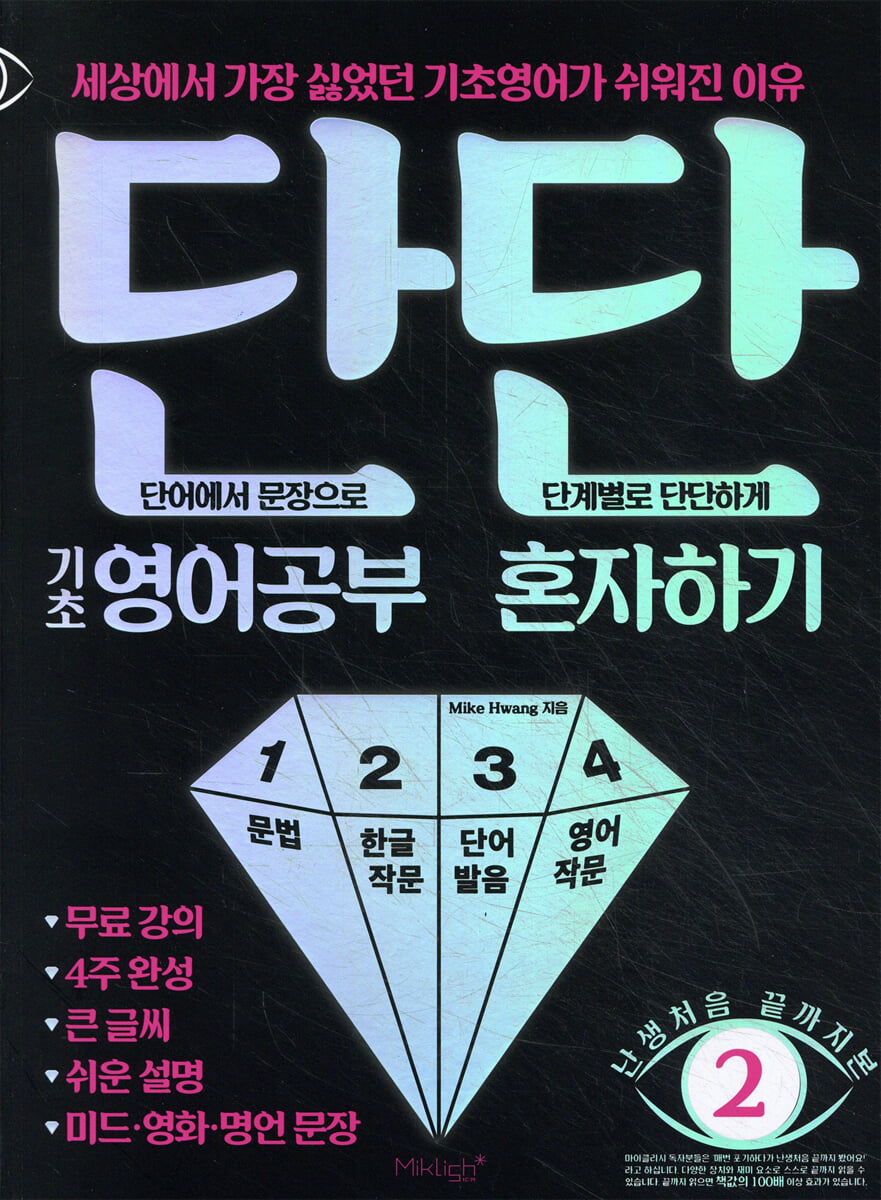
Whenever I buy an English book, I give up after reading the first 10 pages. The reason we give up is not because we lack will. Because the book was boring and difficult. 'Solid Basic English Study Alone' is made up of fun sentences selected from movies, American dramas, and famous quotes. It is explained in easy-to-understand 'words' and 'sentences', step by step, starting with the easy ones. Grammar terms have been purified to the maximum extent possible, and the large font makes it accessible to everyone from elementary school students to the elderly. Anyone can study English on their own with free lectures directly from the author, MP3s from native speakers, and Q&A sessions on YouTube and miklish.com. |
- You can preview some of the book's contents.
Preview
index
*preface
*Book structure/use
*Excerpt from the book
*Pronunciation by alphabet
*283 words included 4 or more times
*time
*1 week
Why is there an a in the word "day"? 18
Why can't I count the number of meals I eat in two days? 22
3 days I you see Is it me who sees it or is it you who sees it? 26
4th a Moon/the Moon Which is correct? 30
How do I find out who it belongs to on the 5th? 34
Why do we use "loves" instead of "love" on the 6th? 38
7 days you are one person, so why do we use are? 42
Week 1 Summary 46
*2 weeks
What is the difference between is and are on the 8th? 50
How do you express "in the middle" on the 9th? 54
Why do we use the verb "be" in the 10-day progressive tense? 58
Why is "Past Me" in the third person? 62
How to change "do" to "did" on the 12th? 66
13th be doesn't mean passive? 70
14. "Eat" and "Feed" make different sentences? 74
2-Week Summary 78
*3 weeks
Who/what is handsome on the 15th? 82
What if you want to use the verb 16 one more time? 86
Why was the "to-infinitive" difficult on the 17th? 90
On the 18th, there are various "~에서" in English? 94
Why is "to" after "go" on the 19th? 98
20 days will not be the future? 102
On the 21st, the "past verb" wasn't in the past? 106
3-Week Summary 110
*4 weeks
22nd because isn't 'because'? 114
Why is "23rd doesn't likes" wrong? 118
Why isn't "am not" abbreviated on the 24th? 122
Are do and be auxiliary verbs on the 25th? 126
Asking in word order on the 26th? 130
On the 27th, how does "how" mean "how much" or "how"? 134
Why did "Who/What" disappear on the 28th? 138
4-Week Summary 142
*Vowel pronunciation
e vs æ 20 e 28 y 44 a 64 i 96
o 124 oo 132 w 136 wh 140
*supplement
500 words by frequency 144
Irregular Conjugation of Verbs by Type 148
*Book structure/use
*Excerpt from the book
*Pronunciation by alphabet
*283 words included 4 or more times
*time
*1 week
Why is there an a in the word "day"? 18
Why can't I count the number of meals I eat in two days? 22
3 days I you see Is it me who sees it or is it you who sees it? 26
4th a Moon/the Moon Which is correct? 30
How do I find out who it belongs to on the 5th? 34
Why do we use "loves" instead of "love" on the 6th? 38
7 days you are one person, so why do we use are? 42
Week 1 Summary 46
*2 weeks
What is the difference between is and are on the 8th? 50
How do you express "in the middle" on the 9th? 54
Why do we use the verb "be" in the 10-day progressive tense? 58
Why is "Past Me" in the third person? 62
How to change "do" to "did" on the 12th? 66
13th be doesn't mean passive? 70
14. "Eat" and "Feed" make different sentences? 74
2-Week Summary 78
*3 weeks
Who/what is handsome on the 15th? 82
What if you want to use the verb 16 one more time? 86
Why was the "to-infinitive" difficult on the 17th? 90
On the 18th, there are various "~에서" in English? 94
Why is "to" after "go" on the 19th? 98
20 days will not be the future? 102
On the 21st, the "past verb" wasn't in the past? 106
3-Week Summary 110
*4 weeks
22nd because isn't 'because'? 114
Why is "23rd doesn't likes" wrong? 118
Why isn't "am not" abbreviated on the 24th? 122
Are do and be auxiliary verbs on the 25th? 126
Asking in word order on the 26th? 130
On the 27th, how does "how" mean "how much" or "how"? 134
Why did "Who/What" disappear on the 28th? 138
4-Week Summary 142
*Vowel pronunciation
e vs æ 20 e 28 y 44 a 64 i 96
o 124 oo 132 w 136 wh 140
*supplement
500 words by frequency 144
Irregular Conjugation of Verbs by Type 148
Detailed image
Publisher's Review
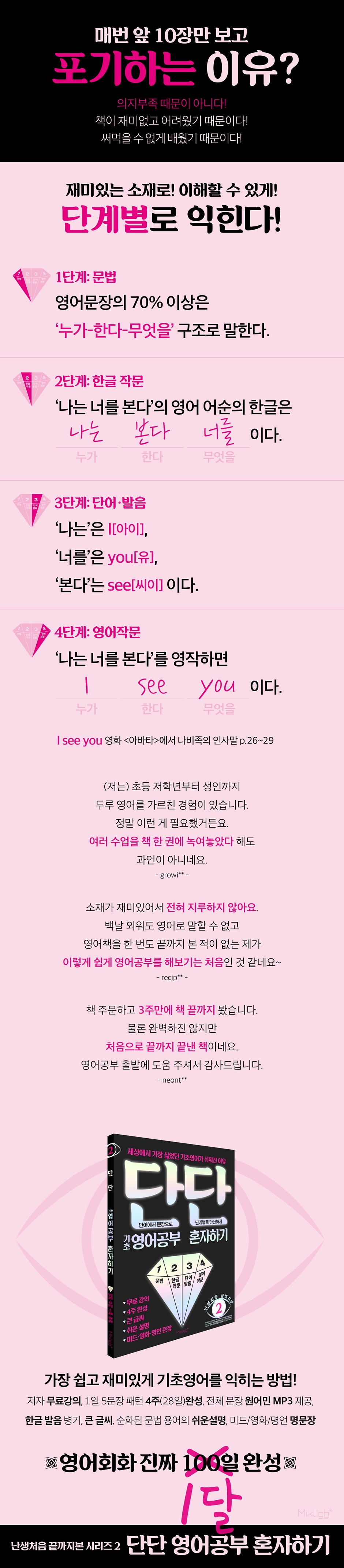
Why You Can't Speak English Even After Memorizing It for a Hundred Days
Even after studying for over 10 years from elementary school to university, I am speechless when I meet foreigners.
Even if I get a TOEIC score of 900 and know English grammar almost perfectly and answer all the grammar questions correctly, I still can't speak English.
This is because we go through completely different thought processes when interpreting and when speaking.
Just as watching and playing soccer are different, or reading and writing a novel are different, no matter how much you study, you will never be able to speak English if you have never tried speaking and writing in English.
Why I Can't Finish Reading an English Book
Whenever I start studying English, I always give up after reading the first 10 pages or so.
The more you repeat this, the more books pile up, your self-esteem grows, and you end up blaming your own lack of willpower, but your English skills do not improve at all.
But the real problem isn't people, it's books.
Because the book was poorly written.
Most books are full of difficult-to-understand terms and explanations, so even if you read them multiple times, you won't be able to write in English or solve problems.
Or the sentence is so boring that I can't finish it.
Because sentences that don't allow you to empathize take a long time to learn.
Just as you can't forget "I'm your father" (the villain Darth Vader was actually the protagonist's father) when watching Star Wars, you can learn quickly by learning sentences that provide context and vocabulary and sentences that are actually used a lot.
Characteristics of 'Solid English'
·You can learn on your own with free video lectures directly from the author on YouTube and miklish.com (bit.ly/3kI34im).
·Fun and easy sentences were selected from Michael Crisis' representative books (Mid Angel, Daily English Conversation Angel, Movie Writing, English Quote Diary).
·It is written in large letters so it is easy for children and the elderly to read.
·Before writing in English, you write in Korean using English word order, so even beginners can learn without difficulty.
· Grammar terms are purified as much as possible (e.g. ‘who’ instead of ‘subject’) so that they can be easily understood and used.
·It is less burdensome as it consists of 5 sentences (4 pages) per day and 4 weeks to complete.
·Since we repeat the key points by inserting a ‘summary’ every 7 days, they stick in your memory better.
For those who absolutely need 'solid English'
·When people in their 20s and 30s who have not studied English for a long time do not know where to start.
·People in their 50s to 70s who dream of traveling abroad freely.
·People in their 30s and 40s who lack the basics to teach their children
.·A teenager who dreads class time because his friends speak English fluently, but he struggles to read English.
Even after studying for over 10 years from elementary school to university, I am speechless when I meet foreigners.
Even if I get a TOEIC score of 900 and know English grammar almost perfectly and answer all the grammar questions correctly, I still can't speak English.
This is because we go through completely different thought processes when interpreting and when speaking.
Just as watching and playing soccer are different, or reading and writing a novel are different, no matter how much you study, you will never be able to speak English if you have never tried speaking and writing in English.
Why I Can't Finish Reading an English Book
Whenever I start studying English, I always give up after reading the first 10 pages or so.
The more you repeat this, the more books pile up, your self-esteem grows, and you end up blaming your own lack of willpower, but your English skills do not improve at all.
But the real problem isn't people, it's books.
Because the book was poorly written.
Most books are full of difficult-to-understand terms and explanations, so even if you read them multiple times, you won't be able to write in English or solve problems.
Or the sentence is so boring that I can't finish it.
Because sentences that don't allow you to empathize take a long time to learn.
Just as you can't forget "I'm your father" (the villain Darth Vader was actually the protagonist's father) when watching Star Wars, you can learn quickly by learning sentences that provide context and vocabulary and sentences that are actually used a lot.
Characteristics of 'Solid English'
·You can learn on your own with free video lectures directly from the author on YouTube and miklish.com (bit.ly/3kI34im).
·Fun and easy sentences were selected from Michael Crisis' representative books (Mid Angel, Daily English Conversation Angel, Movie Writing, English Quote Diary).
·It is written in large letters so it is easy for children and the elderly to read.
·Before writing in English, you write in Korean using English word order, so even beginners can learn without difficulty.
· Grammar terms are purified as much as possible (e.g. ‘who’ instead of ‘subject’) so that they can be easily understood and used.
·It is less burdensome as it consists of 5 sentences (4 pages) per day and 4 weeks to complete.
·Since we repeat the key points by inserting a ‘summary’ every 7 days, they stick in your memory better.
For those who absolutely need 'solid English'
·When people in their 20s and 30s who have not studied English for a long time do not know where to start.
·People in their 50s to 70s who dream of traveling abroad freely.
·People in their 30s and 40s who lack the basics to teach their children
.·A teenager who dreads class time because his friends speak English fluently, but he struggles to read English.
GOODS SPECIFICS
- Publication date: December 14, 2020
- Page count, weight, size: 152 pages | 490g | 188*254*8mm
- ISBN13: 9791187158288
- ISBN10: 1187158283
You may also like
카테고리
korean


korean

![GQ KOREA Mark (Monthly): December [2025]](http://librairie.coreenne.fr/cdn/shop/files/8ef265dbbfbf186523ed75ba7319009d.jpg?v=1765340328&width=3840)


