

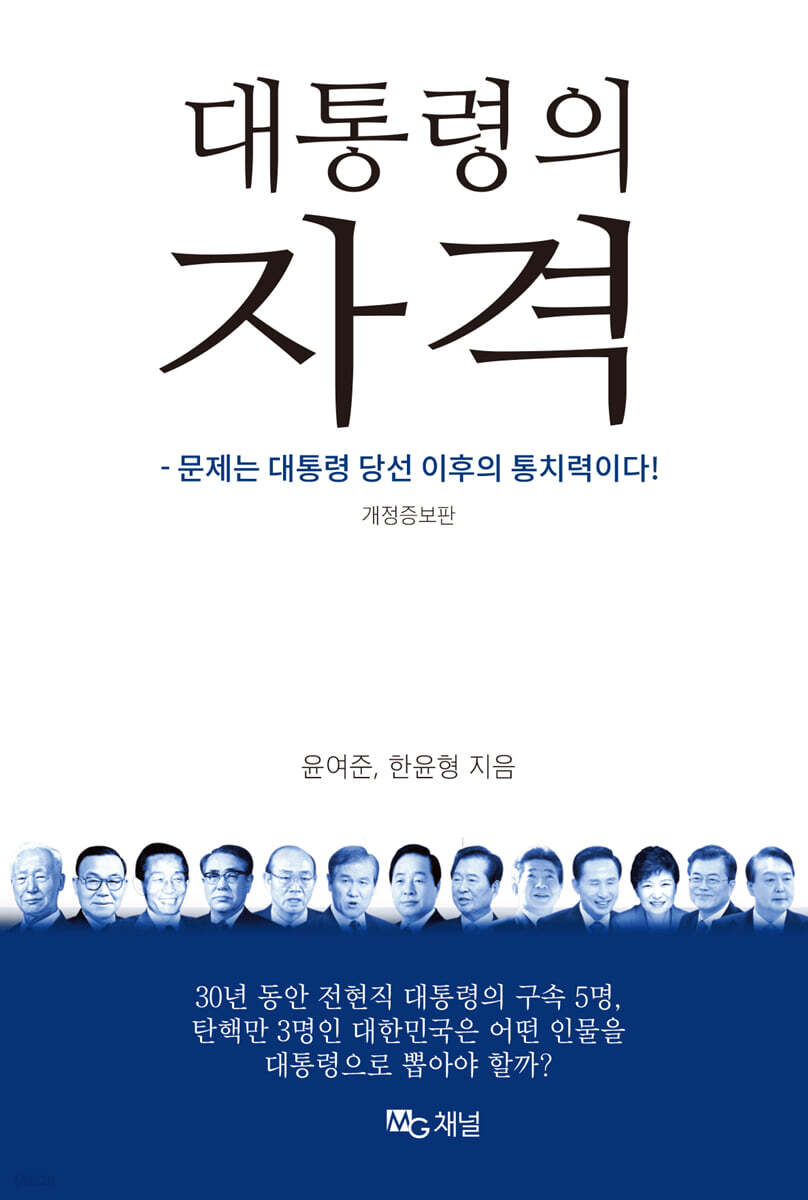
Qualifications of the President
 |
Description
Book Introduction
Former Minister of Environment Yoon Yeo-joon worked in government administration for over 20 years, including in the Blue House, the executive branch, the National Assembly, and political parties.
Including the 10 years he worked as a political reporter before entering public office, he has been directly or indirectly involved in running the country for over 30 years.
His father, Mr. Yoon Seok-oh, also served as secretary to Dr. Syngman Rhee from 1945, immediately after liberation, and after the establishment of the government in 1948, he continued to work as Vice Minister of General Affairs for two more years, showing that both father and son worked in the Presidential Office.
In 2011, during the Lee Myung-bak administration, the author published “Qualifications of the President” in which he sharply commented on past presidents.
The book borrows the conceptual framework of 'statecraft' ('governance capacity' or 'governance strategy'), and knowledge of Eastern and Western imperial studies and governance studies enriches the discussion.
It goes without saying that the author's political experience and extensive reading are the foundation of this book. A revised and expanded edition was published in 2025, after three presidential elections.
Here, the author diagnoses the merits and demerits of 14 years of national administration.
It is encouraging that Korea has escaped the 'middle-income trap' and entered the ranks of developed countries.
However, the crisis in the political and social aspects is more urgent than in the past.
The biggest problem is that politics, which exists to solve social and economic problems, has lost its original function and is instead functioning as an obstacle to the national economy.
The book is divided into three parts.
Part 1 is the concept of 'statecraft' traced through the historical discourses of the East and the West, Part 2 is an evaluation of the statecraft of past presidents, and Part 3 is the main content of the author's thoughts on the qualifications of the president.
The revised and expanded edition revised and supplemented President Lee Myung-bak's statecraft evaluation from 2011.
New evaluations of Presidents Park Geun-hye, Moon Jae-in, and Yoon Seok-yeol have been added here.
In Part 3, the author's lectures and subsequent research and commentary since the publication of the 2011 work have been added.
If the 2011 work was written independently, the revised and expanded edition is marked as co-authored.
The co-author is writer Han Yun-hyeong.
The content added to the revised and expanded edition was interviewed and drafted by Han Yun-hyeong, and reviewed and revised by Yoon Yeo-jun.
We live in an era where 'political civil war' is intensifying and there are even concerns about 'physical civil war'.
Everyone says that the current constitution has reached its limits, and some even argue that the presidential system should be abolished.
Nevertheless, South Korea must still hold a new presidential election without amending the constitution.
At this point, it is more urgent to discuss the ‘qualifications of the president.’
This book will serve as essential knowledge not only for those who aspire to rule the Republic of Korea, those who wish to assist such leaders, but also for citizens who wish to imagine what kind of person a worthy ruler would be and what kind of country such a ruler would rule.
Including the 10 years he worked as a political reporter before entering public office, he has been directly or indirectly involved in running the country for over 30 years.
His father, Mr. Yoon Seok-oh, also served as secretary to Dr. Syngman Rhee from 1945, immediately after liberation, and after the establishment of the government in 1948, he continued to work as Vice Minister of General Affairs for two more years, showing that both father and son worked in the Presidential Office.
In 2011, during the Lee Myung-bak administration, the author published “Qualifications of the President” in which he sharply commented on past presidents.
The book borrows the conceptual framework of 'statecraft' ('governance capacity' or 'governance strategy'), and knowledge of Eastern and Western imperial studies and governance studies enriches the discussion.
It goes without saying that the author's political experience and extensive reading are the foundation of this book. A revised and expanded edition was published in 2025, after three presidential elections.
Here, the author diagnoses the merits and demerits of 14 years of national administration.
It is encouraging that Korea has escaped the 'middle-income trap' and entered the ranks of developed countries.
However, the crisis in the political and social aspects is more urgent than in the past.
The biggest problem is that politics, which exists to solve social and economic problems, has lost its original function and is instead functioning as an obstacle to the national economy.
The book is divided into three parts.
Part 1 is the concept of 'statecraft' traced through the historical discourses of the East and the West, Part 2 is an evaluation of the statecraft of past presidents, and Part 3 is the main content of the author's thoughts on the qualifications of the president.
The revised and expanded edition revised and supplemented President Lee Myung-bak's statecraft evaluation from 2011.
New evaluations of Presidents Park Geun-hye, Moon Jae-in, and Yoon Seok-yeol have been added here.
In Part 3, the author's lectures and subsequent research and commentary since the publication of the 2011 work have been added.
If the 2011 work was written independently, the revised and expanded edition is marked as co-authored.
The co-author is writer Han Yun-hyeong.
The content added to the revised and expanded edition was interviewed and drafted by Han Yun-hyeong, and reviewed and revised by Yoon Yeo-jun.
We live in an era where 'political civil war' is intensifying and there are even concerns about 'physical civil war'.
Everyone says that the current constitution has reached its limits, and some even argue that the presidential system should be abolished.
Nevertheless, South Korea must still hold a new presidential election without amending the constitution.
At this point, it is more urgent to discuss the ‘qualifications of the president.’
This book will serve as essential knowledge not only for those who aspire to rule the Republic of Korea, those who wish to assist such leaders, but also for citizens who wish to imagine what kind of person a worthy ruler would be and what kind of country such a ruler would rule.
index
To the revised and expanded edition
preface
Part 1: What is Statecraft?
Chapter 1 Introduction
1.
South Korea, a history of miracles
2.
Reflection on the Nation
Chapter 2: The State and Statecraft
1.
political community or nation
2.
Statecraft (governance or national management)
Chapter 3: Statecraft in Traditional Eastern Countries
1.
Traditional Chinese Statecraft: Focusing on the Zhenguan Zhengyao
2.
Traditional statecraft in the Korean Peninsula
Chapter 4 Statecraft in Western Countries
1.
Statecraft in Western pre-modern states
2.
Statecraft in Western modern states
Chapter 5: Statecraft in the Modern State
1.
Statecraft of a latecomer country
2.
Statecraft in modern democracies
Chapter 6 Conclusion
The future of South Korea depends on statecraft.
Part 2 Statecraft of the President of the Republic of Korea
Chapter 1: The Legacy of the Japanese Colonial Period
Chapter 2: The Impact of Liberated Space on Statecraft
Chapter 3: The First Republic and President Syngman Rhee's Statecraft
Chapter 4: April 19 and May 16, or Statecraft in Choosing the Path to Modernization
1.
introduction
2.
The Fall of the Syngman Rhee Government and the Interim Government from a Statecraft Perspective
3.
Statecraft of the Democratic Party government
4.
The Democratic Party government's statecraft revealed during the collapse of the regime
5.
The nature of May 16 and new statecraft
Chapter 5: President Park Chung-hee's Statecraft and Merits and Flaws
1.
introduction
2.
Statecraft during the military regime
3.
Export-oriented economic development plan and statecraft
4.
The Limits of Authoritarian Statecraft
5.
Yushin Regime and Statecraft
6.
Lessons for today
Chapter 6: Statecraft of Presidents Choi Kyu-hah and Chun Doo-hwan
1.
'Spring in Seoul' and the Extension of Authoritarianism
2.
Statecraft of President Chun Doo-hwan of the Fifth Republic
3.
Democratization Process and Statecraft
4.
A Comprehensive Evaluation of President Chun Doo-hwan's Statecraft
Chapter 7 President Roh Tae-woo and Statecraft
1.
The Emergence of a New Democratic Statecraft After the June 29 Declaration
2.
Statecraft in the early days of the administration, when the opposition party was in power
3.
President Roh's statecraft during the latter half of his term under the opposition party
4.
President Roh Tae-woo's Statecraft Evaluation
Chapter 8: President Kim Young-sam's Statecraft
1.
introduction
2.
Achievements and Problems of Early Reforms
3.
Statecraft in the mid-period of the Kim Young-sam administration
4.
The total failure of the final days of the Kim Young-sam administration
5.
President Kim Young-sam's Statecraft Evaluation
Chapter 9 President Kim Dae-jung's Statecraft
1.
introduction
2.
Statecraft during the first half of President Kim Dae-jung's term
3.
Statecraft in the latter half of President Kim Dae-jung's term
4.
President Kim Dae-jung's Statecraft Evaluation
Chapter 10: President Roh Moo-hyun's Statecraft
1.
introduction
2.
Statecraft in the early days of President Roh Moo-hyun's administration
3.
Statecraft during the second half of President Roh Moo-hyun's term
4.
President Roh Moo-hyun's Statecraft Evaluation
Chapter 11 President Lee Myung-bak's Statecraft
1.
introduction
2.
A leadership crisis in the first year of his term
3.
The Characteristics and Problems of President Lee Myung-bak's Statecraft
4.
conclusion
Chapter 12: President Park Geun-hye's Statecraft Closing Remarks
1.
introduction
2.
A politician who wanted to be president but didn't?
3.
Impeachment is a result of failure to accept public opinion.
4.
conclusion
Chapter 13: President Moon Jae-in's Statecraft
1.
introduction
2.
Statecraft in political reform and socio-economic issues
3.
Statecraft in North Korea Policy and Foreign Affairs
4.
Cracks in the support base and the failure to recreate the regime
5.
President Moon Jae-in's Statecraft Evaluation
Chapter 14: President Yoon Seok-yeol's Statecraft
1.
introduction
2.
The "anti-activist forces" that came to power to fight the activist forces
3.
Shedding the virtues of 'pragmatic conservatism'
4.
conclusion
Part 3 Conclusion
In 2025, the public once again asks about the "qualifications of the presidency," and Yoon Yeo-jun answers.
Chapter 1: Re-Questioning the President's Qualifications
In 2025, the presidential qualifications will be questioned again.
Overcoming the 1987 regime and achieving proper change
Chapter 2: Presidential Qualifications as Answered by Yoon Yeo-jun
Qualifications for the President: Six Abilities and Two Qualities
Four Qualities of Words and Conduct Required of a President
Three Presidential Social Views
Balanced national view
A perspective on North Korea based on checks and balances and negotiations
Insight is power
Like a monarch who knows how to rule over his longevity
Career and morality
Chapter 3: The People Must Become More Mature
Epilogue
preface
Part 1: What is Statecraft?
Chapter 1 Introduction
1.
South Korea, a history of miracles
2.
Reflection on the Nation
Chapter 2: The State and Statecraft
1.
political community or nation
2.
Statecraft (governance or national management)
Chapter 3: Statecraft in Traditional Eastern Countries
1.
Traditional Chinese Statecraft: Focusing on the Zhenguan Zhengyao
2.
Traditional statecraft in the Korean Peninsula
Chapter 4 Statecraft in Western Countries
1.
Statecraft in Western pre-modern states
2.
Statecraft in Western modern states
Chapter 5: Statecraft in the Modern State
1.
Statecraft of a latecomer country
2.
Statecraft in modern democracies
Chapter 6 Conclusion
The future of South Korea depends on statecraft.
Part 2 Statecraft of the President of the Republic of Korea
Chapter 1: The Legacy of the Japanese Colonial Period
Chapter 2: The Impact of Liberated Space on Statecraft
Chapter 3: The First Republic and President Syngman Rhee's Statecraft
Chapter 4: April 19 and May 16, or Statecraft in Choosing the Path to Modernization
1.
introduction
2.
The Fall of the Syngman Rhee Government and the Interim Government from a Statecraft Perspective
3.
Statecraft of the Democratic Party government
4.
The Democratic Party government's statecraft revealed during the collapse of the regime
5.
The nature of May 16 and new statecraft
Chapter 5: President Park Chung-hee's Statecraft and Merits and Flaws
1.
introduction
2.
Statecraft during the military regime
3.
Export-oriented economic development plan and statecraft
4.
The Limits of Authoritarian Statecraft
5.
Yushin Regime and Statecraft
6.
Lessons for today
Chapter 6: Statecraft of Presidents Choi Kyu-hah and Chun Doo-hwan
1.
'Spring in Seoul' and the Extension of Authoritarianism
2.
Statecraft of President Chun Doo-hwan of the Fifth Republic
3.
Democratization Process and Statecraft
4.
A Comprehensive Evaluation of President Chun Doo-hwan's Statecraft
Chapter 7 President Roh Tae-woo and Statecraft
1.
The Emergence of a New Democratic Statecraft After the June 29 Declaration
2.
Statecraft in the early days of the administration, when the opposition party was in power
3.
President Roh's statecraft during the latter half of his term under the opposition party
4.
President Roh Tae-woo's Statecraft Evaluation
Chapter 8: President Kim Young-sam's Statecraft
1.
introduction
2.
Achievements and Problems of Early Reforms
3.
Statecraft in the mid-period of the Kim Young-sam administration
4.
The total failure of the final days of the Kim Young-sam administration
5.
President Kim Young-sam's Statecraft Evaluation
Chapter 9 President Kim Dae-jung's Statecraft
1.
introduction
2.
Statecraft during the first half of President Kim Dae-jung's term
3.
Statecraft in the latter half of President Kim Dae-jung's term
4.
President Kim Dae-jung's Statecraft Evaluation
Chapter 10: President Roh Moo-hyun's Statecraft
1.
introduction
2.
Statecraft in the early days of President Roh Moo-hyun's administration
3.
Statecraft during the second half of President Roh Moo-hyun's term
4.
President Roh Moo-hyun's Statecraft Evaluation
Chapter 11 President Lee Myung-bak's Statecraft
1.
introduction
2.
A leadership crisis in the first year of his term
3.
The Characteristics and Problems of President Lee Myung-bak's Statecraft
4.
conclusion
Chapter 12: President Park Geun-hye's Statecraft Closing Remarks
1.
introduction
2.
A politician who wanted to be president but didn't?
3.
Impeachment is a result of failure to accept public opinion.
4.
conclusion
Chapter 13: President Moon Jae-in's Statecraft
1.
introduction
2.
Statecraft in political reform and socio-economic issues
3.
Statecraft in North Korea Policy and Foreign Affairs
4.
Cracks in the support base and the failure to recreate the regime
5.
President Moon Jae-in's Statecraft Evaluation
Chapter 14: President Yoon Seok-yeol's Statecraft
1.
introduction
2.
The "anti-activist forces" that came to power to fight the activist forces
3.
Shedding the virtues of 'pragmatic conservatism'
4.
conclusion
Part 3 Conclusion
In 2025, the public once again asks about the "qualifications of the presidency," and Yoon Yeo-jun answers.
Chapter 1: Re-Questioning the President's Qualifications
In 2025, the presidential qualifications will be questioned again.
Overcoming the 1987 regime and achieving proper change
Chapter 2: Presidential Qualifications as Answered by Yoon Yeo-jun
Qualifications for the President: Six Abilities and Two Qualities
Four Qualities of Words and Conduct Required of a President
Three Presidential Social Views
Balanced national view
A perspective on North Korea based on checks and balances and negotiations
Insight is power
Like a monarch who knows how to rule over his longevity
Career and morality
Chapter 3: The People Must Become More Mature
Epilogue
Into the book
We have all recently witnessed the 'unfitness of the president' and have been heartbroken to see how ridiculous a person who is put in a position of responsibility can become.
It is comforting to see the level of resistance from the younger generation, who seem to embody democracy much more than the older generation.
However, this moment, when we feel the 'unqualification of the president' so keenly, may be the time to question the 'qualification of the president' again.
--- From "On the Revised and Expanded Edition"
The majority of the people were suffering from a serious mental and emotional illness of defeatism and self-destruction.
While the theories of Japanese imperialism's invasion, such as 'Asiatic despotism', 'peninsular character theory', and 'stasis theory', were prevalent, we ourselves were caught up in a 'culture of resentment', and an extreme sense of defeatism was rampant in our society, with the idea that 'we can't do it (meaning that Koreans can't do it either).'
--- From “Introduction, Part 1, Chapter 1”
Therefore, to avoid confusion in terminology, here we will refer to the state in the general sense as a body politic (or polity), which is an academic term, unlike the modern nation-state.
--- From "Part 1, Chapter 2"
Emperor Taizong of Tang believed that floods and disasters were simply the laws of nature, and that governing a country was like planting a tree. If you cherish and nurture it, it will prosper day by day, but if you don't, it will wither and die over time.
--- From "Part 1, Chapter 3"
The first person to seriously and directly consider the principles and techniques of governance of a modern state was Niccolo Machiavelli.
Above all, he deeply explored how to build, maintain, and prosper the 'stato', the early modern state that was emerging at the time.
--- From "Part 1, Chapter 4"
Thus, the experience of colonial rule led to the formation of opposing ideas among Koreans: a highly powerful state and a people who submit to or resist it.
This oppressive ruling system and behavior not only caused Koreans to resist foreign rule, but also to have an extremely negative perception of the modern state itself.
--- From "Part 2, Chapter 1"
If at that time, even the 200 or so vicious and high-ranking pro-Japanese collaborators had been properly punished, it would have been difficult for the perception to arise that Korean society had failed to properly “liquidate pro-Japanese collaborators” and thus justice had not been served.
--- From "Part 2, Chapter 3"
May 16 needs to be viewed in the context of April 19.
To conclude, they were two different political responses that arose under identical socio-economic conditions and within the same fundamentally political structure, and they came from two different forces: students and soldiers.
--- From "Part 2, Chapter 4"
However, the Yushin regime was difficult to run even for the most outstanding individuals, as it aimed for a high degree of centralization and personalization of power.
Moreover, after the death of First Lady Yuk Young-soo, President Park began to show a significant decline in her sense of governance.
--- From "Part 2, Chapter 5"
He showed an obsession with victory in running the country based on the hegemonic value that 'the principle of politics is that those with power do what they want.'
If President Park Chung-hee was a meticulous staff-type, President Chun Doo-hwan was a combat commander who appeared to be arrogant, and was closer to a proactive, reckless problem-solver who created favorable situational conditions.
--- From "Part 2, Chapter 6"
At the time, the Blue House staff even self-deprecatingly referred to themselves as a "mayfly government."
It appears that President Roh's popularity-oriented leadership style, which is sensitive to public opinion and values legitimacy, appearance, and image over substance, has had a significant influence on this.
--- From "Part 2, Chapter 7"
Reform is a double-edged sword.
The sharper the blade, the more likely it is to end up hurting oneself when the one holding the hilt is weak in morality and justification.
The Kim Young-sam administration, which prioritized reform, was no exception.
--- From "Part 2, Chapter 8"
He made immortal contributions to the struggle for democracy and was eventually able to rise to the top leadership of the country.
He demonstrated his outstanding qualities as a politician and succeeded in ‘starting a business’.
However, he revealed significant problems in running the country as president, that is, in 'Su-seong'.
--- From "Part 2, Chapter 9"
By the end of his term, the consensus among most people in society, regardless of whether they were conservative or progressive, was that President Roh Moo-hyun's administration had been a failure.
However, after leaving office, he tragically ended his life while under investigation by prosecutors on charges of receiving illegal funds, which led to the formation of an atmosphere of remembrance.
--- From "Part 2, Chapter 10"
The most regrettable thing about President Lee Myung-bak's governance was the lack of publicness, which is a core value of statecraft.
On the one hand, state power is delegated to public officials through elections, but this does not mean that they can operate everything they want during their term as long as it does not violate the law.
--- From "Part 2, Chapter 11"
In that sense, if the problem with the Lee Myung-bak administration's governing style was the 'lack of publicness,' then the Park Geun-hye administration was monopolizing power by privatizing the public sphere without even recognizing what publicness is.
--- From "Part 2, Chapter 12"
President Moon Jae-in expanded his political influence to the presidency not through his personal charisma, but as the eldest brother and leader of the pro-Roh group that came together after the tragic death of former President Roh Moo-hyun.
His reputation for being a good person was also proof that he was not at odds with anyone in the group.
That may be true, but there was no way to rule the Republic of Korea without being at odds with anyone.
--- From "Part 2, Chapter 13"
I had mixed feelings watching President Yoon Seok-yeol's downfall.
While I was wondering, 'How did Korea's conservatives get to this point when they weren't even this bad?', I also felt that they must have been helpless in the face of a president who was running wild because I had experienced firsthand how opportunistic they were.
--- From "Part 2, Chapter 14"
President Yoon's statecraft is unprecedented since the founding of the Republic of Korea, and if we must compare it, we must go back to the pre-modern history of the East and compare it to those who were called "foolish kings who were ignorant of reason" and "dark rulers."
--- From "Part 2, Chapter 14"
Since democratization, we have experienced four horizontal regime changes, each with its own unique form, and have thus far experienced both left-right and right-wing approaches to state administration.
We have also had both professional and professional politicians become presidents.
As a result, we were able to realize that if we do not elect a president who possesses proper statecraft, it will be difficult to run the country normally, let alone achieve national development.
--- From "Part 3, Chapter 1"
When democratic values are internalized, there will be no misunderstandings about the position of president.
The president should not be at the top of a vertical hierarchy, but should occupy a position similar to that of a "chief among fellow citizens."
You should think of yourself as riding high on the shoulders of your fellow citizens and cabinet staff, assisted by them.
The President is merely the head of the executive branch, and should not be mistaken for the head of state.
The role of the president as head of state is purely in the realm of foreign relations, but there have been many who mistakenly believed that the president should also act as a head of state who transcends the executive branch in the realm of domestic politics.
It is comforting to see the level of resistance from the younger generation, who seem to embody democracy much more than the older generation.
However, this moment, when we feel the 'unqualification of the president' so keenly, may be the time to question the 'qualification of the president' again.
--- From "On the Revised and Expanded Edition"
The majority of the people were suffering from a serious mental and emotional illness of defeatism and self-destruction.
While the theories of Japanese imperialism's invasion, such as 'Asiatic despotism', 'peninsular character theory', and 'stasis theory', were prevalent, we ourselves were caught up in a 'culture of resentment', and an extreme sense of defeatism was rampant in our society, with the idea that 'we can't do it (meaning that Koreans can't do it either).'
--- From “Introduction, Part 1, Chapter 1”
Therefore, to avoid confusion in terminology, here we will refer to the state in the general sense as a body politic (or polity), which is an academic term, unlike the modern nation-state.
--- From "Part 1, Chapter 2"
Emperor Taizong of Tang believed that floods and disasters were simply the laws of nature, and that governing a country was like planting a tree. If you cherish and nurture it, it will prosper day by day, but if you don't, it will wither and die over time.
--- From "Part 1, Chapter 3"
The first person to seriously and directly consider the principles and techniques of governance of a modern state was Niccolo Machiavelli.
Above all, he deeply explored how to build, maintain, and prosper the 'stato', the early modern state that was emerging at the time.
--- From "Part 1, Chapter 4"
Thus, the experience of colonial rule led to the formation of opposing ideas among Koreans: a highly powerful state and a people who submit to or resist it.
This oppressive ruling system and behavior not only caused Koreans to resist foreign rule, but also to have an extremely negative perception of the modern state itself.
--- From "Part 2, Chapter 1"
If at that time, even the 200 or so vicious and high-ranking pro-Japanese collaborators had been properly punished, it would have been difficult for the perception to arise that Korean society had failed to properly “liquidate pro-Japanese collaborators” and thus justice had not been served.
--- From "Part 2, Chapter 3"
May 16 needs to be viewed in the context of April 19.
To conclude, they were two different political responses that arose under identical socio-economic conditions and within the same fundamentally political structure, and they came from two different forces: students and soldiers.
--- From "Part 2, Chapter 4"
However, the Yushin regime was difficult to run even for the most outstanding individuals, as it aimed for a high degree of centralization and personalization of power.
Moreover, after the death of First Lady Yuk Young-soo, President Park began to show a significant decline in her sense of governance.
--- From "Part 2, Chapter 5"
He showed an obsession with victory in running the country based on the hegemonic value that 'the principle of politics is that those with power do what they want.'
If President Park Chung-hee was a meticulous staff-type, President Chun Doo-hwan was a combat commander who appeared to be arrogant, and was closer to a proactive, reckless problem-solver who created favorable situational conditions.
--- From "Part 2, Chapter 6"
At the time, the Blue House staff even self-deprecatingly referred to themselves as a "mayfly government."
It appears that President Roh's popularity-oriented leadership style, which is sensitive to public opinion and values legitimacy, appearance, and image over substance, has had a significant influence on this.
--- From "Part 2, Chapter 7"
Reform is a double-edged sword.
The sharper the blade, the more likely it is to end up hurting oneself when the one holding the hilt is weak in morality and justification.
The Kim Young-sam administration, which prioritized reform, was no exception.
--- From "Part 2, Chapter 8"
He made immortal contributions to the struggle for democracy and was eventually able to rise to the top leadership of the country.
He demonstrated his outstanding qualities as a politician and succeeded in ‘starting a business’.
However, he revealed significant problems in running the country as president, that is, in 'Su-seong'.
--- From "Part 2, Chapter 9"
By the end of his term, the consensus among most people in society, regardless of whether they were conservative or progressive, was that President Roh Moo-hyun's administration had been a failure.
However, after leaving office, he tragically ended his life while under investigation by prosecutors on charges of receiving illegal funds, which led to the formation of an atmosphere of remembrance.
--- From "Part 2, Chapter 10"
The most regrettable thing about President Lee Myung-bak's governance was the lack of publicness, which is a core value of statecraft.
On the one hand, state power is delegated to public officials through elections, but this does not mean that they can operate everything they want during their term as long as it does not violate the law.
--- From "Part 2, Chapter 11"
In that sense, if the problem with the Lee Myung-bak administration's governing style was the 'lack of publicness,' then the Park Geun-hye administration was monopolizing power by privatizing the public sphere without even recognizing what publicness is.
--- From "Part 2, Chapter 12"
President Moon Jae-in expanded his political influence to the presidency not through his personal charisma, but as the eldest brother and leader of the pro-Roh group that came together after the tragic death of former President Roh Moo-hyun.
His reputation for being a good person was also proof that he was not at odds with anyone in the group.
That may be true, but there was no way to rule the Republic of Korea without being at odds with anyone.
--- From "Part 2, Chapter 13"
I had mixed feelings watching President Yoon Seok-yeol's downfall.
While I was wondering, 'How did Korea's conservatives get to this point when they weren't even this bad?', I also felt that they must have been helpless in the face of a president who was running wild because I had experienced firsthand how opportunistic they were.
--- From "Part 2, Chapter 14"
President Yoon's statecraft is unprecedented since the founding of the Republic of Korea, and if we must compare it, we must go back to the pre-modern history of the East and compare it to those who were called "foolish kings who were ignorant of reason" and "dark rulers."
--- From "Part 2, Chapter 14"
Since democratization, we have experienced four horizontal regime changes, each with its own unique form, and have thus far experienced both left-right and right-wing approaches to state administration.
We have also had both professional and professional politicians become presidents.
As a result, we were able to realize that if we do not elect a president who possesses proper statecraft, it will be difficult to run the country normally, let alone achieve national development.
--- From "Part 3, Chapter 1"
When democratic values are internalized, there will be no misunderstandings about the position of president.
The president should not be at the top of a vertical hierarchy, but should occupy a position similar to that of a "chief among fellow citizens."
You should think of yourself as riding high on the shoulders of your fellow citizens and cabinet staff, assisted by them.
The President is merely the head of the executive branch, and should not be mistaken for the head of state.
The role of the president as head of state is purely in the realm of foreign relations, but there have been many who mistakenly believed that the president should also act as a head of state who transcends the executive branch in the realm of domestic politics.
--- From "Part 3, Chapter 2"
Publisher's Review
In an era of growing fear of civil war, the qualifications of the president must be reassessed.
In early 2025, Korean society is facing the threat of a civil war, with the impeachment of the president and a new presidential election imminent.
A large part of the cause of this situation cannot be denied in the culture in which politicians are evaluated based on partisan advantages and disadvantages, while the fundamental question of "the qualifications of the president" is dismissed as "desktop theory."
Since the launch of the Sixth Republic in 1987, our democracy has seemed to be developing little by little.
However, since the 2010s, as political polarization has deepened, politics has gradually become dysfunctional due to the ‘routineness of political strife’ and has been unable to play a role in improving the lives of the community.
"The Qualifications of a President" is a book in which the author, who has long served in public office primarily under conservative governments and political parties, combines the theoretical knowledge he has honed through reading with the practical knowledge he has accumulated over the years to desperately explore what the "qualifications of a president" are that our society needs.
To this end, Part 1 outlines the theories of imperialism and governance in the East and the West, and Part 2 evaluates the 'statecraft' ('governance ability' or 'state management') of past presidents.
In Part 3, I describe my own conclusions from such research.
In particular, as we look at the discussion in Part 2, we come to think that the polarization of politics we are currently experiencing is also a product of an overly extreme partisan understanding of modern Korean history.
The historical criticism of the industrialization forces, which only evaluates the contributions of Syngman Rhee, Park Chung-hee, or even Chun Doo-hwan in a more extreme way, is narrow-minded, but the historical discourse and narrative of the pro-democracy and progressive camps, which have excessively downplayed the roles and contributions of the presidents before democratization, are also not sufficiently neutral.
For example, the author criticizes President Syngman Rhee for failing to liquidate pro-Japanese collaborators by disbanding the Special Committee on Anti-National Activities.
However, as can be seen from the fact that the Special Committee on Anti-Japanese Collaborators at the time actually indicted 221 people, and that the 263 major pro-Japanese collaborators that Kim Gu mentioned as targets for liquidation were major pro-Japanese collaborators, I do not think that we should have liquidated at least thousands of pro-Japanese collaborators after liberation, as the progressive camp thinks, but rather “I wish that even a few of the worst pro-Japanese collaborators had been punished to the maximum extent possible.”
Furthermore, when evaluating Park Chung-hee, it is diagnosed that while his authoritarian leadership in itself cannot serve as a role model for today's politics, certain elements of his leadership can be sufficiently evaluated as positive.
Also, regarding the leaders of the post-democratization era, he diagnosed that both Presidents Kim Young-sam and Kim Dae-jung were successful in starting businesses but failed to maintain them, and even mentioned the old classic saying, “You can conquer the world on horseback, but you cannot govern it on horseback.”
This analysis, which applies the arguments of Eastern imperialism to the political leaders of democratic nations, possesses a rare originality and insight.
The author's assessment of 'statecraft' becomes more scathing and harsh as it approaches more recent presidents.
This does not necessarily mean that people today are inferior to those of the past, but rather that the role of politics in managing the development and growth of society has not matured in step with it.
Ultimately, when describing presidents who have been or will soon be impeached by the Constitutional Court, the descriptions tend to be based on lessons learned from others.
Nevertheless, in a time when scribes ridicule politicians by saying, "Anyone would be better than those people," "Qualifications for the President" does not give up on serious consideration of what kind of people we should elect to protect our community, but strives to present alternatives.
Thus, this book will be a faithful feast, filled with sincere efforts, prepared for those who want to go beyond ridicule and cynicism and delve into old arguments to find new alternatives.
In early 2025, Korean society is facing the threat of a civil war, with the impeachment of the president and a new presidential election imminent.
A large part of the cause of this situation cannot be denied in the culture in which politicians are evaluated based on partisan advantages and disadvantages, while the fundamental question of "the qualifications of the president" is dismissed as "desktop theory."
Since the launch of the Sixth Republic in 1987, our democracy has seemed to be developing little by little.
However, since the 2010s, as political polarization has deepened, politics has gradually become dysfunctional due to the ‘routineness of political strife’ and has been unable to play a role in improving the lives of the community.
"The Qualifications of a President" is a book in which the author, who has long served in public office primarily under conservative governments and political parties, combines the theoretical knowledge he has honed through reading with the practical knowledge he has accumulated over the years to desperately explore what the "qualifications of a president" are that our society needs.
To this end, Part 1 outlines the theories of imperialism and governance in the East and the West, and Part 2 evaluates the 'statecraft' ('governance ability' or 'state management') of past presidents.
In Part 3, I describe my own conclusions from such research.
In particular, as we look at the discussion in Part 2, we come to think that the polarization of politics we are currently experiencing is also a product of an overly extreme partisan understanding of modern Korean history.
The historical criticism of the industrialization forces, which only evaluates the contributions of Syngman Rhee, Park Chung-hee, or even Chun Doo-hwan in a more extreme way, is narrow-minded, but the historical discourse and narrative of the pro-democracy and progressive camps, which have excessively downplayed the roles and contributions of the presidents before democratization, are also not sufficiently neutral.
For example, the author criticizes President Syngman Rhee for failing to liquidate pro-Japanese collaborators by disbanding the Special Committee on Anti-National Activities.
However, as can be seen from the fact that the Special Committee on Anti-Japanese Collaborators at the time actually indicted 221 people, and that the 263 major pro-Japanese collaborators that Kim Gu mentioned as targets for liquidation were major pro-Japanese collaborators, I do not think that we should have liquidated at least thousands of pro-Japanese collaborators after liberation, as the progressive camp thinks, but rather “I wish that even a few of the worst pro-Japanese collaborators had been punished to the maximum extent possible.”
Furthermore, when evaluating Park Chung-hee, it is diagnosed that while his authoritarian leadership in itself cannot serve as a role model for today's politics, certain elements of his leadership can be sufficiently evaluated as positive.
Also, regarding the leaders of the post-democratization era, he diagnosed that both Presidents Kim Young-sam and Kim Dae-jung were successful in starting businesses but failed to maintain them, and even mentioned the old classic saying, “You can conquer the world on horseback, but you cannot govern it on horseback.”
This analysis, which applies the arguments of Eastern imperialism to the political leaders of democratic nations, possesses a rare originality and insight.
The author's assessment of 'statecraft' becomes more scathing and harsh as it approaches more recent presidents.
This does not necessarily mean that people today are inferior to those of the past, but rather that the role of politics in managing the development and growth of society has not matured in step with it.
Ultimately, when describing presidents who have been or will soon be impeached by the Constitutional Court, the descriptions tend to be based on lessons learned from others.
Nevertheless, in a time when scribes ridicule politicians by saying, "Anyone would be better than those people," "Qualifications for the President" does not give up on serious consideration of what kind of people we should elect to protect our community, but strives to present alternatives.
Thus, this book will be a faithful feast, filled with sincere efforts, prepared for those who want to go beyond ridicule and cynicism and delve into old arguments to find new alternatives.
GOODS SPECIFICS
- Date of issue: February 20, 2025
- Page count, weight, size: 569 pages | 842g | 150*255*25mm
- ISBN13: 9791198868015
- ISBN10: 1198868015
You may also like
카테고리
korean


korean

![GQ KOREA Mark (Monthly): December [2025]](http://librairie.coreenne.fr/cdn/shop/files/8ef265dbbfbf186523ed75ba7319009d.jpg?v=1765340328&width=3840)


