

World History on the Table
 |
Description
Book Introduction
Winner of the 2nd Changbi Youth Book Award in the liberal arts category.
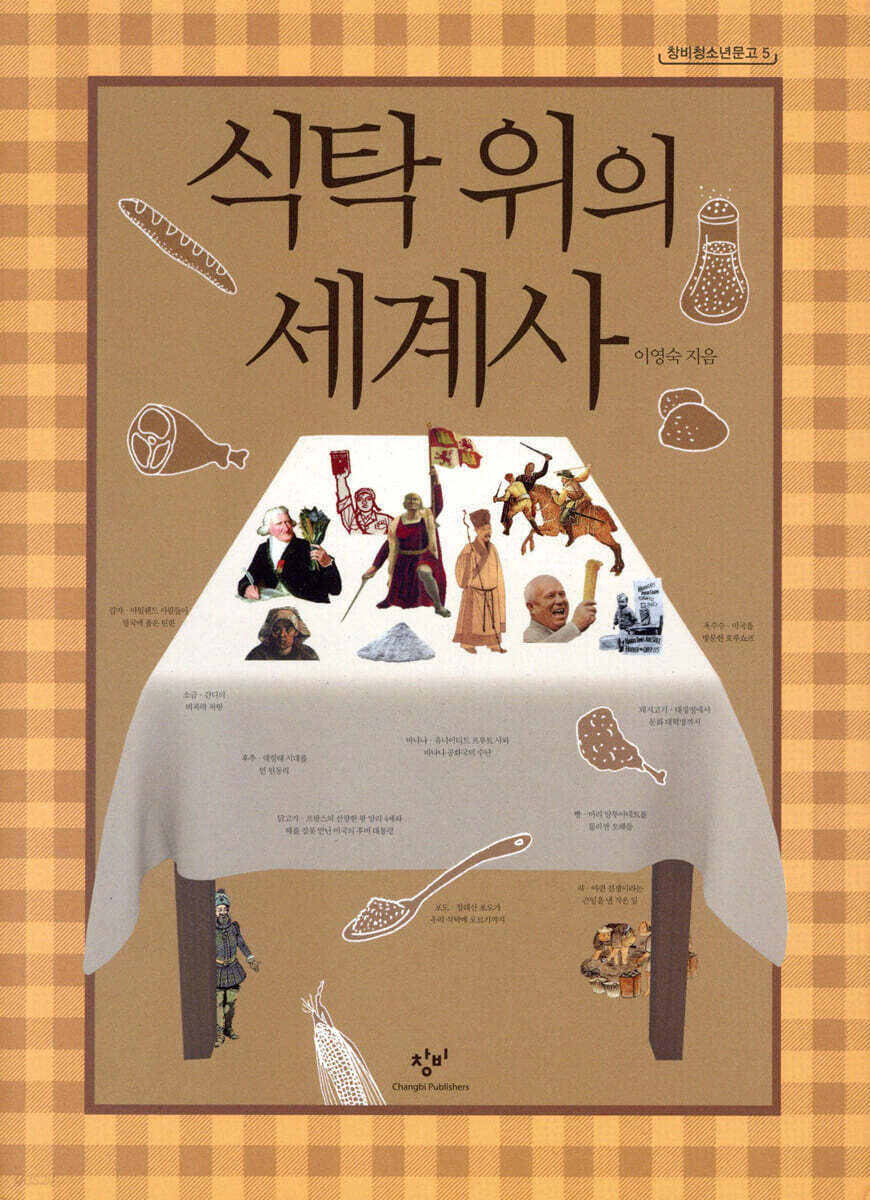
"World History on the Table" is an engaging youth education book that guides us through stories about important events and figures in world history through familiar foods like salt and pepper.
It is not burdensome because it is in the format of a mother telling a story to her children, and it is not a typical chronology starting from ancient history, so there is no time to get bored.
The book unfolds ten stories related to food ingredients, from the Irish famine caused by potatoes, to Russian leader Khrushchev's passion for corn, to Gandhi's Salt March in protest of the Salt Laws.
Rather than simply tracing the origins of food or conveying trivial information about museums, it provides a detailed account of key events in world history related to it.
Stories like how the Age of Exploration was born from the spicy flavor of pepper, or how poet Su Dongpo was a creative culinary inventor who invented dishes like Dongpo Pork, are fascinating facts in themselves that draw readers in, and the author's skill in starting with these introductions and then leading us to major issues in world history like the Cultural Revolution and the Opium Wars is so skillful that it's hard to believe this is his first book.
Covering the period from ancient times to the present, the book is not simply told in chronological order, but is organized around the medium of food, which adds to its interest. The balanced distribution of East and West is also noteworthy.
Readers will naturally learn key historical facts from both the East and the West as they immerse themselves in this book, which explores the interconnectedness of food.
"World History on the Table" is an engaging youth education book that guides us through stories about important events and figures in world history through familiar foods like salt and pepper.
It is not burdensome because it is in the format of a mother telling a story to her children, and it is not a typical chronology starting from ancient history, so there is no time to get bored.
The book unfolds ten stories related to food ingredients, from the Irish famine caused by potatoes, to Russian leader Khrushchev's passion for corn, to Gandhi's Salt March in protest of the Salt Laws.
Rather than simply tracing the origins of food or conveying trivial information about museums, it provides a detailed account of key events in world history related to it.
Stories like how the Age of Exploration was born from the spicy flavor of pepper, or how poet Su Dongpo was a creative culinary inventor who invented dishes like Dongpo Pork, are fascinating facts in themselves that draw readers in, and the author's skill in starting with these introductions and then leading us to major issues in world history like the Cultural Revolution and the Opium Wars is so skillful that it's hard to believe this is his first book.
Covering the period from ancient times to the present, the book is not simply told in chronological order, but is organized around the medium of food, which adds to its interest. The balanced distribution of East and West is also noteworthy.
Readers will naturally learn key historical facts from both the East and the West as they immerse themselves in this book, which explores the interconnectedness of food.
- You can preview some of the book's contents.
Preview
index
Entering
-Potatoes-The Irish people's grudge against the British
-Salt-Gandhi's nonviolent resistance
-Pepper- The driving force behind the Age of Exploration
Pork - From the Long March to the Cultural Revolution
-Bread-Misconceptions Surrounding Marie Antoinette
-Chicken- The good King Henry IV of France and the ill-timed American President Hoover
-Corn- Khrushchev visits the United States
Banana - United Fruits and the Suffering of the Republic
-Grapes- How Chilean grapes reach our tables
-The small leaf that started the great war called the Tea-Opium War
-Potatoes-The Irish people's grudge against the British
-Salt-Gandhi's nonviolent resistance
-Pepper- The driving force behind the Age of Exploration
Pork - From the Long March to the Cultural Revolution
-Bread-Misconceptions Surrounding Marie Antoinette
-Chicken- The good King Henry IV of France and the ill-timed American President Hoover
-Corn- Khrushchev visits the United States
Banana - United Fruits and the Suffering of the Republic
-Grapes- How Chilean grapes reach our tables
-The small leaf that started the great war called the Tea-Opium War
Publisher's Review
“It can’t get any more delicious than this!”
A feast of world history that is pleasing to the eyes and mouth
The winner of the 2nd Changbi Youth Book Award in the liberal arts category, 『World History on the Table』, has been published as the 5th volume of the Changbi Youth Library.
"World History on the Table" is an engaging youth education book that guides us through stories about important events and figures in world history through familiar foods like salt and pepper.
It is not burdensome because it is in the format of a mother telling a story to her children, and it is not a typical chronology that starts from ancient history, so there is no time to get bored.
From potatoes to peppers, from Gandhi to Antoinette
A world history connected by food
"World History on the Table" unfolds ten stories related to food ingredients, from the Irish famine that began with potatoes, to Russian leader Khrushchev's passion for corn, to Gandhi's Salt March in protest of the Salt Law.
Rather than simply tracing the origins of food or conveying trivial information about museums, it provides a detailed account of key events in world history related to it.
Stories like how the Age of Exploration was born from the spicy flavor of pepper, or how poet Su Dongpo was a creative culinary inventor who invented dishes like Dongpo Pork, are fascinating facts in themselves that draw readers in, and the author's skill in starting with these introductions and then leading us to major issues in world history like the Cultural Revolution and the Opium Wars is so skillful that it's hard to believe this is his first book.
Covering the period from ancient times to the present, the book is not simply told in chronological order, but is organized around the medium of food, which adds to its interest. The balanced distribution of East and West is also noteworthy.
Readers will naturally learn key historical facts from both the East and the West as they immerse themselves in this book, which explores the interconnectedness of food.
A feast of world history that is a feast for the eyes and mouth is unfolding!
"World History on the Dining Table" also contains stories shared by the author, who worked as a teacher for over ten years and is a mother of three and a housewife, while eating meals or snacks with her children at the dining table.
As a former teacher, he said he knew well what students found difficult and how much they could understand, which allowed him to write books that were suitable for teenagers.
In addition to adopting the format of a story told by a mother, the fact that over 50 photographs and drawings were appropriately used to connect them with the theme is also an eye-catching element.
For example, a story could unfold from a croissant, a crescent-shaped bread, to the flags of Islamic countries with crescent moon patterns, or a photo of Gandhi at a spinning wheel could be shown to remind people of the clothes he made himself as part of India's independence movement.
"World History on the Table," which is both entertaining and informative, will appeal not only to young readers who find world history difficult, but also to general readers, teachers, and parents.
I often think that the food and ingredients on the table we see every day contain a whole world.
Just looking at the history of the ingredients that come to our table, and the events and people they evoke, I can feel that it is truly colorful and rich.
Many of the stories in this book are actually stories I shared with my children over meals.
We've connected ten familiar foods, so please enjoy the story with a light heart.
(…) World history is by no means a discipline confined to books.
It's not something that exists far away, nor is it something that's difficult.
It permeates every aspect of our lives.
I want to share that fun with you.
From the author's note (introduction)
The 2nd Changbi Youth Book Award Grand Prize Winner
『World History on the Table』 won the grand prize in the liberal arts category at the 2011 Changbi Youth Book Award, which was held for the second time.
The judges (Do Jong-hwan, Ahn Gwang-bok, Kim Joo-hwan, Han Ki-ho), comprised of current teachers and experts, honored this book with the grand prize, following 『I Came to Play Because It's Cool』 (written by Seolheun, Changbi Youth Library 1) and 『Saturday Psychology Club』 (written by Kim Da-myeong, illustrated by Kim Seo-yoon, Changbi Youth Library 4), which were published last year.
The judges agreed that 『World History on the Table』 would be loved for a long time as a youth book, citing the following criteria for the award: the manuscript must be creative, it must be more than just a compilation of information, it must be a book that both parents and children can enjoy, and it must be an interesting book that is suitable for young readers.
Going forward, Changbi will continue to discover educational books with new sensibilities and perspectives through the Changbi Youth Book Award and the Changbi Youth Library series.
A feast of world history that is pleasing to the eyes and mouth
The winner of the 2nd Changbi Youth Book Award in the liberal arts category, 『World History on the Table』, has been published as the 5th volume of the Changbi Youth Library.
"World History on the Table" is an engaging youth education book that guides us through stories about important events and figures in world history through familiar foods like salt and pepper.
It is not burdensome because it is in the format of a mother telling a story to her children, and it is not a typical chronology that starts from ancient history, so there is no time to get bored.
From potatoes to peppers, from Gandhi to Antoinette
A world history connected by food
"World History on the Table" unfolds ten stories related to food ingredients, from the Irish famine that began with potatoes, to Russian leader Khrushchev's passion for corn, to Gandhi's Salt March in protest of the Salt Law.
Rather than simply tracing the origins of food or conveying trivial information about museums, it provides a detailed account of key events in world history related to it.
Stories like how the Age of Exploration was born from the spicy flavor of pepper, or how poet Su Dongpo was a creative culinary inventor who invented dishes like Dongpo Pork, are fascinating facts in themselves that draw readers in, and the author's skill in starting with these introductions and then leading us to major issues in world history like the Cultural Revolution and the Opium Wars is so skillful that it's hard to believe this is his first book.
Covering the period from ancient times to the present, the book is not simply told in chronological order, but is organized around the medium of food, which adds to its interest. The balanced distribution of East and West is also noteworthy.
Readers will naturally learn key historical facts from both the East and the West as they immerse themselves in this book, which explores the interconnectedness of food.
A feast of world history that is a feast for the eyes and mouth is unfolding!
"World History on the Dining Table" also contains stories shared by the author, who worked as a teacher for over ten years and is a mother of three and a housewife, while eating meals or snacks with her children at the dining table.
As a former teacher, he said he knew well what students found difficult and how much they could understand, which allowed him to write books that were suitable for teenagers.
In addition to adopting the format of a story told by a mother, the fact that over 50 photographs and drawings were appropriately used to connect them with the theme is also an eye-catching element.
For example, a story could unfold from a croissant, a crescent-shaped bread, to the flags of Islamic countries with crescent moon patterns, or a photo of Gandhi at a spinning wheel could be shown to remind people of the clothes he made himself as part of India's independence movement.
"World History on the Table," which is both entertaining and informative, will appeal not only to young readers who find world history difficult, but also to general readers, teachers, and parents.
I often think that the food and ingredients on the table we see every day contain a whole world.
Just looking at the history of the ingredients that come to our table, and the events and people they evoke, I can feel that it is truly colorful and rich.
Many of the stories in this book are actually stories I shared with my children over meals.
We've connected ten familiar foods, so please enjoy the story with a light heart.
(…) World history is by no means a discipline confined to books.
It's not something that exists far away, nor is it something that's difficult.
It permeates every aspect of our lives.
I want to share that fun with you.
From the author's note (introduction)
The 2nd Changbi Youth Book Award Grand Prize Winner
『World History on the Table』 won the grand prize in the liberal arts category at the 2011 Changbi Youth Book Award, which was held for the second time.
The judges (Do Jong-hwan, Ahn Gwang-bok, Kim Joo-hwan, Han Ki-ho), comprised of current teachers and experts, honored this book with the grand prize, following 『I Came to Play Because It's Cool』 (written by Seolheun, Changbi Youth Library 1) and 『Saturday Psychology Club』 (written by Kim Da-myeong, illustrated by Kim Seo-yoon, Changbi Youth Library 4), which were published last year.
The judges agreed that 『World History on the Table』 would be loved for a long time as a youth book, citing the following criteria for the award: the manuscript must be creative, it must be more than just a compilation of information, it must be a book that both parents and children can enjoy, and it must be an interesting book that is suitable for young readers.
Going forward, Changbi will continue to discover educational books with new sensibilities and perspectives through the Changbi Youth Book Award and the Changbi Youth Library series.
GOODS SPECIFICS
- Date of publication: May 29, 2012
- Page count, weight, size: 192 pages | 294g | 153*224*20mm
- ISBN13: 9788936452056
- ISBN10: 8936452053
You may also like
카테고리
korean


korean

![GQ KOREA Mark (Monthly): December [2025]](http://librairie.coreenne.fr/cdn/shop/files/8ef265dbbfbf186523ed75ba7319009d.jpg?v=1765340328&width=3840)


