

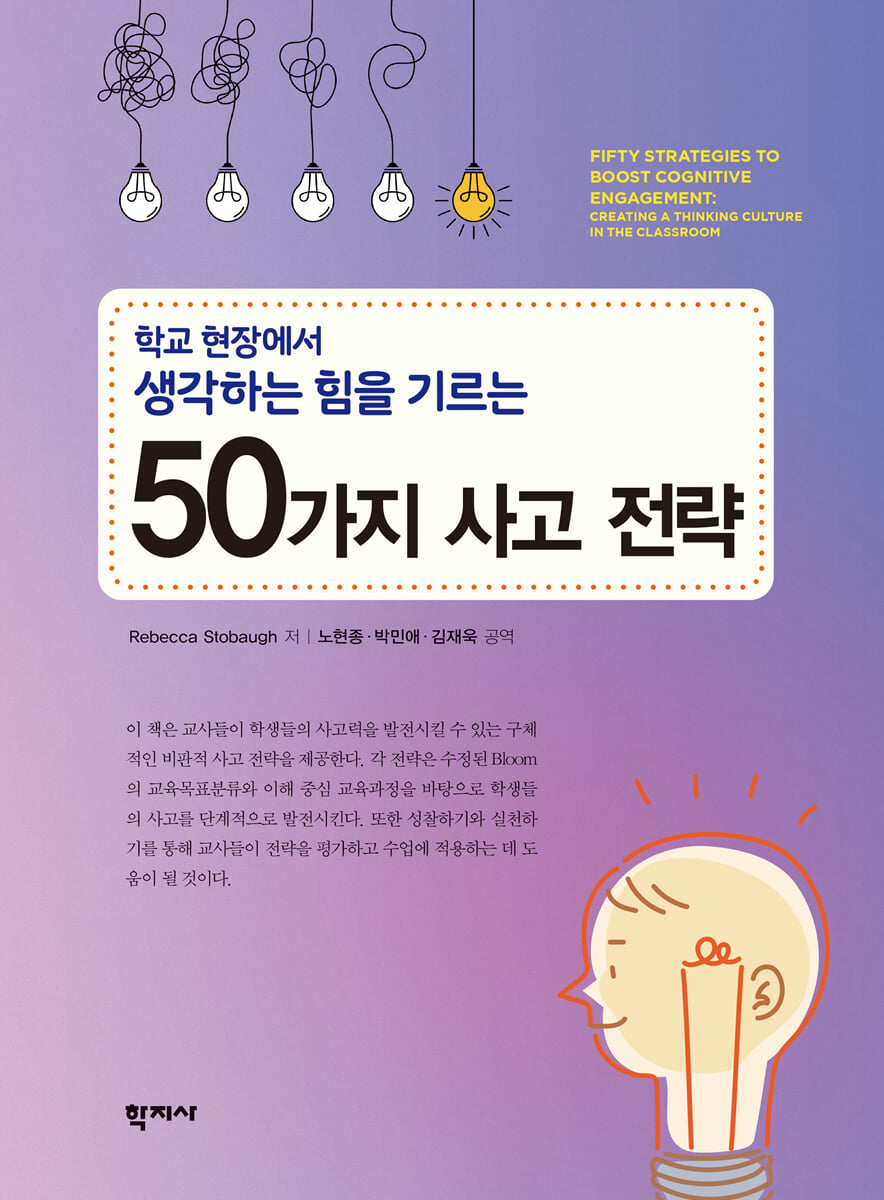
50 Thinking Strategies to Develop Thinking Power in Schools
 |
Description
Book Introduction
This book provides teachers with specific critical thinking strategies to help develop students' thinking skills.
Each strategy develops students' thinking in stages based on a modified Bloom's taxonomy of educational objectives and an understanding-centered curriculum.
It will also help teachers evaluate and apply strategies in their lessons through reflection and practice.
Each strategy develops students' thinking in stages based on a modified Bloom's taxonomy of educational objectives and an understanding-centered curriculum.
It will also help teachers evaluate and apply strategies in their lessons through reflection and practice.
index
Translator's Preface
To begin with
Chapter 1: Understanding Cognitive Engagement and the Thinking-Based Classroom
critical thinking
cognitive engagement
Reflect
Put it into practice
Chapter 2: Applying Cognitive Thinking Classification in the Classroom
Thinking at the 'remember' level
Thinking at the 'understanding' level
Thinking at the 'Apply' level
Thinking at the 'analyzing' level
Thinking at the 'evaluate' level
Thinking at the 'creative' level
See the big picture
Reflect
Put it into practice
Chapter 3 Developing Critical Thinking Skills and Promoting Academic Engagement
Providing opportunities for student participation
Reflect
Put it into practice
Chapter 4: Implementing Strategies at the "Understanding" Level
Strategy 1: Speak with your body
Strategy 2: Inductive Learning
Strategy 3: Matrix
Strategy 4: The 10 Most Important Words
Strategy 5: Building Background Knowledge
Strategy 6: Make Connections
Reflect
Put it into practice
Chapter 5: Implementing Strategy at the "Analysis" Level
Strategy 7: Concept Acquisition
Strategy 8: Analogy
Strategy 9: Media Metaphors
Strategy 10: Quote! Crack the Code!
Strategy 11: Visual Thinking
Strategy 12: Concept Map
Strategy 13: Mind Map
Strategy 14: Listen, Think, and Wonder
Strategy 15: Anticipation Guide
Strategy 16: Using the Dice
Strategy 17: Consensus Gram
Strategy 18: Fishbone Causality Analysis
Strategy 19: Guided Reading-Thinking Activities
Strategy 20: Pick Up Quotes
Strategy 21: Riddle
Strategy 22: Tick Marker
Strategy 23: SWOT Analysis
Strategy 24: Gallery Walk
Reflect
Put it into practice
Chapter 6: Implementing Level Strategies
Strategy 25: Four Corners
Strategy 26: Ranking
Strategy 27: Question Protocol
Strategy 28: Inferring
Strategy 29: Direct Sales Case Study
Strategy 30: The Think-Pair-Share Continuum
Strategy 31: Decision Making
Strategy 32: Peer Criticism
Strategy 33: Circular Saw Evaluation
Strategy 34: Research
Strategy 35: Evaluating the Author's Inferences
Strategy 36: Media Analysis
Strategy 37: Request
Strategy 38: Jin-Jin-Ga
Strategy 39: Quad
Strategy 40: Claim-Evidence-Reason
Strategy 41: Color-Coded Feedback
Strategy 42: Rank-Speak-Write
Strategy 43: Agreeing and Disagreeing with Quotes
Reflect
Put it into practice
Chapter 7: Implementing the "Creating" Level Strategy
Strategy 44: Relevance Diagram
Strategy 45: Problem Solving
Strategy 46: Merry-Go-Round Brainstorming
Strategy 47: Scamper
Strategy 48: Hit and Spot
Strategy 49: Six-Color Thinking Hat
Strategy 50: Inference Ladder
Reflect
Put it into practice
Chapter 8: Creating a Thinking-Based Classroom
Understanding the Teacher's Role
Adjust the difficulty of the task
Modeling Thinking Technologies
Strengthening student capacity
Establishing norms of thinking
Applying it to real life
Promise related terms to think
Provide practice opportunities
Provide feedback
Configuring the physical environment
Maintaining a Culture of Thinking
Reflect
Put it into practice
References
Search
To begin with
Chapter 1: Understanding Cognitive Engagement and the Thinking-Based Classroom
critical thinking
cognitive engagement
Reflect
Put it into practice
Chapter 2: Applying Cognitive Thinking Classification in the Classroom
Thinking at the 'remember' level
Thinking at the 'understanding' level
Thinking at the 'Apply' level
Thinking at the 'analyzing' level
Thinking at the 'evaluate' level
Thinking at the 'creative' level
See the big picture
Reflect
Put it into practice
Chapter 3 Developing Critical Thinking Skills and Promoting Academic Engagement
Providing opportunities for student participation
Reflect
Put it into practice
Chapter 4: Implementing Strategies at the "Understanding" Level
Strategy 1: Speak with your body
Strategy 2: Inductive Learning
Strategy 3: Matrix
Strategy 4: The 10 Most Important Words
Strategy 5: Building Background Knowledge
Strategy 6: Make Connections
Reflect
Put it into practice
Chapter 5: Implementing Strategy at the "Analysis" Level
Strategy 7: Concept Acquisition
Strategy 8: Analogy
Strategy 9: Media Metaphors
Strategy 10: Quote! Crack the Code!
Strategy 11: Visual Thinking
Strategy 12: Concept Map
Strategy 13: Mind Map
Strategy 14: Listen, Think, and Wonder
Strategy 15: Anticipation Guide
Strategy 16: Using the Dice
Strategy 17: Consensus Gram
Strategy 18: Fishbone Causality Analysis
Strategy 19: Guided Reading-Thinking Activities
Strategy 20: Pick Up Quotes
Strategy 21: Riddle
Strategy 22: Tick Marker
Strategy 23: SWOT Analysis
Strategy 24: Gallery Walk
Reflect
Put it into practice
Chapter 6: Implementing Level Strategies
Strategy 25: Four Corners
Strategy 26: Ranking
Strategy 27: Question Protocol
Strategy 28: Inferring
Strategy 29: Direct Sales Case Study
Strategy 30: The Think-Pair-Share Continuum
Strategy 31: Decision Making
Strategy 32: Peer Criticism
Strategy 33: Circular Saw Evaluation
Strategy 34: Research
Strategy 35: Evaluating the Author's Inferences
Strategy 36: Media Analysis
Strategy 37: Request
Strategy 38: Jin-Jin-Ga
Strategy 39: Quad
Strategy 40: Claim-Evidence-Reason
Strategy 41: Color-Coded Feedback
Strategy 42: Rank-Speak-Write
Strategy 43: Agreeing and Disagreeing with Quotes
Reflect
Put it into practice
Chapter 7: Implementing the "Creating" Level Strategy
Strategy 44: Relevance Diagram
Strategy 45: Problem Solving
Strategy 46: Merry-Go-Round Brainstorming
Strategy 47: Scamper
Strategy 48: Hit and Spot
Strategy 49: Six-Color Thinking Hat
Strategy 50: Inference Ladder
Reflect
Put it into practice
Chapter 8: Creating a Thinking-Based Classroom
Understanding the Teacher's Role
Adjust the difficulty of the task
Modeling Thinking Technologies
Strengthening student capacity
Establishing norms of thinking
Applying it to real life
Promise related terms to think
Provide practice opportunities
Provide feedback
Configuring the physical environment
Maintaining a Culture of Thinking
Reflect
Put it into practice
References
Search
GOODS SPECIFICS
- Date of issue: February 20, 2025
- Page count, weight, size: 296 pages | 188*255*12mm
- ISBN13: 9788999733338
- ISBN10: 8999733335
You may also like
카테고리
korean


korean

![GQ KOREA Mark (Monthly): December [2025]](http://librairie.coreenne.fr/cdn/shop/files/8ef265dbbfbf186523ed75ba7319009d.jpg?v=1765340328&width=3840)


