

Korean Peninsula War Scenario
 |
Description
Book Introduction
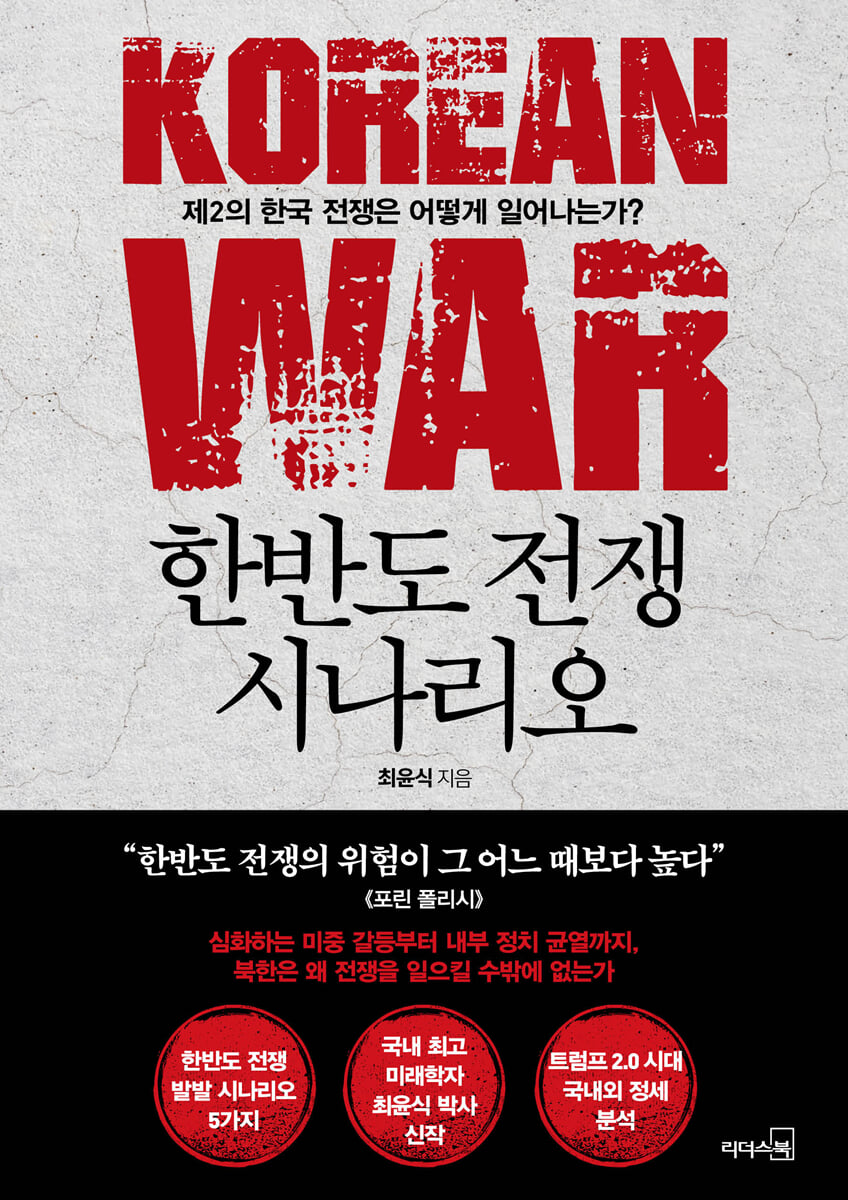
"The risk of war on the Korean Peninsula is higher than ever" (Foreign Policy)
From the deepening US-China conflict to internal political divisions,
Why does North Korea have no choice but to start a war?
★5 Scenarios for the Outbreak of War on the Korean Peninsula
★New work by Dr. Choi Yun-sik, Korea's leading futurologist
★In-Depth Analysis of Domestic and International Politics in the Trump 2.0 Era
"From North Korea's perspective, war would be suicidal." This is a common response to the possibility of war breaking out on the Korean Peninsula.
But this time the stakes are different.
Experts around the world agree that the likelihood of war breaking out on the Korean Peninsula is higher than ever.
As the recent outbreak of the Russia-Ukraine war demonstrates, the ever-escalating international tensions could escalate into actual military conflict at any time.
South Korea, which may become a direct party to the war, seems to have no worries.
We are in a state of war apathy.
North Korea has never given up nuclear weapons or war.
Now, rather, they are showing off their military capabilities.
Last year, Chairman Kim Jong-un characterized inter-Korean relations as "hostile" and designated South Korea as the "primary enemy."
The international situation today, with America's war deterrence weakened, is also showing a serious trend.
China and Russia are likely to intervene more actively in Korean Peninsula affairs as part of their strategic calculations to limit American power.
Trump, whose direction is uncertain, could also serve as a trigger for the outbreak of war on the Korean Peninsula.
In particular, the nuclear weapons believed to be in North Korea's possession and the strengthening of military cooperation between North Korea and Russia are threats we cannot ignore.
South Korea may be facing its worst times.
This book addresses future scenarios we might prefer to ignore but must prepare for.
The author, Korea's leading futurologist, analyzes the geopolitical situation surrounding the Korean Peninsula, the military balance, North Korea's internal situation, the strategic calculations of major countries, and the historical context from various angles. He realistically simulates the nature of the war that will unfold based on the decisive events that will lead North Korea to attempt war, from an all-out war to exploit an opening in the US-China conflict to a localized war to divert an internal crisis to the outside world.
Indeed, the possibility of a US-China conflict surrounding Taiwan poses a grave threat to us.
We cannot ignore the scenario in which the Baekdu Mountain eruption becomes the fuse for war.
Preparing for the future begins with reversing your current thinking.
It is time to face war, which we have considered an 'unexpected future,' as an 'imminent future.'
As the international order is being reorganized and the nature of war is changing, this book will serve as the most accurate guide to understanding the crisis we face.
From the deepening US-China conflict to internal political divisions,
Why does North Korea have no choice but to start a war?
★5 Scenarios for the Outbreak of War on the Korean Peninsula
★New work by Dr. Choi Yun-sik, Korea's leading futurologist
★In-Depth Analysis of Domestic and International Politics in the Trump 2.0 Era
"From North Korea's perspective, war would be suicidal." This is a common response to the possibility of war breaking out on the Korean Peninsula.
But this time the stakes are different.
Experts around the world agree that the likelihood of war breaking out on the Korean Peninsula is higher than ever.
As the recent outbreak of the Russia-Ukraine war demonstrates, the ever-escalating international tensions could escalate into actual military conflict at any time.
South Korea, which may become a direct party to the war, seems to have no worries.
We are in a state of war apathy.
North Korea has never given up nuclear weapons or war.
Now, rather, they are showing off their military capabilities.
Last year, Chairman Kim Jong-un characterized inter-Korean relations as "hostile" and designated South Korea as the "primary enemy."
The international situation today, with America's war deterrence weakened, is also showing a serious trend.
China and Russia are likely to intervene more actively in Korean Peninsula affairs as part of their strategic calculations to limit American power.
Trump, whose direction is uncertain, could also serve as a trigger for the outbreak of war on the Korean Peninsula.
In particular, the nuclear weapons believed to be in North Korea's possession and the strengthening of military cooperation between North Korea and Russia are threats we cannot ignore.
South Korea may be facing its worst times.
This book addresses future scenarios we might prefer to ignore but must prepare for.
The author, Korea's leading futurologist, analyzes the geopolitical situation surrounding the Korean Peninsula, the military balance, North Korea's internal situation, the strategic calculations of major countries, and the historical context from various angles. He realistically simulates the nature of the war that will unfold based on the decisive events that will lead North Korea to attempt war, from an all-out war to exploit an opening in the US-China conflict to a localized war to divert an internal crisis to the outside world.
Indeed, the possibility of a US-China conflict surrounding Taiwan poses a grave threat to us.
We cannot ignore the scenario in which the Baekdu Mountain eruption becomes the fuse for war.
Preparing for the future begins with reversing your current thinking.
It is time to face war, which we have considered an 'unexpected future,' as an 'imminent future.'
As the international order is being reorganized and the nature of war is changing, this book will serve as the most accurate guide to understanding the crisis we face.
- You can preview some of the book's contents.
Preview
index
[Introductory Note] There is no war that will never happen.
Chapter 1: The Changing Situation and the Unchanging War Apathy
What could happen in 18 months
subcritical war
How much damage would there be if war broke out on the Korean Peninsula?
North Korea's 'Three-Day War' Scenario
The 21st century, dominated by the logic of power and the unsettling nature of North Korea.
Kim Jong-un is more dangerous than Kim Il-sung.
The Nuclear Negotiation Table and Kim Jong-un's Lies
Trump's re-election and the possibility of war breaking out on the Korean Peninsula
Denuclearization is impossible even in the Trump 2.0 era.
Does the United States have the power to prevent war on the Korean Peninsula?
Preparing for the future begins with rethinking your present thinking.
Chapter 2: How the Korean War Occurred
Three Historical Patterns of War
Why war is less likely to occur due to external pressure
War Outbreak Scenario 1: In a Strategic Opportunity Crack
Why Xi Jinping and Kim Jong Un Are Dangerous Figures in Northeast Asia
The Korean War's Trigger, the Taiwan War
Gungseo Seolmyo
The scale of damage to Korea and the world if a war breaks out in Taiwan
The first internal problem that could trigger Kim Jong-un's war
War Outbreak Scenario 2: Gambling for Regime Preservation
Kim Jong-un's second internal problem that could trigger war
War Outbreak Scenario 3: Hellfire Engulfs the Korean Peninsula
Scientific evidence and real-life examples of the Baekdu Mountain volcanic eruption.
If war breaks out on the Korean Peninsula, neither the United States nor Japan will suffer.
Chapter 3: How the Korean War Unfolds
North Korea practices future warfare in Ukraine
AI is North Korea's asymmetric power weapon
North Korea could also employ an upgraded Hamas-style strategy.
Unexpected Scenario 1: The Beginning of Local Warfare, Unannounced Infiltration
With North Korea's tactical nuclear strategy added, South Korea's victory cannot be guaranteed.
Comparison of North and South Korean combat power
Russia and China, which will compensate for North Korea's conventional military weakness.
Unexpected Scenario 2: Attacks on North Korean Nuclear Facilities and Cyberattacks
What would happen if North Korea attacked South Korea's nuclear power plants?
Chapter 4: There is no impossible future.
The trap of thinking that overconfidently believes in oneself and undervalues others
If war breaks out, how will it end?
The 'Strange Truce' scenario
If a rebellion breaks out in North Korea: The Collective Leadership Model
Even without war, an 'unexpected future' can occur.
[Exiting Article] A New Future Scenario for the Korean Peninsula
[main]
Chapter 1: The Changing Situation and the Unchanging War Apathy
What could happen in 18 months
subcritical war
How much damage would there be if war broke out on the Korean Peninsula?
North Korea's 'Three-Day War' Scenario
The 21st century, dominated by the logic of power and the unsettling nature of North Korea.
Kim Jong-un is more dangerous than Kim Il-sung.
The Nuclear Negotiation Table and Kim Jong-un's Lies
Trump's re-election and the possibility of war breaking out on the Korean Peninsula
Denuclearization is impossible even in the Trump 2.0 era.
Does the United States have the power to prevent war on the Korean Peninsula?
Preparing for the future begins with rethinking your present thinking.
Chapter 2: How the Korean War Occurred
Three Historical Patterns of War
Why war is less likely to occur due to external pressure
War Outbreak Scenario 1: In a Strategic Opportunity Crack
Why Xi Jinping and Kim Jong Un Are Dangerous Figures in Northeast Asia
The Korean War's Trigger, the Taiwan War
Gungseo Seolmyo
The scale of damage to Korea and the world if a war breaks out in Taiwan
The first internal problem that could trigger Kim Jong-un's war
War Outbreak Scenario 2: Gambling for Regime Preservation
Kim Jong-un's second internal problem that could trigger war
War Outbreak Scenario 3: Hellfire Engulfs the Korean Peninsula
Scientific evidence and real-life examples of the Baekdu Mountain volcanic eruption.
If war breaks out on the Korean Peninsula, neither the United States nor Japan will suffer.
Chapter 3: How the Korean War Unfolds
North Korea practices future warfare in Ukraine
AI is North Korea's asymmetric power weapon
North Korea could also employ an upgraded Hamas-style strategy.
Unexpected Scenario 1: The Beginning of Local Warfare, Unannounced Infiltration
With North Korea's tactical nuclear strategy added, South Korea's victory cannot be guaranteed.
Comparison of North and South Korean combat power
Russia and China, which will compensate for North Korea's conventional military weakness.
Unexpected Scenario 2: Attacks on North Korean Nuclear Facilities and Cyberattacks
What would happen if North Korea attacked South Korea's nuclear power plants?
Chapter 4: There is no impossible future.
The trap of thinking that overconfidently believes in oneself and undervalues others
If war breaks out, how will it end?
The 'Strange Truce' scenario
If a rebellion breaks out in North Korea: The Collective Leadership Model
Even without war, an 'unexpected future' can occur.
[Exiting Article] A New Future Scenario for the Korean Peninsula
[main]
Detailed image
Into the book
Wars usually start in unexpected ways.
This book focuses on aspects of war that we are not currently observing with interest or that could begin in ways we never anticipated.
A representative example is the case where the US-China military conflict surrounding Taiwan leads to war on the Korean Peninsula.
There is also a future in which the eruption of Mt. Baekdu could be the trigger for war on the Korean Peninsula.
A scenario where North Korea launches a surprise attack on South Korea's nuclear power plants and paralyzes the power grid and financial system with a large-scale cyberattack, leading to a military counterattack by South Korea, triggering an all-out war is also possible.
--- From "There is no war that will never happen"
Overseas North Korea experts and officials warn that Kim Jong-un could take physical military action at any time.
On October 20, 2024, the National Intelligence Service reported that North Korea was expected to deploy 10,000 to 15,000 special forces troops to the Russia-Ukraine war.
The whole world expressed anxiety that North Korea's deployment of troops could lead to World War III, but only South Korea showed an indifferent response.
But as we all know, North Korea actually went ahead with the deployment.
--- From "The Changing Situation and the Unchanged War Apathy"
So, does the United States have the ability to deter war on the Korean Peninsula? No one questions this.
But the reality is different.
In the case of the Israel-Hamas war, which entered a temporary ceasefire in January 2025, the United States was left to fiddle for over a year, hoping only to avoid an escalation.
The war that started with Russia's invasion of Ukraine is now in its fourth year, but all the United States has done is provide Ukraine with military supplies.
Even shells were in short supply, so we had to ask our country for help.
--- From "The Changing Situation and the Unchanged War Apathy"
If the United States goes to war with China over Taiwan, it will be difficult to wage another war at the same time.
Moreover, the Taiwan Strait is a vital route for international trade, and conflict in this region could have a significant impact on the global economy.
If the global economy were to fall into crisis, America's allies would also be in conflict, making their own economic situation a more important criterion for judging outcomes than the outcome of a war in Taiwan or the prevention of a local war on the Korean Peninsula.
This situation provides North Korea with a strategic opportunity to launch an invasion.
--- From "How the Korean Peninsula War Occurred"
Experts point to Udo and Yeonpyeongdo as the most dangerous of the five West Sea islands.
There are no civilians on Udo Island, and only a small number of Marines are stationed on Yeonpyeong Island, so the battle can be ended quickly and the risk of escalation is the lowest.
North Korea will seize these two islands in an instant with an "upgraded Hamas-style strategy," then claim the waters surrounding the West Sea's five islands as North Korean territorial waters and bring the United States to the negotiating table to prevent further escalation of the war in South Korea.
Since 1999, North Korea has been insisting that the median line between Deungdeung Cape and Guleop Island be designated as the new maritime military demarcation line, based on Article 3 of the New Maritime Law, which came into effect in 1994, which states that the territorial sea width is 12 nautical miles.
--- From "How the Korean Peninsula War Will Unfold"
Applying these historical examples to the situation on the Korean Peninsula clearly demonstrates how dangerous a scenario unification through war can be.
The Korean Peninsula is currently in a complex situation that cannot be compared to the cases of Vietnam or Yemen.
If unification occurs suddenly and forcibly through war, South Korea will inevitably suffer serious war damage.
It is clear that serious problems will arise, including a large-scale refugee crisis, the risk of retaliation and purges, and astronomical social integration costs.
Sudden unification through war can never be a desirable solution.
Rather, if war breaks out on the Korean Peninsula and unification is achieved suddenly, it could lead to very dangerous and complex consequences.
--- From "There is no impossible future"
Now is the time to think about the future scenario of the Korean Peninsula differently from the past.
The era of a unified Korean Peninsula will come someday.
This is because the possibility of the Kim Jong-un regime's fourth-generation hereditary succession is gradually decreasing.
But even if unification is achieved, many unexpected challenges will arise in the process.
The possibility of war, whether local or all-out, is one of them.
This book focuses on aspects of war that we are not currently observing with interest or that could begin in ways we never anticipated.
A representative example is the case where the US-China military conflict surrounding Taiwan leads to war on the Korean Peninsula.
There is also a future in which the eruption of Mt. Baekdu could be the trigger for war on the Korean Peninsula.
A scenario where North Korea launches a surprise attack on South Korea's nuclear power plants and paralyzes the power grid and financial system with a large-scale cyberattack, leading to a military counterattack by South Korea, triggering an all-out war is also possible.
--- From "There is no war that will never happen"
Overseas North Korea experts and officials warn that Kim Jong-un could take physical military action at any time.
On October 20, 2024, the National Intelligence Service reported that North Korea was expected to deploy 10,000 to 15,000 special forces troops to the Russia-Ukraine war.
The whole world expressed anxiety that North Korea's deployment of troops could lead to World War III, but only South Korea showed an indifferent response.
But as we all know, North Korea actually went ahead with the deployment.
--- From "The Changing Situation and the Unchanged War Apathy"
So, does the United States have the ability to deter war on the Korean Peninsula? No one questions this.
But the reality is different.
In the case of the Israel-Hamas war, which entered a temporary ceasefire in January 2025, the United States was left to fiddle for over a year, hoping only to avoid an escalation.
The war that started with Russia's invasion of Ukraine is now in its fourth year, but all the United States has done is provide Ukraine with military supplies.
Even shells were in short supply, so we had to ask our country for help.
--- From "The Changing Situation and the Unchanged War Apathy"
If the United States goes to war with China over Taiwan, it will be difficult to wage another war at the same time.
Moreover, the Taiwan Strait is a vital route for international trade, and conflict in this region could have a significant impact on the global economy.
If the global economy were to fall into crisis, America's allies would also be in conflict, making their own economic situation a more important criterion for judging outcomes than the outcome of a war in Taiwan or the prevention of a local war on the Korean Peninsula.
This situation provides North Korea with a strategic opportunity to launch an invasion.
--- From "How the Korean Peninsula War Occurred"
Experts point to Udo and Yeonpyeongdo as the most dangerous of the five West Sea islands.
There are no civilians on Udo Island, and only a small number of Marines are stationed on Yeonpyeong Island, so the battle can be ended quickly and the risk of escalation is the lowest.
North Korea will seize these two islands in an instant with an "upgraded Hamas-style strategy," then claim the waters surrounding the West Sea's five islands as North Korean territorial waters and bring the United States to the negotiating table to prevent further escalation of the war in South Korea.
Since 1999, North Korea has been insisting that the median line between Deungdeung Cape and Guleop Island be designated as the new maritime military demarcation line, based on Article 3 of the New Maritime Law, which came into effect in 1994, which states that the territorial sea width is 12 nautical miles.
--- From "How the Korean Peninsula War Will Unfold"
Applying these historical examples to the situation on the Korean Peninsula clearly demonstrates how dangerous a scenario unification through war can be.
The Korean Peninsula is currently in a complex situation that cannot be compared to the cases of Vietnam or Yemen.
If unification occurs suddenly and forcibly through war, South Korea will inevitably suffer serious war damage.
It is clear that serious problems will arise, including a large-scale refugee crisis, the risk of retaliation and purges, and astronomical social integration costs.
Sudden unification through war can never be a desirable solution.
Rather, if war breaks out on the Korean Peninsula and unification is achieved suddenly, it could lead to very dangerous and complex consequences.
--- From "There is no impossible future"
Now is the time to think about the future scenario of the Korean Peninsula differently from the past.
The era of a unified Korean Peninsula will come someday.
This is because the possibility of the Kim Jong-un regime's fourth-generation hereditary succession is gradually decreasing.
But even if unification is achieved, many unexpected challenges will arise in the process.
The possibility of war, whether local or all-out, is one of them.
--- From "New Future Scenarios for the Korean Peninsula"
Publisher's Review
“There is no war that will never happen.”
The worst time for Korea is coming,
And the signs of doom we're missing
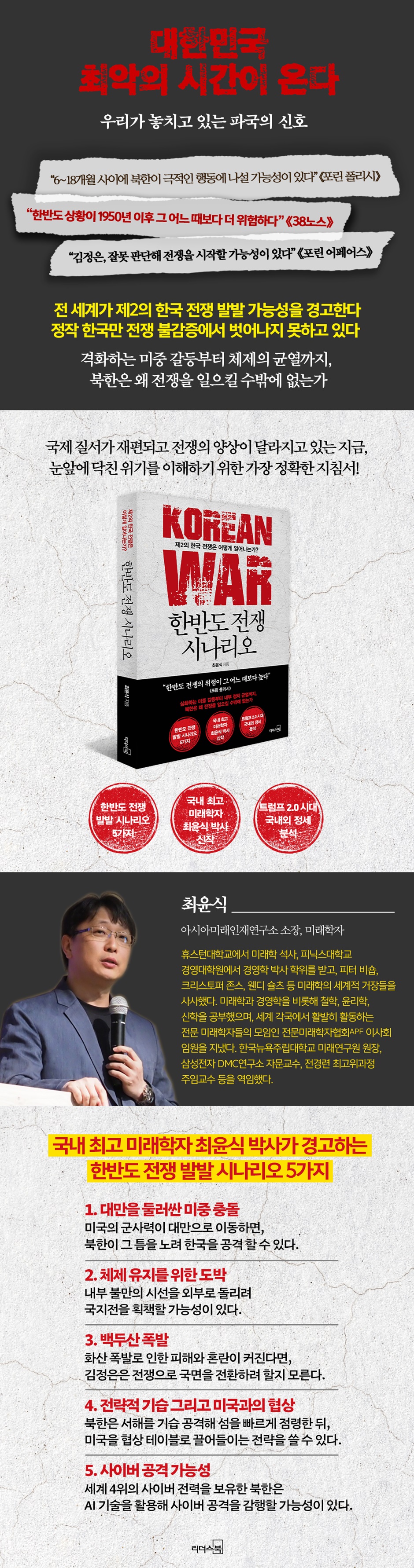
“North Korea could take dramatic action within six to 18 months” (Foreign Policy), “The situation on the Korean Peninsula is more dangerous than at any time since 1950” (38 North), “Kim Jong-un could miscalculate and start a war” (Foreign Affairs).
These are some of the major articles that have pointed out the possibility of war breaking out on the Korean Peninsula in the past year or so.
Experts around the world are unanimously analyzing the risks of war.
As the two Koreas are in a state of armistice, the possibility of war between them has always existed, but this time it is different.
Only South Korea, which may become a direct party to the war, responded by saying, "It's an exaggeration," and "From North Korea's perspective, war is an act of suicide."
We are in a state of war apathy.
Dr. Choi Yoon-sik, Korea's leading futurologist and author of numerous bestsellers including "Korea's Future Scenario for the Next 5 Years" and "US-China War Scenario for the Next 5 Years," addresses the future scenario of a "second Korean War" in his new book, "Korean Peninsula War Scenario."
In the changing international situation, it is to detect the signs of catastrophe that we are missing and to warn of a future that could happen at any time.
The author provides a detailed account of the possible paths and nature of the war that could lead to Kim Jong-un's final gambit, the "Korean Peninsula War."
If North Korea were to launch a local war, the most likely area would be the five islands in the West Sea, with Udo and Yeonpyeong Island being the most at risk.
Because only a small number of troops are stationed there, the fighting can be ended quickly, the risk of escalation is low, and the United States can be brought to the negotiating table.
Additionally, if North Korea were to employ a tactical nuclear strategy, it would likely target densely populated areas such as Seoul or Busan.
Busan is a likely target because it is close to Japan, which could amplify Japan's fears, and it is also the farthest from North Korea, making it the safest from nuclear contamination in the North.
Sangju is also a candidate because it is located in the exact center of South Korea and has a flat basin terrain, which would maximize the power of the atomic bomb.
Discussions about what might happen after the war also have important implications.
It deals with unexpected endings, such as the "strange armistice" that has an ambiguous beginning and end in recent cases, and North Korea's transition to a socialist collective leadership system.
The world is now watching the possibility of war breaking out on the Korean Peninsula.
Five War Scenarios for the Korean Peninsula, as Warn by Futurist Choi Yoon-sik
Author Dr. Choi Yun-sik has been analyzing North Korea's history, power structure, and society for a long time.
This forecast, which covers in depth everything from the causes of the Korean War to its development and post-war situation, is based on an analysis of North Korea's politics, military, economy, and culture, as well as the characteristics of Kim Jong-un, the recent geopolitical situation in East Asia, China's ruling structure, and trends in the United States.
1.
US-China conflict in Taiwan
China's military expansion is increasing the threat to Taiwan, further escalating tensions between the United States and China.
If the United States goes to war with China over Taiwan, it will be difficult to wage another war at the same time.
There is a possibility that Kim Jong-un will take advantage of the situation where the US military power is dispersed.
2.
Gambling to maintain the system
There are continuous reports that the discontent among North Koreans and the military has reached a critical point due to the current Kim Jong-un regime's oppressive rule and economic difficulties.
As internal divisions deepen, Kim Jong-un will likely turn his attention to the outside world through war.
The author believes that in this case, the war is unlikely to last long because the goal of the war is to quell military discontent and change public sentiment.
3.
Baekdu Mountain eruption
There is a very real possibility that Mt. Baekdu will erupt.
And if the natural disaster caused by the Baekdu Mountain eruption makes it difficult to govern the country, a situation like scenario 2 could arise where Kim Jong-un uses war as a card to change the situation.
4.
Strategic surprise and negotiations with the United States
If North Korea attempts a local war, it could employ an "upgraded Hamas-style strategy."
In addition to surprise attacks, it also involves the use of military robots.
Experts point to Udo and Yeonpyeongdo as the most dangerous of the five West Sea islands.
After North Korea quickly seizes these two islands, it will claim the waters surrounding the West Sea Five Islands as its territorial waters and bring the United States to the negotiating table to prevent further escalation of the war in South Korea.
5.
Possibility of cyberattack
North Korea's cyber power is known to be ranked 4th in the world.
South Korea's nuclear facilities, communications networks and other infrastructure systems can be attacked at any time.
If North Korea were to launch a cyberattack using AI, it could cause serious disruption to our society and military.
The variable of the Trump administration's second term...
How will the situation on the Korean Peninsula unfold amidst this uncertain reality?
In addition, there is another important point to consider.
It's Donald Trump.
Many people focus solely on Trump's trade war.
However, the actions of the second Trump administration could have a significant impact on the outbreak of war on the Korean Peninsula.
Trump's "dealing through conflict" style and Kim Jong-un's "pragmatic gambler" nature could potentially lead to a temporary easing of tensions and groundbreaking negotiation results in a situation where both sides share interests. However, if miscalculations or a battle of egos overlap, there is a risk that the situation could escalate into a military conflict in an instant.
Trump will first end the wars in the Middle East and Ukraine, then turn his attention to the denuclearization of the Korean Peninsula.
There is a high possibility that denuclearization negotiations between the United States and North Korea will resume.
However, if negotiations reach a deadlock or there are significant differences of opinion, Kim Jong-un will likely try to turn the situation around with military provocations or missile tests.
Trump will never back down if Kim Jong-un pushes the situation toward extreme confrontation.
Ultimately, this increases the possibility of a local war breaking out on the Korean Peninsula.
The issue of US troops stationed in Korea and changes in military power on the Korean Peninsula, which Trump has consistently insisted on, could also be important factors that increase the possibility of war breaking out on the Korean Peninsula.
Many experts say that globalization based on free trade is coming to an end and that an era of hegemonic competition centered on ideology and national interests has arrived.
Moreover, the pace of change in technology, industry, and the global environment has accelerated, as has the economic situation.
South Korea's population, economy, industry, politics, and society are all moving in a completely different direction than they did over the past 50 years.
While history should not be ignored, relying on past experiences without understanding the changing context is a surefire path to failure.
The biggest crises are caused by 'unexpected events' or 'unexpected incidents'.
Wars always break out without warning and unfold in unexpected ways.
This is why we should not ignore the author's warnings about the "worst-case scenario."
The worst time for Korea is coming,
And the signs of doom we're missing
“North Korea could take dramatic action within six to 18 months” (Foreign Policy), “The situation on the Korean Peninsula is more dangerous than at any time since 1950” (38 North), “Kim Jong-un could miscalculate and start a war” (Foreign Affairs).
These are some of the major articles that have pointed out the possibility of war breaking out on the Korean Peninsula in the past year or so.
Experts around the world are unanimously analyzing the risks of war.
As the two Koreas are in a state of armistice, the possibility of war between them has always existed, but this time it is different.
Only South Korea, which may become a direct party to the war, responded by saying, "It's an exaggeration," and "From North Korea's perspective, war is an act of suicide."
We are in a state of war apathy.
Dr. Choi Yoon-sik, Korea's leading futurologist and author of numerous bestsellers including "Korea's Future Scenario for the Next 5 Years" and "US-China War Scenario for the Next 5 Years," addresses the future scenario of a "second Korean War" in his new book, "Korean Peninsula War Scenario."
In the changing international situation, it is to detect the signs of catastrophe that we are missing and to warn of a future that could happen at any time.
The author provides a detailed account of the possible paths and nature of the war that could lead to Kim Jong-un's final gambit, the "Korean Peninsula War."
If North Korea were to launch a local war, the most likely area would be the five islands in the West Sea, with Udo and Yeonpyeong Island being the most at risk.
Because only a small number of troops are stationed there, the fighting can be ended quickly, the risk of escalation is low, and the United States can be brought to the negotiating table.
Additionally, if North Korea were to employ a tactical nuclear strategy, it would likely target densely populated areas such as Seoul or Busan.
Busan is a likely target because it is close to Japan, which could amplify Japan's fears, and it is also the farthest from North Korea, making it the safest from nuclear contamination in the North.
Sangju is also a candidate because it is located in the exact center of South Korea and has a flat basin terrain, which would maximize the power of the atomic bomb.
Discussions about what might happen after the war also have important implications.
It deals with unexpected endings, such as the "strange armistice" that has an ambiguous beginning and end in recent cases, and North Korea's transition to a socialist collective leadership system.
The world is now watching the possibility of war breaking out on the Korean Peninsula.
Five War Scenarios for the Korean Peninsula, as Warn by Futurist Choi Yoon-sik
Author Dr. Choi Yun-sik has been analyzing North Korea's history, power structure, and society for a long time.
This forecast, which covers in depth everything from the causes of the Korean War to its development and post-war situation, is based on an analysis of North Korea's politics, military, economy, and culture, as well as the characteristics of Kim Jong-un, the recent geopolitical situation in East Asia, China's ruling structure, and trends in the United States.
1.
US-China conflict in Taiwan
China's military expansion is increasing the threat to Taiwan, further escalating tensions between the United States and China.
If the United States goes to war with China over Taiwan, it will be difficult to wage another war at the same time.
There is a possibility that Kim Jong-un will take advantage of the situation where the US military power is dispersed.
2.
Gambling to maintain the system
There are continuous reports that the discontent among North Koreans and the military has reached a critical point due to the current Kim Jong-un regime's oppressive rule and economic difficulties.
As internal divisions deepen, Kim Jong-un will likely turn his attention to the outside world through war.
The author believes that in this case, the war is unlikely to last long because the goal of the war is to quell military discontent and change public sentiment.
3.
Baekdu Mountain eruption
There is a very real possibility that Mt. Baekdu will erupt.
And if the natural disaster caused by the Baekdu Mountain eruption makes it difficult to govern the country, a situation like scenario 2 could arise where Kim Jong-un uses war as a card to change the situation.
4.
Strategic surprise and negotiations with the United States
If North Korea attempts a local war, it could employ an "upgraded Hamas-style strategy."
In addition to surprise attacks, it also involves the use of military robots.
Experts point to Udo and Yeonpyeongdo as the most dangerous of the five West Sea islands.
After North Korea quickly seizes these two islands, it will claim the waters surrounding the West Sea Five Islands as its territorial waters and bring the United States to the negotiating table to prevent further escalation of the war in South Korea.
5.
Possibility of cyberattack
North Korea's cyber power is known to be ranked 4th in the world.
South Korea's nuclear facilities, communications networks and other infrastructure systems can be attacked at any time.
If North Korea were to launch a cyberattack using AI, it could cause serious disruption to our society and military.
The variable of the Trump administration's second term...
How will the situation on the Korean Peninsula unfold amidst this uncertain reality?
In addition, there is another important point to consider.
It's Donald Trump.
Many people focus solely on Trump's trade war.
However, the actions of the second Trump administration could have a significant impact on the outbreak of war on the Korean Peninsula.
Trump's "dealing through conflict" style and Kim Jong-un's "pragmatic gambler" nature could potentially lead to a temporary easing of tensions and groundbreaking negotiation results in a situation where both sides share interests. However, if miscalculations or a battle of egos overlap, there is a risk that the situation could escalate into a military conflict in an instant.
Trump will first end the wars in the Middle East and Ukraine, then turn his attention to the denuclearization of the Korean Peninsula.
There is a high possibility that denuclearization negotiations between the United States and North Korea will resume.
However, if negotiations reach a deadlock or there are significant differences of opinion, Kim Jong-un will likely try to turn the situation around with military provocations or missile tests.
Trump will never back down if Kim Jong-un pushes the situation toward extreme confrontation.
Ultimately, this increases the possibility of a local war breaking out on the Korean Peninsula.
The issue of US troops stationed in Korea and changes in military power on the Korean Peninsula, which Trump has consistently insisted on, could also be important factors that increase the possibility of war breaking out on the Korean Peninsula.
Many experts say that globalization based on free trade is coming to an end and that an era of hegemonic competition centered on ideology and national interests has arrived.
Moreover, the pace of change in technology, industry, and the global environment has accelerated, as has the economic situation.
South Korea's population, economy, industry, politics, and society are all moving in a completely different direction than they did over the past 50 years.
While history should not be ignored, relying on past experiences without understanding the changing context is a surefire path to failure.
The biggest crises are caused by 'unexpected events' or 'unexpected incidents'.
Wars always break out without warning and unfold in unexpected ways.
This is why we should not ignore the author's warnings about the "worst-case scenario."
GOODS SPECIFICS
- Date of issue: February 14, 2025
- Page count, weight, size: 288 pages | 512g | 152*215*20mm
- ISBN13: 9788901293349
- ISBN10: 890129334X
You may also like
카테고리
korean


korean

![GQ KOREA Mark (Monthly): December [2025]](http://librairie.coreenne.fr/cdn/shop/files/8ef265dbbfbf186523ed75ba7319009d.jpg?v=1765340328&width=3840)


