

Math nerd
 |
Description
Book Introduction
Written by a leading German intellectual
The Best Math Novels for Children and Young Adults
A fantastic twelve-night journey with the math ghost who appeared in my dreams.
A classic math book beloved for over 20 years, a revised edition commemorating the 100th printing in Korea.
A math book included in elementary school Korean language textbooks
Domestic sales exceed 800,000 copies
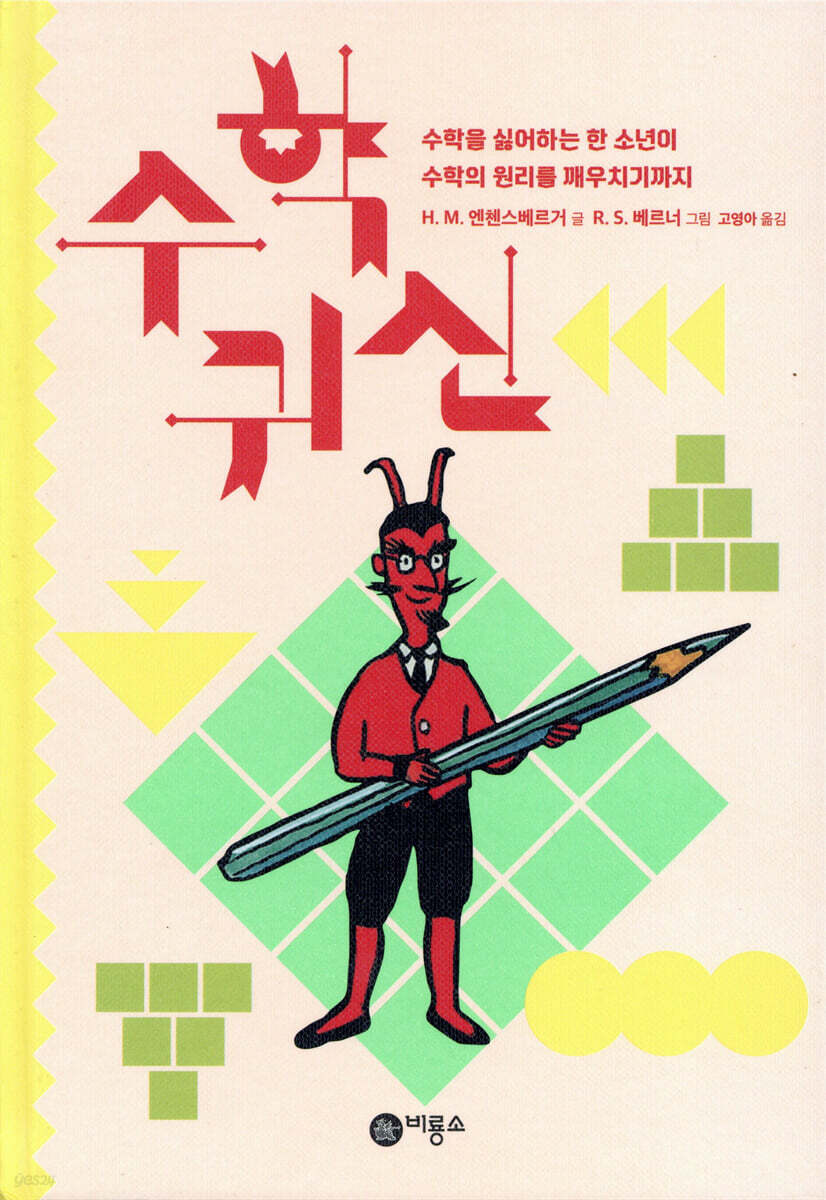
The revised edition of 『Math Ghost』, a classic math book loved around the world for over 20 years and considered the 'best math novel for teenagers', has been published by Biryongso.
This book was written by Hans Magnus Enzensberger, a leading German intellectual, for his ten-year-old daughter, and illustrated by Rotraut Susanne Werner, a Hans Christian Andersen Award-winning author.
Since its publication in Germany in 1997, it has been a bestseller widely read around the world as a ‘mathematical novel for those who can’t sleep because of math.’
It sold over 800,000 copies in Korea alone, and was included in the elementary school Korean language textbook for the 7th national curriculum in Korea.
To commemorate the 100th printing of the domestic publication, the cover design and main text have been neatly redesigned with a new format and binding, and the index has been reorganized to include explanations of mathematical terms for better viewing.
The Best Math Novels for Children and Young Adults
A fantastic twelve-night journey with the math ghost who appeared in my dreams.
A classic math book beloved for over 20 years, a revised edition commemorating the 100th printing in Korea.
A math book included in elementary school Korean language textbooks
Domestic sales exceed 800,000 copies
The revised edition of 『Math Ghost』, a classic math book loved around the world for over 20 years and considered the 'best math novel for teenagers', has been published by Biryongso.
This book was written by Hans Magnus Enzensberger, a leading German intellectual, for his ten-year-old daughter, and illustrated by Rotraut Susanne Werner, a Hans Christian Andersen Award-winning author.
Since its publication in Germany in 1997, it has been a bestseller widely read around the world as a ‘mathematical novel for those who can’t sleep because of math.’
It sold over 800,000 copies in Korea alone, and was included in the elementary school Korean language textbook for the 7th national curriculum in Korea.
To commemorate the 100th printing of the domestic publication, the cover design and main text have been neatly redesigned with a new format and binding, and the index has been reorganized to include explanations of mathematical terms for better viewing.
- You can preview some of the book's contents.
Preview
index
First night
Second night
Third night
Fourth night
Fifth night
Sixth night
Seventh night
Eighth night
The ninth night
The tenth night
The Eleventh Night
Twelfth Night
Search
Acknowledgements
Translator's Note
Second night
Third night
Fourth night
Fifth night
Sixth night
Seventh night
Eighth night
The ninth night
The tenth night
The Eleventh Night
Twelfth Night
Search
Acknowledgements
Translator's Note
Detailed image

Into the book
“You only need one thing to start crunching numbers.
That is none other than '1'.
“With 10,000, you can do almost anything.” --- p.
17
“Guessing doesn’t work in mathematics, you understand? Mathematics is all about accuracy.” --- p.
27
“Because 0 is the last number thought of by humans.
Well, it's not that strange.
“0 is, so to speak, the most sophisticated number among numbers.” --- p.
34
“Division by zero is the most strictly forbidden thing.” --- p.
58
“Because nothing in this world excites the heart as much as numbers.” --- p.
100
“You shouldn’t think that mathematics is only for mathematicians.
Even in nature, things that happen cannot be explained without numbers.
Even things like trees and shells can calculate.” --- pp.
121~122
“We only eat cake.
“Because the cake is round and the circle is the most perfect of all shapes.”
That is none other than '1'.
“With 10,000, you can do almost anything.” --- p.
17
“Guessing doesn’t work in mathematics, you understand? Mathematics is all about accuracy.” --- p.
27
“Because 0 is the last number thought of by humans.
Well, it's not that strange.
“0 is, so to speak, the most sophisticated number among numbers.” --- p.
34
“Division by zero is the most strictly forbidden thing.” --- p.
58
“Because nothing in this world excites the heart as much as numbers.” --- p.
100
“You shouldn’t think that mathematics is only for mathematicians.
Even in nature, things that happen cannot be explained without numbers.
Even things like trees and shells can calculate.” --- pp.
121~122
“We only eat cake.
“Because the cake is round and the circle is the most perfect of all shapes.”
--- p.
271
271
Publisher's Review
The wonderful principles of mathematics unfolding in the dream world
Robert meets the Math Demon for twelve nights and experiences strange mathematical phenomena.
In fact, Robert hates math, and he doesn't like his math teacher, Dr. Bokel.
But the Math Genius appears in Robert's dreams and magically teaches him fun math.
The terminology used by the Math Genius is not typical mathematical terminology, but rather something special.
'Jump up' is exponentiation, 'pull up roots' is finding square roots, 'approximate numbers' is prime numbers, and 'bang' is factorial. These expressions are different from those used in school, adding fun and helping students remember the characteristics of the concepts.
The concepts Robert learns over the twelve nights are:
First night? Number 1, infinitely large number, infinitely small number
Second Night? Number 0, Roman numerals, decimals, negative numbers, jumping (exponentiation)
Third night? Division, approximate numbers (decimals)
Fourth night? Prime numbers, recurring decimals, irrational numbers, roots (square roots)
Fifth night? Triangular numbers, square numbers
Sixth Night? Fibonacci Sequence
Seventh Night? Number Triangle (Pascal's Triangle) Eighth Night? Permutations, Combinations, Bang (Factorial)
The ninth night? Ordinary numbers (natural numbers), infinity, series
Tenth Night? Irrational Numbers, the Golden Ratio, Euler's Rule: Theorems of Polyhedra
Eleventh Night? Proof, Proposition, Axiom
Twelfth Night? Klein Bottle, Imaginary Numbers (i), Pi (π), Math Fools
It covers a wide range of important topics in mathematics, from basic concepts like natural numbers, real numbers, and irrational numbers to high school-level infinite series and Euler's law, which is the basis of topology.
Meanwhile, on the twelfth night, Robert, who was invited to the Math Hell or Math Heaven, follows the Math Demon Teplotaxl and meets famous Math Demons, that is, historical mathematicians, such as Russell, Klein, Cantor, Euler, Gauss, Fibonacci, Pythagoras, Pascal, and Cantor.
Robert is surprised that there are so many Math Geniuses and only six or seven women, and the Math Genius explains that he used to think math was a man's job, but that will change.
And Robert receives a precious gift from another math genius.
A math book that conveys surprising mathematical phenomena in an interesting way.
One of the most common mistakes made when teaching mathematics is giving too much detail in advance.
Like other natural principles, learning mathematics requires time to savor surprising phenomena, to wonder, and to reflect on them.
However, explaining math too much to children often has the unfortunate result of stifling their growing curiosity.
This book succeeds in extracting the secrets and principles of mathematics through surprisingly simple conversations.
This book is special in that it refrained from direct explanation and conveyed the reader to the novel pleasure of the phenomenon itself.
However, it does not simply present the basic principles of mathematics, but cleverly combines mathematical content with literary devices.
Because mathematical phenomena unfold in the imaginary world of dreams, it has a special charm that allows for freer thinking.
There's a piece of gum shared with people all over the world, a giant iron pillar shaped like the number 1, a snake with the number 9 biting its own tail, flying number mosquitoes, a giant fluffy flour counter, and numbers filling Robert's bedroom.
Because it is a dream, the unrealistic descriptions stimulate curiosity and allow us to feel the mystery of mathematics.
Additionally, the background of each chapter is closely related to the mathematical content covered therein.
For example, by setting the dream setting as a 'cave with no exit' to suggest that there is no general rule for determining prime numbers, that is, that there is no magic trick for determining prime numbers, the literary device is used to express mathematical phenomena and make them more comprehensively understandable.
And by changing mathematical terms into interesting words, it stimulates the reader's interest.
For example, exponentiation is written as jumping, square root as uprooting, and combination as changing places, making it easy to understand the concepts naturally.
Meanwhile, the story's fun begins with Robert and the math genius engaging in a strange war of nerves, but gradually growing fond of each other.
On the last night, Robert is recognized as a student learning the magic of numbers, and he easily solves Dr. Bokel's problems. The amazing transformation that has taken place in a child who hated math is quite touching.
All these elements work together to naturally transport the reader into a world of mathematics, guided by a math genius, a world where questions are endless, imagination reaches infinity, and surprising secrets abound.
Robert meets the Math Demon for twelve nights and experiences strange mathematical phenomena.
In fact, Robert hates math, and he doesn't like his math teacher, Dr. Bokel.
But the Math Genius appears in Robert's dreams and magically teaches him fun math.
The terminology used by the Math Genius is not typical mathematical terminology, but rather something special.
'Jump up' is exponentiation, 'pull up roots' is finding square roots, 'approximate numbers' is prime numbers, and 'bang' is factorial. These expressions are different from those used in school, adding fun and helping students remember the characteristics of the concepts.
The concepts Robert learns over the twelve nights are:
First night? Number 1, infinitely large number, infinitely small number
Second Night? Number 0, Roman numerals, decimals, negative numbers, jumping (exponentiation)
Third night? Division, approximate numbers (decimals)
Fourth night? Prime numbers, recurring decimals, irrational numbers, roots (square roots)
Fifth night? Triangular numbers, square numbers
Sixth Night? Fibonacci Sequence
Seventh Night? Number Triangle (Pascal's Triangle) Eighth Night? Permutations, Combinations, Bang (Factorial)
The ninth night? Ordinary numbers (natural numbers), infinity, series
Tenth Night? Irrational Numbers, the Golden Ratio, Euler's Rule: Theorems of Polyhedra
Eleventh Night? Proof, Proposition, Axiom
Twelfth Night? Klein Bottle, Imaginary Numbers (i), Pi (π), Math Fools
It covers a wide range of important topics in mathematics, from basic concepts like natural numbers, real numbers, and irrational numbers to high school-level infinite series and Euler's law, which is the basis of topology.
Meanwhile, on the twelfth night, Robert, who was invited to the Math Hell or Math Heaven, follows the Math Demon Teplotaxl and meets famous Math Demons, that is, historical mathematicians, such as Russell, Klein, Cantor, Euler, Gauss, Fibonacci, Pythagoras, Pascal, and Cantor.
Robert is surprised that there are so many Math Geniuses and only six or seven women, and the Math Genius explains that he used to think math was a man's job, but that will change.
And Robert receives a precious gift from another math genius.
A math book that conveys surprising mathematical phenomena in an interesting way.
One of the most common mistakes made when teaching mathematics is giving too much detail in advance.
Like other natural principles, learning mathematics requires time to savor surprising phenomena, to wonder, and to reflect on them.
However, explaining math too much to children often has the unfortunate result of stifling their growing curiosity.
This book succeeds in extracting the secrets and principles of mathematics through surprisingly simple conversations.
This book is special in that it refrained from direct explanation and conveyed the reader to the novel pleasure of the phenomenon itself.
However, it does not simply present the basic principles of mathematics, but cleverly combines mathematical content with literary devices.
Because mathematical phenomena unfold in the imaginary world of dreams, it has a special charm that allows for freer thinking.
There's a piece of gum shared with people all over the world, a giant iron pillar shaped like the number 1, a snake with the number 9 biting its own tail, flying number mosquitoes, a giant fluffy flour counter, and numbers filling Robert's bedroom.
Because it is a dream, the unrealistic descriptions stimulate curiosity and allow us to feel the mystery of mathematics.
Additionally, the background of each chapter is closely related to the mathematical content covered therein.
For example, by setting the dream setting as a 'cave with no exit' to suggest that there is no general rule for determining prime numbers, that is, that there is no magic trick for determining prime numbers, the literary device is used to express mathematical phenomena and make them more comprehensively understandable.
And by changing mathematical terms into interesting words, it stimulates the reader's interest.
For example, exponentiation is written as jumping, square root as uprooting, and combination as changing places, making it easy to understand the concepts naturally.
Meanwhile, the story's fun begins with Robert and the math genius engaging in a strange war of nerves, but gradually growing fond of each other.
On the last night, Robert is recognized as a student learning the magic of numbers, and he easily solves Dr. Bokel's problems. The amazing transformation that has taken place in a child who hated math is quite touching.
All these elements work together to naturally transport the reader into a world of mathematics, guided by a math genius, a world where questions are endless, imagination reaches infinity, and surprising secrets abound.
GOODS SPECIFICS
- Date of issue: August 1, 2019
- Format: Hardcover book binding method guide
- Page count, weight, size: 296 pages | 688g | 160*230*20mm
- ISBN13: 9788949187310
- ISBN10: 8949187310
- KC Certification: Certification Type: Conformity Confirmation
You may also like
카테고리
korean


korean

![GQ KOREA Mark (Monthly): December [2025]](http://librairie.coreenne.fr/cdn/shop/files/8ef265dbbfbf186523ed75ba7319009d.jpg?v=1765340328&width=3840)


