

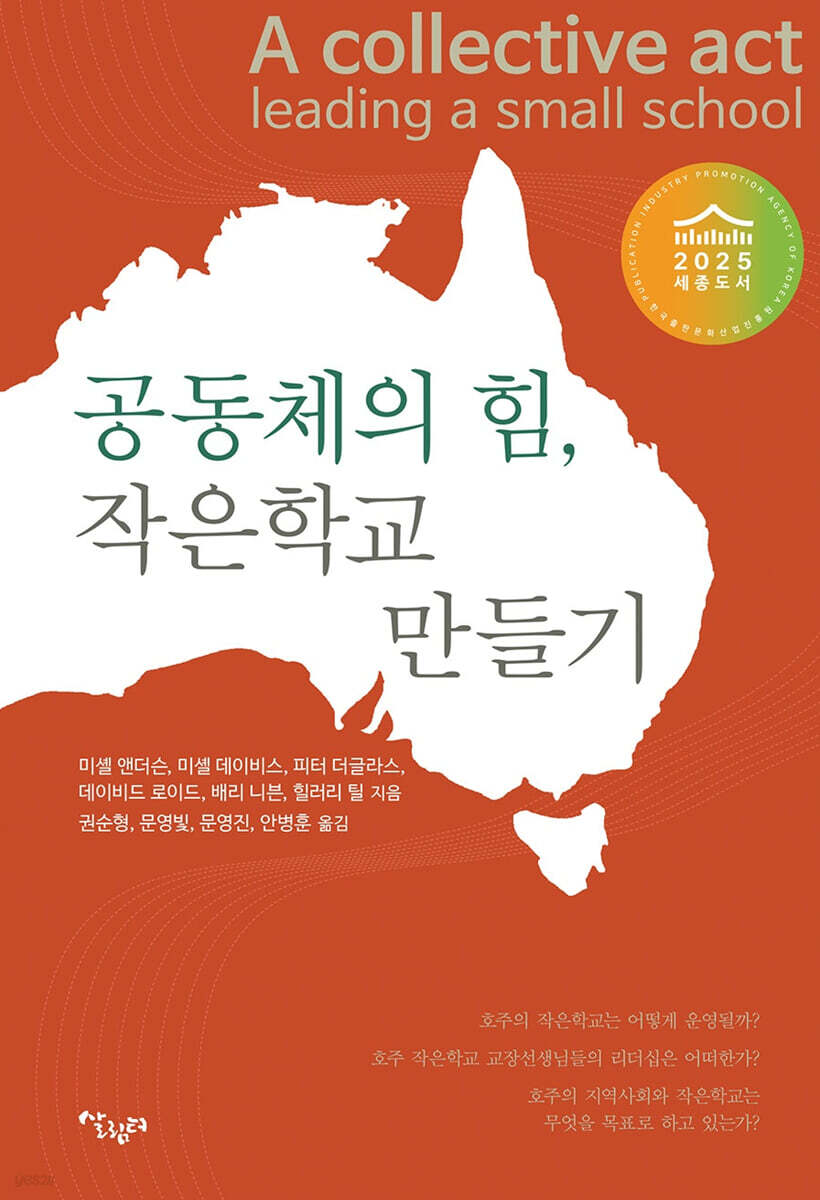
The Power of Community: Creating Small Schools
 |
Description
Book Introduction
Australia is a vast land, but even within it there is a small school.
How can small schools, which continue to foster learning across diverse locations, demonstrate leadership? What are their approaches to living in harmony with the local community?
Let's listen to the stories of struggling principals in small schools.
In an era of population decline, let's study the leadership that helps small schools survive.
Our country's population decline is having a tangible impact on all areas of society, culture, and politics.
Cases of school consolidation in small and medium-sized cities are not uncommon, and many small schools are closing.
In a reality where birth rates and population decline continue, how can small schools sustain themselves? What leadership qualities are necessary for survival? A book that offers readers a clue to these questions is now available.
Australia, the only country on the continent, has a very large land area (approximately 7.69 million square kilometers). However, due to historical and geographical factors, the population is concentrated in some coastal cities, resulting in a very low population density.
This characteristic of population distribution is even more pronounced in inland areas.
In these areas, schools are also small and few in number relative to the size of the area.
What power do these small schools have to survive? The answer lies in the title of this book: "The Power of Community."
Survival leadership, where community and school members join forces, is at the core.
How can small schools, which continue to foster learning across diverse locations, demonstrate leadership? What are their approaches to living in harmony with the local community?
Let's listen to the stories of struggling principals in small schools.
In an era of population decline, let's study the leadership that helps small schools survive.
Our country's population decline is having a tangible impact on all areas of society, culture, and politics.
Cases of school consolidation in small and medium-sized cities are not uncommon, and many small schools are closing.
In a reality where birth rates and population decline continue, how can small schools sustain themselves? What leadership qualities are necessary for survival? A book that offers readers a clue to these questions is now available.
Australia, the only country on the continent, has a very large land area (approximately 7.69 million square kilometers). However, due to historical and geographical factors, the population is concentrated in some coastal cities, resulting in a very low population density.
This characteristic of population distribution is even more pronounced in inland areas.
In these areas, schools are also small and few in number relative to the size of the area.
What power do these small schools have to survive? The answer lies in the title of this book: "The Power of Community."
Survival leadership, where community and school members join forces, is at the core.
- You can preview some of the book's contents.
Preview
index
Translator's Preface
Thank you
About this book
Guide to the Educational Leadership Conversation Series
preface
Part Ⅰ.
Image of a small school
Chapter 1: The Problem of Scale
Chapter 2: Images of small schools
Chapter 3: The Importance of School Leadership
Chapter 4: Challenges, Tensions, and Possibilities
Chapter 5 Leadership Learning and Support Network
Part Ⅱ.
Small School Case Study
Chapter 6 Wonga Beach State School, Queensland
Chapter 7 St. Patrick's School, Tasmania
Chapter 8: Burke High School, New South Wales
Chapter 9: Rapid Bay and Ramco Primary School, South Australia
Chapter 10: Murrayville Community College, Victoria
Part Ⅲ.
The power of community
Chapter 11: Key Messages and Challenges for Leading Small Schools
Translator's Note
Thank you
About this book
Guide to the Educational Leadership Conversation Series
preface
Part Ⅰ.
Image of a small school
Chapter 1: The Problem of Scale
Chapter 2: Images of small schools
Chapter 3: The Importance of School Leadership
Chapter 4: Challenges, Tensions, and Possibilities
Chapter 5 Leadership Learning and Support Network
Part Ⅱ.
Small School Case Study
Chapter 6 Wonga Beach State School, Queensland
Chapter 7 St. Patrick's School, Tasmania
Chapter 8: Burke High School, New South Wales
Chapter 9: Rapid Bay and Ramco Primary School, South Australia
Chapter 10: Murrayville Community College, Victoria
Part Ⅲ.
The power of community
Chapter 11: Key Messages and Challenges for Leading Small Schools
Translator's Note
Publisher's Review
In an era of population decline, let's study the leadership that helps small schools survive.
Our country's population decline is having a tangible impact on all areas of society, culture, and politics.
Cases of school consolidation in small and medium-sized cities are not uncommon, and many small schools are closing.
In a reality where birth rates and population decline continue, how can small schools sustain themselves? What leadership qualities are necessary for survival? A book that offers readers a clue to these questions is now available.
Australia, the only country on the continent, has a very large land area (approximately 7.69 million square kilometers). However, due to historical and geographical factors, the population is concentrated in some coastal cities, resulting in a very low population density.
This characteristic of population distribution is even more pronounced in inland areas.
In these areas, schools are also small and few in number relative to the size of the area.
What power do these small schools have to survive? The answer lies in the title of this book: "The Power of Community."
Survival leadership, where community and school members join forces, is at the core.
The power of networks and communities
One of the things to note in this book is coexistence leadership.
If the leadership required in existing large-scale schools is a principal-centered structure, the successful leadership seen in this book is one in which students, teachers, staff, and the principal all work together.
The five principals featured in the case study all emphasize the same thing.
“Cooperation, especially within the community, is very important.”
Because the land is vast and even nearby locations are often more than a 30-minute drive away, the understanding and support of the local community is crucial to the school's survival.
The basis of this is coexistence leadership, where each person shares the work and takes responsibility.
Meanwhile, solidarity among small schools is also very important.
Small schools struggling to find staff can network with each other to exchange resources and find ways to overcome financial challenges.
Accordingly, it may provide better educational opportunities to students.
This means sustainable education, and is closely related to the survival of the community.
Learn from vivid examples of leadership.
This book introduces the cases of five principals.
The process of leaving one's own life behind and immersing oneself in school work, and gradually discovering the power of community, comes to life vividly.
Not only the process of building a good cooperative relationship, but also the story of becoming the principal of a small school is deeply relatable.
It can also serve as a good guide to teacher leadership for those who are new to the teaching profession.
In particular, it makes us think about the importance of 'a network that creates people who come running when something happens,' which these principals commonly talk about and emphasize.
Leadership is not just about giving special powers to individuals.
Understanding the community's expectations, empowering the community to highlight its strengths and mitigate its weaknesses, and clearly dividing responsibilities among individuals—this was the kind of leadership needed in small schools in Australia, and I believe it's the kind of leadership our society needs today.
If small schools in Korean society seek sustainable development, this book will provide helpful information and wisdom through various precedents.
At a time when we are concerned about population decline, this book's publication is a welcome development.
Our country's population decline is having a tangible impact on all areas of society, culture, and politics.
Cases of school consolidation in small and medium-sized cities are not uncommon, and many small schools are closing.
In a reality where birth rates and population decline continue, how can small schools sustain themselves? What leadership qualities are necessary for survival? A book that offers readers a clue to these questions is now available.
Australia, the only country on the continent, has a very large land area (approximately 7.69 million square kilometers). However, due to historical and geographical factors, the population is concentrated in some coastal cities, resulting in a very low population density.
This characteristic of population distribution is even more pronounced in inland areas.
In these areas, schools are also small and few in number relative to the size of the area.
What power do these small schools have to survive? The answer lies in the title of this book: "The Power of Community."
Survival leadership, where community and school members join forces, is at the core.
The power of networks and communities
One of the things to note in this book is coexistence leadership.
If the leadership required in existing large-scale schools is a principal-centered structure, the successful leadership seen in this book is one in which students, teachers, staff, and the principal all work together.
The five principals featured in the case study all emphasize the same thing.
“Cooperation, especially within the community, is very important.”
Because the land is vast and even nearby locations are often more than a 30-minute drive away, the understanding and support of the local community is crucial to the school's survival.
The basis of this is coexistence leadership, where each person shares the work and takes responsibility.
Meanwhile, solidarity among small schools is also very important.
Small schools struggling to find staff can network with each other to exchange resources and find ways to overcome financial challenges.
Accordingly, it may provide better educational opportunities to students.
This means sustainable education, and is closely related to the survival of the community.
Learn from vivid examples of leadership.
This book introduces the cases of five principals.
The process of leaving one's own life behind and immersing oneself in school work, and gradually discovering the power of community, comes to life vividly.
Not only the process of building a good cooperative relationship, but also the story of becoming the principal of a small school is deeply relatable.
It can also serve as a good guide to teacher leadership for those who are new to the teaching profession.
In particular, it makes us think about the importance of 'a network that creates people who come running when something happens,' which these principals commonly talk about and emphasize.
Leadership is not just about giving special powers to individuals.
Understanding the community's expectations, empowering the community to highlight its strengths and mitigate its weaknesses, and clearly dividing responsibilities among individuals—this was the kind of leadership needed in small schools in Australia, and I believe it's the kind of leadership our society needs today.
If small schools in Korean society seek sustainable development, this book will provide helpful information and wisdom through various precedents.
At a time when we are concerned about population decline, this book's publication is a welcome development.
GOODS SPECIFICS
- Date of issue: February 18, 2025
- Page count, weight, size: 264 pages | 153*224*20mm
- ISBN13: 9791159303128
- ISBN10: 1159303126
You may also like
카테고리
korean


korean

![GQ KOREA Mark (Monthly): December [2025]](http://librairie.coreenne.fr/cdn/shop/files/8ef265dbbfbf186523ed75ba7319009d.jpg?v=1765340328&width=3840)


