

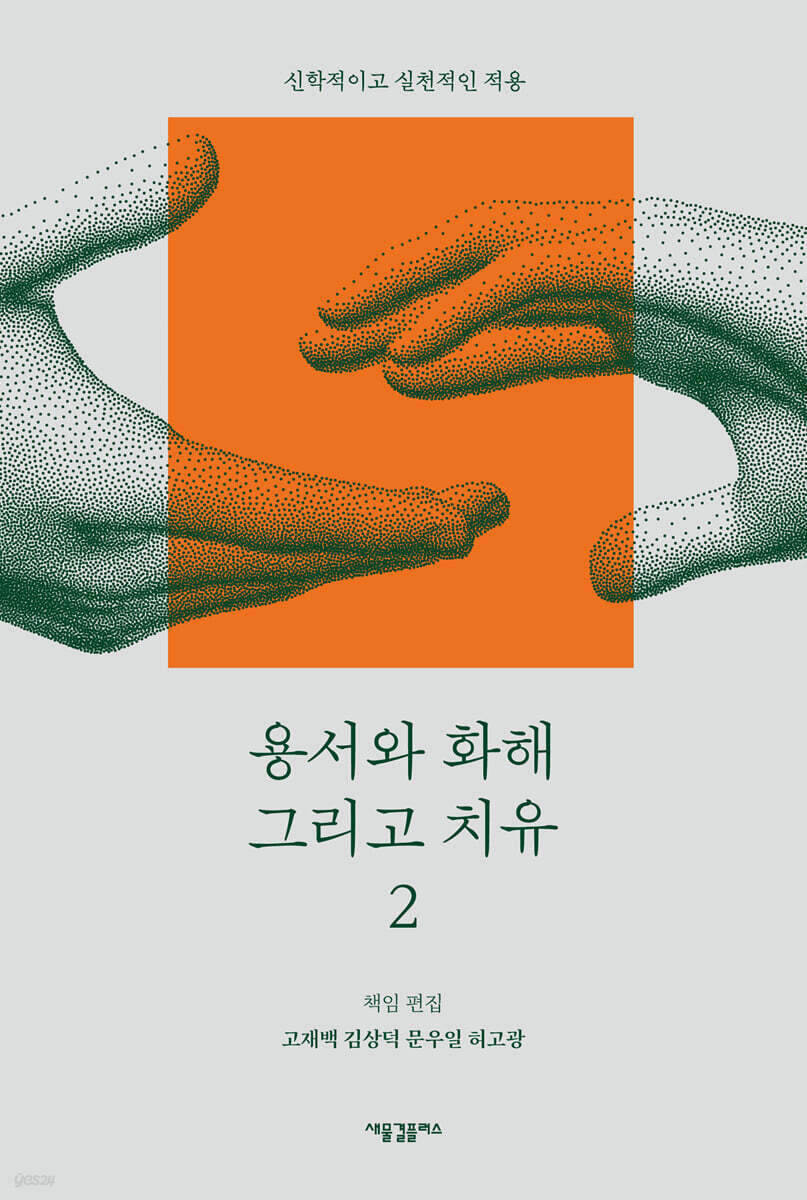
Forgiveness, Reconciliation, and Healing 2
 |
Description
Book Introduction
The national chaos triggered by martial law in the winter of 2024 has further saddled our society with great conflict and confrontation.
In these difficult times, we hope for reconciliation and peace, and publish “Forgiveness, Reconciliation, and Healing 2.”
This book is the second result of a research project led by the Institute for Social and Cultural Studies and the Institute for Future Society.
The first book, "Forgiveness, Reconciliation, and Healing" (2022), was written by 13 authors from various academic fields, including philosophy, education, history, political sociology, religious studies, and theology, who diagnosed conflicts in our society, introduced discussions in each field, and sought means for reconciliation and healing.
This sequel, "Forgiveness, Reconciliation, and Healing 2," focuses on Christianity and contains theological and practical suggestions discussed by 12 Christian experts from theological, pastoral, and various social fields, based on their own experiences and insights.
These two books are designed to be used as Christian education books and as textbooks for liberal arts departments at universities.
In these difficult times, we hope for reconciliation and peace, and publish “Forgiveness, Reconciliation, and Healing 2.”
This book is the second result of a research project led by the Institute for Social and Cultural Studies and the Institute for Future Society.
The first book, "Forgiveness, Reconciliation, and Healing" (2022), was written by 13 authors from various academic fields, including philosophy, education, history, political sociology, religious studies, and theology, who diagnosed conflicts in our society, introduced discussions in each field, and sought means for reconciliation and healing.
This sequel, "Forgiveness, Reconciliation, and Healing 2," focuses on Christianity and contains theological and practical suggestions discussed by 12 Christian experts from theological, pastoral, and various social fields, based on their own experiences and insights.
These two books are designed to be used as Christian education books and as textbooks for liberal arts departments at universities.
- You can preview some of the book's contents.
Preview
index
Editor's Preface 9
General
Christian forgiveness, reconciliation, and healing
How can this be the hope of this age? Cha Jeong-sik, 21
Part 1: Diagnosing Our Times: Survey Results and Analysis
Statistics on Conflict and Forgiveness in Korean Churches
Kim Sang-deok, 57
Part 2 Theological Discourse
"Forgiveness, Reconciliation, and Healing" in the Old Testament by Kim Hoe-kwon 117
Healing the "Army Demon-Possessed" by Chae Young-sam 157
The Boundaries of Forgiveness
Moon Woo-il 197: Origen's Interpretation of the "Forgiveness" in the Lord's Prayer
Forgiveness and reconciliation from the perspective of liberation theology
Healing Hong In-sik 227
Forgiveness at the Personal, Community, and Social Levels from a Pastoral Perspective by Lee Do-young, 265
Part 3: Practical Discourse
Criminal Justice and Forgiveness, by Jong-Ho Cheon, 321
The German Church's History of Overcoming Its Nazi Past
The German Church's Efforts for Apology, Forgiveness, and Reconciliation and Their Significance, Ko Jae-baek, 379
Forgiveness and reconciliation
Lee Hee-chul 435: A Christian Counseling Perspective
What a Broken World Expects from the Church
Forgiveness and Healing through Film by Eun Choi 467
A Christian Perspective on “Forgiveness, Reconciliation, and Healing”
Unification Field Jeong Ji-woong 503
About the Author (Alphabetical Order) 537
About the Editor-in-Chief 541
General
Christian forgiveness, reconciliation, and healing
How can this be the hope of this age? Cha Jeong-sik, 21
Part 1: Diagnosing Our Times: Survey Results and Analysis
Statistics on Conflict and Forgiveness in Korean Churches
Kim Sang-deok, 57
Part 2 Theological Discourse
"Forgiveness, Reconciliation, and Healing" in the Old Testament by Kim Hoe-kwon 117
Healing the "Army Demon-Possessed" by Chae Young-sam 157
The Boundaries of Forgiveness
Moon Woo-il 197: Origen's Interpretation of the "Forgiveness" in the Lord's Prayer
Forgiveness and reconciliation from the perspective of liberation theology
Healing Hong In-sik 227
Forgiveness at the Personal, Community, and Social Levels from a Pastoral Perspective by Lee Do-young, 265
Part 3: Practical Discourse
Criminal Justice and Forgiveness, by Jong-Ho Cheon, 321
The German Church's History of Overcoming Its Nazi Past
The German Church's Efforts for Apology, Forgiveness, and Reconciliation and Their Significance, Ko Jae-baek, 379
Forgiveness and reconciliation
Lee Hee-chul 435: A Christian Counseling Perspective
What a Broken World Expects from the Church
Forgiveness and Healing through Film by Eun Choi 467
A Christian Perspective on “Forgiveness, Reconciliation, and Healing”
Unification Field Jeong Ji-woong 503
About the Author (Alphabetical Order) 537
About the Editor-in-Chief 541
Into the book
Reconciliation is the most important prerequisite for achieving peace, the highest value of Christianity.
There is no peace without reconciliation.
The doctrinal theological proposition that Jesus Christ was incarnated on this earth, bore the cross, and took upon himself the sins of all mankind, thus atonement, is illuminated in a word as the ministry of “reconciliation.”
Since the fall of Paradise, God has continuously raised up His servants to spread His word in order to save the fallen people of this earth.
The core message is that at the very top, God confirmed His justice and love by sending His only begotten Son to die on the cross as a sacrificial offering to take upon Himself all of humanity's sins, and that through the cross, He broke down the wall between God and humanity, opening the way for reconciliation.
--- From "General Theory - Forgiveness, Reconciliation, and Healing in Christianity"
God's restorative justice is not a cold rationalism or pale fairness, but the source of an unreasonable(?) love and an incomprehensibly gracious mercy.
This absurdly tireless love and inexhaustible good will of God is the true face of God's restorative justice.
This restorative justice of God is the unchanging sincerity of Yahweh God, and this sincerity was expressed as a single-minded love for humanity in the love of giving up His only begotten Son on the cross.
--- From “Part 2 - “Forgiveness, Reconciliation, and Healing” in the Old Testament
One of the weaknesses of the Korean church is that it cannot distinguish between the personal and social dimensions.
It only talks about conversion and faith on a personal level, not conversion and faith on a social level.
Because the personal and social dimensions are different, even if personal change occurs, society does not change on its own. However, because we focus only on personal change, we fail to properly address the social dimension.
--- From “Part 2 - Forgiveness at the Personal, Community, and Social Levels from a Pastoral Perspective”
We cannot fulfill our duty of forgiveness unless our original nature is restored to its original state.
To inscribe forgiveness into our character, we must first accept that forgiveness is a duty.
This means that you should not think that it is okay to forgive or not.
Furthermore, to properly fulfill the duty of forgiveness, forgiveness must become a desire of the heart.
This requires training in forgiveness.
“Forgiveness is a discipline before it is an emotion.”
There is no peace without reconciliation.
The doctrinal theological proposition that Jesus Christ was incarnated on this earth, bore the cross, and took upon himself the sins of all mankind, thus atonement, is illuminated in a word as the ministry of “reconciliation.”
Since the fall of Paradise, God has continuously raised up His servants to spread His word in order to save the fallen people of this earth.
The core message is that at the very top, God confirmed His justice and love by sending His only begotten Son to die on the cross as a sacrificial offering to take upon Himself all of humanity's sins, and that through the cross, He broke down the wall between God and humanity, opening the way for reconciliation.
--- From "General Theory - Forgiveness, Reconciliation, and Healing in Christianity"
God's restorative justice is not a cold rationalism or pale fairness, but the source of an unreasonable(?) love and an incomprehensibly gracious mercy.
This absurdly tireless love and inexhaustible good will of God is the true face of God's restorative justice.
This restorative justice of God is the unchanging sincerity of Yahweh God, and this sincerity was expressed as a single-minded love for humanity in the love of giving up His only begotten Son on the cross.
--- From “Part 2 - “Forgiveness, Reconciliation, and Healing” in the Old Testament
One of the weaknesses of the Korean church is that it cannot distinguish between the personal and social dimensions.
It only talks about conversion and faith on a personal level, not conversion and faith on a social level.
Because the personal and social dimensions are different, even if personal change occurs, society does not change on its own. However, because we focus only on personal change, we fail to properly address the social dimension.
--- From “Part 2 - Forgiveness at the Personal, Community, and Social Levels from a Pastoral Perspective”
We cannot fulfill our duty of forgiveness unless our original nature is restored to its original state.
To inscribe forgiveness into our character, we must first accept that forgiveness is a duty.
This means that you should not think that it is okay to forgive or not.
Furthermore, to properly fulfill the duty of forgiveness, forgiveness must become a desire of the heart.
This requires training in forgiveness.
“Forgiveness is a discipline before it is an emotion.”
--- From “Part 3 - Criminal Justice and Forgiveness”
Publisher's Review
The book's general introduction poses the question, "Christian forgiveness, reconciliation, and healing: How can they be the hope of our times?" and discusses the timeliness of this research topic and the need for public discussion.
The following article is divided into three parts.
Part 1 statistically analyzes and thematically diagnoses how Korean Christians perceive this topic, based on the “Survey on Christian Perceptions of Conflict, Forgiveness, and Reconciliation in Our Society,” conducted specifically for this project.
Part 2 contains original interpretations of this topic by theologians and pastors from various fields, including Old Testament studies, New Testament studies, early Christian studies, liberation theology, and pastoral theology.
Part 3 features a diverse range of stories from Christian experts in various fields, including lawyers, historians, counselors, film critics, and political scientists, who responded to the challenges of our time based on their field experience and expertise.
As I read each author's writings, I realized that forgiveness, reconciliation, and healing are themes that can enable Christians to create social progress and good by building solidarity with citizens without a secular academic or religious foundation.
Furthermore, by recognizing the efforts of previous generations to reconcile conflicting and hostile parties, we will be reminded of the meaning of “forgiveness and reconciliation,” which is at the core of the Christian gospel, and thus rediscover our calling as “children of God who bring peace.”
Those who aspire to create a society where we all live together, and who wish to sow the seeds of peace in their daily lives by affirming their faith in the values of forgiveness and reconciliation, will find a small spark of hope in this book.
The following article is divided into three parts.
Part 1 statistically analyzes and thematically diagnoses how Korean Christians perceive this topic, based on the “Survey on Christian Perceptions of Conflict, Forgiveness, and Reconciliation in Our Society,” conducted specifically for this project.
Part 2 contains original interpretations of this topic by theologians and pastors from various fields, including Old Testament studies, New Testament studies, early Christian studies, liberation theology, and pastoral theology.
Part 3 features a diverse range of stories from Christian experts in various fields, including lawyers, historians, counselors, film critics, and political scientists, who responded to the challenges of our time based on their field experience and expertise.
As I read each author's writings, I realized that forgiveness, reconciliation, and healing are themes that can enable Christians to create social progress and good by building solidarity with citizens without a secular academic or religious foundation.
Furthermore, by recognizing the efforts of previous generations to reconcile conflicting and hostile parties, we will be reminded of the meaning of “forgiveness and reconciliation,” which is at the core of the Christian gospel, and thus rediscover our calling as “children of God who bring peace.”
Those who aspire to create a society where we all live together, and who wish to sow the seeds of peace in their daily lives by affirming their faith in the values of forgiveness and reconciliation, will find a small spark of hope in this book.
GOODS SPECIFICS
- Date of issue: December 27, 2024
- Page count, weight, size: 544 pages | 148*220*35mm
- ISBN13: 9791161292946
- ISBN10: 1161292942
You may also like
카테고리
korean


korean

![GQ KOREA Mark (Monthly): December [2025]](http://librairie.coreenne.fr/cdn/shop/files/8ef265dbbfbf186523ed75ba7319009d.jpg?v=1765340328&width=3840)


